

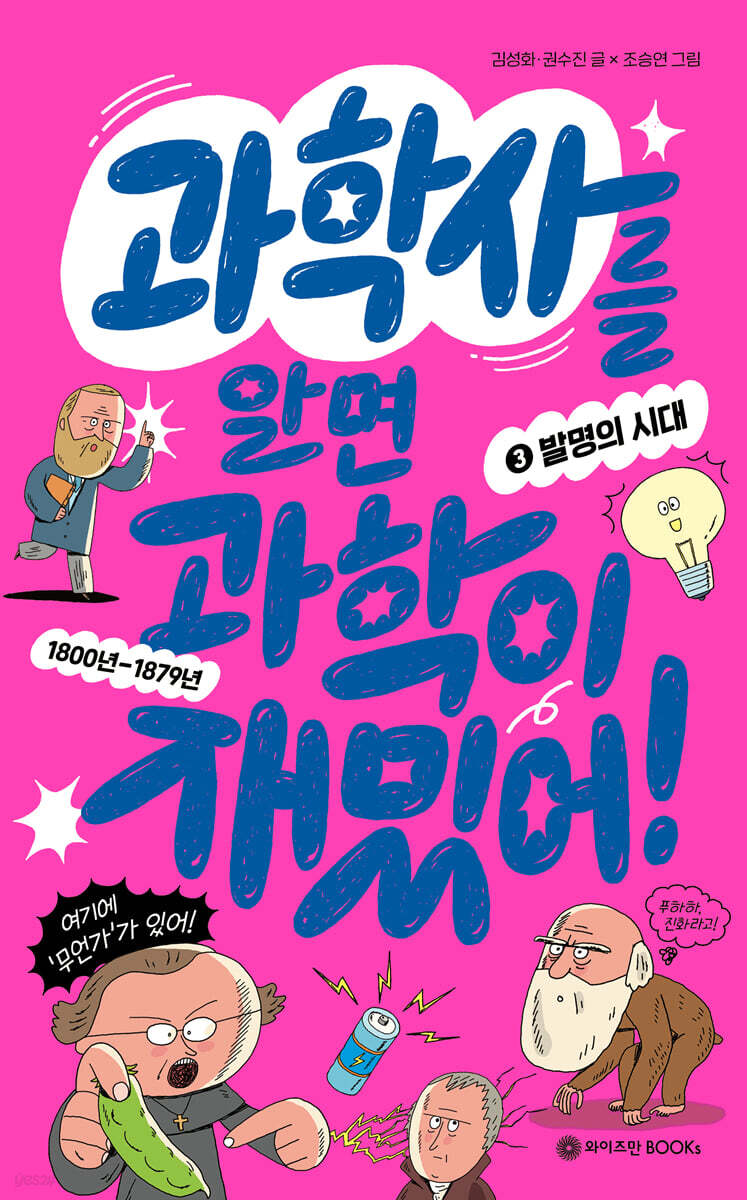
Knowing the History of Science Makes Science Fun! Part 3: The Age of Invention
 |
Description
Book Introduction
From observation and experimentation to invention and innovation, the story of those who uncovered the secrets of the world.
"Science is fun when you know the history of science!" Volume 3 covers the 19th century, the "Age of Invention," when science and technology developed rapidly with innovative inventions that completely transformed human life.
When steam engines moved the world and electricity banished darkness, scientists looked at the world before them with curious eyes and 'invented' new ways to understand the world.
Galvani, who discovered the secret of electricity in frog legs, the chemists who spread aluminum, which was more expensive than gold, throughout the world, Darwin, who traced the origin of life, and Mendel, who discovered the laws of heredity with peas.
Their experiments and discoveries show that they were not just tools or machines, but 'intellectual inventions' that changed the way we understand the world.
"Science is fun when you know the history of science!" Volume 3 covers the 19th century, the "Age of Invention," when science and technology developed rapidly with innovative inventions that completely transformed human life.
When steam engines moved the world and electricity banished darkness, scientists looked at the world before them with curious eyes and 'invented' new ways to understand the world.
Galvani, who discovered the secret of electricity in frog legs, the chemists who spread aluminum, which was more expensive than gold, throughout the world, Darwin, who traced the origin of life, and Mendel, who discovered the laws of heredity with peas.
Their experiments and discoveries show that they were not just tools or machines, but 'intellectual inventions' that changed the way we understand the world.
- You can preview some of the book's contents.
Preview
index
1.
Frog Battery vs. Voltaic Battery
2.
A novel way to discover elements
3.
A time when aluminum was more expensive than gold
4.
Your Majesty, you can tax electricity!
5.
Age of Invention
6.
Energy is not free
7.
The Birth of Paleontology
8.
Darwin's grandfather was a monkey?
9.
Living things do not arise spontaneously.
10.
Mendel, the monk who discovered the laws of heredity
11.
Suspect bacteria
12.
The kingdom of elements created by Mendeleev
Frog Battery vs. Voltaic Battery
2.
A novel way to discover elements
3.
A time when aluminum was more expensive than gold
4.
Your Majesty, you can tax electricity!
5.
Age of Invention
6.
Energy is not free
7.
The Birth of Paleontology
8.
Darwin's grandfather was a monkey?
9.
Living things do not arise spontaneously.
10.
Mendel, the monk who discovered the laws of heredity
11.
Suspect bacteria
12.
The kingdom of elements created by Mendeleev
Detailed image

Publisher's Review
Did the invention of the battery start with a dead frog?
How Weird Science Can Change the World
The power to change the world always begins with curiosity.
Paleontologists who found traces of life in a pile of stones, Pasteur who doubted germs, Mendeleev who built the kingdom of elements… … .
Scientists saw the world with different eyes and never stopped asking questions.
The question, “Why?” led us into the world of microbes, led us to discover new elements, and unlocked the secrets of life.
Volume 3 of “Science is fun when you know the history of science!” embodies the power of these very questions.
Children, with the boundless curiosity of scientists and the experimental spirit that is not afraid of failure, take a step closer to the question, “What is science?”
Curiosity is the beginning, observation becomes the path, and at the end, science that changed the world is born.
The history of science was difficult, until I encountered this book!
The emergence of a history of science that reads like a webtoon
〈Science is fun when you know the history of science!〉 is a children's science history series that combines webtoon-style illustrations and text to help readers learn the history of scientific development in chronological order in an easy and fun way. It promotes the idea of "learning the history of science through pictures."
The book is composed of webtoon-style illustrations, concise dialogue, and information-packed narration that allows children to naturally follow the history of ancient science.
Rather than simply listing events and people, it demonstrates the 'power of thinking' by revealing the thought processes and observation methods that scientists used to solve problems.
The core of the "Science is Fun When You Know the History of Science!" series is a book that allows children to naturally grasp the flow of science while reading it smoothly and without burden, like a fun story.
From the history of scientific development to the quirky and lively behind-the-scenes stories
The only children's science book that makes science fun
Science is the study of how the world works through verifiable methods such as mathematics, observation, and experimentation.
Humanity's curiosity has been gradually answered through science, and in the process, new discoveries and inventions have followed.
Studying the history of science not only provides simple knowledge, but also allows us to understand how humanity has solved problems and what failures and challenges it has overcome to reach the science we know today.
However, it is not easy for children to access the history of science.
Scientific information outside of textbooks is often overly difficult, and simple, list-like explanations can be uninteresting.
"Science is Fun When You Know the History of Science!" overcomes these limitations with its unique structure, helping children naturally encounter the history of science and experience the joy of asking questions and exploring on their own.
As a result, children themselves come to feel that science is truly fun, which is why children need the history of science and why the series “Science is Fun When You Know the History of Science!” was born.
How Weird Science Can Change the World
The power to change the world always begins with curiosity.
Paleontologists who found traces of life in a pile of stones, Pasteur who doubted germs, Mendeleev who built the kingdom of elements… … .
Scientists saw the world with different eyes and never stopped asking questions.
The question, “Why?” led us into the world of microbes, led us to discover new elements, and unlocked the secrets of life.
Volume 3 of “Science is fun when you know the history of science!” embodies the power of these very questions.
Children, with the boundless curiosity of scientists and the experimental spirit that is not afraid of failure, take a step closer to the question, “What is science?”
Curiosity is the beginning, observation becomes the path, and at the end, science that changed the world is born.
The history of science was difficult, until I encountered this book!
The emergence of a history of science that reads like a webtoon
〈Science is fun when you know the history of science!〉 is a children's science history series that combines webtoon-style illustrations and text to help readers learn the history of scientific development in chronological order in an easy and fun way. It promotes the idea of "learning the history of science through pictures."
The book is composed of webtoon-style illustrations, concise dialogue, and information-packed narration that allows children to naturally follow the history of ancient science.
Rather than simply listing events and people, it demonstrates the 'power of thinking' by revealing the thought processes and observation methods that scientists used to solve problems.
The core of the "Science is Fun When You Know the History of Science!" series is a book that allows children to naturally grasp the flow of science while reading it smoothly and without burden, like a fun story.
From the history of scientific development to the quirky and lively behind-the-scenes stories
The only children's science book that makes science fun
Science is the study of how the world works through verifiable methods such as mathematics, observation, and experimentation.
Humanity's curiosity has been gradually answered through science, and in the process, new discoveries and inventions have followed.
Studying the history of science not only provides simple knowledge, but also allows us to understand how humanity has solved problems and what failures and challenges it has overcome to reach the science we know today.
However, it is not easy for children to access the history of science.
Scientific information outside of textbooks is often overly difficult, and simple, list-like explanations can be uninteresting.
"Science is Fun When You Know the History of Science!" overcomes these limitations with its unique structure, helping children naturally encounter the history of science and experience the joy of asking questions and exploring on their own.
As a result, children themselves come to feel that science is truly fun, which is why children need the history of science and why the series “Science is Fun When You Know the History of Science!” was born.
GOODS SPECIFICS
- Date of issue: November 15, 2025
- Page count, weight, size: 224 pages | 384g | 140*225*20mm
- ISBN13: 9791192936666
- ISBN10: 1192936663
- KC Certification: Certification Type: Conformity Confirmation
You may also like
카테고리
korean


korean

![GQ KOREA Mark (Monthly): December [2025]](http://librairie.coreenne.fr/cdn/shop/files/8ef265dbbfbf186523ed75ba7319009d.jpg?v=1765340328&width=3840)


