

Robust reinforcement learning
 |
Description
Book Introduction
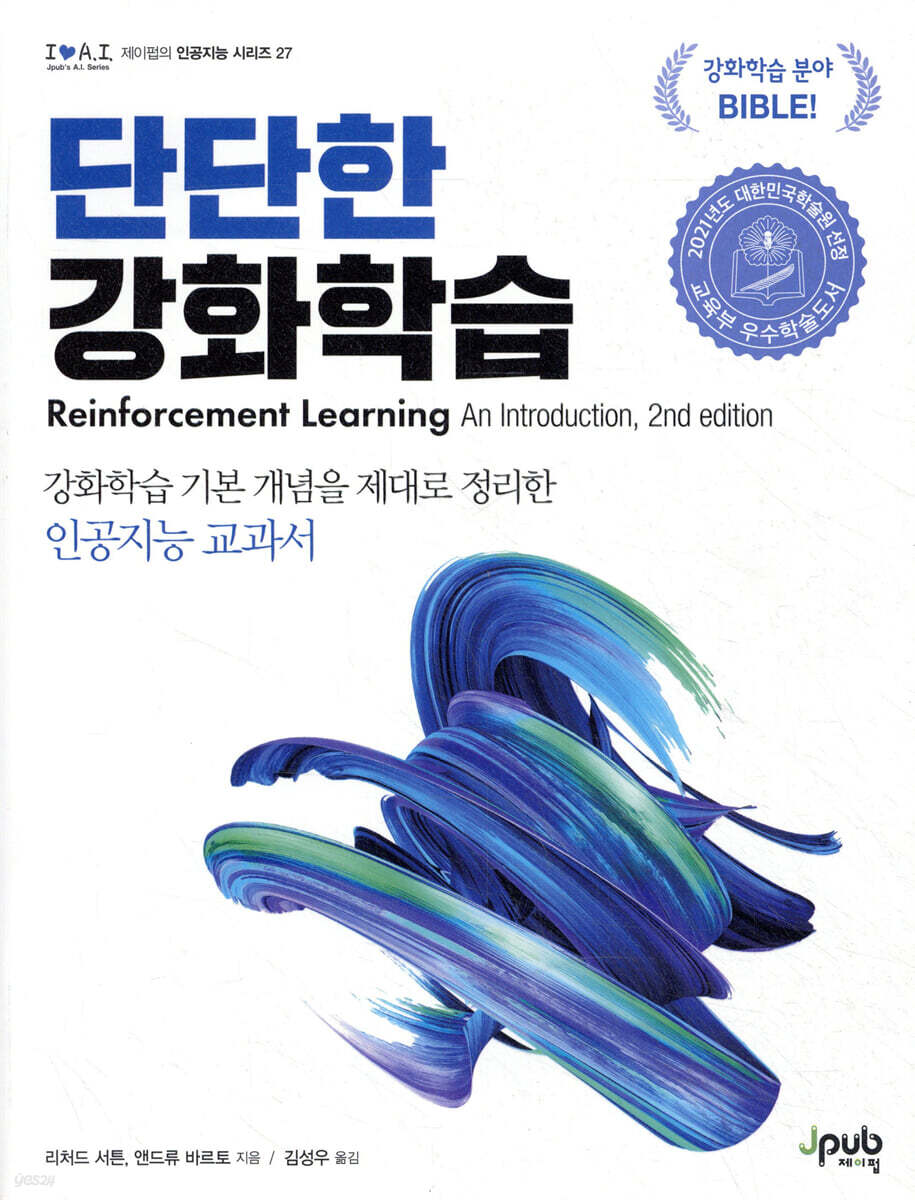
The absolute bible of reinforcement learning, revised for the first time in 20 years with significantly enhanced content!
Reinforcement learning, one of the most actively researched areas in artificial intelligence, is a numerical computational learning method that maximizes the reward given to a learner interacting with a complex and uncertain environment.
In their book, Robust Reinforcement Learning, Richard Sutton and Andrew Barto explain the core concepts and algorithms of reinforcement learning clearly and easily.
Since the publication of the first edition, new topics have been added, and topics already covered have been updated with the latest content.
Reinforcement learning, one of the most actively researched areas in artificial intelligence, is a numerical computational learning method that maximizes the reward given to a learner interacting with a complex and uncertain environment.
In their book, Robust Reinforcement Learning, Richard Sutton and Andrew Barto explain the core concepts and algorithms of reinforcement learning clearly and easily.
Since the publication of the first edition, new topics have been added, and topics already covered have been updated with the latest content.
- You can preview some of the book's contents.
Preview
index
CHAPTER 01 Introduction 1
1.1 Reinforcement Learning 2
1.2 Example 5
1.3 Components of Reinforcement Learning 7
1.4 Limitations and Scope 9
1.5 Extended Example: Tic-Tac-Toe 10
1.6 Summary 16
1.7 Early History of Reinforcement Learning 17
Reference 27
PART I Solutions in Table Form
CHAPTER 02 Multiple Choice 31
2.1 Multiple Choice Problem 32
2.2 Behavioral Value Method 34
2.3 10-choice test 35
2.4 Incremental Implementation 38
2.5 Traces of Abnormal Problems 40
2.6 Positive initial value 42
2.7 Trust Limit Action Selection 44
2.8 Gradient Multiple Selection Algorithm 46
2.9 Related Search (Contextual Multiple Choice) 50
2.10 Summary 51
References and Historical Facts 54
CHAPTER 03 Finite Markov Decision Processes 57
3.1 Agent-Environment Interface 58
3.2 Goals and Rewards 64
3.3 Rewards and Episode 66
3.4 Unified Notation for Episodic and Continuous Work 69
3.5 Policy and Value Functions 70
3.6 Optimal Policy and Optimal Value Function 76
3.7 Optimality and Approximation 82
3.8 Summary 83
References and Historical Facts 84
CHAPTER 04 DYNAMIC PROGRAMMING 89
4.1 Policy Evaluation (Prediction) 90
4.2 Policy Improvement 94
4.3 Policy Repetition 97
4.4 Value Repeat 100
4.5 Asynchronous Dynamic Programming 103
4.6 Generalized Policy Iteration 104
4.7 Efficiency of Dynamic Programming 106
4.8 Summary 107
References and Historical Facts 109
CHAPTER 05 Monte Carlo Methods 111
5.1 Monte Carlo Forecasting 112
5.2 Monte Carlo Action Value Estimation 118
5.3 Monte Carlo Control 119
5.4 Monte Carlo Control Without Starting Exploration 123
5.5 Predicting Inactive Policies Using Importance Extraction 126
5.6 Incremental Implementation 133
5.7 Inactive Monte Carlo Control 135
Importance Extraction Method Considering Discounts 138
5.9 Decision-Level Importance Extraction Method 139
5.10 Summary 141
References and Historical Facts 143
CHAPTER 06 Time-Differential Learning 145
6.1 TD Prediction 146
6.2 Advantages of the TD Prediction Method 150
6.3 Optimality of TD(0) 153
6.4 Salsa: Active Policy TD Control 157
6.5 Q Learning: Inactive Policy TD Control 160
6.6 Expected value Salsa 162
6.7 Maximizing Variance and Dual Learning 163
6.8 Games, Post-Game Conditions, and Other Special Cases 166
6.9 Summary 168
References and Historical Facts 169
CHAPTER 07 n-step bootstrap 171
7.1 n-step TD prediction 172
7.2 n-level salsa 177
7.3 Learning n-step inactive policies 179
7.4 Step-by-step method for decision making with control variables 181
7.5 Passive Policy Learning Without Importance Extraction: An n-Stage Tree Augmentation Algorithm 184
7.6 Integration Algorithm: n-Step Q(σ) 187
7.7 Summary 189
References and Historical Facts 190
CHAPTER 08 Planning and Learning Using Table-Based Methods 191
8.1 Models and Plans 192
8.2 Dyna: Integrating Planning, Action, and Learning 194
8.3 When the model is wrong 199
8.4 Prioritized Batch Processing 202
8.5 Expected Updates vs. Sample Updates 206
8.6 Trajectory Sampling 210
8.7 Real-Time Dynamic Programming 213
8.8 Planning at the Decision Point 217
8.9 Empirical Exploration 219
8.10 Dice Rolling Algorithm 221
8.11 Monte Carlo Tree Search 223
8.12 Summary 227
8.13 Part 1 Summary: Dimension 228
References and Historical Facts 231
PART II Approximate Solutions
CHAPTER 09 Active Policy Prediction Using Approximation 237
9.1 Value Function Approximation 238
9.2 Predictive Objectives (VE) 239
9.3 Probabilistic Gradient and Semi-Gradient Methods 241
9.4 Linear Methods 246
9.5 Creating Features for Linear Methods 253
9.6 Manually selecting time interval parameters 268
9.7 Nonlinear Function Approximation: Artificial Neural Networks 269
9.8 Least Squares TD 275
9.9 Memory-Based Function Approximation 278
9.10 Kernel-Based Function Approximation 280
A Deeper Look at 9/11 Active Policy Learning: Focus and Emphasis 282
9.12 Summary 285
References and Historical Facts 286
CHAPTER 10 Active Policy Control with Approximation 293
10.1 Episodic Semi-Slope Control 294
10.2 Semi-slope n-level Salsa 297
10.3 Average Reward: Setting a New Problem for Continuous Tasks 300
10.4 Objection to Discounted Settings 304
10.5 Differential Semi-Slope n-Step Salsa 307
10.6 Summary 308
References and Historical Facts 308
CHAPTER 11: Inactive Policy Methods Using Approximation 311
11.1 Semi-slope Method 312
11.2 Example of Inactive Policy Emission 315
11.3 Deadly Trinity 320
11.4 Linear Value Function Geometry 322
11.5 Gradient Descent in Bellman Error 327
11.6 Bellman error cannot be learned 332
11.7 Gradient TD Method 337
11.8 Strong TD Method 341
11.9 Reducing Variance 343
11.10 Summary 345
References and Historical Facts 346
CHAPTER 12 Eligible Traces 349
12.1 λ gain 350
12.2 TD(λ) 355
12.3 Interrupted n-step λ gain method 359
12.4 Re-Updating: Online λ Gain Algorithm 361
12.5 True Online TD(λ) 363
12.6 Dutch Traces in Monte Carlo Learning 366
12.7 Salsa (λ) 368
12.8 Variable λ and γ 372
12.9 Inactive Policy Traces with Control Variables 374
12.10 From Watkins' Q(λ) to Tree Augmentation(λ) 378
12.11 Stable Inactivity Policy Method Using Traces 381
12.12 Implementation Issue 383
12.13 Conclusion 384
References and Historical Facts 386
CHAPTER 13 Policy Gradient Methods 389
13.1 Policy Approximation and Its Advantages 390
13.2 Policy Gradient Summary 393
13.3 REINFORCE: Monte Carlo Policy Gradient 395
13.4 REINFORCE 399 with reference values
13.5 The Doer-Critic Method 401
13.6 Policy Gradients for Continuous Problems 403
13.7 Policy Parameterization for Continuous Actions 406
13.8 Summary 408
References and Historical Facts 409
PART III A DEEPER DIG
CHAPTER 14 Psychology 413
14.1 Prediction and Control 414
14.2 Classical Conditioning 416
14.3 Instrumental Conditioning 433
14.4 Delayed Reinforcement 438
14.5 Cognitive Map 440
14.6 Habitual and Goal-Directed Behavior 442
14.7 Summary 447
References and Historical Facts 449
CHAPTER 15: NEUROSCIENCE 457
15.1 Neuroscience Fundamentals 458
15.2 Reward Signals, Reinforcement Signals, Value, and Prediction Error 460
15.3 Reward Prediction Error Hypothesis 463
15.4 Dopamine 465
15.5 Experimental Support for the Reward Prediction Error Hypothesis 469
15.6 TD error/dopamine similarity 473
15.7 Neurobehavior-Critic 479
15.8 Doer and Critic Learning Rules 482
15.9 Hedonistic Neurons 488
15.10 Collective Reinforcement Learning 490
15.11 Model-Based Methods in the Brain 494
15.12 Addiction 496
15.13 Summary 497
References and Historical Facts 501
CHAPTER 16 Applications and Case Studies 511
16.1 TD-Garmon 511
16.2 Samuel's Checkers Player 518
16.3 Watson's Double Wager 522
16.4 Memory Control Optimization 526
16.5 Human-level video game skills 531
16.6 Mastering the Game of Baduk 539
16.7 Personalized Web Services 550
16.8 Fever Rise 554
CHAPTER 17 Frontier 559
17.1 General Value Functions and Auxiliary Operations 559
17.2 Temporal Abstraction through Options 562
17.3 Observations and Conditions 565
17.4 Design of the Compensation Signal 572
17.5 Remaining Issues 576
17.6 The Future of Artificial Intelligence 580
References and Historical Facts 584
Reference 588
Search 626
1.1 Reinforcement Learning 2
1.2 Example 5
1.3 Components of Reinforcement Learning 7
1.4 Limitations and Scope 9
1.5 Extended Example: Tic-Tac-Toe 10
1.6 Summary 16
1.7 Early History of Reinforcement Learning 17
Reference 27
PART I Solutions in Table Form
CHAPTER 02 Multiple Choice 31
2.1 Multiple Choice Problem 32
2.2 Behavioral Value Method 34
2.3 10-choice test 35
2.4 Incremental Implementation 38
2.5 Traces of Abnormal Problems 40
2.6 Positive initial value 42
2.7 Trust Limit Action Selection 44
2.8 Gradient Multiple Selection Algorithm 46
2.9 Related Search (Contextual Multiple Choice) 50
2.10 Summary 51
References and Historical Facts 54
CHAPTER 03 Finite Markov Decision Processes 57
3.1 Agent-Environment Interface 58
3.2 Goals and Rewards 64
3.3 Rewards and Episode 66
3.4 Unified Notation for Episodic and Continuous Work 69
3.5 Policy and Value Functions 70
3.6 Optimal Policy and Optimal Value Function 76
3.7 Optimality and Approximation 82
3.8 Summary 83
References and Historical Facts 84
CHAPTER 04 DYNAMIC PROGRAMMING 89
4.1 Policy Evaluation (Prediction) 90
4.2 Policy Improvement 94
4.3 Policy Repetition 97
4.4 Value Repeat 100
4.5 Asynchronous Dynamic Programming 103
4.6 Generalized Policy Iteration 104
4.7 Efficiency of Dynamic Programming 106
4.8 Summary 107
References and Historical Facts 109
CHAPTER 05 Monte Carlo Methods 111
5.1 Monte Carlo Forecasting 112
5.2 Monte Carlo Action Value Estimation 118
5.3 Monte Carlo Control 119
5.4 Monte Carlo Control Without Starting Exploration 123
5.5 Predicting Inactive Policies Using Importance Extraction 126
5.6 Incremental Implementation 133
5.7 Inactive Monte Carlo Control 135
Importance Extraction Method Considering Discounts 138
5.9 Decision-Level Importance Extraction Method 139
5.10 Summary 141
References and Historical Facts 143
CHAPTER 06 Time-Differential Learning 145
6.1 TD Prediction 146
6.2 Advantages of the TD Prediction Method 150
6.3 Optimality of TD(0) 153
6.4 Salsa: Active Policy TD Control 157
6.5 Q Learning: Inactive Policy TD Control 160
6.6 Expected value Salsa 162
6.7 Maximizing Variance and Dual Learning 163
6.8 Games, Post-Game Conditions, and Other Special Cases 166
6.9 Summary 168
References and Historical Facts 169
CHAPTER 07 n-step bootstrap 171
7.1 n-step TD prediction 172
7.2 n-level salsa 177
7.3 Learning n-step inactive policies 179
7.4 Step-by-step method for decision making with control variables 181
7.5 Passive Policy Learning Without Importance Extraction: An n-Stage Tree Augmentation Algorithm 184
7.6 Integration Algorithm: n-Step Q(σ) 187
7.7 Summary 189
References and Historical Facts 190
CHAPTER 08 Planning and Learning Using Table-Based Methods 191
8.1 Models and Plans 192
8.2 Dyna: Integrating Planning, Action, and Learning 194
8.3 When the model is wrong 199
8.4 Prioritized Batch Processing 202
8.5 Expected Updates vs. Sample Updates 206
8.6 Trajectory Sampling 210
8.7 Real-Time Dynamic Programming 213
8.8 Planning at the Decision Point 217
8.9 Empirical Exploration 219
8.10 Dice Rolling Algorithm 221
8.11 Monte Carlo Tree Search 223
8.12 Summary 227
8.13 Part 1 Summary: Dimension 228
References and Historical Facts 231
PART II Approximate Solutions
CHAPTER 09 Active Policy Prediction Using Approximation 237
9.1 Value Function Approximation 238
9.2 Predictive Objectives (VE) 239
9.3 Probabilistic Gradient and Semi-Gradient Methods 241
9.4 Linear Methods 246
9.5 Creating Features for Linear Methods 253
9.6 Manually selecting time interval parameters 268
9.7 Nonlinear Function Approximation: Artificial Neural Networks 269
9.8 Least Squares TD 275
9.9 Memory-Based Function Approximation 278
9.10 Kernel-Based Function Approximation 280
A Deeper Look at 9/11 Active Policy Learning: Focus and Emphasis 282
9.12 Summary 285
References and Historical Facts 286
CHAPTER 10 Active Policy Control with Approximation 293
10.1 Episodic Semi-Slope Control 294
10.2 Semi-slope n-level Salsa 297
10.3 Average Reward: Setting a New Problem for Continuous Tasks 300
10.4 Objection to Discounted Settings 304
10.5 Differential Semi-Slope n-Step Salsa 307
10.6 Summary 308
References and Historical Facts 308
CHAPTER 11: Inactive Policy Methods Using Approximation 311
11.1 Semi-slope Method 312
11.2 Example of Inactive Policy Emission 315
11.3 Deadly Trinity 320
11.4 Linear Value Function Geometry 322
11.5 Gradient Descent in Bellman Error 327
11.6 Bellman error cannot be learned 332
11.7 Gradient TD Method 337
11.8 Strong TD Method 341
11.9 Reducing Variance 343
11.10 Summary 345
References and Historical Facts 346
CHAPTER 12 Eligible Traces 349
12.1 λ gain 350
12.2 TD(λ) 355
12.3 Interrupted n-step λ gain method 359
12.4 Re-Updating: Online λ Gain Algorithm 361
12.5 True Online TD(λ) 363
12.6 Dutch Traces in Monte Carlo Learning 366
12.7 Salsa (λ) 368
12.8 Variable λ and γ 372
12.9 Inactive Policy Traces with Control Variables 374
12.10 From Watkins' Q(λ) to Tree Augmentation(λ) 378
12.11 Stable Inactivity Policy Method Using Traces 381
12.12 Implementation Issue 383
12.13 Conclusion 384
References and Historical Facts 386
CHAPTER 13 Policy Gradient Methods 389
13.1 Policy Approximation and Its Advantages 390
13.2 Policy Gradient Summary 393
13.3 REINFORCE: Monte Carlo Policy Gradient 395
13.4 REINFORCE 399 with reference values
13.5 The Doer-Critic Method 401
13.6 Policy Gradients for Continuous Problems 403
13.7 Policy Parameterization for Continuous Actions 406
13.8 Summary 408
References and Historical Facts 409
PART III A DEEPER DIG
CHAPTER 14 Psychology 413
14.1 Prediction and Control 414
14.2 Classical Conditioning 416
14.3 Instrumental Conditioning 433
14.4 Delayed Reinforcement 438
14.5 Cognitive Map 440
14.6 Habitual and Goal-Directed Behavior 442
14.7 Summary 447
References and Historical Facts 449
CHAPTER 15: NEUROSCIENCE 457
15.1 Neuroscience Fundamentals 458
15.2 Reward Signals, Reinforcement Signals, Value, and Prediction Error 460
15.3 Reward Prediction Error Hypothesis 463
15.4 Dopamine 465
15.5 Experimental Support for the Reward Prediction Error Hypothesis 469
15.6 TD error/dopamine similarity 473
15.7 Neurobehavior-Critic 479
15.8 Doer and Critic Learning Rules 482
15.9 Hedonistic Neurons 488
15.10 Collective Reinforcement Learning 490
15.11 Model-Based Methods in the Brain 494
15.12 Addiction 496
15.13 Summary 497
References and Historical Facts 501
CHAPTER 16 Applications and Case Studies 511
16.1 TD-Garmon 511
16.2 Samuel's Checkers Player 518
16.3 Watson's Double Wager 522
16.4 Memory Control Optimization 526
16.5 Human-level video game skills 531
16.6 Mastering the Game of Baduk 539
16.7 Personalized Web Services 550
16.8 Fever Rise 554
CHAPTER 17 Frontier 559
17.1 General Value Functions and Auxiliary Operations 559
17.2 Temporal Abstraction through Options 562
17.3 Observations and Conditions 565
17.4 Design of the Compensation Signal 572
17.5 Remaining Issues 576
17.6 The Future of Artificial Intelligence 580
References and Historical Facts 584
Reference 588
Search 626
Detailed image
.jpg)
Into the book
Artificial intelligence technology has advanced tremendously in the 20 years since this book was first published in 1998.
Advances in machine learning technologies, including reinforcement learning, have provided a major impetus for the development of artificial intelligence.
While the advancement of machine learning technology has been partly due to the remarkable advancement of computers' computing power, the development of new theories and algorithms has also played a significant role.
Despite these changes, work on the second edition of this book was delayed for a long time, and work could not begin until 2012.
The purpose of this second edition is no different from that of the first publication of this book.
That is, the goal is to enable readers from all relevant fields to easily and clearly understand the core concepts and algorithms of reinforcement learning.
--- From the "Preface"
Consider the following learning problem:
You must repeatedly choose one of k different options or actions.
After each selection, a numerical reward is given.
At this time, the value representing the reward is obtained from a stationary probability distribution (a probability distribution that does not change over time_translator) determined according to the selected action.
The goal of selection is to maximize the expected value of the total amount of reward given over a period of time, for example, over the period of selecting actions 1,000 times or over 1,000 time steps.
--- p.32
Another reasonable answer is to simply observe that we have encountered state A once and the resulting payoff was zero, so we estimate the value of V(A) to be zero.
This answer is given by the batch Monte Carlo method.
Note that this is the answer that derives the least squares error for the training data.
In fact, this answer yields an error of 0 on the training data.
--- p.155
Overfitting is a problem in all function approximation methods that have many degrees of freedom and fit a function based on limited training data.
Although this problem is less pronounced in online reinforcement learning, which is not constrained by limited training data, effective generalization remains a critical issue.
Overfitting is a problem with ANNs in general, but it becomes more serious with deep ANNs because of their tendency to have a very large number of weights.
--- p.272
In contrast to trial-phase models such as the Rescorla-Wagner model, the TD model is a real-time model.
In the Rescorla-Wagner model, a single step t represents an entire conditioning trial. The TD model does not care about the details of what happens during the time a conditioning trial occurs or what happens between conditioning trials.
During each conditioning trial, the animal may experience different stimuli occurring at specific times and for specific periods of time.
Advances in machine learning technologies, including reinforcement learning, have provided a major impetus for the development of artificial intelligence.
While the advancement of machine learning technology has been partly due to the remarkable advancement of computers' computing power, the development of new theories and algorithms has also played a significant role.
Despite these changes, work on the second edition of this book was delayed for a long time, and work could not begin until 2012.
The purpose of this second edition is no different from that of the first publication of this book.
That is, the goal is to enable readers from all relevant fields to easily and clearly understand the core concepts and algorithms of reinforcement learning.
--- From the "Preface"
Consider the following learning problem:
You must repeatedly choose one of k different options or actions.
After each selection, a numerical reward is given.
At this time, the value representing the reward is obtained from a stationary probability distribution (a probability distribution that does not change over time_translator) determined according to the selected action.
The goal of selection is to maximize the expected value of the total amount of reward given over a period of time, for example, over the period of selecting actions 1,000 times or over 1,000 time steps.
--- p.32
Another reasonable answer is to simply observe that we have encountered state A once and the resulting payoff was zero, so we estimate the value of V(A) to be zero.
This answer is given by the batch Monte Carlo method.
Note that this is the answer that derives the least squares error for the training data.
In fact, this answer yields an error of 0 on the training data.
--- p.155
Overfitting is a problem in all function approximation methods that have many degrees of freedom and fit a function based on limited training data.
Although this problem is less pronounced in online reinforcement learning, which is not constrained by limited training data, effective generalization remains a critical issue.
Overfitting is a problem with ANNs in general, but it becomes more serious with deep ANNs because of their tendency to have a very large number of weights.
--- p.272
In contrast to trial-phase models such as the Rescorla-Wagner model, the TD model is a real-time model.
In the Rescorla-Wagner model, a single step t represents an entire conditioning trial. The TD model does not care about the details of what happens during the time a conditioning trial occurs or what happens between conditioning trials.
During each conditioning trial, the animal may experience different stimuli occurring at specific times and for specific periods of time.
--- p.423
Publisher's Review
The absolute bible of reinforcement learning, revised for the first time in 20 years with significantly enhanced content!
Understand the core concepts and latest algorithms of reinforcement learning in a simple and clear way!
Reinforcement learning, one of the most actively researched areas in artificial intelligence, is a numerical computational learning method that maximizes the reward given to a learner interacting with a complex and uncertain environment.
In their book, Robust Reinforcement Learning, Richard Sutton and Andrew Barto explain the core concepts and algorithms of reinforcement learning clearly and easily.
Since the publication of the first edition, new topics have been added, and topics already covered have been updated with the latest content.
Like the first edition, the second edition focuses on core online learning algorithms, but includes more mathematical content in separate text boxes.
This book is broadly divided into three parts:
■ In the first part, we covered as many reinforcement learning methods as possible, applying only table-based methods that can find accurate solutions.
Many of the algorithms presented in the first part are new to the second edition, including UCB, Expected Value Salsa, and Dual Learning.
■ In the second part, the methods presented in the first part are extended to function approximation-based methods, with new sections covering topics such as artificial neural networks and Fourier-based methods, and the content on inactive policy learning and policy gradient methods is enriched.
■ The third part includes new chapters on how reinforcement learning relates to psychology and neuroscience, and updated chapters on case studies such as AlphaGo and AlphaGo Zero, Atari games, and IBM Watson's betting strategies.
In the final chapter, we discussed the impact of reinforcement learning on future society.
Understand the core concepts and latest algorithms of reinforcement learning in a simple and clear way!
Reinforcement learning, one of the most actively researched areas in artificial intelligence, is a numerical computational learning method that maximizes the reward given to a learner interacting with a complex and uncertain environment.
In their book, Robust Reinforcement Learning, Richard Sutton and Andrew Barto explain the core concepts and algorithms of reinforcement learning clearly and easily.
Since the publication of the first edition, new topics have been added, and topics already covered have been updated with the latest content.
Like the first edition, the second edition focuses on core online learning algorithms, but includes more mathematical content in separate text boxes.
This book is broadly divided into three parts:
■ In the first part, we covered as many reinforcement learning methods as possible, applying only table-based methods that can find accurate solutions.
Many of the algorithms presented in the first part are new to the second edition, including UCB, Expected Value Salsa, and Dual Learning.
■ In the second part, the methods presented in the first part are extended to function approximation-based methods, with new sections covering topics such as artificial neural networks and Fourier-based methods, and the content on inactive policy learning and policy gradient methods is enriched.
■ The third part includes new chapters on how reinforcement learning relates to psychology and neuroscience, and updated chapters on case studies such as AlphaGo and AlphaGo Zero, Atari games, and IBM Watson's betting strategies.
In the final chapter, we discussed the impact of reinforcement learning on future society.
GOODS SPECIFICS
- Date of issue: March 31, 2020
- Page count, weight, size: 664 pages | 1,290g | 188*245*33mm
- ISBN13: 9791190665179
- ISBN10: 1190665174
You may also like
카테고리
korean


korean

![GQ KOREA Mark (Monthly): December [2025]](http://librairie.coreenne.fr/cdn/shop/files/8ef265dbbfbf186523ed75ba7319009d.jpg?v=1765340328&width=3840)


