

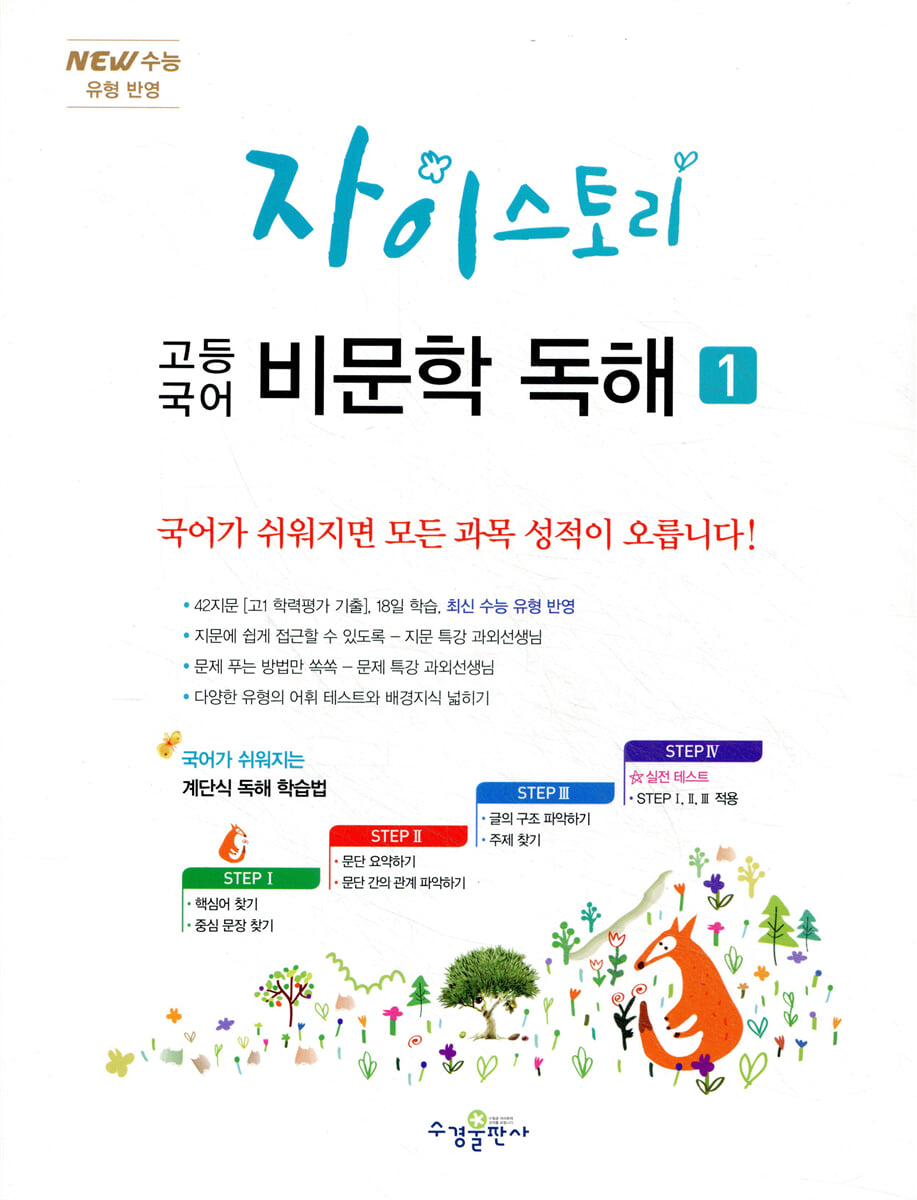
Zaistory High School Korean Non-Fiction Reading 1
 |
Description
Book Introduction
The reason many students have difficulty reading (non-fiction) is because they are exposed to boring material and difficult texts that do not match their level.
『Zistory High School Korean Non-Fiction Reading』 is divided into reading passages by level and is structured to help readers improve their reading comprehension skills in a step-by-step manner.
By having fun studying with the latest issues and interesting passages and improving your Korean reading comprehension, you can improve your grades in all subjects.
『Zistory High School Korean Non-Fiction Reading』 is divided into reading passages by level and is structured to help readers improve their reading comprehension skills in a step-by-step manner.
By having fun studying with the latest issues and interesting passages and improving your Korean reading comprehension, you can improve your grades in all subjects.
- You can preview some of the book's contents.
Preview
index
STEP 1: Find keywords and central sentences
Day 01 X-ray Art [Art] 12
+ Fingerprint Special Lecture 13
+ Special Lecture 15
Post-Purchase Advertising Exploration [Society] 18
Day 02: The Principles of Autophagy [Science] 22
+ Fingerprint Special Lecture 23
+ Special lecture on problem 25
What is Kinetic Art? [Art] 28
Day 03 Subscription Economy [Society] 32
High-Speed Auxiliary Storage Devices: SSD [Technology] 34
Day 04 Hume [Humanities] 38
Bacteriophage [Science] 41
STEP 2: Summarizing paragraphs and understanding the relationships between paragraphs
Day 05: Stages of Memory and Aspects of Forgetting [Humanities] 48
+ Fingerprint Special Lecture 49
+ Special Lecture on Problem 51
Bookbinding: The Art of Making Good Books [Techniques] 55
Day 06: Pricing Premium Coffee [Society] 58
+ Fingerprint Special Lecture 59
+ Special Lecture on Problem 61
Our Body's Inflammatory Response [Science] 63
Day 07 Spain is Gaudi [Art] 66
Understanding Interest Rates [Society] 68
Day 08: The Relationship Between Humans and Technology [Humanities] 72
Heating Principles of Electric Ranges [Technology] 74
STEP 3: Understanding the structure of the text and finding the topic
Day 09 Eudaimonia [Humanities] 82
+ Fingerprint Special Lecture 83
+ Special Lecture on Problem 85
Impressionism and Post-Impressionism [Art] 88
Day 10: Tax Efficiency and Fairness [Society] 92
+ Fingerprint Special Lecture 93
+ Special Lecture on Problem 95
Moral Dilemmas and Criteria for Judgment [Humanities] 97
Day 11 Joseon Dynasty Landscape Painting [Art] 100
High-rise Building Construction Technology [Technology] 103
Day 12 Product Liability Law [Society] 108
Space Probes and Swingby [Science] 111
STEP ④ Practical Test
Day 13: Network Markets and Information Goods [Society] 118
Sunja's "Bulgujicheon" [Humanities] 122
How to Obtain Depth Information [Technique] 124
Day 14: Theory of Human Nature in the Warring States Period [Humanities] 126
Evolution of Criminological Theory [Society] 130
How Plants Draw Up Water [Science] 133
Day 15 Expected Utility Theory and Prospect Theory [Complex] 136
Beomjong [Art] 140
Why Sea Ice Lives So Long [Science] 142
Mock exam (15 questions, 3 passages per session)
Day 16 1st Mock Exam
Train Safety Devices [Technology] 145
Theoretical Approaches to Empathy Formation [Humanities] 147
Apparent Celestial Motion and Observations of Venus [Science] 150
Day 17 2nd Mock Exam
Nietzsche and Expressionist Art [Complex] 153
Consumer Engagement and the FCB Grid Model [Society] 156
District Heating and Phase Change Materials [Complex] 159
Day 18 3rd Mock Exam
Heart [Science] 161
Theory of Language Processing [Complex] 163
Wittgenstein's Truth-Function Theory [Humanities] 166
Day 01 X-ray Art [Art] 12
+ Fingerprint Special Lecture 13
+ Special Lecture 15
Post-Purchase Advertising Exploration [Society] 18
Day 02: The Principles of Autophagy [Science] 22
+ Fingerprint Special Lecture 23
+ Special lecture on problem 25
What is Kinetic Art? [Art] 28
Day 03 Subscription Economy [Society] 32
High-Speed Auxiliary Storage Devices: SSD [Technology] 34
Day 04 Hume [Humanities] 38
Bacteriophage [Science] 41
STEP 2: Summarizing paragraphs and understanding the relationships between paragraphs
Day 05: Stages of Memory and Aspects of Forgetting [Humanities] 48
+ Fingerprint Special Lecture 49
+ Special Lecture on Problem 51
Bookbinding: The Art of Making Good Books [Techniques] 55
Day 06: Pricing Premium Coffee [Society] 58
+ Fingerprint Special Lecture 59
+ Special Lecture on Problem 61
Our Body's Inflammatory Response [Science] 63
Day 07 Spain is Gaudi [Art] 66
Understanding Interest Rates [Society] 68
Day 08: The Relationship Between Humans and Technology [Humanities] 72
Heating Principles of Electric Ranges [Technology] 74
STEP 3: Understanding the structure of the text and finding the topic
Day 09 Eudaimonia [Humanities] 82
+ Fingerprint Special Lecture 83
+ Special Lecture on Problem 85
Impressionism and Post-Impressionism [Art] 88
Day 10: Tax Efficiency and Fairness [Society] 92
+ Fingerprint Special Lecture 93
+ Special Lecture on Problem 95
Moral Dilemmas and Criteria for Judgment [Humanities] 97
Day 11 Joseon Dynasty Landscape Painting [Art] 100
High-rise Building Construction Technology [Technology] 103
Day 12 Product Liability Law [Society] 108
Space Probes and Swingby [Science] 111
STEP ④ Practical Test
Day 13: Network Markets and Information Goods [Society] 118
Sunja's "Bulgujicheon" [Humanities] 122
How to Obtain Depth Information [Technique] 124
Day 14: Theory of Human Nature in the Warring States Period [Humanities] 126
Evolution of Criminological Theory [Society] 130
How Plants Draw Up Water [Science] 133
Day 15 Expected Utility Theory and Prospect Theory [Complex] 136
Beomjong [Art] 140
Why Sea Ice Lives So Long [Science] 142
Mock exam (15 questions, 3 passages per session)
Day 16 1st Mock Exam
Train Safety Devices [Technology] 145
Theoretical Approaches to Empathy Formation [Humanities] 147
Apparent Celestial Motion and Observations of Venus [Science] 150
Day 17 2nd Mock Exam
Nietzsche and Expressionist Art [Complex] 153
Consumer Engagement and the FCB Grid Model [Society] 156
District Heating and Phase Change Materials [Complex] 159
Day 18 3rd Mock Exam
Heart [Science] 161
Theory of Language Processing [Complex] 163
Wittgenstein's Truth-Function Theory [Humanities] 166
Detailed image
Publisher's Review
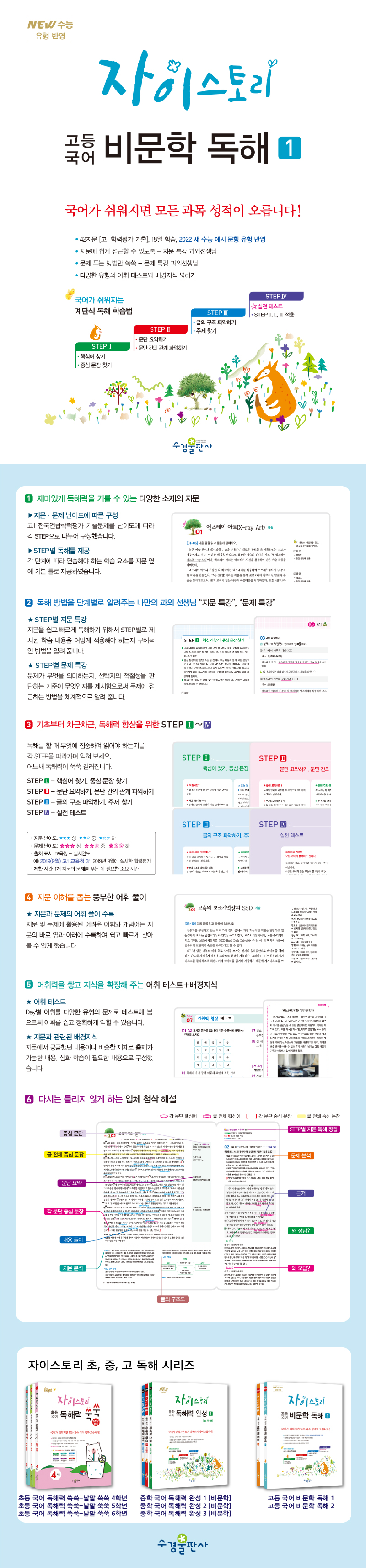
If Korean becomes easier, your grades in all subjects will go up!
ㆍ42 questions, 18 days of study, reflecting the sample question types of the new 2022 CSAT
Step-by-step reading training according to reading STEP
ㆍSTEP I: Finding keywords and central sentences
STEP II: Summarizing paragraphs and understanding relationships between paragraphs
STEP III: Understanding the structure of the text and finding the topic
ㆍSTEP practical test
ㆍSpecial lecture on fingerprints: Learning how to read fingerprints
ㆍSpecial lecture on problems: Learning how to approach problems
ㆍVarious types of vocabulary tests and background knowledge
ㆍ3D editing and commentary that supplements concepts to prevent mistakes from happening again
[Problem] Features
1.
Structure according to fingerprint and problem difficulty
The questions from the National Academic Achievement Test for the first year of high school are divided into steps according to difficulty.
2. Providing a reading framework for each step
We've provided a basic framework next to the text with the learning elements you need to practice for each step.
- STEP Ⅰ Find keywords and central sentences
Read the passage, looking for the central keyword that forms the center of each paragraph and the central sentence that contains the main idea of each paragraph.
This is the first step to understanding the content of the text.
- STEP Ⅱ Summarizing paragraphs and understanding the relationships between paragraphs
Summarizing the main idea of a paragraph and figuring out how each paragraph is connected will help you understand the flow of the text.
- STEP Ⅲ Understanding the structure of the text and finding the topic
If you understand the structure of the text, you can easily find the topic, or what the writer is trying to convey!
- STEP Ⅳ Practical Test
In each step, apply what you have learned about reading fingerprints and solving problems to real-world problems.
You can confirm that your reading comprehension skills have improved by solving actual exam questions while thinking about what you have learned.
5.
Fingerprint special lecture
If you practice reading texts as taught in the “Fingerprint Special Lecture,” you will learn what you need to know first to accurately understand the content of the text, and you will be able to grasp the entire content of the text easily and simply.
6.
Special lecture on problems
By learning how to solve problems through “Problem Special Lectures,” you will be able to solve even difficult and complex problems with ease.
7.
Includes fingerprints and vocabulary explanations for problems
Difficult vocabulary and concepts used in the text and problems are listed right next to and below the text for quick and easy reference.
8.
Vocabulary test
You can learn vocabulary easily and accurately by testing your vocabulary by day with various types of problems.
9.
Background knowledge related to fingerprints
It consists of content that was curious about in the fingerprint, content that can be tested with similar materials, and content that requires in-depth study.
[Commentary] Features
1.
The commentary includes the entire text and the full text of the question, and the explanations for the multiple choice answers are provided to help you understand at a glance why the answer is correct and why it is incorrect.
2.
We summarize the content of each paragraph and display the keywords and central sentences of each paragraph and the keywords and central sentences of the entire text to help you quickly understand the content of the text.
3.
We have provided a breakdown of the content, topics, relationships between paragraphs, and a structure diagram of the text to help you fully understand the content of the text.
4.
By asking 'Why is it correct?' and 'Why is it wrong?', we provide the basis for the correct and incorrect answers, thereby increasing understanding of the problem.
5.
'Problem Analysis' allows you to see at a glance what the problem means.
6.
We have provided various reference materials to help you understand the problem.
ㆍ42 questions, 18 days of study, reflecting the sample question types of the new 2022 CSAT
Step-by-step reading training according to reading STEP
ㆍSTEP I: Finding keywords and central sentences
STEP II: Summarizing paragraphs and understanding relationships between paragraphs
STEP III: Understanding the structure of the text and finding the topic
ㆍSTEP practical test
ㆍSpecial lecture on fingerprints: Learning how to read fingerprints
ㆍSpecial lecture on problems: Learning how to approach problems
ㆍVarious types of vocabulary tests and background knowledge
ㆍ3D editing and commentary that supplements concepts to prevent mistakes from happening again
[Problem] Features
1.
Structure according to fingerprint and problem difficulty
The questions from the National Academic Achievement Test for the first year of high school are divided into steps according to difficulty.
2. Providing a reading framework for each step
We've provided a basic framework next to the text with the learning elements you need to practice for each step.
- STEP Ⅰ Find keywords and central sentences
Read the passage, looking for the central keyword that forms the center of each paragraph and the central sentence that contains the main idea of each paragraph.
This is the first step to understanding the content of the text.
- STEP Ⅱ Summarizing paragraphs and understanding the relationships between paragraphs
Summarizing the main idea of a paragraph and figuring out how each paragraph is connected will help you understand the flow of the text.
- STEP Ⅲ Understanding the structure of the text and finding the topic
If you understand the structure of the text, you can easily find the topic, or what the writer is trying to convey!
- STEP Ⅳ Practical Test
In each step, apply what you have learned about reading fingerprints and solving problems to real-world problems.
You can confirm that your reading comprehension skills have improved by solving actual exam questions while thinking about what you have learned.
5.
Fingerprint special lecture
If you practice reading texts as taught in the “Fingerprint Special Lecture,” you will learn what you need to know first to accurately understand the content of the text, and you will be able to grasp the entire content of the text easily and simply.
6.
Special lecture on problems
By learning how to solve problems through “Problem Special Lectures,” you will be able to solve even difficult and complex problems with ease.
7.
Includes fingerprints and vocabulary explanations for problems
Difficult vocabulary and concepts used in the text and problems are listed right next to and below the text for quick and easy reference.
8.
Vocabulary test
You can learn vocabulary easily and accurately by testing your vocabulary by day with various types of problems.
9.
Background knowledge related to fingerprints
It consists of content that was curious about in the fingerprint, content that can be tested with similar materials, and content that requires in-depth study.
[Commentary] Features
1.
The commentary includes the entire text and the full text of the question, and the explanations for the multiple choice answers are provided to help you understand at a glance why the answer is correct and why it is incorrect.
2.
We summarize the content of each paragraph and display the keywords and central sentences of each paragraph and the keywords and central sentences of the entire text to help you quickly understand the content of the text.
3.
We have provided a breakdown of the content, topics, relationships between paragraphs, and a structure diagram of the text to help you fully understand the content of the text.
4.
By asking 'Why is it correct?' and 'Why is it wrong?', we provide the basis for the correct and incorrect answers, thereby increasing understanding of the problem.
5.
'Problem Analysis' allows you to see at a glance what the problem means.
6.
We have provided various reference materials to help you understand the problem.
GOODS SPECIFICS
- Date of publication: July 15, 2020
- Page count, weight, size: 320 pages | 215*280*30mm
- ISBN13: 9791162402634
- ISBN10: 1162402636
You may also like
카테고리
korean


korean

![GQ KOREA Mark (Monthly): December [2025]](http://librairie.coreenne.fr/cdn/shop/files/8ef265dbbfbf186523ed75ba7319009d.jpg?v=1765340328&width=3840)


