

Have you ever studied math, chewing on the concepts?
 |
Description
Book Introduction
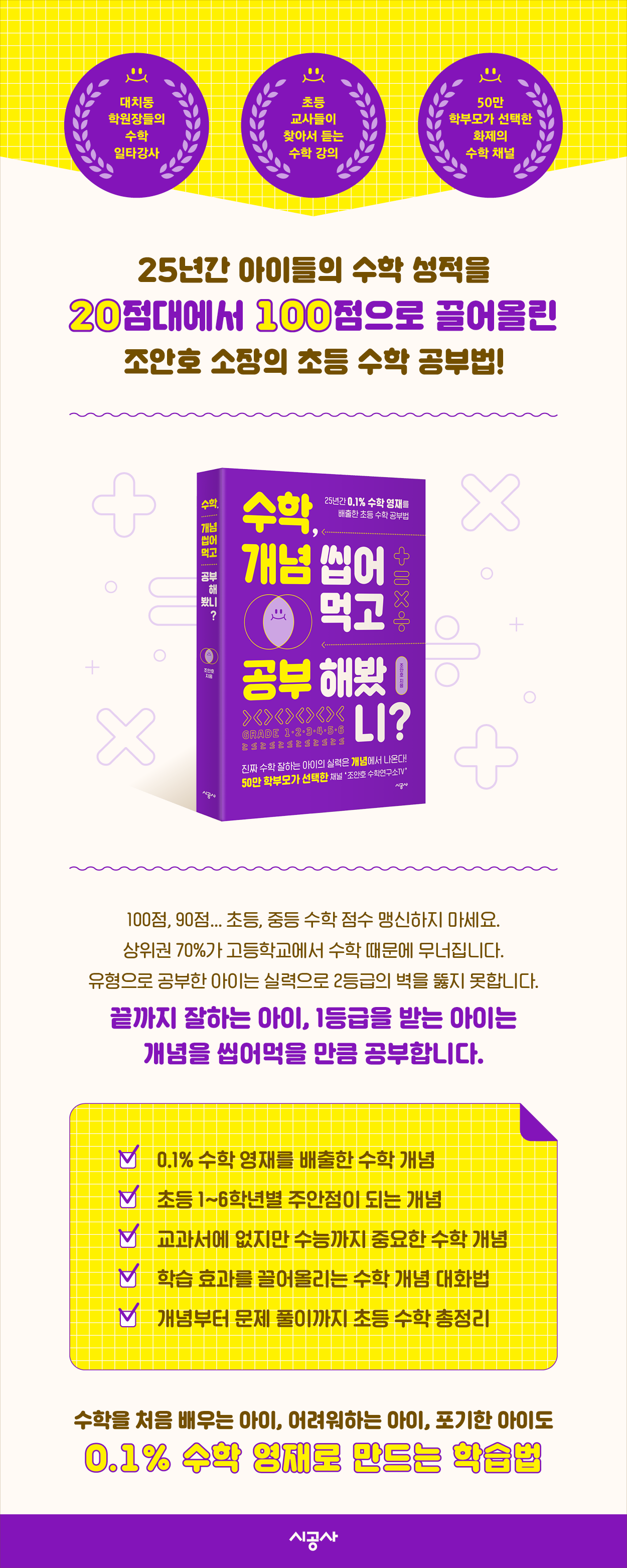
★ Daily Math Instructor from Daechi-dong Academy Directors ★ Math lectures that elementary school teachers seek out and listen to ★ The hot math channel chosen by 500,000 parents Jo An-ho's elementary school math study method, which has produced 0.1% of math prodigies over 25 years. “100 points, 90 points... Don't blindly trust elementary and middle school math scores. The top 70% of students fail in high school because of math. A child who studies by type cannot break through the second-grade wall with his/her skills. “The kids who do well until the end, the kids who get first grades, study hard enough to chew on the concepts.” The best way to improve your child's math skills is to learn math from a good teacher. It's clear, but unfortunately, finding a good teacher is a rare possibility, and even if you do find one, there's no guarantee that you'll learn from it. The second method is for parents to study math and teach their children. However, most parents are also math dropouts, so they don't know how to do well in math, and there is no roadmap to refer to for education. The only way is to make children study on their own, but schools and academies don't teach them properly; they just make them memorize problem types and problem-solving techniques. So, a whopping 90% of children give up on math over the course of 12 years in elementary, middle, and high school. Is there really no way to get good at math, no way to study easily? The author of this book, Director Jo An-ho, is a math expert whose skills have been proven, known as the “excellent student maker” and “the math world’s best” for raising children’s math scores from the 20s to 100s over the past 25 years. Teachers offer advice on how to study math, and academy directors in Daechi-dong, Gangnam, and Mok-dong request one-on-one tutoring. He has published a book on elementary school mathematics, the foundation and center of all mathematics, by incorporating his accumulated know-how. This book teaches you how to completely master the essential concepts in elementary school math from grades 1 to 6, as well as the important concepts that lead up to the college entrance exam. This book, which comprehensively covers elementary mathematics, from problem solving to reading and writing math concepts and checking a child's learning progress, can help children who are learning math for the first time, children who find math difficult, and even children who have given up on math become math prodigies. |
- You can preview some of the book's contents.
Preview
index
prolog.
If only I could entrust math to someone
Chapter 0.
Elementary Math, Your Study Method is Wrong!
Why do kids give up on math?
Why are parents so obsessed with problem solving?
Why do schools and academies only teach us to solve type problems?
Improper math education turns children into math idiots.
How to be good at math that no one has ever properly explained
How to chew on math concepts
Elementary Math Basic Concept Test
Chapter 1.
First-grade math concepts should be eaten like this.
Math Interpretation for First Graders
Analysis of Mr. Cho's textbook
centuries
Digits are more important than place value
Mental calculation skills
Comparison of numbers starting with 'less than' and 'greater than'
Create a formula
TIP Math concepts that children often get wrong
COLUMN Children doing finger counting
Chapter 2.
This is how you should eat 2nd grade math concepts
Math Interpretation for 2nd Graders
Analysis of Mr. Cho's textbook
Multiplication table
Extension of addition and subtraction to develop number sense
Creating addition and subtraction expressions from word problems
The relationship between sum and difference
The first step toward probability
TIP Math concepts that children often get wrong
COLUMN Is it really necessary to teach the properties of equations in the second grade?
Chapter 3.
3rd Grade Math Concepts: How to Eat
Math Interpretation for 3rd Graders
Analysis of Mr. Cho's textbook
quickness
Two digits × one digit
Division, the most important subject in math textbooks
Distinguishing between multiplication and division in word problems
Number sense that needs to be developed even in third grade
Definition of shape
The beginning of the fountain
COLUMN Children who are apathetic about math
Chapter 4.
4th Grade Math Concepts: How to Eat
Math Interpreter for 4th Graders
Analysis of Mr. Cho's textbook
A larger number corresponding to a larger number
Decimals for number sense
Exponentiation to avoid confusion between addition and multiplication
4th grade logic problems
A triangle you can't miss
Rules leading to middle and high school functions
The most important triangle in geometry
mixed calculations
COLUMN Why is multiplication and division of large numbers difficult?
How to solve COLUMN word problems
Chapter 5.
5th Grade Math Concepts: How to Eat
Math Interpreter for 5th Graders
Analysis of Mr. Cho's textbook
Multiples and divisors
Greatest common divisor and least common multiple
Reduction, the basis of fractional operations
Common denominators are important in adding and subtracting fractions.
7 Fractions and Decimals
Multiplication of fractions
Division of fractions
Thinking about fractions in a range of numbers
diagram
Area of all shapes using triangles
Figures in symmetrical positions
TIP Math concepts that children often get wrong
Chapter 6.
6th Grade Math Concepts: How to Eat
Math Interpreter for 6th Graders
Analysis of Mr. Cho's textbook
Four arithmetic operations with fractions
Division of decimals
Rain and ratio
The great properties of fractions that help us understand the nature of rain
Proportional distribution
three-dimensional figures
The purpose of equations is to practice the properties of equality.
The completion of elementary mathematics is the word problem of fractions.
Epilogue.
The conclusion is to read mathematics as a concept.
If only I could entrust math to someone
Chapter 0.
Elementary Math, Your Study Method is Wrong!
Why do kids give up on math?
Why are parents so obsessed with problem solving?
Why do schools and academies only teach us to solve type problems?
Improper math education turns children into math idiots.
How to be good at math that no one has ever properly explained
How to chew on math concepts
Elementary Math Basic Concept Test
Chapter 1.
First-grade math concepts should be eaten like this.
Math Interpretation for First Graders
Analysis of Mr. Cho's textbook
centuries
Digits are more important than place value
Mental calculation skills
Comparison of numbers starting with 'less than' and 'greater than'
Create a formula
TIP Math concepts that children often get wrong
COLUMN Children doing finger counting
Chapter 2.
This is how you should eat 2nd grade math concepts
Math Interpretation for 2nd Graders
Analysis of Mr. Cho's textbook
Multiplication table
Extension of addition and subtraction to develop number sense
Creating addition and subtraction expressions from word problems
The relationship between sum and difference
The first step toward probability
TIP Math concepts that children often get wrong
COLUMN Is it really necessary to teach the properties of equations in the second grade?
Chapter 3.
3rd Grade Math Concepts: How to Eat
Math Interpretation for 3rd Graders
Analysis of Mr. Cho's textbook
quickness
Two digits × one digit
Division, the most important subject in math textbooks
Distinguishing between multiplication and division in word problems
Number sense that needs to be developed even in third grade
Definition of shape
The beginning of the fountain
COLUMN Children who are apathetic about math
Chapter 4.
4th Grade Math Concepts: How to Eat
Math Interpreter for 4th Graders
Analysis of Mr. Cho's textbook
A larger number corresponding to a larger number
Decimals for number sense
Exponentiation to avoid confusion between addition and multiplication
4th grade logic problems
A triangle you can't miss
Rules leading to middle and high school functions
The most important triangle in geometry
mixed calculations
COLUMN Why is multiplication and division of large numbers difficult?
How to solve COLUMN word problems
Chapter 5.
5th Grade Math Concepts: How to Eat
Math Interpreter for 5th Graders
Analysis of Mr. Cho's textbook
Multiples and divisors
Greatest common divisor and least common multiple
Reduction, the basis of fractional operations
Common denominators are important in adding and subtracting fractions.
7 Fractions and Decimals
Multiplication of fractions
Division of fractions
Thinking about fractions in a range of numbers
diagram
Area of all shapes using triangles
Figures in symmetrical positions
TIP Math concepts that children often get wrong
Chapter 6.
6th Grade Math Concepts: How to Eat
Math Interpreter for 6th Graders
Analysis of Mr. Cho's textbook
Four arithmetic operations with fractions
Division of decimals
Rain and ratio
The great properties of fractions that help us understand the nature of rain
Proportional distribution
three-dimensional figures
The purpose of equations is to practice the properties of equality.
The completion of elementary mathematics is the word problem of fractions.
Epilogue.
The conclusion is to read mathematics as a concept.
Detailed image
Publisher's Review
The reason math is difficult is because you study it wrong!
How to be good at math that no one has ever properly explained
80 percent of children give up on math in elementary and middle school.
Of the remaining 20 percent, half are frustrated because they cannot get into the second grade of the math area, and they end up becoming dropouts later.
As a result, close to 90 percent of children give up on math during their 12 years of elementary, middle, and high school.
If you say that children are bad at math because they are stupid, then 90 percent of children are stupid, but that doesn't make sense.
Rather, the reality of our country's math education is that even excellent students, let alone average students, fail despite putting in tremendous effort.
For decades, math education has been repeating the same pattern of pouring enormous amounts of money and time into solving massive problems, visiting academies, and memorizing problem sets, thereby halving math scores.
Yet, no one really talks about how to do math well.
Rather, people who have never taught elementary math talk about how to be good at math simply because they have authority or are in an environment where they teach children.
But there are so many wrong stories.
They make fun of elementary math and pollute what little reliable information remains with unverified statements.
The biggest reason children give up on math is because they are learning it the wrong way.
A child who is truly good at math comes from concepts!
A learning method that turns even children who struggle with math into 0.1% gifted students.
Most children solve problems without learning the concepts.
Math problems need to be solved conceptually, but since I don't have the concepts in my head, I can't solve them.
Even teachers who don't know the concepts only teach children problem-solving techniques, which means the children lose the opportunity to learn the concepts and are never able to move beyond the techniques.
So what should we do with concepts that neither schools nor academies can teach? Teaching concepts is a truly difficult task.
However, the author of this book, Director Jo An-ho, confidently says that anyone can do it if it is elementary mathematics.
It is so easy that you would think that a child could just memorize the math concepts, but you can master them with certainty.
In fact, all the children who went to Seoul National University organized their own mathematical concepts and solved a single workbook over and over again until they understood the concepts.
"Have you ever studied math by chewing on the concepts?" is a book written by Director Jo An-ho, who has taught children for 25 years and has selected and explained in detail the concepts that "must know" in elementary math.
There are not many concepts required in elementary mathematics.
And among them, only the truly necessary concepts are covered in this book.
However, for readers who hesitate because they think math is difficult or hard to study, Director Jo An-ho boldly shares his secrets, including a math concept conversation method that increases learning effectiveness, math concepts organized based on 25 years of experience in producing gifted students, and a learning process that improves skills by solving problems using concepts as tools.
We analyze the key concepts for each grade, the important concepts in the textbook and the important concepts not in the textbook, and interpret them until all children thoroughly chew on and fully digest math.
It presents the easiest and most reliable study method to parents and children who are frustrated with math.
“Studying well in elementary and middle school was useless.”
Chosen by 500,000 parents, Jo An-ho's math is different!
A complete 6-year elementary school math study method, from concepts to problem solving, all in one book.
Memorizing problem types or problem-solving techniques will not last long.
Children who had good grades in elementary school fall to the lower middle and high school levels due to math problems.
In fact, the highest score a child who studied math by solving problems and memorizing types of problems can receive in the math section of the CSAT is a grade 3.
Many children work on problems until dawn for years because they can advance to level 2 if they get just one more question right from level 3.
However, a child who studies by type cannot break through the second-grade wall in terms of ability.
Children who consistently maintain a high level of grades and consistently receive first-class grades know the concept so well that it can be said that they have mastered it without exception.
Concepts shine brighter as a child advances in grade level, and when concepts are solid, they can solve problems that are new to them or that mix various concepts.
You should never be complacent just because your child gets 100 or 90 points in elementary math.
Elementary and middle school math grades are not a measure of ability.
If you go to a high school where the Korea Institute for Curriculum and Evaluation and each provincial and municipal office of education create about 1,000 new problems a year, children who study math through type and technique will inevitably fail.
There's no use regretting it then.
Studying mathematics conceptually should begin in elementary school.
And all the methods are in this book.
If parents read "Have you ever studied math by chewing on the concepts?" and interpret math for their children, and if the children learn to read and write math concepts, I can confidently say that anyone can become a math genius.
How to be good at math that no one has ever properly explained
80 percent of children give up on math in elementary and middle school.
Of the remaining 20 percent, half are frustrated because they cannot get into the second grade of the math area, and they end up becoming dropouts later.
As a result, close to 90 percent of children give up on math during their 12 years of elementary, middle, and high school.
If you say that children are bad at math because they are stupid, then 90 percent of children are stupid, but that doesn't make sense.
Rather, the reality of our country's math education is that even excellent students, let alone average students, fail despite putting in tremendous effort.
For decades, math education has been repeating the same pattern of pouring enormous amounts of money and time into solving massive problems, visiting academies, and memorizing problem sets, thereby halving math scores.
Yet, no one really talks about how to do math well.
Rather, people who have never taught elementary math talk about how to be good at math simply because they have authority or are in an environment where they teach children.
But there are so many wrong stories.
They make fun of elementary math and pollute what little reliable information remains with unverified statements.
The biggest reason children give up on math is because they are learning it the wrong way.
A child who is truly good at math comes from concepts!
A learning method that turns even children who struggle with math into 0.1% gifted students.
Most children solve problems without learning the concepts.
Math problems need to be solved conceptually, but since I don't have the concepts in my head, I can't solve them.
Even teachers who don't know the concepts only teach children problem-solving techniques, which means the children lose the opportunity to learn the concepts and are never able to move beyond the techniques.
So what should we do with concepts that neither schools nor academies can teach? Teaching concepts is a truly difficult task.
However, the author of this book, Director Jo An-ho, confidently says that anyone can do it if it is elementary mathematics.
It is so easy that you would think that a child could just memorize the math concepts, but you can master them with certainty.
In fact, all the children who went to Seoul National University organized their own mathematical concepts and solved a single workbook over and over again until they understood the concepts.
"Have you ever studied math by chewing on the concepts?" is a book written by Director Jo An-ho, who has taught children for 25 years and has selected and explained in detail the concepts that "must know" in elementary math.
There are not many concepts required in elementary mathematics.
And among them, only the truly necessary concepts are covered in this book.
However, for readers who hesitate because they think math is difficult or hard to study, Director Jo An-ho boldly shares his secrets, including a math concept conversation method that increases learning effectiveness, math concepts organized based on 25 years of experience in producing gifted students, and a learning process that improves skills by solving problems using concepts as tools.
We analyze the key concepts for each grade, the important concepts in the textbook and the important concepts not in the textbook, and interpret them until all children thoroughly chew on and fully digest math.
It presents the easiest and most reliable study method to parents and children who are frustrated with math.
“Studying well in elementary and middle school was useless.”
Chosen by 500,000 parents, Jo An-ho's math is different!
A complete 6-year elementary school math study method, from concepts to problem solving, all in one book.
Memorizing problem types or problem-solving techniques will not last long.
Children who had good grades in elementary school fall to the lower middle and high school levels due to math problems.
In fact, the highest score a child who studied math by solving problems and memorizing types of problems can receive in the math section of the CSAT is a grade 3.
Many children work on problems until dawn for years because they can advance to level 2 if they get just one more question right from level 3.
However, a child who studies by type cannot break through the second-grade wall in terms of ability.
Children who consistently maintain a high level of grades and consistently receive first-class grades know the concept so well that it can be said that they have mastered it without exception.
Concepts shine brighter as a child advances in grade level, and when concepts are solid, they can solve problems that are new to them or that mix various concepts.
You should never be complacent just because your child gets 100 or 90 points in elementary math.
Elementary and middle school math grades are not a measure of ability.
If you go to a high school where the Korea Institute for Curriculum and Evaluation and each provincial and municipal office of education create about 1,000 new problems a year, children who study math through type and technique will inevitably fail.
There's no use regretting it then.
Studying mathematics conceptually should begin in elementary school.
And all the methods are in this book.
If parents read "Have you ever studied math by chewing on the concepts?" and interpret math for their children, and if the children learn to read and write math concepts, I can confidently say that anyone can become a math genius.
GOODS SPECIFICS
- Date of issue: January 2, 2022
- Page count, weight, size: 404 pages | 572g | 150*220*20mm
- ISBN13: 9791165798543
- ISBN10: 1165798549
You may also like
카테고리
korean


korean

![ELLE 엘르 스페셜 에디션 A형 : 12월 [2025]](http://librairie.coreenne.fr/cdn/shop/files/b8e27a3de6c9538896439686c6b0e8fb.jpg?v=1766436872&width=3840)


