

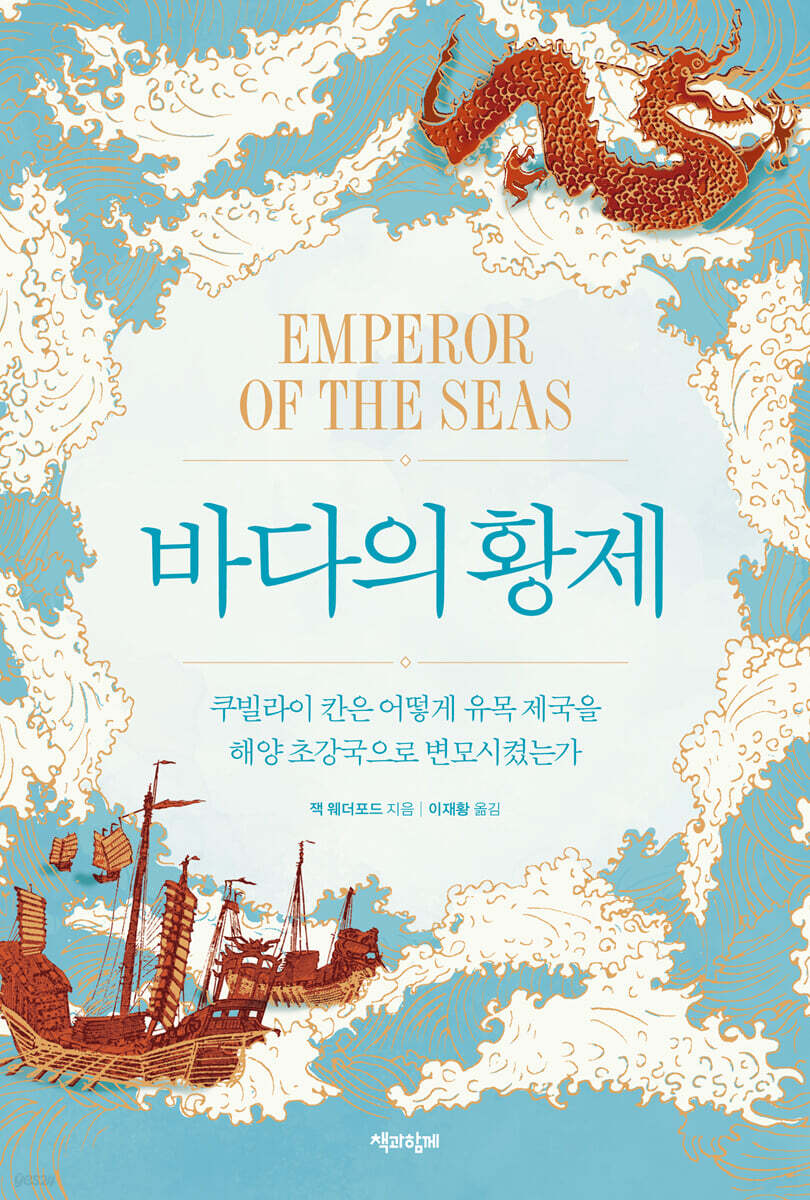
Emperor of the Sea
 |
Description
Book Introduction
“He wanted to conquer the world, and the sea was right in the middle of it.”
Kublai Khan, the greatest conqueror since Genghis Khan
Moving the stage of history from land to sea
The nomadic empire of Mongolia and the sea sound like an unlikely combination.
However, there was only one person who made the title of the supreme ruler of the Mongols, 'Dalai Khan', or 'Emperor of the Sea', a reality: Kublai Khan, the grandson of Genghis Khan.
He successfully conquered the Southern Song Dynasty, which seemed impossible, and laid the foundation for the empire to expand to the sea.
He fundamentally revolutionized the way the empire was run, adopting the technologies and cultures of enemy countries and conquered peoples, including the Chinese system, and employing foreigners. Based on this, he established a commercial-based financial system and fostered a navy, deploying new strategies.
For him, the sea was not the end, but another stage on which to complete his conquest.
Jack Weatherford, a world-renowned authority on Mongolian history, portrays Kublai Khan's life as a process of creating a new maritime order.
Kublai Khan controlled the maritime trade network from Sakhalin to the Persian Gulf, and the Yuan Dynasty he founded became a model for later maritime empires in world history.
Kublai Khan was the first leader to transcend the boundaries of the nomadic empire and the first architect of a new empire.
Additionally, there is the fun of encountering familiar stories, such as the history of Goryeo, the Sinan shipwreck, and the conquest of Japan, in a different context.
Kublai Khan, the greatest conqueror since Genghis Khan
Moving the stage of history from land to sea
The nomadic empire of Mongolia and the sea sound like an unlikely combination.
However, there was only one person who made the title of the supreme ruler of the Mongols, 'Dalai Khan', or 'Emperor of the Sea', a reality: Kublai Khan, the grandson of Genghis Khan.
He successfully conquered the Southern Song Dynasty, which seemed impossible, and laid the foundation for the empire to expand to the sea.
He fundamentally revolutionized the way the empire was run, adopting the technologies and cultures of enemy countries and conquered peoples, including the Chinese system, and employing foreigners. Based on this, he established a commercial-based financial system and fostered a navy, deploying new strategies.
For him, the sea was not the end, but another stage on which to complete his conquest.
Jack Weatherford, a world-renowned authority on Mongolian history, portrays Kublai Khan's life as a process of creating a new maritime order.
Kublai Khan controlled the maritime trade network from Sakhalin to the Persian Gulf, and the Yuan Dynasty he founded became a model for later maritime empires in world history.
Kublai Khan was the first leader to transcend the boundaries of the nomadic empire and the first architect of a new empire.
Additionally, there is the fun of encountering familiar stories, such as the history of Goryeo, the Sinan shipwreck, and the conquest of Japan, in a different context.
- You can preview some of the book's contents.
Preview
index
Introduction: China's Maritime Golden Age
Prologue: The Travels of Marco Polo
Part 1: Kublai Khan: The Unworthy Emperor
Chapter 1: The Mongols' Southward Advance
Chapter 2: Still in the Dust
Chapter 3: Brothers on Two Continents
Chapter 4: Mongke's Ascension to the Great Khanship and the Resumption of the Mongol War
Chapter 5: The War from the Pacific to the Mediterranean
Chapter 6: Kublai Khan's Stretch
Part 2: Kublai Khan Goes to Sea
Chapter 7: The Great Wall of China
Chapter 8: The Arms Race That Began with Funding
Chapter 9: Kublai Khan's Construction of an Offensive Naval Force
Chapter 10: Daewon, a Great Beginning
Chapter 11: Chaos off the coast of Japan
Chapter 12: The Fall Before the Flood
Chapter 13: The Great Song's Finale
Chapter 14: A Navy Without a Country
Part 3: The Silk Road of the Sea
Chapter 15: The Black Wind Over Japan
Chapter 16: Markets, Money, and Murder
Chapter 17: Disappearing in the jungle and drifting on the sea
Chapter 18: Egypt Instead of Vietnam
Chapter 19: The Mongolian Princess and the Tiger
Chapter 20: The End of the Kublai Khanate
Part 4: Calm and Decline after Kublai Khan
Chapter 21: The Iron Man and the Lotus
Chapter 22: From Conquest to Commerce
Chapter 23: Ports of Profit and Pleasure, Poetry and Vanity
Chapter 24: Rotting Ships, Sinking Money
Chapter 25: China's Withdrawal from the Sea
Chapter 26: The Wolf Comes in the Rain
Chapter 27: The Departure of the Emperor of China
Epilogue: History does not tolerate tyranny.
Acknowledgements
Translator's Note
main
Search
Prologue: The Travels of Marco Polo
Part 1: Kublai Khan: The Unworthy Emperor
Chapter 1: The Mongols' Southward Advance
Chapter 2: Still in the Dust
Chapter 3: Brothers on Two Continents
Chapter 4: Mongke's Ascension to the Great Khanship and the Resumption of the Mongol War
Chapter 5: The War from the Pacific to the Mediterranean
Chapter 6: Kublai Khan's Stretch
Part 2: Kublai Khan Goes to Sea
Chapter 7: The Great Wall of China
Chapter 8: The Arms Race That Began with Funding
Chapter 9: Kublai Khan's Construction of an Offensive Naval Force
Chapter 10: Daewon, a Great Beginning
Chapter 11: Chaos off the coast of Japan
Chapter 12: The Fall Before the Flood
Chapter 13: The Great Song's Finale
Chapter 14: A Navy Without a Country
Part 3: The Silk Road of the Sea
Chapter 15: The Black Wind Over Japan
Chapter 16: Markets, Money, and Murder
Chapter 17: Disappearing in the jungle and drifting on the sea
Chapter 18: Egypt Instead of Vietnam
Chapter 19: The Mongolian Princess and the Tiger
Chapter 20: The End of the Kublai Khanate
Part 4: Calm and Decline after Kublai Khan
Chapter 21: The Iron Man and the Lotus
Chapter 22: From Conquest to Commerce
Chapter 23: Ports of Profit and Pleasure, Poetry and Vanity
Chapter 24: Rotting Ships, Sinking Money
Chapter 25: China's Withdrawal from the Sea
Chapter 26: The Wolf Comes in the Rain
Chapter 27: The Departure of the Emperor of China
Epilogue: History does not tolerate tyranny.
Acknowledgements
Translator's Note
main
Search
Into the book
He (Marco Polo) spent half of his life in China at the time, and later wrote about what he saw during his trip, which inspired later European explorers.
In his writings we can find something that he only vaguely understood.
This is an investigation into what Kublai Khan accomplished during those 20 years.
Kublai Khan built the world's largest navy.
With that navy, he unified China and further expanded the commercial network that stretched from the Pacific Ocean in the Arctic region to the tropical coast of China.
He created a completely new system of international order and world commerce based on maritime power.
Kublai Khan shifted the stage of history from land to sea.
---From the "Prologue"
Kublai's mother seemed to be the only person who really cared about his upbringing, encouraging him to maintain his interests rather than trying to change him.
Sorkokhtani planned for Kublai Khan to play a special role.
Because she and her husband were in charge of a vast swathe of northern China, and she knew from the beginning that raiding, pillaging, and conquest would not be profitable in the long run.
The Mongols needed to govern the lands they conquered.
If you slaughter a cow, you will get meat for a feast, but if you raise a cow, you will get milk for the future.
The clever Sorkokhtani realized that having a son familiar with Chinese culture and education would help him rule the land.
Especially if the Mongols conquer southern China.
---From "Chapter 2, Still in the Dust"
Compared to his handsome brother, Kublai Khan was overweight and suffered from gout.
He was intelligent but impulsive.
Eventually, I became a person who felt more comfortable riding an elephant than a horse.
He was a Mongolian who went hunting wearing a white sable outfit made by cutting and pasting black mink.
He did not fit in well with the small wooden saddles of the Mongol soldiers.
Kublai Khan was the most unlikely of the Mongol imperial males to become emperor.
---From "Chapter 6: Kublai Khan's Stretch"
According to Rashid al-Din, Chabuyi sent a coded message in the form of a fable to Kublai on the battlefield, warning him.
“The heads of the big fish and the small fish were cut off.
“Who else is left besides you and Arigböke? Come back now.” Chabui was pleading with Kublai to confront his brother.
Conquering Southern China was not a priority.
It was not the Southern Song emperor but Ariq Boke who was the immediate enemy.
Chabui told her husband to postpone the expedition and return to the capital to fight for the throne.
…Chabuyi's message offered Kublai a direction in life, a deeper meaning, a new challenge, a unique opportunity to act independently rather than simply obeying the orders of his superiors back home in Mongolia.
---From "Chapter 6: Kublai Khan's Stretch"
The Jin Dynasty's failure to break through the Song Dynasty's Great Wall provided Kublai Khan with a good lesson.
Twenty-five years after the two decisive naval battles, a Southern Song official put it clearly:
These victories, he said, were “not won by our cavalry, nor by our archers, nor by our infantry, but by our own standards.”
A new day of war dawned, and Kublai Khan was determined to win.
I still didn't know what to do, but I knew what not to do.
---From "Chapter 7: The Great Wall of China"
Previous Mongol khans prioritized fighting skills and paid little attention to finances (which were considered women's work), and this system worked as long as the army was self-sufficient.
If there were pastures to feed the horses and other animals required by the army, and if raids and plunder could provide for all other financial and luxury needs, and if the army could roam within a short distance of the grassy steppe, and could go there at any time to feed and breed its animals, then...
But when the army moved further into the jungles of Vietnam, the farm fields and muddy soils of Europe, or encountered the mighty Great Wall of the Southern Song, everything fell apart.
---From "Chapter 8: The Arms Race That Began with Funding"
The Mongols now realized they had taken over one of the most cosmopolitan cities in the world.
None of the cities they had in the north could compare to this.
In the months following the Song surrender, documents and books, furniture and furnishings, weapons and works of art, imperial clothing and embroidered fabrics, silverware and tableware, and just other curiosities were loaded onto carts and ships and transported to the Mongol capital in Beijing.
Since the time of Genghis Khan, plundering had been a systematic and disciplined affair, with meticulous accounts of each item recorded and complex redistribution systems ensuring that everyone—even the wives and children of dead soldiers—received their fair share.
According to official Yuan records, the Bayan, now equipped with a large fleet, “transported paintings, books, and other spoils plundered from the Song to the capital by sea.”
---From "Chapter 13: The Great Song's Finale"
The financial and maritime reforms introduced by Kublai Khan allowed trade to flourish.
The goods were transported by sea and various land routes to a few selected ports in the south, where they were sold to merchants around the world and exported to foreign cities.
This transformed China's ports into global commercial centers, and culture and wealth spread to the coast.
As trade networks rapidly expanded geographically and the size of ships and the scale of investment grew, the variety of products available increased dramatically.
These included glass and coral necklaces, a wide variety of textiles, spices, jewels, and industrial raw materials (ranging from tortoiseshell to beeswax).
During the Yuan Dynasty, China imported black pepper from the Malabar Coast of India and became the largest consumer of it.
---From "Chapter 16: Market, Money, and Murder"
One of the most powerful leaders in history, he did not realize that although he had not conquered Vietnam, Japan, or Java, his ships dominated the seas around them.
He built the largest naval fleet in history, and through Kukezin's travels he fulfilled his dream of extending Mongolia's land postal system by sea.
These were things that had previously failed in his prelude to going to Japan.
Control of the seas ensured commercial dominance on land, and China controlled all the most lucrative sea routes.
---From "Chapter 20: The End of the Kublai Khan Era"
The Mongol Empire under Kublai Khan and Temür Khan was a period of dynamic change.
After centuries of navigation and technological innovation during China's Tang and Song dynasties, it was under the Mongol Yuan Dynasty that China suddenly became a major global maritime power.
Trade, which had previously been confined to small boats sailing along the coast or crossing narrow, protected waters from island to island, now moved to the open sea.
Because large ships could cross seemingly endless oceans and sail for weeks on end without land in sight.
Oceanic trade between nations grew in importance, rivaling the traditional internal markets of most countries.
Controlling the sea lanes became more valuable than occupying land territory, and the spaces between empires became more important than their centers.
Now the nation that controls the sea controls commerce.
China became the world's most powerful empire, and Kublai Khan created the model for the maritime nations that followed.
---From "Chapter 23: Ports of Profit and Pleasure, Poetry and Vanity"
The departure of the Princess Fleet from southern China in 1291 marked the beginning of China's maritime golden age.
This period lasted nearly 150 years, with the last Ming ship leaving the port of Hormuz in March 1433.
Since then, China has turned its back on the world.
The world continued to open its doors to new European nations seeking to take up the old route.
The Ming withdrawal left a huge gap in world trade.
What was equally strange and powerful about the Ming's withdrawal from the world and the seas was that it gave them time (and eventually succeeded) to consolidate their rule and reassert control over the population and the economy.
Life in China slowly began to improve before the end of the century.
But it was too late.
The wolf was already barking at the door.
---From "Chapter 25: China's Withdrawal from the Sea"
In September, Britain invaded China from the sea.
China, which had no navy to mobilize to defend it, surrendered after three years of destruction.
At the beginning of the 20th century, France occupied Simian Island in Guangzhou.
Portugal transformed Macau from a foreign trading port into a colony.
The German Kaiser took control of Tsingtao Bay, and the Russian Tsar took Dalian in the north.
Weaker countries such as Belgium, Austria-Hungary, Italy, and the United States occupied concessions in Tianjin.
Europeans extended their demand for free trade beyond ports to rivers and even railways, and divided China into spheres of influence.
Here, opium became a religion imposed on the masses.
The Chinese became prisoners in their own country.
In his writings we can find something that he only vaguely understood.
This is an investigation into what Kublai Khan accomplished during those 20 years.
Kublai Khan built the world's largest navy.
With that navy, he unified China and further expanded the commercial network that stretched from the Pacific Ocean in the Arctic region to the tropical coast of China.
He created a completely new system of international order and world commerce based on maritime power.
Kublai Khan shifted the stage of history from land to sea.
---From the "Prologue"
Kublai's mother seemed to be the only person who really cared about his upbringing, encouraging him to maintain his interests rather than trying to change him.
Sorkokhtani planned for Kublai Khan to play a special role.
Because she and her husband were in charge of a vast swathe of northern China, and she knew from the beginning that raiding, pillaging, and conquest would not be profitable in the long run.
The Mongols needed to govern the lands they conquered.
If you slaughter a cow, you will get meat for a feast, but if you raise a cow, you will get milk for the future.
The clever Sorkokhtani realized that having a son familiar with Chinese culture and education would help him rule the land.
Especially if the Mongols conquer southern China.
---From "Chapter 2, Still in the Dust"
Compared to his handsome brother, Kublai Khan was overweight and suffered from gout.
He was intelligent but impulsive.
Eventually, I became a person who felt more comfortable riding an elephant than a horse.
He was a Mongolian who went hunting wearing a white sable outfit made by cutting and pasting black mink.
He did not fit in well with the small wooden saddles of the Mongol soldiers.
Kublai Khan was the most unlikely of the Mongol imperial males to become emperor.
---From "Chapter 6: Kublai Khan's Stretch"
According to Rashid al-Din, Chabuyi sent a coded message in the form of a fable to Kublai on the battlefield, warning him.
“The heads of the big fish and the small fish were cut off.
“Who else is left besides you and Arigböke? Come back now.” Chabui was pleading with Kublai to confront his brother.
Conquering Southern China was not a priority.
It was not the Southern Song emperor but Ariq Boke who was the immediate enemy.
Chabui told her husband to postpone the expedition and return to the capital to fight for the throne.
…Chabuyi's message offered Kublai a direction in life, a deeper meaning, a new challenge, a unique opportunity to act independently rather than simply obeying the orders of his superiors back home in Mongolia.
---From "Chapter 6: Kublai Khan's Stretch"
The Jin Dynasty's failure to break through the Song Dynasty's Great Wall provided Kublai Khan with a good lesson.
Twenty-five years after the two decisive naval battles, a Southern Song official put it clearly:
These victories, he said, were “not won by our cavalry, nor by our archers, nor by our infantry, but by our own standards.”
A new day of war dawned, and Kublai Khan was determined to win.
I still didn't know what to do, but I knew what not to do.
---From "Chapter 7: The Great Wall of China"
Previous Mongol khans prioritized fighting skills and paid little attention to finances (which were considered women's work), and this system worked as long as the army was self-sufficient.
If there were pastures to feed the horses and other animals required by the army, and if raids and plunder could provide for all other financial and luxury needs, and if the army could roam within a short distance of the grassy steppe, and could go there at any time to feed and breed its animals, then...
But when the army moved further into the jungles of Vietnam, the farm fields and muddy soils of Europe, or encountered the mighty Great Wall of the Southern Song, everything fell apart.
---From "Chapter 8: The Arms Race That Began with Funding"
The Mongols now realized they had taken over one of the most cosmopolitan cities in the world.
None of the cities they had in the north could compare to this.
In the months following the Song surrender, documents and books, furniture and furnishings, weapons and works of art, imperial clothing and embroidered fabrics, silverware and tableware, and just other curiosities were loaded onto carts and ships and transported to the Mongol capital in Beijing.
Since the time of Genghis Khan, plundering had been a systematic and disciplined affair, with meticulous accounts of each item recorded and complex redistribution systems ensuring that everyone—even the wives and children of dead soldiers—received their fair share.
According to official Yuan records, the Bayan, now equipped with a large fleet, “transported paintings, books, and other spoils plundered from the Song to the capital by sea.”
---From "Chapter 13: The Great Song's Finale"
The financial and maritime reforms introduced by Kublai Khan allowed trade to flourish.
The goods were transported by sea and various land routes to a few selected ports in the south, where they were sold to merchants around the world and exported to foreign cities.
This transformed China's ports into global commercial centers, and culture and wealth spread to the coast.
As trade networks rapidly expanded geographically and the size of ships and the scale of investment grew, the variety of products available increased dramatically.
These included glass and coral necklaces, a wide variety of textiles, spices, jewels, and industrial raw materials (ranging from tortoiseshell to beeswax).
During the Yuan Dynasty, China imported black pepper from the Malabar Coast of India and became the largest consumer of it.
---From "Chapter 16: Market, Money, and Murder"
One of the most powerful leaders in history, he did not realize that although he had not conquered Vietnam, Japan, or Java, his ships dominated the seas around them.
He built the largest naval fleet in history, and through Kukezin's travels he fulfilled his dream of extending Mongolia's land postal system by sea.
These were things that had previously failed in his prelude to going to Japan.
Control of the seas ensured commercial dominance on land, and China controlled all the most lucrative sea routes.
---From "Chapter 20: The End of the Kublai Khan Era"
The Mongol Empire under Kublai Khan and Temür Khan was a period of dynamic change.
After centuries of navigation and technological innovation during China's Tang and Song dynasties, it was under the Mongol Yuan Dynasty that China suddenly became a major global maritime power.
Trade, which had previously been confined to small boats sailing along the coast or crossing narrow, protected waters from island to island, now moved to the open sea.
Because large ships could cross seemingly endless oceans and sail for weeks on end without land in sight.
Oceanic trade between nations grew in importance, rivaling the traditional internal markets of most countries.
Controlling the sea lanes became more valuable than occupying land territory, and the spaces between empires became more important than their centers.
Now the nation that controls the sea controls commerce.
China became the world's most powerful empire, and Kublai Khan created the model for the maritime nations that followed.
---From "Chapter 23: Ports of Profit and Pleasure, Poetry and Vanity"
The departure of the Princess Fleet from southern China in 1291 marked the beginning of China's maritime golden age.
This period lasted nearly 150 years, with the last Ming ship leaving the port of Hormuz in March 1433.
Since then, China has turned its back on the world.
The world continued to open its doors to new European nations seeking to take up the old route.
The Ming withdrawal left a huge gap in world trade.
What was equally strange and powerful about the Ming's withdrawal from the world and the seas was that it gave them time (and eventually succeeded) to consolidate their rule and reassert control over the population and the economy.
Life in China slowly began to improve before the end of the century.
But it was too late.
The wolf was already barking at the door.
---From "Chapter 25: China's Withdrawal from the Sea"
In September, Britain invaded China from the sea.
China, which had no navy to mobilize to defend it, surrendered after three years of destruction.
At the beginning of the 20th century, France occupied Simian Island in Guangzhou.
Portugal transformed Macau from a foreign trading port into a colony.
The German Kaiser took control of Tsingtao Bay, and the Russian Tsar took Dalian in the north.
Weaker countries such as Belgium, Austria-Hungary, Italy, and the United States occupied concessions in Tianjin.
Europeans extended their demand for free trade beyond ports to rivers and even railways, and divided China into spheres of influence.
Here, opium became a religion imposed on the masses.
The Chinese became prisoners in their own country.
---From "Chapter 27: The Departure of the Emperor of China"
Publisher's Review
Beyond the limits of the nomadic empire
Kublai Khan, who designed a new empire with ships instead of horses
In 1271, Marco Polo and his father headed to Dadu (Beijing), the capital of the Yuan Dynasty.
They tried to cross the Indian Ocean by boat, but it was impossible at the time due to the lack of technology and infrastructure.
In the end, it took three years to enter China by land.
They took advantage of the groundbreaking post station system created by Genghis Khan.
Genghis Khan used this system to unify the East and the West into a single communication and transportation system, but it was limited to land routes.
And in 1292, about 20 years later, Marco Polo returned to his homeland, Venice, after a two-year voyage on a state-of-the-art Chinese junk from the southern coast of China to the Persian Gulf.
In the meantime, the world had clearly changed.
The nomadic empire that had once roamed Asia on horseback was now dominating the world through sea routes.
This book, "The Emperor of the Sea," is about Kublai Khan, the man who brought about that groundbreaking change.
The grandson of Genghis Khan and founder of the Yuan Dynasty, he was the successor to a nomadic empire and the first leader in human history to design a maritime empire.
He was also the only person who made the title of 'Dalai Khan', or 'Emperor of the Sea', the highest ruler in Mongolia, a reality.
Jack Weatherford, a world-renowned authority on Mongolian history
Discovering a New World Order in Kublai Khan
“This book is different from what I intended to write.
After studying the rise of the Mongol Empire for 20 years, I began what I expected to be the story of its decline.
I first examined Kublai Khan's defeats at sea in Japan and Java, and on land and sea in Vietnam.
But the deeper I delved into the material, the more I discovered there was another story waiting to be told.
Far from being a story of decline, it marked the beginning of a century of extraordinary commercial and cultural development for China and the world.” ― From Acknowledgments
Jack Weatherford is a world-renowned authority on Mongolian history, known for his representative works, including Genghis Khan: Awakening Europe from Sleep, Genghis Khan's Daughters: Rule the Empire, and Genghis Khan: Dreaming of an Empire Equal Before God.
Having previously focused on how Genghis Khan and the Mongol Empire changed world history, he paints a picture of a very different Mongol Empire through the life and achievements of Kublai Khan in this book.
It is generally accepted that the decline of Mongolia began during the Yuan Dynasty.
Even the author himself started this book as a plan to write about the downhill slope of Mongolia.
But as the research deepened, the author revealed that he realized that this period was actually the starting point of a new world order.
It is increasingly becoming clear that this was not the end of the expansion of the nomadic empire, but rather a turning point in the empire's direction, a historical turning point in which the nomadic empire evolved into a maritime empire.
This shift in thinking reveals a different side of the Mongol Empire and the Yuan Dynasty, previously considered to be nomadic empires confined to land.
Additionally, it unravels familiar stories about Goryeo history, the Sinan shipwreck, and the conquest of Japan in a unique context.
Kublai Khan, who was not like a Mongol
Leadership formed outside the nomadic tradition
This book traces the life of Kublai Khan and reveals the significance of the historical transformation he brought about.
First, we will focus on his unconventional Mongolian temperament and unique upbringing, and delve into the factors that enabled him to become the ultimate victor and revolutionize Mongolia.
Kublai Khan was considered unfit to become the Great Khan during his childhood.
He resembled his mother and had dark skin, so his appearance was quite different from that of other Mongolians.
Unlike his peers who were cruel, martial arts-loving, and eager to go into battle and gain fame, he enjoyed studying and debating.
Above all, he knew how to learn lessons from history.
His mother, Sorgothani, who recognized this aspect, tried to educate Kublai in a way different from the Mongolian tradition.
That is, they provided Chinese education and taught them urban planning, administration, philosophy, and religion.
And he took the lead by traveling to the North Pole via Lake Baikal.
The insight and example shown by Sorgothani became an important foundation for Kublai Khan's future conquest of China and expansion into the sea.
In 1259, when he was 44 years old, Kublai Khan finally began to show his true colors.
When his older brother, Mongke, whom he had followed so faithfully, died, he did not compete for the throne, but instead focused on conquering the Southern Song Dynasty, which had been Mongke's last directive.
However, his wife Chabui, who had excellent political acumen, actively encouraged him to compete for the throne, and eventually Kublai Khan became the Great Khan, established the Yuan Dynasty, and ultimately emerged victorious in the power struggle with his brothers.
Afterwards, Kublai Khan began to design his own empire based on the various experiences and perspectives he had accumulated over the years.
Fundamentally change the Mongolian system
Success in conquering the Southern Song Dynasty, which seemed impossible
“A new day of war dawned, and Kublai Khan was determined to win.
“I didn’t know what to do yet, but I knew what not to do.” ― Chapter 7, “China’s Great Wall”
After defeating his rivals, Kublai Khan's first task was to conquer the Southern Song Dynasty.
In order to destroy the Southern Song Dynasty, which had long held out using the Yangtze River as a natural defense line, the existing cavalry-centered strategy had clear limitations.
To cross the Yangtze River and attack the Southern Song Dynasty, a powerful navy was needed.
Learning from the failures of the Jin Dynasty, which had built a large navy but lacked training and did not use vessels suitable for the large rivers, Kublai Khan embarked on a comprehensive reform of the system.
He had Goryeo technicians build ships and reorganized the navy by extensively acquiring knowledge related to naval forces, weapons, and medicine from the Southern Song Dynasty.
Above all, it brings about fundamental innovations to establish a financial foundation for naval construction.
By converting the existing tribute-based finances to a commercial basis, a stable source of revenue was secured, the currency system was streamlined by issuing banknotes, and the administrative system was reorganized.
This result was possible because they did not insist on Mongolian traditions and actively recruited diverse talents, including experts from foreign countries such as Southern Song and Arabia.
In the end, he succeeded in conquering the Southern Song Dynasty, which seemed impossible, and unified the entire Chinese mainland.
Mongolia was now beginning to advance towards the sea.
Moving the stage of history to the sea
Creating a Model of a Maritime Empire
“Now the nation that controls the sea controls commerce.
China became the most powerful empire in the world, and Kublai Khan created the model for the maritime nations that followed.” ― From Chapter 23, “Ports of Profit and Pleasure, Poetry and Vanity”
After conquering the Southern Song Dynasty, Kublai Khan attempted to expand his territory by invading Japan, Vietnam, Java, and other countries, but failed due to various adverse conditions such as the climate and unfamiliar natural environment.
This is why the author considered this period to be the beginning of Mongolia's decline.
But despite these failures, his ships still dominated the seas.
Kublai Khan, with the largest naval fleet in history, controlled the vast sea lanes from Sakhalin to Hormuz, realizing his grandfather Genghis Khan's vision of extending Mongolia's overland postal system by sea.
The true achievement of Kublai Khan, as highlighted in this book, is that he established the world's first maritime empire by opening the Maritime Silk Road and establishing a national system to match.
The financial and maritime reforms he achieved greatly promoted commerce and trade, allowing goods such as porcelain, spices, gems, and industrial raw materials to be transported to major southern ports, sold to merchants around the world, and exported to foreign countries.
As trade networks rapidly expanded and the size of ships and the scale of investment grew, the variety of goods offered also increased.
Furthermore, as factory production became organized and specialized, luxury goods such as books, art, silk, tea, and porcelain became mass-market goods.
All these changes could not have been accomplished without a powerful fleet to ensure the safety of the entire sea lanes.
In this way, Kublai Khan shifted the stage of history from land to sea, and his empire became the model for the maritime empires that would appear in later history.
Modern China forgot the lessons of Kublai Khan
The final four parts of the book show the rapid decline of the maritime empire he built after Kublai Khan.
Kublai Khan's successors were corrupt and indulged in hedonism, which led to their own crisis, and they were eventually driven back to Inner Mongolia when the Ming Dynasty conquered China for the first time in over a century.
The Ming Dynasty withdrew from the sea, suppressed commerce, and locked the country's gates.
During the reign of Emperor Yongle, Zheng He led a large fleet on an expedition to Africa, but this was only for a short time.
This trend continued during the Qing Dynasty, which succeeded the Ming Dynasty.
In this way, China forgets the lesson of Kublai Khan: whoever controls the seas holds world hegemony.
Since the 16th century, Western empires such as Portugal, Spain, the Netherlands, and Britain, which pioneered new sea routes, have rapidly penetrated the Pacific Ocean, and China was finally forced to completely relinquish its hegemony after its defeat in the Opium Wars in the 19th century.
And it took over a century for China to return to the seas and compete for world hegemony.
This history not only reminds us of the importance of the sea, but also further highlights Kublai Khan's pioneering spirit.
Kublai Khan, who designed a new empire with ships instead of horses
In 1271, Marco Polo and his father headed to Dadu (Beijing), the capital of the Yuan Dynasty.
They tried to cross the Indian Ocean by boat, but it was impossible at the time due to the lack of technology and infrastructure.
In the end, it took three years to enter China by land.
They took advantage of the groundbreaking post station system created by Genghis Khan.
Genghis Khan used this system to unify the East and the West into a single communication and transportation system, but it was limited to land routes.
And in 1292, about 20 years later, Marco Polo returned to his homeland, Venice, after a two-year voyage on a state-of-the-art Chinese junk from the southern coast of China to the Persian Gulf.
In the meantime, the world had clearly changed.
The nomadic empire that had once roamed Asia on horseback was now dominating the world through sea routes.
This book, "The Emperor of the Sea," is about Kublai Khan, the man who brought about that groundbreaking change.
The grandson of Genghis Khan and founder of the Yuan Dynasty, he was the successor to a nomadic empire and the first leader in human history to design a maritime empire.
He was also the only person who made the title of 'Dalai Khan', or 'Emperor of the Sea', the highest ruler in Mongolia, a reality.
Jack Weatherford, a world-renowned authority on Mongolian history
Discovering a New World Order in Kublai Khan
“This book is different from what I intended to write.
After studying the rise of the Mongol Empire for 20 years, I began what I expected to be the story of its decline.
I first examined Kublai Khan's defeats at sea in Japan and Java, and on land and sea in Vietnam.
But the deeper I delved into the material, the more I discovered there was another story waiting to be told.
Far from being a story of decline, it marked the beginning of a century of extraordinary commercial and cultural development for China and the world.” ― From Acknowledgments
Jack Weatherford is a world-renowned authority on Mongolian history, known for his representative works, including Genghis Khan: Awakening Europe from Sleep, Genghis Khan's Daughters: Rule the Empire, and Genghis Khan: Dreaming of an Empire Equal Before God.
Having previously focused on how Genghis Khan and the Mongol Empire changed world history, he paints a picture of a very different Mongol Empire through the life and achievements of Kublai Khan in this book.
It is generally accepted that the decline of Mongolia began during the Yuan Dynasty.
Even the author himself started this book as a plan to write about the downhill slope of Mongolia.
But as the research deepened, the author revealed that he realized that this period was actually the starting point of a new world order.
It is increasingly becoming clear that this was not the end of the expansion of the nomadic empire, but rather a turning point in the empire's direction, a historical turning point in which the nomadic empire evolved into a maritime empire.
This shift in thinking reveals a different side of the Mongol Empire and the Yuan Dynasty, previously considered to be nomadic empires confined to land.
Additionally, it unravels familiar stories about Goryeo history, the Sinan shipwreck, and the conquest of Japan in a unique context.
Kublai Khan, who was not like a Mongol
Leadership formed outside the nomadic tradition
This book traces the life of Kublai Khan and reveals the significance of the historical transformation he brought about.
First, we will focus on his unconventional Mongolian temperament and unique upbringing, and delve into the factors that enabled him to become the ultimate victor and revolutionize Mongolia.
Kublai Khan was considered unfit to become the Great Khan during his childhood.
He resembled his mother and had dark skin, so his appearance was quite different from that of other Mongolians.
Unlike his peers who were cruel, martial arts-loving, and eager to go into battle and gain fame, he enjoyed studying and debating.
Above all, he knew how to learn lessons from history.
His mother, Sorgothani, who recognized this aspect, tried to educate Kublai in a way different from the Mongolian tradition.
That is, they provided Chinese education and taught them urban planning, administration, philosophy, and religion.
And he took the lead by traveling to the North Pole via Lake Baikal.
The insight and example shown by Sorgothani became an important foundation for Kublai Khan's future conquest of China and expansion into the sea.
In 1259, when he was 44 years old, Kublai Khan finally began to show his true colors.
When his older brother, Mongke, whom he had followed so faithfully, died, he did not compete for the throne, but instead focused on conquering the Southern Song Dynasty, which had been Mongke's last directive.
However, his wife Chabui, who had excellent political acumen, actively encouraged him to compete for the throne, and eventually Kublai Khan became the Great Khan, established the Yuan Dynasty, and ultimately emerged victorious in the power struggle with his brothers.
Afterwards, Kublai Khan began to design his own empire based on the various experiences and perspectives he had accumulated over the years.
Fundamentally change the Mongolian system
Success in conquering the Southern Song Dynasty, which seemed impossible
“A new day of war dawned, and Kublai Khan was determined to win.
“I didn’t know what to do yet, but I knew what not to do.” ― Chapter 7, “China’s Great Wall”
After defeating his rivals, Kublai Khan's first task was to conquer the Southern Song Dynasty.
In order to destroy the Southern Song Dynasty, which had long held out using the Yangtze River as a natural defense line, the existing cavalry-centered strategy had clear limitations.
To cross the Yangtze River and attack the Southern Song Dynasty, a powerful navy was needed.
Learning from the failures of the Jin Dynasty, which had built a large navy but lacked training and did not use vessels suitable for the large rivers, Kublai Khan embarked on a comprehensive reform of the system.
He had Goryeo technicians build ships and reorganized the navy by extensively acquiring knowledge related to naval forces, weapons, and medicine from the Southern Song Dynasty.
Above all, it brings about fundamental innovations to establish a financial foundation for naval construction.
By converting the existing tribute-based finances to a commercial basis, a stable source of revenue was secured, the currency system was streamlined by issuing banknotes, and the administrative system was reorganized.
This result was possible because they did not insist on Mongolian traditions and actively recruited diverse talents, including experts from foreign countries such as Southern Song and Arabia.
In the end, he succeeded in conquering the Southern Song Dynasty, which seemed impossible, and unified the entire Chinese mainland.
Mongolia was now beginning to advance towards the sea.
Moving the stage of history to the sea
Creating a Model of a Maritime Empire
“Now the nation that controls the sea controls commerce.
China became the most powerful empire in the world, and Kublai Khan created the model for the maritime nations that followed.” ― From Chapter 23, “Ports of Profit and Pleasure, Poetry and Vanity”
After conquering the Southern Song Dynasty, Kublai Khan attempted to expand his territory by invading Japan, Vietnam, Java, and other countries, but failed due to various adverse conditions such as the climate and unfamiliar natural environment.
This is why the author considered this period to be the beginning of Mongolia's decline.
But despite these failures, his ships still dominated the seas.
Kublai Khan, with the largest naval fleet in history, controlled the vast sea lanes from Sakhalin to Hormuz, realizing his grandfather Genghis Khan's vision of extending Mongolia's overland postal system by sea.
The true achievement of Kublai Khan, as highlighted in this book, is that he established the world's first maritime empire by opening the Maritime Silk Road and establishing a national system to match.
The financial and maritime reforms he achieved greatly promoted commerce and trade, allowing goods such as porcelain, spices, gems, and industrial raw materials to be transported to major southern ports, sold to merchants around the world, and exported to foreign countries.
As trade networks rapidly expanded and the size of ships and the scale of investment grew, the variety of goods offered also increased.
Furthermore, as factory production became organized and specialized, luxury goods such as books, art, silk, tea, and porcelain became mass-market goods.
All these changes could not have been accomplished without a powerful fleet to ensure the safety of the entire sea lanes.
In this way, Kublai Khan shifted the stage of history from land to sea, and his empire became the model for the maritime empires that would appear in later history.
Modern China forgot the lessons of Kublai Khan
The final four parts of the book show the rapid decline of the maritime empire he built after Kublai Khan.
Kublai Khan's successors were corrupt and indulged in hedonism, which led to their own crisis, and they were eventually driven back to Inner Mongolia when the Ming Dynasty conquered China for the first time in over a century.
The Ming Dynasty withdrew from the sea, suppressed commerce, and locked the country's gates.
During the reign of Emperor Yongle, Zheng He led a large fleet on an expedition to Africa, but this was only for a short time.
This trend continued during the Qing Dynasty, which succeeded the Ming Dynasty.
In this way, China forgets the lesson of Kublai Khan: whoever controls the seas holds world hegemony.
Since the 16th century, Western empires such as Portugal, Spain, the Netherlands, and Britain, which pioneered new sea routes, have rapidly penetrated the Pacific Ocean, and China was finally forced to completely relinquish its hegemony after its defeat in the Opium Wars in the 19th century.
And it took over a century for China to return to the seas and compete for world hegemony.
This history not only reminds us of the importance of the sea, but also further highlights Kublai Khan's pioneering spirit.
GOODS SPECIFICS
- Date of issue: April 22, 2025
- Page count, weight, size: 464 pages | 666g | 152*225*24mm
- ISBN13: 9791194263388
- ISBN10: 1194263380
You may also like
카테고리
korean


korean

![GQ KOREA Mark (Monthly): December [2025]](http://librairie.coreenne.fr/cdn/shop/files/8ef265dbbfbf186523ed75ba7319009d.jpg?v=1765340328&width=3840)


