

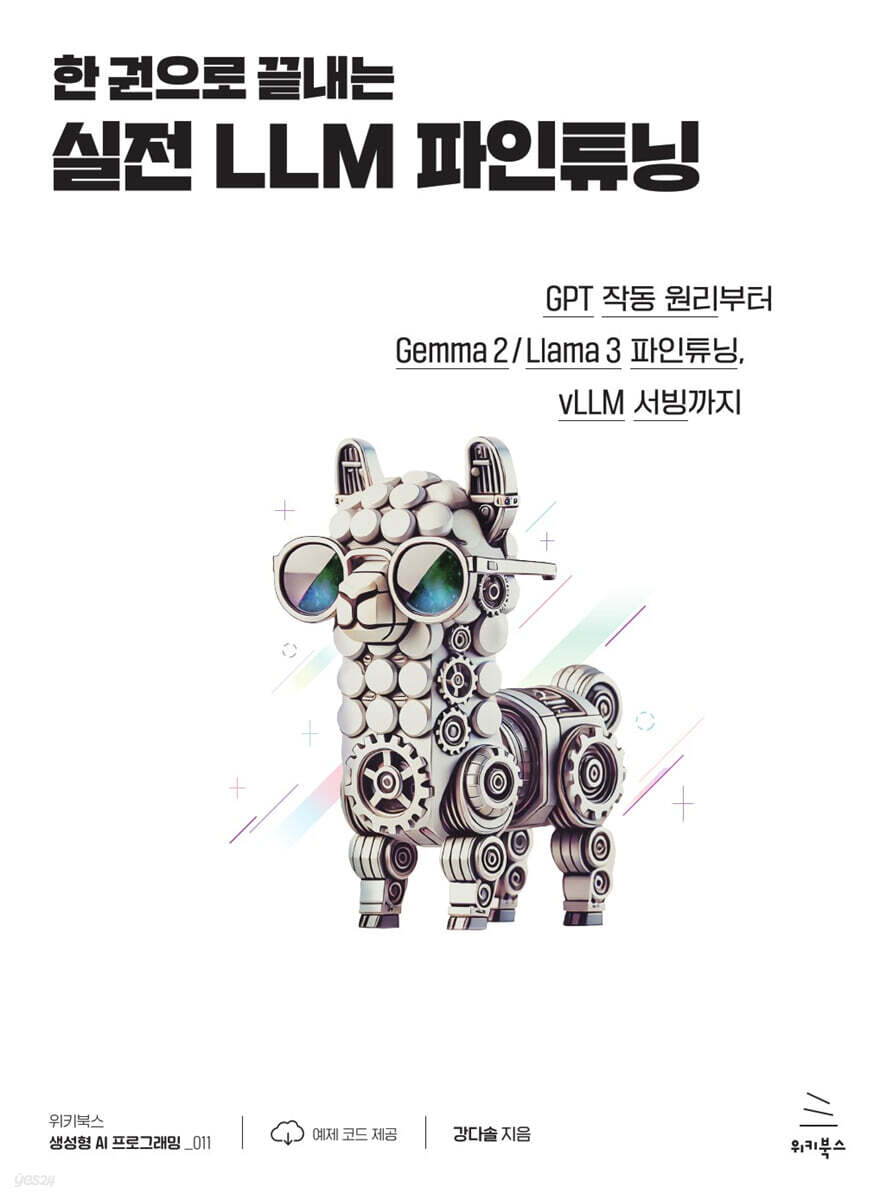
Practical LLM Fine Tuning in One Book
 |
Description
Book Introduction
Let's learn the fine tuning, PEFT, and vLLM serving techniques that are essential in the field through hands-on practice!
Learn everything about LLM Fine-Tuning from the forefront of AI technology! Master it step-by-step, from theoretical foundations to practical application. Covering the historical development of NLP and the core principles of backpropagation, an in-depth understanding of GPT models: from self-attention and tokenizer implementation to practical applications, analysis of the latest Gemma 2 and Llama 3 models and GPU parallel learning, hands-on fine-tuning techniques using LoRA and QLoRA, and model serving applicable to real-world services with vLLM.
You can learn both theory and practice simultaneously through hands-on projects in the Runpod environment, and it provides know-how that can be immediately applied in real-world environments, from single GPUs to multi-GPU environments.
Learn everything about LLM Fine-Tuning from the forefront of AI technology! Master it step-by-step, from theoretical foundations to practical application. Covering the historical development of NLP and the core principles of backpropagation, an in-depth understanding of GPT models: from self-attention and tokenizer implementation to practical applications, analysis of the latest Gemma 2 and Llama 3 models and GPU parallel learning, hands-on fine-tuning techniques using LoRA and QLoRA, and model serving applicable to real-world services with vLLM.
You can learn both theory and practice simultaneously through hands-on projects in the Runpod environment, and it provides know-how that can be immediately applied in real-world environments, from single GPUs to multi-GPU environments.
- You can preview some of the book's contents.
Preview
index
▣ Chapter 1: NLP's Past and Present
1.1 Key Milestones in the Advancement of Natural Language Processing
1.2 Early history and turning points of machine translation
__1.2.1 The study of Artsruny and Troyansky
__1.2.2 Weaver's Proposal and the Georgetown-IBM Experiment
__1.2.3 Limitations of Early Machine Translation and a New Transformation
1.3 The Beginning of Artificial Intelligence
__1.3.1 Turing's Question: Can Machines Think?
__1.3.2 Limitations of the Turing Test
1.4 How does artificial intelligence learn?
__1.4.1 Development of artificial intelligence learning mechanisms
__1.4.2 Perceptron: The First Step in Artificial Intelligence Learning
1.5 Backpropagation Algorithm: A Revolution in Learning
__1.5.1 Nonlinearity: The Key to Building Smarter AI
__1.5.2 Backpropagation Algorithm
1.6 The Rise of Transformers: A New Era in NLP
▣ Chapter 2: GPT
2.1 Introduction and usage of Runpot
__2.1.1 Runpot Membership Registration
__2.1.2 Purchase Credits
__2.1.3 Pod Configuration
__2.1.4 Jupiter Lab
2.2 Data Preparation and Model Configuration
2.3 Building a Language Model
__2.3.1 Library Description
__2.3.2 __init__ function
__2.3.3 forward method
__2.3.4 generate method
2.4 Adding an Optimizer
__2.4.1 Passing data to the GPU
__2.4.2 Creating a Loss Function
__2.4.3 Review the entire code
2.5 Adding Self-Attention
__2.5.1 How information is exchanged between characters (average method)
__2.5.2 Exchange information faster with matrix multiplication operations
__2.5.3 What is self-attention?
__2.5.4 Why should we divide by dk?
__2.5.5 Applying Self-Attention
2.6 Multihead Attention and Feedforward
__2.6.1 Creating multi-head attention
__2.6.2 Creating a feedforward
2.7 Creating Blocks
2.8 Creating a Tokenizer
__2.8.1 Comparison of tokenization according to changes in vocab_size
__2.8.2 Creating a tokenizer
▣ Chapter 3: Overall Fine Tuning
3.1 Preparing the entire fine-tuning data
__3.1.1 Principles and types of overall fine tuning
__3.1.2 Various tasks and datasets
__3.1.3 Data Preprocessing
3.2 Analysis of Gemma and Llama 3 model structures
__3.2.1 Gemma Model Structure Analysis
__3.2.2 Comparison of Gemma and Gemma 2 Models
__3.2.3 Llama 3 model structure analysis
__3.2.4 Comparison of GPT, Gemma, and Llama
3.3 GPU Parallelization Techniques
__3.3.1 Data Parallelism
__3.3.2 Model Parallelism
__3.3.3 Pipeline Parallelization
__3.3.4 Tensor Parallel Processing
__3.3.5 FSDP
3.4 Fine-tuning Gemma-2B-it using a single GPU
__3.4.1 Runpot Environment Settings
__3.4.2 Preparing the Gemma model
__3.4.3 Preparing the dataset
__3.4.4 Checking the Gemma model's functions
__3.4.5 Generating keyword data
__3.4.6 Data Preprocessing
__3.4.7 Separating datasets and setting up collators
__3.4.8 Setting learning parameters
__3.4.9 Defining Evaluation Metrics
__3.4.10 Model Training and Evaluation
__3.4.11 Testing the fine-tuned model
3.5 Fine-tuning Llama3.1-8B-instruct using multiple GPUs
__3.5.1 Runpot Environment Settings
__3.5.2 Llama 3.1 Learning Parameter Settings
__3.5.3 Preparing the dataset
__3.5.4 Llama 3.1 Model Parameter Settings
__3.5.5 Examining the Llama 3.1 Model Training Code
__3.5.6 Running Llama 3.1 model training
__3.5.7 Wandb setup and usage
__3.5.8 Testing the trained Llama 3.1 model
__3.5.9 Evaluating Generated Text Data with OpenAI
__3.5.10 Calculating Grading Score
▣ Chapter 4: Efficient Parameter Tuning Techniques (PEFT)
4.1 LoRA Theory and Practice
__4.1.1 LoRA Concept
__4.1.2 Runpot Environment Settings
__4.1.3 Preparing the Gemma-2-9B-it model
__4.1.4 Data Preprocessing
__4.1.5 LoRA parameter settings
__4.1.6 Model Training
__4.1.7 Testing the trained model
__4.1.8 Evaluating model performance with OpenAI
4.2 QLoRA Theory and Practice
__4.2.1 Understanding Quantization
__4.2.2 Runpot Environment Settings
__4.2.3 Preparing the dataset
__4.2.4 Setting quantization parameters
__4.2.5 Model Preparation
__4.2.6 Parameter settings
__4.2.7 Model Training
__4.2.8 Uploading a model to the Hugging Face Hub
__4.2.9 Testing the trained model
__4.2.10 Evaluation using Exact Match
__4.2.11 Evaluating with the OpenAI API
▣ Chapter 5: Serving with vLLM
5.1 Paged Attention Principle
5.2 How to use vLLM
5.3 Accelerate LLaMA3 generation speed
5.4 Multi-LoRA using vLLM
__5.4.1 Multi-LoRA Practice
__5.4.2 Practice in a laptop environment
5.5 Things to keep in mind when using Multi-LoRA
▣ Appendix
Mathematical Review of Backpropagation
Backpropagation code review
1.1 Key Milestones in the Advancement of Natural Language Processing
1.2 Early history and turning points of machine translation
__1.2.1 The study of Artsruny and Troyansky
__1.2.2 Weaver's Proposal and the Georgetown-IBM Experiment
__1.2.3 Limitations of Early Machine Translation and a New Transformation
1.3 The Beginning of Artificial Intelligence
__1.3.1 Turing's Question: Can Machines Think?
__1.3.2 Limitations of the Turing Test
1.4 How does artificial intelligence learn?
__1.4.1 Development of artificial intelligence learning mechanisms
__1.4.2 Perceptron: The First Step in Artificial Intelligence Learning
1.5 Backpropagation Algorithm: A Revolution in Learning
__1.5.1 Nonlinearity: The Key to Building Smarter AI
__1.5.2 Backpropagation Algorithm
1.6 The Rise of Transformers: A New Era in NLP
▣ Chapter 2: GPT
2.1 Introduction and usage of Runpot
__2.1.1 Runpot Membership Registration
__2.1.2 Purchase Credits
__2.1.3 Pod Configuration
__2.1.4 Jupiter Lab
2.2 Data Preparation and Model Configuration
2.3 Building a Language Model
__2.3.1 Library Description
__2.3.2 __init__ function
__2.3.3 forward method
__2.3.4 generate method
2.4 Adding an Optimizer
__2.4.1 Passing data to the GPU
__2.4.2 Creating a Loss Function
__2.4.3 Review the entire code
2.5 Adding Self-Attention
__2.5.1 How information is exchanged between characters (average method)
__2.5.2 Exchange information faster with matrix multiplication operations
__2.5.3 What is self-attention?
__2.5.4 Why should we divide by dk?
__2.5.5 Applying Self-Attention
2.6 Multihead Attention and Feedforward
__2.6.1 Creating multi-head attention
__2.6.2 Creating a feedforward
2.7 Creating Blocks
2.8 Creating a Tokenizer
__2.8.1 Comparison of tokenization according to changes in vocab_size
__2.8.2 Creating a tokenizer
▣ Chapter 3: Overall Fine Tuning
3.1 Preparing the entire fine-tuning data
__3.1.1 Principles and types of overall fine tuning
__3.1.2 Various tasks and datasets
__3.1.3 Data Preprocessing
3.2 Analysis of Gemma and Llama 3 model structures
__3.2.1 Gemma Model Structure Analysis
__3.2.2 Comparison of Gemma and Gemma 2 Models
__3.2.3 Llama 3 model structure analysis
__3.2.4 Comparison of GPT, Gemma, and Llama
3.3 GPU Parallelization Techniques
__3.3.1 Data Parallelism
__3.3.2 Model Parallelism
__3.3.3 Pipeline Parallelization
__3.3.4 Tensor Parallel Processing
__3.3.5 FSDP
3.4 Fine-tuning Gemma-2B-it using a single GPU
__3.4.1 Runpot Environment Settings
__3.4.2 Preparing the Gemma model
__3.4.3 Preparing the dataset
__3.4.4 Checking the Gemma model's functions
__3.4.5 Generating keyword data
__3.4.6 Data Preprocessing
__3.4.7 Separating datasets and setting up collators
__3.4.8 Setting learning parameters
__3.4.9 Defining Evaluation Metrics
__3.4.10 Model Training and Evaluation
__3.4.11 Testing the fine-tuned model
3.5 Fine-tuning Llama3.1-8B-instruct using multiple GPUs
__3.5.1 Runpot Environment Settings
__3.5.2 Llama 3.1 Learning Parameter Settings
__3.5.3 Preparing the dataset
__3.5.4 Llama 3.1 Model Parameter Settings
__3.5.5 Examining the Llama 3.1 Model Training Code
__3.5.6 Running Llama 3.1 model training
__3.5.7 Wandb setup and usage
__3.5.8 Testing the trained Llama 3.1 model
__3.5.9 Evaluating Generated Text Data with OpenAI
__3.5.10 Calculating Grading Score
▣ Chapter 4: Efficient Parameter Tuning Techniques (PEFT)
4.1 LoRA Theory and Practice
__4.1.1 LoRA Concept
__4.1.2 Runpot Environment Settings
__4.1.3 Preparing the Gemma-2-9B-it model
__4.1.4 Data Preprocessing
__4.1.5 LoRA parameter settings
__4.1.6 Model Training
__4.1.7 Testing the trained model
__4.1.8 Evaluating model performance with OpenAI
4.2 QLoRA Theory and Practice
__4.2.1 Understanding Quantization
__4.2.2 Runpot Environment Settings
__4.2.3 Preparing the dataset
__4.2.4 Setting quantization parameters
__4.2.5 Model Preparation
__4.2.6 Parameter settings
__4.2.7 Model Training
__4.2.8 Uploading a model to the Hugging Face Hub
__4.2.9 Testing the trained model
__4.2.10 Evaluation using Exact Match
__4.2.11 Evaluating with the OpenAI API
▣ Chapter 5: Serving with vLLM
5.1 Paged Attention Principle
5.2 How to use vLLM
5.3 Accelerate LLaMA3 generation speed
5.4 Multi-LoRA using vLLM
__5.4.1 Multi-LoRA Practice
__5.4.2 Practice in a laptop environment
5.5 Things to keep in mind when using Multi-LoRA
▣ Appendix
Mathematical Review of Backpropagation
Backpropagation code review
Detailed image

GOODS SPECIFICS
- Date of issue: December 17, 2024
- Page count, weight, size: 348 pages | 175*235*15mm
- ISBN13: 9791158395629
You may also like
카테고리
korean


korean

![GQ KOREA Mark (Monthly): December [2025]](http://librairie.coreenne.fr/cdn/shop/files/8ef265dbbfbf186523ed75ba7319009d.jpg?v=1765340328&width=3840)


