

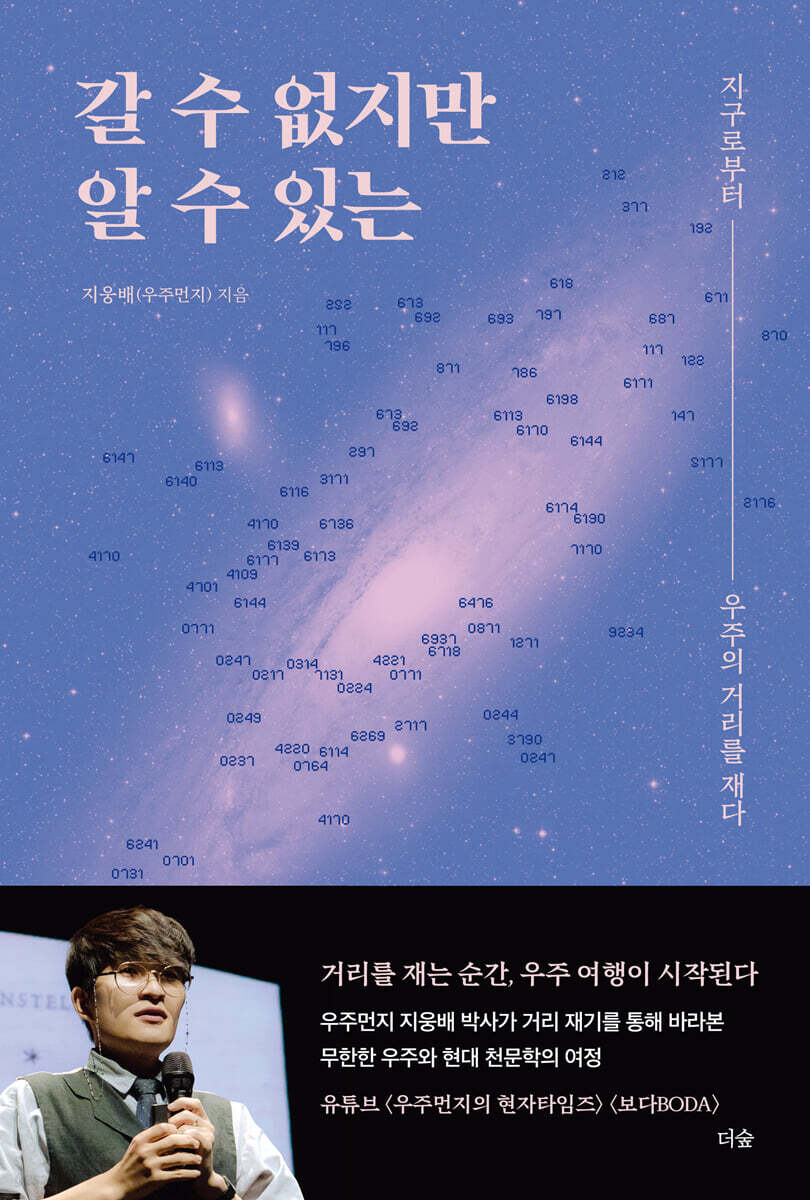
I can't go but I can know
 |
Description
Book Introduction
Measuring distances is the first step to understanding the universe!
Dr. Ji Woong-bae of 'Space Dust' looks at the distance through distance measurement
The Journey of Infinite Space and Modern Astronomy
Modern astronomy can be seen as a journey of constant distance measurement to understand the distant universe that we cannot reach.
In the process, we learn that the moon is steadily moving away from the Earth, and that the reason oceans exist on Earth is because the Earth is located at just the right distance from the Sun—not too far or too close.
"Can't Go But Can Know" is an interesting science book written by Dr. Ji Woong-bae, who is well-known to the public through YouTube channels "Space Dust's Sage Times" and "BODA", in which he unfolds the journey of astronomy exploration through a unique perspective of "distance measurement."
How have astronomers measured the distances of the distant universe, beyond our direct reach? What cosmic secrets have they uncovered in the process?
This book contains the long journey of astronomers 'struggling' to measure the distances in the universe, and unfolds a vivid story of the endlessly expanding space that they discovered as a result of their exploration of distance measurements.
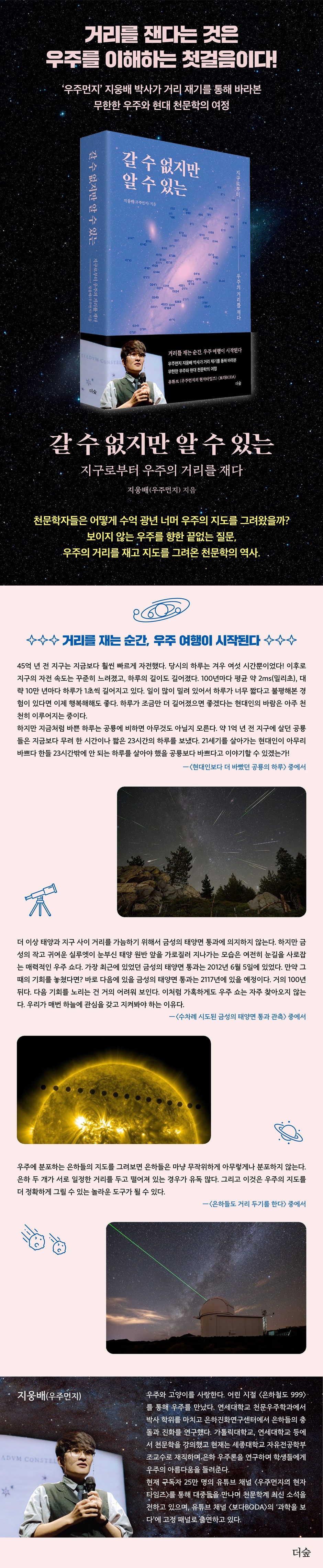
The fact that the Earth rotated much faster 4.5 billion years ago makes us imagine the days of dinosaurs, who were busier than modern humans, and the vivid photos of the observation of Venus's transit across the sun make us feel as if we are seeing the spectacle of space right before our eyes.
In addition, difficult astronomical concepts are explained with historical anecdotes to make them easier to understand.
The author's 80-plus photographs and materials invite readers on a journey into space, further clarifying the essence of astronomy: "You can't go there, but you can know."
This book shows that astronomy is not just numbers and data, but a special journey of exploring and thinking about our relationship with the universe.
Dr. Ji Woong-bae of 'Space Dust' looks at the distance through distance measurement
The Journey of Infinite Space and Modern Astronomy
Modern astronomy can be seen as a journey of constant distance measurement to understand the distant universe that we cannot reach.
In the process, we learn that the moon is steadily moving away from the Earth, and that the reason oceans exist on Earth is because the Earth is located at just the right distance from the Sun—not too far or too close.
"Can't Go But Can Know" is an interesting science book written by Dr. Ji Woong-bae, who is well-known to the public through YouTube channels "Space Dust's Sage Times" and "BODA", in which he unfolds the journey of astronomy exploration through a unique perspective of "distance measurement."
How have astronomers measured the distances of the distant universe, beyond our direct reach? What cosmic secrets have they uncovered in the process?
This book contains the long journey of astronomers 'struggling' to measure the distances in the universe, and unfolds a vivid story of the endlessly expanding space that they discovered as a result of their exploration of distance measurements.
The fact that the Earth rotated much faster 4.5 billion years ago makes us imagine the days of dinosaurs, who were busier than modern humans, and the vivid photos of the observation of Venus's transit across the sun make us feel as if we are seeing the spectacle of space right before our eyes.
In addition, difficult astronomical concepts are explained with historical anecdotes to make them easier to understand.
The author's 80-plus photographs and materials invite readers on a journey into space, further clarifying the essence of astronomy: "You can't go there, but you can know."
This book shows that astronomy is not just numbers and data, but a special journey of exploring and thinking about our relationship with the universe.
- You can preview some of the book's contents.
Preview
index
prolog
Chapter 1 | The Moon Isn't Close
A traveler who hung a family photo at the highest point in the world
The time from Earth to the Moon is 1.25 seconds at the speed of light.
Special spoils of humanity left on the lunar surface
A 1mm difference shaped the fate of lunar exploration.
A dinosaur's day was busier than modern humans
Measuring the distance to the moon with one finger
Parallax, the first gateway to mapping the universe
Chapter 2 | Alien Life or Death: Distance is the Question
Rumors that there may be extraterrestrial life on Venus
Another name for Venus, the Morning Star or the Dog's Paw
Observations of Venus' transit across the Sun have been attempted several times.
Vulcan, the legendary blacksmith planet
Einstein's theory blossomed amidst Mercury's distortions
A coincidence too fitting to be a coincidence
Astronomy's dark history is back in the spotlight
Chapter 3 | Drawing a Map for a Hitchhiker Traveling the Galaxy
A relic containing the universe stolen by grave robbers
Seven sisters who fled into the night sky to avoid Orion
A true shooting star with real stars falling
Nomads floating in the Milky Way
Galileo's heliocentric theory, later proven
Light-year, an abandoned unit of measurement not actually used in astronomy
The Mystery of Hipparchus, Who Presents Different Values Alone
The moment you leave Earth, the constellations of Earth become useless.
Chapter 4 | The candle that illuminates the soul becomes the starlight in the night sky.
The most scientific way to find aliens
A candle that serves as a standard for measuring the brightness of stars
Fair rules that apply to all stars
Coloring the map of the universe with a palette of starlight
Aliens live on a star that is out of alignment
Chapter 5 | The Capricious Lighthouse Lights a Sea of Galaxies
Memories of Starlight in a Shard of Glass
Until the night sky of Peru was conveyed to Rabbit
A Guide for Space Travelers
On a night when the spiral nebula shines
Hubble and Shapley's fatal mistake
Chapter 6 | Beyond the Visible World: The Invisible World
The most universal clock in the universe
A map of our galaxy, completed with messages from aliens
Our galaxy is inhabited not by aliens but by ghosts.
Beyond the map of the galaxy, to each and every star within the galaxy
Chapter 7 | The Cosmic Horizon Continues to Retreat
The sound of a trumpet on a moving train
The sound of a train whistle drifting through space
The truth always stirs
The movement of raisin grains moving away simultaneously
If you know the speed of a fleeing galaxy, you can figure out its distance.
How to map the ends of the universe
Chapter 8 | A 21st-Century Astrologer Who Sees the Future Through Star Maps
A star explosion that comes without warning
The boundary that marks the death of a star
Beyond the end of the stars, towards the end of the universe
Standard Candle vs. Standardizable Candle
Our universe was lucky
Epilogue - The Unfinished Street War
Even galaxies keep their distance
One Universe, Two Expansions, and the Dissonance of the Universe
Chapter 1 | The Moon Isn't Close
A traveler who hung a family photo at the highest point in the world
The time from Earth to the Moon is 1.25 seconds at the speed of light.
Special spoils of humanity left on the lunar surface
A 1mm difference shaped the fate of lunar exploration.
A dinosaur's day was busier than modern humans
Measuring the distance to the moon with one finger
Parallax, the first gateway to mapping the universe
Chapter 2 | Alien Life or Death: Distance is the Question
Rumors that there may be extraterrestrial life on Venus
Another name for Venus, the Morning Star or the Dog's Paw
Observations of Venus' transit across the Sun have been attempted several times.
Vulcan, the legendary blacksmith planet
Einstein's theory blossomed amidst Mercury's distortions
A coincidence too fitting to be a coincidence
Astronomy's dark history is back in the spotlight
Chapter 3 | Drawing a Map for a Hitchhiker Traveling the Galaxy
A relic containing the universe stolen by grave robbers
Seven sisters who fled into the night sky to avoid Orion
A true shooting star with real stars falling
Nomads floating in the Milky Way
Galileo's heliocentric theory, later proven
Light-year, an abandoned unit of measurement not actually used in astronomy
The Mystery of Hipparchus, Who Presents Different Values Alone
The moment you leave Earth, the constellations of Earth become useless.
Chapter 4 | The candle that illuminates the soul becomes the starlight in the night sky.
The most scientific way to find aliens
A candle that serves as a standard for measuring the brightness of stars
Fair rules that apply to all stars
Coloring the map of the universe with a palette of starlight
Aliens live on a star that is out of alignment
Chapter 5 | The Capricious Lighthouse Lights a Sea of Galaxies
Memories of Starlight in a Shard of Glass
Until the night sky of Peru was conveyed to Rabbit
A Guide for Space Travelers
On a night when the spiral nebula shines
Hubble and Shapley's fatal mistake
Chapter 6 | Beyond the Visible World: The Invisible World
The most universal clock in the universe
A map of our galaxy, completed with messages from aliens
Our galaxy is inhabited not by aliens but by ghosts.
Beyond the map of the galaxy, to each and every star within the galaxy
Chapter 7 | The Cosmic Horizon Continues to Retreat
The sound of a trumpet on a moving train
The sound of a train whistle drifting through space
The truth always stirs
The movement of raisin grains moving away simultaneously
If you know the speed of a fleeing galaxy, you can figure out its distance.
How to map the ends of the universe
Chapter 8 | A 21st-Century Astrologer Who Sees the Future Through Star Maps
A star explosion that comes without warning
The boundary that marks the death of a star
Beyond the end of the stars, towards the end of the universe
Standard Candle vs. Standardizable Candle
Our universe was lucky
Epilogue - The Unfinished Street War
Even galaxies keep their distance
One Universe, Two Expansions, and the Dissonance of the Universe
Detailed image
Into the book
4.5 billion years ago, the Earth rotated much faster than it does now.
Back then, a day lasted only six hours! Since then, the Earth's rotation has steadily slowed, and the length of the day has also increased.
The day is getting longer by an average of about 2 milliseconds (ms) every 100 years, or roughly 1 second every 100,000 years.
If you've ever complained that the days are too short because you have so much work to do, you can now be happy.
The modern person's wish for the days to be just a little longer is slowly coming true.
But a busy day like today might be nothing compared to a dinosaur.
Dinosaurs that lived on Earth about 100 million years ago had a 23-hour day, a full hour shorter than today.
No matter how busy modern people living in the 21st century are, can we really say that they are busier than dinosaurs who had to live a day of only 23 hours?
--- From "A Dinosaur's Day, Busier Than Modern People"
We no longer rely on transits of Venus to estimate the distance between the Sun and Earth.
But the sight of Venus's cute little silhouette passing in front of the dazzling solar disk is still a captivating cosmic show.
The most recent transit of Venus across the Sun occurred on June 5, 2012.
What if you missed that opportunity? The next transit of Venus is scheduled for 2117.
Almost 100 years later.
It seems almost impossible to wait for the next opportunity.
As brutal as this one, space shows don't come around very often.
This is why we must always be interested in the sky and watch it.
--- From "Observations of Venus' Transit Across the Sun: Several Attempts"
Venus is an inner planet, orbiting further inside the solar system than Earth.
So in Earth's sky, Venus never strays far from the Sun.
Venus is never visible in the sky directly opposite the Sun at midnight.
It is always visible only around the Sun.
So, the easiest times to find Venus are usually in the early morning, just before sunrise, or in the early evening, just after sunset.
Even at midday, Venus will be somewhere in the same direction as the Sun, but it will be hidden from view in the bright daytime sky.
Venus can be seen when the Sun is just below the horizon, before its bright sunlight covers Earth's sky.
You may have seen a small star shining particularly brightly near the horizon in the early evening.
Quite a few people see it and mistake it for a UFO.
But there's no need to worry about Earth being invaded by aliens.
That would be Venus.
--- From "Morning Star or Dog Food Bowl"
The reason Earth can have oceans filled with liquid water is because it is located at just the right distance from the Sun—not too far, not too close.
If the Earth's orbit were smaller than it is now, the Earth would be exposed to excessive sunlight and all of its oceans would dry up.
Conversely, if the Earth's orbit were larger, it would not receive enough sunlight and would become frozen.
The current distance of 1 AU from the Sun is truly exquisite.
Likewise, exoplanets orbiting other stars must be at the right distance from their star—neither too far nor too close—to support liquid oceans.
Ultimately, the distance of a planet from its star and the size of its orbit determine the habitability of an exoplanet.
The range of distances from the central star where a planet could have an ocean of liquid water on its surface is called the "habitable zone" or "Goldilocks zone."
--- From "Astronomy's Dark History in the Spotlight Again"
Many people believe that shooting stars are caused by cosmic rocks flying towards Earth while it is stationary.
But the reality is quite the opposite.
Rather, it is a phenomenon that occurs when the Earth directly rushes toward a cosmic rock or piece of debris that has been floating quietly in space.
Asteroids and comets orbit the sun, shedding debris behind them.
The crumbs they leave behind linger in space, like the breadcrumbs dropped by Hansel and Gretel in the fairy tale.
Sometimes the flow of debris coincides with the Earth's orbit around the Sun.
The Earth, unaware of anything, simply follows its own orbit.
The Earth happens to pass through a cloud of debris scattered across its orbit.
From Earth's perspective, it appears as if large and small pieces of debris are falling towards it.
This is the real reason why shooting stars fall.
Back then, a day lasted only six hours! Since then, the Earth's rotation has steadily slowed, and the length of the day has also increased.
The day is getting longer by an average of about 2 milliseconds (ms) every 100 years, or roughly 1 second every 100,000 years.
If you've ever complained that the days are too short because you have so much work to do, you can now be happy.
The modern person's wish for the days to be just a little longer is slowly coming true.
But a busy day like today might be nothing compared to a dinosaur.
Dinosaurs that lived on Earth about 100 million years ago had a 23-hour day, a full hour shorter than today.
No matter how busy modern people living in the 21st century are, can we really say that they are busier than dinosaurs who had to live a day of only 23 hours?
--- From "A Dinosaur's Day, Busier Than Modern People"
We no longer rely on transits of Venus to estimate the distance between the Sun and Earth.
But the sight of Venus's cute little silhouette passing in front of the dazzling solar disk is still a captivating cosmic show.
The most recent transit of Venus across the Sun occurred on June 5, 2012.
What if you missed that opportunity? The next transit of Venus is scheduled for 2117.
Almost 100 years later.
It seems almost impossible to wait for the next opportunity.
As brutal as this one, space shows don't come around very often.
This is why we must always be interested in the sky and watch it.
--- From "Observations of Venus' Transit Across the Sun: Several Attempts"
Venus is an inner planet, orbiting further inside the solar system than Earth.
So in Earth's sky, Venus never strays far from the Sun.
Venus is never visible in the sky directly opposite the Sun at midnight.
It is always visible only around the Sun.
So, the easiest times to find Venus are usually in the early morning, just before sunrise, or in the early evening, just after sunset.
Even at midday, Venus will be somewhere in the same direction as the Sun, but it will be hidden from view in the bright daytime sky.
Venus can be seen when the Sun is just below the horizon, before its bright sunlight covers Earth's sky.
You may have seen a small star shining particularly brightly near the horizon in the early evening.
Quite a few people see it and mistake it for a UFO.
But there's no need to worry about Earth being invaded by aliens.
That would be Venus.
--- From "Morning Star or Dog Food Bowl"
The reason Earth can have oceans filled with liquid water is because it is located at just the right distance from the Sun—not too far, not too close.
If the Earth's orbit were smaller than it is now, the Earth would be exposed to excessive sunlight and all of its oceans would dry up.
Conversely, if the Earth's orbit were larger, it would not receive enough sunlight and would become frozen.
The current distance of 1 AU from the Sun is truly exquisite.
Likewise, exoplanets orbiting other stars must be at the right distance from their star—neither too far nor too close—to support liquid oceans.
Ultimately, the distance of a planet from its star and the size of its orbit determine the habitability of an exoplanet.
The range of distances from the central star where a planet could have an ocean of liquid water on its surface is called the "habitable zone" or "Goldilocks zone."
--- From "Astronomy's Dark History in the Spotlight Again"
Many people believe that shooting stars are caused by cosmic rocks flying towards Earth while it is stationary.
But the reality is quite the opposite.
Rather, it is a phenomenon that occurs when the Earth directly rushes toward a cosmic rock or piece of debris that has been floating quietly in space.
Asteroids and comets orbit the sun, shedding debris behind them.
The crumbs they leave behind linger in space, like the breadcrumbs dropped by Hansel and Gretel in the fairy tale.
Sometimes the flow of debris coincides with the Earth's orbit around the Sun.
The Earth, unaware of anything, simply follows its own orbit.
The Earth happens to pass through a cloud of debris scattered across its orbit.
From Earth's perspective, it appears as if large and small pieces of debris are falling towards it.
This is the real reason why shooting stars fall.
--- From "A Real Shooting Star Where Real Stars Fall"
Publisher's Review
How do astronomers know that hundreds of millions of light years away?
Have you drawn a map of the universe?
The moment you measure the distance, space travel begins.
This book consists of a total of 8 chapters.
Starting with the story of the moon, the celestial body most familiar to humans, the story continues with interesting topics such as Venus, also called the 'morning star' or 'dog food bowl', Einstein's theory that blossomed from the distortion of Mercury, the surprising similarities between Pluto and Earth, which were stripped of their planetary status, the Pleiades cluster, which is the reference point for drawing cosmic maps, the real reason why shooting stars fall, and the hidden story of female astronomers called 'calculators'.
The problem of Mercury's orbit being 40 inches off from what was predicted could not be explained by Newtonian mechanics, but Einstein's general theory of relativity solved it.
Einstein interpreted gravity not as a simple force of attraction, but as a warping of spacetime.
Massive celestial bodies warp the space-time around them, causing Mercury's orbit to warp more as it approaches the Sun, shifting its perihelion.
To demonstrate this concept, British astronomer Arthur Eddington observed gravitational lensing, the bending of starlight around the Sun during a total solar eclipse in 1919.
As a result, the positions of the stars appeared slightly off, which was exactly as Einstein predicted.
Due to the Sun's gravity, Mercury experiences an environment where time flows more slowly the closer it is to the Sun, and when it moves away, time flows more quickly, causing a deviation in its orbit.
Accordingly, Mercury's elliptical orbit gradually changes direction and moves.
This discovery brought the theory of relativity to the attention of the academic world, redefining the nature of gravity, which could not be explained by Newtonian mechanics, and opening a new paradigm in physics.
The tiny distortion of the small planet Mercury has become a crucial clue that has revealed the concept of space-time in the vast universe.
The Pleiades is one of the few places in the night sky where multiple stars can be easily observed with the naked eye.
So, it is said that in ancient Rome, this cluster was used to test the eyesight of soldiers when recruiting them, and the eyesight of the applicants was assessed by asking how many stars they could see in the cluster.
Because it is relatively close to other stars, it is useful for correcting the scale of cosmic maps before drawing maps of the farther reaches of the universe.
So many telescopes first aim at the Pleiades before starting any serious observations.
And the performance of the newly built telescope will be tested by seeing how accurately it can measure the distance to the Pleiades star cluster.
Interestingly, however, astronomers still do not know the exact distance to the Pleiades star cluster.
This is because the distance to the cluster varies slightly depending on how and with which telescope the distance is measured.
So, how have we, unable to perfectly measure even the distances of the nearby universe, explored the universe hundreds of millions of light-years beyond? Astronomers have captured subtle variations in starlight and employed various measurement techniques, constantly improving their accuracy.
This book explores such journeys through a unique lens of "distance measurement," and offers a fascinating exploration of how we have come to understand the distant universe, a place we cannot directly visit.
The reason for our existence and the flow of time
The universe, a giant mirror that makes us look at it in a new way.
Measure and map the distances of space!
Astronomy is more than just science.
It shows us that space is not just a distant space, but a giant mirror that makes us look at the reason for our existence and the flow of time in a new way.
At first glance, all the stars in the night sky appear to remain stationary in one place.
But in fact, all the stars move.
The stars in the Milky Way move in their own orbits centered around the center of our galaxy.
The same goes for our sun.
It takes about 250 million years for our solar system to make one full orbit around our galaxy.
The period it takes for the Earth to complete one orbit around the Sun is called one solar year, and similarly, the period it takes for the Solar System to complete one orbit around our Milky Way Galaxy is defined as one galactic year.
It was about 100 million years ago that dinosaurs ruled the Earth.
It was exactly half a galactic year ago in our solar system.
That is, at a time when the solar system was located directly opposite its current position in the center of the Milky Way galaxy, dinosaurs were running wild on Earth.
During the past half-century, during which our solar system completed half an orbit around the Milky Way, a giant meteor struck the coast of Mexico's Yucatan Peninsula, and in the meantime, Earth's rulers changed from giant reptiles to cunning primates.
A correspondingly huge change took place on Earth as well.
Based on cosmic time, the time that humanity has lived is just an instant.
But even in that brief moment, we have been constantly striving to understand the universe.
"Unable to Go, but Knowable" shows that although we cannot go to the ends of the universe, the process of gradually uncovering its mysteries through science and exploration is the greatest charm of astronomy.
Have you drawn a map of the universe?
The moment you measure the distance, space travel begins.
This book consists of a total of 8 chapters.
Starting with the story of the moon, the celestial body most familiar to humans, the story continues with interesting topics such as Venus, also called the 'morning star' or 'dog food bowl', Einstein's theory that blossomed from the distortion of Mercury, the surprising similarities between Pluto and Earth, which were stripped of their planetary status, the Pleiades cluster, which is the reference point for drawing cosmic maps, the real reason why shooting stars fall, and the hidden story of female astronomers called 'calculators'.
The problem of Mercury's orbit being 40 inches off from what was predicted could not be explained by Newtonian mechanics, but Einstein's general theory of relativity solved it.
Einstein interpreted gravity not as a simple force of attraction, but as a warping of spacetime.
Massive celestial bodies warp the space-time around them, causing Mercury's orbit to warp more as it approaches the Sun, shifting its perihelion.
To demonstrate this concept, British astronomer Arthur Eddington observed gravitational lensing, the bending of starlight around the Sun during a total solar eclipse in 1919.
As a result, the positions of the stars appeared slightly off, which was exactly as Einstein predicted.
Due to the Sun's gravity, Mercury experiences an environment where time flows more slowly the closer it is to the Sun, and when it moves away, time flows more quickly, causing a deviation in its orbit.
Accordingly, Mercury's elliptical orbit gradually changes direction and moves.
This discovery brought the theory of relativity to the attention of the academic world, redefining the nature of gravity, which could not be explained by Newtonian mechanics, and opening a new paradigm in physics.
The tiny distortion of the small planet Mercury has become a crucial clue that has revealed the concept of space-time in the vast universe.
The Pleiades is one of the few places in the night sky where multiple stars can be easily observed with the naked eye.
So, it is said that in ancient Rome, this cluster was used to test the eyesight of soldiers when recruiting them, and the eyesight of the applicants was assessed by asking how many stars they could see in the cluster.
Because it is relatively close to other stars, it is useful for correcting the scale of cosmic maps before drawing maps of the farther reaches of the universe.
So many telescopes first aim at the Pleiades before starting any serious observations.
And the performance of the newly built telescope will be tested by seeing how accurately it can measure the distance to the Pleiades star cluster.
Interestingly, however, astronomers still do not know the exact distance to the Pleiades star cluster.
This is because the distance to the cluster varies slightly depending on how and with which telescope the distance is measured.
So, how have we, unable to perfectly measure even the distances of the nearby universe, explored the universe hundreds of millions of light-years beyond? Astronomers have captured subtle variations in starlight and employed various measurement techniques, constantly improving their accuracy.
This book explores such journeys through a unique lens of "distance measurement," and offers a fascinating exploration of how we have come to understand the distant universe, a place we cannot directly visit.
The reason for our existence and the flow of time
The universe, a giant mirror that makes us look at it in a new way.
Measure and map the distances of space!
Astronomy is more than just science.
It shows us that space is not just a distant space, but a giant mirror that makes us look at the reason for our existence and the flow of time in a new way.
At first glance, all the stars in the night sky appear to remain stationary in one place.
But in fact, all the stars move.
The stars in the Milky Way move in their own orbits centered around the center of our galaxy.
The same goes for our sun.
It takes about 250 million years for our solar system to make one full orbit around our galaxy.
The period it takes for the Earth to complete one orbit around the Sun is called one solar year, and similarly, the period it takes for the Solar System to complete one orbit around our Milky Way Galaxy is defined as one galactic year.
It was about 100 million years ago that dinosaurs ruled the Earth.
It was exactly half a galactic year ago in our solar system.
That is, at a time when the solar system was located directly opposite its current position in the center of the Milky Way galaxy, dinosaurs were running wild on Earth.
During the past half-century, during which our solar system completed half an orbit around the Milky Way, a giant meteor struck the coast of Mexico's Yucatan Peninsula, and in the meantime, Earth's rulers changed from giant reptiles to cunning primates.
A correspondingly huge change took place on Earth as well.
Based on cosmic time, the time that humanity has lived is just an instant.
But even in that brief moment, we have been constantly striving to understand the universe.
"Unable to Go, but Knowable" shows that although we cannot go to the ends of the universe, the process of gradually uncovering its mysteries through science and exploration is the greatest charm of astronomy.
GOODS SPECIFICS
- Date of issue: March 28, 2025
- Page count, weight, size: 428 pages | 738g | 152*225*30mm
- ISBN13: 9791194273165
- ISBN10: 1194273165
You may also like
카테고리
korean


korean

![GQ KOREA Mark (Monthly): December [2025]](http://librairie.coreenne.fr/cdn/shop/files/8ef265dbbfbf186523ed75ba7319009d.jpg?v=1765340328&width=3840)


