

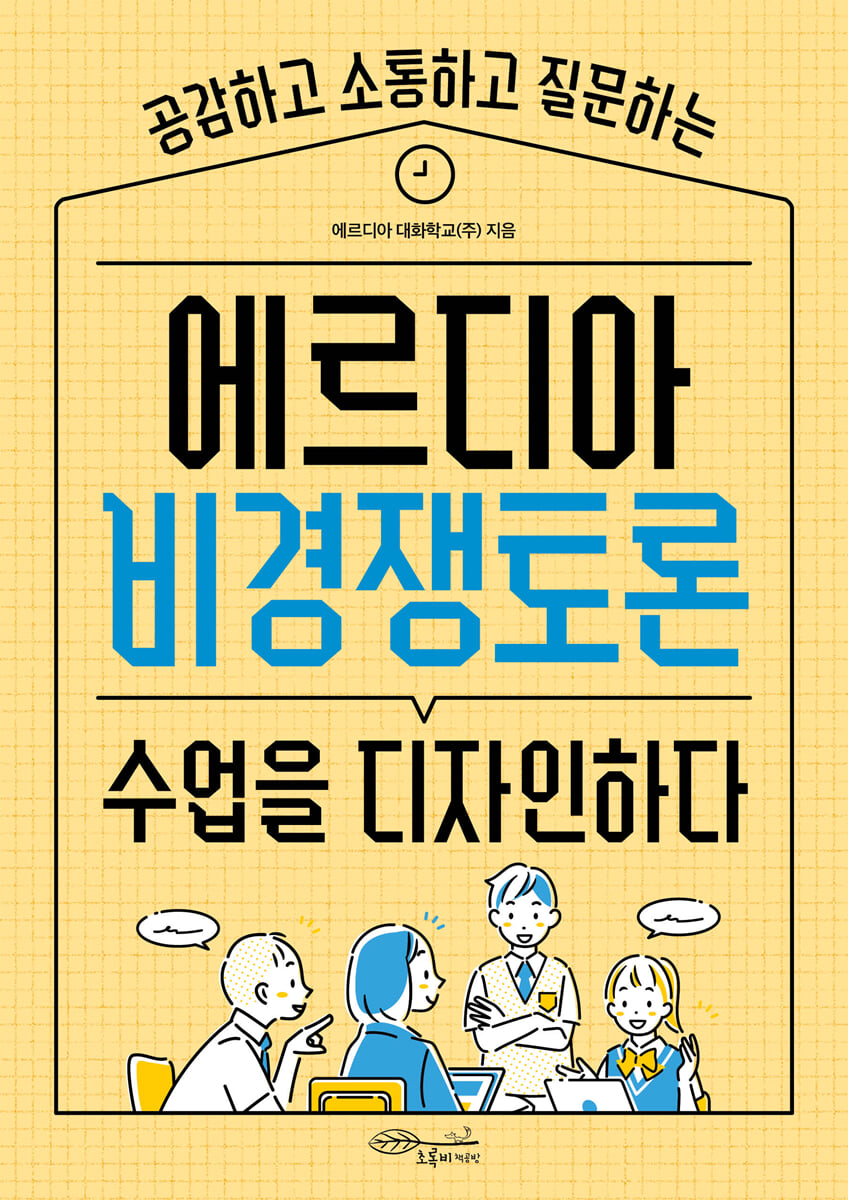
Designing a Non-Competitive Debate Class at Erdia
 |
Description
Book Introduction
Empathy and communication created through conversation
Erdia's non-competitive debate shifts the paradigm of pro- and con-style debate culture.
It has been 15 years since Erdia, which started as a talent donation program for youth who wanted to do something meaningful and were tired of the hamster wheel of daily life, changed the paradigm of debate culture with the method of 'non-competitive debate.'
Erdia, which started with two high school students, has spread to over 30 schools, libraries, and youth centers across the country through word of mouth without any advertising, and currently over 7,000 youth are experiencing the essence of Erdia non-competitive debate.
'ERDIA' is a word created using the first letters of the German words 'ernster' and 'dialog', and means 'serious conversation'.
We have pioneered a new debate culture that is different from the existing one, moving away from competitive debates where one must find and point out the flaws in others' opinions in order to push one's point of view, and toward a new format of interactive debate where one shares one's own thoughts, adds to each other's ideas, and opens up diverse perspectives.
This book is a collection of experiences and know-how accumulated over many years in the field by 15 authors who are spreading Erdia's values of 'communication and empathy created through warm conversation' to young people.
It contains detailed instructions on how to design and conduct classes step by step, so you can also feel the liveliness of the discussion scene.
Erdia's non-competitive debate shifts the paradigm of pro- and con-style debate culture.
It has been 15 years since Erdia, which started as a talent donation program for youth who wanted to do something meaningful and were tired of the hamster wheel of daily life, changed the paradigm of debate culture with the method of 'non-competitive debate.'
Erdia, which started with two high school students, has spread to over 30 schools, libraries, and youth centers across the country through word of mouth without any advertising, and currently over 7,000 youth are experiencing the essence of Erdia non-competitive debate.
'ERDIA' is a word created using the first letters of the German words 'ernster' and 'dialog', and means 'serious conversation'.
We have pioneered a new debate culture that is different from the existing one, moving away from competitive debates where one must find and point out the flaws in others' opinions in order to push one's point of view, and toward a new format of interactive debate where one shares one's own thoughts, adds to each other's ideas, and opens up diverse perspectives.
This book is a collection of experiences and know-how accumulated over many years in the field by 15 authors who are spreading Erdia's values of 'communication and empathy created through warm conversation' to young people.
It contains detailed instructions on how to design and conduct classes step by step, so you can also feel the liveliness of the discussion scene.
- You can preview some of the book's contents.
Preview
index
Entering
prolog
Part 1.
Increase energy
Make a group
Connecting myself and others
Define the roles of the conversation
stimulate curiosity
Take on the challenge together
Part 2.
Open your mind through slow conversation
Start with feelings and emotions
Bring out your experiences and thoughts
recall a story
Part 3.
Designing Discussions with Questions
Questions for discussion
How to create a question
Instructions before discussion
Questions you can apply right away in class
Part 4.
Add ideas to your thoughts
Expand your perspective and add to your thoughts through discussion.
Converge thoughts
Share your reflections
prolog
Part 1.
Increase energy
Make a group
Connecting myself and others
Define the roles of the conversation
stimulate curiosity
Take on the challenge together
Part 2.
Open your mind through slow conversation
Start with feelings and emotions
Bring out your experiences and thoughts
recall a story
Part 3.
Designing Discussions with Questions
Questions for discussion
How to create a question
Instructions before discussion
Questions you can apply right away in class
Part 4.
Add ideas to your thoughts
Expand your perspective and add to your thoughts through discussion.
Converge thoughts
Share your reflections
Detailed image

Into the book
'What should I say?'
'What if I'm wrong?'
'Can I tell you what I think?'
This tension existed in the traditional debate format.
I had to convince others with logical arguments, and I often focused on finding counterarguments rather than listening to what others had to say.
In a competitive discussion, this question arose:
Why is discussion necessary?
It is often said that debate helps develop critical thinking skills, express ideas, and improve critical thinking.
However, when looking at actual discussions, it is often effective only for some students who actively participate, and is not helpful to the remaining passive students.
'Does debate necessarily have to be competitive?'
"Isn't it more necessary to have discussions where everyone can freely express their thoughts, listen to each other's opinions, and learn from our differences?"
These questions kept popping into my head.
And after thinking about a new way of debating where everyone could learn and enjoy together, Erdia Non-Competitive Debate was born.
--- From p.12-13 "Prologue"
Erdia's non-competitive debate aims to share ideas and expand thinking through free dialogue.
Teachers must create a “safe space for conversation” where students can freely and comfortably share their opinions.
People feel more comfortable and safer in small groups than in large ones.
For this reason, Erdia non-competitive debates are mainly conducted in groups.
Working in groups allows students to freely express their thoughts and share their opinions without feeling left out.
And if the teacher assigns a role to each group member, it can foster a sense of belonging and responsibility, preventing a passive attitude of 'someone will do it'.
To achieve positive effects from group activities, teachers must carefully consider how to structure the groups.
It is necessary to quickly and appropriately form groups according to the discussion subject, discussion time, and discussion topic.
How groups are formed can vary depending on the situation, such as a multi-grade reading club discussion class, a student council discussion, or a leadership camp.
--- pp.27-28
Any teacher wants to capture the hearts of their students when they start class.
The best way to move students' hearts is to stimulate curiosity, the fundamental driving force behind learning and exploration.
When we encounter new information, curiosity and interest naturally lead to a desire to understand it more deeply.
The three methods introduced here are excellent for opening students' minds to increase their curiosity and concentration.
First, the activity of 'predicting the content by looking at the changed book cover' stimulates students' curiosity, raises their anticipation for the flow of the class, and helps improve concentration by having them carefully observe the book cover and make predictions and imaginations.
The 'Book Cover Tear Bingo' activity allows you to predict and match your thoughts with your friend's thoughts, creating a little tension and talking about what you consider important.
Finally, 'Newspaper Magic' and 'Growing Picture Magic' are great ways to pique students' interest and curiosity before reading a book, as they are curiosity-inducing activities.
Magic can also stimulate curiosity and relax students through uncertainty and surprise.
These two magical activities are effective in stimulating students' imaginations through visual surprises and building anticipation for the story's flow.
Through magic, students can naturally ask questions and share their thoughts with each other.
Concluding the lesson with a simple magic activity makes for an engaging way to wrap up the lesson, and students feel a sense of pride in having created their own magic tool.
--- pp.55-56
As we read a book following the author's thoughts, various thoughts and feelings unfold in our heads.
Within this expanded thinking, sharing how each person felt about what they read becomes a time to encounter each person's own 'self' discovered within the story, and at the same time, it becomes the foundation for various interpretations of the book.
As readers read, they freely imagine the content of the book, recalling scenes in their minds, and indirectly experiencing the background and events in the book, putting themselves in the characters' shoes and feeling various emotions.
At this time, if you talk about your overall impression or feeling of the book, what you learned or felt from the actions of the main character or characters, and your impressions while following the flow of the story in various ways, it will have the effect of looking back at the contents of the book once again.
Also, because there are no set answers to feelings and emotions, it can be a practice for students to share their stories without feeling burdened.
If we start with feelings and emotions, we can see that even after reading the same book, each reader can express emotions differently depending on the reader.
These findings help students understand that when they encounter different perspectives during subsequent discussions and debates, the book's content can be interpreted differently based on their individual knowledge, information, experiences, and values.
Students can also accept opinions that differ from their own with greater respect and empathy.
--- pp.86-87
After reading a book, reviewing the story in your mind again is an important step in the reading process that should not be missed.
This is because it goes beyond simply remembering the plot; it is a process of more deeply understanding and internalizing the emotions and realizations the book leaves us with.
Our reading journey doesn't end the moment we close the book.
Rather, it can be said that from that point on, true reading that connects the contents of the book with our lives begins.
In this process, we can reflect on the contents of the book in various ways, discover new meanings within it, and expand our thoughts.
The process of recalling a story not only helps us remember the content of the book longer and more deeply, but it also greatly helps us develop our critical thinking and creativity.
This will also serve as a foundation for future reading, enriching our reading experience.
--- pp.113-114
The phrase 'designing discussions with questions' means that the core of the discussion is placed in the questions.
In Erdia's non-competitive debate, questions are not just tools, but they play a crucial role in guiding the overall flow of the discussion, forming the backbone of the debate.
The importance of questions cannot be overemphasized.
This is because the direction of the discussion is determined by the direction of the question, the participants' thinking is expanded, and ultimately, the depth and breadth of the discussion can greatly change.
Furthermore, questions are like keys that stimulate the curiosity of students participating in discussions and open new perspectives.
Appropriate questions encourage students to think outside the box and from different perspectives, which ultimately leads to richer and more meaningful discussions.
Therefore, designing a discussion with questions means going beyond simply creating questions; it also means meticulously planning and structuring the overall flow of the discussion and the thought processes that occur within it.
--- p.135
Unlike traditional debate methods, Erdia non-competitive debate primarily uses a 'writing and discussion' method so that all students can express their opinions well and experience the power of collective intelligence.
Why do we discuss things while writing? Because everyone thinks at different speeds, writing while discussing allows us to start a conversation together and allows us to listen attentively to what others have to say.
Among Erdia's non-competitive debate methods, 'silent debate', which makes good use of the power of silence, is a good way to organize one's thoughts and discuss them.
Silent discussion is an activity in which students organize and share their thoughts on a discussion topic without speaking.
This method focuses on deeply reflecting on one's own opinions and respecting the perspectives of others.
Silent discussion is a conversation that focuses on listening and observation.
Through these activities, students can understand different perspectives and experience an expansion of their thinking simply by seeing other people's opinions.
'What if I'm wrong?'
'Can I tell you what I think?'
This tension existed in the traditional debate format.
I had to convince others with logical arguments, and I often focused on finding counterarguments rather than listening to what others had to say.
In a competitive discussion, this question arose:
Why is discussion necessary?
It is often said that debate helps develop critical thinking skills, express ideas, and improve critical thinking.
However, when looking at actual discussions, it is often effective only for some students who actively participate, and is not helpful to the remaining passive students.
'Does debate necessarily have to be competitive?'
"Isn't it more necessary to have discussions where everyone can freely express their thoughts, listen to each other's opinions, and learn from our differences?"
These questions kept popping into my head.
And after thinking about a new way of debating where everyone could learn and enjoy together, Erdia Non-Competitive Debate was born.
--- From p.12-13 "Prologue"
Erdia's non-competitive debate aims to share ideas and expand thinking through free dialogue.
Teachers must create a “safe space for conversation” where students can freely and comfortably share their opinions.
People feel more comfortable and safer in small groups than in large ones.
For this reason, Erdia non-competitive debates are mainly conducted in groups.
Working in groups allows students to freely express their thoughts and share their opinions without feeling left out.
And if the teacher assigns a role to each group member, it can foster a sense of belonging and responsibility, preventing a passive attitude of 'someone will do it'.
To achieve positive effects from group activities, teachers must carefully consider how to structure the groups.
It is necessary to quickly and appropriately form groups according to the discussion subject, discussion time, and discussion topic.
How groups are formed can vary depending on the situation, such as a multi-grade reading club discussion class, a student council discussion, or a leadership camp.
--- pp.27-28
Any teacher wants to capture the hearts of their students when they start class.
The best way to move students' hearts is to stimulate curiosity, the fundamental driving force behind learning and exploration.
When we encounter new information, curiosity and interest naturally lead to a desire to understand it more deeply.
The three methods introduced here are excellent for opening students' minds to increase their curiosity and concentration.
First, the activity of 'predicting the content by looking at the changed book cover' stimulates students' curiosity, raises their anticipation for the flow of the class, and helps improve concentration by having them carefully observe the book cover and make predictions and imaginations.
The 'Book Cover Tear Bingo' activity allows you to predict and match your thoughts with your friend's thoughts, creating a little tension and talking about what you consider important.
Finally, 'Newspaper Magic' and 'Growing Picture Magic' are great ways to pique students' interest and curiosity before reading a book, as they are curiosity-inducing activities.
Magic can also stimulate curiosity and relax students through uncertainty and surprise.
These two magical activities are effective in stimulating students' imaginations through visual surprises and building anticipation for the story's flow.
Through magic, students can naturally ask questions and share their thoughts with each other.
Concluding the lesson with a simple magic activity makes for an engaging way to wrap up the lesson, and students feel a sense of pride in having created their own magic tool.
--- pp.55-56
As we read a book following the author's thoughts, various thoughts and feelings unfold in our heads.
Within this expanded thinking, sharing how each person felt about what they read becomes a time to encounter each person's own 'self' discovered within the story, and at the same time, it becomes the foundation for various interpretations of the book.
As readers read, they freely imagine the content of the book, recalling scenes in their minds, and indirectly experiencing the background and events in the book, putting themselves in the characters' shoes and feeling various emotions.
At this time, if you talk about your overall impression or feeling of the book, what you learned or felt from the actions of the main character or characters, and your impressions while following the flow of the story in various ways, it will have the effect of looking back at the contents of the book once again.
Also, because there are no set answers to feelings and emotions, it can be a practice for students to share their stories without feeling burdened.
If we start with feelings and emotions, we can see that even after reading the same book, each reader can express emotions differently depending on the reader.
These findings help students understand that when they encounter different perspectives during subsequent discussions and debates, the book's content can be interpreted differently based on their individual knowledge, information, experiences, and values.
Students can also accept opinions that differ from their own with greater respect and empathy.
--- pp.86-87
After reading a book, reviewing the story in your mind again is an important step in the reading process that should not be missed.
This is because it goes beyond simply remembering the plot; it is a process of more deeply understanding and internalizing the emotions and realizations the book leaves us with.
Our reading journey doesn't end the moment we close the book.
Rather, it can be said that from that point on, true reading that connects the contents of the book with our lives begins.
In this process, we can reflect on the contents of the book in various ways, discover new meanings within it, and expand our thoughts.
The process of recalling a story not only helps us remember the content of the book longer and more deeply, but it also greatly helps us develop our critical thinking and creativity.
This will also serve as a foundation for future reading, enriching our reading experience.
--- pp.113-114
The phrase 'designing discussions with questions' means that the core of the discussion is placed in the questions.
In Erdia's non-competitive debate, questions are not just tools, but they play a crucial role in guiding the overall flow of the discussion, forming the backbone of the debate.
The importance of questions cannot be overemphasized.
This is because the direction of the discussion is determined by the direction of the question, the participants' thinking is expanded, and ultimately, the depth and breadth of the discussion can greatly change.
Furthermore, questions are like keys that stimulate the curiosity of students participating in discussions and open new perspectives.
Appropriate questions encourage students to think outside the box and from different perspectives, which ultimately leads to richer and more meaningful discussions.
Therefore, designing a discussion with questions means going beyond simply creating questions; it also means meticulously planning and structuring the overall flow of the discussion and the thought processes that occur within it.
--- p.135
Unlike traditional debate methods, Erdia non-competitive debate primarily uses a 'writing and discussion' method so that all students can express their opinions well and experience the power of collective intelligence.
Why do we discuss things while writing? Because everyone thinks at different speeds, writing while discussing allows us to start a conversation together and allows us to listen attentively to what others have to say.
Among Erdia's non-competitive debate methods, 'silent debate', which makes good use of the power of silence, is a good way to organize one's thoughts and discuss them.
Silent discussion is an activity in which students organize and share their thoughts on a discussion topic without speaking.
This method focuses on deeply reflecting on one's own opinions and respecting the perspectives of others.
Silent discussion is a conversation that focuses on listening and observation.
Through these activities, students can understand different perspectives and experience an expansion of their thinking simply by seeing other people's opinions.
--- pp.184-185
Publisher's Review
A true debate is not about winning or losing, but about finding common ground.
Erdia, a leader in non-competitive debate that has transformed the debate ecosystem
The old saying, "A plan for a hundred years," is becoming meaningless as school education is constantly changing to keep up with the rapidly changing times.
It has only been a short time since the direction of education changed from spoon-fed instruction to participatory classes and from written assessments to performance assessments, but now the implementation of the high school credit system and the adoption of IB education are emerging as major issues.
Because of this, educators have always been thinking about new teaching methods.
When debate began to become a part of school classes, the competitive culture of beating others to gain an advantage still existed in the educational world, so debate classes were mainly competitive debates where participants divided into pros and cons and won by pushing their own arguments.
Any child who has participated in a debate class has probably experienced a crushing defeat in the debate arena at least once and felt a sense of inferiority countless times in the midst of competition.
As I searched for ways to restore my shattered self-esteem, I began to consider alternative discussion methods to preserve the true purpose of discussion: acknowledging the other person's opinion and finding common ground through back-and-forth conversation.
Thanks to such efforts, a new type of debate culture called non-competitive debate began to take root.
Erdia is at the forefront.
From a child who loses arguments to a child who knows how to debate
The magical power of Erdia's non-competitive debate
Erdia Non-Competitive Debate was created to promote a culture of non-competitive debate based on empathy, listening, and questions, and to foster growth through warm conversation. Its core values include listening, empathy, safe conversation zones, slow conversation, learning, questions, and collective intelligence.
Conversation begins with listening carefully to what the other person is saying and empathizing with them, and when you feel respected, you can talk about anything comfortably.
Rather than making quick judgments, it is important to empathize and understand the other person's intentions. Acknowledging differences in opinion and considering various perspectives is another fun aspect of learning.
Questions help us understand the other person more deeply, elicit sharp insights, and find solutions to problems together.
Children who have experienced Erdia's non-competitive debate learn to listen to others' opinions, empathize with them, and solve problems through collective intelligence without heated debate.
Rather than finding a set answer in a given situation, we look at the problem from various angles and derive food for thought from various perspectives.
Additionally, rather than having a teacher-led discussion class, children can become facilitators and lead discussions themselves.
Children who accurately understand and acquire the purpose of debate through Erdia non-competitive debate are evaluated as 'children who are good at debating' rather than 'children who lose in debates'.
Designing classes with 15 years of expertise from 15 authors.
Step-by-step process for conducting an Erdia non-competitive debate
Erdia Non-competitive Debate is not a technique for debate, but a method for better conversation and a process for deeper thinking.
Fifteen authors, who have grown up alongside children in educational settings, have detailed their 15 years of expertise in Erdia's non-competitive debate, using the following six-step process for teachers to immediately apply in their classrooms or for young people to engage in their own debate activities.
Step 1: Create a Safe Zone for Conversation
An important starting point for non-competitive debate is creating a safe space for conversation.
We need to create an atmosphere where people can talk about anything without being judged, and where even somewhat odd things are tolerated.
Step 2: Expressing Your Feelings
Erdia's non-competitive debate focuses more on the feelings of the reader than on the content of the book.
Asking how someone feels is an effective way to get the conversation flowing without being overwhelming.
Step 3: Shift your focus to keywords
Even if multiple people read the same book, different keywords appear.
By having a conversation with various keywords, you can discover new meanings that you had not thought of before.
Difference is not an inconvenience, but a gift that allows us to think differently.
Step 4: Create a Question
The flower of Erdia's non-competitive debate is 'questions'.
Asking your own questions makes discussions more enjoyable.
When you give children the opportunity, they gain the power to create questions, make connections, and choose their own.
As the questions change, so does what you learn and the content of the conversation.
Step 5: Discuss while writing
Constant question-and-answer discussions give us the opportunity to refine our thinking and hear the thoughts of others.
There is no right answer to thinking.
There is no need to draw a conclusion.
Just listening to each other's thoughts is meaningful enough.
Step 6: Reflect
Reflection is an important final step that must be taken in a non-competitive debate.
Through the reflections of others, I can discover things I didn't know before.
It doesn't stop there, but the power to find a point to apply to my life and take action is achieved at the stage of reflection.
Erdia, a leader in non-competitive debate that has transformed the debate ecosystem
The old saying, "A plan for a hundred years," is becoming meaningless as school education is constantly changing to keep up with the rapidly changing times.
It has only been a short time since the direction of education changed from spoon-fed instruction to participatory classes and from written assessments to performance assessments, but now the implementation of the high school credit system and the adoption of IB education are emerging as major issues.
Because of this, educators have always been thinking about new teaching methods.
When debate began to become a part of school classes, the competitive culture of beating others to gain an advantage still existed in the educational world, so debate classes were mainly competitive debates where participants divided into pros and cons and won by pushing their own arguments.
Any child who has participated in a debate class has probably experienced a crushing defeat in the debate arena at least once and felt a sense of inferiority countless times in the midst of competition.
As I searched for ways to restore my shattered self-esteem, I began to consider alternative discussion methods to preserve the true purpose of discussion: acknowledging the other person's opinion and finding common ground through back-and-forth conversation.
Thanks to such efforts, a new type of debate culture called non-competitive debate began to take root.
Erdia is at the forefront.
From a child who loses arguments to a child who knows how to debate
The magical power of Erdia's non-competitive debate
Erdia Non-Competitive Debate was created to promote a culture of non-competitive debate based on empathy, listening, and questions, and to foster growth through warm conversation. Its core values include listening, empathy, safe conversation zones, slow conversation, learning, questions, and collective intelligence.
Conversation begins with listening carefully to what the other person is saying and empathizing with them, and when you feel respected, you can talk about anything comfortably.
Rather than making quick judgments, it is important to empathize and understand the other person's intentions. Acknowledging differences in opinion and considering various perspectives is another fun aspect of learning.
Questions help us understand the other person more deeply, elicit sharp insights, and find solutions to problems together.
Children who have experienced Erdia's non-competitive debate learn to listen to others' opinions, empathize with them, and solve problems through collective intelligence without heated debate.
Rather than finding a set answer in a given situation, we look at the problem from various angles and derive food for thought from various perspectives.
Additionally, rather than having a teacher-led discussion class, children can become facilitators and lead discussions themselves.
Children who accurately understand and acquire the purpose of debate through Erdia non-competitive debate are evaluated as 'children who are good at debating' rather than 'children who lose in debates'.
Designing classes with 15 years of expertise from 15 authors.
Step-by-step process for conducting an Erdia non-competitive debate
Erdia Non-competitive Debate is not a technique for debate, but a method for better conversation and a process for deeper thinking.
Fifteen authors, who have grown up alongside children in educational settings, have detailed their 15 years of expertise in Erdia's non-competitive debate, using the following six-step process for teachers to immediately apply in their classrooms or for young people to engage in their own debate activities.
Step 1: Create a Safe Zone for Conversation
An important starting point for non-competitive debate is creating a safe space for conversation.
We need to create an atmosphere where people can talk about anything without being judged, and where even somewhat odd things are tolerated.
Step 2: Expressing Your Feelings
Erdia's non-competitive debate focuses more on the feelings of the reader than on the content of the book.
Asking how someone feels is an effective way to get the conversation flowing without being overwhelming.
Step 3: Shift your focus to keywords
Even if multiple people read the same book, different keywords appear.
By having a conversation with various keywords, you can discover new meanings that you had not thought of before.
Difference is not an inconvenience, but a gift that allows us to think differently.
Step 4: Create a Question
The flower of Erdia's non-competitive debate is 'questions'.
Asking your own questions makes discussions more enjoyable.
When you give children the opportunity, they gain the power to create questions, make connections, and choose their own.
As the questions change, so does what you learn and the content of the conversation.
Step 5: Discuss while writing
Constant question-and-answer discussions give us the opportunity to refine our thinking and hear the thoughts of others.
There is no right answer to thinking.
There is no need to draw a conclusion.
Just listening to each other's thoughts is meaningful enough.
Step 6: Reflect
Reflection is an important final step that must be taken in a non-competitive debate.
Through the reflections of others, I can discover things I didn't know before.
It doesn't stop there, but the power to find a point to apply to my life and take action is achieved at the stage of reflection.
GOODS SPECIFICS
- Date of issue: March 30, 2025
- Page count, weight, size: 240 pages | 362g | 152*220*20mm
- ISBN13: 9791193296844
- ISBN10: 1193296846
You may also like
카테고리
korean


korean

![ELLE 엘르 스페셜 에디션 A형 : 12월 [2025]](http://librairie.coreenne.fr/cdn/shop/files/b8e27a3de6c9538896439686c6b0e8fb.jpg?v=1766436872&width=3840)


