

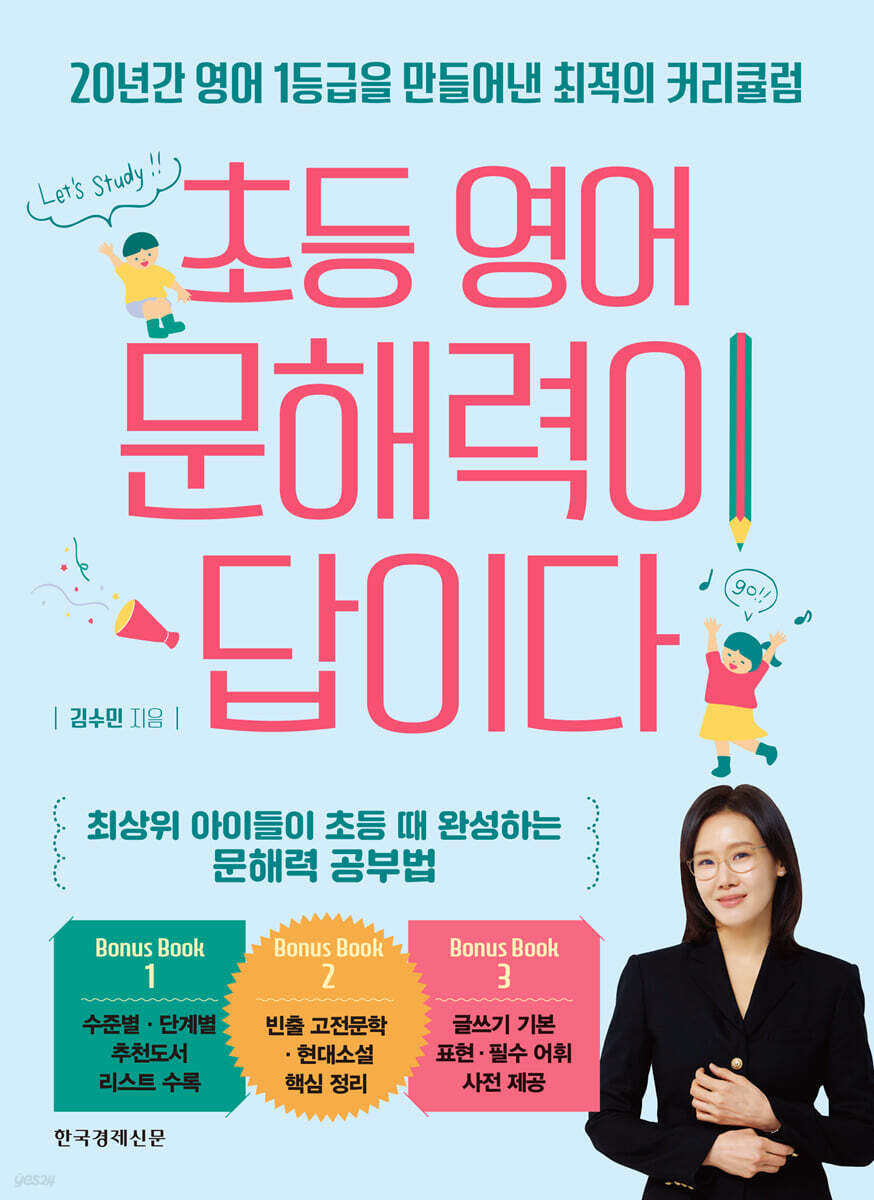
Elementary English literacy is the answer
 |
Description
Book Introduction
The answer to elementary English: Why English literacy?
Elementary English Literacy Study Method Proven by Top-Ranking Maker Director Kim
“Seize the golden time of the 6th year of elementary school, when the focus shifts to reading and writing!”
Han ○, a third grader who hated English, started reading chapter books for 10 minutes a day, and a year later, he started writing in English.
Currently, he is working as a writer for an English newspaper at the Department of Electrical and Electronic Engineering at Seoul National University.
_Among the testimonials showing amazing achievements through English literacy study methods
《Elementary English Literacy is the Answer》 emphasizes the importance of English literacy and presents a systematic learning method to effectively develop English literacy.
English proficiency is often thought to be centered around speaking and listening, but true English proficiency comes from 'reading and writing skills (literacy)'.
In particular, the elementary school years are important as they transition from 'listening and speaking'-centered English learning to 'reading and writing'-centered learning.
Sentences are getting longer, texts are getting deeper, and tasks that require logical expression of thoughts are increasing.
Over the past 20 years, the author has met countless students in the field and observed many becoming frustrated with long passages and fearful of expressing their thoughts in English.
These difficulties increased as they entered middle school, often leading to a loss of confidence in learning English in general.
To address these issues, we have been researching and developing systematic English literacy study methods tailored to children's developmental stages for a long time.
This is because I have experienced countless times in the educational field that no matter how well you know vocabulary and grammar, you cannot acquire true English skills without a deep understanding and ability to express yourself.
Literacy was the foundation and completion of English learning.
Every year, countless students have achieved remarkable growth through systematic English literacy study methods.
Students who have steadily built up their literacy skills since elementary school have maintained excellent grades even after entering middle school, and many have achieved the feat of entering specialized high schools such as science high schools and foreign language high schools, as well as SKY and KAIST.
This was not simply a result of simple English skills, but rather a result of having deep thinking skills and systematic expression skills.
This book systematically organizes proven English literacy study methods so that anyone can follow them!
Elementary English Literacy Study Method Proven by Top-Ranking Maker Director Kim
“Seize the golden time of the 6th year of elementary school, when the focus shifts to reading and writing!”
Han ○, a third grader who hated English, started reading chapter books for 10 minutes a day, and a year later, he started writing in English.
Currently, he is working as a writer for an English newspaper at the Department of Electrical and Electronic Engineering at Seoul National University.
_Among the testimonials showing amazing achievements through English literacy study methods
《Elementary English Literacy is the Answer》 emphasizes the importance of English literacy and presents a systematic learning method to effectively develop English literacy.
English proficiency is often thought to be centered around speaking and listening, but true English proficiency comes from 'reading and writing skills (literacy)'.
In particular, the elementary school years are important as they transition from 'listening and speaking'-centered English learning to 'reading and writing'-centered learning.
Sentences are getting longer, texts are getting deeper, and tasks that require logical expression of thoughts are increasing.
Over the past 20 years, the author has met countless students in the field and observed many becoming frustrated with long passages and fearful of expressing their thoughts in English.
These difficulties increased as they entered middle school, often leading to a loss of confidence in learning English in general.
To address these issues, we have been researching and developing systematic English literacy study methods tailored to children's developmental stages for a long time.
This is because I have experienced countless times in the educational field that no matter how well you know vocabulary and grammar, you cannot acquire true English skills without a deep understanding and ability to express yourself.
Literacy was the foundation and completion of English learning.
Every year, countless students have achieved remarkable growth through systematic English literacy study methods.
Students who have steadily built up their literacy skills since elementary school have maintained excellent grades even after entering middle school, and many have achieved the feat of entering specialized high schools such as science high schools and foreign language high schools, as well as SKY and KAIST.
This was not simply a result of simple English skills, but rather a result of having deep thinking skills and systematic expression skills.
This book systematically organizes proven English literacy study methods so that anyone can follow them!
- You can preview some of the book's contents.
Preview
index
Prologue_ The friendliest guide to English literacy: Why is English literacy?
PART 1: English Literacy: A Keyword That Unlocks Your Child's Potential
CHAPTER 1.
The power of literacy
True English proficiency and literacy are key.
Literacy is not innate
Developing literacy is more important than achieving a high AR index.
CHAPTER 2.
The first six years of elementary school are the golden age for English literacy development.
Don't miss the golden opportunity to develop English literacy.
Identifying factors that hinder English literacy development
How to Start Reading and Writing English Effectively
CHAPTER 3.
4 Key Secrets to Improving English Literacy
Key Secret 1.
Building a solid vocabulary
Key Secret 2.
Read deeply and understand the context
Key Secret 3.
Understand the main points of a text by organizing and summarizing it.
Key Secret 4.
Expressing thoughts in English
CHAPTER 4.
The 5-Step Growth Formula for Improving English Literacy
Growth formula 1.
Developing good reading habits
Growth formula 2.
Developing the power to think in English
Growth formula 3.
Try writing a little bit every day
Growth formula 4.
Express what you have learned in speech and writing
Growth formula 5.
Creating a habit of doing it consistently
| PART 2 | Step by step, without any gaps
CHAPTER 5.
Killing Two Birds at Once: English Literacy and Self-Directed Learning
Setting goals and plans together
The role of parents as facilitators
Utilizing AI Tools Effectively
CHAPTER 6.
Grades 1-2: Planting the Seeds of English Literacy
Getting started with Phoenix and site words
Beginning English Reading: Step-by-Step Guide to Reading English Books
Building vocabulary and using words
English Writing Begins with Sentences
·Improve your literacy - Upgrade your skills with a 'reading journal'
CHAPTER 7.
Grades 3-4: Building the Foundation for English Literacy
Developing reading comprehension skills step by step
Building a solid vocabulary
Challenge yourself to write a paragraph on a topic
Master basic grammar smartly
·Improve your literacy - Build your skills with an 'In-depth Reading Journal'
CHAPTER 8.
Grades 5-6: Developing English Literacy
Balancing between intensive and speed reading
Systematically learn advanced vocabulary
Laying the Foundations of Essay Writing
Learn advanced grammar step by step
·Improve literacy - Create concept notes and error notes
| PART 3 | English Literacy: A Lifelong Asset
CHAPTER 9.
Middle and High School: Strategies for Continuing to Improve English Literacy
Naturally connecting literacy skills in elementary and middle school
Analyzing complex sentence structures
Systematically prepare for performance evaluation
·Improve your literacy - How to read charts and graphs well
Epilogue: English Literacy: Let's Walk This Path Together
References and Sites
[Appendix 1] Parent's Guide: FAQs for Parents of Elementary School Children
[Appendix 2] Student Guide: A Collection of Tools to Help You Study English Literacy
PART 1: English Literacy: A Keyword That Unlocks Your Child's Potential
CHAPTER 1.
The power of literacy
True English proficiency and literacy are key.
Literacy is not innate
Developing literacy is more important than achieving a high AR index.
CHAPTER 2.
The first six years of elementary school are the golden age for English literacy development.
Don't miss the golden opportunity to develop English literacy.
Identifying factors that hinder English literacy development
How to Start Reading and Writing English Effectively
CHAPTER 3.
4 Key Secrets to Improving English Literacy
Key Secret 1.
Building a solid vocabulary
Key Secret 2.
Read deeply and understand the context
Key Secret 3.
Understand the main points of a text by organizing and summarizing it.
Key Secret 4.
Expressing thoughts in English
CHAPTER 4.
The 5-Step Growth Formula for Improving English Literacy
Growth formula 1.
Developing good reading habits
Growth formula 2.
Developing the power to think in English
Growth formula 3.
Try writing a little bit every day
Growth formula 4.
Express what you have learned in speech and writing
Growth formula 5.
Creating a habit of doing it consistently
| PART 2 | Step by step, without any gaps
CHAPTER 5.
Killing Two Birds at Once: English Literacy and Self-Directed Learning
Setting goals and plans together
The role of parents as facilitators
Utilizing AI Tools Effectively
CHAPTER 6.
Grades 1-2: Planting the Seeds of English Literacy
Getting started with Phoenix and site words
Beginning English Reading: Step-by-Step Guide to Reading English Books
Building vocabulary and using words
English Writing Begins with Sentences
·Improve your literacy - Upgrade your skills with a 'reading journal'
CHAPTER 7.
Grades 3-4: Building the Foundation for English Literacy
Developing reading comprehension skills step by step
Building a solid vocabulary
Challenge yourself to write a paragraph on a topic
Master basic grammar smartly
·Improve your literacy - Build your skills with an 'In-depth Reading Journal'
CHAPTER 8.
Grades 5-6: Developing English Literacy
Balancing between intensive and speed reading
Systematically learn advanced vocabulary
Laying the Foundations of Essay Writing
Learn advanced grammar step by step
·Improve literacy - Create concept notes and error notes
| PART 3 | English Literacy: A Lifelong Asset
CHAPTER 9.
Middle and High School: Strategies for Continuing to Improve English Literacy
Naturally connecting literacy skills in elementary and middle school
Analyzing complex sentence structures
Systematically prepare for performance evaluation
·Improve your literacy - How to read charts and graphs well
Epilogue: English Literacy: Let's Walk This Path Together
References and Sites
[Appendix 1] Parent's Guide: FAQs for Parents of Elementary School Children
[Appendix 2] Student Guide: A Collection of Tools to Help You Study English Literacy
Detailed image

Into the book
When we say 'a child who is good at English', we usually picture them speaking fluently and reading thick English books fluently.
That's true, of course, but a child who has true skills based on literacy goes beyond that.
Children with excellent literacy skills absorb text with their whole body.
He reads the message and resonance of the times in Obama's speech and the depth of life in Frost's poetry, and reinterprets them in his own words.
--- p.15
In this way, English education begins with the stage of ‘learning to read’ and gradually develops into the stage of ‘learning through reading.’
What exactly does this mean? As explained earlier, early elementary school students focus on English reading skills themselves.
This is literally the time to learn how to read English.
But things change when they reach 3rd or 4th grade.
Now, we begin to learn various topics through texts in English.
Learning science, history, and culture in English.
As students progress through the grades, this type of learning becomes more prevalent.
Eventually, as we move through middle and high school and reach university, learning centered on 'listening and speaking' decreases and learning centered on 'reading and writing' becomes the mainstream.
After teaching English to children for 20 years, I realized that this transition period is very important.
However, many children struggle at this point or do not move forward.
--- p.17~18
Since my children entered middle school, they often say things like, “English suddenly became difficult” or “I started to hate English.”
In most cases, the timing for appropriate English literacy education was missed during elementary school.
Education experts call this phenomenon the "Literacy Cliff."
The difficulties experienced during this period are not simply a problem with English grades, but have a major impact on overall learning.
As the saying goes, “There is a time for everything,” and there is also a time that is best for developing English literacy.
If you miss this golden age, it will require more time and effort later.
--- p.28
In fact, the earlier children receive writing instruction, the better they accept and absorb it.
This is precisely why there are many children who cannot even write a single word in English even after reaching the upper grades of elementary school.
So, it is better to think that the faster you write, the better you write.
Especially by the time they reach 3rd or 4th grade, their cognitive level has developed sufficiently, so teaching writing at the same time as other learning is very effective.
--- p.62
In learning, it is also important to determine the appropriate level of intervention for each grade.
Elementary school grades 1 and 2 are a time to establish 'basic study habits', so direct guidance is necessary, such as reading English books together at the same time every day and observing children memorize vocabulary.
When children reach the third or fourth grade of elementary school, they must begin 'semi-independent learning'.
This is the time when the child finds his or her own learning style.
For example, when a child wants to write an English diary on their own, it is best to help them choose a topic and let them do the rest on their own before giving them feedback.
Self-direction becomes more important in 5th and 6th grade.
Just set weekly learning goals together and let the child choose how to achieve them.
Through this, children can discover their own effective learning method.
--- p.84
As the difficulty of the text increases, the summarization method needs to be adjusted.
In particular, for texts at the 6th grade level or longer than 300 words, it is more effective to summarize them in Korean.
This is because the exam questions for middle and high school courses are written in Korean.
A Korean summary helps you clearly understand and structure the core of the text, and enables more in-depth analysis.
Therefore, it is recommended to appropriately combine English and Korean summaries according to grade and difficulty level.
'Summarizing' is an essential learning method that must be continuously practiced for 2 to 3 years during elementary school.
As you become more adept at summarizing, other reading strategies will naturally follow.
Therefore, it is effective to make learning how to read and summarize books the first step in improving reading comprehension.
--- p.147~148
The answer to the question, “How many English words does my child need to know to do well on tests?” is simple.
It would be good to know all the words included in the vocabulary books available on the market.
The important thing here is to learn with examples, not just memorization.
Many students just memorize the words and skip the examples, which is very dangerous.
Vocabulary learning in the upper elementary grades is for reading non-fiction texts, so memorizing words without examples does not lead to actual improvement in reading comprehension.
Therefore, from the 6th grade of elementary school to the 1st grade of high school, vocabulary books should be the center of English study.
Because vocabulary is the foundation of literacy and the key to reading comprehension.
--- p.202
Sentences that are difficult to interpret can be resolved through ‘sentence structure analysis’.
Long sentences become much easier to understand if you break them down into smaller units, just like assembling Lego blocks.
Even if it takes a little more time at first, if you develop these analytical habits, your reading comprehension skills will improve by leaps and bounds.
There is no need to analyze every single sentence.
It is efficient to select and analyze the topic sentence that contains the core content of a paragraph, sentences with complex structures, or important sentences with detailed grammar explanations in the study guide.
These sentences often contain conjunctions or relative pronouns, or are made up of multiple clauses.
--- p.259
Han ○, a third grader who had a strong aversion to English, started by reading chapter books for 10 minutes a day.
The child's changes were gradual but evident.
A year later, the child began writing in English, and is now working as a writer for the English newspaper section of the Department of Electrical and Electronic Engineering at Seoul National University.
The most important lesson I've learned from 20 years of teaching experience is that practice is more important than method, and consistency is more important than theory.
That's true, of course, but a child who has true skills based on literacy goes beyond that.
Children with excellent literacy skills absorb text with their whole body.
He reads the message and resonance of the times in Obama's speech and the depth of life in Frost's poetry, and reinterprets them in his own words.
--- p.15
In this way, English education begins with the stage of ‘learning to read’ and gradually develops into the stage of ‘learning through reading.’
What exactly does this mean? As explained earlier, early elementary school students focus on English reading skills themselves.
This is literally the time to learn how to read English.
But things change when they reach 3rd or 4th grade.
Now, we begin to learn various topics through texts in English.
Learning science, history, and culture in English.
As students progress through the grades, this type of learning becomes more prevalent.
Eventually, as we move through middle and high school and reach university, learning centered on 'listening and speaking' decreases and learning centered on 'reading and writing' becomes the mainstream.
After teaching English to children for 20 years, I realized that this transition period is very important.
However, many children struggle at this point or do not move forward.
--- p.17~18
Since my children entered middle school, they often say things like, “English suddenly became difficult” or “I started to hate English.”
In most cases, the timing for appropriate English literacy education was missed during elementary school.
Education experts call this phenomenon the "Literacy Cliff."
The difficulties experienced during this period are not simply a problem with English grades, but have a major impact on overall learning.
As the saying goes, “There is a time for everything,” and there is also a time that is best for developing English literacy.
If you miss this golden age, it will require more time and effort later.
--- p.28
In fact, the earlier children receive writing instruction, the better they accept and absorb it.
This is precisely why there are many children who cannot even write a single word in English even after reaching the upper grades of elementary school.
So, it is better to think that the faster you write, the better you write.
Especially by the time they reach 3rd or 4th grade, their cognitive level has developed sufficiently, so teaching writing at the same time as other learning is very effective.
--- p.62
In learning, it is also important to determine the appropriate level of intervention for each grade.
Elementary school grades 1 and 2 are a time to establish 'basic study habits', so direct guidance is necessary, such as reading English books together at the same time every day and observing children memorize vocabulary.
When children reach the third or fourth grade of elementary school, they must begin 'semi-independent learning'.
This is the time when the child finds his or her own learning style.
For example, when a child wants to write an English diary on their own, it is best to help them choose a topic and let them do the rest on their own before giving them feedback.
Self-direction becomes more important in 5th and 6th grade.
Just set weekly learning goals together and let the child choose how to achieve them.
Through this, children can discover their own effective learning method.
--- p.84
As the difficulty of the text increases, the summarization method needs to be adjusted.
In particular, for texts at the 6th grade level or longer than 300 words, it is more effective to summarize them in Korean.
This is because the exam questions for middle and high school courses are written in Korean.
A Korean summary helps you clearly understand and structure the core of the text, and enables more in-depth analysis.
Therefore, it is recommended to appropriately combine English and Korean summaries according to grade and difficulty level.
'Summarizing' is an essential learning method that must be continuously practiced for 2 to 3 years during elementary school.
As you become more adept at summarizing, other reading strategies will naturally follow.
Therefore, it is effective to make learning how to read and summarize books the first step in improving reading comprehension.
--- p.147~148
The answer to the question, “How many English words does my child need to know to do well on tests?” is simple.
It would be good to know all the words included in the vocabulary books available on the market.
The important thing here is to learn with examples, not just memorization.
Many students just memorize the words and skip the examples, which is very dangerous.
Vocabulary learning in the upper elementary grades is for reading non-fiction texts, so memorizing words without examples does not lead to actual improvement in reading comprehension.
Therefore, from the 6th grade of elementary school to the 1st grade of high school, vocabulary books should be the center of English study.
Because vocabulary is the foundation of literacy and the key to reading comprehension.
--- p.202
Sentences that are difficult to interpret can be resolved through ‘sentence structure analysis’.
Long sentences become much easier to understand if you break them down into smaller units, just like assembling Lego blocks.
Even if it takes a little more time at first, if you develop these analytical habits, your reading comprehension skills will improve by leaps and bounds.
There is no need to analyze every single sentence.
It is efficient to select and analyze the topic sentence that contains the core content of a paragraph, sentences with complex structures, or important sentences with detailed grammar explanations in the study guide.
These sentences often contain conjunctions or relative pronouns, or are made up of multiple clauses.
--- p.259
Han ○, a third grader who had a strong aversion to English, started by reading chapter books for 10 minutes a day.
The child's changes were gradual but evident.
A year later, the child began writing in English, and is now working as a writer for the English newspaper section of the Department of Electrical and Electronic Engineering at Seoul National University.
The most important lesson I've learned from 20 years of teaching experience is that practice is more important than method, and consistency is more important than theory.
--- p.288
Publisher's Review
English literacy must be developed in elementary school.
The paradigm of English learning is changing.
While the emphasis in the past was on exposure to English, simple vocabulary memorization, and grammar learning, English literacy is now emerging as a key factor in assessing true English proficiency.
The author, with over 20 years of teaching experience, saw children who had lived abroad for several years struggle with learning English. He realized that a timely and accurate, systematic approach to English learning was essential, and so he researched a curriculum tailored to this need.
The author emphasizes that elementary school is the most important period to develop English literacy.
Literacy is a concept that goes beyond simple reading comprehension skills and includes the ability to read, understand, organize, and express.
The book systematically organizes literacy learning methods that can be applied to each age group, divided into 1st and 2nd grades, 3rd and 4th grades, and 5th and 6th grades.
- Elementary 1st and 2nd graders: Build the foundation of reading by learning phonics and sight words, and practice writing short sentences.
- 3rd-4th graders: Read short sentences, summarize them, and write about them with additional thoughts.
- Elementary 5th-6th graders: Analyze long passages to develop critical thinking and logical thinking skills, and write essays that include opinions.
The most important thing in this process is to strike a balance between reading and writing.
It is emphasized that reading a lot of books does not automatically improve literacy, but rather that the process of organizing what you read and expressing it in writing must also occur.
Practical learning methods and real-world examples
One of the greatest strengths of this book is that it is rich in teaching methods and case studies that have proven effective in real-world educational settings.
The book presents examples of students who have actually practiced literacy learning.
Do○, a 6th grader, studied vocabulary and grammar hard, but had difficulty understanding long texts.
However, after training myself to understand sentence structure and find key information, I started getting over 90 points on my middle school grades in just six months.
Han ○, a third grader who hated English, started reading chapter books for 10 minutes a day, and a year later, he started writing in English.
Currently, he is working as a writer for an English newspaper at the Department of Electrical and Electronic Engineering at Seoul National University.
These examples demonstrate how effective English literacy instruction can be in substantially improving children's English skills.
Good English literacy creates a virtuous cycle of learning.
English literacy is not just a language skill; it is the foundation of all learning.
In order to understand and apply important concepts in all subjects, including math, science, and social studies, the process of reading → understanding → organizing → expressing is essential.
If you have poor literacy skills, you may know the meaning of words, but you may not be able to properly interpret sentences, and you may have difficulty reading long texts and grasping the main points.
If you can't organize what you've learned into writing, your thinking skills will be limited.
On the other hand, those with excellent literacy skills have richer background knowledge, expanded thinking skills, and improved ability to understand and analyze various texts.
It is an essential skill in today's world where critical thinking and creative problem-solving skills are so important, as it allows you to organize and express your thoughts logically.
English literacy is the most effective way to develop these skills.
- A solid vocabulary forms the foundation of literacy.
- The ability to understand text in context enables deep reading.
- The ability to organize and summarize complex information is essential in literacy.
- You must gradually develop the ability to express your thoughts in English.
- The core skills that develop English literacy develop in a complementary manner.
The Importance and Growth Principles of English Literacy
Being good at reading doesn't mean you're good at writing.
Many students say, “I’m good at reading, but I have trouble writing.” However, reading and writing must be studied together.
Even if you read a lot of books, if you don't have the experience of organizing them into writing, your ability to express yourself may be lacking.
It is important to summarize what you read and add your own thoughts.
This must be practiced systematically, step by step, at each level.
To improve your writing skills, you should start with short pieces and gradually expand them, and you should also consistently practice thinking about a topic and expressing it in writing.
If you develop the habit of writing without pressure in the form of a 'diary' or 'impression' from elementary school, it will be advantageous in middle school grades and performance evaluations.
- Develop a reading habit - Read a set amount of material every day
- The Power of Thinking in English - The Decisive Question: The Beginning of English Learning
- Short writing practice - Start without pressure with diaries, impressions, etc.
- Express what you have learned verbally and in writing - Use discussions and essays
- Consistent, repetitive learning - Continuous review and application are important.
Providing cutting-edge learning methods suited to the AI era
Moreover, this book does not simply introduce traditional learning methods, but also covers literacy learning methods using AI tools such as ChatGPT.
For example, it introduces how to use AI to receive feedback on your English writing, how to improve reading comprehension through online English reading programs, and how to use digital tools to enhance learning efficiency, suggesting effective English learning methods that are in line with the latest trends.
This allows even parents who are not good at English to study English literacy with their children accurately and reliably.
Practice your English writing and get feedback with ChatGPT.
- Use of online English reading programs
- In-depth learning using translation and summary functions
English skills don't develop automatically, gradually, or naturally.
The biggest message this book conveys is that English literacy is not something that can be developed overnight, but rather something that is achieved through consistent practice.
Although many people become impatient and expect short-term results when it comes to English education, the author emphasizes that developing a daily habit of reading, writing, and speaking a little bit at a time ultimately determines a child's English skills.
No matter how good a method is, it is meaningless without practice, and it is said that consistent practice without impatience is the most important.
The author's educational philosophy demonstrates that this book is not simply an English textbook, but a practical guidebook that fosters children's lifelong learning abilities.
- Provides specific, customized learning strategies for each grade and level.
- Providing a practical and effective elementary and secondary learning roadmap.
- Includes recommended textbooks by grade level, essential writing vocabulary, and a summary of frequently used literary works.
A systematic English literacy study method with proven effectiveness
The effectiveness of the English literacy study method has been proven through the success stories of students who entered Seoul National University, KAIST, medical schools, and other institutions.
English literacy mastered during elementary school becomes a lifelong competitive edge for children, beyond their middle and high school grades and college entrance exams. It also serves as the cornerstone for them to think and express themselves freely in English and confidently advance into the world.
If you're a parent struggling with your child's English studies, or looking for a systematic and effective English learning method from elementary to middle school, follow the optimal curriculum presented in this book.
Recommendation
The time I spent with teacher Kim Su-min for about seven years, starting in the third grade of elementary school, became the foundation of my English skills.
The 'sentence structure analysis method' that the teacher emphasized was a great help in interpreting high school English texts.
I developed the habit of analyzing even complex sentences step by step, so I wasn't afraid of English for my school grades or the CSAT.
By effectively understanding and organizing text, I was able to quickly grasp the main points of the text and express my thoughts logically.
The English literacy study method will also serve as a foundation for my college major studies.
_Go ○ Yoon (Seoul National University Department of Electrical and Computer Engineering, Inje University College of Medicine, Soonchunhyang University College of Medicine, KAIST College Scholastic Ability Test (CSAT) excellent student admission)
Teacher Kim Soo-min helped me develop the ability to think and express myself in English, rather than simply memorizing words and studying grammar.
Also, thanks to my teacher, I learned how to deeply understand English original texts by consistently writing a 'reading journal'.
Because of these habits, I had no interest in books or English when I was young, but English became my strong subject when I was in middle school.
By being exposed to a wide variety of writing, I have become able to confidently handle any writing.
In particular, training in analyzing middle and high school English text types from elementary school onwards was very helpful.
Thanks to my teacher, English has become my greatest strength.
_Kim ○-ik (accepted to Seoul National University's Department of Electrical and Computer Engineering)
Teacher Kim Soo-min always emphasized that 'the key to learning English is understanding and expressing yourself well.'
I didn't really understand its meaning when I was in elementary school, but I realized its importance when I got to high school.
By consistently studying vocabulary throughout middle and high school using the teacher's 'topic-based vocabulary organization method,' I was able to solve even the technical terms that appeared on the CSAT without difficulty.
By making it a habit to write a little bit in English every day, I gained confidence in essays and writing in English.
The English literacy I developed since elementary school became the foundation for my dream of becoming a teacher.
_Ho○pyo (accepted by Gyeongin National University of Education)
When I was in elementary school, English was the most difficult subject, but I gained confidence through the English literacy study method I learned from teacher Kim Su-min.
In particular, the English literacy study method learned in middle school shone brightly during high school.
The method of writing 'concept notes' and 'wrong answer notes' was central to my English studies throughout high school.
Also, I was able to manage my time well in the English section of the CSAT thanks to practicing strategies like 'skimming' and 'finding key information' since elementary school.
The teacher's teachings have been an asset to my English skills.
_Go ○ Won (accepted to Korea University's Department of Life Sciences and Sungkyunkwan University's Department of Global Biomedical Engineering)
The paradigm of English learning is changing.
While the emphasis in the past was on exposure to English, simple vocabulary memorization, and grammar learning, English literacy is now emerging as a key factor in assessing true English proficiency.
The author, with over 20 years of teaching experience, saw children who had lived abroad for several years struggle with learning English. He realized that a timely and accurate, systematic approach to English learning was essential, and so he researched a curriculum tailored to this need.
The author emphasizes that elementary school is the most important period to develop English literacy.
Literacy is a concept that goes beyond simple reading comprehension skills and includes the ability to read, understand, organize, and express.
The book systematically organizes literacy learning methods that can be applied to each age group, divided into 1st and 2nd grades, 3rd and 4th grades, and 5th and 6th grades.
- Elementary 1st and 2nd graders: Build the foundation of reading by learning phonics and sight words, and practice writing short sentences.
- 3rd-4th graders: Read short sentences, summarize them, and write about them with additional thoughts.
- Elementary 5th-6th graders: Analyze long passages to develop critical thinking and logical thinking skills, and write essays that include opinions.
The most important thing in this process is to strike a balance between reading and writing.
It is emphasized that reading a lot of books does not automatically improve literacy, but rather that the process of organizing what you read and expressing it in writing must also occur.
Practical learning methods and real-world examples
One of the greatest strengths of this book is that it is rich in teaching methods and case studies that have proven effective in real-world educational settings.
The book presents examples of students who have actually practiced literacy learning.
Do○, a 6th grader, studied vocabulary and grammar hard, but had difficulty understanding long texts.
However, after training myself to understand sentence structure and find key information, I started getting over 90 points on my middle school grades in just six months.
Han ○, a third grader who hated English, started reading chapter books for 10 minutes a day, and a year later, he started writing in English.
Currently, he is working as a writer for an English newspaper at the Department of Electrical and Electronic Engineering at Seoul National University.
These examples demonstrate how effective English literacy instruction can be in substantially improving children's English skills.
Good English literacy creates a virtuous cycle of learning.
English literacy is not just a language skill; it is the foundation of all learning.
In order to understand and apply important concepts in all subjects, including math, science, and social studies, the process of reading → understanding → organizing → expressing is essential.
If you have poor literacy skills, you may know the meaning of words, but you may not be able to properly interpret sentences, and you may have difficulty reading long texts and grasping the main points.
If you can't organize what you've learned into writing, your thinking skills will be limited.
On the other hand, those with excellent literacy skills have richer background knowledge, expanded thinking skills, and improved ability to understand and analyze various texts.
It is an essential skill in today's world where critical thinking and creative problem-solving skills are so important, as it allows you to organize and express your thoughts logically.
English literacy is the most effective way to develop these skills.
- A solid vocabulary forms the foundation of literacy.
- The ability to understand text in context enables deep reading.
- The ability to organize and summarize complex information is essential in literacy.
- You must gradually develop the ability to express your thoughts in English.
- The core skills that develop English literacy develop in a complementary manner.
The Importance and Growth Principles of English Literacy
Being good at reading doesn't mean you're good at writing.
Many students say, “I’m good at reading, but I have trouble writing.” However, reading and writing must be studied together.
Even if you read a lot of books, if you don't have the experience of organizing them into writing, your ability to express yourself may be lacking.
It is important to summarize what you read and add your own thoughts.
This must be practiced systematically, step by step, at each level.
To improve your writing skills, you should start with short pieces and gradually expand them, and you should also consistently practice thinking about a topic and expressing it in writing.
If you develop the habit of writing without pressure in the form of a 'diary' or 'impression' from elementary school, it will be advantageous in middle school grades and performance evaluations.
- Develop a reading habit - Read a set amount of material every day
- The Power of Thinking in English - The Decisive Question: The Beginning of English Learning
- Short writing practice - Start without pressure with diaries, impressions, etc.
- Express what you have learned verbally and in writing - Use discussions and essays
- Consistent, repetitive learning - Continuous review and application are important.
Providing cutting-edge learning methods suited to the AI era
Moreover, this book does not simply introduce traditional learning methods, but also covers literacy learning methods using AI tools such as ChatGPT.
For example, it introduces how to use AI to receive feedback on your English writing, how to improve reading comprehension through online English reading programs, and how to use digital tools to enhance learning efficiency, suggesting effective English learning methods that are in line with the latest trends.
This allows even parents who are not good at English to study English literacy with their children accurately and reliably.
Practice your English writing and get feedback with ChatGPT.
- Use of online English reading programs
- In-depth learning using translation and summary functions
English skills don't develop automatically, gradually, or naturally.
The biggest message this book conveys is that English literacy is not something that can be developed overnight, but rather something that is achieved through consistent practice.
Although many people become impatient and expect short-term results when it comes to English education, the author emphasizes that developing a daily habit of reading, writing, and speaking a little bit at a time ultimately determines a child's English skills.
No matter how good a method is, it is meaningless without practice, and it is said that consistent practice without impatience is the most important.
The author's educational philosophy demonstrates that this book is not simply an English textbook, but a practical guidebook that fosters children's lifelong learning abilities.
- Provides specific, customized learning strategies for each grade and level.
- Providing a practical and effective elementary and secondary learning roadmap.
- Includes recommended textbooks by grade level, essential writing vocabulary, and a summary of frequently used literary works.
A systematic English literacy study method with proven effectiveness
The effectiveness of the English literacy study method has been proven through the success stories of students who entered Seoul National University, KAIST, medical schools, and other institutions.
English literacy mastered during elementary school becomes a lifelong competitive edge for children, beyond their middle and high school grades and college entrance exams. It also serves as the cornerstone for them to think and express themselves freely in English and confidently advance into the world.
If you're a parent struggling with your child's English studies, or looking for a systematic and effective English learning method from elementary to middle school, follow the optimal curriculum presented in this book.
Recommendation
The time I spent with teacher Kim Su-min for about seven years, starting in the third grade of elementary school, became the foundation of my English skills.
The 'sentence structure analysis method' that the teacher emphasized was a great help in interpreting high school English texts.
I developed the habit of analyzing even complex sentences step by step, so I wasn't afraid of English for my school grades or the CSAT.
By effectively understanding and organizing text, I was able to quickly grasp the main points of the text and express my thoughts logically.
The English literacy study method will also serve as a foundation for my college major studies.
_Go ○ Yoon (Seoul National University Department of Electrical and Computer Engineering, Inje University College of Medicine, Soonchunhyang University College of Medicine, KAIST College Scholastic Ability Test (CSAT) excellent student admission)
Teacher Kim Soo-min helped me develop the ability to think and express myself in English, rather than simply memorizing words and studying grammar.
Also, thanks to my teacher, I learned how to deeply understand English original texts by consistently writing a 'reading journal'.
Because of these habits, I had no interest in books or English when I was young, but English became my strong subject when I was in middle school.
By being exposed to a wide variety of writing, I have become able to confidently handle any writing.
In particular, training in analyzing middle and high school English text types from elementary school onwards was very helpful.
Thanks to my teacher, English has become my greatest strength.
_Kim ○-ik (accepted to Seoul National University's Department of Electrical and Computer Engineering)
Teacher Kim Soo-min always emphasized that 'the key to learning English is understanding and expressing yourself well.'
I didn't really understand its meaning when I was in elementary school, but I realized its importance when I got to high school.
By consistently studying vocabulary throughout middle and high school using the teacher's 'topic-based vocabulary organization method,' I was able to solve even the technical terms that appeared on the CSAT without difficulty.
By making it a habit to write a little bit in English every day, I gained confidence in essays and writing in English.
The English literacy I developed since elementary school became the foundation for my dream of becoming a teacher.
_Ho○pyo (accepted by Gyeongin National University of Education)
When I was in elementary school, English was the most difficult subject, but I gained confidence through the English literacy study method I learned from teacher Kim Su-min.
In particular, the English literacy study method learned in middle school shone brightly during high school.
The method of writing 'concept notes' and 'wrong answer notes' was central to my English studies throughout high school.
Also, I was able to manage my time well in the English section of the CSAT thanks to practicing strategies like 'skimming' and 'finding key information' since elementary school.
The teacher's teachings have been an asset to my English skills.
_Go ○ Won (accepted to Korea University's Department of Life Sciences and Sungkyunkwan University's Department of Global Biomedical Engineering)
GOODS SPECIFICS
- Date of issue: March 20, 2025
- Page count, weight, size: 344 pages | 652g | 160*220*30mm
- ISBN13: 9788947549974
- ISBN10: 8947549975
You may also like
카테고리
korean


korean

![GQ KOREA Mark (Monthly): December [2025]](http://librairie.coreenne.fr/cdn/shop/files/8ef265dbbfbf186523ed75ba7319009d.jpg?v=1765340328&width=3840)


