

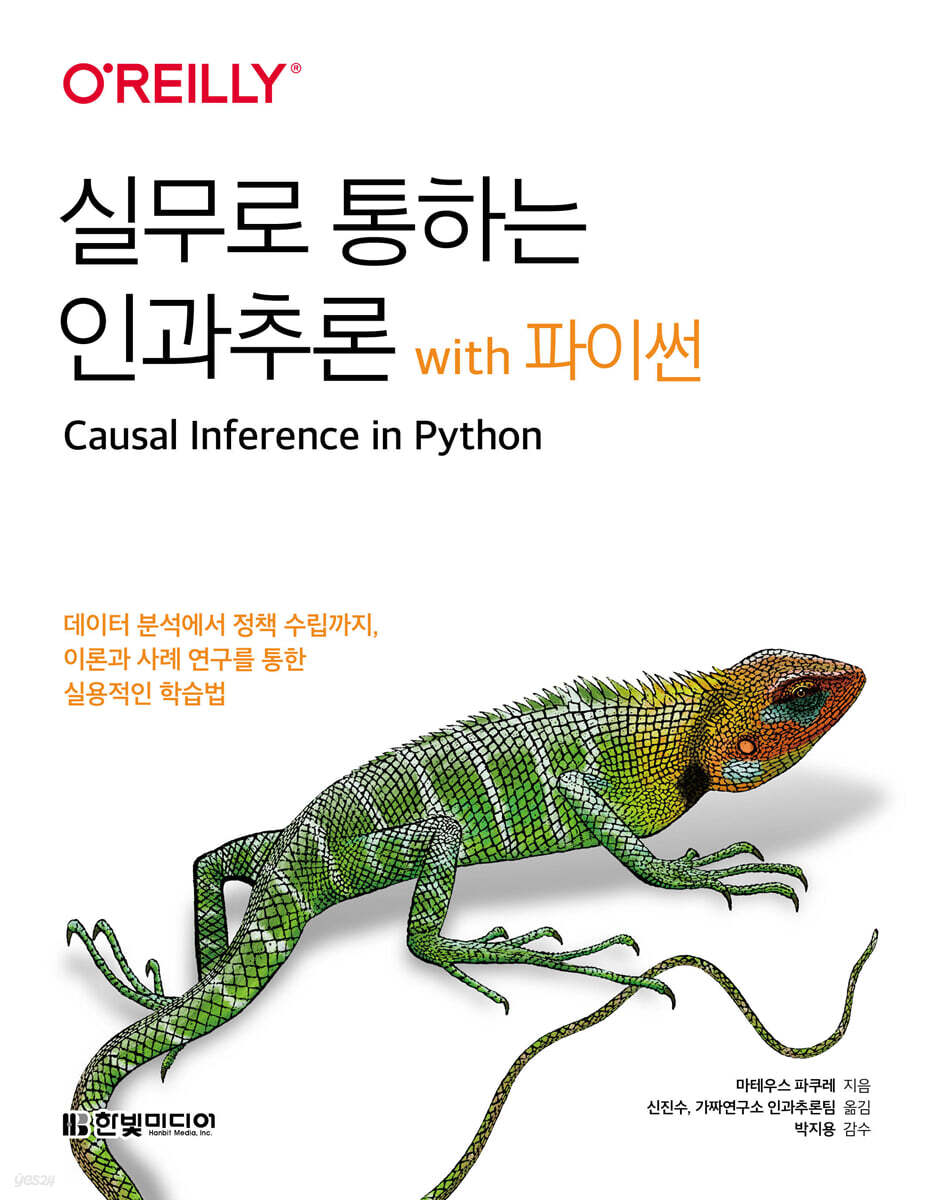
Practical Causal Inference with Python
 |
Description
Book Introduction
Causal inference for data-driven, insightful decision-making,
Successful business policy decisions through effective impact analysis
How much more buyers will there be if we increase our online marketing budget by $1? How do we identify customers who only buy when they receive a discount coupon? How can we develop an optimal pricing strategy? Causal inference is the most useful way to understand how the factors you manage affect your desired business metrics.
Causal inference can be easily implemented with just a few lines of Python code.
This book demonstrates the untapped potential of causal inference in estimating influence and effects.
This book covers classic causal inference methods, such as A/B testing, linear regression, propensity scores, control group synthesis, and double differencing, for managers, data scientists, and data analysts, as well as modern approaches, such as machine learning for heterogeneous effect estimation, with practical application examples.
Successful business policy decisions through effective impact analysis
How much more buyers will there be if we increase our online marketing budget by $1? How do we identify customers who only buy when they receive a discount coupon? How can we develop an optimal pricing strategy? Causal inference is the most useful way to understand how the factors you manage affect your desired business metrics.
Causal inference can be easily implemented with just a few lines of Python code.
This book demonstrates the untapped potential of causal inference in estimating influence and effects.
This book covers classic causal inference methods, such as A/B testing, linear regression, propensity scores, control group synthesis, and double differencing, for managers, data scientists, and data analysts, as well as modern approaches, such as machine learning for heterogeneous effect estimation, with practical application examples.
- You can preview some of the book's contents.
Preview
index
[PART 1: Basic Causal Inference]
Chapter 1: Introduction to Causal Inference
_1.1 The concept of causal inference
_1.2 Purpose of causal inference
_1.3 Machine Learning and Causal Inference
_1.4 Correlation and Causality
_1.5 bias
_1.6 Identifying Causal Effects
_1.7 Summary
Chapter 2: Randomized Experiments and Basic Statistics Review
_2.1 Ensuring independence through random assignment
_2.2 A/B Testing Case
_2.3 Ideal Experiment
_2.4 The most dangerous formula
_2.5 Standard error of the estimate
_2.6 Confidence interval
_2.7 Hypothesis Testing
_2.8 p value
_2.9 Black power
_2.10 Calculating sample size
_2.11 Summary
Chapter 3 Graph Causal Model
_3.1 Thinking about causality
_3.2 Graph Model Intensive Training
_3.3 Reinterpretation of Identification
_3.4 Conditional Independence Assumption and Correction Formula
_3.5 Positive assumption
_3.6 Concrete Identification Examples
_3.7 Confounding Bias
_3.8 Selection Bias
_3.9 Summary
[PART 2 BIAS CORRECTION]
Chapter 4: Useful Linear Regression
_4.1 The Need for Linear Regression
_4.2 Regression Analysis Theory
_4.3 Frisch-Warr-Lobel theorem and orthogonalization
_4.4 Regression Analysis as a Results Model
_4.5 Positive and Extrapolation
_4.6 Nonlinearity in Linear Regression
_4.7 Regression analysis using dummy variables
_4.8 Omitted variable bias
_4.9 Neutral control variables
_4.10 Summary
Chapter 5 Propensity Score
_5.1 Effectiveness of Manager Training
_5.2 Regression Analysis and Calibration
_5.3 Propensity Score
_5.4 Design vs.
Model-based identification
_5.5 Double Robust Estimation
_5.6 Generalized propensity score in continuous treatment
_5.7 Summary
[PART 3: Heterogeneous Effects and Personalization]
Chapter 6: Heterogeneous Treatment Effects
_6.1 From ATE to CATE
_6.2 Why Predictions Are Not the Answer
_6.3 Obtaining CATE using regression analysis
_6.4 Evaluating CATE Predictions
_6.5 Effects according to model atmosphere
_6.6 Cumulative Effect Curve
_6.7 Cumulative gain curve
_6.8 Target Conversion
_6.9 When the prediction model is good for effect sorting
_6.10 CATE for Decision Making
_6.11 Summary
Chapter 7 Meta Runner
_7.1 Discrete Treatment Meta Runner
_7.2 Continuous Kill Meta Runner
_7.3 Summary
[PART 4 Panel Data]
Chapter 8 Double Difference Method
_8.1 Panel data
_8.2 Standard double difference method
_8.3 Identification Assumptions
_8.4 Effect variation over time
_8.5 Double Difference Method and Covariance
_8.6 Double Robust Double Difference Method
_8.7 Introduction of time difference in church
_8.8 Summary
Chapter 9 Control Group Synthesis
_9.1 Online Marketing Dataset
_9.2 Matrix Representation
_9.3 Control group synthesis and horizontal regression analysis
_9.4 Standard Control Group Synthesis Method
_9.5 Control group synthesis and covariates
_9.6 Control group synthesis and bias elimination
_9.7 Inference
_9.8 Synthetic double difference method
_9.9 Summary
[PART 5 ALTERNATIVE EXPERIMENTAL DESIGN]
Chapter 10: Local and Switchback Experiments
_10.1 Regional Experiment
_10.2 Control group synthesis design
_10.3 Switchback Experiment
_10.4 Summary
Chapter 11 Non-response and Instrumental Variables
_11.1 Non-response
_11.2 Expanding Potential Outcomes
_11.3 Instrumental Variable Identification Assumptions
_11.4 Step 1
_11.5 Step 2
_11.6 Two-stage least squares method
_11.7 Standard error
_11.8 Adding control variables and instrumental variables
_11.9 Discontinuous Design
_11.10 Summary
Chapter 12: What More to Learn
_12.1 Discovering causal relationships
_12.2 Sequential Decision Making
_12.3 Causal Reinforcement Learning
_12.4 Causal Prediction
_12.5 Domain Adaptation
_12.6 Summary
Epilogue: Applying Causal Inference to Practice
Search
Chapter 1: Introduction to Causal Inference
_1.1 The concept of causal inference
_1.2 Purpose of causal inference
_1.3 Machine Learning and Causal Inference
_1.4 Correlation and Causality
_1.5 bias
_1.6 Identifying Causal Effects
_1.7 Summary
Chapter 2: Randomized Experiments and Basic Statistics Review
_2.1 Ensuring independence through random assignment
_2.2 A/B Testing Case
_2.3 Ideal Experiment
_2.4 The most dangerous formula
_2.5 Standard error of the estimate
_2.6 Confidence interval
_2.7 Hypothesis Testing
_2.8 p value
_2.9 Black power
_2.10 Calculating sample size
_2.11 Summary
Chapter 3 Graph Causal Model
_3.1 Thinking about causality
_3.2 Graph Model Intensive Training
_3.3 Reinterpretation of Identification
_3.4 Conditional Independence Assumption and Correction Formula
_3.5 Positive assumption
_3.6 Concrete Identification Examples
_3.7 Confounding Bias
_3.8 Selection Bias
_3.9 Summary
[PART 2 BIAS CORRECTION]
Chapter 4: Useful Linear Regression
_4.1 The Need for Linear Regression
_4.2 Regression Analysis Theory
_4.3 Frisch-Warr-Lobel theorem and orthogonalization
_4.4 Regression Analysis as a Results Model
_4.5 Positive and Extrapolation
_4.6 Nonlinearity in Linear Regression
_4.7 Regression analysis using dummy variables
_4.8 Omitted variable bias
_4.9 Neutral control variables
_4.10 Summary
Chapter 5 Propensity Score
_5.1 Effectiveness of Manager Training
_5.2 Regression Analysis and Calibration
_5.3 Propensity Score
_5.4 Design vs.
Model-based identification
_5.5 Double Robust Estimation
_5.6 Generalized propensity score in continuous treatment
_5.7 Summary
[PART 3: Heterogeneous Effects and Personalization]
Chapter 6: Heterogeneous Treatment Effects
_6.1 From ATE to CATE
_6.2 Why Predictions Are Not the Answer
_6.3 Obtaining CATE using regression analysis
_6.4 Evaluating CATE Predictions
_6.5 Effects according to model atmosphere
_6.6 Cumulative Effect Curve
_6.7 Cumulative gain curve
_6.8 Target Conversion
_6.9 When the prediction model is good for effect sorting
_6.10 CATE for Decision Making
_6.11 Summary
Chapter 7 Meta Runner
_7.1 Discrete Treatment Meta Runner
_7.2 Continuous Kill Meta Runner
_7.3 Summary
[PART 4 Panel Data]
Chapter 8 Double Difference Method
_8.1 Panel data
_8.2 Standard double difference method
_8.3 Identification Assumptions
_8.4 Effect variation over time
_8.5 Double Difference Method and Covariance
_8.6 Double Robust Double Difference Method
_8.7 Introduction of time difference in church
_8.8 Summary
Chapter 9 Control Group Synthesis
_9.1 Online Marketing Dataset
_9.2 Matrix Representation
_9.3 Control group synthesis and horizontal regression analysis
_9.4 Standard Control Group Synthesis Method
_9.5 Control group synthesis and covariates
_9.6 Control group synthesis and bias elimination
_9.7 Inference
_9.8 Synthetic double difference method
_9.9 Summary
[PART 5 ALTERNATIVE EXPERIMENTAL DESIGN]
Chapter 10: Local and Switchback Experiments
_10.1 Regional Experiment
_10.2 Control group synthesis design
_10.3 Switchback Experiment
_10.4 Summary
Chapter 11 Non-response and Instrumental Variables
_11.1 Non-response
_11.2 Expanding Potential Outcomes
_11.3 Instrumental Variable Identification Assumptions
_11.4 Step 1
_11.5 Step 2
_11.6 Two-stage least squares method
_11.7 Standard error
_11.8 Adding control variables and instrumental variables
_11.9 Discontinuous Design
_11.10 Summary
Chapter 12: What More to Learn
_12.1 Discovering causal relationships
_12.2 Sequential Decision Making
_12.3 Causal Reinforcement Learning
_12.4 Causal Prediction
_12.5 Domain Adaptation
_12.6 Summary
Epilogue: Applying Causal Inference to Practice
Search
Detailed image

Publisher's Review
Learning Causal Inference with Python:
Understand business principles and develop successful strategies.
“We live our daily lives unconsciously making countless causal inferences.
Although causal inference is so closely related to our way of thinking, it is easy to overlook its importance and difficulty.
But as data analytics begins to replace our reasoning and decision-making, the causal relationships between phenomena are becoming increasingly obscure, buried in the deluge of big data.
Inferring cause and effect from data is much more difficult than you might think.
That doesn't mean it's impossible.
Over the past several years, interest in causal inference has grown day by day, and the need for causal inference has emerged not only in academia but also among developers and data analysts in the field. This has brought about a change in the data science trend that has been focused on building big data and developing AI/ML models (with the primary purpose of prediction).
In a world where Korean language learning materials are scarce, this book will be a welcome relief for those seeking to delve into causal inference.
This book explains the core concepts of causal inference in an accessible way without being overly focused on the mathematics and theory of statistics and machine learning, and even faithfully incorporates the latest research findings.
Moreover, since it provides a balanced approach to practical and hands-on learning through Python practice, it serves as a valuable guide and reference book that you can keep by your side and refer to when needed.
I highly recommend this book to researchers new to causal inference and to practicing data analysts.”
- From the introduction, ‘The Editor’s Note’
Key Contents
· Learn the basic concepts and applications of causal inference.
Understanding the relationship between causal inference and bias
Solving business problems using causal inference
· Observe customers over time using causal inference
· Learn why causal effects may vary across experimental subjects.
Understand business principles and develop successful strategies.
“We live our daily lives unconsciously making countless causal inferences.
Although causal inference is so closely related to our way of thinking, it is easy to overlook its importance and difficulty.
But as data analytics begins to replace our reasoning and decision-making, the causal relationships between phenomena are becoming increasingly obscure, buried in the deluge of big data.
Inferring cause and effect from data is much more difficult than you might think.
That doesn't mean it's impossible.
Over the past several years, interest in causal inference has grown day by day, and the need for causal inference has emerged not only in academia but also among developers and data analysts in the field. This has brought about a change in the data science trend that has been focused on building big data and developing AI/ML models (with the primary purpose of prediction).
In a world where Korean language learning materials are scarce, this book will be a welcome relief for those seeking to delve into causal inference.
This book explains the core concepts of causal inference in an accessible way without being overly focused on the mathematics and theory of statistics and machine learning, and even faithfully incorporates the latest research findings.
Moreover, since it provides a balanced approach to practical and hands-on learning through Python practice, it serves as a valuable guide and reference book that you can keep by your side and refer to when needed.
I highly recommend this book to researchers new to causal inference and to practicing data analysts.”
- From the introduction, ‘The Editor’s Note’
Key Contents
· Learn the basic concepts and applications of causal inference.
Understanding the relationship between causal inference and bias
Solving business problems using causal inference
· Observe customers over time using causal inference
· Learn why causal effects may vary across experimental subjects.
GOODS SPECIFICS
- Date of issue: March 5, 2024
- Page count, weight, size: 464 pages | 832g | 183*235*20mm
- ISBN13: 9791169212113
- ISBN10: 1169212115
You may also like
카테고리
korean


korean

![GQ KOREA Mark (Monthly): December [2025]](http://librairie.coreenne.fr/cdn/shop/files/8ef265dbbfbf186523ed75ba7319009d.jpg?v=1765340328&width=3840)


