

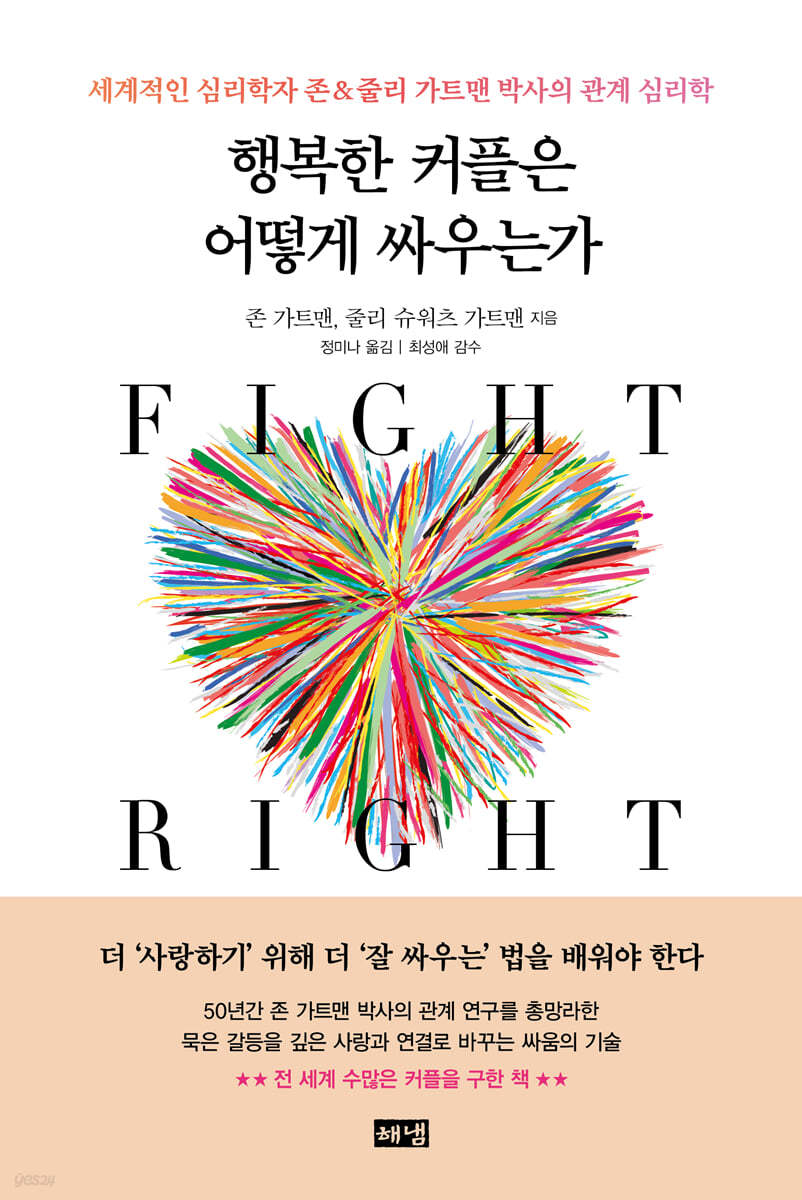
How Happy Couples Fight
 |
Description
Book Introduction
Conflict is another opportunity to understand each other more deeply.
World-renowned psychologists Dr. John & Julie Gottman
The ultimate conflict management manual, developed by Love Lab over 30 years of research and experience with thousands of couples.
“How could a puppy ruin a marriage?” Some people want to keep a puppy, others don’t… Often, such trivial differences of opinion can lead couples to ruin.
But behind the problem lies the fundamental and complex intertwining of two people's desires.
In this regard, Dr. John Gottman and Julie Schwartz Gottman, world-renowned psychologists and experts in relationship therapy, share their "wisdom of fighting" to help couples healthily resolve the numerous conflicts and crises they face in their relationships in their new book, "Fight Right: How Happy Couples Turn Conflict into Connection."
This is a conflict management manual that provides helpful guidance on everything from the psychological causes of conflict to typical types of fights and communication techniques for reconciliation.
Dr. John Gottman, professor emeritus of psychology at the University of Washington, who has been praised as the "Einstein of relationships," has compiled the "science of love" he has studied for over 50 years in this book.
It contains the secrets of love relationships scientifically revealed through long-term follow-up research on over 3,000 couples over 30 years at the Love Lab, the world's leading relationship research institute, together with his wife, Dr. Julie Schwartz Gottman.
The author, who has continued to evolve his research amidst the advancements in brain science and scientific technology, discovered sophisticated rules of interaction to maintain lasting affection by recording couples' interactions in hundredths of a second and encoding behavioral patterns through an AI program trained with the 'Specific Affective Encoding System (SPAFF)' after the coronavirus.
What Dr. Gottman and his wife noticed through this was the nature of the conflict between couples.
This book proposes a systematically established "rule of fighting" based on this, and provides specific guidelines for putting it into practice in daily life.
In particular, it was reviewed by Choi Seong-ae, director of HD Family Clinic, an internationally certified Gottman couples therapist and the only official Gottman research institute in Korea, adding to its credibility.
Even happy couples fight,
Just fight 'well'
While conflict and fights between couples are often considered to be something to be avoided, Dr. Gottman and his wife argue that couples' conflicts are actually opportunities to understand each other more deeply and form a closer bond.
Through conflict, couples can explore each other's values, unrecognized desires, and hidden dreams.
Of course, for this, you have to fight 'well'.
The key is not what you argue about, but how you argue about it.
Happy couples fight too, but what sets them apart from unhappy couples is that they choose to fight in a positive way.
Even when they argue, they respect each other's feelings, express concern and affection, empathize, use timely humor, and constantly try to reconcile.
This is also an action that maintains the positivity to negativity ratio of 5 to 1, which Dr. Gottman revealed as the 'secret of a happy relationship'.
In other words, if you can maintain this magic ratio, conflict will no longer be a hindrance to your relationship.
If we learn how to "fight well" and manage conflicts with our partners in a healthy way, we can remain together as loving partners based on trust and affection for a long time, regardless of the number or content of the fights.
World-renowned psychologists Dr. John & Julie Gottman
The ultimate conflict management manual, developed by Love Lab over 30 years of research and experience with thousands of couples.
“How could a puppy ruin a marriage?” Some people want to keep a puppy, others don’t… Often, such trivial differences of opinion can lead couples to ruin.
But behind the problem lies the fundamental and complex intertwining of two people's desires.
In this regard, Dr. John Gottman and Julie Schwartz Gottman, world-renowned psychologists and experts in relationship therapy, share their "wisdom of fighting" to help couples healthily resolve the numerous conflicts and crises they face in their relationships in their new book, "Fight Right: How Happy Couples Turn Conflict into Connection."
This is a conflict management manual that provides helpful guidance on everything from the psychological causes of conflict to typical types of fights and communication techniques for reconciliation.
Dr. John Gottman, professor emeritus of psychology at the University of Washington, who has been praised as the "Einstein of relationships," has compiled the "science of love" he has studied for over 50 years in this book.
It contains the secrets of love relationships scientifically revealed through long-term follow-up research on over 3,000 couples over 30 years at the Love Lab, the world's leading relationship research institute, together with his wife, Dr. Julie Schwartz Gottman.
The author, who has continued to evolve his research amidst the advancements in brain science and scientific technology, discovered sophisticated rules of interaction to maintain lasting affection by recording couples' interactions in hundredths of a second and encoding behavioral patterns through an AI program trained with the 'Specific Affective Encoding System (SPAFF)' after the coronavirus.
What Dr. Gottman and his wife noticed through this was the nature of the conflict between couples.
This book proposes a systematically established "rule of fighting" based on this, and provides specific guidelines for putting it into practice in daily life.
In particular, it was reviewed by Choi Seong-ae, director of HD Family Clinic, an internationally certified Gottman couples therapist and the only official Gottman research institute in Korea, adding to its credibility.
Even happy couples fight,
Just fight 'well'
While conflict and fights between couples are often considered to be something to be avoided, Dr. Gottman and his wife argue that couples' conflicts are actually opportunities to understand each other more deeply and form a closer bond.
Through conflict, couples can explore each other's values, unrecognized desires, and hidden dreams.
Of course, for this, you have to fight 'well'.
The key is not what you argue about, but how you argue about it.
Happy couples fight too, but what sets them apart from unhappy couples is that they choose to fight in a positive way.
Even when they argue, they respect each other's feelings, express concern and affection, empathize, use timely humor, and constantly try to reconcile.
This is also an action that maintains the positivity to negativity ratio of 5 to 1, which Dr. Gottman revealed as the 'secret of a happy relationship'.
In other words, if you can maintain this magic ratio, conflict will no longer be a hindrance to your relationship.
If we learn how to "fight well" and manage conflicts with our partners in a healthy way, we can remain together as loving partners based on trust and affection for a long time, regardless of the number or content of the fights.
- You can preview some of the book's contents.
Preview
index
Reviewer's Note: A Conflict Management Manual for Every Couple
Introduction: We're 'fighting' the wrong thing right now.
Part 1: Why do we fight?
Chapter 1: Couples Without Conflict Are More Dangerous
How to decipher the code of conflict
A typical fight sequence
The Fateful Reason Why Couples Inevitably Fight
Don't be afraid of anger and conflict.
Conflict is the royal road to understanding
Chapter 2 Why do we fight in similar patterns?
3 Conflict Styles Based on Couple Type
The success or failure of a relationship lies in the 'proportion'
Positivity vs. Negativity
Differences in superemotions lead to misunderstandings.
Stage 3 of the fight
Disagreements are not a hindrance to a relationship.
Can we change our conflict style?
Chapter 3: What on earth are they fighting about?
The ecstasy turned into thin ice in an instant
A clue to resolving deep-rooted conflicts
Resolvable fights and persistent fights
Factors that disrupt the fight
Deep wounds beneath the conflict
When it means the end of a relationship
10 Misconceptions About Conflict
A shortcut to a big mistake
Part 2: Conflict Management Methods Based on Couple Fight Types
Chapter 4: Throwing Bombs: Suddenly and Roughly Starting
A brief but decisive moment of opportunity
The most common mistake made during conflict
Why It's Common to Start Roughly
How to Open the Door to Conversation
It's a good start
Listen carefully to what the other person is saying
The effects of delaying persuasion
Scenarios for a smooth start
Words to bear depending on your conflict style
More smoothly!
Chapter 5: Attack and Defense: A sudden rush to attack and defense, then a sudden closure
What is 'Flood'?
Two couples caught in a flood
What's wrong?
When your own physiological alarm goes off
Solve this moment
Just express your desires
When to lie and when to tell the truth
Try to reconcile at every moment of the conversation
Talking about conflict without being swept away by the flood
It's okay to have different opinions
Chapter 6: Repeating superficial problems
A sign that you need to go deeper
Discovering Dreams in Conflict
A person who listens to dreams
The fact that money wasn't the issue
The worst conflicts are the best opportunities to build intimacy.
I need time to explore my memories.
What you want and what you don't want
How to Find Your Lost Dreams
Help for 'Dream Conversations'
Find out everything you can
Chapter 7: Zero-sum: Going to the edge of a cliff to win
If only we could see the situation from the other person's perspective
Zero-sum couple communication style
Give in to win
Accepting the influence of others
Don't be a rock blocking the road
A deserted island survival game where you explore each other's influence.
Winning through true compromise
Compromise and non-compete areas
When your partner's dreams are the exact opposite
Win-win, not win-lose
Let's make a compromise!
Chapter 8: The Trap of the Past: Constantly Bringing Up Past Events
Trying to 'just forget and move on'
Unresolved fights can last a lifetime.
A sign that the past needs to be dealt with
Everyone becomes an adult with a burden on their heart.
Each reality has its own valid reasons.
A 5-Step Test for Resolving Stale Conflicts
Now all we have to do is settle the fight.
How to fill deep cracks
Things to keep in mind when ending a fight
Outgoing text: Fighting well
A Quick Guide to Healthy Conflict Management
Acknowledgements
main
Introduction: We're 'fighting' the wrong thing right now.
Part 1: Why do we fight?
Chapter 1: Couples Without Conflict Are More Dangerous
How to decipher the code of conflict
A typical fight sequence
The Fateful Reason Why Couples Inevitably Fight
Don't be afraid of anger and conflict.
Conflict is the royal road to understanding
Chapter 2 Why do we fight in similar patterns?
3 Conflict Styles Based on Couple Type
The success or failure of a relationship lies in the 'proportion'
Positivity vs. Negativity
Differences in superemotions lead to misunderstandings.
Stage 3 of the fight
Disagreements are not a hindrance to a relationship.
Can we change our conflict style?
Chapter 3: What on earth are they fighting about?
The ecstasy turned into thin ice in an instant
A clue to resolving deep-rooted conflicts
Resolvable fights and persistent fights
Factors that disrupt the fight
Deep wounds beneath the conflict
When it means the end of a relationship
10 Misconceptions About Conflict
A shortcut to a big mistake
Part 2: Conflict Management Methods Based on Couple Fight Types
Chapter 4: Throwing Bombs: Suddenly and Roughly Starting
A brief but decisive moment of opportunity
The most common mistake made during conflict
Why It's Common to Start Roughly
How to Open the Door to Conversation
It's a good start
Listen carefully to what the other person is saying
The effects of delaying persuasion
Scenarios for a smooth start
Words to bear depending on your conflict style
More smoothly!
Chapter 5: Attack and Defense: A sudden rush to attack and defense, then a sudden closure
What is 'Flood'?
Two couples caught in a flood
What's wrong?
When your own physiological alarm goes off
Solve this moment
Just express your desires
When to lie and when to tell the truth
Try to reconcile at every moment of the conversation
Talking about conflict without being swept away by the flood
It's okay to have different opinions
Chapter 6: Repeating superficial problems
A sign that you need to go deeper
Discovering Dreams in Conflict
A person who listens to dreams
The fact that money wasn't the issue
The worst conflicts are the best opportunities to build intimacy.
I need time to explore my memories.
What you want and what you don't want
How to Find Your Lost Dreams
Help for 'Dream Conversations'
Find out everything you can
Chapter 7: Zero-sum: Going to the edge of a cliff to win
If only we could see the situation from the other person's perspective
Zero-sum couple communication style
Give in to win
Accepting the influence of others
Don't be a rock blocking the road
A deserted island survival game where you explore each other's influence.
Winning through true compromise
Compromise and non-compete areas
When your partner's dreams are the exact opposite
Win-win, not win-lose
Let's make a compromise!
Chapter 8: The Trap of the Past: Constantly Bringing Up Past Events
Trying to 'just forget and move on'
Unresolved fights can last a lifetime.
A sign that the past needs to be dealt with
Everyone becomes an adult with a burden on their heart.
Each reality has its own valid reasons.
A 5-Step Test for Resolving Stale Conflicts
Now all we have to do is settle the fight.
How to fill deep cracks
Things to keep in mind when ending a fight
Outgoing text: Fighting well
A Quick Guide to Healthy Conflict Management
Acknowledgements
main
Detailed image

Into the book
We are 'fighting' the wrong thing right now
Conflict is a natural part of all human relationships.
And it is a necessary part of all human relationships.
We tend to think that low conflict equals happiness, but that's not true.
The absence of conflict does not imply a strong relationship.
Rather, it is likely that the opposite relationship will occur.
A study conducted by the Divorce Mediation Research Project found that the majority of divorced couples cited growing distance and loss of intimacy as the main reason for their breakup.
However, our own research has shown that couples can have happy, long-lasting relationships, regardless of their conflict style.
It is not the presence or absence of conflict that determines whether a relationship will work or break.
Even happy couples fight.
The important thing is how you fight.
The problem is, we've never really learned how to do that.
---From the "Introductory Note"
The future of a relationship depends on how you fight.
Persistent problems between partners often stem from differences in personality and lifestyle tendencies.
It would be better if couples could be more accepting of each other's differences, but often times, they try to change their partner to be like them, and when that doesn't work, they blame their partner, which ends up causing the relationship to go astray.
These differences in temperament, which were once so attractive, later become a source of friction.
“I used to say, ‘I was attracted to his spontaneity,’” he says now.
“Why can’t you make a plan and then stick to it?” The person who once said, “I was completely captivated by her outgoing personality and great sense of humor,” now complains like this.
“When you go to a party, do you really have to grab everyone and talk to them?”
---From "Chapter 1: Couples Without Conflict Are More Dangerous"
Some of the more common "conflict styles" that exist in healthy partnerships are avoidant, accommodating, and irritable.
All three types are points on a spectrum rather than absolutes.
We don't belong 100 percent to one of these three types, but rather we fall somewhere in between, swaying in one direction or the other.
· Avoidant
There is a tendency to avoid conflicting conversations altogether.
I prefer to keep the peace by 'acknowledging each other's differences' rather than getting bogged down in a potentially hurtful conversation.
· Acceptable
We fight, but we fight respectfully.
We will discuss the issues together and try to find a compromise.
When we have different opinions, we are not afraid to address those differences.
· Angry type
Relatively speaking, conflicts erupt more frequently, are more heated, and are generally more intense and extreme.
There is nothing wrong with expressing emotions.
Rather, the expression of emotions is extremely natural.
---From Chapter 2, “Why Do We Fight in Similar Patterns?”
When attempts to connect go unnoticed or ignored become routine, and partners become disconnected, any fight can escalate into a violent one.
There is a greater tendency to misunderstand each other and interpret things very negatively.
Rather than gaining the ability to interpret each other's intentions in a positive light, it's easy to develop a lens through which you view your partner or their actions negatively.
When our emotional bank account is empty, we become more prone to relying on the four poisons: blame, contempt, defensiveness, and stonewalling.
If you and your partner have been having problems recently due to escalating or worsening conflict, answer the following questions:
·Are your recent attempts to connect with your partner getting a response?
·How are you responding to your partner's attempts to connect?
·Are you seeing a recurring pattern of ignoring or even turning your back on someone recently?
·How much is your emotional account filled now?
---From "Chapter 3: What on earth are they fighting about?"
Starting off rough is a very common problem.
In our recent global survey of 40,000 couples, 90 percent of all couples who entered therapy, regardless of sexual identity, experienced problems due to rough start and the subsequent fallout from those rough start.
Few couples have never struggled with this problem.
Starting off rough is generally the main thing they have in common.
① It starts with criticism.
Rather than pointing out the problem with the situation, I'm pointing out the problem with your identity as a person.
② Talk about someone other than yourself.
We often pick fights by talking about the other person and pointing out all the wrong things they did.
③ Pull out all the other lumps that have been pressed down.
The tendency to not deal with just one problem, that is, to pile up other problems that are bothering you and deal with them.
---From "Chapter 4: Throwing Bombs | Starting Roughly Suddenly"
Flooding is a state in which we become so overwhelmed by our nervous system in response to our partner's negativity during a conflict with them that we become unable to control ourselves.
As we observed with couples in the Love Lab, if a situation of overflow occurs between a couple and no intervention is made, the two will progress towards discord.
Because you can't fight well when you're in a flood.
The moment we fall into a flood, we begin to rapidly lose our ability to process information.
It becomes harder to pay attention.
I can't hear or understand what the other person is saying.
We react reflexively and deploy toxins that ruin relationships.
When this happens, the partner usually resorts to the fourth poison (damaging).
---From "Chapter 5 Attack and Defense | Rushing into a Rush and Then Shutting Down"
Manuel and Shanna had been having the same fight for years.
The couple, an interracial couple, are in their late 30s and have been married for nearly 10 years.
When they came to us for intensive couples therapy, they had no trouble explaining their situation and why they were fighting.
Because we've discussed that point hundreds of times.
There was no disagreement between the two as to the cause of the fight.
According to the couple, gift-giving and money issues were the cause of the fight.
On this point, both sides certainly agreed.
The problem was that the cause seemed impossible to resolve.
Every solution we came up with ran into difficulties.
The situation kept repeating itself, coming back to the same issue again and again.
If you're a couple stuck in a deadlocked, recurring conflict that's not making any progress, you need to pause, calm down, and dig deeper instead of moving forward.
---From "Chapter 6: Scratching the Surface | Repeating Superficial Problems"
Despite 40 years of research on love and conflict, we're still as vulnerable to bad fights as any other couple in the world.
But after this fight, we were in a more advantageous position than others.
Because we had a new blueprint for how to handle fights.
First of all, calm down.
My husband and I also didn't try to fix the fight right away the night we had it.
They were both too furious to do so.
When you are angry and flooded with anger, these five steps do not work well.
You should be able to see from a distance, broadening your perspective, as if you were a theater audience member sitting in the second-floor auditorium looking down on the play on stage.
You should be able to watch and describe, in a calm state, what happened in the play in the order you remember it.
The next day, my husband and I both calmed down and were able to take that distanced perspective.
So, we went through the five steps to end the fight.
Step 1: Talk about your feelings
Step 2: Recognize reality
Step 3: Recognize Your Triggers
Step 4: Accept Responsibility
Step 5: Make a constructive plan
Conflict is a natural part of all human relationships.
And it is a necessary part of all human relationships.
We tend to think that low conflict equals happiness, but that's not true.
The absence of conflict does not imply a strong relationship.
Rather, it is likely that the opposite relationship will occur.
A study conducted by the Divorce Mediation Research Project found that the majority of divorced couples cited growing distance and loss of intimacy as the main reason for their breakup.
However, our own research has shown that couples can have happy, long-lasting relationships, regardless of their conflict style.
It is not the presence or absence of conflict that determines whether a relationship will work or break.
Even happy couples fight.
The important thing is how you fight.
The problem is, we've never really learned how to do that.
---From the "Introductory Note"
The future of a relationship depends on how you fight.
Persistent problems between partners often stem from differences in personality and lifestyle tendencies.
It would be better if couples could be more accepting of each other's differences, but often times, they try to change their partner to be like them, and when that doesn't work, they blame their partner, which ends up causing the relationship to go astray.
These differences in temperament, which were once so attractive, later become a source of friction.
“I used to say, ‘I was attracted to his spontaneity,’” he says now.
“Why can’t you make a plan and then stick to it?” The person who once said, “I was completely captivated by her outgoing personality and great sense of humor,” now complains like this.
“When you go to a party, do you really have to grab everyone and talk to them?”
---From "Chapter 1: Couples Without Conflict Are More Dangerous"
Some of the more common "conflict styles" that exist in healthy partnerships are avoidant, accommodating, and irritable.
All three types are points on a spectrum rather than absolutes.
We don't belong 100 percent to one of these three types, but rather we fall somewhere in between, swaying in one direction or the other.
· Avoidant
There is a tendency to avoid conflicting conversations altogether.
I prefer to keep the peace by 'acknowledging each other's differences' rather than getting bogged down in a potentially hurtful conversation.
· Acceptable
We fight, but we fight respectfully.
We will discuss the issues together and try to find a compromise.
When we have different opinions, we are not afraid to address those differences.
· Angry type
Relatively speaking, conflicts erupt more frequently, are more heated, and are generally more intense and extreme.
There is nothing wrong with expressing emotions.
Rather, the expression of emotions is extremely natural.
---From Chapter 2, “Why Do We Fight in Similar Patterns?”
When attempts to connect go unnoticed or ignored become routine, and partners become disconnected, any fight can escalate into a violent one.
There is a greater tendency to misunderstand each other and interpret things very negatively.
Rather than gaining the ability to interpret each other's intentions in a positive light, it's easy to develop a lens through which you view your partner or their actions negatively.
When our emotional bank account is empty, we become more prone to relying on the four poisons: blame, contempt, defensiveness, and stonewalling.
If you and your partner have been having problems recently due to escalating or worsening conflict, answer the following questions:
·Are your recent attempts to connect with your partner getting a response?
·How are you responding to your partner's attempts to connect?
·Are you seeing a recurring pattern of ignoring or even turning your back on someone recently?
·How much is your emotional account filled now?
---From "Chapter 3: What on earth are they fighting about?"
Starting off rough is a very common problem.
In our recent global survey of 40,000 couples, 90 percent of all couples who entered therapy, regardless of sexual identity, experienced problems due to rough start and the subsequent fallout from those rough start.
Few couples have never struggled with this problem.
Starting off rough is generally the main thing they have in common.
① It starts with criticism.
Rather than pointing out the problem with the situation, I'm pointing out the problem with your identity as a person.
② Talk about someone other than yourself.
We often pick fights by talking about the other person and pointing out all the wrong things they did.
③ Pull out all the other lumps that have been pressed down.
The tendency to not deal with just one problem, that is, to pile up other problems that are bothering you and deal with them.
---From "Chapter 4: Throwing Bombs | Starting Roughly Suddenly"
Flooding is a state in which we become so overwhelmed by our nervous system in response to our partner's negativity during a conflict with them that we become unable to control ourselves.
As we observed with couples in the Love Lab, if a situation of overflow occurs between a couple and no intervention is made, the two will progress towards discord.
Because you can't fight well when you're in a flood.
The moment we fall into a flood, we begin to rapidly lose our ability to process information.
It becomes harder to pay attention.
I can't hear or understand what the other person is saying.
We react reflexively and deploy toxins that ruin relationships.
When this happens, the partner usually resorts to the fourth poison (damaging).
---From "Chapter 5 Attack and Defense | Rushing into a Rush and Then Shutting Down"
Manuel and Shanna had been having the same fight for years.
The couple, an interracial couple, are in their late 30s and have been married for nearly 10 years.
When they came to us for intensive couples therapy, they had no trouble explaining their situation and why they were fighting.
Because we've discussed that point hundreds of times.
There was no disagreement between the two as to the cause of the fight.
According to the couple, gift-giving and money issues were the cause of the fight.
On this point, both sides certainly agreed.
The problem was that the cause seemed impossible to resolve.
Every solution we came up with ran into difficulties.
The situation kept repeating itself, coming back to the same issue again and again.
If you're a couple stuck in a deadlocked, recurring conflict that's not making any progress, you need to pause, calm down, and dig deeper instead of moving forward.
---From "Chapter 6: Scratching the Surface | Repeating Superficial Problems"
Despite 40 years of research on love and conflict, we're still as vulnerable to bad fights as any other couple in the world.
But after this fight, we were in a more advantageous position than others.
Because we had a new blueprint for how to handle fights.
First of all, calm down.
My husband and I also didn't try to fix the fight right away the night we had it.
They were both too furious to do so.
When you are angry and flooded with anger, these five steps do not work well.
You should be able to see from a distance, broadening your perspective, as if you were a theater audience member sitting in the second-floor auditorium looking down on the play on stage.
You should be able to watch and describe, in a calm state, what happened in the play in the order you remember it.
The next day, my husband and I both calmed down and were able to take that distanced perspective.
So, we went through the five steps to end the fight.
Step 1: Talk about your feelings
Step 2: Recognize reality
Step 3: Recognize Your Triggers
Step 4: Accept Responsibility
Step 5: Make a constructive plan
---From "Chapter 8: Traps of the Past | Constantly Bringing Up Past Events"
Publisher's Review
This book, consisting of 8 chapters in 2 parts, guides you through the principles and techniques of fighting effectively while following the rules, just like in a sports game.
Part 1 explores the types of ways couples deal with conflict and addresses the root causes.
It helps you to check which type you are by categorizing conflict styles into ‘avoidant, irritable, and accommodating.’
Part 2 presents five common types of fights couples have and conflict management methods, including conversation techniques for each type.
The first type of fight starts harshly with accusations and blame, the second type of fight is one that gets heated up and then shuts down in an instant, the third type of fight is one that repeatedly fights over superficial issues like washing dishes and giving gifts, the fourth type of fight is one that pushes each other to the end to win over even trivial issues, and the fifth type of fight is one that constantly brings up past events.
The book also offers key tips for turning conflict into a positive one, including starting gently depending on the type of fight, stopping the fight when you feel swept away by physical, cognitive, or emotional flooding, asking magical questions that fulfill your dreams, identifying areas for compromise, and working through regrets. Above all, the authors emphasize starting gently, even when you're angry.
Because a gentle first word is a powerful tool that can help couples maintain a successful long-term relationship.
This book dissects fights, following the process from the moment a fight starts, through the escalation, to the aftermath, through the cases of couples of various ages, from their 20s to their 60s.
In particular, Dr. John and Julie Gottman candidly share their experiences of overcoming the unexpected fights, the recurring fights over the same issues, and the wrong fights as they got married and became parents, helping readers empathize.
Additionally, each chapter contains dialogue, questions, checklists, precautions, and attribute guides for each stage of the fight, so that couples can easily utilize them even during an argument.
Even psychologists who have dedicated 50 years to studying relationships say that couples fight.
Just take the fight one step at a time
When people with different backgrounds, personalities, and values come together, conflict is inevitable in the relationship.
Moreover, amidst rapid changes, stressful situations occurring in society and at home have been amplified, and we are facing more moments of conflict.
It is an environment where anyone can fight at any time, no matter what the problem.
If you're arguing over trivial matters right now, if you've said something you regret and are waiting for a chance to take it back, follow the rules of fighting presented in this book.
It will give couples and soon-to-be couples the opportunity to get to know each other more deeply and prevent unhappy relationships, and it will give married couples time to find true happiness and growth in their relationships.
It will provide practical solutions that can be applied not only to married couples, but also to anyone struggling in their relationships.
Moreover, at a time when reality shows are increasingly appearing, often too lightly, to examine the conflicts within relationships, observing couples heading toward divorce, this book will provide an opportunity to seriously consider the foundation for healthy relationships and long-lasting affection.
Part 1 explores the types of ways couples deal with conflict and addresses the root causes.
It helps you to check which type you are by categorizing conflict styles into ‘avoidant, irritable, and accommodating.’
Part 2 presents five common types of fights couples have and conflict management methods, including conversation techniques for each type.
The first type of fight starts harshly with accusations and blame, the second type of fight is one that gets heated up and then shuts down in an instant, the third type of fight is one that repeatedly fights over superficial issues like washing dishes and giving gifts, the fourth type of fight is one that pushes each other to the end to win over even trivial issues, and the fifth type of fight is one that constantly brings up past events.
The book also offers key tips for turning conflict into a positive one, including starting gently depending on the type of fight, stopping the fight when you feel swept away by physical, cognitive, or emotional flooding, asking magical questions that fulfill your dreams, identifying areas for compromise, and working through regrets. Above all, the authors emphasize starting gently, even when you're angry.
Because a gentle first word is a powerful tool that can help couples maintain a successful long-term relationship.
This book dissects fights, following the process from the moment a fight starts, through the escalation, to the aftermath, through the cases of couples of various ages, from their 20s to their 60s.
In particular, Dr. John and Julie Gottman candidly share their experiences of overcoming the unexpected fights, the recurring fights over the same issues, and the wrong fights as they got married and became parents, helping readers empathize.
Additionally, each chapter contains dialogue, questions, checklists, precautions, and attribute guides for each stage of the fight, so that couples can easily utilize them even during an argument.
Even psychologists who have dedicated 50 years to studying relationships say that couples fight.
Just take the fight one step at a time
When people with different backgrounds, personalities, and values come together, conflict is inevitable in the relationship.
Moreover, amidst rapid changes, stressful situations occurring in society and at home have been amplified, and we are facing more moments of conflict.
It is an environment where anyone can fight at any time, no matter what the problem.
If you're arguing over trivial matters right now, if you've said something you regret and are waiting for a chance to take it back, follow the rules of fighting presented in this book.
It will give couples and soon-to-be couples the opportunity to get to know each other more deeply and prevent unhappy relationships, and it will give married couples time to find true happiness and growth in their relationships.
It will provide practical solutions that can be applied not only to married couples, but also to anyone struggling in their relationships.
Moreover, at a time when reality shows are increasingly appearing, often too lightly, to examine the conflicts within relationships, observing couples heading toward divorce, this book will provide an opportunity to seriously consider the foundation for healthy relationships and long-lasting affection.
GOODS SPECIFICS
- Date of issue: December 20, 2024
- Page count, weight, size: 468 pages | 620g | 145*217*23mm
- ISBN13: 9791167141033
- ISBN10: 1167141032
You may also like
카테고리
korean


korean

![ELLE 엘르 스페셜 에디션 A형 : 12월 [2025]](http://librairie.coreenne.fr/cdn/shop/files/b8e27a3de6c9538896439686c6b0e8fb.jpg?v=1766436872&width=3840)


