

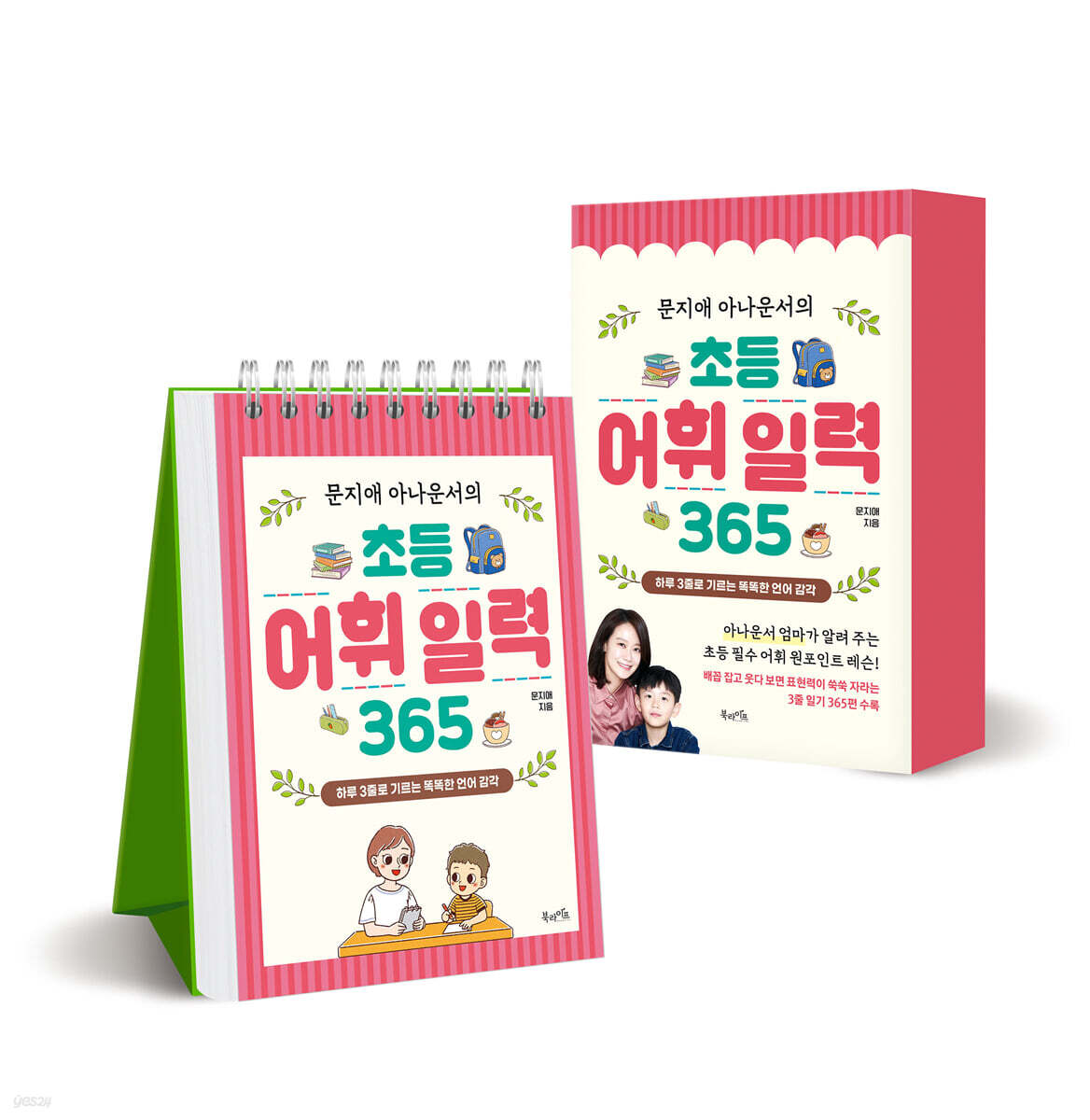
Announcer Moon Ji-ae's Elementary Vocabulary Calendar 365
 |
Description
Book Introduction
“If you just learn these expressions, you’ll be the king of elementary school vocabulary starting today!”
Announcer Mom tells you
Minimum Korean language study for elementary school students these days
Children who excel at reading not only have better comprehension skills but also greater empathy.
To quickly understand sentences and express your thoughts accurately and richly, it is important to learn a diverse vocabulary.
《Anchor Moon Ji-ae's Elementary Vocabulary Calendar 365》 is a book published by announcer Moon Ji-ae, who has provided useful information to many viewers through news, educational programs, and radio, to help children develop proper language habits and improve literacy skills.
Based on my expertise as an announcer with a good command of the language and my experience as a mother raising elementary school children, I have carefully selected 365 essential vocabulary words, including idioms, proverbs, and other words that elementary school students must know, so that children can learn a variety of vocabulary in a balanced way, one per day.
In particular, this book contains 365 three-line diaries (Beommin Diary) written by the author's son, Jeon Beommin, using newly learned vocabulary.
You can review today's vocabulary by reading a diary written in a fun way from the perspective of a peer.
If you turn the pages of the calendar one by one and practice expressions consistently and faithfully every day, your child will naturally acquire a variety of vocabulary.
Let's practice applying the new expressions you learned today to real life by writing a 'three-line diary'.
Before you know it, your child's reading, writing, and speaking skills will improve significantly, and they will also be able to develop good study habits.
Announcer Mom tells you
Minimum Korean language study for elementary school students these days
Children who excel at reading not only have better comprehension skills but also greater empathy.
To quickly understand sentences and express your thoughts accurately and richly, it is important to learn a diverse vocabulary.
《Anchor Moon Ji-ae's Elementary Vocabulary Calendar 365》 is a book published by announcer Moon Ji-ae, who has provided useful information to many viewers through news, educational programs, and radio, to help children develop proper language habits and improve literacy skills.
Based on my expertise as an announcer with a good command of the language and my experience as a mother raising elementary school children, I have carefully selected 365 essential vocabulary words, including idioms, proverbs, and other words that elementary school students must know, so that children can learn a variety of vocabulary in a balanced way, one per day.
In particular, this book contains 365 three-line diaries (Beommin Diary) written by the author's son, Jeon Beommin, using newly learned vocabulary.
You can review today's vocabulary by reading a diary written in a fun way from the perspective of a peer.
If you turn the pages of the calendar one by one and practice expressions consistently and faithfully every day, your child will naturally acquire a variety of vocabulary.
Let's practice applying the new expressions you learned today to real life by writing a 'three-line diary'.
Before you know it, your child's reading, writing, and speaking skills will improve significantly, and they will also be able to develop good study habits.
- You can preview some of the book's contents.
Preview
index
- 10 minutes a day, building basic Korean language skills through table conversation
-Read it like this
january
february
March
april
May
June
July
August
September
october
November
december
-Read it like this
january
february
March
april
May
June
July
August
September
october
November
december
Detailed image

Publisher's Review
Just talking to your child for 10 minutes a day will add up.
Basic Korean language skills!
These days, elementary school students are familiar with MBTI and new words, but they often have difficulty using idioms and spelling correctly.
Their vocabulary is so bad that they know '대행전' as 'big joint', '을씨년싶을서로' as 'swear word', '신나브로' as 'exciting', '개편하다' as 'really comfortable', '오금' as 'subway station name', '산님' as 'short for teacher', and '미딥다' as 'no faith'.
Because of this phenomenon, parents are very interested in their children's language skills, especially literacy, which is the ability to read, understand, and write.
Literacy is essential for children's learning ability, as well as for understanding textbooks and completing classes.
In order for children to understand and follow the curriculum well, it is very important to learn a variety of vocabulary and develop the habit of expressing themselves accurately from the early elementary school years.
Anchorwoman Moon Ji-ae, who recognized the need for children to learn Korean, published “Anchor Moon Ji-ae’s Elementary Vocabulary Calendar 365” based on her long career in broadcasting.
I wanted to pass on the Korean language skills I've developed over the years, using refined vocabulary and appropriate expressions in news and educational programs, to my son, who is in elementary school.
Idioms, idioms, spelling, and even proverbs
Complete mastery of essential vocabulary for elementary school students in one book.
This book contains 365 vocabulary words, including idioms, proverbs, and idioms.
Highly useful idioms and proverbs in daily life are designed for 2 days each, frequently used words but confusing spellings are designed for 1 day each, and proverbs that can be learned with fun pictures are designed for 2 days in total, so that children can learn a variety of vocabulary in a balanced way without getting bored, one page per day.
-Idioms: We have selected idioms that are frequently used in daily life, such as “gapron-eulbak,” “haksugodae,” “isiljikgog,” and “makgyeokjigan,” so you can learn the meaning and origin of today’s vocabulary along with interesting stories.
- Idioms: Various idioms such as 'taste the heat', 'hit the knee', 'get used to it', 'eat noodles', and 'stick out' are explained at a level suitable for children with real-life examples.
In addition to this, it also contains a wealth of expanded vocabulary, including synonyms and antonyms.
-Spelling: When delivering an object, should I use "geonneuda" or "geonnaeda"? When missing the bus, should I use "hamatyeon" or "hamatyeon"? When homework absolutely must be done, should I use "bangdeureotdeureot" or "be sure to"? We've selected the most common spelling mistakes in everyday life, such as similar spellings that can be confusing, to help children more easily learn the correct expressions.
- Proverbs: 'Well begun is half done', 'Eating mustard while crying', 'Even iron becomes a needle when sharpened', 'My nose is three feet long', etc. Yoon Sang unravels the origins of proverbs and real-life proverb stories along with the witty drawings of an illustrator.
If you read it every day, you will laugh and hold your stomach
A 3-line diary that will help you develop your expressive skills
Language skills are not developed overnight.
It becomes yours only when you read it a lot, write it often, and use it consistently in your daily life.
For this, it is very useful to write a diary, even if it is short, every day.
This book contains 365 three-line diaries written by the author's elementary school-aged son, Jeon Beom-min.
Beommin writes a simple three-line diary entry using newly learned vocabulary every day, demonstrating how he can use the vocabulary in real life.
By reading diaries written by peers like this, children can easily review the vocabulary they have learned, and by practicing writing their own diaries, even if briefly, they can solidify their vocabulary.
Build your Korean language confidence every day with one word a day and one page a day!
The most important thing for children to develop their language skills is consistent practice in daily life.
We encourage parents to actively utilize this book so that their children can read one page a day, naturally learn a variety of vocabulary and spelling, and build their language confidence.
If you are concerned about your elementary school child's vocabulary and literacy skills, who lives with their smartphones, or if you are a parent who is concerned about improving your child's vocabulary as well as your own, try placing "Anchor Moon Ji-ae's Elementary Vocabulary Calendar 365" on the dining table or living room and talking with your child.
Beyond simply learning vocabulary, children will develop the ability to express their thoughts clearly.
※Thanks for your help
Jeon Beom-min (son who wrote a diary of practical examples of application from a child's perspective)
Born in 2017, I am currently in the second grade of elementary school.
I like reading books and I love soccer.
Since I was six years old, I have been recording my day in three lines every day through the Instagram account 'Beommin Diary'.
My daily writing helped my mom a lot in writing her book.
·Instagram: bummin_diary
Illustration_Yoon Sang-eun
I majored in animation in college and am currently working as an illustrator.
Her published books include the illustrated essay for adults, “My Sister and I,” and the picture book for children, “Prince, Beware of Strangers!” She also illustrated “Reading Textbook Masterpieces for Elementary School Students” and “Little Birds.”
Instagram: paper_fly07
Basic Korean language skills!
These days, elementary school students are familiar with MBTI and new words, but they often have difficulty using idioms and spelling correctly.
Their vocabulary is so bad that they know '대행전' as 'big joint', '을씨년싶을서로' as 'swear word', '신나브로' as 'exciting', '개편하다' as 'really comfortable', '오금' as 'subway station name', '산님' as 'short for teacher', and '미딥다' as 'no faith'.
Because of this phenomenon, parents are very interested in their children's language skills, especially literacy, which is the ability to read, understand, and write.
Literacy is essential for children's learning ability, as well as for understanding textbooks and completing classes.
In order for children to understand and follow the curriculum well, it is very important to learn a variety of vocabulary and develop the habit of expressing themselves accurately from the early elementary school years.
Anchorwoman Moon Ji-ae, who recognized the need for children to learn Korean, published “Anchor Moon Ji-ae’s Elementary Vocabulary Calendar 365” based on her long career in broadcasting.
I wanted to pass on the Korean language skills I've developed over the years, using refined vocabulary and appropriate expressions in news and educational programs, to my son, who is in elementary school.
Idioms, idioms, spelling, and even proverbs
Complete mastery of essential vocabulary for elementary school students in one book.
This book contains 365 vocabulary words, including idioms, proverbs, and idioms.
Highly useful idioms and proverbs in daily life are designed for 2 days each, frequently used words but confusing spellings are designed for 1 day each, and proverbs that can be learned with fun pictures are designed for 2 days in total, so that children can learn a variety of vocabulary in a balanced way without getting bored, one page per day.
-Idioms: We have selected idioms that are frequently used in daily life, such as “gapron-eulbak,” “haksugodae,” “isiljikgog,” and “makgyeokjigan,” so you can learn the meaning and origin of today’s vocabulary along with interesting stories.
- Idioms: Various idioms such as 'taste the heat', 'hit the knee', 'get used to it', 'eat noodles', and 'stick out' are explained at a level suitable for children with real-life examples.
In addition to this, it also contains a wealth of expanded vocabulary, including synonyms and antonyms.
-Spelling: When delivering an object, should I use "geonneuda" or "geonnaeda"? When missing the bus, should I use "hamatyeon" or "hamatyeon"? When homework absolutely must be done, should I use "bangdeureotdeureot" or "be sure to"? We've selected the most common spelling mistakes in everyday life, such as similar spellings that can be confusing, to help children more easily learn the correct expressions.
- Proverbs: 'Well begun is half done', 'Eating mustard while crying', 'Even iron becomes a needle when sharpened', 'My nose is three feet long', etc. Yoon Sang unravels the origins of proverbs and real-life proverb stories along with the witty drawings of an illustrator.
If you read it every day, you will laugh and hold your stomach
A 3-line diary that will help you develop your expressive skills
Language skills are not developed overnight.
It becomes yours only when you read it a lot, write it often, and use it consistently in your daily life.
For this, it is very useful to write a diary, even if it is short, every day.
This book contains 365 three-line diaries written by the author's elementary school-aged son, Jeon Beom-min.
Beommin writes a simple three-line diary entry using newly learned vocabulary every day, demonstrating how he can use the vocabulary in real life.
By reading diaries written by peers like this, children can easily review the vocabulary they have learned, and by practicing writing their own diaries, even if briefly, they can solidify their vocabulary.
Build your Korean language confidence every day with one word a day and one page a day!
The most important thing for children to develop their language skills is consistent practice in daily life.
We encourage parents to actively utilize this book so that their children can read one page a day, naturally learn a variety of vocabulary and spelling, and build their language confidence.
If you are concerned about your elementary school child's vocabulary and literacy skills, who lives with their smartphones, or if you are a parent who is concerned about improving your child's vocabulary as well as your own, try placing "Anchor Moon Ji-ae's Elementary Vocabulary Calendar 365" on the dining table or living room and talking with your child.
Beyond simply learning vocabulary, children will develop the ability to express their thoughts clearly.
※Thanks for your help
Jeon Beom-min (son who wrote a diary of practical examples of application from a child's perspective)
Born in 2017, I am currently in the second grade of elementary school.
I like reading books and I love soccer.
Since I was six years old, I have been recording my day in three lines every day through the Instagram account 'Beommin Diary'.
My daily writing helped my mom a lot in writing her book.
·Instagram: bummin_diary
Illustration_Yoon Sang-eun
I majored in animation in college and am currently working as an illustrator.
Her published books include the illustrated essay for adults, “My Sister and I,” and the picture book for children, “Prince, Beware of Strangers!” She also illustrated “Reading Textbook Masterpieces for Elementary School Students” and “Little Birds.”
Instagram: paper_fly07
GOODS SPECIFICS
- Date of issue: October 4, 2024
- Format: Springbook book binding method guide
- Page count, weight, size: 384 pages | 126*178*30mm
- ISBN13: 9791191013726
- ISBN10: 1191013723
You may also like
카테고리
korean


korean

![GQ KOREA Mark (Monthly): December [2025]](http://librairie.coreenne.fr/cdn/shop/files/8ef265dbbfbf186523ed75ba7319009d.jpg?v=1765340328&width=3840)


