

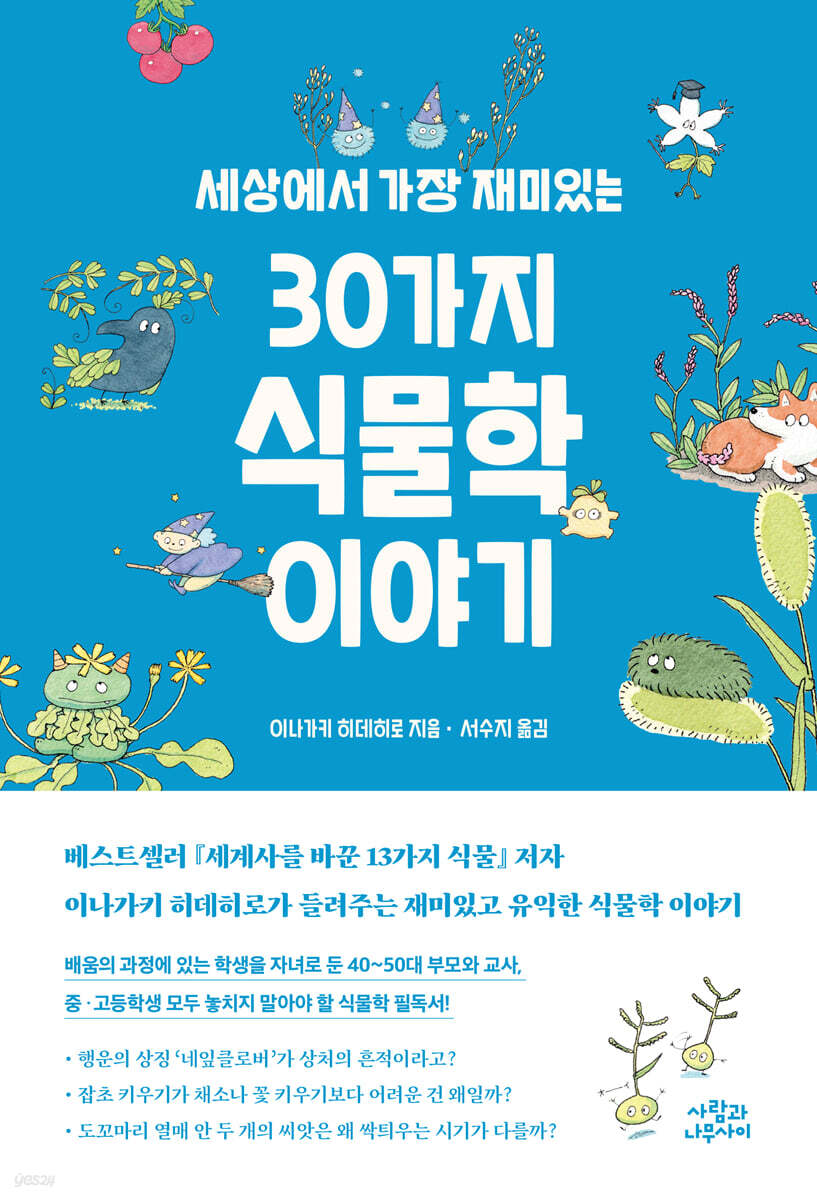
30 of the World's Most Interesting Botanical Facts
 |
Description
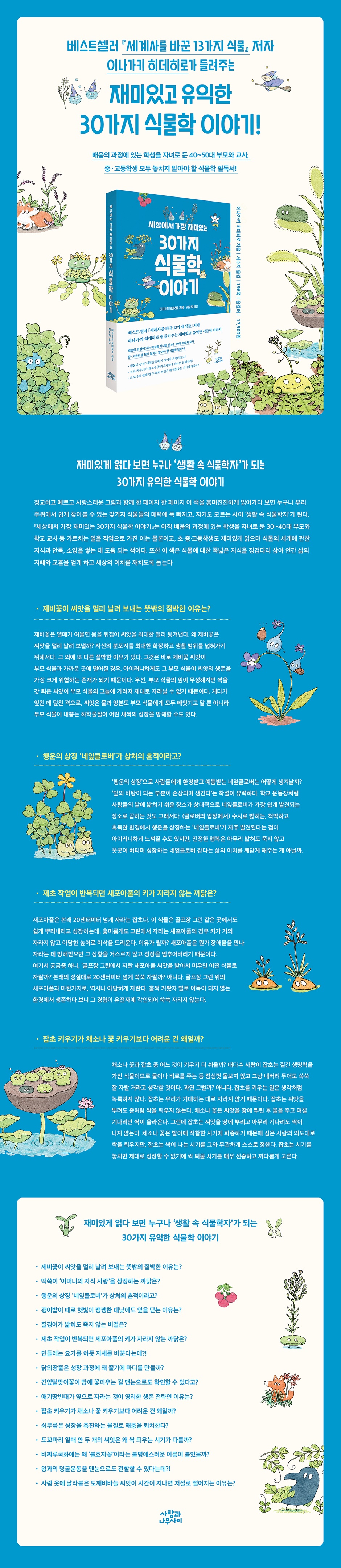
Book Introduction
A world-renowned botanist
Hidehiro Inagaki, considered one of the best writers in the field of botany, tells us
30 Fun and Informative Botanical Stories
One question.
“Why do violets flip their bodies over when their fruit ripens and fling the seeds far away?” Ironically, if the seeds fall near the parent plant, the parent plant becomes a fatal threat to the seed’s survival.
More specifically, it is because they have difficulty growing in the shade created by the lush leaves of the parent plant, are easily deprived of water and nutrients, and can become dangerous due to the chemicals emitted by the parent plant.
Two questions.
"The lucky four-leaf clover is a scar?" How do four-leaf clovers form? There are many reasons why four leaves form, but the most popular theory is that they form when the base of the leaf is damaged.
Therefore, places where people and animals frequently come and go and are 'frequently stepped on' are places where the probability of finding a four-leaf clover is relatively high.
Three questions.
“Why do the two seeds inside a cocklebur fruit sprout at different times?” Cocklebur fruits travel to unfamiliar lands by sticking to people’s clothes or animal fur, and it is not easy to determine when they should sprout in order to survive in unfamiliar lands.
For this reason, the genus Dokkomari evolved to contain both early-germinating and late-germinating seeds within its fruit.
As you read this book page by page with exquisite, beautiful, and lovely illustrations, you will be captivated by the charm of various plants that can be easily found around us, and before you know it, you will become a 'botanist in your life'.
"30 Most Interesting Botanical Stories in the World" is a book that will help build knowledge, insight, and understanding of the world of plants, not only for parents in their 30s and 40s with children still in the learning process, and for teachers, but also for elementary, middle, and high school students, while having fun reading it.
Furthermore, this book uses its extensive knowledge of plants as a stepping stone to gain wisdom and lessons for human life and to help us understand the ways of the world.
Hidehiro Inagaki, considered one of the best writers in the field of botany, tells us
30 Fun and Informative Botanical Stories
One question.
“Why do violets flip their bodies over when their fruit ripens and fling the seeds far away?” Ironically, if the seeds fall near the parent plant, the parent plant becomes a fatal threat to the seed’s survival.
More specifically, it is because they have difficulty growing in the shade created by the lush leaves of the parent plant, are easily deprived of water and nutrients, and can become dangerous due to the chemicals emitted by the parent plant.
Two questions.
"The lucky four-leaf clover is a scar?" How do four-leaf clovers form? There are many reasons why four leaves form, but the most popular theory is that they form when the base of the leaf is damaged.
Therefore, places where people and animals frequently come and go and are 'frequently stepped on' are places where the probability of finding a four-leaf clover is relatively high.
Three questions.
“Why do the two seeds inside a cocklebur fruit sprout at different times?” Cocklebur fruits travel to unfamiliar lands by sticking to people’s clothes or animal fur, and it is not easy to determine when they should sprout in order to survive in unfamiliar lands.
For this reason, the genus Dokkomari evolved to contain both early-germinating and late-germinating seeds within its fruit.
As you read this book page by page with exquisite, beautiful, and lovely illustrations, you will be captivated by the charm of various plants that can be easily found around us, and before you know it, you will become a 'botanist in your life'.
"30 Most Interesting Botanical Stories in the World" is a book that will help build knowledge, insight, and understanding of the world of plants, not only for parents in their 30s and 40s with children still in the learning process, and for teachers, but also for elementary, middle, and high school students, while having fun reading it.
Furthermore, this book uses its extensive knowledge of plants as a stepping stone to gain wisdom and lessons for human life and to help us understand the ways of the world.
- You can preview some of the book's contents.
Preview
index
1.
What is the unexpectedly desperate reason why violets send their seeds far away?
2.
Why do rosette plants spread only their leaves on the ground?
3.
They say that even a hawk grows by 'looking sideways'?!
4.
How is a poribangi different from a gaboribbongi?
5.
Even the dandelions that stretch out to the side look up at the sky?
6.
Why does mugwort symbolize ‘a mother’s love for her child’?
7.
The lucky symbol, the four-leaf clover, is a scar?
8.
Why is the Korean dandelion called 'Bujacho'?
9.
Why do dandelions sometimes close their leaves even in the bright sunlight of the day?
10.
What is the secret to not dying even when stepped on?
11.
Why doesn't the height of the cellophane plant grow when weeding is repeated?
12.
Dandelions change their poses like they do yoga?!
13.
Why does the chicken manure plant form nodes on its stems during growth?
14.
You can see with the naked eye that the evening primrose blooms at night?
15.
Why is growing sideways a clever survival strategy for baby ground beetles?
16.
Why is growing weeds more difficult than growing vegetables or flowers?
17.
They say that purslane is also a plant that grows sideways?!
18.
Why is the dog grass called 'puppy grass'?
19.
Why is the stem of the goldenrod triangular?
20.
Does ox knee repel pests with growth promoting substances?
21.
Why do the two seeds inside a dokkomari fruit sprout at different times?
22.
Why did the chrysanthemum get the dishonorable name of “unfilial flower”?
23.
You can observe the vine movement with the king with the naked eye?!
24.
Why are the roots of the Sukryong so difficult to pull out?
25.
Why are weeds like reeds stronger and more durable than crops?
26.
Why do both right-handed and left-handed flowers exist among water hyacinths?
27.
Why is kudzu considered a plant with strong personality?
28.
Why is the plant called yeomju given this name?
29.
It is said that the dogwood is a surprisingly useful plant for humans?!
30.
Why do the goblin needle seeds stuck to people's clothes fall off on their own over time?
What is the unexpectedly desperate reason why violets send their seeds far away?
2.
Why do rosette plants spread only their leaves on the ground?
3.
They say that even a hawk grows by 'looking sideways'?!
4.
How is a poribangi different from a gaboribbongi?
5.
Even the dandelions that stretch out to the side look up at the sky?
6.
Why does mugwort symbolize ‘a mother’s love for her child’?
7.
The lucky symbol, the four-leaf clover, is a scar?
8.
Why is the Korean dandelion called 'Bujacho'?
9.
Why do dandelions sometimes close their leaves even in the bright sunlight of the day?
10.
What is the secret to not dying even when stepped on?
11.
Why doesn't the height of the cellophane plant grow when weeding is repeated?
12.
Dandelions change their poses like they do yoga?!
13.
Why does the chicken manure plant form nodes on its stems during growth?
14.
You can see with the naked eye that the evening primrose blooms at night?
15.
Why is growing sideways a clever survival strategy for baby ground beetles?
16.
Why is growing weeds more difficult than growing vegetables or flowers?
17.
They say that purslane is also a plant that grows sideways?!
18.
Why is the dog grass called 'puppy grass'?
19.
Why is the stem of the goldenrod triangular?
20.
Does ox knee repel pests with growth promoting substances?
21.
Why do the two seeds inside a dokkomari fruit sprout at different times?
22.
Why did the chrysanthemum get the dishonorable name of “unfilial flower”?
23.
You can observe the vine movement with the king with the naked eye?!
24.
Why are the roots of the Sukryong so difficult to pull out?
25.
Why are weeds like reeds stronger and more durable than crops?
26.
Why do both right-handed and left-handed flowers exist among water hyacinths?
27.
Why is kudzu considered a plant with strong personality?
28.
Why is the plant called yeomju given this name?
29.
It is said that the dogwood is a surprisingly useful plant for humans?!
30.
Why do the goblin needle seeds stuck to people's clothes fall off on their own over time?
Detailed image
Into the book
Why do plants disperse their seeds far? One reason is to expand their distribution area.
It is to expand the range of life by moving seeds to distant places.
In this way, plants thrive.
But if you think about it carefully, there is no guarantee that a seed that has set out on a long journey will sprout safely, grow, and settle in suitable soil.
But why do plants send their seeds on such long journeys? Beyond the need to expand their territory, there's another, more important reason why plant seeds embark on such reckless journeys.
This is to keep the next generation of plants as far away from the parent plant as possible.
When a seed falls near the parent plant, ironically, the parent plant becomes the biggest threat to the seed's survival.
This is because when the parent plant's leaves become lush, the newly sprouted seeds are shaded by the parent plant and cannot grow sufficiently.
Moreover, seeds also take water and nutrients from the parent plant.
Chemicals emitted by the parent plant may hinder the growth of young shoots.
--- From "The unexpectedly desperate reason why violets send their seeds far away?"
The four-leaf clover is widely known as a symbol of good luck. It is said that this originates from St. Patrick, the patron saint of Ireland, who likened the three leaves of the clover to the trinity of 'love, hope, and faith' and then said that the fourth leaf represented 'happiness'.
Many people probably have memories of wandering around a field frantically looking for a four-leaf clover.
Hide and seek, where you search for four-leaf clovers hidden in a cluster of clovers, is a fun game for both children and adults.
The secret to finding a four-leaf clover hidden among mostly three-leaf clovers is to find a place where four leaves are likely to form, and your chances of success will increase.
There are various theories as to why four leaves appear, but the most well-known one is that they appear when the base of the leaf is damaged.
So the first secret to finding a four-leaf clover is to search places where people can easily step on it, such as roadsides or school playgrounds.
--- From "The lucky symbol 'four-leaf clover' is a scar?"
The leaves of the plantain grow flat on the ground, so that they can be less impacted when stepped on.
The large leaves look soft and smooth, but inside the leaves are five strong threads.
You can pull out these threads by tearing off the leaves and gently pulling them out.
It is flexible and strong, so it does not get crushed or crushed even when stepped on or flattened.
In order to bloom, the stem must extend, and unlike the leaves, the stem is hard on the outside and soft on the inside.
So it can change shape flexibly as it is stepped on and does not break.
It's not just about enduring a life of being trampled on.
The seeds of the plantain contain a jelly-like substance that becomes sticky when wet and can stick to people's shoes or car tires.
Just as dandelions spread their seeds on the wind, plantains spread their seeds when people step on them.
So, you can see the expansion of the power of the sedge along the road.
--- From "What is the secret to not dying even when stepped on?"
When a plant's growth is hindered by an obstacle, it stops growing rather than trying to overcome the situation.
The new poa grass does not grow taller if weeded repeatedly.
It is a mysterious providence of nature.
If you take seeds of the new sedge that grew on the golf course green and grow them, they will grow nicely.
Because they live in an environment where there is no benefit to growing up, they do not grow well.
Golf courses have courses with different grass heights, such as fairways and roughs, in addition to greens, so weeding is done at different heights for each.
If you collect newpoa grass seeds from each course and grow them, they will all hang down to the same height as when the weeding work was done.
Growth has stopped due to obstacles.
This is the survival strategy of the new poa plant.
These survival strategies can be found in other plants as well.
For example, if you pamper a flower in a pot too much, it will only grow to a cute size.
Environments that involve a lot of human intervention seem to provide stimuli that are no different from obstacles, such as weeding.
--- From “Why doesn’t the height of the cellophane plant grow when weeding is repeated?”
Baby ground beetles thrive in places with a lot of foot traffic, such as on sidewalks.
If you try to climb up, you will be crushed flat by being stepped on, so you use a strategy of growing sideways from the beginning to avoid the shock of being stepped on.
But while everyone else grows vertically, is it okay for the plant to grow horizontally? Will it receive the sunlight essential for plant survival? Since it's crawling along the ground, won't it be unable to receive enough sunlight? Of course, these are all unnecessary worries.
There aren't many plants that can grow in an environment where they are prone to being trampled.
Since there are no other plants to compete with, the baby's breath can monopolize sunlight with its leaves even when growing horizontally.
What about flowers, then? Wouldn't pollinating insects like bees and others pass by the flowers of the common ground beetle without even noticing them? Actually, there's no need to worry about that either.
This is because the baby ground beetle uses a strategy of transferring pollen to ants rather than bees or bees.
Ants move along the stems of the honeybee plant to collect nectar, and in the process, pollen that gets stuck around the ants' mouths is transferred to other places.
Ants are practical insects that gather only for the scent of honey, so there is no need to decorate them with beautiful petals to attract bees and ants like other plants.
--- From "Why is it a smart survival strategy for baby ground beetles to grow sideways?"
Inside the dokkomari fruit there are two long seeds.
Although the seeds were placed side by side, each had a different personality.
The big one is the impatient older brother who sprouts first, and the small one is the leisurely younger brother who sprouts later.
Why are seeds of different natures found together within a single fruit? The fruit of the dwarf clings to human clothing or animal fur, transporting it to unfamiliar lands.
It would have been difficult to estimate when to sprout in order to survive in the new land.
So, there are seeds that sprout quickly and seeds that sprout late.
You can't say which of two seeds with different personalities is smart and which is not.
It is a mystery of nature that the Dokkomari have survived until now thanks to their different personalities.
--- From "Why do the two seeds inside the dokkomari fruit sprout at different times?"
There are many different ways to stick.
Some have hook-shaped thorns, while others stick like Velcro, commonly called hook-and-loop fasteners, and each type sticks in a different way.
After passing through the grass, you have a hard time removing the goblin needles that are stuck to your clothes.
However, the annoyingly stubborn goblin needles that were hard to come off, miraculously fall off on their own if left alone.
The providence of nature is mysterious.
The goblin's needle is something that has stuck to your clothes in preparation for a journey to a new land, so if it continues to hang on, it will never be able to take root in the ground and will never be able to sprout.
So, the goblin needle has evolved to adjust its strength appropriately so that it can stick tightly or fall off naturally over time.
For example, the seeds of the hairy goblin needle stick to clothes with needles that look like fish harpoons, but these needles are brittle and fall off over time.
It is to expand the range of life by moving seeds to distant places.
In this way, plants thrive.
But if you think about it carefully, there is no guarantee that a seed that has set out on a long journey will sprout safely, grow, and settle in suitable soil.
But why do plants send their seeds on such long journeys? Beyond the need to expand their territory, there's another, more important reason why plant seeds embark on such reckless journeys.
This is to keep the next generation of plants as far away from the parent plant as possible.
When a seed falls near the parent plant, ironically, the parent plant becomes the biggest threat to the seed's survival.
This is because when the parent plant's leaves become lush, the newly sprouted seeds are shaded by the parent plant and cannot grow sufficiently.
Moreover, seeds also take water and nutrients from the parent plant.
Chemicals emitted by the parent plant may hinder the growth of young shoots.
--- From "The unexpectedly desperate reason why violets send their seeds far away?"
The four-leaf clover is widely known as a symbol of good luck. It is said that this originates from St. Patrick, the patron saint of Ireland, who likened the three leaves of the clover to the trinity of 'love, hope, and faith' and then said that the fourth leaf represented 'happiness'.
Many people probably have memories of wandering around a field frantically looking for a four-leaf clover.
Hide and seek, where you search for four-leaf clovers hidden in a cluster of clovers, is a fun game for both children and adults.
The secret to finding a four-leaf clover hidden among mostly three-leaf clovers is to find a place where four leaves are likely to form, and your chances of success will increase.
There are various theories as to why four leaves appear, but the most well-known one is that they appear when the base of the leaf is damaged.
So the first secret to finding a four-leaf clover is to search places where people can easily step on it, such as roadsides or school playgrounds.
--- From "The lucky symbol 'four-leaf clover' is a scar?"
The leaves of the plantain grow flat on the ground, so that they can be less impacted when stepped on.
The large leaves look soft and smooth, but inside the leaves are five strong threads.
You can pull out these threads by tearing off the leaves and gently pulling them out.
It is flexible and strong, so it does not get crushed or crushed even when stepped on or flattened.
In order to bloom, the stem must extend, and unlike the leaves, the stem is hard on the outside and soft on the inside.
So it can change shape flexibly as it is stepped on and does not break.
It's not just about enduring a life of being trampled on.
The seeds of the plantain contain a jelly-like substance that becomes sticky when wet and can stick to people's shoes or car tires.
Just as dandelions spread their seeds on the wind, plantains spread their seeds when people step on them.
So, you can see the expansion of the power of the sedge along the road.
--- From "What is the secret to not dying even when stepped on?"
When a plant's growth is hindered by an obstacle, it stops growing rather than trying to overcome the situation.
The new poa grass does not grow taller if weeded repeatedly.
It is a mysterious providence of nature.
If you take seeds of the new sedge that grew on the golf course green and grow them, they will grow nicely.
Because they live in an environment where there is no benefit to growing up, they do not grow well.
Golf courses have courses with different grass heights, such as fairways and roughs, in addition to greens, so weeding is done at different heights for each.
If you collect newpoa grass seeds from each course and grow them, they will all hang down to the same height as when the weeding work was done.
Growth has stopped due to obstacles.
This is the survival strategy of the new poa plant.
These survival strategies can be found in other plants as well.
For example, if you pamper a flower in a pot too much, it will only grow to a cute size.
Environments that involve a lot of human intervention seem to provide stimuli that are no different from obstacles, such as weeding.
--- From “Why doesn’t the height of the cellophane plant grow when weeding is repeated?”
Baby ground beetles thrive in places with a lot of foot traffic, such as on sidewalks.
If you try to climb up, you will be crushed flat by being stepped on, so you use a strategy of growing sideways from the beginning to avoid the shock of being stepped on.
But while everyone else grows vertically, is it okay for the plant to grow horizontally? Will it receive the sunlight essential for plant survival? Since it's crawling along the ground, won't it be unable to receive enough sunlight? Of course, these are all unnecessary worries.
There aren't many plants that can grow in an environment where they are prone to being trampled.
Since there are no other plants to compete with, the baby's breath can monopolize sunlight with its leaves even when growing horizontally.
What about flowers, then? Wouldn't pollinating insects like bees and others pass by the flowers of the common ground beetle without even noticing them? Actually, there's no need to worry about that either.
This is because the baby ground beetle uses a strategy of transferring pollen to ants rather than bees or bees.
Ants move along the stems of the honeybee plant to collect nectar, and in the process, pollen that gets stuck around the ants' mouths is transferred to other places.
Ants are practical insects that gather only for the scent of honey, so there is no need to decorate them with beautiful petals to attract bees and ants like other plants.
--- From "Why is it a smart survival strategy for baby ground beetles to grow sideways?"
Inside the dokkomari fruit there are two long seeds.
Although the seeds were placed side by side, each had a different personality.
The big one is the impatient older brother who sprouts first, and the small one is the leisurely younger brother who sprouts later.
Why are seeds of different natures found together within a single fruit? The fruit of the dwarf clings to human clothing or animal fur, transporting it to unfamiliar lands.
It would have been difficult to estimate when to sprout in order to survive in the new land.
So, there are seeds that sprout quickly and seeds that sprout late.
You can't say which of two seeds with different personalities is smart and which is not.
It is a mystery of nature that the Dokkomari have survived until now thanks to their different personalities.
--- From "Why do the two seeds inside the dokkomari fruit sprout at different times?"
There are many different ways to stick.
Some have hook-shaped thorns, while others stick like Velcro, commonly called hook-and-loop fasteners, and each type sticks in a different way.
After passing through the grass, you have a hard time removing the goblin needles that are stuck to your clothes.
However, the annoyingly stubborn goblin needles that were hard to come off, miraculously fall off on their own if left alone.
The providence of nature is mysterious.
The goblin's needle is something that has stuck to your clothes in preparation for a journey to a new land, so if it continues to hang on, it will never be able to take root in the ground and will never be able to sprout.
So, the goblin needle has evolved to adjust its strength appropriately so that it can stick tightly or fall off naturally over time.
For example, the seeds of the hairy goblin needle stick to clothes with needles that look like fish harpoons, but these needles are brittle and fall off over time.
--- From "Why do the goblin needle seeds stuck to people's clothes fall off on their own over time?"
Publisher's Review
A world-renowned botanist and botanist
Hidehiro Inagaki, considered one of the best writers, tells us
30 Fun and Informative Botanical Stories
As you read this book page by page with exquisite, beautiful, and lovely illustrations, you will be captivated by the charm of various plants that can be easily found around us, and before you know it, you will become a 'botanist in your life'.
"30 Most Interesting Botanical Stories in the World" is a book that will help build knowledge, insight, and understanding of the world of plants, not only for parents in their 30s and 40s with children still in the learning process, and for teachers, but also for elementary, middle, and high school students, while having fun reading it.
Furthermore, this book uses its extensive knowledge of plants as a stepping stone to gain wisdom and lessons for human life and to help us understand the ways of the world.
"30 of the World's Most Interesting Botanical Stories" is packed with living knowledge that reveals the hidden truths and surprising secrets of familiar plants you've always been curious about but never knew their names or characteristics.
By the time you turn the last page of this book, people will be calling you a "lifetime botanist."
If you read it with interest, anyone can become a ‘botanist in life’.
30 Useful Botanical Facts
What is the unexpectedly desperate reason why violets send their seeds far away?
Dandelions spread their seeds with their fluffy hairs, and cockleburs carry their thorny fruits over long distances by sticking to people's clothes or animal fur.
The same goes for violets.
When the fruit ripens, the insect flips over and flings the seeds as far as possible.
Why do these types of plants disperse their seeds so far? The common reason is to maximize their distribution and expand their range.
Besides these reasons, there is another pressing reason, for example, in the case of violets.
This is because, ironically, when a violet seed falls close to its parent plant, the parent plant becomes the biggest threat to the seed's survival.
Why? First, when the parent plant's leaves become lush, the newly sprouted seeds are shaded by the parent plant and cannot grow properly.
To make matters worse, not only do the seeds lose all their water and nutrients to the parent plant, but the chemicals emitted by the parent plant can also hinder the growth of the young sprouts.
For this reason, violets try to spread their seeds as far as possible so that they can take root, grow, and live as independent organisms.
The lucky symbol, the four-leaf clover, is a scar?
The four-leaf clover is very rare compared to the three-leaf clover, so it is welcomed and loved by people as a 'symbol of good luck'.
A sudden question arises: 'How do four-leaf clovers form?' Scholars have various theories about why clovers have four leaves, but the most widely known reason is that 'the base of the leaf is damaged and forms.'
For this reason, places where people's feet easily step on them, such as school playgrounds, are considered to be the places where four-leaf clovers are most easily found.
It may seem a bit ironic that the 'four-leaf clover', a symbol of good luck, is often found in harsh and inhospitable environments (from the clover's perspective) where it is frequently trampled on.
But if you think about it differently.
I think that true happiness is like a four-leaf clover that grows and endures without dying even when stepped on.
Why doesn't the new poa plant grow taller when weeding is repeated?
The new-poa grass is a weed that originally grows over 20 centimeters.
This plant can easily take root and grow even on places like golf course greens, but interestingly, the new poa grass that grows on the greens doesn't grow very tall and instead produces small, drooping heads.
Why? Because when the new-leafed plant encounters an obstacle that impedes its growth, it stops growing without fighting back.
In environments where weeding is done frequently, such as golf course greens, the new poa grass does not grow tall.
We cannot help but recognize it as a plant that survives wisely by adapting to the environment rather than fighting against it.
Here's a question: If you were to collect seeds of a new-leafed sedge plant grown on a golf course green and plant them, what kind of plant would they grow into? Would they grow taller than 20 centimeters, as they naturally do? No.
Like the new poa grass on the golf course green, it grows neatly.
Because they survive in an environment where growing up doesn't bring them much benefit, that experience is imprinted on their genes and they don't grow up quickly.
Why is growing weeds more difficult than growing vegetables or flowers?
Imagine growing weeds like you would vegetables or flowers.
Perhaps eight or nine out of ten people think that weeds are plants with tenacious vitality, so they will grow well even if left alone without much care, such as watering or fertilizing.
Is that really true? No.
Growing weeds is not as easy as it sounds.
Why? Because weeds don't grow as we expect.
Weeds are hard to sprout even if you sow their seeds.
For vegetables or flowers, after sowing the seeds in the ground, water them and wait a few days for them to sprout.
But weeds are different.
No matter how long you wait after sowing the seeds in the ground, they do not sprout.
Vegetables and flowers sprout as we intend because we sow them at the right time for germination, but weeds decide the time of sprouting on their own, regardless of human intention.
Weeds cannot grow properly if the timing is missed, so they are very careful and picky about when to sprout.
Hidehiro Inagaki, considered one of the best writers, tells us
30 Fun and Informative Botanical Stories
As you read this book page by page with exquisite, beautiful, and lovely illustrations, you will be captivated by the charm of various plants that can be easily found around us, and before you know it, you will become a 'botanist in your life'.
"30 Most Interesting Botanical Stories in the World" is a book that will help build knowledge, insight, and understanding of the world of plants, not only for parents in their 30s and 40s with children still in the learning process, and for teachers, but also for elementary, middle, and high school students, while having fun reading it.
Furthermore, this book uses its extensive knowledge of plants as a stepping stone to gain wisdom and lessons for human life and to help us understand the ways of the world.
"30 of the World's Most Interesting Botanical Stories" is packed with living knowledge that reveals the hidden truths and surprising secrets of familiar plants you've always been curious about but never knew their names or characteristics.
By the time you turn the last page of this book, people will be calling you a "lifetime botanist."
If you read it with interest, anyone can become a ‘botanist in life’.
30 Useful Botanical Facts
What is the unexpectedly desperate reason why violets send their seeds far away?
Dandelions spread their seeds with their fluffy hairs, and cockleburs carry their thorny fruits over long distances by sticking to people's clothes or animal fur.
The same goes for violets.
When the fruit ripens, the insect flips over and flings the seeds as far as possible.
Why do these types of plants disperse their seeds so far? The common reason is to maximize their distribution and expand their range.
Besides these reasons, there is another pressing reason, for example, in the case of violets.
This is because, ironically, when a violet seed falls close to its parent plant, the parent plant becomes the biggest threat to the seed's survival.
Why? First, when the parent plant's leaves become lush, the newly sprouted seeds are shaded by the parent plant and cannot grow properly.
To make matters worse, not only do the seeds lose all their water and nutrients to the parent plant, but the chemicals emitted by the parent plant can also hinder the growth of the young sprouts.
For this reason, violets try to spread their seeds as far as possible so that they can take root, grow, and live as independent organisms.
The lucky symbol, the four-leaf clover, is a scar?
The four-leaf clover is very rare compared to the three-leaf clover, so it is welcomed and loved by people as a 'symbol of good luck'.
A sudden question arises: 'How do four-leaf clovers form?' Scholars have various theories about why clovers have four leaves, but the most widely known reason is that 'the base of the leaf is damaged and forms.'
For this reason, places where people's feet easily step on them, such as school playgrounds, are considered to be the places where four-leaf clovers are most easily found.
It may seem a bit ironic that the 'four-leaf clover', a symbol of good luck, is often found in harsh and inhospitable environments (from the clover's perspective) where it is frequently trampled on.
But if you think about it differently.
I think that true happiness is like a four-leaf clover that grows and endures without dying even when stepped on.
Why doesn't the new poa plant grow taller when weeding is repeated?
The new-poa grass is a weed that originally grows over 20 centimeters.
This plant can easily take root and grow even on places like golf course greens, but interestingly, the new poa grass that grows on the greens doesn't grow very tall and instead produces small, drooping heads.
Why? Because when the new-leafed plant encounters an obstacle that impedes its growth, it stops growing without fighting back.
In environments where weeding is done frequently, such as golf course greens, the new poa grass does not grow tall.
We cannot help but recognize it as a plant that survives wisely by adapting to the environment rather than fighting against it.
Here's a question: If you were to collect seeds of a new-leafed sedge plant grown on a golf course green and plant them, what kind of plant would they grow into? Would they grow taller than 20 centimeters, as they naturally do? No.
Like the new poa grass on the golf course green, it grows neatly.
Because they survive in an environment where growing up doesn't bring them much benefit, that experience is imprinted on their genes and they don't grow up quickly.
Why is growing weeds more difficult than growing vegetables or flowers?
Imagine growing weeds like you would vegetables or flowers.
Perhaps eight or nine out of ten people think that weeds are plants with tenacious vitality, so they will grow well even if left alone without much care, such as watering or fertilizing.
Is that really true? No.
Growing weeds is not as easy as it sounds.
Why? Because weeds don't grow as we expect.
Weeds are hard to sprout even if you sow their seeds.
For vegetables or flowers, after sowing the seeds in the ground, water them and wait a few days for them to sprout.
But weeds are different.
No matter how long you wait after sowing the seeds in the ground, they do not sprout.
Vegetables and flowers sprout as we intend because we sow them at the right time for germination, but weeds decide the time of sprouting on their own, regardless of human intention.
Weeds cannot grow properly if the timing is missed, so they are very careful and picky about when to sprout.
GOODS SPECIFICS
- Date of issue: March 3, 2025
- Page count, weight, size: 196 pages | 322g | 140*205*17mm
- ISBN13: 9791194096085
- ISBN10: 1194096085
You may also like
카테고리
korean


korean

![GQ KOREA Mark (Monthly): December [2025]](http://librairie.coreenne.fr/cdn/shop/files/8ef265dbbfbf186523ed75ba7319009d.jpg?v=1765340328&width=3840)


