

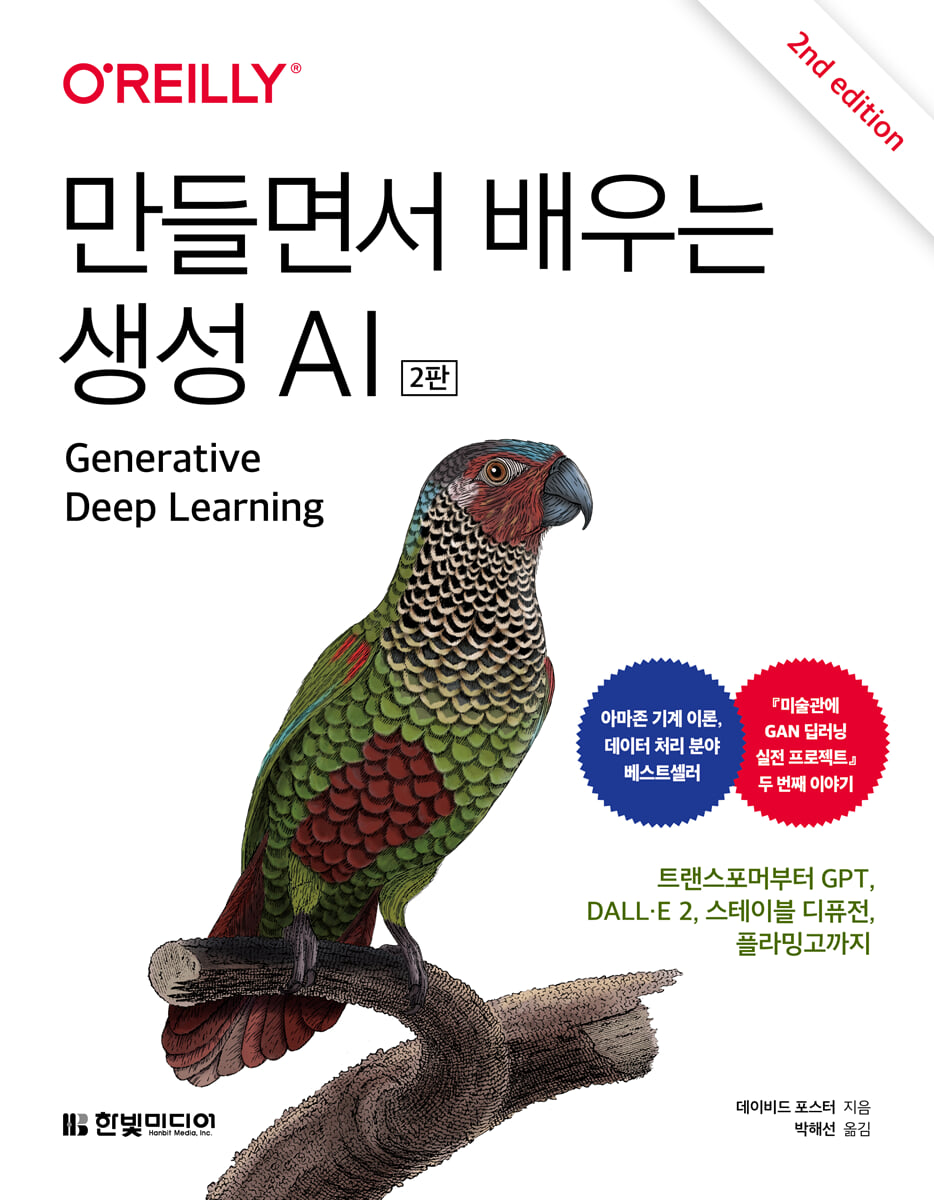
Generative AI that learns while creating
 |
Description
Book Introduction
A Complete Guide to Generative AI: Transcending the Boundaries of Evolution and Innovation
This book explains everything from the basics of deep learning to the latest generative AI models.
We'll cover how to use TensorFlow and Keras to build impressive generative deep learning models, including variational autoencoders (VAEs), generative adversarial networks (GANs), transformers, normalized flow models, energy-based models, and denoising diffusion models.
Learn how to use various generative AI to efficiently train models and create creative generative models.
This book explains everything from the basics of deep learning to the latest generative AI models.
We'll cover how to use TensorFlow and Keras to build impressive generative deep learning models, including variational autoencoders (VAEs), generative adversarial networks (GANs), transformers, normalized flow models, energy-based models, and denoising diffusion models.
Learn how to use various generative AI to efficiently train models and create creative generative models.
- You can preview some of the book's contents.
Preview
index
[PART 1: Introduction to Generative Deep Learning]
CHAPTER 1 Generative Modeling
_1.1 What is generative modeling?
_1.2 First generation model
_1.3 Core probability theory
_1.4 Generative Model Classification
_1.5 Generating Deep Learning Example Code
_1.6 Summary
CHAPTER 2 DEEP LEARNING
_2.1 Data for deep learning
_2.2 Deep Neural Networks
_2.3 Multilayer Perceptron
_2.4 Convolutional Neural Network
_2.5 Summary
[PART 2: 6 Generative Modeling Methods]
CHAPTER 3 Variational Autoencoders
_3.1 Introduction
_3.2 Autoencoder
_3.3 Variational Autoencoder
_3.4 Exploring the latent space
_3.5 Summary
CHAPTER 4 Generative Adversarial Networks
_4.1 Introduction
_4.2 Deep Convolutional GAN (DCGAN)
_4.3 Wasserstein GAN-Gradient Penalty (WGAN-GP)
_4.4 Conditional GAN (CGAN)
_4.5 Summary
CHAPTER 5 Autoregressive Models
_5.1 Introduction
_5.2 Introduction to LSTM Networks
_5.3 RNN Extension
_5.4 PixelCNN
_5.5 Summary
CHAPTER 6: NORMALIZING FLOW MODEL
_6.1 Introduction
_6.2 Normalizing Flow
_6.3 RealNVP
_6.4 Other normalizing flow models
_6.5 Summary
CHAPTER 7 Energy-Based Models
_7.1 Introduction
_7.2 Energy-based model
_7.3 Summary
CHAPTER 8 Diffusion Models
_8.1 Introduction
_8.2 Noise Reduction Diffusion Model
_8.3 Summary
[PART 3 Applications of Generative Modeling]
CHAPTER 9 TRANSFORMERS
_9.1 Introduction
_9.2 GPT
_9.3 Other Transformers
_9.4 Summary
CHAPTER 10 ADVANCED GAN
_10.1 Introduction
_10.2 ProGAN
_10.3 StyleGAN
_10.4 StyleGAN2
_10.5 Other important GANs
_10.6 Summary
CHAPTER 11 MUSIC CREATION
_11.1 Introduction
_11.2 Transformers for music generation
_11.3 MuseGAN
_11.4 Summary
CHAPTER 12 World Model
_12.1 Introduction
_12.2 Reinforcement Learning
_12.3 World Model Overview
_12.4 Random Rollout Data Collection
_12.5 VAE Training
_12.6 Collecting MDN-RNN training data
_12.7 MDN-RNN Training
_12.8 Controller Training
_12.9 Training in Dreams
_12.10 Summary
CHAPTER 13 Multimodal Models
_13.1 Introduction
_13.2 DALL?E 2
_13.3 Imagen
_13.4 Stable Diffusion
_13.5 Flamingo
_13.6 Summary
CHAPTER 14 CONCLUSION
_14.1 Timeline of Generated AI
_14.2 Current State of Generative AI
_14.3 The Future of Generative AI
_14.4 Final Comments
CHAPTER 1 Generative Modeling
_1.1 What is generative modeling?
_1.2 First generation model
_1.3 Core probability theory
_1.4 Generative Model Classification
_1.5 Generating Deep Learning Example Code
_1.6 Summary
CHAPTER 2 DEEP LEARNING
_2.1 Data for deep learning
_2.2 Deep Neural Networks
_2.3 Multilayer Perceptron
_2.4 Convolutional Neural Network
_2.5 Summary
[PART 2: 6 Generative Modeling Methods]
CHAPTER 3 Variational Autoencoders
_3.1 Introduction
_3.2 Autoencoder
_3.3 Variational Autoencoder
_3.4 Exploring the latent space
_3.5 Summary
CHAPTER 4 Generative Adversarial Networks
_4.1 Introduction
_4.2 Deep Convolutional GAN (DCGAN)
_4.3 Wasserstein GAN-Gradient Penalty (WGAN-GP)
_4.4 Conditional GAN (CGAN)
_4.5 Summary
CHAPTER 5 Autoregressive Models
_5.1 Introduction
_5.2 Introduction to LSTM Networks
_5.3 RNN Extension
_5.4 PixelCNN
_5.5 Summary
CHAPTER 6: NORMALIZING FLOW MODEL
_6.1 Introduction
_6.2 Normalizing Flow
_6.3 RealNVP
_6.4 Other normalizing flow models
_6.5 Summary
CHAPTER 7 Energy-Based Models
_7.1 Introduction
_7.2 Energy-based model
_7.3 Summary
CHAPTER 8 Diffusion Models
_8.1 Introduction
_8.2 Noise Reduction Diffusion Model
_8.3 Summary
[PART 3 Applications of Generative Modeling]
CHAPTER 9 TRANSFORMERS
_9.1 Introduction
_9.2 GPT
_9.3 Other Transformers
_9.4 Summary
CHAPTER 10 ADVANCED GAN
_10.1 Introduction
_10.2 ProGAN
_10.3 StyleGAN
_10.4 StyleGAN2
_10.5 Other important GANs
_10.6 Summary
CHAPTER 11 MUSIC CREATION
_11.1 Introduction
_11.2 Transformers for music generation
_11.3 MuseGAN
_11.4 Summary
CHAPTER 12 World Model
_12.1 Introduction
_12.2 Reinforcement Learning
_12.3 World Model Overview
_12.4 Random Rollout Data Collection
_12.5 VAE Training
_12.6 Collecting MDN-RNN training data
_12.7 MDN-RNN Training
_12.8 Controller Training
_12.9 Training in Dreams
_12.10 Summary
CHAPTER 13 Multimodal Models
_13.1 Introduction
_13.2 DALL?E 2
_13.3 Imagen
_13.4 Stable Diffusion
_13.5 Flamingo
_13.6 Summary
CHAPTER 14 CONCLUSION
_14.1 Timeline of Generated AI
_14.2 Current State of Generative AI
_14.3 The Future of Generative AI
_14.4 Final Comments
Detailed image

Publisher's Review
Part 2 of "GAN Deep Learning in the Art Museum: A Practical Project"
The past, present, and future of generative AI that changed the world.
David Foster is back, explaining generative AI clearly and persuasively.
The first edition of this book, "GAN Deep Learning Practical Project for Art Museums," focused on GANs, but the field of generative AI has advanced significantly since its publication.
We've updated the 2nd edition to capture the dazzling advancements in generative AI that have astonished the world.
We've updated the existing content with the latest technical information, added more detailed transformer descriptions, and added new multimodal model content.
The upgraded second edition is now available under the new name, "Learning Generative AI by Creating," as it doesn't cover content specific to GANs.
Armed with cutting-edge technology, this book will transform you into a generative AI expert, complete with engaging stories, practical examples, and practical applications.
Learn how to use the most advanced computer-aided creative techniques.
It's okay if you have no experience with generative AI.
We will guide you step by step from the beginning so that you can learn the skills.
All you need is some Python coding experience.
After understanding the fundamentals of generative models, learn generative AI by coding directly with Python and Keras.
What's changed in the 2nd edition
-Chapter 1 introduces various generative models and contains a classification system that shows their relationships.
-Chapter 2 has improved illustrations and explains key concepts in more detail.
-Chapter 3 contains new examples and explanations.
-Chapter 4 explains the conditional GAN architecture.
-Chapter 5 describes autoregressive models for images (e.g., PixelCNN).
-Chapter 6 is a completely new chapter, explaining the RealNVP model.
-Chapter 7 is also new and focuses on techniques such as Langevin dynamics and contrastive divergence.
-Chapter 8 is a newly written chapter for noise-removing diffusion models, which form the basis of many modern applications today.
-Chapter 9 expands on the last chapter of the first edition, providing in-depth coverage of various StyleGAN model architectures and new content on VQ-GAN.
-Chapter 10 is a new chapter that takes a closer look at the transformer architecture.
-Chapter 11 covers the latest transformer architecture, replacing the LSTM model from the first edition.
-Chapter 12 has updated illustrations and explanations, and introduces how this approach influences today's state-of-the-art reinforcement learning.
-Chapter 13 is a new chapter that details how impressive models such as DALL·E 2, Imagen, Stable Diffusion, and Flamingo work.
Chapter 14 reflects the remarkable progress made in generative AI since the first edition and provides a more complete and detailed view of where things are headed next.
Target audience
- Undergraduate students and developers who want to understand how generative AI works and try using it themselves.
Machine learning engineers, data scientists, and researchers interested in the latest deep learning technologies.
Key Contents
-Change facial expressions in photos with VAE
- Generating images using a GAN trained on its own dataset.
-Creating new flower types using a diffusion model
-Training your own GPT for text generation
Learn how to train ChatGPT, a large-scale language model.
-Investigate state-of-the-art architectures such as StyleGAN2 and ViT VQ-GAN.
-Composing polyphonic music using Transformers and MuseGAN
- Understand how world models solve reinforcement learning tasks.
-Learn about multimodal models such as DALL·E 2, Imagen, and Stable Diffusion.
The past, present, and future of generative AI that changed the world.
David Foster is back, explaining generative AI clearly and persuasively.
The first edition of this book, "GAN Deep Learning Practical Project for Art Museums," focused on GANs, but the field of generative AI has advanced significantly since its publication.
We've updated the 2nd edition to capture the dazzling advancements in generative AI that have astonished the world.
We've updated the existing content with the latest technical information, added more detailed transformer descriptions, and added new multimodal model content.
The upgraded second edition is now available under the new name, "Learning Generative AI by Creating," as it doesn't cover content specific to GANs.
Armed with cutting-edge technology, this book will transform you into a generative AI expert, complete with engaging stories, practical examples, and practical applications.
Learn how to use the most advanced computer-aided creative techniques.
It's okay if you have no experience with generative AI.
We will guide you step by step from the beginning so that you can learn the skills.
All you need is some Python coding experience.
After understanding the fundamentals of generative models, learn generative AI by coding directly with Python and Keras.
What's changed in the 2nd edition
-Chapter 1 introduces various generative models and contains a classification system that shows their relationships.
-Chapter 2 has improved illustrations and explains key concepts in more detail.
-Chapter 3 contains new examples and explanations.
-Chapter 4 explains the conditional GAN architecture.
-Chapter 5 describes autoregressive models for images (e.g., PixelCNN).
-Chapter 6 is a completely new chapter, explaining the RealNVP model.
-Chapter 7 is also new and focuses on techniques such as Langevin dynamics and contrastive divergence.
-Chapter 8 is a newly written chapter for noise-removing diffusion models, which form the basis of many modern applications today.
-Chapter 9 expands on the last chapter of the first edition, providing in-depth coverage of various StyleGAN model architectures and new content on VQ-GAN.
-Chapter 10 is a new chapter that takes a closer look at the transformer architecture.
-Chapter 11 covers the latest transformer architecture, replacing the LSTM model from the first edition.
-Chapter 12 has updated illustrations and explanations, and introduces how this approach influences today's state-of-the-art reinforcement learning.
-Chapter 13 is a new chapter that details how impressive models such as DALL·E 2, Imagen, Stable Diffusion, and Flamingo work.
Chapter 14 reflects the remarkable progress made in generative AI since the first edition and provides a more complete and detailed view of where things are headed next.
Target audience
- Undergraduate students and developers who want to understand how generative AI works and try using it themselves.
Machine learning engineers, data scientists, and researchers interested in the latest deep learning technologies.
Key Contents
-Change facial expressions in photos with VAE
- Generating images using a GAN trained on its own dataset.
-Creating new flower types using a diffusion model
-Training your own GPT for text generation
Learn how to train ChatGPT, a large-scale language model.
-Investigate state-of-the-art architectures such as StyleGAN2 and ViT VQ-GAN.
-Composing polyphonic music using Transformers and MuseGAN
- Understand how world models solve reinforcement learning tasks.
-Learn about multimodal models such as DALL·E 2, Imagen, and Stable Diffusion.
GOODS SPECIFICS
- Date of issue: September 15, 2023
- Page count, weight, size: 480 pages | 1,195g | 183*235*30mm
- ISBN13: 9791169211437
- ISBN10: 1169211437
You may also like
카테고리
korean


korean

![GQ KOREA Mark (Monthly): December [2025]](http://librairie.coreenne.fr/cdn/shop/files/8ef265dbbfbf186523ed75ba7319009d.jpg?v=1765340328&width=3840)


