

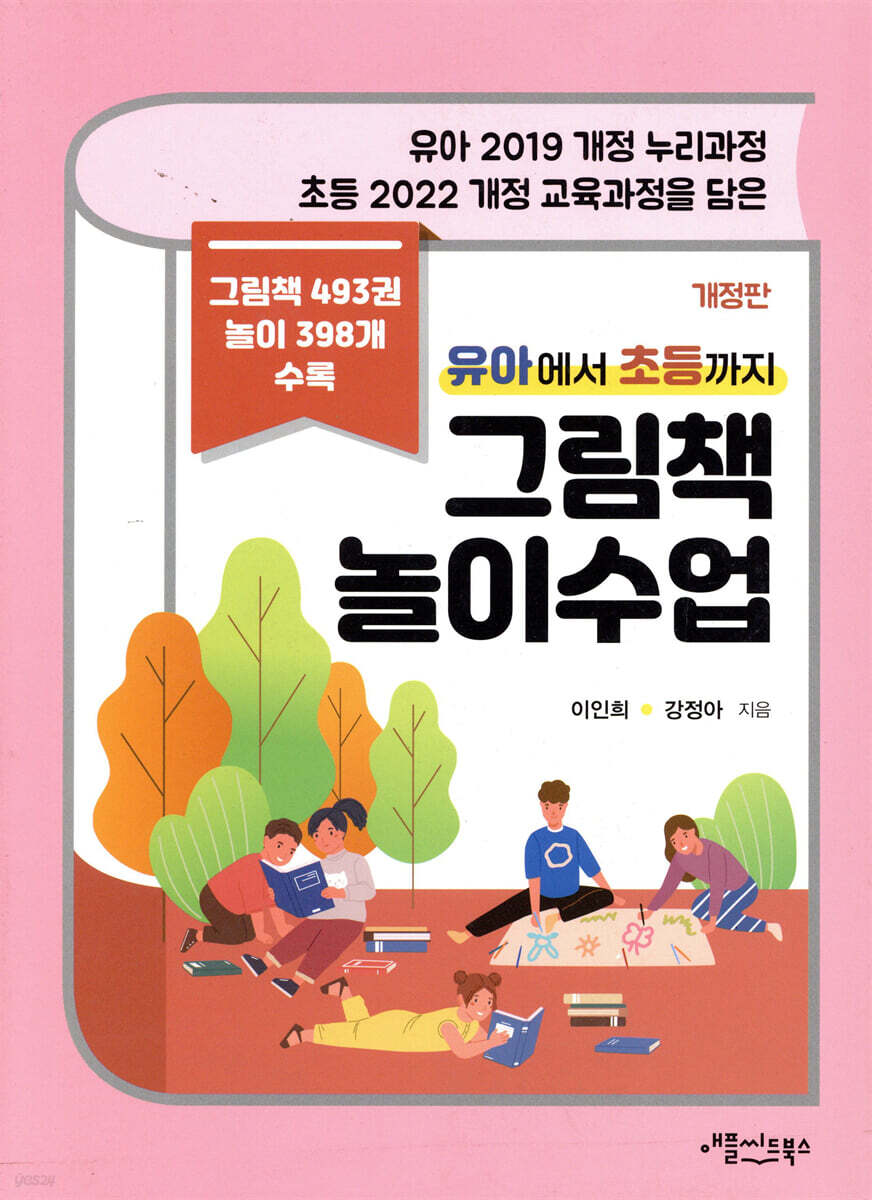
Picture book play classes for children from toddlers to elementary school students
 |
Description
Book Introduction
A playful lesson book that integrates picture books and school subjects.
An effective way to connect and integrate the kindergarten and elementary school curriculum is through play.
To this end, authors Lee In-hee and Kang Jeong-ah, who teach picture book play classes, have published “Picture Book Play Classes from Infants to Elementary School” based on their field experience and the 2019 revised Nuri Curriculum for infants and the 2022 revised elementary school curriculum.
It is important to become familiar with books because project classes that integrate picture books and school subjects according to the child's interests increase the enjoyment of learning and the quality of education.
I hope this book will serve as a solid stepping stone for teachers who are concerned about providing happy education to children.
I also hope that parents of toddlers and elementary school children will read it.
An effective way to connect and integrate the kindergarten and elementary school curriculum is through play.
To this end, authors Lee In-hee and Kang Jeong-ah, who teach picture book play classes, have published “Picture Book Play Classes from Infants to Elementary School” based on their field experience and the 2019 revised Nuri Curriculum for infants and the 2022 revised elementary school curriculum.
It is important to become familiar with books because project classes that integrate picture books and school subjects according to the child's interests increase the enjoyment of learning and the quality of education.
I hope this book will serve as a solid stepping stone for teachers who are concerned about providing happy education to children.
I also hope that parents of toddlers and elementary school children will read it.
- You can preview some of the book's contents.
Preview
index
Recommendation | Prologue | How to Use Picture Book Play Classes | Redesigned for the 2019 Revised Early Childhood Curriculum | Redesigned for the 2022 Revised Elementary School Curriculum's "Integrated Subjects"
Part 1.
Early Childhood Social Relationships, Physical Exercise, and Health & Elementary Integration and Social Studies
Village Map Project
Have you ever drawn a map? - A large piece of paper
Chapter 1 - School
What kind of bag do you want? | First graders are leaving!
Have you ever hated a friend? | The day you hated your friend
Chapter 2 - Me
Do you love me? | I wish I were another animal
Chapter 3 - Family
Is there anything more empowering than family? | A magnificent doghouse
What's the weather like for our family? | Our home weather forecast
Chapter 4 - The Village
Who lives next door? | I'm moving to a 10-story, large, wooden apartment.
What jobs are available in the village? | Police officer in Dotori Village
Chapter 5 - The Village
What if I fall into a pit? | Rokube, just wait a minute.
Are you playing in a safe place? | Sooni and her younger sibling
How to use fire safely? | Hope
Chapter 6 - The Country
Can you feast in a tiger's belly? | A feast in a tiger's belly
Who will win the second race? | The Tortoise and the Hare's Journey Around the World
Chapter 7 - Space
What is it like outside Earth? | Not knowing is cool
Part 2.
Early Childhood Nature Exploration and Art Experience & Elementary Integrated Science and Arts
Four Seasons Project
Why are trees shapeshifters? | Trees are shapeshifters
Chapter 1 - One Day
What's a Day Like for a Child in Our Country? | A Day in the Life of Seven Children in Seven Countries
Chapter 2 - Spring
What's in the frog's bag? | What's in the bag?
What were spring outings like in the old days? | Dallaene Flower Viewing
Chapter 3 - Summer
Which pool would you like to go to? | Watermelon Pool
Do you like rainy days? | It's nice when it rains.
Chapter 4 - Autumn
Who do you want to go to the mountains with? | Let's go to the mountains
What's your favorite Chuseok game? | Ssireum Goblin Chuseok
Chapter 5 - Winter
What's the most fun thing to do on a snowy day? | Snowy Day
What do you most want to do for Christmas? | Ferdi's Christmas
Part 3.
Early Childhood Communication & Elementary Korean Language
Letter Project
What do you want to hear most from your mom? | Mom's voice said
Chapter 1 - Listening and Speaking
What if I mishear and misunderstand? | Iparapanyamunyamu
What are the benefits of speaking nicely? | Don't get angry, speak nicely. 239
Chapter 2 - Reading
Is there anything that makes me laugh? | Gogumaguma
Is there someone you feel good with? | Mr. Gumpy's Drive
Chapter 3 - Writing
Why should I keep a diary? | School days
Chapter 4 - Grammar
Can I make letters with my body? | Try this with my body
Chapter 5 - Literature
Have you ever read a book to someone? | The Reading Gorilla
Want to play tag together? | Siridongdong Spiderdongdong
Chapter 6 - Media
How do you use digital media? | Saturday with Dad
Part 4.
Early Childhood Nature Exploration & Elementary Math
Number Project
What if all the numbers in the world disappeared? | Star Princess
Chapter 1 - Numbers and Operations
What's the hardest order to wait for? | Next is you
What do I want to share? | The doorbell keeps ringing.
Chapter 2 - Change and Relationships
Let's find some rules in life! | Buy a hat!
Chapter 3 - Shapes
What if you went to a world made of shapes? | Square Country, Triangle Country, Circle Country
Are Circles and Balls Different? | The Gorilla King and the Cannon
Chapter 4 - Measurement
The longer the better? | If my hair grows long
Can you tell the exact time? | I keep getting more and more clocks.
Chapter 5 - Data and Possibilities
Can Fish Get Colds? | Fish with Colds
Epilogue
Part 1.
Early Childhood Social Relationships, Physical Exercise, and Health & Elementary Integration and Social Studies
Village Map Project
Have you ever drawn a map? - A large piece of paper
Chapter 1 - School
What kind of bag do you want? | First graders are leaving!
Have you ever hated a friend? | The day you hated your friend
Chapter 2 - Me
Do you love me? | I wish I were another animal
Chapter 3 - Family
Is there anything more empowering than family? | A magnificent doghouse
What's the weather like for our family? | Our home weather forecast
Chapter 4 - The Village
Who lives next door? | I'm moving to a 10-story, large, wooden apartment.
What jobs are available in the village? | Police officer in Dotori Village
Chapter 5 - The Village
What if I fall into a pit? | Rokube, just wait a minute.
Are you playing in a safe place? | Sooni and her younger sibling
How to use fire safely? | Hope
Chapter 6 - The Country
Can you feast in a tiger's belly? | A feast in a tiger's belly
Who will win the second race? | The Tortoise and the Hare's Journey Around the World
Chapter 7 - Space
What is it like outside Earth? | Not knowing is cool
Part 2.
Early Childhood Nature Exploration and Art Experience & Elementary Integrated Science and Arts
Four Seasons Project
Why are trees shapeshifters? | Trees are shapeshifters
Chapter 1 - One Day
What's a Day Like for a Child in Our Country? | A Day in the Life of Seven Children in Seven Countries
Chapter 2 - Spring
What's in the frog's bag? | What's in the bag?
What were spring outings like in the old days? | Dallaene Flower Viewing
Chapter 3 - Summer
Which pool would you like to go to? | Watermelon Pool
Do you like rainy days? | It's nice when it rains.
Chapter 4 - Autumn
Who do you want to go to the mountains with? | Let's go to the mountains
What's your favorite Chuseok game? | Ssireum Goblin Chuseok
Chapter 5 - Winter
What's the most fun thing to do on a snowy day? | Snowy Day
What do you most want to do for Christmas? | Ferdi's Christmas
Part 3.
Early Childhood Communication & Elementary Korean Language
Letter Project
What do you want to hear most from your mom? | Mom's voice said
Chapter 1 - Listening and Speaking
What if I mishear and misunderstand? | Iparapanyamunyamu
What are the benefits of speaking nicely? | Don't get angry, speak nicely. 239
Chapter 2 - Reading
Is there anything that makes me laugh? | Gogumaguma
Is there someone you feel good with? | Mr. Gumpy's Drive
Chapter 3 - Writing
Why should I keep a diary? | School days
Chapter 4 - Grammar
Can I make letters with my body? | Try this with my body
Chapter 5 - Literature
Have you ever read a book to someone? | The Reading Gorilla
Want to play tag together? | Siridongdong Spiderdongdong
Chapter 6 - Media
How do you use digital media? | Saturday with Dad
Part 4.
Early Childhood Nature Exploration & Elementary Math
Number Project
What if all the numbers in the world disappeared? | Star Princess
Chapter 1 - Numbers and Operations
What's the hardest order to wait for? | Next is you
What do I want to share? | The doorbell keeps ringing.
Chapter 2 - Change and Relationships
Let's find some rules in life! | Buy a hat!
Chapter 3 - Shapes
What if you went to a world made of shapes? | Square Country, Triangle Country, Circle Country
Are Circles and Balls Different? | The Gorilla King and the Cannon
Chapter 4 - Measurement
The longer the better? | If my hair grows long
Can you tell the exact time? | I keep getting more and more clocks.
Chapter 5 - Data and Possibilities
Can Fish Get Colds? | Fish with Colds
Epilogue
Detailed image

Into the book
Children look around while waiting for the school bus or taking the bus to kindergarten.
On the way to kindergarten or school, I look at facilities such as stores with curious eyes.
There are interconnected roads in the village, and various facilities related to daily life exist along the roads.
How can we easily find essential locations like supermarkets and hospitals? A project to create a village map is a good way to encourage children to become interested in and adapt to the society and world around them.
What facilities are located around the kindergarten (school)? How many routes are there from home to the kindergarten (school)? Which of the supermarkets and hospitals children frequently visit is farther from home? Let's create a neighborhood map to observe and explore the space we live in.
First, we find our town on a computer using satellite and regular maps and compare them.
Check the location of the kindergarten (school) and surrounding facilities on the map and visit the site with the children.
How about starting a 'village map' activity by taking pictures with the children and drawing pictures of the shops?
--- p.
22
Teacher: What do you see on the cover?
Toddlers: Frog!
Teacher: The frog is jumping.
Why is the frog jumping?
Child 1: I'm late for school!
Teacher: Why were you late?
Child 1: I slept late this morning!
Teacher: Are there any friends who think differently?
Toddler 2: There's something in the bag, but he's running so I don't see it.
Toddler 3: I need to poop now.
Child 4: There's something delicious in the bag.
Wherever I go, other kids try to steal it away.
Teacher: So, have any of your friends ever run as fast as this frog?
Child 1: When I was playing tag with my older brother, he was really fast, so I ran really fast too.
Toddler 2: I was playing tag with my dad, and when he came to catch me, I ran quickly so I wouldn't get caught.
Toddler 3: I bought a toy at the mart and wanted to play with it so I ran home.
Toddler 4: We played thief and police, and we ran hard to avoid being caught by the police.
Toddler 5: I ran with my older sister and I won.
Teacher: You beat your sister! You were really fast at running!
--- pp.
From “Reading the Text” 158-159
Look back
Teacher: We found it. Who said our house was?
Students: Animals.
Teacher: What is the frog doing?
Student 1: Look at the tadpole.
Teacher: What do other animals do?
Student 2: The monkey picks the banana.
Student 3: The squirrel picks acorns.
Student 4: The rabbit picks the carrot.
Student 5: The bear catches salmon.
Teacher: How do you think the animals feel when they find a home?
Student 6: I'm happy.
Teacher: When was the last time you were happy and joyful at home?
Student 7: On Saturdays, when I eat tangerines and watch TV.
Student 8: I was happy because I received two cats for my sister's birthday.
Student 9: I was happy that my aunt and younger sibling stayed at our house.
Student 10: I was happy when I went on a trip to Jeju Island.
Home-linked activities
go.
Let's set a smartphone usage policy at home!
These are rules that parents and children can follow to use smartphones in a healthy way.
I'm writing down some things that can be put into practice.
Put it somewhere visible, have your family practice it for a week, and then have time to look back on it at the end of the week.
me.
Make snacks by searching online
Search the internet for snacks you want to eat with your child.
Take your time and look through the material you've searched for with your child.
Prepare the ingredients and make the snack with your child while observing the cooking steps.
On the way to kindergarten or school, I look at facilities such as stores with curious eyes.
There are interconnected roads in the village, and various facilities related to daily life exist along the roads.
How can we easily find essential locations like supermarkets and hospitals? A project to create a village map is a good way to encourage children to become interested in and adapt to the society and world around them.
What facilities are located around the kindergarten (school)? How many routes are there from home to the kindergarten (school)? Which of the supermarkets and hospitals children frequently visit is farther from home? Let's create a neighborhood map to observe and explore the space we live in.
First, we find our town on a computer using satellite and regular maps and compare them.
Check the location of the kindergarten (school) and surrounding facilities on the map and visit the site with the children.
How about starting a 'village map' activity by taking pictures with the children and drawing pictures of the shops?
--- p.
22
Teacher: What do you see on the cover?
Toddlers: Frog!
Teacher: The frog is jumping.
Why is the frog jumping?
Child 1: I'm late for school!
Teacher: Why were you late?
Child 1: I slept late this morning!
Teacher: Are there any friends who think differently?
Toddler 2: There's something in the bag, but he's running so I don't see it.
Toddler 3: I need to poop now.
Child 4: There's something delicious in the bag.
Wherever I go, other kids try to steal it away.
Teacher: So, have any of your friends ever run as fast as this frog?
Child 1: When I was playing tag with my older brother, he was really fast, so I ran really fast too.
Toddler 2: I was playing tag with my dad, and when he came to catch me, I ran quickly so I wouldn't get caught.
Toddler 3: I bought a toy at the mart and wanted to play with it so I ran home.
Toddler 4: We played thief and police, and we ran hard to avoid being caught by the police.
Toddler 5: I ran with my older sister and I won.
Teacher: You beat your sister! You were really fast at running!
--- pp.
From “Reading the Text” 158-159
Look back
Teacher: We found it. Who said our house was?
Students: Animals.
Teacher: What is the frog doing?
Student 1: Look at the tadpole.
Teacher: What do other animals do?
Student 2: The monkey picks the banana.
Student 3: The squirrel picks acorns.
Student 4: The rabbit picks the carrot.
Student 5: The bear catches salmon.
Teacher: How do you think the animals feel when they find a home?
Student 6: I'm happy.
Teacher: When was the last time you were happy and joyful at home?
Student 7: On Saturdays, when I eat tangerines and watch TV.
Student 8: I was happy because I received two cats for my sister's birthday.
Student 9: I was happy that my aunt and younger sibling stayed at our house.
Student 10: I was happy when I went on a trip to Jeju Island.
Home-linked activities
go.
Let's set a smartphone usage policy at home!
These are rules that parents and children can follow to use smartphones in a healthy way.
I'm writing down some things that can be put into practice.
Put it somewhere visible, have your family practice it for a week, and then have time to look back on it at the end of the week.
me.
Make snacks by searching online
Search the internet for snacks you want to eat with your child.
Take your time and look through the material you've searched for with your child.
Prepare the ingredients and make the snack with your child while observing the cooking steps.
--- p.
299
299
Publisher's Review
Picture book play classes based on the revised early childhood curriculum and elementary school curriculum
How can we help children adapt well to elementary school? We need to integrate the curricula taught in kindergarten and elementary school.
An effective way to connect and integrate the kindergarten and elementary school curriculum is through play.
To this end, authors Lee In-hee and Kang Jeong-ah, who teach picture book play classes, present “Picture Book Play Classes from Toddlers to Elementary School” based on their field experience and the 2019 revised Nuri Curriculum for infants and the 2022 revised elementary school curriculum.
The 2019 Revised Nuri Curriculum is called a "child-centered, play-centered curriculum," and the "2022 Revised Curriculum" emphasizes play-based learning that takes into account students' developmental levels.
The 43 picture books introduced in this book are closely related to the curriculum for infants and elementary school students, and each picture book introduces approximately 30 questions and up to 10 play activities.
We've included questions to reflect on our lives, examples of conversations between teachers and children, while exploring the cover, while reading the text, and after reading.
Through this book, we hope that happy picture book play classes that combine play, learning, and life will blossom in classrooms.
How to Use Picture Book Play Classes
How to use picture book play classes is as follows.
- Exploration Project: Develops the ability to conduct in-depth inquiry in real-life contexts related to life.
- Picture book introduction: Introduces the picture book theme, plot, and class story.
- Asking Questions: Here are some examples of questions to clarify your thinking and exploration.
- Share a conversation: Shows interactive conversations between teachers and children/students.
- Into the Play: Introducing various play activities that can be carried out in conjunction with picture books.
- Home-linked activities: Picture book activities should not end in the classroom but be linked to the home.
- Reference picture books: Additional picture books that are good to read together are introduced.
For those who are teaching a picture book play class, please refer to the textbook to select about 6 questions that are appropriate for the class or children, and select 3-4 games that the children want or that you think are necessary.
Then, if you apply it to your classes, anyone can have a happy picture book play class where play, learning, and life are all combined.
I hope this book will be a small seed that will make children happy and fill classrooms and homes with laughter.
A child whose best friend is a book
Everyone knows the importance of reading, so many adults advise children to make it a habit to read a lot of books.
However, rather than reading many books, children should have the experience of reading one book in a fun and deep way.
Books should be good friends for children.
It is important to become familiar with books because project classes that integrate picture books and school subjects according to the child's interests increase the enjoyment of learning and the quality of education.
Authors Lee In-hee and Kang Jeong-ah dreamed of a happy education in early childhood and elementary school, and considered linked classes for early childhood and elementary school.
The classes conducted in kindergartens and elementary schools have now borne fruit and been published as a book.
I hope this book will serve as a solid stepping stone for teachers who are concerned about providing happy education to children.
I also hope that parents of toddlers and elementary school children will read it.
How can we help children adapt well to elementary school? We need to integrate the curricula taught in kindergarten and elementary school.
An effective way to connect and integrate the kindergarten and elementary school curriculum is through play.
To this end, authors Lee In-hee and Kang Jeong-ah, who teach picture book play classes, present “Picture Book Play Classes from Toddlers to Elementary School” based on their field experience and the 2019 revised Nuri Curriculum for infants and the 2022 revised elementary school curriculum.
The 2019 Revised Nuri Curriculum is called a "child-centered, play-centered curriculum," and the "2022 Revised Curriculum" emphasizes play-based learning that takes into account students' developmental levels.
The 43 picture books introduced in this book are closely related to the curriculum for infants and elementary school students, and each picture book introduces approximately 30 questions and up to 10 play activities.
We've included questions to reflect on our lives, examples of conversations between teachers and children, while exploring the cover, while reading the text, and after reading.
Through this book, we hope that happy picture book play classes that combine play, learning, and life will blossom in classrooms.
How to Use Picture Book Play Classes
How to use picture book play classes is as follows.
- Exploration Project: Develops the ability to conduct in-depth inquiry in real-life contexts related to life.
- Picture book introduction: Introduces the picture book theme, plot, and class story.
- Asking Questions: Here are some examples of questions to clarify your thinking and exploration.
- Share a conversation: Shows interactive conversations between teachers and children/students.
- Into the Play: Introducing various play activities that can be carried out in conjunction with picture books.
- Home-linked activities: Picture book activities should not end in the classroom but be linked to the home.
- Reference picture books: Additional picture books that are good to read together are introduced.
For those who are teaching a picture book play class, please refer to the textbook to select about 6 questions that are appropriate for the class or children, and select 3-4 games that the children want or that you think are necessary.
Then, if you apply it to your classes, anyone can have a happy picture book play class where play, learning, and life are all combined.
I hope this book will be a small seed that will make children happy and fill classrooms and homes with laughter.
A child whose best friend is a book
Everyone knows the importance of reading, so many adults advise children to make it a habit to read a lot of books.
However, rather than reading many books, children should have the experience of reading one book in a fun and deep way.
Books should be good friends for children.
It is important to become familiar with books because project classes that integrate picture books and school subjects according to the child's interests increase the enjoyment of learning and the quality of education.
Authors Lee In-hee and Kang Jeong-ah dreamed of a happy education in early childhood and elementary school, and considered linked classes for early childhood and elementary school.
The classes conducted in kindergartens and elementary schools have now borne fruit and been published as a book.
I hope this book will serve as a solid stepping stone for teachers who are concerned about providing happy education to children.
I also hope that parents of toddlers and elementary school children will read it.
GOODS SPECIFICS
- Publication date: June 5, 2022
- Page count, weight, size: 382 pages | 1,016g | 190*260*22mm
- ISBN13: 9791196921552
- ISBN10: 1196921555
You may also like
카테고리
korean


korean

![GQ KOREA Mark (Monthly): December [2025]](http://librairie.coreenne.fr/cdn/shop/files/8ef265dbbfbf186523ed75ba7319009d.jpg?v=1765340328&width=3840)


