

Numbers Korea
 |
Description
Book Introduction
The Republic of Korea today
Are you reading the numbers correctly?
The recent martial law situation that has thrown South Korea into shock and confusion.
The 2020 election fraud conspiracy theory, which was blamed for the incident, shows that numbers are more than just data, and can sometimes act as a tool to shake social trust.
This conspiracy theory, which raises the possibility of government manipulation based on the fact that the average early voting percentages for the two parties at the time were consistent at a ratio of '63 to 36' in Seoul, Incheon, and Gyeonggi, reveals that there are people in our society who believe that there is a political intention behind the election results rather than accepting them as objective truth.
While numbers have the power to clearly represent social reality, they also run the risk of reinforcing illusions like conspiracy theories through misinterpretation or intentional distortion.
One of the main reasons this phenomenon occurs is the lack of ability to read the context and intent behind numbers.
When we don't properly understand the context and intent of numbers, we are more likely to be swayed by biased interpretations or the temptation of conspiracy theories.
To overcome this, it is essential that all members of society have the ability to interpret numbers correctly.
Ultimately, we need to go beyond simply reading the numbers correctly and consider at least once who produced these numbers and for what purpose.
And if that intention doesn't align with my vision of a more desirable world, then rather than forcibly denying that number, we need to figure out how to create a new number that refutes it.
- In the closing remarks
Are you reading the numbers correctly?
The recent martial law situation that has thrown South Korea into shock and confusion.
The 2020 election fraud conspiracy theory, which was blamed for the incident, shows that numbers are more than just data, and can sometimes act as a tool to shake social trust.
This conspiracy theory, which raises the possibility of government manipulation based on the fact that the average early voting percentages for the two parties at the time were consistent at a ratio of '63 to 36' in Seoul, Incheon, and Gyeonggi, reveals that there are people in our society who believe that there is a political intention behind the election results rather than accepting them as objective truth.
While numbers have the power to clearly represent social reality, they also run the risk of reinforcing illusions like conspiracy theories through misinterpretation or intentional distortion.
One of the main reasons this phenomenon occurs is the lack of ability to read the context and intent behind numbers.
When we don't properly understand the context and intent of numbers, we are more likely to be swayed by biased interpretations or the temptation of conspiracy theories.
To overcome this, it is essential that all members of society have the ability to interpret numbers correctly.
Ultimately, we need to go beyond simply reading the numbers correctly and consider at least once who produced these numbers and for what purpose.
And if that intention doesn't align with my vision of a more desirable world, then rather than forcibly denying that number, we need to figure out how to create a new number that refutes it.
- In the closing remarks
- You can preview some of the book's contents.
Preview
index
Opening Remarks Why should we read numbers?
Chapter 1: Population Change and Society
1 Average life expectancy of Koreans
Postpartum care period by household income
3. Active duty military service rate
4. Economically inactive population without a reason
5 Estimated old-age dependency ratio
Chapter 2 Artificial Intelligence and the Economy
6 Artificial Intelligence Exposure Index
7 Estimated drug use
8. Regional electricity self-sufficiency rate
9 Number of R&D budget cuts
10. Proportion of online and offline sales
Chapter 3: Climate Change and the Environment
11 Number of children and adolescents with this infection
12 Number of patients with enteritis per year
13 Annual catch of defense and squid
14 Area of forest loss
15 Fine dust concentration before and after COVID-19
Chapter 4 Regulations and Policies
16. Percentage of female patients with alcohol addiction
17. Cash share of household expenditures
18. Readmission rate of patients with severe mental illness
19 Number of divorces by marriage period
Recidivism rate within 20 years
What's Hidden Behind the Closing Numbers
References
Search
Chapter 1: Population Change and Society
1 Average life expectancy of Koreans
Postpartum care period by household income
3. Active duty military service rate
4. Economically inactive population without a reason
5 Estimated old-age dependency ratio
Chapter 2 Artificial Intelligence and the Economy
6 Artificial Intelligence Exposure Index
7 Estimated drug use
8. Regional electricity self-sufficiency rate
9 Number of R&D budget cuts
10. Proportion of online and offline sales
Chapter 3: Climate Change and the Environment
11 Number of children and adolescents with this infection
12 Number of patients with enteritis per year
13 Annual catch of defense and squid
14 Area of forest loss
15 Fine dust concentration before and after COVID-19
Chapter 4 Regulations and Policies
16. Percentage of female patients with alcohol addiction
17. Cash share of household expenditures
18. Readmission rate of patients with severe mental illness
19 Number of divorces by marriage period
Recidivism rate within 20 years
What's Hidden Behind the Closing Numbers
References
Search
Detailed image

Publisher's Review
Author Park Han-seul, the 'writing pharmacist'
Prescription for South Korea
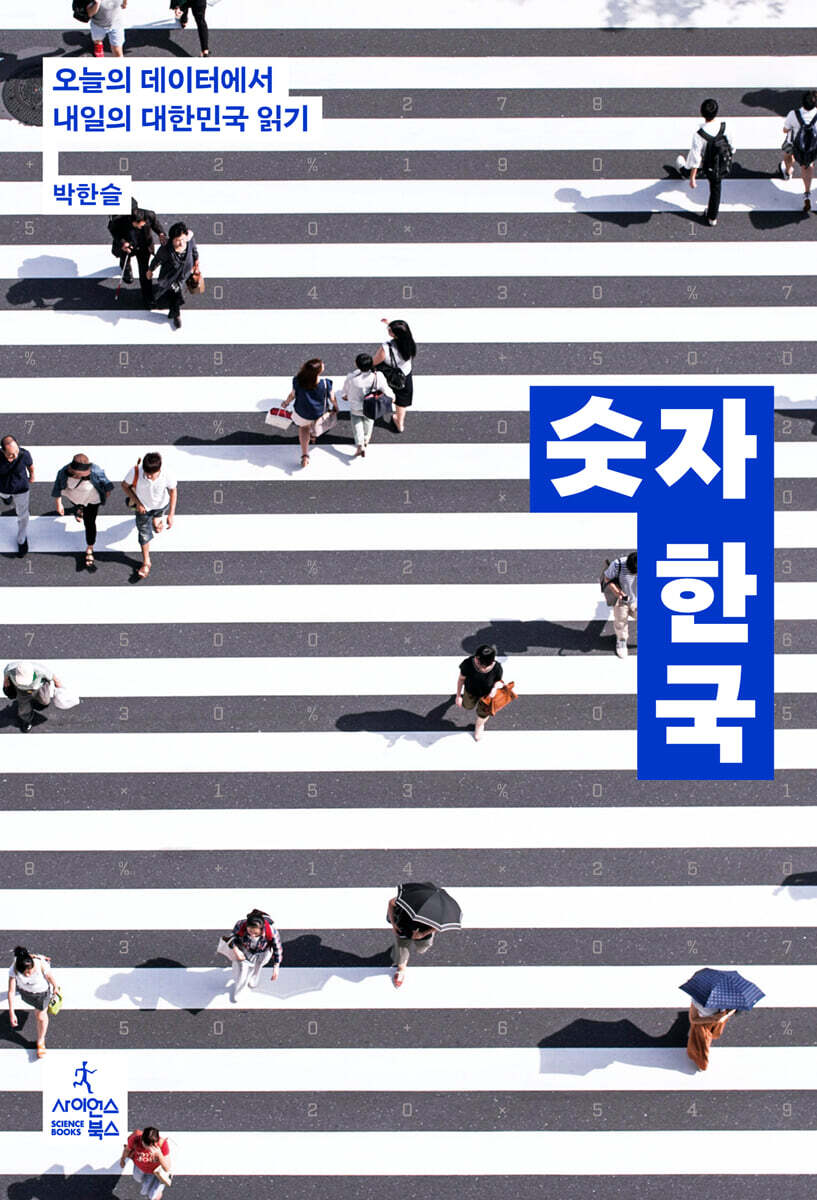
At this point, Park Han-seul's new book, "Korea in Numbers: Reading Tomorrow's Korea from Today's Data," published by Science Books in 2025, is a data science essay that traces the meaning behind numbers through 20 data points that permeate South Korea, such as the fine dust index, unionization rate, and total fertility rate.
The author, Hanseul Park, has a unique background, having worked as a pharmacist at a university hospital and majored in statistics.
He works as a medical writer for a foreign pharmaceutical company and communicates with the public through social writing. He has previously appeared on influential media outlets such as 'Sampyo TV' and 'Dr. Choi Jun-young's Globe Research Institute'.
Additionally, he is currently actively writing a series titled “Park Han-seul’s Horizon of Health” in Monthly Chosun, and delivering weekly stories about medical services and health on KBS 1 Radio.
In this book, based on the serial "Park Han-seul's Reading of Numbers," which he has been serializing in the JoongAng Ilbo since 2022, author Park Han-seul preaches that numbers are a powerful tool for understanding and changing the world, and emphasizes that new wisdom can be gained through numbers.
Through "Korea in Numbers," readers will be able to view South Korea today from a richer and more three-dimensional perspective, while also gaining valuable insights necessary to design the future of our society.
Readers, please just read it comfortably.
I hope that through this book, readers will be able to understand the numbers that permeate our society in their proper context.
─From the “Opening Note”
Looking at the numbers
The present and future of South Korea
"Korea in Numbers" is structured to examine various issues ranging from healthcare to political and social issues through four parts: "Population Change and Society," "Artificial Intelligence and the Economy," "Climate Change and the Environment," and "Regulation and Policy," each of which is divided into five chapters.
Part 1, "Population Change and Society," which is the beginning, verifies the reality of our time, namely low birth rates and aging population, through numbers and seeks the direction of social change based on this.
In Chapter 1, “Average Life Expectancy of Koreans,” author Park Han-seul verified the excellence of the South Korean healthcare system, which achieved results even during the COVID-19 pandemic, when the average life expectancy in advanced countries plummeted to 12 years of its previous level. However, in Chapter 2, “Postpartum Care Period by Household Income,” she points out that the goals of healthcare are misaligned to the point that they cannot even resolve the gap in health care for mothers immediately after childbirth, and raises the need for a structural solution to problems related to childbirth.
Chapter 3, “Active Duty Determination Rate of the National Army,” which explains the reality that the future size of the military cannot be maintained even if 100% of the target population is conscripted for active duty, and Chapter 4, “Economically Inactive Population without Reason,” which examines the reality of 3 million people who are not participating in economic activities and whose whereabouts and activities are unknown, reveal that the maximum future population has already been determined by the number of children born to date, and the only way left for us is to make the best use of those who are born.
It is now time to accept that the future population structure has been determined and consider how to respond to the problems that arise within it.
(Chapter 5 “Estimation of Old Age Dependency Ratio”).
The decline in military resources is just the beginning.
Systems designed assuming a typical birth rate in the past are gradually starting to creak as we enter an era of low birth rates.
All the children who will turn 20 in 2042 have already been born, and we cannot change the past now.
So, instead of complaining about the irreversible birth rate, it is more urgent to devise more proactive population measures in the era of low birth rates.
─In Chapter 3, “Active Duty Determination Rates for the Armed Forces”
Part 2, "Artificial Intelligence and the Economy," examines in-depth, numerically, the impact of recent advances in artificial intelligence (AI) technology, with its various potentials, on the economy and labor.
In Chapter 6, “Artificial Intelligence Exposure Index,” author Park Han-seul directly calculates the number of jobs that will be lost due to the introduction of AI and assumes that discussions about AI should start with realistic numbers. In terms of data and electricity, which are key resources in the AI era, author Park Han-seul makes readers realize that although we are already a production powerhouse in data, which is the basis of artificial intelligence learning (Chapter 7, “Estimated Narcotics Use”), we urgently need to prepare for the future in terms of electricity, which is its physical foundation.
(Chapter 8 “Regional Electricity Self-Sufficiency Rate”) AI will bring about fundamental changes not only to the economy but also to the work environment.
What our society needs to focus on is providing policy support to help individuals develop their capabilities (Chapter 9, “Number of R&D Budget Cuts”) and adjusting work to fit the new work environment.
(Chapter 10, "Online and Offline Sales Proportion")
AI is not something that will appear in the future, but rather one of the important factors influencing our current economy.
Money is already moving much faster, and our society's discussion about AI is just far behind.
While it's good to know about complex AI technologies, what we really need to know are the impacts they create.
Only by correctly understanding the impact of artificial intelligence can we discuss how society should respond to it and develop appropriate policies and regulations.
─Chapter 10, “Online and Offline Sales Proportion”
The main characters of Part 3, “Climate Change and the Environment,” are numbers related to climate change, which is already becoming a reality in various fields.
Author Park Han-seul discusses the importance of environmental policy and practical solutions, focusing on data that threatens the sustainability of the planet.
In Chapter 11, “The Number of Children and Adolescents with Infectious Diseases,” author Park Han-seul visualizes the process of climate change and environmental pollution spreading, which we cannot directly feel, in numbers. Then, in Chapter 12, “The Number of Patients with Enteritis per Year,” she points out that we are experiencing the effects of climate change without even realizing it, to the point that the number of patients with enteritis has increased by 154 percent over the past 10 years.
Even Chapter 13, “Annual Catch of Mackerel and Squid,” shows that climate change is influencing even the food production stage, based on the dramatic divergence in catches of the two species over the past 15 years.
What should we do to prevent climate change? In Chapter 14, "Deforestation Area," author Park Han-seul emphasizes that simply using eco-friendly products isn't enough to solve the problem; we must consider practical and sustainable solutions.
Finally, in Chapter 15, "Fine Dust Concentration Before and After COVID-19," he presents data that contradicts conventional wisdom, showing that Korea is more affected by ultrafine dust than any other country. He teaches us that instead of blaming external factors, we must create change ourselves.
Discussions on practical environmental improvement have been endlessly postponed due to empty arguments about whether to be pro-China or anti-China.
But the question of which of the many causes of a particular problem accounts for the largest proportion and the question of which of the many causes can actually be improved are two entirely different questions.
─Chapter 15, “Fine Dust Concentration Before and After COVID-19”
The final part, Part 4, “Regulation and Policy,” addresses the need for regulations and policies that keep pace with changing times.
Author Park Han-seul emphasizes the importance of data-driven policy design, arguing that this is necessary to develop appropriate responses to changing times.
In Chapter 16, “The Rate of Female Alcoholics,” the reader analyzes the adverse effects of 30 years of alcohol industry policies, and in Chapter 17, “The Share of Cash in Household Expenditures,” the reader considers ways to bridge the digital divide among the elderly. This naturally leads the reader to realize that, rather than focusing solely on the targets of regulation, they should deeply understand data and numbers and design policies based on this understanding.
In Chapter 18, "Re-treatment Rates for Patients with Severe Mental Illness," he warns that even policies designed with good intentions can produce unexpected results if side effects are not fully considered, based on shocking data showing that 5,000 people with mental illness are neglected in Korean society.
Furthermore, Chapter 19, “Number of Divorces by Marital Duration,” shows that, based on the number of divorces in the twilight years, which has increased sixfold over the past 20 years, institutional changes ultimately follow society, and that more fundamental problems must be addressed.
Finally, in Chapter 20, “Recidivism Rates Within Three Years,” author Park Han-seul compares recidivism rate data from the United States and Korea, conveying the point that the key to policy design lies in careful data interpretation and a balanced approach based on this data.
After all, nothing in this world is simple, and the best results come from carefully looking at the numbers and weighing the side effects and benefits.
What should not be misunderstood is that these institutional changes do not artificially encourage divorce.
All the new law does is help those who have been struggling to maintain a broken marriage finally decide to break up.
─In Chapter 19, “Number of Divorces by Marital Duration”
Reading numbers,
A start for a better society
While compiling the series "Park Han-seul's Reading Numbers" into a book, author Park Han-seul added stories that could not be included in the limited space and unified the infographic design that was different for each article.
What is particularly noteworthy is that the numbers and sources that formed the basis of the infographic are clearly stated, allowing readers to verify the data directly while reading the book.
This is a result of the author's belief that developing the ability to read and interpret numbers directly goes beyond simply strengthening personal capacity and is a social responsibility.
Author Park Han-seul emphasizes that Korean society can move toward a more desirable future when each citizen can see the essence of numbers and think critically based on this.
“Numbers Korea” doesn’t stop at simply understanding numbers correctly.
This book argues that we must consider who produced the numbers and with what intention, and when that intention doesn't align with our vision of a better world, we must find ways to generate new data to refute it.
The author concludes that this process can lead Korean society in a better direction.
These days, with unprecedented events in the history of the Republic of Korea occurring one after another, darkening our hearts, if the world feels unstable and fearful, let's examine the reality through numbers and statistics and consider alternatives, as suggested by "Korea in Numbers."
This book, which helps readers read and understand the world with a more proactive attitude, will provide new inspiration not only to readers seeking a deeper understanding of Korea's present and future, but also to all those considering the responsibilities and roles of citizens in the data age.
Prescription for South Korea
At this point, Park Han-seul's new book, "Korea in Numbers: Reading Tomorrow's Korea from Today's Data," published by Science Books in 2025, is a data science essay that traces the meaning behind numbers through 20 data points that permeate South Korea, such as the fine dust index, unionization rate, and total fertility rate.
The author, Hanseul Park, has a unique background, having worked as a pharmacist at a university hospital and majored in statistics.
He works as a medical writer for a foreign pharmaceutical company and communicates with the public through social writing. He has previously appeared on influential media outlets such as 'Sampyo TV' and 'Dr. Choi Jun-young's Globe Research Institute'.
Additionally, he is currently actively writing a series titled “Park Han-seul’s Horizon of Health” in Monthly Chosun, and delivering weekly stories about medical services and health on KBS 1 Radio.
In this book, based on the serial "Park Han-seul's Reading of Numbers," which he has been serializing in the JoongAng Ilbo since 2022, author Park Han-seul preaches that numbers are a powerful tool for understanding and changing the world, and emphasizes that new wisdom can be gained through numbers.
Through "Korea in Numbers," readers will be able to view South Korea today from a richer and more three-dimensional perspective, while also gaining valuable insights necessary to design the future of our society.
Readers, please just read it comfortably.
I hope that through this book, readers will be able to understand the numbers that permeate our society in their proper context.
─From the “Opening Note”
Looking at the numbers
The present and future of South Korea
"Korea in Numbers" is structured to examine various issues ranging from healthcare to political and social issues through four parts: "Population Change and Society," "Artificial Intelligence and the Economy," "Climate Change and the Environment," and "Regulation and Policy," each of which is divided into five chapters.
Part 1, "Population Change and Society," which is the beginning, verifies the reality of our time, namely low birth rates and aging population, through numbers and seeks the direction of social change based on this.
In Chapter 1, “Average Life Expectancy of Koreans,” author Park Han-seul verified the excellence of the South Korean healthcare system, which achieved results even during the COVID-19 pandemic, when the average life expectancy in advanced countries plummeted to 12 years of its previous level. However, in Chapter 2, “Postpartum Care Period by Household Income,” she points out that the goals of healthcare are misaligned to the point that they cannot even resolve the gap in health care for mothers immediately after childbirth, and raises the need for a structural solution to problems related to childbirth.
Chapter 3, “Active Duty Determination Rate of the National Army,” which explains the reality that the future size of the military cannot be maintained even if 100% of the target population is conscripted for active duty, and Chapter 4, “Economically Inactive Population without Reason,” which examines the reality of 3 million people who are not participating in economic activities and whose whereabouts and activities are unknown, reveal that the maximum future population has already been determined by the number of children born to date, and the only way left for us is to make the best use of those who are born.
It is now time to accept that the future population structure has been determined and consider how to respond to the problems that arise within it.
(Chapter 5 “Estimation of Old Age Dependency Ratio”).
The decline in military resources is just the beginning.
Systems designed assuming a typical birth rate in the past are gradually starting to creak as we enter an era of low birth rates.
All the children who will turn 20 in 2042 have already been born, and we cannot change the past now.
So, instead of complaining about the irreversible birth rate, it is more urgent to devise more proactive population measures in the era of low birth rates.
─In Chapter 3, “Active Duty Determination Rates for the Armed Forces”
Part 2, "Artificial Intelligence and the Economy," examines in-depth, numerically, the impact of recent advances in artificial intelligence (AI) technology, with its various potentials, on the economy and labor.
In Chapter 6, “Artificial Intelligence Exposure Index,” author Park Han-seul directly calculates the number of jobs that will be lost due to the introduction of AI and assumes that discussions about AI should start with realistic numbers. In terms of data and electricity, which are key resources in the AI era, author Park Han-seul makes readers realize that although we are already a production powerhouse in data, which is the basis of artificial intelligence learning (Chapter 7, “Estimated Narcotics Use”), we urgently need to prepare for the future in terms of electricity, which is its physical foundation.
(Chapter 8 “Regional Electricity Self-Sufficiency Rate”) AI will bring about fundamental changes not only to the economy but also to the work environment.
What our society needs to focus on is providing policy support to help individuals develop their capabilities (Chapter 9, “Number of R&D Budget Cuts”) and adjusting work to fit the new work environment.
(Chapter 10, "Online and Offline Sales Proportion")
AI is not something that will appear in the future, but rather one of the important factors influencing our current economy.
Money is already moving much faster, and our society's discussion about AI is just far behind.
While it's good to know about complex AI technologies, what we really need to know are the impacts they create.
Only by correctly understanding the impact of artificial intelligence can we discuss how society should respond to it and develop appropriate policies and regulations.
─Chapter 10, “Online and Offline Sales Proportion”
The main characters of Part 3, “Climate Change and the Environment,” are numbers related to climate change, which is already becoming a reality in various fields.
Author Park Han-seul discusses the importance of environmental policy and practical solutions, focusing on data that threatens the sustainability of the planet.
In Chapter 11, “The Number of Children and Adolescents with Infectious Diseases,” author Park Han-seul visualizes the process of climate change and environmental pollution spreading, which we cannot directly feel, in numbers. Then, in Chapter 12, “The Number of Patients with Enteritis per Year,” she points out that we are experiencing the effects of climate change without even realizing it, to the point that the number of patients with enteritis has increased by 154 percent over the past 10 years.
Even Chapter 13, “Annual Catch of Mackerel and Squid,” shows that climate change is influencing even the food production stage, based on the dramatic divergence in catches of the two species over the past 15 years.
What should we do to prevent climate change? In Chapter 14, "Deforestation Area," author Park Han-seul emphasizes that simply using eco-friendly products isn't enough to solve the problem; we must consider practical and sustainable solutions.
Finally, in Chapter 15, "Fine Dust Concentration Before and After COVID-19," he presents data that contradicts conventional wisdom, showing that Korea is more affected by ultrafine dust than any other country. He teaches us that instead of blaming external factors, we must create change ourselves.
Discussions on practical environmental improvement have been endlessly postponed due to empty arguments about whether to be pro-China or anti-China.
But the question of which of the many causes of a particular problem accounts for the largest proportion and the question of which of the many causes can actually be improved are two entirely different questions.
─Chapter 15, “Fine Dust Concentration Before and After COVID-19”
The final part, Part 4, “Regulation and Policy,” addresses the need for regulations and policies that keep pace with changing times.
Author Park Han-seul emphasizes the importance of data-driven policy design, arguing that this is necessary to develop appropriate responses to changing times.
In Chapter 16, “The Rate of Female Alcoholics,” the reader analyzes the adverse effects of 30 years of alcohol industry policies, and in Chapter 17, “The Share of Cash in Household Expenditures,” the reader considers ways to bridge the digital divide among the elderly. This naturally leads the reader to realize that, rather than focusing solely on the targets of regulation, they should deeply understand data and numbers and design policies based on this understanding.
In Chapter 18, "Re-treatment Rates for Patients with Severe Mental Illness," he warns that even policies designed with good intentions can produce unexpected results if side effects are not fully considered, based on shocking data showing that 5,000 people with mental illness are neglected in Korean society.
Furthermore, Chapter 19, “Number of Divorces by Marital Duration,” shows that, based on the number of divorces in the twilight years, which has increased sixfold over the past 20 years, institutional changes ultimately follow society, and that more fundamental problems must be addressed.
Finally, in Chapter 20, “Recidivism Rates Within Three Years,” author Park Han-seul compares recidivism rate data from the United States and Korea, conveying the point that the key to policy design lies in careful data interpretation and a balanced approach based on this data.
After all, nothing in this world is simple, and the best results come from carefully looking at the numbers and weighing the side effects and benefits.
What should not be misunderstood is that these institutional changes do not artificially encourage divorce.
All the new law does is help those who have been struggling to maintain a broken marriage finally decide to break up.
─In Chapter 19, “Number of Divorces by Marital Duration”
Reading numbers,
A start for a better society
While compiling the series "Park Han-seul's Reading Numbers" into a book, author Park Han-seul added stories that could not be included in the limited space and unified the infographic design that was different for each article.
What is particularly noteworthy is that the numbers and sources that formed the basis of the infographic are clearly stated, allowing readers to verify the data directly while reading the book.
This is a result of the author's belief that developing the ability to read and interpret numbers directly goes beyond simply strengthening personal capacity and is a social responsibility.
Author Park Han-seul emphasizes that Korean society can move toward a more desirable future when each citizen can see the essence of numbers and think critically based on this.
“Numbers Korea” doesn’t stop at simply understanding numbers correctly.
This book argues that we must consider who produced the numbers and with what intention, and when that intention doesn't align with our vision of a better world, we must find ways to generate new data to refute it.
The author concludes that this process can lead Korean society in a better direction.
These days, with unprecedented events in the history of the Republic of Korea occurring one after another, darkening our hearts, if the world feels unstable and fearful, let's examine the reality through numbers and statistics and consider alternatives, as suggested by "Korea in Numbers."
This book, which helps readers read and understand the world with a more proactive attitude, will provide new inspiration not only to readers seeking a deeper understanding of Korea's present and future, but also to all those considering the responsibilities and roles of citizens in the data age.
GOODS SPECIFICS
- Date of issue: January 31, 2025
- Format: Paperback book binding method guide
- Page count, weight, size: 268 pages | 348g | 128*188*18mm
- ISBN13: 9791194087069
- ISBN10: 119408706X
You may also like
카테고리
korean


korean

![GQ KOREA Mark (Monthly): December [2025]](http://librairie.coreenne.fr/cdn/shop/files/8ef265dbbfbf186523ed75ba7319009d.jpg?v=1765340328&width=3840)


