

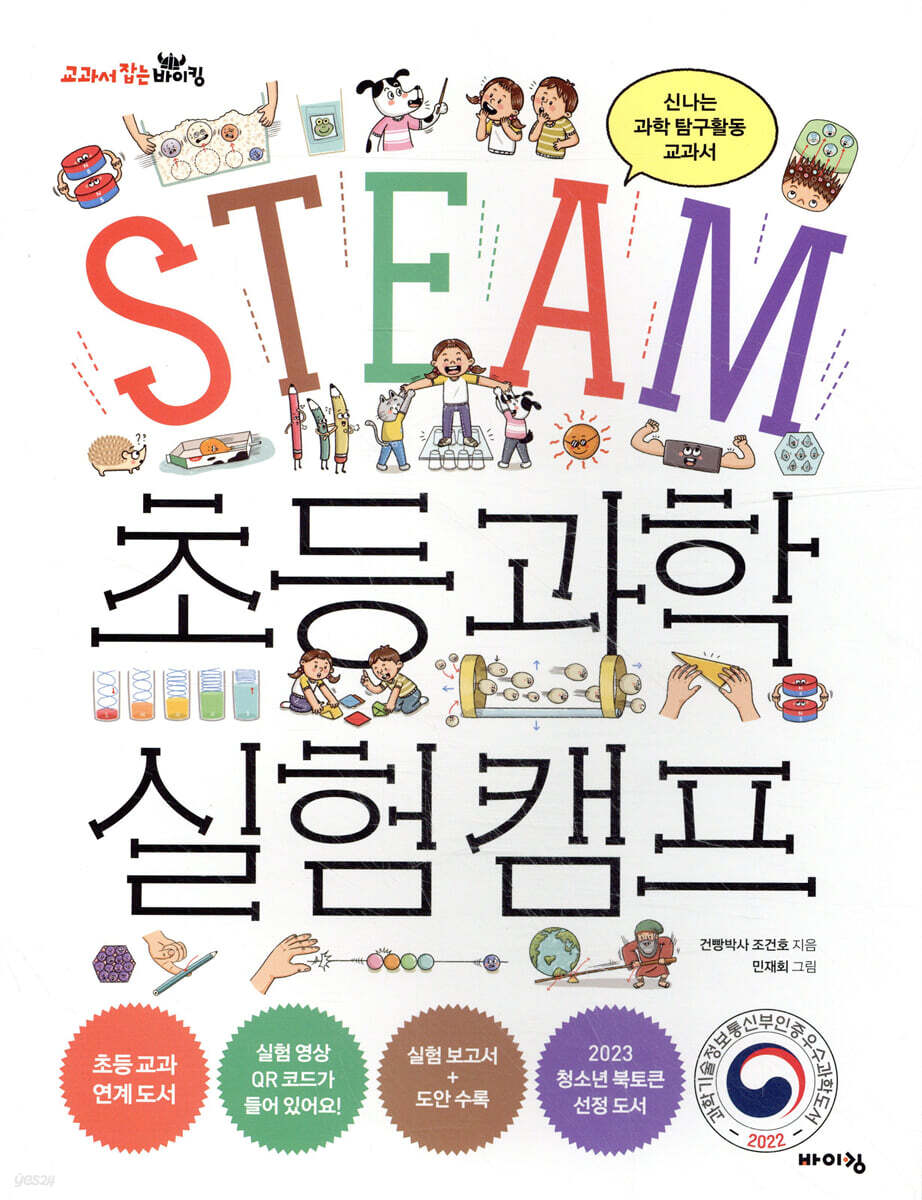
STEAM Elementary Science Experiment Camp
 |
Description
Book Introduction
The world's most fun STEAM elementary science experiment camp! 77 experiment ideas that will transform your home into a "science lab." From science exploration activities that demonstrate principles and grasp concepts to magical experiments that make textbook drawings disappear underwater, to artistically expressive marker chromatography experiments, and even hands-on hologram creations, there are plenty of experiment ideas that will transform your home into a science lab. By following these fun and surprising science experiments, scientific concepts will become ingrained in your mind! Difficult scientific principles are explained with illustrations, making them easy to understand. We invite you to the exciting science exploration textbook, "STEAM Elementary Science Experiment Camp," where principles are visible and concepts are grasped! |
- You can preview some of the book's contents.
Preview
index
To all of you reading this book
View experiments by subject
How to use this book
Chapter 1: The picture disappears in the water?
Either a magician or an artist
1. A picture disappearing into the water
2 Snip it off with scissors! Magnet magic
3. Create Amazing Marble Art with Milk
4 Which ball will come up first?
5 Magic Bottle that sucks up quail eggs
6 Chromatography using a marker pen
7 Coins that swing as you wish
8. Lifting Heavy Bottles Easily! The Secret of Wooden Chopsticks
9 Up and down the submarine as I please
10. Blowing a whistle with a plastic bottle
Chapter 2 The direction of the arrow changes?
On the contrary! Upside down! Moving experiment
11 Magic to change the direction of the arrow
12 Amazing Balloons That Inflate on Their Own
13 The water doesn't pour!
14. Freeze! Liquid Tower Stacking
15 Colored paper rises by itself
16 The more you look at it, the more amazing it becomes. The Möbius strip.
17 Who's faster? Inflatable boat
18 Bubble Bubbles! Dancing Air Bubbles
19 Water is rising upside down?
20 Ball Bouncing Up in Water Magic
Chapter 3: Can you make a hologram?
An experiment to make it with my own hands!
21 Holograms made with my own hands
22 Longer, Farther Flying Ring Plane
23 A cup that doesn't overflow no matter how much water you put in it?
24 Let's make a wooden chopstick gun!
25 Vroom Vroom Balloon Car
26 Super Easy! Straw Whistle
27 A CD top that changes color when you spin it
28 Dangling, Dancing Magnetic Spiders
29 Super Easy! Make a Chopstick Catapult
30 Spinning Balloon Watermill
Chapter 4 Can you see the sound?
Experiments that reveal invisible forces
31 Can you see the sound?
32 Dancing Foil Beads
33 Make a rainbow with chocolate
34 A woodpecker coming down pecking at a rubber band
35 Egg Doremi made with salt water
36 The Secret to Picking Carrots and Forks with Toothpicks
37 Water flowing along the thread
38 Strong Paper Pillars
39 Raisins Dancing in Cider
What if you drop a tray and a balloon together?
Chapter 5: If you stab a water balloon, it won't burst?
Play experiments with family and friends
41 A water bag that won't burst no matter how much you poke it
42 Bouncy Egg Bouncy Balls
43 A fair game of marbles for everyone
44 Make a Paper Bomb That Explodes with a Bang!
You're putting a pencil on a 45 dollar bill?
46 Just drop the eggs into the cup!
Challenge 47: Climb onto a paper cup
48 A wriggling caterpillar
49 Just one drop of detergent and the boat will soar!
50 Maze Escape! Magnetic Car
Appendix: Exciting Science Exploration Activities
Science Experiment Report
Observational Experiment Report
Design ①~⑦
Helpful Resources
View experiments by subject
How to use this book
Chapter 1: The picture disappears in the water?
Either a magician or an artist
1. A picture disappearing into the water
2 Snip it off with scissors! Magnet magic
3. Create Amazing Marble Art with Milk
4 Which ball will come up first?
5 Magic Bottle that sucks up quail eggs
6 Chromatography using a marker pen
7 Coins that swing as you wish
8. Lifting Heavy Bottles Easily! The Secret of Wooden Chopsticks
9 Up and down the submarine as I please
10. Blowing a whistle with a plastic bottle
Chapter 2 The direction of the arrow changes?
On the contrary! Upside down! Moving experiment
11 Magic to change the direction of the arrow
12 Amazing Balloons That Inflate on Their Own
13 The water doesn't pour!
14. Freeze! Liquid Tower Stacking
15 Colored paper rises by itself
16 The more you look at it, the more amazing it becomes. The Möbius strip.
17 Who's faster? Inflatable boat
18 Bubble Bubbles! Dancing Air Bubbles
19 Water is rising upside down?
20 Ball Bouncing Up in Water Magic
Chapter 3: Can you make a hologram?
An experiment to make it with my own hands!
21 Holograms made with my own hands
22 Longer, Farther Flying Ring Plane
23 A cup that doesn't overflow no matter how much water you put in it?
24 Let's make a wooden chopstick gun!
25 Vroom Vroom Balloon Car
26 Super Easy! Straw Whistle
27 A CD top that changes color when you spin it
28 Dangling, Dancing Magnetic Spiders
29 Super Easy! Make a Chopstick Catapult
30 Spinning Balloon Watermill
Chapter 4 Can you see the sound?
Experiments that reveal invisible forces
31 Can you see the sound?
32 Dancing Foil Beads
33 Make a rainbow with chocolate
34 A woodpecker coming down pecking at a rubber band
35 Egg Doremi made with salt water
36 The Secret to Picking Carrots and Forks with Toothpicks
37 Water flowing along the thread
38 Strong Paper Pillars
39 Raisins Dancing in Cider
What if you drop a tray and a balloon together?
Chapter 5: If you stab a water balloon, it won't burst?
Play experiments with family and friends
41 A water bag that won't burst no matter how much you poke it
42 Bouncy Egg Bouncy Balls
43 A fair game of marbles for everyone
44 Make a Paper Bomb That Explodes with a Bang!
You're putting a pencil on a 45 dollar bill?
46 Just drop the eggs into the cup!
Challenge 47: Climb onto a paper cup
48 A wriggling caterpillar
49 Just one drop of detergent and the boat will soar!
50 Maze Escape! Magnetic Car
Appendix: Exciting Science Exploration Activities
Science Experiment Report
Observational Experiment Report
Design ①~⑦
Helpful Resources
Detailed image
.jpg)
Publisher's Review
★ Selected as an Excellent Science Book by the Korea Foundation for the Advancement of Science and Creativity in 2022!
★ 2023 Youth Book Token Book Selection!
The world's most fun STEAM elementary science experiment camp!
77 Experimental Ideas to Turn Your Home into a Science Lab
A textbook for scientific inquiry activities that demonstrates principles and grasps concepts.
★ STEAM science experiment project that integrates science, technology, engineering, art, and math.
★ Full of activities to develop convergent thinking, problem-solving, and creative inquiry skills for science geniuses!
★ Includes 2 experimental reports and 7 designs!
What is science? Science is thinking.
Kids these days have a hard time thinking.
They want to see results right away and think that as long as the results are good, that's all that matters.
Develop your children's thinking skills with science experiments that spark their curiosity.
While conducting a scientific experiment, we ask countless questions like, "Why is that?", "Then what should we do?", and "What if we do this?", and in the process of finding the answers, our thinking skills grow.
★ Turn your home into a fun science lab!
We've collected some fun experiments that kids will love, including paper bombs that explode with a pop, water bags that won't explode no matter how much you poke them with a pencil, and pictures that disappear when you turn them sideways in water.
You can learn about 'atmospheric pressure' with the magic bottle experiment that sucks up quail eggs, and 'diffusion' with the chocolate rainbow experiment.
It contains 78 scientific concepts such as buoyancy, capillary action, and elasticity.
Children will be able to naturally learn scientific principles through hands-on craft experiments, such as toy guns, catapults, and 3D holograms made with wooden chopsticks.
It's full of simple experiments you can do with things you already have at home, like milk, cotton swabs, rice, and thread.
You can easily conduct science experiments anytime, anywhere!
★ You can easily understand scientific principles through illustrations!
When you study science, there are many principles that are difficult to understand.
There are invisible sounds, center of gravity, and the law of action and reaction.
These scientific principles are explained in pictures so that you can easily understand them.
For example, in an experiment where you place a book on top of a paper pillar, you learn about the concepts of weight, force, and force distribution.
At the same time, I have illustrated the principle of how force is distributed and why more books can be placed on a cylinder than on a triangular prism.
It will be of great help to friends who are unfamiliar with scientific concepts to understand them step by step, from concepts to principles.
You can even visualize fleeting scientific phenomena in pictures to see exactly what they look like.
★ If you follow the experiment, you will see the principle and grasp the concept!
For each science experiment, we've organized the elementary school curriculum and key concepts.
Before beginning the experiment, please read the introduction and objectives of the experiment.
You can figure out what experiments to do and what you can learn from them.
In the 'Let's Experiment Differently!' corner, you can conduct a variety of experiments using the same materials or applying the concepts and principles learned in the experiment.
Through 'Amazing Science Stories', you can expand your scientific knowledge , including the transpiration process of plants, the principle of arch structures, and the difference in gravity between the sun and the moon.
After completing the experiment, be sure to use the 'Experiment Report' in the appendix.
By writing down the experimental sequence, results, and impressions, you will be able to fully understand scientific concepts and principles!
★ You can watch vivid science experiment videos with QR codes!
Before doing the experiment, watch the video in advance.
Watching the amazing and fun science experiment videos of Dr. Jo Geon-ho, the bread expert, will make science experiments even more enjoyable.
We will help you follow the experimental process step by step.
You can learn what concepts and principles are applied in the experiment and what to pay attention to during the experiment.
It's okay to make mistakes when doing science experiments.
During the time you spend thinking, you will be able to develop the strength to solve problems on your own.
Science experiments are memorable because you see, touch, and feel them firsthand.
Whenever science gets difficult, try recalling the fun times you had doing science experiments.
It will awaken your interest in science.
Let's all become great scientists with the 『STEAM Elementary Science Experiment Camp』!
★ 2023 Youth Book Token Book Selection!
The world's most fun STEAM elementary science experiment camp!
77 Experimental Ideas to Turn Your Home into a Science Lab
A textbook for scientific inquiry activities that demonstrates principles and grasps concepts.
★ STEAM science experiment project that integrates science, technology, engineering, art, and math.
★ Full of activities to develop convergent thinking, problem-solving, and creative inquiry skills for science geniuses!
★ Includes 2 experimental reports and 7 designs!
What is science? Science is thinking.
Kids these days have a hard time thinking.
They want to see results right away and think that as long as the results are good, that's all that matters.
Develop your children's thinking skills with science experiments that spark their curiosity.
While conducting a scientific experiment, we ask countless questions like, "Why is that?", "Then what should we do?", and "What if we do this?", and in the process of finding the answers, our thinking skills grow.
★ Turn your home into a fun science lab!
We've collected some fun experiments that kids will love, including paper bombs that explode with a pop, water bags that won't explode no matter how much you poke them with a pencil, and pictures that disappear when you turn them sideways in water.
You can learn about 'atmospheric pressure' with the magic bottle experiment that sucks up quail eggs, and 'diffusion' with the chocolate rainbow experiment.
It contains 78 scientific concepts such as buoyancy, capillary action, and elasticity.
Children will be able to naturally learn scientific principles through hands-on craft experiments, such as toy guns, catapults, and 3D holograms made with wooden chopsticks.
It's full of simple experiments you can do with things you already have at home, like milk, cotton swabs, rice, and thread.
You can easily conduct science experiments anytime, anywhere!
★ You can easily understand scientific principles through illustrations!
When you study science, there are many principles that are difficult to understand.
There are invisible sounds, center of gravity, and the law of action and reaction.
These scientific principles are explained in pictures so that you can easily understand them.
For example, in an experiment where you place a book on top of a paper pillar, you learn about the concepts of weight, force, and force distribution.
At the same time, I have illustrated the principle of how force is distributed and why more books can be placed on a cylinder than on a triangular prism.
It will be of great help to friends who are unfamiliar with scientific concepts to understand them step by step, from concepts to principles.
You can even visualize fleeting scientific phenomena in pictures to see exactly what they look like.
★ If you follow the experiment, you will see the principle and grasp the concept!
For each science experiment, we've organized the elementary school curriculum and key concepts.
Before beginning the experiment, please read the introduction and objectives of the experiment.
You can figure out what experiments to do and what you can learn from them.
In the 'Let's Experiment Differently!' corner, you can conduct a variety of experiments using the same materials or applying the concepts and principles learned in the experiment.
Through 'Amazing Science Stories', you can expand your scientific knowledge , including the transpiration process of plants, the principle of arch structures, and the difference in gravity between the sun and the moon.
After completing the experiment, be sure to use the 'Experiment Report' in the appendix.
By writing down the experimental sequence, results, and impressions, you will be able to fully understand scientific concepts and principles!
★ You can watch vivid science experiment videos with QR codes!
Before doing the experiment, watch the video in advance.
Watching the amazing and fun science experiment videos of Dr. Jo Geon-ho, the bread expert, will make science experiments even more enjoyable.
We will help you follow the experimental process step by step.
You can learn what concepts and principles are applied in the experiment and what to pay attention to during the experiment.
It's okay to make mistakes when doing science experiments.
During the time you spend thinking, you will be able to develop the strength to solve problems on your own.
Science experiments are memorable because you see, touch, and feel them firsthand.
Whenever science gets difficult, try recalling the fun times you had doing science experiments.
It will awaken your interest in science.
Let's all become great scientists with the 『STEAM Elementary Science Experiment Camp』!
GOODS SPECIFICS
- Publication date: March 15, 2022
- Page count, weight, size: 240 pages | 870g | 210*275*16mm
- ISBN13: 9788964945391
- ISBN10: 8964945395
- KC Certification: Certification Type: Conformity Confirmation
You may also like
카테고리
korean


korean

![GQ KOREA Mark (Monthly): December [2025]](http://librairie.coreenne.fr/cdn/shop/files/8ef265dbbfbf186523ed75ba7319009d.jpg?v=1765340328&width=3840)


