

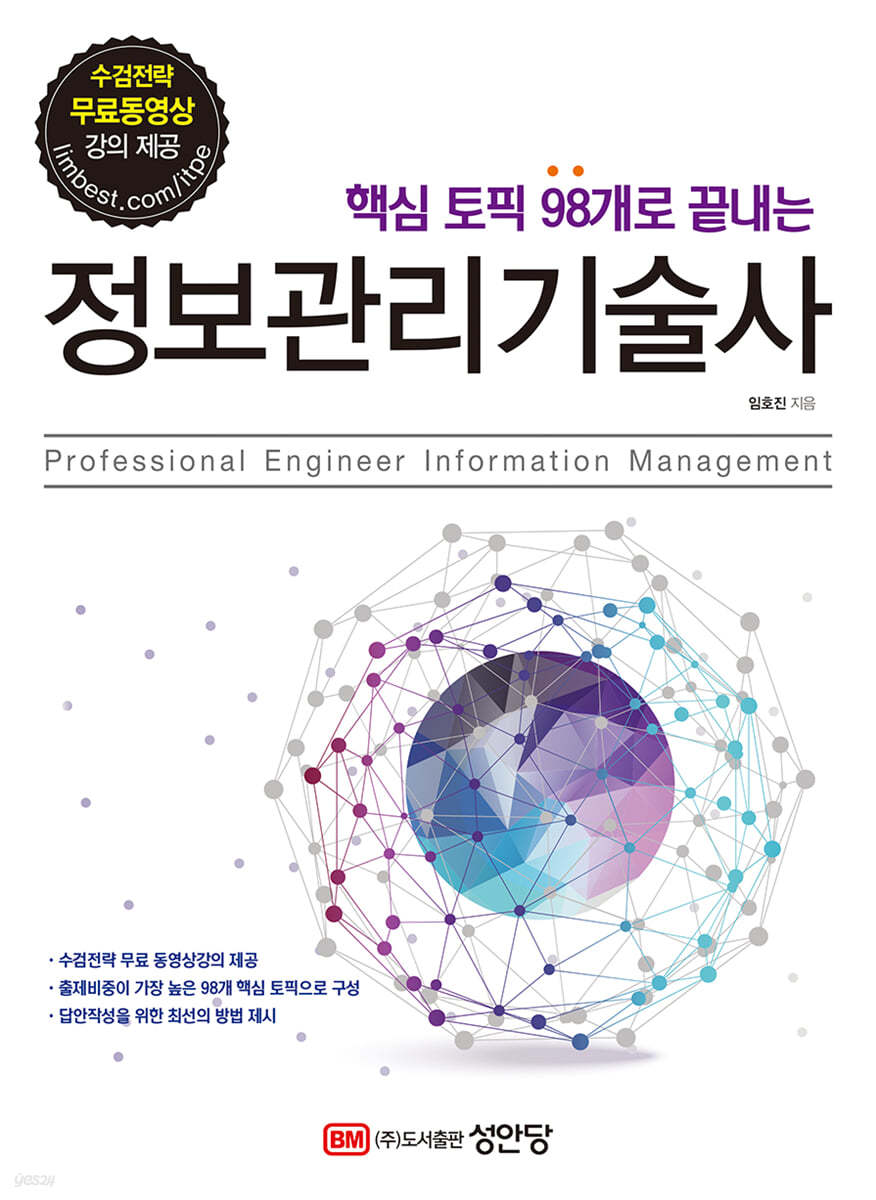
Information Management Technician Exam: 98 Core Topics
 |
Description
Book Introduction
When studying for the technical engineer exam, you usually need to study about 200 to 800 topics, but studying a lot of topics does not give you an absolute advantage on the exam.
In particular, the Information Management Technician exam has the characteristic of covering in-depth questions on approximately 90 topics.
Accordingly, this book is designed to enable in-depth study of 98 core topics with the highest test percentages. For each topic, it provides representative past exam questions to help you write answers, study materials for high scores, and similar past exam questions, so you can prepare for the exam efficiently.
In particular, the Information Management Technician exam has the characteristic of covering in-depth questions on approximately 90 topics.
Accordingly, this book is designed to enable in-depth study of 98 core topics with the highest test percentages. For each topic, it provides representative past exam questions to help you write answers, study materials for high scores, and similar past exam questions, so you can prepare for the exam efficiently.
- You can preview some of the book's contents.
Preview
index
Part 1 Information Management Technician
Chapter 01 What is an Information Management Technician?
1.1 Information Management Technician
1.2 Information Management Technician Examination Method
1.3 Information Management Technician Examiner
1.4 Information Management Technician Exam Qualifications
1.5 Information Management Technician Exam Answer Sheet
Chapter 02 What are the benefits of obtaining an information management technician license?
2.1 Let me evaluate your information system!
2.2 Becoming an instructor even though I didn't want to.
2.3 Joining IBM Korea Software Consulting Services
2.4 Receive a technical engineer allowance of 350,000 won per month for the first time.
2.5 I felt skeptical about obtaining a technical engineer license.
But I overcame it.
Chapter 03 Learning Point!
3.1 For whom do you create subnotes?
3.2 The keyword for passing is not understanding, but repeated training.
Part 2 Frequently Asked Topics
Chapter 01 Finishing Software Engineering with 22 Topics
1.1 Request for Proposal
1.2 Waterfall and Iterative Incremental Models
1.3 Iteration Plan
1.4 Requirements Management
1.5 Software Architecture
1.6 Architecture Driver
1.7 UML Stereotypes
1.8 Overloading and Overriding
1.9 Abstract Classes and Interfaces
1.10 State Diagram
1.11 Design Patterns
1.12 Test Driver
1.13 Software Regression Testing
1.14 Scrum and Kanban Methods
1.15 Function Points
1.16 EV(Earned Value)
1.17 Information System Audit
1.18 Software Safety Analysis
1.19 Software Functional Safety Specification
1.20 Software Maintenance
1.21 Software Configuration Management
1.22 Package Software
Chapter 02: Database Topics Ended with Modeling
2.1 Database Integrity
2.2 Database Concurrency Control
2.3 Checkpoint
2.4 B-Tree and Bitmap
2.5 Deriving database keys
2.6 Functional Dependencies
2.7 Database Tuning
2.8 Data Mining
2.9 Neural Network Analysis
2.10 Big Data Hadoop
2.11 HDFS
2.12 R language
2.13 Sharding
2.14 Deriving Database Keys
Chapter 03 It's too difficult.
But if you know it, it's an easy algorithm
3.1 Greedy algorithm
3.2 K-Nears Neighbor
3.3 Binary search tree
3.4 B-Tree and B+ Tree
3.5 Quick Sort
3.6 Stack
3.7 Linked List
Chapter 04 Network Infrastructure for Convergence
4.1 Error Handling
4.2 CRC (Cyclic Redundancy Check)
4.3 PCM modulation
4.4 Subnet
4.5 Network Address Translation (NAT)
4.6 WLAN (Wireless Local Area Network)
Chapter 05 APT is the Problem, Information Security
5.1 APT Attack
5.2 Ransomware
5.3 Secure SDLC
5.4 Software Obfuscation
5.5 FIDO (Fast Identity Online)
5.6 De-identification of Personal Information
5.7 IoT Security
5.8 Fintech Security
5.9 Hash Function
5.10 Technical and administrative safeguards
5.11 Digital Forensics
5.12 Smartphone Forensics
5.13 IPSEC VPN
5.14 Digital Envelope
5.15 Disaster Recovery DRS
5.16 Encryption Security Strength
5.17 Blind SQL Injection
5.18 Uploading files in dangerous formats
5.19 Cross-site scripting
5.20 Types of Disabilities and Response Methods
5.21 Data 3 Laws
Chapter 06 Booting the operating system!
6.1 Process Scheduling
6.2 Virtual Memory
6.3 Deadlock
6.4 Disk Scheduling
6.5 Context Switching
6.6 Unix Access Control
6.7 Unix i-Node
6.8 Unix Link
Chapter 07 IT Management for Time to Market
7.1 EAI
7.2 Incident Management and Problem Management
Chapter 08 Solving Too Many Cutting-Edge Tech Topics
8.1 Waterfall and Iterative Incremental Models
8.2 AOSP (Android Open Source Project)
8.3 Deep Learning
8.4 Beacon
8.5 Fintech and Internet Banking
8.6 O2O (Online to Offline to Online)
8.7 Crowdsourcing Test
8.8 Machine Learning
8.9 Arduino and Raspberry Pi
8.10 V2V (Vehicle to Vehicle)
8.11 Virtualization
8.12 Augmented Reality
8.13 M2M and IoE
8.14 BYOD
8.15 HTML Version 5
8.16 Cloud Computing
8.17 Principles for Selecting Big Data Analysis Tools
8.18 Bagging and boosting among ensembles
Chapter 01 What is an Information Management Technician?
1.1 Information Management Technician
1.2 Information Management Technician Examination Method
1.3 Information Management Technician Examiner
1.4 Information Management Technician Exam Qualifications
1.5 Information Management Technician Exam Answer Sheet
Chapter 02 What are the benefits of obtaining an information management technician license?
2.1 Let me evaluate your information system!
2.2 Becoming an instructor even though I didn't want to.
2.3 Joining IBM Korea Software Consulting Services
2.4 Receive a technical engineer allowance of 350,000 won per month for the first time.
2.5 I felt skeptical about obtaining a technical engineer license.
But I overcame it.
Chapter 03 Learning Point!
3.1 For whom do you create subnotes?
3.2 The keyword for passing is not understanding, but repeated training.
Part 2 Frequently Asked Topics
Chapter 01 Finishing Software Engineering with 22 Topics
1.1 Request for Proposal
1.2 Waterfall and Iterative Incremental Models
1.3 Iteration Plan
1.4 Requirements Management
1.5 Software Architecture
1.6 Architecture Driver
1.7 UML Stereotypes
1.8 Overloading and Overriding
1.9 Abstract Classes and Interfaces
1.10 State Diagram
1.11 Design Patterns
1.12 Test Driver
1.13 Software Regression Testing
1.14 Scrum and Kanban Methods
1.15 Function Points
1.16 EV(Earned Value)
1.17 Information System Audit
1.18 Software Safety Analysis
1.19 Software Functional Safety Specification
1.20 Software Maintenance
1.21 Software Configuration Management
1.22 Package Software
Chapter 02: Database Topics Ended with Modeling
2.1 Database Integrity
2.2 Database Concurrency Control
2.3 Checkpoint
2.4 B-Tree and Bitmap
2.5 Deriving database keys
2.6 Functional Dependencies
2.7 Database Tuning
2.8 Data Mining
2.9 Neural Network Analysis
2.10 Big Data Hadoop
2.11 HDFS
2.12 R language
2.13 Sharding
2.14 Deriving Database Keys
Chapter 03 It's too difficult.
But if you know it, it's an easy algorithm
3.1 Greedy algorithm
3.2 K-Nears Neighbor
3.3 Binary search tree
3.4 B-Tree and B+ Tree
3.5 Quick Sort
3.6 Stack
3.7 Linked List
Chapter 04 Network Infrastructure for Convergence
4.1 Error Handling
4.2 CRC (Cyclic Redundancy Check)
4.3 PCM modulation
4.4 Subnet
4.5 Network Address Translation (NAT)
4.6 WLAN (Wireless Local Area Network)
Chapter 05 APT is the Problem, Information Security
5.1 APT Attack
5.2 Ransomware
5.3 Secure SDLC
5.4 Software Obfuscation
5.5 FIDO (Fast Identity Online)
5.6 De-identification of Personal Information
5.7 IoT Security
5.8 Fintech Security
5.9 Hash Function
5.10 Technical and administrative safeguards
5.11 Digital Forensics
5.12 Smartphone Forensics
5.13 IPSEC VPN
5.14 Digital Envelope
5.15 Disaster Recovery DRS
5.16 Encryption Security Strength
5.17 Blind SQL Injection
5.18 Uploading files in dangerous formats
5.19 Cross-site scripting
5.20 Types of Disabilities and Response Methods
5.21 Data 3 Laws
Chapter 06 Booting the operating system!
6.1 Process Scheduling
6.2 Virtual Memory
6.3 Deadlock
6.4 Disk Scheduling
6.5 Context Switching
6.6 Unix Access Control
6.7 Unix i-Node
6.8 Unix Link
Chapter 07 IT Management for Time to Market
7.1 EAI
7.2 Incident Management and Problem Management
Chapter 08 Solving Too Many Cutting-Edge Tech Topics
8.1 Waterfall and Iterative Incremental Models
8.2 AOSP (Android Open Source Project)
8.3 Deep Learning
8.4 Beacon
8.5 Fintech and Internet Banking
8.6 O2O (Online to Offline to Online)
8.7 Crowdsourcing Test
8.8 Machine Learning
8.9 Arduino and Raspberry Pi
8.10 V2V (Vehicle to Vehicle)
8.11 Virtualization
8.12 Augmented Reality
8.13 M2M and IoE
8.14 BYOD
8.15 HTML Version 5
8.16 Cloud Computing
8.17 Principles for Selecting Big Data Analysis Tools
8.18 Bagging and boosting among ensembles
Detailed image
Publisher's Review
1.
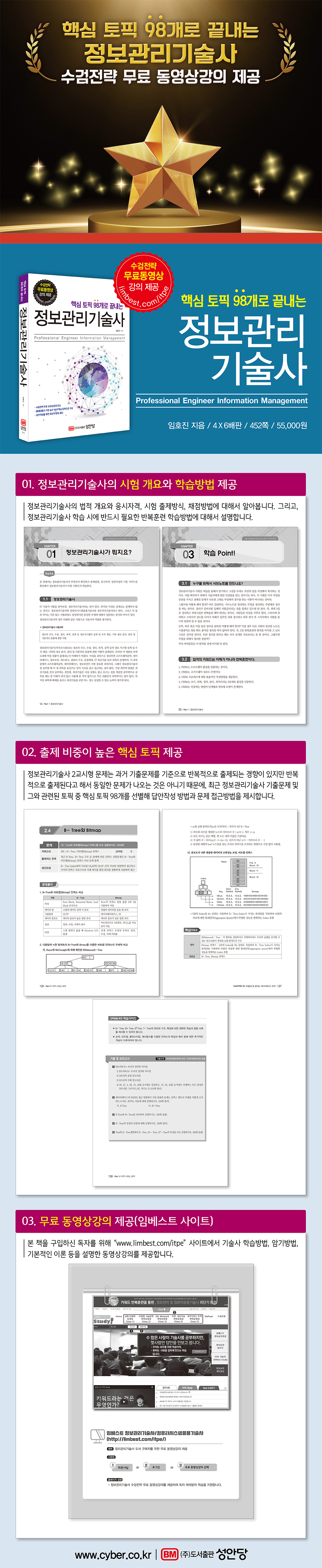
Provides an overview of the Information Management Technician exam and study methods.
Learn about the legal outline of the Information Management Technician exam, eligibility requirements, exam format, and grading method.
Additionally, we will explain the repetitive training learning method that is absolutely necessary when studying for the information management technician exam.
2.
Providing core topics with a high proportion of questions
Information Management Technician 2nd Period Exam questions tend to be repeated based on past exam questions, but since repeated questions do not necessarily mean the same questions will appear, we have selected 98 key topics from recent Information Management Technician past exam questions and related topics and presented methods for writing answers and approaching problems.
3.
Free video lectures provided (Imbest site)
For readers who have purchased this book, we provide video lectures explaining the technical history study method, memorization method, etc. on the website “www.limbest.com/itpe.”
Provides an overview of the Information Management Technician exam and study methods.
Learn about the legal outline of the Information Management Technician exam, eligibility requirements, exam format, and grading method.
Additionally, we will explain the repetitive training learning method that is absolutely necessary when studying for the information management technician exam.
2.
Providing core topics with a high proportion of questions
Information Management Technician 2nd Period Exam questions tend to be repeated based on past exam questions, but since repeated questions do not necessarily mean the same questions will appear, we have selected 98 key topics from recent Information Management Technician past exam questions and related topics and presented methods for writing answers and approaching problems.
3.
Free video lectures provided (Imbest site)
For readers who have purchased this book, we provide video lectures explaining the technical history study method, memorization method, etc. on the website “www.limbest.com/itpe.”
GOODS SPECIFICS
- Date of issue: January 11, 2023
- Page count, weight, size: 452 pages | 954g | 190*260*23mm
- ISBN13: 9788931559194
- ISBN10: 8931559194
You may also like
카테고리
korean


korean

![GQ KOREA Mark (Monthly): December [2025]](http://librairie.coreenne.fr/cdn/shop/files/8ef265dbbfbf186523ed75ba7319009d.jpg?v=1765340328&width=3840)


