

Beyond the window
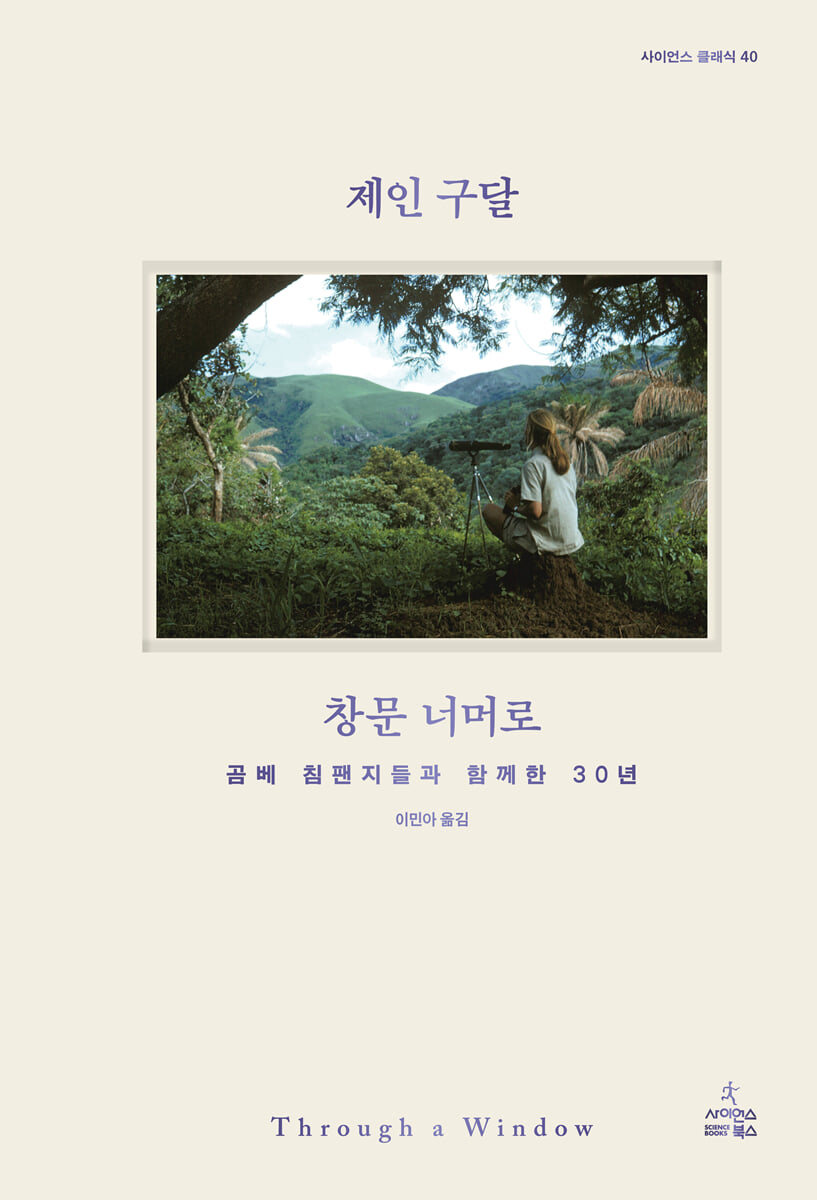 |
Description
Book Introduction
A story of war, genocide, friendship and family love.
A classic scientific study that illuminates the social behavior of wild chimpanzees
This book fully captures the remarkable legacy of Jane Goodall, one of our generation's most outstanding scientists in the field of field ecological research.
Flo and Fifi, Gilka and Gigi, Melissa and Gremlin, Goliath and Mike, Fegan and Goblin, Homer and Evered, and David Greybeard will remain in our hearts forever.
Choi Jae-cheon (Professor Emeritus, Department of Eco-Science, Ewha Womans University; Chairman of the Biodiversity Foundation)
Chimpanzees, which are listed as endangered on the International Union for Conservation of Nature (IUCN) Red List, are humans' closest living relatives.
Recently, the Max Planck Institute for Human Cognitive and Brain Sciences released a high-resolution MRI data map showing the structure of chimpanzee brains, using a new CT scan method that can examine the brains of chimpanzees that died naturally in the wild or in zoos.
By comparing this to the human brain, we have taken a step further in elucidating the process by which the brain developed during human evolution.
Jane Goodall's study of wild chimpanzees in Gombe National Park, Tanzania, as early as 1960 led the scientific community to recognize that chimpanzees and humans share similarities not only biologically but also intellectually and behaviorally.
Jane Goodall's work in researching, protecting, and educating wild chimpanzees, which the Washington Post called one of the greatest scientific achievements of the 20th century, is approaching its 65th anniversary.
Following 『In the Shadow of Man』, which was published in 1971 and summarized the first 10 years of research (the Korean edition was first introduced by Science Books in 2001), 『Through a Window: My Thirty Years with the Chimpanzees of Gombe』, which contains 30 years of research, was first published in 1990, and this Korean edition published by Science Books adds the story of 20 years later, making it a classic of science that compiles field research and is also the latest in the Science Classics series.
A classic scientific study that illuminates the social behavior of wild chimpanzees
This book fully captures the remarkable legacy of Jane Goodall, one of our generation's most outstanding scientists in the field of field ecological research.
Flo and Fifi, Gilka and Gigi, Melissa and Gremlin, Goliath and Mike, Fegan and Goblin, Homer and Evered, and David Greybeard will remain in our hearts forever.
Choi Jae-cheon (Professor Emeritus, Department of Eco-Science, Ewha Womans University; Chairman of the Biodiversity Foundation)
Chimpanzees, which are listed as endangered on the International Union for Conservation of Nature (IUCN) Red List, are humans' closest living relatives.
Recently, the Max Planck Institute for Human Cognitive and Brain Sciences released a high-resolution MRI data map showing the structure of chimpanzee brains, using a new CT scan method that can examine the brains of chimpanzees that died naturally in the wild or in zoos.
By comparing this to the human brain, we have taken a step further in elucidating the process by which the brain developed during human evolution.
Jane Goodall's study of wild chimpanzees in Gombe National Park, Tanzania, as early as 1960 led the scientific community to recognize that chimpanzees and humans share similarities not only biologically but also intellectually and behaviorally.
Jane Goodall's work in researching, protecting, and educating wild chimpanzees, which the Washington Post called one of the greatest scientific achievements of the 20th century, is approaching its 65th anniversary.
Following 『In the Shadow of Man』, which was published in 1971 and summarized the first 10 years of research (the Korean edition was first introduced by Science Books in 2001), 『Through a Window: My Thirty Years with the Chimpanzees of Gombe』, which contains 30 years of research, was first published in 1990, and this Korean edition published by Science Books adds the story of 20 years later, making it a classic of science that compiles field research and is also the latest in the Science Classics series.
- You can preview some of the book's contents.
Preview
index
Forewords 7 / Preface 11 / Chapter 1 Gombe 25 / Chapter 2 The Mind of the Chimpanzee 41 / Chapter 3 Gombe Research Center 59 / Chapter 4 Mothers and Daughters 71 / Chapter 5 The Rise of Pigeon 87 / Chapter 6 Power 103 / Chapter 7 Change 121 / Chapter 8 Gilka 135 / Chapter 9 Sexuality 151 / Chapter 10 War 169 / Chapter 11 Mothers and Sons 189 / Chapter 12 Bibi 207 / Chapter 13 Goblins 227 / Chapter 14 Homeo 245 / Chapter 15 Melissa 259 / Chapter 16 Support 281 / Chapter 17 Love 299 / Chapter 18 Building Bridges 319 / Chapter 19 The Dark Side of Humanity 335 / Chapter 20 Conclusion 361 / The Story That Came After 375 / Acknowledgments 388 / Appendix 1: Some Thoughts on the Use of Nonhuman Animals 398 / Appendix 2: Chimpanzee Conservation Movement and Sanctuaries 407 / Gombe References 415 / Research Activities and Support in Gombe 418 / Index 424
Detailed image

Publisher's Review
New insights into human-centered thinking,
A new window opens toward Gombe
Someday, through this window, we will be able to see more clearly into the mind of a chimpanzee.
― In the text
The title of "Through the Window" comes from the window through which we look at the world and find meaning.
Among the countless windows, the one opened by science allows us to see further and more clearly into areas previously unreachable by human knowledge.
It was through such windows that Jane Goodall was able to learn about chimpanzee behavior after arriving in Gombe.
At the same time, the window has allowed us to better understand many aspects of human behavior and has become a conduit through which we can perceive the place of chimpanzees and humans in the natural world.
In addition to the windows of scientists, there are also windows of philosophers, mystics, and religious leaders.
That is, when we ponder unresolved questions about our own existence, we look into the world through one of these windows.
Even our field of vision becomes narrow due to the glass window clouded by our exhaled breath.
Jane Goodall describes the moment that comes to those who have been alone in nature, the wondrous sight of the forest at dusk, the insects and birds flapping their wings, the scent of leaves and fruit, and the sounds of ibapala and chimpanzees looking for a place to sleep, as if it were a world seen through a window that only chimpanzees can see.
How much could we learn if we could see the world through the eyes of a chimpanzee, even if only for a moment?
Chapter 1, "Gombe," introduces the work of following chimpanzees and recalls the early days of research.
Jane Goodall will never forget the moment in October 1960 when her friend David Greybeard, who opened her first window into the world of chimpanzees, was fishing for termites with a blade of grass, and when he first approached her camp and took a banana.
We must observe, record, and interpret over the long term.
As knowledge accumulates and more and more people collaborate to pool information, the curtain that has been covering the window can gradually be lifted.
Chapter 2, “The Mind of a Chimpanzee,” begins with experiences looking into the eyes of a chimpanzee.
For a long time, discussions about animal minds were not allowed in academic circles, including comparative ethology, but Jane Goodall, in her first paper, insisted that he and she could not be changed to that, elevating chimpanzees to the status of 'beings' with their own nature.
Lucy, a chimpanzee raised as a human child in the home of the Temelins, was different from both wild chimpanzees and humans and expressed herself through sign language.
When asked why chimpanzees have evolved such complex intellectual abilities while living in the wild, Jane Goodall asserts that it is because living in the wild is not simple.
Living in complex chimpanzee societies requires a variety of social skills, including choosing where to go, who to go with, and how to get your share.
Under the guidance of my advisor, Professor Robert Hind, I gradually acquired the minimum qualities required of a scientist.
Although I still held onto my original beliefs—that animals have personalities, that they can feel joy, sadness, and fear, that they strive to achieve their intended goals, and that they achieve greater success when they are strongly motivated—I realized that these personal beliefs were actually quite difficult to prove.
“There’s no way we could know that Fifi is jealous,” Hind advised, after a brief argument.
“If Fifi were a human child, we would say that Fifi felt jealous.
How about saying it like this?" I did.
― In the text
Chapter 3: The Gombe Research Center has become one of the most dynamic field bases in the field of animal behavior research worldwide.
Animal observations, data collection, and discussions continued, and Jane Goodall's son, Grub, also spent his childhood at the lake surrounded by baboons and chimpanzees.
Flo reminds me of how important a mother's role is in society.
Chapter 4, “Mother and Daughter,” introduces the contrasting parenting styles of a mother and daughter.
Fifi, the daughter of Flo, who was the top female, was also confident and actively took care of her younger siblings.
Pom, the anti-social fashion daughter, was insecure and dependent and took a long time to open up to her younger brother.
Their behavior also influenced how they gave birth and raised their young.
Chapter 5, "The Rise of Piegan," impressively depicts the rise of Piegan, who had displayed high intelligence and a desire for show since "In the Shadow of Man," to the position of leader.
As the time for Pigan finally arrives in the Kasekela community, Jane Goodall observes the struggle for space and realizes how crucial cooperation is.
You need a comrade who will faithfully help you in times of trouble, and an ally who will not join hands with your enemies.
Chapter 6, "Power," examines in detail the process by which Fagan, who rose to the top with the help of his older brother Fagan, maintains his position.
Chapter 7's "Change" comes suddenly.
In May 1975, four Gombe schoolchildren were kidnapped by Zairean armed men, and it took two weeks for the hostage crisis to be resolved.
The Gombe Institute was staffed by local Tanzanians, while Jane Goodall stayed primarily in Dar es Salaam, focusing on analysis and writing.
Meanwhile, in Gombe, news arrives that Gilka's baby Ota, who appears in Chapter 8, has been eaten by Fashion and Form.
The first instance of cannibalism, not for the purpose of defending territory from outside groups, has been observed in Gombe.
This mysterious killing of pups occurred over a period of four years, targeting six pups until Fashion and Form became pregnant.
Chapter 9, "Sex Life," examines the chimpanzee honeymoon, including the story of Gilka's older brother, Evered, who left the group and actively mated.
Each breeding season and companionship period had its own territory and strategy. Chapter 10, "War," begins with the Kasekela community's Sayton, Homeo, Pigan, Everred, Mustard, Goblin, and Jiji raiding the Mitumba community's territory.
Normally, the two groups would return to their respective territories after threatening each other, but after the Kasekela community split and the southern group formed the Kahama community, relentless attacks continued for four years.
It was also a time when kidnappings and cannibalism occurred.
The aggression and cannibalism witnessed in the Gombe chimpanzee community completely changed Jane Goodall's perception of chimpanzees, who she generally believed to be more "gentle" than humans.
I realized that chimpanzees can be cruel in an instant, and that there is a dark side to their nature.
What's the flip side of this coin? Where do chimpanzees rank compared to us in terms of expressions of love, compassion, and altruism? Because of their apparent violent and cruel behavior, it's easy to get the impression that chimpanzees are far more aggressive than they actually are.
However, peaceful interactions occur much more often than belligerent interactions.
Chimpanzees have a rich repertoire of behaviors that maintain or restore community cohesion and strengthen bonds among members.
How much more could they have accomplished if they could have spoken to each other?
― In the text
Chapter 11, "Mother and Son," compares the development of Pippi's sons, Freud and Frodo, and Passion's son, Prof.
A sign that a young male is becoming increasingly independent is the increasing number of times he participates in gatherings without his mother.
Frodo, who never developed the same confidence as Freud or Frodo, spent most of his time with his mother and was also afraid of baboons after being attacked by colobus monkeys.
In Gombe, there are so many baboons that there are 12 baboon communities for every chimpanzee community.
Chapter 12, “Bibi,” examines the complex interactions between these two species.
Although baboons eat a wider variety of prey and can attack cheetahs, chimpanzees appear to have established their dominant status thanks to their ability to throw rocks and sticks.
Chapter 13 follows Melissa's baby "Goblin" as he grows up to become the leader.
Despite all the setbacks, he was so determined to rise to the top of the hierarchy and maintain his power, along with the courage and tenacity required to do so, that it seems that the other males, tired of his repeated provocations and showy behavior, surrendered.
In Chapter 14, we meet "Homeo", a large man who, unlike the goblins, has no ambition at all.
Despite his eccentric personality and numerous setbacks, Homer was able to become a respected elder in the community.
Chapter 15, "Melissa," is an observation about the mother of not only goblins but also the only mother of twins.
After Zyre falls from the tree, the opportunity to document the twins' growth in the wild is lost, but the remaining Gimble grows into a small but determined adult.
Chapter 16, "Jiji," shows the unique journey of Jiji, who left no descendants but was popular with the males of the community.
Aunt Jiji was also a great help to mothers who did not care for their young.
Chapter 17, “Love,” explores the bond between two chimpanzees.
When a child who was a toddler begins to stand on his own, his relationship with his mother changes.
In some cases, younger siblings are raised by older siblings.
In 1987, a pneumonia-like epidemic killed many chimpanzees, but orphaned infants were 'adopted' by other adults.
How do chimpanzees who experience trauma as infants behave like adults?
All you have to do to get the answer is to wait patiently and write it down while waiting.
Chapter 18, "Building Bridges," reiterates that the Gombe study began with the goal of finding similarities between chimpanzee and human behavior and learning more about early humans.
Common observations included forming bonds and relying on relationships between family members, the importance of learning, nonverbal communication patterns, tool use and making, cooperative hunting within the group, and social pressure.
Jane Goodall identifies the most important trait that distinguishes humans from our primate cousins as our advanced linguistic ability to prepare for the future by explaining things verbally rather than demonstrating them.
Even in war, a behavior unique to humans, chimpanzees and we are on the borderline.
The chimpanzees were not dependent on me in any way.
Even receiving bananas was very irregular.
Many people assume that's because I don't consider chimpanzees part of my family.
I have a deep concern for and respect for chimpanzees.
I find chimpanzee behavior endlessly fascinating and curious, and I could spend hours or days with them.
I even wonder if I like chimpanzees more than people.
The answer is easy.
Some chimpanzees are better than some people, and some people are better than some chimpanzees! Of course, each person is so different, whether they're chimpanzees or people.
― In the text
Coexistence of humans and nature
One unexpected reward of becoming more deeply involved in chimpanzee habitat conservation and laboratory animal welfare work has been meeting many activists who are fighting on the same front.
But now, as if an invisible conductor had suddenly swung his baton, many activists began to gather strength.
Their solidarity efforts will make a significant contribution to the survival and well-being of chimpanzees worldwide.
― In the text
Chapter 19, "The Dark Shadow of Humanity," highlights the reality of chimpanzees whose survival is threatened by human logging and mining activities that shrink their habitat, expose them to human diseases, and reduce their genetic diversity.
Some chimpanzees are trained harshly before being released on circus stages or movie sets, or spend their entire lives in prison-like laboratory cages.
Improving laboratory conditions is necessary not only for chimpanzees but also for the people who care for them.
Jane Goodall knows that her visits give them hope and courage to fight for better conditions.
What is the realistic future for African chimpanzees? The best we can hope for for these proud and free-ranging beings is a series of national parks or reserves, with well-managed buffer zones, where chimpanzees and the many other forest inhabitants can live peacefully in nature.
As important as educational programs to raise awareness among local residents and contribute to the local economy, it's also important to inspire enthusiasm in residents and spread that enthusiasm to their families and friends.
In Chapter 20, “Conclusion,” Jane Goodall emphasizes that the 30 years she spent in Gombe are only two-thirds of a chimpanzee’s lifespan, and emphasizes the need for long-term research to understand the complex society of chimpanzees.
Having lived there for such a long time, I was able to document the process of forming close and strong bonds between family members year after year.
If the study had ended after 10 years, we would never have witnessed the conflict and brutality between communities, and if it had ended after 20 years, we would never have recorded the touching story of an adolescent male spindle adopting a baby Mel.
Who knows what the next ten years will bring?
"The Story That Came After" tells the story of the Gombe chimpanzee family's transformation over the 20 years since the first publication of "Through the Window."
Unlike in the past when you could tell who was there just by looking up at a tree, now a new generation of chimpanzees is taking their place.
Jane Goodall renews her hopes for the future, which will be discovered again in the coming time.
"Appendix 1: Some Thoughts on the Use of Nonhuman Animals" and "Appendix 2: Chimpanzee Conservation Movement and Sanctuaries" are chapters that repeatedly call for a change in awareness while introducing alternative technologies to improve the environment against the ethically acceptable practice of experiments on nonhuman animals, including chimpanzees.
To combat abuse, whether directed at another person or at non-human entities, we must confront the inhumanity within ourselves and overcome it with empathy and compassion.
As humanity stands on the threshold of a new stage of evolution, we have reached the point where we can embody our most unique characteristic: humanity.
From ecologist to environmental activist
The Record of Jane Goodall, an Icon of Hope
As Professor Choi Jae-cheon, an animal behaviorist, said in his “Foreword,” an incident occurred between the publication of “In the Shadow of Men” and “Through the Window,” forcing Jane Goodall to travel around the world, leaving the Gombe research to her juniors.
Jane Goodall, who attended the 'Understanding Chimpanzees' conference held in Chicago, USA in 1986 as a researcher, faced the reality of chimpanzee habitat destruction and population decline, and was reborn as an activist to protect the environment of chimpanzees and humans.
The preface to this book, written in 2009, mentions the changes in Jane Goodall's perception of chimpanzees after she first began researching them and after she left the field.
New technologies have been introduced, including GPS, GIS, and satellite imagery to create maps, and advanced equipment to study vocal communication.
Fifty years of observational data have been computerized, and more specimens are available for DNA analysis.
The Jane Goodall Institute continues to build the trust and support of local residents and the cooperation of authorities through its community-centered conservation program, TACARE.
The Roots and Shoots Movement, which began in 1991 with 12 Tanzanian high school students to spread the message that each and every person can make a difference in their daily lives, has spread to over 110 countries and grown into a global movement.
Chimpanzees have contributed to human understanding and cognition, both in the wild and in captivity.
Jane Goodall takes readers into the morning grasslands of Gombe and into the darkness beyond the laboratory bars, hoping that our efforts to protect this remarkable species will succeed and that new discoveries will continue to be made by the next generation of researchers.
"Through the Window" is a book that shows the footsteps of living creatures that have lived through nature's infinite life cycle, while also suggesting a direction for living together.
As in human societies, in chimpanzee societies a series of individuals play a key role in determining the fate of the community.
The chimpanzee history books will honor Goliath Braveheart, Tin King Mike, Humphrey the Merciless, Emperor Piegan, and "King Zealot" Goblin as shining leaders who displayed remarkable determination, courage, and intelligence.
Their arduous struggle for power and their brilliant victory would have been recorded as a great epic in their history books.
Another chimpanzee that played a significant role in their history is:
If it weren't for Hugh and Charlie, the Kasekela community wouldn't have split.
Their attitude toward their neighboring communities would have been much less aggressive and belligerent if it had not been for the support of excited males who followed them around in droves.
Let's imagine.
What if chimpanzees could speak? ― From the text
A new window opens toward Gombe
Someday, through this window, we will be able to see more clearly into the mind of a chimpanzee.
― In the text
The title of "Through the Window" comes from the window through which we look at the world and find meaning.
Among the countless windows, the one opened by science allows us to see further and more clearly into areas previously unreachable by human knowledge.
It was through such windows that Jane Goodall was able to learn about chimpanzee behavior after arriving in Gombe.
At the same time, the window has allowed us to better understand many aspects of human behavior and has become a conduit through which we can perceive the place of chimpanzees and humans in the natural world.
In addition to the windows of scientists, there are also windows of philosophers, mystics, and religious leaders.
That is, when we ponder unresolved questions about our own existence, we look into the world through one of these windows.
Even our field of vision becomes narrow due to the glass window clouded by our exhaled breath.
Jane Goodall describes the moment that comes to those who have been alone in nature, the wondrous sight of the forest at dusk, the insects and birds flapping their wings, the scent of leaves and fruit, and the sounds of ibapala and chimpanzees looking for a place to sleep, as if it were a world seen through a window that only chimpanzees can see.
How much could we learn if we could see the world through the eyes of a chimpanzee, even if only for a moment?
Chapter 1, "Gombe," introduces the work of following chimpanzees and recalls the early days of research.
Jane Goodall will never forget the moment in October 1960 when her friend David Greybeard, who opened her first window into the world of chimpanzees, was fishing for termites with a blade of grass, and when he first approached her camp and took a banana.
We must observe, record, and interpret over the long term.
As knowledge accumulates and more and more people collaborate to pool information, the curtain that has been covering the window can gradually be lifted.
Chapter 2, “The Mind of a Chimpanzee,” begins with experiences looking into the eyes of a chimpanzee.
For a long time, discussions about animal minds were not allowed in academic circles, including comparative ethology, but Jane Goodall, in her first paper, insisted that he and she could not be changed to that, elevating chimpanzees to the status of 'beings' with their own nature.
Lucy, a chimpanzee raised as a human child in the home of the Temelins, was different from both wild chimpanzees and humans and expressed herself through sign language.
When asked why chimpanzees have evolved such complex intellectual abilities while living in the wild, Jane Goodall asserts that it is because living in the wild is not simple.
Living in complex chimpanzee societies requires a variety of social skills, including choosing where to go, who to go with, and how to get your share.
Under the guidance of my advisor, Professor Robert Hind, I gradually acquired the minimum qualities required of a scientist.
Although I still held onto my original beliefs—that animals have personalities, that they can feel joy, sadness, and fear, that they strive to achieve their intended goals, and that they achieve greater success when they are strongly motivated—I realized that these personal beliefs were actually quite difficult to prove.
“There’s no way we could know that Fifi is jealous,” Hind advised, after a brief argument.
“If Fifi were a human child, we would say that Fifi felt jealous.
How about saying it like this?" I did.
― In the text
Chapter 3: The Gombe Research Center has become one of the most dynamic field bases in the field of animal behavior research worldwide.
Animal observations, data collection, and discussions continued, and Jane Goodall's son, Grub, also spent his childhood at the lake surrounded by baboons and chimpanzees.
Flo reminds me of how important a mother's role is in society.
Chapter 4, “Mother and Daughter,” introduces the contrasting parenting styles of a mother and daughter.
Fifi, the daughter of Flo, who was the top female, was also confident and actively took care of her younger siblings.
Pom, the anti-social fashion daughter, was insecure and dependent and took a long time to open up to her younger brother.
Their behavior also influenced how they gave birth and raised their young.
Chapter 5, "The Rise of Piegan," impressively depicts the rise of Piegan, who had displayed high intelligence and a desire for show since "In the Shadow of Man," to the position of leader.
As the time for Pigan finally arrives in the Kasekela community, Jane Goodall observes the struggle for space and realizes how crucial cooperation is.
You need a comrade who will faithfully help you in times of trouble, and an ally who will not join hands with your enemies.
Chapter 6, "Power," examines in detail the process by which Fagan, who rose to the top with the help of his older brother Fagan, maintains his position.
Chapter 7's "Change" comes suddenly.
In May 1975, four Gombe schoolchildren were kidnapped by Zairean armed men, and it took two weeks for the hostage crisis to be resolved.
The Gombe Institute was staffed by local Tanzanians, while Jane Goodall stayed primarily in Dar es Salaam, focusing on analysis and writing.
Meanwhile, in Gombe, news arrives that Gilka's baby Ota, who appears in Chapter 8, has been eaten by Fashion and Form.
The first instance of cannibalism, not for the purpose of defending territory from outside groups, has been observed in Gombe.
This mysterious killing of pups occurred over a period of four years, targeting six pups until Fashion and Form became pregnant.
Chapter 9, "Sex Life," examines the chimpanzee honeymoon, including the story of Gilka's older brother, Evered, who left the group and actively mated.
Each breeding season and companionship period had its own territory and strategy. Chapter 10, "War," begins with the Kasekela community's Sayton, Homeo, Pigan, Everred, Mustard, Goblin, and Jiji raiding the Mitumba community's territory.
Normally, the two groups would return to their respective territories after threatening each other, but after the Kasekela community split and the southern group formed the Kahama community, relentless attacks continued for four years.
It was also a time when kidnappings and cannibalism occurred.
The aggression and cannibalism witnessed in the Gombe chimpanzee community completely changed Jane Goodall's perception of chimpanzees, who she generally believed to be more "gentle" than humans.
I realized that chimpanzees can be cruel in an instant, and that there is a dark side to their nature.
What's the flip side of this coin? Where do chimpanzees rank compared to us in terms of expressions of love, compassion, and altruism? Because of their apparent violent and cruel behavior, it's easy to get the impression that chimpanzees are far more aggressive than they actually are.
However, peaceful interactions occur much more often than belligerent interactions.
Chimpanzees have a rich repertoire of behaviors that maintain or restore community cohesion and strengthen bonds among members.
How much more could they have accomplished if they could have spoken to each other?
― In the text
Chapter 11, "Mother and Son," compares the development of Pippi's sons, Freud and Frodo, and Passion's son, Prof.
A sign that a young male is becoming increasingly independent is the increasing number of times he participates in gatherings without his mother.
Frodo, who never developed the same confidence as Freud or Frodo, spent most of his time with his mother and was also afraid of baboons after being attacked by colobus monkeys.
In Gombe, there are so many baboons that there are 12 baboon communities for every chimpanzee community.
Chapter 12, “Bibi,” examines the complex interactions between these two species.
Although baboons eat a wider variety of prey and can attack cheetahs, chimpanzees appear to have established their dominant status thanks to their ability to throw rocks and sticks.
Chapter 13 follows Melissa's baby "Goblin" as he grows up to become the leader.
Despite all the setbacks, he was so determined to rise to the top of the hierarchy and maintain his power, along with the courage and tenacity required to do so, that it seems that the other males, tired of his repeated provocations and showy behavior, surrendered.
In Chapter 14, we meet "Homeo", a large man who, unlike the goblins, has no ambition at all.
Despite his eccentric personality and numerous setbacks, Homer was able to become a respected elder in the community.
Chapter 15, "Melissa," is an observation about the mother of not only goblins but also the only mother of twins.
After Zyre falls from the tree, the opportunity to document the twins' growth in the wild is lost, but the remaining Gimble grows into a small but determined adult.
Chapter 16, "Jiji," shows the unique journey of Jiji, who left no descendants but was popular with the males of the community.
Aunt Jiji was also a great help to mothers who did not care for their young.
Chapter 17, “Love,” explores the bond between two chimpanzees.
When a child who was a toddler begins to stand on his own, his relationship with his mother changes.
In some cases, younger siblings are raised by older siblings.
In 1987, a pneumonia-like epidemic killed many chimpanzees, but orphaned infants were 'adopted' by other adults.
How do chimpanzees who experience trauma as infants behave like adults?
All you have to do to get the answer is to wait patiently and write it down while waiting.
Chapter 18, "Building Bridges," reiterates that the Gombe study began with the goal of finding similarities between chimpanzee and human behavior and learning more about early humans.
Common observations included forming bonds and relying on relationships between family members, the importance of learning, nonverbal communication patterns, tool use and making, cooperative hunting within the group, and social pressure.
Jane Goodall identifies the most important trait that distinguishes humans from our primate cousins as our advanced linguistic ability to prepare for the future by explaining things verbally rather than demonstrating them.
Even in war, a behavior unique to humans, chimpanzees and we are on the borderline.
The chimpanzees were not dependent on me in any way.
Even receiving bananas was very irregular.
Many people assume that's because I don't consider chimpanzees part of my family.
I have a deep concern for and respect for chimpanzees.
I find chimpanzee behavior endlessly fascinating and curious, and I could spend hours or days with them.
I even wonder if I like chimpanzees more than people.
The answer is easy.
Some chimpanzees are better than some people, and some people are better than some chimpanzees! Of course, each person is so different, whether they're chimpanzees or people.
― In the text
Coexistence of humans and nature
One unexpected reward of becoming more deeply involved in chimpanzee habitat conservation and laboratory animal welfare work has been meeting many activists who are fighting on the same front.
But now, as if an invisible conductor had suddenly swung his baton, many activists began to gather strength.
Their solidarity efforts will make a significant contribution to the survival and well-being of chimpanzees worldwide.
― In the text
Chapter 19, "The Dark Shadow of Humanity," highlights the reality of chimpanzees whose survival is threatened by human logging and mining activities that shrink their habitat, expose them to human diseases, and reduce their genetic diversity.
Some chimpanzees are trained harshly before being released on circus stages or movie sets, or spend their entire lives in prison-like laboratory cages.
Improving laboratory conditions is necessary not only for chimpanzees but also for the people who care for them.
Jane Goodall knows that her visits give them hope and courage to fight for better conditions.
What is the realistic future for African chimpanzees? The best we can hope for for these proud and free-ranging beings is a series of national parks or reserves, with well-managed buffer zones, where chimpanzees and the many other forest inhabitants can live peacefully in nature.
As important as educational programs to raise awareness among local residents and contribute to the local economy, it's also important to inspire enthusiasm in residents and spread that enthusiasm to their families and friends.
In Chapter 20, “Conclusion,” Jane Goodall emphasizes that the 30 years she spent in Gombe are only two-thirds of a chimpanzee’s lifespan, and emphasizes the need for long-term research to understand the complex society of chimpanzees.
Having lived there for such a long time, I was able to document the process of forming close and strong bonds between family members year after year.
If the study had ended after 10 years, we would never have witnessed the conflict and brutality between communities, and if it had ended after 20 years, we would never have recorded the touching story of an adolescent male spindle adopting a baby Mel.
Who knows what the next ten years will bring?
"The Story That Came After" tells the story of the Gombe chimpanzee family's transformation over the 20 years since the first publication of "Through the Window."
Unlike in the past when you could tell who was there just by looking up at a tree, now a new generation of chimpanzees is taking their place.
Jane Goodall renews her hopes for the future, which will be discovered again in the coming time.
"Appendix 1: Some Thoughts on the Use of Nonhuman Animals" and "Appendix 2: Chimpanzee Conservation Movement and Sanctuaries" are chapters that repeatedly call for a change in awareness while introducing alternative technologies to improve the environment against the ethically acceptable practice of experiments on nonhuman animals, including chimpanzees.
To combat abuse, whether directed at another person or at non-human entities, we must confront the inhumanity within ourselves and overcome it with empathy and compassion.
As humanity stands on the threshold of a new stage of evolution, we have reached the point where we can embody our most unique characteristic: humanity.
From ecologist to environmental activist
The Record of Jane Goodall, an Icon of Hope
As Professor Choi Jae-cheon, an animal behaviorist, said in his “Foreword,” an incident occurred between the publication of “In the Shadow of Men” and “Through the Window,” forcing Jane Goodall to travel around the world, leaving the Gombe research to her juniors.
Jane Goodall, who attended the 'Understanding Chimpanzees' conference held in Chicago, USA in 1986 as a researcher, faced the reality of chimpanzee habitat destruction and population decline, and was reborn as an activist to protect the environment of chimpanzees and humans.
The preface to this book, written in 2009, mentions the changes in Jane Goodall's perception of chimpanzees after she first began researching them and after she left the field.
New technologies have been introduced, including GPS, GIS, and satellite imagery to create maps, and advanced equipment to study vocal communication.
Fifty years of observational data have been computerized, and more specimens are available for DNA analysis.
The Jane Goodall Institute continues to build the trust and support of local residents and the cooperation of authorities through its community-centered conservation program, TACARE.
The Roots and Shoots Movement, which began in 1991 with 12 Tanzanian high school students to spread the message that each and every person can make a difference in their daily lives, has spread to over 110 countries and grown into a global movement.
Chimpanzees have contributed to human understanding and cognition, both in the wild and in captivity.
Jane Goodall takes readers into the morning grasslands of Gombe and into the darkness beyond the laboratory bars, hoping that our efforts to protect this remarkable species will succeed and that new discoveries will continue to be made by the next generation of researchers.
"Through the Window" is a book that shows the footsteps of living creatures that have lived through nature's infinite life cycle, while also suggesting a direction for living together.
As in human societies, in chimpanzee societies a series of individuals play a key role in determining the fate of the community.
The chimpanzee history books will honor Goliath Braveheart, Tin King Mike, Humphrey the Merciless, Emperor Piegan, and "King Zealot" Goblin as shining leaders who displayed remarkable determination, courage, and intelligence.
Their arduous struggle for power and their brilliant victory would have been recorded as a great epic in their history books.
Another chimpanzee that played a significant role in their history is:
If it weren't for Hugh and Charlie, the Kasekela community wouldn't have split.
Their attitude toward their neighboring communities would have been much less aggressive and belligerent if it had not been for the support of excited males who followed them around in droves.
Let's imagine.
What if chimpanzees could speak? ― From the text
GOODS SPECIFICS
- Date of issue: December 13, 2024
- Format: Hardcover book binding method guide
- Page count, weight, size: 472 pages | 800g | 152*224*30mm
- ISBN13: 9791192908069
- ISBN10: 1192908066
You may also like
카테고리
korean


korean

![GQ KOREA Mark (Monthly): December [2025]](http://librairie.coreenne.fr/cdn/shop/files/8ef265dbbfbf186523ed75ba7319009d.jpg?v=1765340328&width=3840)


