

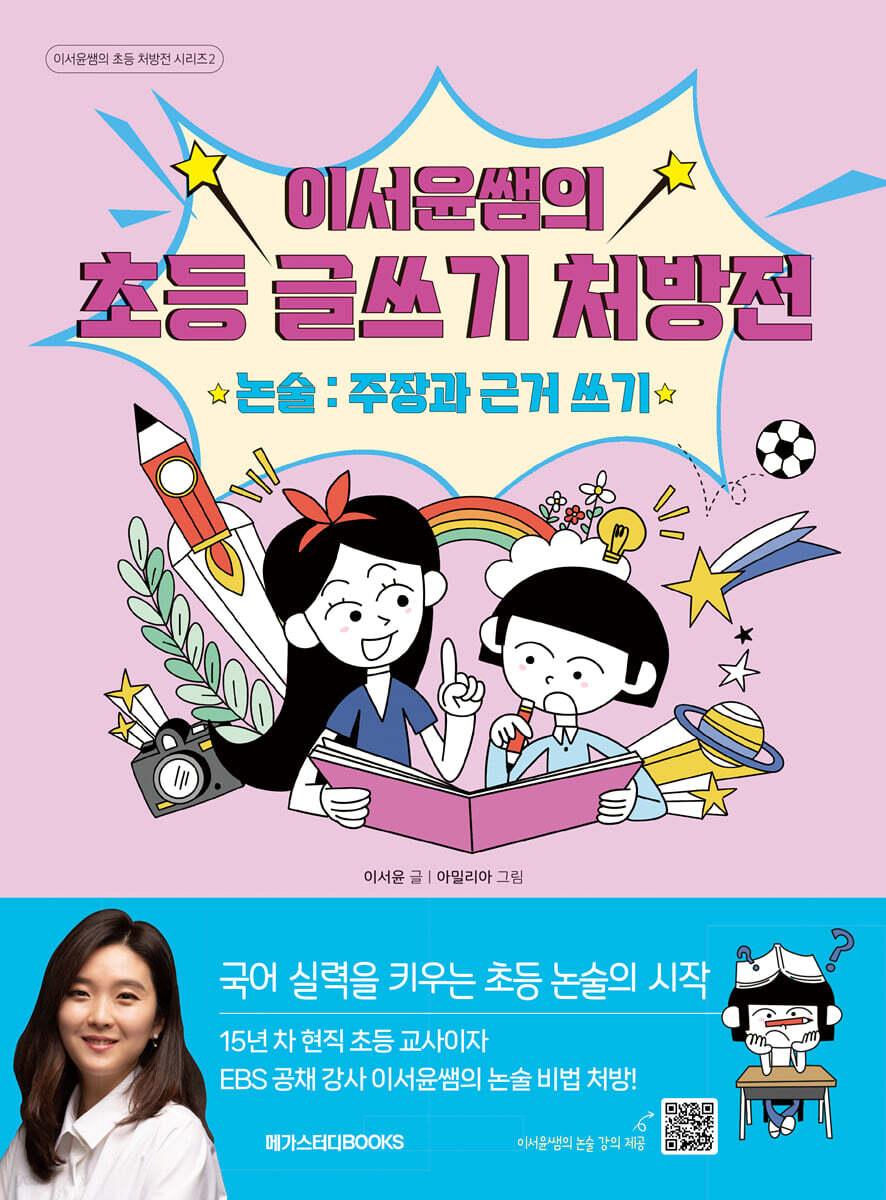
Teacher Lee Seo-yoon's Elementary Writing Prescription: Argumentation and Evidence Writing
 |
Description
Book Introduction
Writing arguments and evidence to help you write your first argument
For elementary school students, 'essay writing' is considered a rigid piece of writing consisting of an introduction, body, and conclusion.
So, I vaguely think that writing is difficult and burdensome.
But the argument isn't all that grandiose.
If you are a child who has experience persuading friends or parents who have different opinions from you, you are already applying argumentation techniques in your daily life.
Because 'argumentation' is about explaining my thoughts in writing and persuading others.
For children who feel a vague aversion to writing essays, teacher Seo-yoon Lee, an elementary school teacher with 15 years of experience, presents a prescription for writing essays for elementary school students.
From familiar life essays to fairy tales, imagination, and social studies essays, children can start writing essays on 50 topics that are easy and fun for them to try.
If you practice the 'claim and evidence writing' method suggested by Teacher Lee Seo-yoon, your argumentative writing foundation will become solid before you know it.
For elementary school students, 'essay writing' is considered a rigid piece of writing consisting of an introduction, body, and conclusion.
So, I vaguely think that writing is difficult and burdensome.
But the argument isn't all that grandiose.
If you are a child who has experience persuading friends or parents who have different opinions from you, you are already applying argumentation techniques in your daily life.
Because 'argumentation' is about explaining my thoughts in writing and persuading others.
For children who feel a vague aversion to writing essays, teacher Seo-yoon Lee, an elementary school teacher with 15 years of experience, presents a prescription for writing essays for elementary school students.
From familiar life essays to fairy tales, imagination, and social studies essays, children can start writing essays on 50 topics that are easy and fun for them to try.
If you practice the 'claim and evidence writing' method suggested by Teacher Lee Seo-yoon, your argumentative writing foundation will become solid before you know it.
- You can preview some of the book's contents.
Preview
index
1.
Life essay
Topic 1.
Break time, is 10 minutes enough?
Topic 2.
Do you have to write beautifully?
Topic 3.
Is it okay for elementary school students to eat ramen?
Topic 4.
Are smartphones really necessary for elementary school students?
Topic 5.
Should I make or buy a birthday present for my friend?
Topic 6.
What do you think about the game to get close to your friends?
Topic 7.
My heart is pounding! Should I become a class officer?
Topic 8.
Should I study alone or with a friend?
Topic 9.
Is it okay to lie on April Fool's Day?
Topic 10.
What should I do if my friend hits me?
Topic 11.
Is it okay for elementary school students to play games?
Topic 12.
How should class officers be selected?
Topic 13.
Is it really necessary to learn English?
Topic 14.
What's the best way to swap pairs in class?
Topic 15.
Is it better to have fewer people in a class or more people?
Topic 16.
Should I be quiet during break time or is it okay to make noise?
Topic 17.
Should I just not look at a tree I can't climb?
Topic 18.
Is it better to use an app to keep a diary or to write it by hand in a paper diary?
Topic 19.
Banning group chats by class! Is it really necessary?
Topic 20.
Should I only buy the things I absolutely need?
2.
Fairy tale essay
Topic 21.
Is the turtle that runs away leaving the napping rabbit the real winner?_The Tortoise and the Rabbit
Topic 22.
Which of the three little pigs' houses do you think is the best?_The Three Little Pigs
Topic 23.
Is the grasshopper really that lazy?_The Ant and the Grasshopper
Topic 24.
What kind of person is Heungbu?_Heungbu and Nolbu
Topic 25.
Is Simcheong truly a filial daughter?_Simcheongjeon
Topic 26.
Couldn't Jack have succeeded without taking the giant's stuff?_Jack and the Beanstalk
Topic 27.
The prince fell in love with Cinderella at first sight. Did he really love her?_Cinderella
Topic 28.
Is it good to save money like a squirrel?_Squirrel
Topic 29.
Was there no way for the Little Mermaid to fall in love with the prince?_The Little Mermaid
Topic 30.
Should I live as kindly as Kongjwi?_Kongjwi and Patjwi
Topic 31.
A crow that adorned itself with other birds' feathers and became the king of the forest—is this a wrong move? _The crow that wants to be king
Topic 32.
Is it right for the crane to take revenge on the fox?_The Fox and the Crane
Topic 33.
Is he a loyal subject growing up or not?_Rabbit War
Topic 34.
Was it true love that made the woodcutter hide the fairy's wings?_The Fairy and the Woodcutter
3.
Imaginative essay
Topic 35.
If you could swap bodies with anyone in your family, who would you want to swap with?
Topic 36.
How can I convince myself that I'm not lazy?
Topic 37.
If there was a vending machine that could instantly produce whatever you wanted, what would you want?
Topic 38.
If you could time travel to the past or future, when would you go?
Topic 39.
If I were a principal, what subjects would I teach my students?
Topic 40.
If you could only have one spoon or one chopsticks left in this world, which would you choose?
Topic 41.
How many days a week should I go to school?
Topic 42.
How do you convince people to sell hot packs in the desert?
Topic 43.
If the king bans chicken, how can you convince him?
Topic 44.
Which is better, a robot teacher or a human teacher?
Topic 45.
If you had a friend with magical abilities, what problem would you ask them to solve in your class?
4.
Social Studies Essay
Topic 46.
Is it not allowed to play ball in the children's park?
Topic 47.
Is it right to impose a heavier penalty on someone who litters secretly?
Topic 48.
Are subway seats for pregnant women really necessary?
Topic 49.
Is it right to feed stray cats?
Topic 50.
Are meatless meals really necessary in schools?
Life essay
Topic 1.
Break time, is 10 minutes enough?
Topic 2.
Do you have to write beautifully?
Topic 3.
Is it okay for elementary school students to eat ramen?
Topic 4.
Are smartphones really necessary for elementary school students?
Topic 5.
Should I make or buy a birthday present for my friend?
Topic 6.
What do you think about the game to get close to your friends?
Topic 7.
My heart is pounding! Should I become a class officer?
Topic 8.
Should I study alone or with a friend?
Topic 9.
Is it okay to lie on April Fool's Day?
Topic 10.
What should I do if my friend hits me?
Topic 11.
Is it okay for elementary school students to play games?
Topic 12.
How should class officers be selected?
Topic 13.
Is it really necessary to learn English?
Topic 14.
What's the best way to swap pairs in class?
Topic 15.
Is it better to have fewer people in a class or more people?
Topic 16.
Should I be quiet during break time or is it okay to make noise?
Topic 17.
Should I just not look at a tree I can't climb?
Topic 18.
Is it better to use an app to keep a diary or to write it by hand in a paper diary?
Topic 19.
Banning group chats by class! Is it really necessary?
Topic 20.
Should I only buy the things I absolutely need?
2.
Fairy tale essay
Topic 21.
Is the turtle that runs away leaving the napping rabbit the real winner?_The Tortoise and the Rabbit
Topic 22.
Which of the three little pigs' houses do you think is the best?_The Three Little Pigs
Topic 23.
Is the grasshopper really that lazy?_The Ant and the Grasshopper
Topic 24.
What kind of person is Heungbu?_Heungbu and Nolbu
Topic 25.
Is Simcheong truly a filial daughter?_Simcheongjeon
Topic 26.
Couldn't Jack have succeeded without taking the giant's stuff?_Jack and the Beanstalk
Topic 27.
The prince fell in love with Cinderella at first sight. Did he really love her?_Cinderella
Topic 28.
Is it good to save money like a squirrel?_Squirrel
Topic 29.
Was there no way for the Little Mermaid to fall in love with the prince?_The Little Mermaid
Topic 30.
Should I live as kindly as Kongjwi?_Kongjwi and Patjwi
Topic 31.
A crow that adorned itself with other birds' feathers and became the king of the forest—is this a wrong move? _The crow that wants to be king
Topic 32.
Is it right for the crane to take revenge on the fox?_The Fox and the Crane
Topic 33.
Is he a loyal subject growing up or not?_Rabbit War
Topic 34.
Was it true love that made the woodcutter hide the fairy's wings?_The Fairy and the Woodcutter
3.
Imaginative essay
Topic 35.
If you could swap bodies with anyone in your family, who would you want to swap with?
Topic 36.
How can I convince myself that I'm not lazy?
Topic 37.
If there was a vending machine that could instantly produce whatever you wanted, what would you want?
Topic 38.
If you could time travel to the past or future, when would you go?
Topic 39.
If I were a principal, what subjects would I teach my students?
Topic 40.
If you could only have one spoon or one chopsticks left in this world, which would you choose?
Topic 41.
How many days a week should I go to school?
Topic 42.
How do you convince people to sell hot packs in the desert?
Topic 43.
If the king bans chicken, how can you convince him?
Topic 44.
Which is better, a robot teacher or a human teacher?
Topic 45.
If you had a friend with magical abilities, what problem would you ask them to solve in your class?
4.
Social Studies Essay
Topic 46.
Is it not allowed to play ball in the children's park?
Topic 47.
Is it right to impose a heavier penalty on someone who litters secretly?
Topic 48.
Are subway seats for pregnant women really necessary?
Topic 49.
Is it right to feed stray cats?
Topic 50.
Are meatless meals really necessary in schools?
Detailed image
.jpg)
Publisher's Review
A customized essay prescription for children from Seo-yoon Lee, an elementary school teacher with 15 years of experience.
With 15 years of teaching experience, Teacher Lee Seo-yoon has taught numerous students in various forms, from the basics of writing to argumentative techniques.
Based on my experience, I've been thinking deeply about how to address the difficulties and burdens that children feel when they first encounter essay writing.
Children who are just beginning to write essays often worry about how to organize their thoughts into writing.
Teacher Lee Seo-yoon asked questions about topics that children would enjoy, making the process of organizing their thoughts and writing them down fun and engaging.
We help children begin their essay writing effortlessly with familiar questions like those from everyday life, those that stimulate the imagination, and those from fairy tales.
"Lee Seo-yoon's Writing Prescription, Essay: Writing Arguments and Evidence" is a book that helps children overcome their fear of essay writing and gain confidence.
We understand that writing essays isn't difficult; it's that people don't know how to connect their arguments with evidence. So, we help them learn the basics step by step.
It will be a great help to children taking their first steps in writing and gaining confidence in logical thinking.
The First Step to Elementary Argumentation: Writing Three Reasons
If you are a child who is just starting to write an argument, it would be good to start by practicing 'writing claims and supporting evidence.'
First, I clarify what I am arguing about a topic and then look for evidence to support that argument.
This book first uses the '3-step method of connecting claims and evidence' to help you express your thoughts as claims and find evidence, making it easy to access through questions and cartoons.
'Step 1: Read the cartoon content and organize your thoughts on the given question.
Step 2: Translate your thoughts into arguments.
Step 3: Find and write down simple, specific examples or reasons to support your argument. Through this process, children will clearly understand how to begin and develop 'argument and evidence writing.'
It also helps you practice 'giving three reasons' for a claim.
Three reasons make your argument more persuasive.
This allows children to naturally learn that argumentation is not simply a list of opinions, but a process of creating logical and credible arguments.
And introduce different types of evidence.
'Experience, examples, citations, and evidence for opinions' each have different effects, and when they are appropriately combined, the argument becomes richer and more logical.
One of the challenges children face when they first begin writing essays is that they don't know how to write them because there are no model answers or examples.
This book provides helpful examples of 'writing claims and supporting evidence' so children can clearly see how to connect claims and supporting evidence.
And Teacher Lee Seo-yoon points out the basis for writing the example essay, and tells you what you did well and what you need to improve on.
Start writing elementary school essays smartly with 50 special prescriptions from Teacher Seo Yoon!
"Lee Seo-yoon's Writing Prescription, Essay: Writing Arguments and Evidence" presents 50 interesting topics to help children easily begin writing essays.
The topics are divided into four categories: life essay, fairy tale essay, imaginary essay, and social essay, helping children easily develop arguments and supporting evidence based on their own experiences and interests.
'Life Essay' is a topic that organizes children's thoughts based on the experiences and emotions they experience in their daily lives.
There are many questions about relationships with friends, communication with family, and experiences at school.
'Fairy Tale Essay' is a topic that asks children to think about the lessons or messages hidden in fairy tales that they are familiar with.
It's a way of writing about how you understood the story and what you thought after reading the fairy tale.
'Imaginative Argumentation' is a topic where children use their imagination to come up with new ideas and logically develop them.
'Social Studies' is a topic based on what happens in society.
This book develops arguments centered around interesting questions that children might be curious about.
For example, you will learn how to naturally connect arguments and evidence through familiar and interesting topics such as “Is it okay for elementary school students to play games?”, “What should I do if a friend hits me?”, and “Is it right to feed stray cats?”
Rather than focusing on difficult topics, we can naturally develop problem-solving skills by using examples that we can easily find around us.
By practicing "writing arguments and supporting evidence" with Teacher Seo Yoon's 50 questions and prescriptions, children will be able to overcome their fear of essay writing and gain confidence in their writing.
Through this book, you will naturally learn logical thinking, which is the most important skill when writing, and also develop the ability to express your thoughts in writing.
With 15 years of teaching experience, Teacher Lee Seo-yoon has taught numerous students in various forms, from the basics of writing to argumentative techniques.
Based on my experience, I've been thinking deeply about how to address the difficulties and burdens that children feel when they first encounter essay writing.
Children who are just beginning to write essays often worry about how to organize their thoughts into writing.
Teacher Lee Seo-yoon asked questions about topics that children would enjoy, making the process of organizing their thoughts and writing them down fun and engaging.
We help children begin their essay writing effortlessly with familiar questions like those from everyday life, those that stimulate the imagination, and those from fairy tales.
"Lee Seo-yoon's Writing Prescription, Essay: Writing Arguments and Evidence" is a book that helps children overcome their fear of essay writing and gain confidence.
We understand that writing essays isn't difficult; it's that people don't know how to connect their arguments with evidence. So, we help them learn the basics step by step.
It will be a great help to children taking their first steps in writing and gaining confidence in logical thinking.
The First Step to Elementary Argumentation: Writing Three Reasons
If you are a child who is just starting to write an argument, it would be good to start by practicing 'writing claims and supporting evidence.'
First, I clarify what I am arguing about a topic and then look for evidence to support that argument.
This book first uses the '3-step method of connecting claims and evidence' to help you express your thoughts as claims and find evidence, making it easy to access through questions and cartoons.
'Step 1: Read the cartoon content and organize your thoughts on the given question.
Step 2: Translate your thoughts into arguments.
Step 3: Find and write down simple, specific examples or reasons to support your argument. Through this process, children will clearly understand how to begin and develop 'argument and evidence writing.'
It also helps you practice 'giving three reasons' for a claim.
Three reasons make your argument more persuasive.
This allows children to naturally learn that argumentation is not simply a list of opinions, but a process of creating logical and credible arguments.
And introduce different types of evidence.
'Experience, examples, citations, and evidence for opinions' each have different effects, and when they are appropriately combined, the argument becomes richer and more logical.
One of the challenges children face when they first begin writing essays is that they don't know how to write them because there are no model answers or examples.
This book provides helpful examples of 'writing claims and supporting evidence' so children can clearly see how to connect claims and supporting evidence.
And Teacher Lee Seo-yoon points out the basis for writing the example essay, and tells you what you did well and what you need to improve on.
Start writing elementary school essays smartly with 50 special prescriptions from Teacher Seo Yoon!
"Lee Seo-yoon's Writing Prescription, Essay: Writing Arguments and Evidence" presents 50 interesting topics to help children easily begin writing essays.
The topics are divided into four categories: life essay, fairy tale essay, imaginary essay, and social essay, helping children easily develop arguments and supporting evidence based on their own experiences and interests.
'Life Essay' is a topic that organizes children's thoughts based on the experiences and emotions they experience in their daily lives.
There are many questions about relationships with friends, communication with family, and experiences at school.
'Fairy Tale Essay' is a topic that asks children to think about the lessons or messages hidden in fairy tales that they are familiar with.
It's a way of writing about how you understood the story and what you thought after reading the fairy tale.
'Imaginative Argumentation' is a topic where children use their imagination to come up with new ideas and logically develop them.
'Social Studies' is a topic based on what happens in society.
This book develops arguments centered around interesting questions that children might be curious about.
For example, you will learn how to naturally connect arguments and evidence through familiar and interesting topics such as “Is it okay for elementary school students to play games?”, “What should I do if a friend hits me?”, and “Is it right to feed stray cats?”
Rather than focusing on difficult topics, we can naturally develop problem-solving skills by using examples that we can easily find around us.
By practicing "writing arguments and supporting evidence" with Teacher Seo Yoon's 50 questions and prescriptions, children will be able to overcome their fear of essay writing and gain confidence in their writing.
Through this book, you will naturally learn logical thinking, which is the most important skill when writing, and also develop the ability to express your thoughts in writing.
GOODS SPECIFICS
- Date of issue: December 15, 2024
- Page count, weight, size: 120 pages | 188*257*20mm
- ISBN13: 9791129713919
- ISBN10: 1129713911
- KC Certification: Certification Type: Conformity Confirmation
You may also like
카테고리
korean


korean

![GQ KOREA Mark (Monthly): December [2025]](http://librairie.coreenne.fr/cdn/shop/files/8ef265dbbfbf186523ed75ba7319009d.jpg?v=1765340328&width=3840)


