

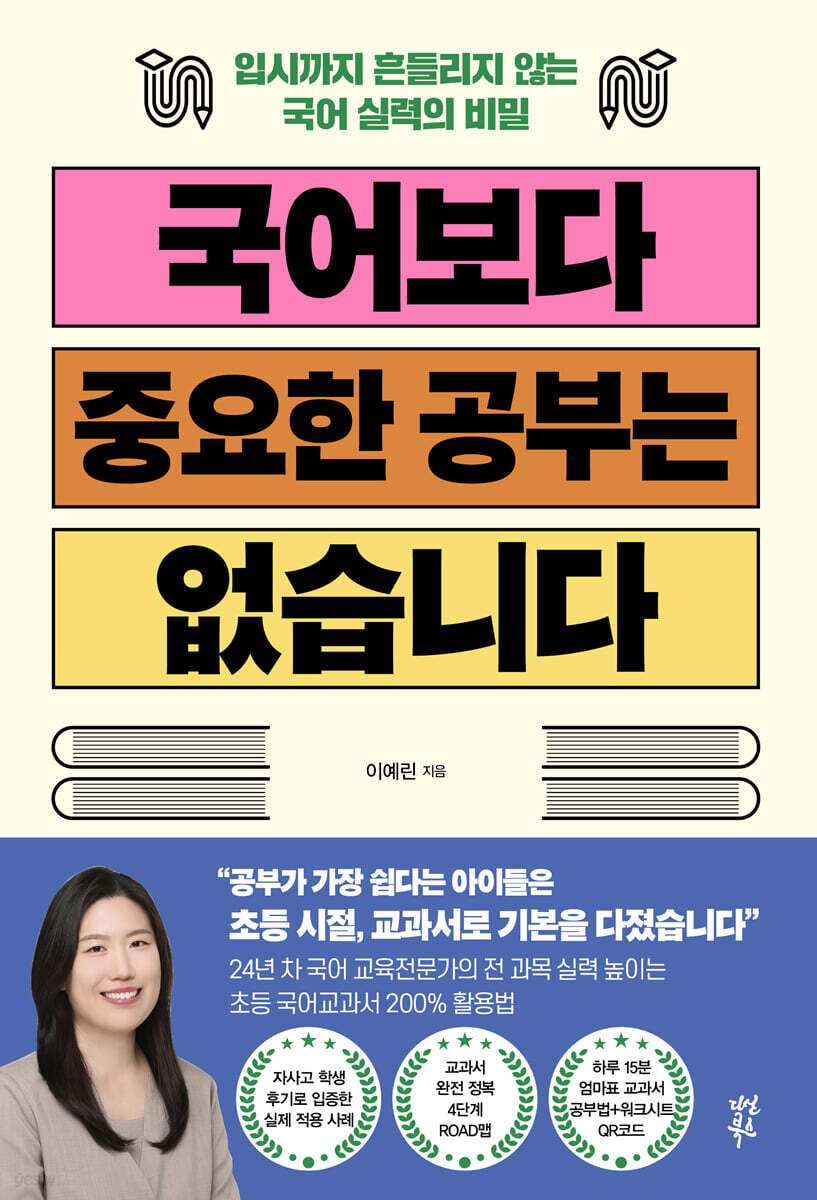
There is no study more important than the Korean language.
 |
Description
Book Introduction
“The children who find studying the easiest
“In elementary school, I laid the foundation with Korean language textbooks.”
Analyzed by a Korean language education expert with 24 years of experience and proven by the top 1% of students
A Korean language study method centered on elementary school textbooks that is more powerful than private education.
In an age where the ability to read and think is disappearing, many parents and students still feel lost when it comes to the Korean language.
However, in the digital and AI era, Korean language skills are not an option but an essential survival skill.
However, Korean is a subject that must be practiced consistently and in the right way.
So, what matters most is not when you start, but how you start.
"There is no study more important than Korean" provides parents and children concerned about improving their Korean language skills with specific and practical learning strategies centered around elementary school Korean language textbooks.
The author has taught numerous students in various educational environments, including private high schools, art high schools, and general high schools, for 24 years and discovered the common learning habits of the top 10% of children.
This means that by repeatedly using textbooks from elementary school, you have solidified your Korean language skills for life.
Children who consistently practiced reading, organizing, asking questions, and expressing themselves in their own words from their textbooks were able to maintain top grades even as their grades advanced or the difficulty of their studies increased.
In this book, the author organizes this Korean language textbook-centered learning method into a systematic four-step routine and introduces it as the 'Korean Language Textbook ROAD Map.'
It is designed to be easy to teach at home with dialogue examples and worksheets (QR included) that can be used for each stage.
"There is no study more important than the Korean language." Any reader can develop literacy, thinking skills, and expressive skills through elementary school Korean language textbooks, and lay the foundation for not only their children's Korean language skills but also lifelong learning.
This book will serve as an essential roadmap for Korean language education for parents of elementary school students.
“In elementary school, I laid the foundation with Korean language textbooks.”
Analyzed by a Korean language education expert with 24 years of experience and proven by the top 1% of students
A Korean language study method centered on elementary school textbooks that is more powerful than private education.
In an age where the ability to read and think is disappearing, many parents and students still feel lost when it comes to the Korean language.
However, in the digital and AI era, Korean language skills are not an option but an essential survival skill.
However, Korean is a subject that must be practiced consistently and in the right way.
So, what matters most is not when you start, but how you start.
"There is no study more important than Korean" provides parents and children concerned about improving their Korean language skills with specific and practical learning strategies centered around elementary school Korean language textbooks.
The author has taught numerous students in various educational environments, including private high schools, art high schools, and general high schools, for 24 years and discovered the common learning habits of the top 10% of children.
This means that by repeatedly using textbooks from elementary school, you have solidified your Korean language skills for life.
Children who consistently practiced reading, organizing, asking questions, and expressing themselves in their own words from their textbooks were able to maintain top grades even as their grades advanced or the difficulty of their studies increased.
In this book, the author organizes this Korean language textbook-centered learning method into a systematic four-step routine and introduces it as the 'Korean Language Textbook ROAD Map.'
It is designed to be easy to teach at home with dialogue examples and worksheets (QR included) that can be used for each stage.
"There is no study more important than the Korean language." Any reader can develop literacy, thinking skills, and expressive skills through elementary school Korean language textbooks, and lay the foundation for not only their children's Korean language skills but also lifelong learning.
This book will serve as an essential roadmap for Korean language education for parents of elementary school students.
- You can preview some of the book's contents.
Preview
index
To begin with
Elementary Korean Language Textbooks: Building Children's Lifelong Skills
Testimonials from top students who implemented the ROAD map in the Korean language textbook
Part 1.
There is a separate reason why studying Korean is necessary.
Chapter 1: Elementary Korean: Why is it so important?
1.
The literacy crisis in South Korea
2.
Why you need to learn Korean systematically
3.
I got 100 points in math, but why didn't my Korean score go up?
4.
The key to success or failure in college entrance is ultimately the Korean language.
Chapter 2.
Elementary Korean Language Textbooks: Changing the Landscape of Learning
1.
The best, most reliable textbook
2.
One thing top kids never miss
3.
Textbook immersion changes grades
4.
How should a child who is unfamiliar with textbooks begin?
Part 2.
Korean Language Textbooks: This is How to Write Them for Real Study
Chapter 3.
Step 1: Read accurately
The way we read textbooks needs to change.
1.
One line of learning objectives can change the direction of your studies.
2.
You must read the following text before answering the questions.
3.
Finding the Key Points in Small Text and Information Boxes
4.
Don't throw away the various activities in the textbook; keep them alive.
5.
Expanding literacy training by reading illustrations, photographs, and diagrams
6.
Literacy navigation that captures the flow with connecting words
★ Case study of a student who studied using Step 1
Chapter 4.
Step 2: Organize: Organize structurally
A child who can organize things at a glance is also more skilled.
1.
Top Students' Textbook Organizing Secrets
2.
Create your own textbook with shapes, symbols, and colors
3.
How to summarize the entire content with a few keywords
4.
From picture structure diagrams to Cornell note-taking strategies
5.
Analog vs. Digital: Choosing a Method of Organization
6.
Create a 15-minute daily textbook organizing routine
★ Case study of a student who studied using Step 2
Chapter 5.
Step 3: Ask: Asking questions that get to the heart of the matter.
Children who are good at studying ask different questions.
1.
The Quality of Questions That Bridge the Learning Gap
2.
The 5 Questions Formula for Deeper Thinking
3.
Strategies to Get Even Passive Children to Ask Questions
4.
Develop personalized thinking skills with level-based questioning strategies.
5.
How to Create a Textbook-Based Question Notebook
6.
How to Build Your Thinking Muscles with One Question a Day
★ Case study of a student who studied using the 3-step method
Chapter 6.
Step 4: Developing Knowledge and Ideas
The moment a child expresses himself, his skills grow.
1.
The child who reads and writes wins in the end.
2.
Being able to explain something in words is true skill.
3.
Information processing exercise to summarize paragraphs into sentences
4.
A method for expanding thinking by starting with the Korean language textbook
5.
The power to develop textbooks into content unique to our children.
6.
Creating a 'Korean Language Portfolio' that helps you express yourself and grow
★ Case study of a student who studied using the 4-step method
Part 3: A Korean Language Growth Routine Completed in 15 Minutes a Day with a Textbook
Chapter 7.
Korean Language Textbook Road Map: Start Like This
1.
The effects of studying Korean for 15 minutes a day
2.
A four-week practice challenge starting from one page of the textbook.
3.
Korean Language Routine Practice Guide by Grade Level
4.
Training in Korean language study methods before entering middle school
5.
"Mom, I don't want to do it" - How to deal with a crisis
6.
A realistic parallel learning strategy using textbooks and smartphones
7.
If your child asks, “Why do I have to study?”
8.
The best way to develop your child's metacognition
In conclusion
How to Raise Children to Become Lifelong Readers and Express Their Thoughts Beyond Korean Language Skills
Elementary Korean Language Textbooks: Building Children's Lifelong Skills
Testimonials from top students who implemented the ROAD map in the Korean language textbook
Part 1.
There is a separate reason why studying Korean is necessary.
Chapter 1: Elementary Korean: Why is it so important?
1.
The literacy crisis in South Korea
2.
Why you need to learn Korean systematically
3.
I got 100 points in math, but why didn't my Korean score go up?
4.
The key to success or failure in college entrance is ultimately the Korean language.
Chapter 2.
Elementary Korean Language Textbooks: Changing the Landscape of Learning
1.
The best, most reliable textbook
2.
One thing top kids never miss
3.
Textbook immersion changes grades
4.
How should a child who is unfamiliar with textbooks begin?
Part 2.
Korean Language Textbooks: This is How to Write Them for Real Study
Chapter 3.
Step 1: Read accurately
The way we read textbooks needs to change.
1.
One line of learning objectives can change the direction of your studies.
2.
You must read the following text before answering the questions.
3.
Finding the Key Points in Small Text and Information Boxes
4.
Don't throw away the various activities in the textbook; keep them alive.
5.
Expanding literacy training by reading illustrations, photographs, and diagrams
6.
Literacy navigation that captures the flow with connecting words
★ Case study of a student who studied using Step 1
Chapter 4.
Step 2: Organize: Organize structurally
A child who can organize things at a glance is also more skilled.
1.
Top Students' Textbook Organizing Secrets
2.
Create your own textbook with shapes, symbols, and colors
3.
How to summarize the entire content with a few keywords
4.
From picture structure diagrams to Cornell note-taking strategies
5.
Analog vs. Digital: Choosing a Method of Organization
6.
Create a 15-minute daily textbook organizing routine
★ Case study of a student who studied using Step 2
Chapter 5.
Step 3: Ask: Asking questions that get to the heart of the matter.
Children who are good at studying ask different questions.
1.
The Quality of Questions That Bridge the Learning Gap
2.
The 5 Questions Formula for Deeper Thinking
3.
Strategies to Get Even Passive Children to Ask Questions
4.
Develop personalized thinking skills with level-based questioning strategies.
5.
How to Create a Textbook-Based Question Notebook
6.
How to Build Your Thinking Muscles with One Question a Day
★ Case study of a student who studied using the 3-step method
Chapter 6.
Step 4: Developing Knowledge and Ideas
The moment a child expresses himself, his skills grow.
1.
The child who reads and writes wins in the end.
2.
Being able to explain something in words is true skill.
3.
Information processing exercise to summarize paragraphs into sentences
4.
A method for expanding thinking by starting with the Korean language textbook
5.
The power to develop textbooks into content unique to our children.
6.
Creating a 'Korean Language Portfolio' that helps you express yourself and grow
★ Case study of a student who studied using the 4-step method
Part 3: A Korean Language Growth Routine Completed in 15 Minutes a Day with a Textbook
Chapter 7.
Korean Language Textbook Road Map: Start Like This
1.
The effects of studying Korean for 15 minutes a day
2.
A four-week practice challenge starting from one page of the textbook.
3.
Korean Language Routine Practice Guide by Grade Level
4.
Training in Korean language study methods before entering middle school
5.
"Mom, I don't want to do it" - How to deal with a crisis
6.
A realistic parallel learning strategy using textbooks and smartphones
7.
If your child asks, “Why do I have to study?”
8.
The best way to develop your child's metacognition
In conclusion
How to Raise Children to Become Lifelong Readers and Express Their Thoughts Beyond Korean Language Skills
Detailed image

Into the book
The answer could only be found when I came to the public education field.
While teaching Korean to thousands of students in various educational environments, including private high schools, art high schools, and general high schools, I discovered that students who never missed the first grade in Korean have something in common.
It was the ‘habit of reading the Korean language textbook properly’ that I had developed since elementary school.
The habit of reading textbooks, the most basic teaching material, in depth was the root of true Korean language skills.
--- From "Getting Started│Elementary Korean Language Textbook, Building Children's Lifelong Skills"
So, does that mean our children who don't read can't be good at Korean? That's not true.
Even if you don't read enough, there are ways to improve your Korean language skills.
It is about reading and using the ‘Korean Language Textbook’ properly.
Improving your Korean language skills is not about ‘quantity’ but ‘quality.’
Rather than blindly reading a lot of books, the process of accurately reading and understanding the texts in the textbook, then organizing and expressing your thoughts is much more effective in improving your Korean language skills.
Reading for fun and strategic reading for academic purposes have different purposes.
Even if a child reads a lot of books, he or she may have difficulty analyzing passages or solving problems on the Korean language test. On the other hand, a child who has developed the habit of reading textbooks carefully and grasping the main points, even if he or she does not read a lot, may show much better results.
Therefore, we have to approach the textbook with a strategic reading method to have a chance of success.
--- From "Chapter 1│Elementary Korean, Why is it so important?"
Our ultimate goal is to help children discover the joy of reading on their own, starting with textbooks, and grow into individuals who enjoy a variety of books.
Textbooks are a starting point, a learning tool that is both easy on the wallet and highly effective.
And the Korean language skills developed in this way become a solid foundation for the child's overall academic success.
Children who develop the habit of reading and thinking by treating their textbooks with respect from elementary school will never waver no matter what subject they encounter in middle and high school.
--- From "Chapter 2│Elementary Korean Language Textbooks, Changing the Landscape of Studying"
A child who is good at solving problems is ultimately a child who is good at 'reading' problems.
This is because only by reading properly can you approach complex texts strategically without losing your bearings.
So, whenever you come across a sentence like, "Let's read the following passage and answer the questions," help your child shift their thinking to, "Oh, the answer is right there in the passage," or "So, this means we should read with a purpose, not just read."
Starting today, start by reviewing the learning objectives and instructions with your child.
You can slowly develop the habit by pointing out, “In which direction should I read this problem?”
As this habit builds, it develops into a powerful reading strategy that can be applied to all subjects, including Korean language, math word problems, scientific inquiry explanations, and social studies diagrams.
--- From "Chapter 3│Step 1 Read: Read Accurately"
Training that connects reading and writing allows us to move beyond the stage of knowing knowledge to the stage of thinking.
In that sense, the experience of reconstructing a paragraph from a textbook in speech or writing helps children understand the content more deeply and apply it creatively.
Children who develop consistent reading and writing habits will grow into "knowledge producers" who actively express their thoughts and communicate with the world, rather than passive learners who simply absorb knowledge.
--- From "Chapter 6│Step 4 Develop: Developing Knowledge and Thought"
The goal of the ROAD Map in the Korean language textbook is to help children expand their thinking while freely using the Korean language, to learn to read out of curiosity, and to grow into individuals who can express their thoughts both verbally and in writing.
Textbooks are the most powerful key to open that door.
Children who discover joy through reading textbooks will find it easier to connect with other books.
As you develop the habit of asking questions, your curiosity about the world grows, and as you learn to expand your thoughts, you gain the power to connect more deeply with others.
While teaching Korean to thousands of students in various educational environments, including private high schools, art high schools, and general high schools, I discovered that students who never missed the first grade in Korean have something in common.
It was the ‘habit of reading the Korean language textbook properly’ that I had developed since elementary school.
The habit of reading textbooks, the most basic teaching material, in depth was the root of true Korean language skills.
--- From "Getting Started│Elementary Korean Language Textbook, Building Children's Lifelong Skills"
So, does that mean our children who don't read can't be good at Korean? That's not true.
Even if you don't read enough, there are ways to improve your Korean language skills.
It is about reading and using the ‘Korean Language Textbook’ properly.
Improving your Korean language skills is not about ‘quantity’ but ‘quality.’
Rather than blindly reading a lot of books, the process of accurately reading and understanding the texts in the textbook, then organizing and expressing your thoughts is much more effective in improving your Korean language skills.
Reading for fun and strategic reading for academic purposes have different purposes.
Even if a child reads a lot of books, he or she may have difficulty analyzing passages or solving problems on the Korean language test. On the other hand, a child who has developed the habit of reading textbooks carefully and grasping the main points, even if he or she does not read a lot, may show much better results.
Therefore, we have to approach the textbook with a strategic reading method to have a chance of success.
--- From "Chapter 1│Elementary Korean, Why is it so important?"
Our ultimate goal is to help children discover the joy of reading on their own, starting with textbooks, and grow into individuals who enjoy a variety of books.
Textbooks are a starting point, a learning tool that is both easy on the wallet and highly effective.
And the Korean language skills developed in this way become a solid foundation for the child's overall academic success.
Children who develop the habit of reading and thinking by treating their textbooks with respect from elementary school will never waver no matter what subject they encounter in middle and high school.
--- From "Chapter 2│Elementary Korean Language Textbooks, Changing the Landscape of Studying"
A child who is good at solving problems is ultimately a child who is good at 'reading' problems.
This is because only by reading properly can you approach complex texts strategically without losing your bearings.
So, whenever you come across a sentence like, "Let's read the following passage and answer the questions," help your child shift their thinking to, "Oh, the answer is right there in the passage," or "So, this means we should read with a purpose, not just read."
Starting today, start by reviewing the learning objectives and instructions with your child.
You can slowly develop the habit by pointing out, “In which direction should I read this problem?”
As this habit builds, it develops into a powerful reading strategy that can be applied to all subjects, including Korean language, math word problems, scientific inquiry explanations, and social studies diagrams.
--- From "Chapter 3│Step 1 Read: Read Accurately"
Training that connects reading and writing allows us to move beyond the stage of knowing knowledge to the stage of thinking.
In that sense, the experience of reconstructing a paragraph from a textbook in speech or writing helps children understand the content more deeply and apply it creatively.
Children who develop consistent reading and writing habits will grow into "knowledge producers" who actively express their thoughts and communicate with the world, rather than passive learners who simply absorb knowledge.
--- From "Chapter 6│Step 4 Develop: Developing Knowledge and Thought"
The goal of the ROAD Map in the Korean language textbook is to help children expand their thinking while freely using the Korean language, to learn to read out of curiosity, and to grow into individuals who can express their thoughts both verbally and in writing.
Textbooks are the most powerful key to open that door.
Children who discover joy through reading textbooks will find it easier to connect with other books.
As you develop the habit of asking questions, your curiosity about the world grows, and as you learn to expand your thoughts, you gain the power to connect more deeply with others.
--- From “In conclusion│The way to raise children who can read and express their thoughts throughout their lives, beyond just Korean language skills”
Publisher's Review
“15 minutes a day, with one Korean textbook
“Please help develop your child’s lifelong learning skills!”
A Korean language education expert with 24 years of experience & a current high school teacher
How to Use Elementary Korean Language Textbooks 200% to Improve Skills in All Subjects
Everything you need to know about top-tier Korean language skills that won't waver until college entrance exams
As the difficulty level of the Korean language section of the College Scholastic Ability Test (CSAT) has increased recently, Korean has emerged as a key subject that determines the success or failure of the college entrance exam.
Accordingly, the importance of elementary Korean language education is once again receiving attention.
However, many parents do not know how to teach their children Korean, so they send them to private academies or just make them read.
If you hesitate to guide your child because you 'don't know how' or 'don't know how to ask questions,' this book may be the answer.
"There is no study more important than Korean." Based on her extensive experience teaching college entrance exams, author Yerin Lee goes beyond the vague advice that "you need to read a lot to be good at Korean," and presents specific and feasible learning strategies that can help even children who don't read enough or don't read well improve their skills through textbooks.
The author has taught top students in various settings, including private high schools (Hanago), art high schools, and general high schools, for 24 years and discovered their common study habits.
Since elementary school, I have been reading Korean language textbooks repeatedly, organizing the content, and consistently practicing expressing it in my own words.
Through this, literacy skills are naturally developed, and the fundamentals of learning are cultivated, such as being able to summarize and review what is learned in class on one's own, while keeping in mind the 'learning objectives' in the textbook rather than solving minor problems.
The thinking and literacy skills developed through elementary school textbooks can later lead to understanding and problem-solving skills in all subjects.
Especially, the elementary school years are not just a time to improve grades, but a golden time for developing vocabulary, thinking skills, expressive skills, and study habits.
How you spend this time will determine the direction and depth of your future studies.
Because Korean is a subject that is difficult to catch up on later if you miss it once, elementary Korean language education must be approached strategically.
To this end, we introduce practical application methods tailored to the level of parents and children through various genres of texts and examples included in actual textbooks, providing a new perspective on elementary Korean language learning.
“The Korean language skills of the top children are
It all started from textbooks!”
Even children who do not read enough or do not read books can do it.
Elementary Korean Language Complete Conquest Level 4 ROAD Map Revealed!
Includes various activity worksheet QR codes, including examples of repeated reading of textbooks.
In particular, the author focused on 'textbooks' that are easily accessible to everyone.
Most people misunderstand textbooks as boring or less effective than workbooks.
However, the author emphasizes that the key to reducing the gap in Korean language skills lies within the ‘textbook.’
Elementary Korean language textbooks are not simply tools for imparting knowledge.
The most reliable learning resource, meticulously designed to develop literacy and thinking skills tailored to your child's developmental level.
The diverse text and visual materials in the textbook help children read and structure independently, ask questions, and express their thoughts.
It is a true learning tool that cultivates inner thinking and expressive skills, fundamentally different from private education or workbook-centered learning.
Additionally, textbooks are a valuable medium through which parents and children can communicate and grow together.
The book presents a learning routine that parents can implement in just 15 minutes a day.
Opening a page of a textbook and asking questions like, "What is the most important concept in this passage?" or "How would you summarize what you learned today in one sentence?" will naturally develop your child's literacy and integrated thinking skills.
It's time to take a fresh look at textbooks. "No Study Is More Important Than Korean" guides you through the four-step ROAD map (Read → Organize → Ask → Develop → Express).
We've included a variety of worksheet formats, including examples of reading conversations based on grade-level textbook passages, how to elicit questions from children, how to create a Korean language growth portfolio to enhance critical thinking skills, and a questionnaire to foster metacognition, all in QR codes for repeated use. By properly utilizing the Korean language textbook, you can achieve balanced Korean language learning without any special private tutoring or workbooks, as well as develop self-directed learning skills to manage your own learning.
Your Korean language skills will definitely improve if you practice consistently and in the right way.
This book will serve as a guide that will open the way for our children to study Korean, which will become the foundation of their lives as well as their lifelong studies.
“Please help develop your child’s lifelong learning skills!”
A Korean language education expert with 24 years of experience & a current high school teacher
How to Use Elementary Korean Language Textbooks 200% to Improve Skills in All Subjects
Everything you need to know about top-tier Korean language skills that won't waver until college entrance exams
As the difficulty level of the Korean language section of the College Scholastic Ability Test (CSAT) has increased recently, Korean has emerged as a key subject that determines the success or failure of the college entrance exam.
Accordingly, the importance of elementary Korean language education is once again receiving attention.
However, many parents do not know how to teach their children Korean, so they send them to private academies or just make them read.
If you hesitate to guide your child because you 'don't know how' or 'don't know how to ask questions,' this book may be the answer.
"There is no study more important than Korean." Based on her extensive experience teaching college entrance exams, author Yerin Lee goes beyond the vague advice that "you need to read a lot to be good at Korean," and presents specific and feasible learning strategies that can help even children who don't read enough or don't read well improve their skills through textbooks.
The author has taught top students in various settings, including private high schools (Hanago), art high schools, and general high schools, for 24 years and discovered their common study habits.
Since elementary school, I have been reading Korean language textbooks repeatedly, organizing the content, and consistently practicing expressing it in my own words.
Through this, literacy skills are naturally developed, and the fundamentals of learning are cultivated, such as being able to summarize and review what is learned in class on one's own, while keeping in mind the 'learning objectives' in the textbook rather than solving minor problems.
The thinking and literacy skills developed through elementary school textbooks can later lead to understanding and problem-solving skills in all subjects.
Especially, the elementary school years are not just a time to improve grades, but a golden time for developing vocabulary, thinking skills, expressive skills, and study habits.
How you spend this time will determine the direction and depth of your future studies.
Because Korean is a subject that is difficult to catch up on later if you miss it once, elementary Korean language education must be approached strategically.
To this end, we introduce practical application methods tailored to the level of parents and children through various genres of texts and examples included in actual textbooks, providing a new perspective on elementary Korean language learning.
“The Korean language skills of the top children are
It all started from textbooks!”
Even children who do not read enough or do not read books can do it.
Elementary Korean Language Complete Conquest Level 4 ROAD Map Revealed!
Includes various activity worksheet QR codes, including examples of repeated reading of textbooks.
In particular, the author focused on 'textbooks' that are easily accessible to everyone.
Most people misunderstand textbooks as boring or less effective than workbooks.
However, the author emphasizes that the key to reducing the gap in Korean language skills lies within the ‘textbook.’
Elementary Korean language textbooks are not simply tools for imparting knowledge.
The most reliable learning resource, meticulously designed to develop literacy and thinking skills tailored to your child's developmental level.
The diverse text and visual materials in the textbook help children read and structure independently, ask questions, and express their thoughts.
It is a true learning tool that cultivates inner thinking and expressive skills, fundamentally different from private education or workbook-centered learning.
Additionally, textbooks are a valuable medium through which parents and children can communicate and grow together.
The book presents a learning routine that parents can implement in just 15 minutes a day.
Opening a page of a textbook and asking questions like, "What is the most important concept in this passage?" or "How would you summarize what you learned today in one sentence?" will naturally develop your child's literacy and integrated thinking skills.
It's time to take a fresh look at textbooks. "No Study Is More Important Than Korean" guides you through the four-step ROAD map (Read → Organize → Ask → Develop → Express).
We've included a variety of worksheet formats, including examples of reading conversations based on grade-level textbook passages, how to elicit questions from children, how to create a Korean language growth portfolio to enhance critical thinking skills, and a questionnaire to foster metacognition, all in QR codes for repeated use. By properly utilizing the Korean language textbook, you can achieve balanced Korean language learning without any special private tutoring or workbooks, as well as develop self-directed learning skills to manage your own learning.
Your Korean language skills will definitely improve if you practice consistently and in the right way.
This book will serve as a guide that will open the way for our children to study Korean, which will become the foundation of their lives as well as their lifelong studies.
GOODS SPECIFICS
- Date of issue: November 13, 2025
- Page count, weight, size: 292 pages | 152*225*20mm
- ISBN13: 9791130672755
- ISBN10: 1130672751
You may also like
카테고리
korean


korean

![GQ KOREA Mark (Monthly): December [2025]](http://librairie.coreenne.fr/cdn/shop/files/8ef265dbbfbf186523ed75ba7319009d.jpg?v=1765340328&width=3840)


