

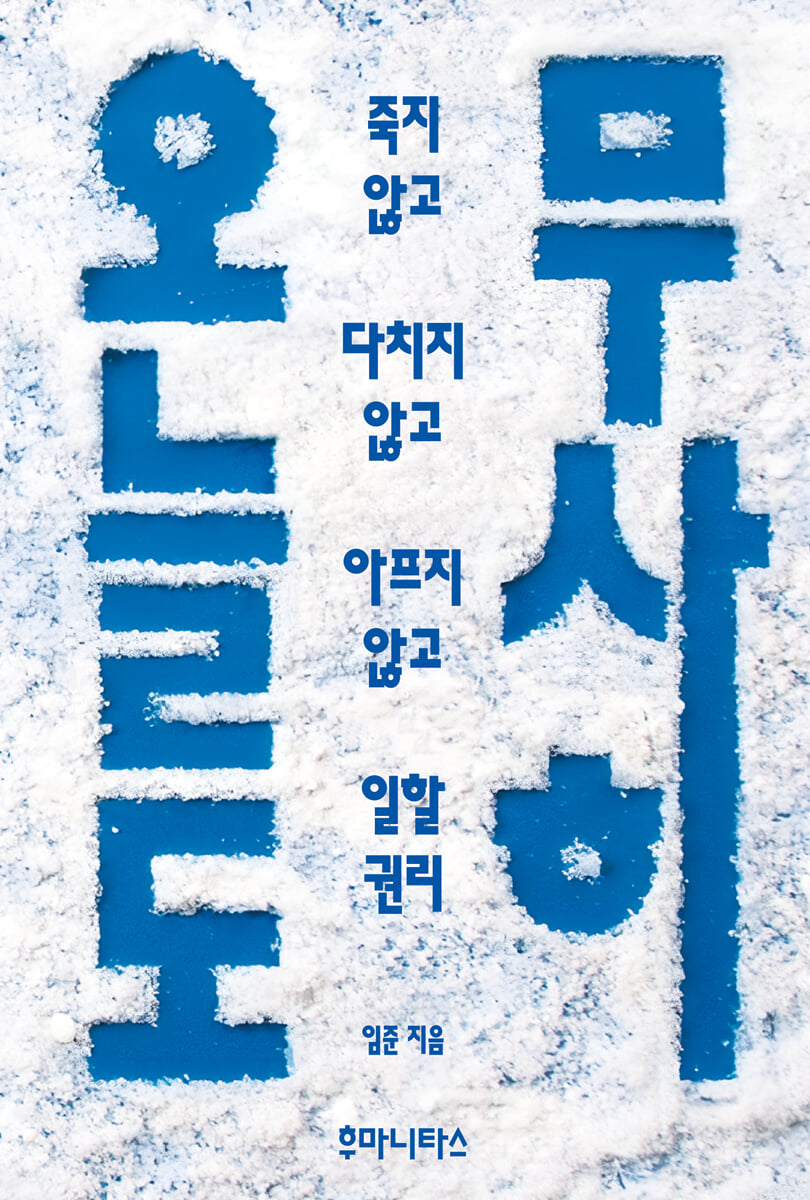
Safe today too
 |
Description
Book Introduction
A workplace that feels like family only when you're healthy
A safe workplace until an accident occurs
In offices and factories, restaurants and cafes, call centers and on the road, hospitals and care settings, are we working healthily?
A safe workplace until an accident occurs
In offices and factories, restaurants and cafes, call centers and on the road, hospitals and care settings, are we working healthily?
- You can preview some of the book's contents.
Preview
index
Recommended Article 8
Introduction 14
Chapter 1: Are Workers Healthy? 23
25 Workers Driven to Death
Tip of the Iceberg 31
36 Unsafe and Unhealthy Workplaces
New Industrial Accident Problem 53
Secrets of Industrial Accident Statistics 58
Issues of burden of proof based on application principle and work attribution 61
Industrial Accident Insurance 67, which only compensates some workers
72 employers who conceal industrial accidents
Chapter 2: Why Doesn't Workers' Health Improve? 77
79 workers treated as machine parts
Socioeconomic Structures That Worsen Worker Health 82
The Birth of the Industrial Safety and Health Act for Exhibition 86
88 Occupational safety and health systems that fail to protect workers' health
Problems with the Current Occupational Safety and Health System 92
Weakened Worker Solidarity, Individualized Worker Health 97
Chapter 3: Changing Demographic Structure and the Crisis of the Occupational Safety and Health System 105
Aging population and increasing number of older workers 109
Changing Workforce Composition 112
With the rise of chronic diseases, worker health management has become increasingly important.
Rising medical costs due to worker health issues 122
The Pitfalls of a Profit-Seeking Supply Structure 125
Rising labor cost 132
Unsustainable Worker Health Insurance System 136
Chapter 4: We Can Work in a Healthy Workplace, Too 141
Paradigm Shift 143
It's not normal to get hurt or sick while working 149
157 Principles to Change the Framework of Occupational Safety and Health
Occupational Safety and Health System for All Workers 167
Proposal 172 for a New Occupational Safety and Health System
Chapter 5: The Current State of Korean Health Insurance 185
Types and Characteristics of Social Security Systems 187
The Development Path of Korea's Social Insurance System 192
Social insurance system incorporated into Bismarckian welfare 193
Problems with the Korean Health Insurance System 200
Chapter 6: Industrial Accident Insurance as a Universal Workers' Health Insurance System 227
Debate over the level of coverage for industrial accident victims 229
Are all workers eligible for workers' compensation insurance? 234
It's sad enough to be sick, but "You can't do it!" 237
The Unscientific Attitude to Determining the Causes of Industrial Accidents 241
Violation of workers' rights 244
249 applies to all working people
What if workers' health insurance systems were integrated? 251
Health insurance 255, which has not been able to shake off the stigma of being a discount system for medical expenses.
Workers' Health and Universal Health Coverage 256
In the long term, industrial accident compensation insurance and health insurance should be integrated. 258
Chapter 7: Where Are the Industrial Accident Workers? 265
A Society That Steals Work 268
Principle of Equal Treatment 270
Rehabilitation and Aftercare 275
In closing, 282
Reference 285
Introduction 14
Chapter 1: Are Workers Healthy? 23
25 Workers Driven to Death
Tip of the Iceberg 31
36 Unsafe and Unhealthy Workplaces
New Industrial Accident Problem 53
Secrets of Industrial Accident Statistics 58
Issues of burden of proof based on application principle and work attribution 61
Industrial Accident Insurance 67, which only compensates some workers
72 employers who conceal industrial accidents
Chapter 2: Why Doesn't Workers' Health Improve? 77
79 workers treated as machine parts
Socioeconomic Structures That Worsen Worker Health 82
The Birth of the Industrial Safety and Health Act for Exhibition 86
88 Occupational safety and health systems that fail to protect workers' health
Problems with the Current Occupational Safety and Health System 92
Weakened Worker Solidarity, Individualized Worker Health 97
Chapter 3: Changing Demographic Structure and the Crisis of the Occupational Safety and Health System 105
Aging population and increasing number of older workers 109
Changing Workforce Composition 112
With the rise of chronic diseases, worker health management has become increasingly important.
Rising medical costs due to worker health issues 122
The Pitfalls of a Profit-Seeking Supply Structure 125
Rising labor cost 132
Unsustainable Worker Health Insurance System 136
Chapter 4: We Can Work in a Healthy Workplace, Too 141
Paradigm Shift 143
It's not normal to get hurt or sick while working 149
157 Principles to Change the Framework of Occupational Safety and Health
Occupational Safety and Health System for All Workers 167
Proposal 172 for a New Occupational Safety and Health System
Chapter 5: The Current State of Korean Health Insurance 185
Types and Characteristics of Social Security Systems 187
The Development Path of Korea's Social Insurance System 192
Social insurance system incorporated into Bismarckian welfare 193
Problems with the Korean Health Insurance System 200
Chapter 6: Industrial Accident Insurance as a Universal Workers' Health Insurance System 227
Debate over the level of coverage for industrial accident victims 229
Are all workers eligible for workers' compensation insurance? 234
It's sad enough to be sick, but "You can't do it!" 237
The Unscientific Attitude to Determining the Causes of Industrial Accidents 241
Violation of workers' rights 244
249 applies to all working people
What if workers' health insurance systems were integrated? 251
Health insurance 255, which has not been able to shake off the stigma of being a discount system for medical expenses.
Workers' Health and Universal Health Coverage 256
In the long term, industrial accident compensation insurance and health insurance should be integrated. 258
Chapter 7: Where Are the Industrial Accident Workers? 265
A Society That Steals Work 268
Principle of Equal Treatment 270
Rehabilitation and Aftercare 275
In closing, 282
Reference 285
Publisher's Review
The Wonjin Rayon incident in 1987 that left numerous victims due to carbon disulfide poisoning; Hwang Yu-mi, who worked at Samsung Semiconductor and died of leukemia in 2007; six young workers who went blind from methanol poisoning at a smartphone parts subcontractor in 2015 and 2016; Kim Yong-gyun, who died in a belt conveyor accident in December 2018; 23 workers who lost their lives in a fire at the Aricel factory in June 2024; and Kang Tae-wan (Mongolian name Taiwang), who lived as an undocumented immigrant child for 26 years and then re-entered the country, only to die in a major accident in November 2024, just eight months after joining the company.
Industrial accidents are still constant and frequent.
According to Statistics Korea, more than 2,000 workers died on the job in 2023 alone.
In Korea, which boasts of having joined the ranks of high-income countries, dozens of times more people are disappearing from the workforce than in other high-income countries.
While deaths are counted and reported, a significant number of those injured or sick on the job are not included in the statistics.
This is because Korea's current accident rate only reflects industrial accidents recognized by industrial accident insurance, not all injuries resulting from actual occupational diseases or accidents.
In other words, the accident rate appears to be low because only industrial accidents that are easily subject to the Industrial Accident Compensation Insurance Act, such as death or serious accidents, are counted.
In order to process it as an industrial accident, the worker must ‘directly prove’ the ‘work-relatedness’ of the accident or illness, but neither of these is easy.
This book very succinctly points out how illusory the narrow and rigidly applied job correlations are.
If we, who spend about half of our waking hours at work, suffer from insomnia, depression, high blood pressure, diabetes, and shoulder and back pain, wouldn't it be more irrational to assume that these problems are unrelated to work?
It has long been known that workers who perform repetitive tasks on belt conveyors without job autonomy have a higher prevalence of cardiovascular disease.
The same goes for the fact that night work, etc., disrupts the endocrine system and increases the risk of developing diabetes.
Given that many of the risk factors for chronic diseases are related to occupational factors, it is natural that chronic disease management and improving the work environment are linked.
Therefore, rather than considering the individual's work-relatedness, it is more scientific and reasonable to determine whether the disease or symptom is common to those engaged in that work and then recognize it as an industrial accident.
It is cost-effective for society as a whole because it can reduce the administrative costs of determining causality and the opportunity costs that arise from not receiving proper treatment and rehabilitation services before industrial accident recognition.
In addition, this book argues that considering the rapidly increasing age of workers in line with the aging population (the proportion of employed people in their 40s was 79.7% for women and 81.8% for men in 1983, and will be 54.8% and 54.5% for women in 2023, and the proportion of employed people aged 65 or older was 5.5% for women and 5.8% for men in 1983, and will be 21.9% for both women and men in 2023), it is no longer possible to avoid treating chronic diseases that arise from long-term exposure to risk factors in everyday work processes as important issues in the industrial safety and health system, as well as existing accidental disasters.
If we fail to address the reality of working conditions that make it easy for workers to drink and smoke due to excessive workload, working hours, and work-related stress, the idea that workers' health problems are due to bad lifestyle habits, including drinking and smoking, will take root.
While the ignorance and rudeness of consumers who complain excessively and use harsh language are blamed for the depression, emotional exhaustion, and other physical and mental health problems of workers engaged in emotional labor, the responsibility of the companies that planned and produced such risks is obscured.
And workers are forced to take care of their health outside of the workplace.
As responsibility for health deterioration becomes more individualized, I practice Pilates diligently and run whenever I have time.
Prepare for tomorrow's pain by taking various nutritional supplements.
I train myself not to become a target of discrimination and exclusion.
Why do we have to live like this?
The responsibility for the health of workers, who are not adequately protected by medical systems such as industrial accident compensation insurance and health insurance, is thus shifted to individuals.
It's now common knowledge that to prevent blood sugar spikes when eating, you should start with fiber and protein, and finish with carbohydrates.
There is a wealth of information about nutritional supplements and vitamins.
As improved eating habits and exercise become seen as the only ways to maintain health, the responsibility of employers and governments to promote workers' right to health diminishes.
This book highlights the obvious fact that a significant number of health problems arise from the workplace environment and work processes, and suggests that we should focus on prevention rather than treatment, make workplaces healthier rather than avoiding problems through outsourcing or introducing migrant workers, and lower the threshold for industrial accident compensation insurance and increase the coverage of health insurance. By doing so, it suggests a way to solve the realistic problems of the Korean medical system.
ㆍKorea, a high-income country, has over 2,000 workers who die on the job every year.
ㆍThe reason why industrial accident deaths are high but accident rates are low
The importance of an industrial safety and health system for managing chronic diseases due to an aging workforce
Workplace safety and workers' health not covered by health insurance and industrial accident compensation insurance
A "Workers' Health Rights Guideline" based on the author's experience as a medical professional and field activist.
Industrial accidents are still constant and frequent.
According to Statistics Korea, more than 2,000 workers died on the job in 2023 alone.
In Korea, which boasts of having joined the ranks of high-income countries, dozens of times more people are disappearing from the workforce than in other high-income countries.
While deaths are counted and reported, a significant number of those injured or sick on the job are not included in the statistics.
This is because Korea's current accident rate only reflects industrial accidents recognized by industrial accident insurance, not all injuries resulting from actual occupational diseases or accidents.
In other words, the accident rate appears to be low because only industrial accidents that are easily subject to the Industrial Accident Compensation Insurance Act, such as death or serious accidents, are counted.
In order to process it as an industrial accident, the worker must ‘directly prove’ the ‘work-relatedness’ of the accident or illness, but neither of these is easy.
This book very succinctly points out how illusory the narrow and rigidly applied job correlations are.
If we, who spend about half of our waking hours at work, suffer from insomnia, depression, high blood pressure, diabetes, and shoulder and back pain, wouldn't it be more irrational to assume that these problems are unrelated to work?
It has long been known that workers who perform repetitive tasks on belt conveyors without job autonomy have a higher prevalence of cardiovascular disease.
The same goes for the fact that night work, etc., disrupts the endocrine system and increases the risk of developing diabetes.
Given that many of the risk factors for chronic diseases are related to occupational factors, it is natural that chronic disease management and improving the work environment are linked.
Therefore, rather than considering the individual's work-relatedness, it is more scientific and reasonable to determine whether the disease or symptom is common to those engaged in that work and then recognize it as an industrial accident.
It is cost-effective for society as a whole because it can reduce the administrative costs of determining causality and the opportunity costs that arise from not receiving proper treatment and rehabilitation services before industrial accident recognition.
In addition, this book argues that considering the rapidly increasing age of workers in line with the aging population (the proportion of employed people in their 40s was 79.7% for women and 81.8% for men in 1983, and will be 54.8% and 54.5% for women in 2023, and the proportion of employed people aged 65 or older was 5.5% for women and 5.8% for men in 1983, and will be 21.9% for both women and men in 2023), it is no longer possible to avoid treating chronic diseases that arise from long-term exposure to risk factors in everyday work processes as important issues in the industrial safety and health system, as well as existing accidental disasters.
If we fail to address the reality of working conditions that make it easy for workers to drink and smoke due to excessive workload, working hours, and work-related stress, the idea that workers' health problems are due to bad lifestyle habits, including drinking and smoking, will take root.
While the ignorance and rudeness of consumers who complain excessively and use harsh language are blamed for the depression, emotional exhaustion, and other physical and mental health problems of workers engaged in emotional labor, the responsibility of the companies that planned and produced such risks is obscured.
And workers are forced to take care of their health outside of the workplace.
As responsibility for health deterioration becomes more individualized, I practice Pilates diligently and run whenever I have time.
Prepare for tomorrow's pain by taking various nutritional supplements.
I train myself not to become a target of discrimination and exclusion.
Why do we have to live like this?
The responsibility for the health of workers, who are not adequately protected by medical systems such as industrial accident compensation insurance and health insurance, is thus shifted to individuals.
It's now common knowledge that to prevent blood sugar spikes when eating, you should start with fiber and protein, and finish with carbohydrates.
There is a wealth of information about nutritional supplements and vitamins.
As improved eating habits and exercise become seen as the only ways to maintain health, the responsibility of employers and governments to promote workers' right to health diminishes.
This book highlights the obvious fact that a significant number of health problems arise from the workplace environment and work processes, and suggests that we should focus on prevention rather than treatment, make workplaces healthier rather than avoiding problems through outsourcing or introducing migrant workers, and lower the threshold for industrial accident compensation insurance and increase the coverage of health insurance. By doing so, it suggests a way to solve the realistic problems of the Korean medical system.
ㆍKorea, a high-income country, has over 2,000 workers who die on the job every year.
ㆍThe reason why industrial accident deaths are high but accident rates are low
The importance of an industrial safety and health system for managing chronic diseases due to an aging workforce
Workplace safety and workers' health not covered by health insurance and industrial accident compensation insurance
A "Workers' Health Rights Guideline" based on the author's experience as a medical professional and field activist.
GOODS SPECIFICS
- Date of issue: December 16, 2024
- Page count, weight, size: 288 pages | 440g | 152*225*20mm
- ISBN13: 9788964374719
- ISBN10: 8964374711
You may also like
카테고리
korean


korean

![GQ KOREA Mark (Monthly): December [2025]](http://librairie.coreenne.fr/cdn/shop/files/8ef265dbbfbf186523ed75ba7319009d.jpg?v=1765340328&width=3840)


