

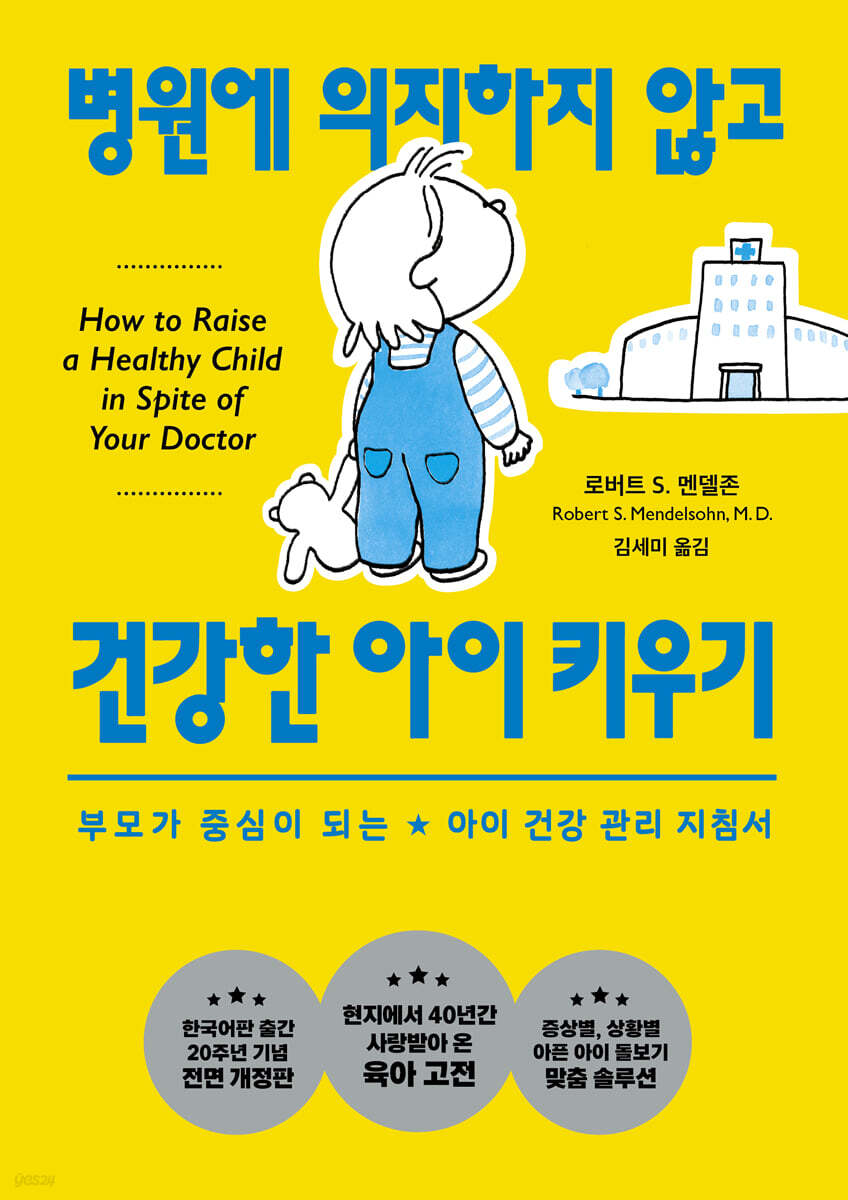
Raising a healthy child without relying on hospitals
 |
Description
Book Introduction
“I want you to be safe from dangerous and inappropriate treatment.
“I hope you can protect yourself.”
30 years of clinical experience from an American pediatrician
How to Manage Your Child's Health Without Being Swayed by Wise Parents
★Revised edition commemorating the 20th anniversary of the Korean version
★A parenting classic loved locally for 40 years
★Customized solutions for caring for sick children, tailored to each symptom and situation.
"Raising Healthy Children Without Relying on Hospitals" is a child health management guide for new parents who have just started caring for a child. It guides parents on how to care for a sick child without relying on hospitals as much as possible.
This book is divided into 21 chapters and organizes various diseases and symptoms that a child may experience from the fetal stage through the growth process, and provides step-by-step instructions on what parents can do for their sick children.
Parents will learn specifically how to distinguish between whether their child should be taken to the hospital immediately when they show symptoms of illness, whether their child can recover quickly with sufficient care at home, and which tests and prescriptions are necessary and which are unnecessary.
It also provides effective ways to improve a child's condition through warm care and treatment that only parents can provide, something that general doctors cannot.
This book is more than just a parenting guide; it contains messages that encourage parents to change their attitudes toward health management and make self-directed decisions.
The author does not say that we should unconditionally distrust doctors, but rather that we should seek their help when necessary, without losing sight of appropriate medical judgment and a balanced response.
The most important thing for parents is to develop their childcare skills so that their children are not exposed to the risk of overtreatment and misdiagnosis, and we send our support to all parents in the world who are caring for their children.
Thanks to the author's heartfelt advice, this book continues to be loved by parents who care for their children even after 40 years since its publication.
Although medical technology has advanced day by day, medical costs and overtreatment remain issues even today. Therefore, the author's insights provide a useful perspective for us living in the 21st century, transcending time.
Parents who want to raise their children while protecting them from overtreatment will find useful advice in this book.
“I hope you can protect yourself.”
30 years of clinical experience from an American pediatrician
How to Manage Your Child's Health Without Being Swayed by Wise Parents
★Revised edition commemorating the 20th anniversary of the Korean version
★A parenting classic loved locally for 40 years
★Customized solutions for caring for sick children, tailored to each symptom and situation.
"Raising Healthy Children Without Relying on Hospitals" is a child health management guide for new parents who have just started caring for a child. It guides parents on how to care for a sick child without relying on hospitals as much as possible.
This book is divided into 21 chapters and organizes various diseases and symptoms that a child may experience from the fetal stage through the growth process, and provides step-by-step instructions on what parents can do for their sick children.
Parents will learn specifically how to distinguish between whether their child should be taken to the hospital immediately when they show symptoms of illness, whether their child can recover quickly with sufficient care at home, and which tests and prescriptions are necessary and which are unnecessary.
It also provides effective ways to improve a child's condition through warm care and treatment that only parents can provide, something that general doctors cannot.
This book is more than just a parenting guide; it contains messages that encourage parents to change their attitudes toward health management and make self-directed decisions.
The author does not say that we should unconditionally distrust doctors, but rather that we should seek their help when necessary, without losing sight of appropriate medical judgment and a balanced response.
The most important thing for parents is to develop their childcare skills so that their children are not exposed to the risk of overtreatment and misdiagnosis, and we send our support to all parents in the world who are caring for their children.
Thanks to the author's heartfelt advice, this book continues to be loved by parents who care for their children even after 40 years since its publication.
Although medical technology has advanced day by day, medical costs and overtreatment remain issues even today. Therefore, the author's insights provide a useful perspective for us living in the 21st century, transcending time.
Parents who want to raise their children while protecting them from overtreatment will find useful advice in this book.
- You can preview some of the book's contents.
Preview
index
Introduction
1.
It's Better in the Morning: Why Medical Treatment Isn't Always Needed
2.
Parents Know Their Kids Better Than Doctors: How to Know When Your Child Is Really Sick
The essential rules for diagnosis | Doctors aren't taught the importance of nutrition | Doctors rarely research prescription drugs | Doctors are taught to deal with mistakes like this
3.
Doctors Make Healthy Children Sick: The Harm Unnecessary Treatments Can Cause
Why Pediatricians Are Dangerous | The Key to Health: Stay Away from Doctors | Why Weight Charts Are Deceptive
4.
Protect your baby before birth: From pregnancy to postpartum care, medical procedures that threaten your baby's health.
Childbirth Should Be a Natural Process | What Injuries Do Babies Suffer When Delivered in Hospitals | Circumcision and Other Surgeries: Unnecessary Measures
5.
Nutritional Supplements Essential for Health and Growth: The Importance of Breastfeeding and Whole Foods
Don't start solid foods too soon | Babies' appetites are fickle | Babies don't have to eat everything
6.
There's no need to compare developmental delays: Common concerns parents have about their children's growth.
Physical Behaviors That Worry Parents | Children Cry Because They Have a Problem | Corporal Punishment Doesn't Help | Some Sayings About Child Behavior
7.
Fever, the Defense System Against Disease: What It Does and How to Deal with It
8.
How to Soothe a Headache: Finding the Real Cause of Your Child's Headache
How to Find Out What's Causing Your Headache | Even Emotional Headaches Are Real | Tension Headaches | Don't Be Afraid to Ask Your Doctor | Dr. Mendelsohn's Clear Advice on Headaches
9.
Mom, My Stomach Hurts!: Identifying the Causes of Stomach Pain: Allergies, Poisoning, Appendicitis, and More
Allergies often cause abdominal pain. Don't try to "cure" abdominal pain with medication. Diagnosing appendicitis. Dr. Mendelsohn's clear advice on abdominal pain.
10.
Coughs, Sneezing, and Runny Noses: How to Protect Your Child's Airways from Indiscriminate Antibiotic Use
Symptoms of Colds and Flu | The Risks of Treating the Flu with Aspirin | Why You Shouldn't Overuse Antibiotics | Dr. Mendelsohn's Clear Advice on Coughs, Colds, and Flu
11.
Sore Throats: Causes of Sore Throats and What to Watch Out for During Tonsillectomy
Causes of pharyngitis that parents can control | 'Tonsillitis' is not a serious condition | Throat culture and penicillin | Rheumatic heart disease is mostly nothing to worry about | Three perspectives on the treatment of streptococcus | Why tonsillectomy should be avoided | Dr. Mendelsohn's clear advice on pharyngitis
12.
Earache, painful but not dangerous: when a foreign object enters the ear or inflammation occurs.
Earache caused by foreign bodies | The risks of removing earwax | Earache caused by pressure | How most doctors treat earache | Myringotomy is rarely necessary | What to do in the middle of the night | Dr. Mendelsohn's clear advice on earache
13.
Protecting Your Child's Vision: Strabismus, Amblyopia, Conjunctivitis, Styes, and Common Myths About Vision
Strabismus usually resolves on its own | Most vision problems are overtreated | Myths about vision | Dr. Mendelsohn's clear advice for your eyes
14.
The Curse of Puberty: Skin Problems: Find Everyday Solutions Instead of Drugs
Why do we get acne? | Most acne treatments are largely ineffective | What about Accutane? | Potential risks for adolescent girls | Experimenting with safe approaches | Other skin conditions | Dangerous steroid hormone therapies | Facts about sunburn | Dr. Mendelsohn's clear advice for skin problems
15.
Orthopedic Debate: Concerns and Overdiagnosis About Children's Body Shape
Leg Development | Shoes Don't Matter | Scoliosis Is Overdiagnosed | Dr. Mendelsohn's Clear Advice on Orthopedic Problems
16.
If an accident occurs: How to protect your child from life-threatening situations when medical help is most needed.
Cuts and Abrasions | Burns | Head Injuries | Poisoning | Sprains and Fractures | Choking | Animal Bites | Frostbite | Car Accidents | Dr. Mendelsohn's Clear Advice for When Accidents Occur
17.
Asthma and Allergies: Soothing Symptoms Naturally and Comfortingly for Your Child
The various symptoms caused by allergies | Severe asthma requires medical treatment | Dr. Mendelsohn's clear advice on allergies
18.
The Restless Child: Overdiagnosis and Treatment of Hyperactivity Disorder
Avoid behavior-modifying drugs | Ritalin's dangerous side effects | Check to see if it's due to emotional stress
19.
Do Vaccinations Work?: Vaccine Risks and Home Remedies
Mumps|Measles|Rubella|Pertussis|Diphtheria|Chickenpox|Scarlet fever|Meningitis|Tuberculosis|Sudden infant death syndrome|Polio|Infectious leukocytosis
20.
Getting Sick in the Hospital: The Illnesses and Emotional Hurts Children Experience in the Hospital
Respiratory illnesses contracted in hospitals | Emotional shock from hospitalization
21.
Choosing a Great Doctor for Your Child: Criteria for Identifying a Competent and Honest Hospital
Translator's Note
reference book
1.
It's Better in the Morning: Why Medical Treatment Isn't Always Needed
2.
Parents Know Their Kids Better Than Doctors: How to Know When Your Child Is Really Sick
The essential rules for diagnosis | Doctors aren't taught the importance of nutrition | Doctors rarely research prescription drugs | Doctors are taught to deal with mistakes like this
3.
Doctors Make Healthy Children Sick: The Harm Unnecessary Treatments Can Cause
Why Pediatricians Are Dangerous | The Key to Health: Stay Away from Doctors | Why Weight Charts Are Deceptive
4.
Protect your baby before birth: From pregnancy to postpartum care, medical procedures that threaten your baby's health.
Childbirth Should Be a Natural Process | What Injuries Do Babies Suffer When Delivered in Hospitals | Circumcision and Other Surgeries: Unnecessary Measures
5.
Nutritional Supplements Essential for Health and Growth: The Importance of Breastfeeding and Whole Foods
Don't start solid foods too soon | Babies' appetites are fickle | Babies don't have to eat everything
6.
There's no need to compare developmental delays: Common concerns parents have about their children's growth.
Physical Behaviors That Worry Parents | Children Cry Because They Have a Problem | Corporal Punishment Doesn't Help | Some Sayings About Child Behavior
7.
Fever, the Defense System Against Disease: What It Does and How to Deal with It
8.
How to Soothe a Headache: Finding the Real Cause of Your Child's Headache
How to Find Out What's Causing Your Headache | Even Emotional Headaches Are Real | Tension Headaches | Don't Be Afraid to Ask Your Doctor | Dr. Mendelsohn's Clear Advice on Headaches
9.
Mom, My Stomach Hurts!: Identifying the Causes of Stomach Pain: Allergies, Poisoning, Appendicitis, and More
Allergies often cause abdominal pain. Don't try to "cure" abdominal pain with medication. Diagnosing appendicitis. Dr. Mendelsohn's clear advice on abdominal pain.
10.
Coughs, Sneezing, and Runny Noses: How to Protect Your Child's Airways from Indiscriminate Antibiotic Use
Symptoms of Colds and Flu | The Risks of Treating the Flu with Aspirin | Why You Shouldn't Overuse Antibiotics | Dr. Mendelsohn's Clear Advice on Coughs, Colds, and Flu
11.
Sore Throats: Causes of Sore Throats and What to Watch Out for During Tonsillectomy
Causes of pharyngitis that parents can control | 'Tonsillitis' is not a serious condition | Throat culture and penicillin | Rheumatic heart disease is mostly nothing to worry about | Three perspectives on the treatment of streptococcus | Why tonsillectomy should be avoided | Dr. Mendelsohn's clear advice on pharyngitis
12.
Earache, painful but not dangerous: when a foreign object enters the ear or inflammation occurs.
Earache caused by foreign bodies | The risks of removing earwax | Earache caused by pressure | How most doctors treat earache | Myringotomy is rarely necessary | What to do in the middle of the night | Dr. Mendelsohn's clear advice on earache
13.
Protecting Your Child's Vision: Strabismus, Amblyopia, Conjunctivitis, Styes, and Common Myths About Vision
Strabismus usually resolves on its own | Most vision problems are overtreated | Myths about vision | Dr. Mendelsohn's clear advice for your eyes
14.
The Curse of Puberty: Skin Problems: Find Everyday Solutions Instead of Drugs
Why do we get acne? | Most acne treatments are largely ineffective | What about Accutane? | Potential risks for adolescent girls | Experimenting with safe approaches | Other skin conditions | Dangerous steroid hormone therapies | Facts about sunburn | Dr. Mendelsohn's clear advice for skin problems
15.
Orthopedic Debate: Concerns and Overdiagnosis About Children's Body Shape
Leg Development | Shoes Don't Matter | Scoliosis Is Overdiagnosed | Dr. Mendelsohn's Clear Advice on Orthopedic Problems
16.
If an accident occurs: How to protect your child from life-threatening situations when medical help is most needed.
Cuts and Abrasions | Burns | Head Injuries | Poisoning | Sprains and Fractures | Choking | Animal Bites | Frostbite | Car Accidents | Dr. Mendelsohn's Clear Advice for When Accidents Occur
17.
Asthma and Allergies: Soothing Symptoms Naturally and Comfortingly for Your Child
The various symptoms caused by allergies | Severe asthma requires medical treatment | Dr. Mendelsohn's clear advice on allergies
18.
The Restless Child: Overdiagnosis and Treatment of Hyperactivity Disorder
Avoid behavior-modifying drugs | Ritalin's dangerous side effects | Check to see if it's due to emotional stress
19.
Do Vaccinations Work?: Vaccine Risks and Home Remedies
Mumps|Measles|Rubella|Pertussis|Diphtheria|Chickenpox|Scarlet fever|Meningitis|Tuberculosis|Sudden infant death syndrome|Polio|Infectious leukocytosis
20.
Getting Sick in the Hospital: The Illnesses and Emotional Hurts Children Experience in the Hospital
Respiratory illnesses contracted in hospitals | Emotional shock from hospitalization
21.
Choosing a Great Doctor for Your Child: Criteria for Identifying a Competent and Honest Hospital
Translator's Note
reference book
Detailed image

Into the book
I hope to raise your awareness of medical shortcomings so that you can protect yourself from dangerous and inappropriate treatments.
--- p.7
This book will provide sound advice to parents who want to provide responsible care for their children's health while avoiding the risks and costs of unnecessary intervention.
--- p.11
If you only have a headache without any other symptoms, there is absolutely no need to call a doctor.
There is no reason to go to the hospital the next day.
Unless your child shows signs of serious illness, going to the hospital won't help at all.
No, rather, it is very likely that even healthy children will end up receiving unnecessary medical treatment that could make them sick!
--- p.21
At least 95 percent of illnesses that children get will resolve on their own and require no medical treatment.
The harm caused by careless or unnecessary medical procedures is often greater than the risk of the disease itself.
--- p.23
Parents need to learn when to call a doctor and what they can do to strengthen the body's ability to heal itself without medical intervention.
--- p.24~25
The purpose of this book is to give you the information you need to hone your skills and gain the confidence to raise a healthy child.
Most childhood illnesses can be treated by the body's normal defense systems, so your natural skills are usually preferable to a doctor's skills in providing the help your child really needs.
--- p.27
How can parents without any medical training claim to be better than doctors when it comes to meeting their children's health needs? It's simply because you're willing to devote time and attention to your child, while doctors aren't.
--- p.32
When you take your child to the pediatrician, the doctor will perform a physical exam, which is often superficial rather than essential.
They order tests and X-rays, make a diagnosis, and then decide on a course of treatment, which often involves medication.
Sometimes, they even make you stay in the hospital longer and make you stay longer.
Throughout this process, doctors provide minimal explanations, don't ask for your permission, and usually don't warn you about the risks and potential side effects of the treatment you're about to undergo, let alone how much it will cost.
After all that, the doctor will bill you for the treatment, regardless of whether the diagnosis was wrong or the treatment didn't work and your child is still sick.
In short, doctors have only a minimal responsibility to their patients for what they do.
--- p.99
The best way to raise a healthy child is to keep them away from doctors except for emergencies such as accidents or clearly serious illnesses.
If your child shows any signs of illness, observe his or her condition closely.
However, do not seek medical help until there is clear evidence that you are seriously ill.
--- p.58
Parents may initially worry about these things and wonder if there is something wrong with their baby's eating.
There is absolutely no need for that.
All of these behaviors can be considered normal as long as your baby is eating well and not losing weight.
--- p.127
If you pay close attention to your child's emotional needs rather than making a fuss about the symptoms, and if you make sure your child knows that you will continue to love him no matter what he does, and if you make him feel secure, most of these problems can be successfully resolved.
Creating that kind of warm relationship between you and your child does more than just break bad habits.
You will be rewarded with a happy, confident, and emotionally stable child!
--- p.139
When you call the hospital because your baby is sick, the doctor's first question is almost always the same.
“Have you taken your temperature?” They tell the child to take an aspirin and then bring him to the hospital.
It's a common rite of passage for pediatricians.
--- p.… ) Sometimes I wonder if some doctors would mechanically give the same answer even if I told them that the child's temperature was 45 degrees.
--- p.142~143
In most cases, you can identify the cause of your headache better than your doctor.
You have the opportunity to monitor your child's behavior and reactions 24 hours a day to look for events or symptoms that may be causing mental or emotional harm.
Since you know your child's normal behavior patterns well, you can usually detect what is causing the child to be distressed.
That is, you have the knowledge and experience to isolate mental or emotional causes, but the doctor does not.
All a doctor can rely on is the limited information he or she can glean from you or your child during the brief time he or she spends with you.
--- p.169~170
As with headaches, stomachaches can be an unconscious expression of a desire to avoid unpleasant events or a desire for warm attention in children who have not fully met their need for love.
If more parents followed the advice, "Did you hold your child today?" many of those recurring colics would go away on their own.
--- p.188
Unfortunately, there is one worst thing that can happen when your child has a cold and you seek medical help.
The real danger with viral infections is that you will be prescribed antibiotics that are useless.
--- p.… ) The more dangerous double harm caused by the indiscriminate use of widespread antibiotics is as follows.
First, there is a general emergence of antibiotic-resistant microorganisms, and second, if a child is exposed to antibiotics unnecessarily and repeatedly, he or she may later be at risk of contracting an infection with a microorganism that is resistant to all known treatments.
--- p.7
This book will provide sound advice to parents who want to provide responsible care for their children's health while avoiding the risks and costs of unnecessary intervention.
--- p.11
If you only have a headache without any other symptoms, there is absolutely no need to call a doctor.
There is no reason to go to the hospital the next day.
Unless your child shows signs of serious illness, going to the hospital won't help at all.
No, rather, it is very likely that even healthy children will end up receiving unnecessary medical treatment that could make them sick!
--- p.21
At least 95 percent of illnesses that children get will resolve on their own and require no medical treatment.
The harm caused by careless or unnecessary medical procedures is often greater than the risk of the disease itself.
--- p.23
Parents need to learn when to call a doctor and what they can do to strengthen the body's ability to heal itself without medical intervention.
--- p.24~25
The purpose of this book is to give you the information you need to hone your skills and gain the confidence to raise a healthy child.
Most childhood illnesses can be treated by the body's normal defense systems, so your natural skills are usually preferable to a doctor's skills in providing the help your child really needs.
--- p.27
How can parents without any medical training claim to be better than doctors when it comes to meeting their children's health needs? It's simply because you're willing to devote time and attention to your child, while doctors aren't.
--- p.32
When you take your child to the pediatrician, the doctor will perform a physical exam, which is often superficial rather than essential.
They order tests and X-rays, make a diagnosis, and then decide on a course of treatment, which often involves medication.
Sometimes, they even make you stay in the hospital longer and make you stay longer.
Throughout this process, doctors provide minimal explanations, don't ask for your permission, and usually don't warn you about the risks and potential side effects of the treatment you're about to undergo, let alone how much it will cost.
After all that, the doctor will bill you for the treatment, regardless of whether the diagnosis was wrong or the treatment didn't work and your child is still sick.
In short, doctors have only a minimal responsibility to their patients for what they do.
--- p.99
The best way to raise a healthy child is to keep them away from doctors except for emergencies such as accidents or clearly serious illnesses.
If your child shows any signs of illness, observe his or her condition closely.
However, do not seek medical help until there is clear evidence that you are seriously ill.
--- p.58
Parents may initially worry about these things and wonder if there is something wrong with their baby's eating.
There is absolutely no need for that.
All of these behaviors can be considered normal as long as your baby is eating well and not losing weight.
--- p.127
If you pay close attention to your child's emotional needs rather than making a fuss about the symptoms, and if you make sure your child knows that you will continue to love him no matter what he does, and if you make him feel secure, most of these problems can be successfully resolved.
Creating that kind of warm relationship between you and your child does more than just break bad habits.
You will be rewarded with a happy, confident, and emotionally stable child!
--- p.139
When you call the hospital because your baby is sick, the doctor's first question is almost always the same.
“Have you taken your temperature?” They tell the child to take an aspirin and then bring him to the hospital.
It's a common rite of passage for pediatricians.
--- p.… ) Sometimes I wonder if some doctors would mechanically give the same answer even if I told them that the child's temperature was 45 degrees.
--- p.142~143
In most cases, you can identify the cause of your headache better than your doctor.
You have the opportunity to monitor your child's behavior and reactions 24 hours a day to look for events or symptoms that may be causing mental or emotional harm.
Since you know your child's normal behavior patterns well, you can usually detect what is causing the child to be distressed.
That is, you have the knowledge and experience to isolate mental or emotional causes, but the doctor does not.
All a doctor can rely on is the limited information he or she can glean from you or your child during the brief time he or she spends with you.
--- p.169~170
As with headaches, stomachaches can be an unconscious expression of a desire to avoid unpleasant events or a desire for warm attention in children who have not fully met their need for love.
If more parents followed the advice, "Did you hold your child today?" many of those recurring colics would go away on their own.
--- p.188
Unfortunately, there is one worst thing that can happen when your child has a cold and you seek medical help.
The real danger with viral infections is that you will be prescribed antibiotics that are useless.
--- p.… ) The more dangerous double harm caused by the indiscriminate use of widespread antibiotics is as follows.
First, there is a general emergence of antibiotic-resistant microorganisms, and second, if a child is exposed to antibiotics unnecessarily and repeatedly, he or she may later be at risk of contracting an infection with a microorganism that is resistant to all known treatments.
--- p.210~211
Publisher's Review
30 years of clinical experience from an American pediatrician
How to Manage Your Child's Health Without Being Swayed by Wise Parents
★Revised edition commemorating the 20th anniversary of the Korean version
★A parenting classic loved locally for 40 years
★Customized solutions for caring for sick children, tailored to each symptom and situation.
'Public Doctor' Robert S.
Mendelsohn specialist tells you
A Parenting Guide to Protecting Your Child from the Threats of Overtreatment, Misdiagnosis, and Harmful Drugs
“Parents should avoid doctors as much as possible.” This is a groundbreaking suggestion from a pediatrician with over 30 years of clinical experience.
Robert S.
Mendelsohn was a 'people's doctor' who continued to treat patients on the side of doctors, not doctors, and dedicated his life to helping parents who had been harmed by the medical community's mistakes.
In his decades of practice, he has witnessed parents over-rely on their children's pediatricians, leading to unnecessary and expensive care and harmful and unnecessary procedures.
Dr. Mendelsohn pointed out that doctors' excessive treatment and prescriptions are actually harming children's health, and emphasized that in order for parents to protect their children's health, they should take the initiative in managing their children's health by establishing their own standards for finding the right treatment and care for their children rather than blindly believing what doctors say.
How to Raise Your Child in Spite of Your Doctor is a book written by Dr. Mendelsohn with his own beliefs and heart for parents.
The authors state that approximately 95% of health problems children experience can be easily cured with parental care alone, without medical intervention.
This book is a child health care guide that guides parents on how to care for sick children without relying on hospitals as much as possible. It helps parents determine which illnesses require a visit to the hospital and which can be managed at home.
The author emphasizes that the message of this book is not to "never go to the hospital," but rather to "get help from the hospital when necessary, but be wary of overtreatment," and encourages parents to find a balance between appropriate medical help and the measures they can take.
Parents can learn how to diagnose and treat common health problems at home through the author's helpful guide, and make medically informed decisions about their children's health.
He also criticizes the structural factors in the medical system that lead doctors to become overly involved, and emphasizes that parents should have a balanced attitude of trusting but also being wary of doctors.
When, how much, and how often should you go to the hospital when you are sick?
The most effective treatment guidelines you can give your child right at home.
This book is divided into 21 chapters and provides guidance on various diseases and symptoms that a child may experience from the fetal stage through the growth process.
The book covers all the health issues that children experience as they grow, from preparing for childbirth and postpartum care to fevers that spike in the middle of the night, headaches, abdominal pain, coughs, sore throats, eyesight, skin, and body shape, as well as the factors that can affect them.
The author explains the reactions a child may exhibit depending on the symptom, and shows how to distinguish between whether the condition requires hospitalization or can be quickly managed at home, and which tests and prescriptions are necessary and which are unnecessary.
We also provide tips for keeping your child safe in critical situations, such as when a child accidentally swallows medicine, is seriously injured, or is in an accident.
We've also included a checklist at the end of this chapter to help parents understand at a glance how to respond when their child suddenly becomes ill.
Even in the middle of the night, when you're feeling confused, you can open this book and immediately know what help your child needs.
Many parents are worried that even the slightest abnormality in their child's condition may be a sign of a more serious illness, or that the symptoms may be permanent.
If a fever rises rapidly, there are concerns about possible aftereffects, if ear inflammation develops, there are concerns about whether the inflammation will become more severe and cause hearing problems, or whether the child's development will be delayed compared to other children.
The author comforts parents by saying that it is natural for them to worry, and explains in detail the extent to which this is a natural phenomenon that children commonly experience as they grow up.
By calmly following the author's explanations, parents can maintain composure and take care of their child's health in the long term.
The author reassures parents that “the human body has an amazing ability to heal itself” (p. 34), so they should not panic too much when their child is sick, but rather wait calmly while checking the condition little by little, and the problem will be resolved.
While the author's guidelines include many medical guidelines, such as how often and how much medication to take when sick, there are also many natural ways to address symptoms without medication and with commonly available household substances.
If you are a parent who wants to raise your child with only the necessary amount of medication, the author's prescription will be of great help in caring for your child.
“You know your child best.”
What doctors cannot do, only parents can do,
Tips for caring for and healing a child's pain
When parents bring their sick child to the doctor, they tend to feel intimidated in front of the doctor, who is a medical professional.
I worry that the things I do to make my child a little healthier might actually be harmful to him or her.
The author encourages such parents to 'trust their intuition', saying that the person who knows their child better than anyone else is the parent, not the doctor.
Of course, when a child is in critical condition or requires medical procedures, it is important to follow the doctor's instructions, but that does not mean that the parent's judgment regarding the child's health is less important than the doctor's prescription.
Because parents are “willing to spend time and pay attention to their children, but doctors are not” (p. 32), they can observe the child’s minor symptoms or changes more closely than anyone else that doctors may not notice.
The author does not stop at providing only fragmentary measures that can be taken when a child is sick, but also points out the warm care and treatment that only parents can give to their children.
For example, if a child who is healthy at home complains of irregular headaches or stomachaches before going to school, the pain the child feels may not be due to a physical problem, but rather may be caused by internal issues such as emotional causes or stress (p. 173).
If your child is restless and hyperactive at school, rather than rushing to the hospital, it is better to first check if there are other reasons for the child's distress at school or if the child is overreacting after coming into contact with a substance to which he or she is allergic (page 390).
The author says, “If your headache is caused by this type of cause, you should not treat it medically.
He asserts that “what such headaches require is the thoughtful and sympathetic care of parents” (p. 173), and that the specific remedy for soothing a child’s pain caused by emotional reasons is “love, affection, understanding, mental support, and genuine parental concern,” so do not miss out on the treatment that only parents can provide.
When a child is struggling due to pain, if the parent stays by the child's side and cares for them, the child will quickly overcome the hardship and get back on his feet.
From the threat of overtreatment, misdiagnosis, and toxic drugs
Advice for Parents Who Want to Protect Their Children
As a physician who guides people through natural remedies that can be done at home, the author advises against medical prescriptions, including medications and surgery.
This book addresses the risks inherent in unnecessary surgeries, treatments, hospitalizations, and vaccinations that parents encounter when bringing their children to the hospital.
The author also argues that we must be extremely cautious with drug treatments and vaccines, and points out which drugs are safe and which should be avoided as much as possible.
In particular, there is a strong opinion that vaccines should be avoided as much as possible because they can cause serious side effects.
Since this author's advice came from the 1980s in the United States, when prescription drugs were overused, it seems difficult for modern parents to blindly follow the author's advice when it comes to their children's health.
But why is the author's story still relevant in this day and age?
As can be found in the 'Translator's Note', we should at least be aware of the existence of such side effects and risks (p. 452).
Parents who are dragged along without any direction and neglect the side effects their child may experience, or conversely, who are gripped by unfounded fears and refuse all treatment, both pose a great threat to the child's health.
By understanding the specifics of what treatment your child will receive at the hospital, you can develop the strength to draw a bigger picture of how to care for your child in the future.
This book helps develop that very power: the power to protect your child's health on your own.
As medical costs and overtreatment remain significant concerns for parents today, the author's insight not to rely solely on hospitals offers a useful perspective for those of us living in the 21st century.
Parents who want to raise their children while protecting them from overtreatment will find effective advice in this book and find a balance between the help of medical institutions and their own standards.
How to Manage Your Child's Health Without Being Swayed by Wise Parents
★Revised edition commemorating the 20th anniversary of the Korean version
★A parenting classic loved locally for 40 years
★Customized solutions for caring for sick children, tailored to each symptom and situation.
'Public Doctor' Robert S.
Mendelsohn specialist tells you
A Parenting Guide to Protecting Your Child from the Threats of Overtreatment, Misdiagnosis, and Harmful Drugs
“Parents should avoid doctors as much as possible.” This is a groundbreaking suggestion from a pediatrician with over 30 years of clinical experience.
Robert S.
Mendelsohn was a 'people's doctor' who continued to treat patients on the side of doctors, not doctors, and dedicated his life to helping parents who had been harmed by the medical community's mistakes.
In his decades of practice, he has witnessed parents over-rely on their children's pediatricians, leading to unnecessary and expensive care and harmful and unnecessary procedures.
Dr. Mendelsohn pointed out that doctors' excessive treatment and prescriptions are actually harming children's health, and emphasized that in order for parents to protect their children's health, they should take the initiative in managing their children's health by establishing their own standards for finding the right treatment and care for their children rather than blindly believing what doctors say.
How to Raise Your Child in Spite of Your Doctor is a book written by Dr. Mendelsohn with his own beliefs and heart for parents.
The authors state that approximately 95% of health problems children experience can be easily cured with parental care alone, without medical intervention.
This book is a child health care guide that guides parents on how to care for sick children without relying on hospitals as much as possible. It helps parents determine which illnesses require a visit to the hospital and which can be managed at home.
The author emphasizes that the message of this book is not to "never go to the hospital," but rather to "get help from the hospital when necessary, but be wary of overtreatment," and encourages parents to find a balance between appropriate medical help and the measures they can take.
Parents can learn how to diagnose and treat common health problems at home through the author's helpful guide, and make medically informed decisions about their children's health.
He also criticizes the structural factors in the medical system that lead doctors to become overly involved, and emphasizes that parents should have a balanced attitude of trusting but also being wary of doctors.
When, how much, and how often should you go to the hospital when you are sick?
The most effective treatment guidelines you can give your child right at home.
This book is divided into 21 chapters and provides guidance on various diseases and symptoms that a child may experience from the fetal stage through the growth process.
The book covers all the health issues that children experience as they grow, from preparing for childbirth and postpartum care to fevers that spike in the middle of the night, headaches, abdominal pain, coughs, sore throats, eyesight, skin, and body shape, as well as the factors that can affect them.
The author explains the reactions a child may exhibit depending on the symptom, and shows how to distinguish between whether the condition requires hospitalization or can be quickly managed at home, and which tests and prescriptions are necessary and which are unnecessary.
We also provide tips for keeping your child safe in critical situations, such as when a child accidentally swallows medicine, is seriously injured, or is in an accident.
We've also included a checklist at the end of this chapter to help parents understand at a glance how to respond when their child suddenly becomes ill.
Even in the middle of the night, when you're feeling confused, you can open this book and immediately know what help your child needs.
Many parents are worried that even the slightest abnormality in their child's condition may be a sign of a more serious illness, or that the symptoms may be permanent.
If a fever rises rapidly, there are concerns about possible aftereffects, if ear inflammation develops, there are concerns about whether the inflammation will become more severe and cause hearing problems, or whether the child's development will be delayed compared to other children.
The author comforts parents by saying that it is natural for them to worry, and explains in detail the extent to which this is a natural phenomenon that children commonly experience as they grow up.
By calmly following the author's explanations, parents can maintain composure and take care of their child's health in the long term.
The author reassures parents that “the human body has an amazing ability to heal itself” (p. 34), so they should not panic too much when their child is sick, but rather wait calmly while checking the condition little by little, and the problem will be resolved.
While the author's guidelines include many medical guidelines, such as how often and how much medication to take when sick, there are also many natural ways to address symptoms without medication and with commonly available household substances.
If you are a parent who wants to raise your child with only the necessary amount of medication, the author's prescription will be of great help in caring for your child.
“You know your child best.”
What doctors cannot do, only parents can do,
Tips for caring for and healing a child's pain
When parents bring their sick child to the doctor, they tend to feel intimidated in front of the doctor, who is a medical professional.
I worry that the things I do to make my child a little healthier might actually be harmful to him or her.
The author encourages such parents to 'trust their intuition', saying that the person who knows their child better than anyone else is the parent, not the doctor.
Of course, when a child is in critical condition or requires medical procedures, it is important to follow the doctor's instructions, but that does not mean that the parent's judgment regarding the child's health is less important than the doctor's prescription.
Because parents are “willing to spend time and pay attention to their children, but doctors are not” (p. 32), they can observe the child’s minor symptoms or changes more closely than anyone else that doctors may not notice.
The author does not stop at providing only fragmentary measures that can be taken when a child is sick, but also points out the warm care and treatment that only parents can give to their children.
For example, if a child who is healthy at home complains of irregular headaches or stomachaches before going to school, the pain the child feels may not be due to a physical problem, but rather may be caused by internal issues such as emotional causes or stress (p. 173).
If your child is restless and hyperactive at school, rather than rushing to the hospital, it is better to first check if there are other reasons for the child's distress at school or if the child is overreacting after coming into contact with a substance to which he or she is allergic (page 390).
The author says, “If your headache is caused by this type of cause, you should not treat it medically.
He asserts that “what such headaches require is the thoughtful and sympathetic care of parents” (p. 173), and that the specific remedy for soothing a child’s pain caused by emotional reasons is “love, affection, understanding, mental support, and genuine parental concern,” so do not miss out on the treatment that only parents can provide.
When a child is struggling due to pain, if the parent stays by the child's side and cares for them, the child will quickly overcome the hardship and get back on his feet.
From the threat of overtreatment, misdiagnosis, and toxic drugs
Advice for Parents Who Want to Protect Their Children
As a physician who guides people through natural remedies that can be done at home, the author advises against medical prescriptions, including medications and surgery.
This book addresses the risks inherent in unnecessary surgeries, treatments, hospitalizations, and vaccinations that parents encounter when bringing their children to the hospital.
The author also argues that we must be extremely cautious with drug treatments and vaccines, and points out which drugs are safe and which should be avoided as much as possible.
In particular, there is a strong opinion that vaccines should be avoided as much as possible because they can cause serious side effects.
Since this author's advice came from the 1980s in the United States, when prescription drugs were overused, it seems difficult for modern parents to blindly follow the author's advice when it comes to their children's health.
But why is the author's story still relevant in this day and age?
As can be found in the 'Translator's Note', we should at least be aware of the existence of such side effects and risks (p. 452).
Parents who are dragged along without any direction and neglect the side effects their child may experience, or conversely, who are gripped by unfounded fears and refuse all treatment, both pose a great threat to the child's health.
By understanding the specifics of what treatment your child will receive at the hospital, you can develop the strength to draw a bigger picture of how to care for your child in the future.
This book helps develop that very power: the power to protect your child's health on your own.
As medical costs and overtreatment remain significant concerns for parents today, the author's insight not to rely solely on hospitals offers a useful perspective for those of us living in the 21st century.
Parents who want to raise their children while protecting them from overtreatment will find effective advice in this book and find a balance between the help of medical institutions and their own standards.
GOODS SPECIFICS
- Date of issue: October 15, 2025
- Page count, weight, size: 464 pages | 642g | 152*215*22mm
- ISBN13: 9788931025958
- ISBN10: 8931025955
You may also like
카테고리
korean


korean

![GQ KOREA Mark (Monthly): December [2025]](http://librairie.coreenne.fr/cdn/shop/files/8ef265dbbfbf186523ed75ba7319009d.jpg?v=1765340328&width=3840)


