

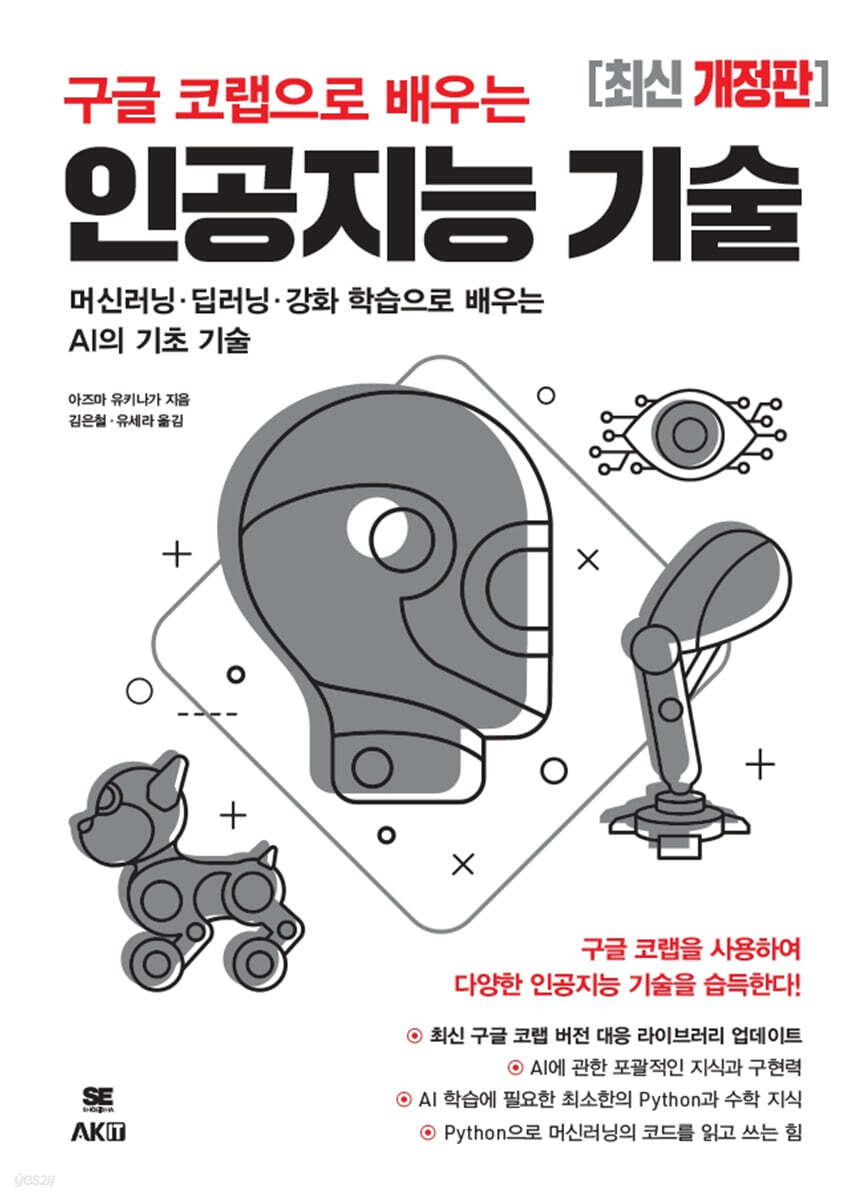
Learning AI Technology with Google Colab
 |
Description
Book Introduction
On the latest AI development platform
Learn the fundamentals of machine learning, deep learning, and reinforcement learning!
This book explains the artificial intelligence technologies required for AI development, focusing on deep learning.
Additionally, it helps readers understand the structure of AI technology by practicing with the samples provided in the book.
For readers with programming experience or those looking to learn machine learning, deep learning, or reinforcement learning, this book will serve as a valuable guide!
Learn the fundamentals of machine learning, deep learning, and reinforcement learning!
This book explains the artificial intelligence technologies required for AI development, focusing on deep learning.
Additionally, it helps readers understand the structure of AI technology by practicing with the samples provided in the book.
For readers with programming experience or those looking to learn machine learning, deep learning, or reinforcement learning, this book will serve as a valuable guide!
- You can preview some of the book's contents.
Preview
index
To begin with
For inquiries regarding the contents of this book
About the operating environment and sample programs of this book sample
Chapter 0 Introduction
0.1 for the first time
Chapter 1: Overview of Artificial Intelligence and Deep Learning
1.1 Overview of Artificial Intelligence
1.2 Examples of AI Applications
1.3 History of Artificial Intelligence
1.4 Chapter 1 Conclusion
Chapter 2 Development Environment
2.1 How to start Google Colaboratory
2.2 Sessions and Instances
2.3 CPU and GPU
2.4 Various features of Google Colaboratory
2.5 Chapter 2 Conclusion
Chapter 3: Python Basics
3.1 Python Basics
3.2 Numpy Basics
3.3 Matplotlib Basics
3.4 Pandas Basics
3.5 Practice
3.6 Example Answer
3.7 Conclusion of Chapter 3
Chapter 4: Simple Deep Learning
4.1 Overview of Deep Learning
4.2 Simple Deep Learning Implementation
4.3 Various neural networks
4.4 Practice
4.5 Example Answer
4.6 Chapter 4 Conclusion
Chapter 5: Theory of Deep Learning
5.1 Fundamentals of Mathematics
5.2 Computation of a single neuron
5.3 Activation function
5.4 Forward and Backpropagation
5.5 Matrices and Matrix Multiplication
5.6 Calculation of floors
5.7 Fundamentals of Differentiation
5.8 Loss function
5.9 Gradient descent
5.10 Slope of the output layer
5.11 Slope of the middle layer
5.12 Epoch and Batch
5.13 Optimization Algorithms
5.14 Practice
5.15 Example Answer
5.16 Chapter 5 Conclusion
Chapter 6: Various Machine Learning Methods
6.1 Regression
6.2 k averaging method
6.3 Support Vector Machines
6.4 Practice
6.5 Example Answer
6.6 Chapter 6 Conclusion
Chapter 7 Convolutional Neural Networks (CNN)
7.1 Overview of CNN
7.2 Convolution and Pooling
7.3 im2col and col2im
7.4 Implementation of convolution
7.5 Implementation of Pooling
7.6 Implementation of CNN
7.7 Data Expansion
7.8 Practice
7.9 Chapter 7 Conclusion
Chapter 8 Recurrent Neural Networks (RNNs)
8.1 Overview of RNNs
8.2 Implementation of a simple RNN
8.3 Overview of LSTM
8.4 Simple LSTM Implementation
8.5 GRU Overview
8.6 Simple implementation of GRU
8.7 Automatic sentence generation using RNN
8.8 Overview of Natural Language Processing
8.9 Practice
8.10 Example Answer
8.11 Chapter 8 Conclusion
Chapter 9 Variational Autoencoder (VAE)
9.1 Overview of VAE
9.2 Structure of VAE
9.3 Implementation of an Autoencoder
9.4 Implementation of VAE
9.5 For those who want to learn more about VAE
9.6 Practice
9.7 Chapter 9 Conclusion
Chapter 10 Generative Adversarial Networks (GANs)
10.1 Overview of GANs
10.2 GAN Structure
10.3 GAN Implementation
10.4 For those who want to learn more about GANs
10.5 Practice
10.6 Example Answer
10.7 Chapter 10 Conclusion
Chapter 11 Reinforcement Learning
11.1 Overview of Reinforcement Learning
11.2 Algorithms for Reinforcement Learning
11.3 Overview of Deep Reinforcement Learning
11.4 Cart Pole Problem
11.5 Implementing Deep Reinforcement Learning
11.6 Controlling the Lunar Lander - Overview -
11.7 Controlling the Lunar Lander - Implementation -
11.8 Practice
11.9 Example answer
11.10 Chapter 11 Conclusion
Chapter 12 Transfer Learning
12.1 Overview of Transfer Learning
12.2 Implementing Transfer Learning
12.3 Implementing Fine Tuning
12.4 Practice
12.5 Example answer
12.6 Chapter 12 Conclusion
Appendix For those who want to learn more
AP-1-1 'AIRS-Lab'
Introducing other books by the author of AP-1-2
AP-1-3 NEWS! AIRS-Lab
AP-1-4 Online Course
AP-1-5 YouTube Channel
AP-1-6 Author X, Instagram account
finally
Search
For inquiries regarding the contents of this book
About the operating environment and sample programs of this book sample
Chapter 0 Introduction
0.1 for the first time
Chapter 1: Overview of Artificial Intelligence and Deep Learning
1.1 Overview of Artificial Intelligence
1.2 Examples of AI Applications
1.3 History of Artificial Intelligence
1.4 Chapter 1 Conclusion
Chapter 2 Development Environment
2.1 How to start Google Colaboratory
2.2 Sessions and Instances
2.3 CPU and GPU
2.4 Various features of Google Colaboratory
2.5 Chapter 2 Conclusion
Chapter 3: Python Basics
3.1 Python Basics
3.2 Numpy Basics
3.3 Matplotlib Basics
3.4 Pandas Basics
3.5 Practice
3.6 Example Answer
3.7 Conclusion of Chapter 3
Chapter 4: Simple Deep Learning
4.1 Overview of Deep Learning
4.2 Simple Deep Learning Implementation
4.3 Various neural networks
4.4 Practice
4.5 Example Answer
4.6 Chapter 4 Conclusion
Chapter 5: Theory of Deep Learning
5.1 Fundamentals of Mathematics
5.2 Computation of a single neuron
5.3 Activation function
5.4 Forward and Backpropagation
5.5 Matrices and Matrix Multiplication
5.6 Calculation of floors
5.7 Fundamentals of Differentiation
5.8 Loss function
5.9 Gradient descent
5.10 Slope of the output layer
5.11 Slope of the middle layer
5.12 Epoch and Batch
5.13 Optimization Algorithms
5.14 Practice
5.15 Example Answer
5.16 Chapter 5 Conclusion
Chapter 6: Various Machine Learning Methods
6.1 Regression
6.2 k averaging method
6.3 Support Vector Machines
6.4 Practice
6.5 Example Answer
6.6 Chapter 6 Conclusion
Chapter 7 Convolutional Neural Networks (CNN)
7.1 Overview of CNN
7.2 Convolution and Pooling
7.3 im2col and col2im
7.4 Implementation of convolution
7.5 Implementation of Pooling
7.6 Implementation of CNN
7.7 Data Expansion
7.8 Practice
7.9 Chapter 7 Conclusion
Chapter 8 Recurrent Neural Networks (RNNs)
8.1 Overview of RNNs
8.2 Implementation of a simple RNN
8.3 Overview of LSTM
8.4 Simple LSTM Implementation
8.5 GRU Overview
8.6 Simple implementation of GRU
8.7 Automatic sentence generation using RNN
8.8 Overview of Natural Language Processing
8.9 Practice
8.10 Example Answer
8.11 Chapter 8 Conclusion
Chapter 9 Variational Autoencoder (VAE)
9.1 Overview of VAE
9.2 Structure of VAE
9.3 Implementation of an Autoencoder
9.4 Implementation of VAE
9.5 For those who want to learn more about VAE
9.6 Practice
9.7 Chapter 9 Conclusion
Chapter 10 Generative Adversarial Networks (GANs)
10.1 Overview of GANs
10.2 GAN Structure
10.3 GAN Implementation
10.4 For those who want to learn more about GANs
10.5 Practice
10.6 Example Answer
10.7 Chapter 10 Conclusion
Chapter 11 Reinforcement Learning
11.1 Overview of Reinforcement Learning
11.2 Algorithms for Reinforcement Learning
11.3 Overview of Deep Reinforcement Learning
11.4 Cart Pole Problem
11.5 Implementing Deep Reinforcement Learning
11.6 Controlling the Lunar Lander - Overview -
11.7 Controlling the Lunar Lander - Implementation -
11.8 Practice
11.9 Example answer
11.10 Chapter 11 Conclusion
Chapter 12 Transfer Learning
12.1 Overview of Transfer Learning
12.2 Implementing Transfer Learning
12.3 Implementing Fine Tuning
12.4 Practice
12.5 Example answer
12.6 Chapter 12 Conclusion
Appendix For those who want to learn more
AP-1-1 'AIRS-Lab'
Introducing other books by the author of AP-1-2
AP-1-3 NEWS! AIRS-Lab
AP-1-4 Online Course
AP-1-5 YouTube Channel
AP-1-6 Author X, Instagram account
finally
Search
Publisher's Review
Learn various AI technologies using Google Colab!
Updated to support the latest version of Google Colab!
Google Colaboratory, the foundation of this book, is a browser-based development environment for machine learning and deep learning. It offers free GPU access, significantly reducing code execution time.
This book provides an easy way to learn the basics of AI using Google Colab.
A textbook-worthy book on AI!
Through this book, readers can acquire comprehensive knowledge and implementation skills about AI, the minimum Python and mathematical knowledge required for AI learning, and the ability to read and write machine learning code in Python.
Ultimately, this is a book that helps develop problem-solving skills using AI.
It will also be of great practical help to readers by staying true to the basics and showing in detail with code what needs to be covered.
Updated to support the latest version of Google Colab!
Google Colaboratory, the foundation of this book, is a browser-based development environment for machine learning and deep learning. It offers free GPU access, significantly reducing code execution time.
This book provides an easy way to learn the basics of AI using Google Colab.
A textbook-worthy book on AI!
Through this book, readers can acquire comprehensive knowledge and implementation skills about AI, the minimum Python and mathematical knowledge required for AI learning, and the ability to read and write machine learning code in Python.
Ultimately, this is a book that helps develop problem-solving skills using AI.
It will also be of great practical help to readers by staying true to the basics and showing in detail with code what needs to be covered.
GOODS SPECIFICS
- Date of issue: April 5, 2025
- Page count, weight, size: 532 pages | 189*258*35mm
- ISBN13: 9791127462390
- ISBN10: 1127462393
You may also like
카테고리
korean


korean

![GQ KOREA Mark (Monthly): December [2025]](http://librairie.coreenne.fr/cdn/shop/files/8ef265dbbfbf186523ed75ba7319009d.jpg?v=1765340328&width=3840)


