

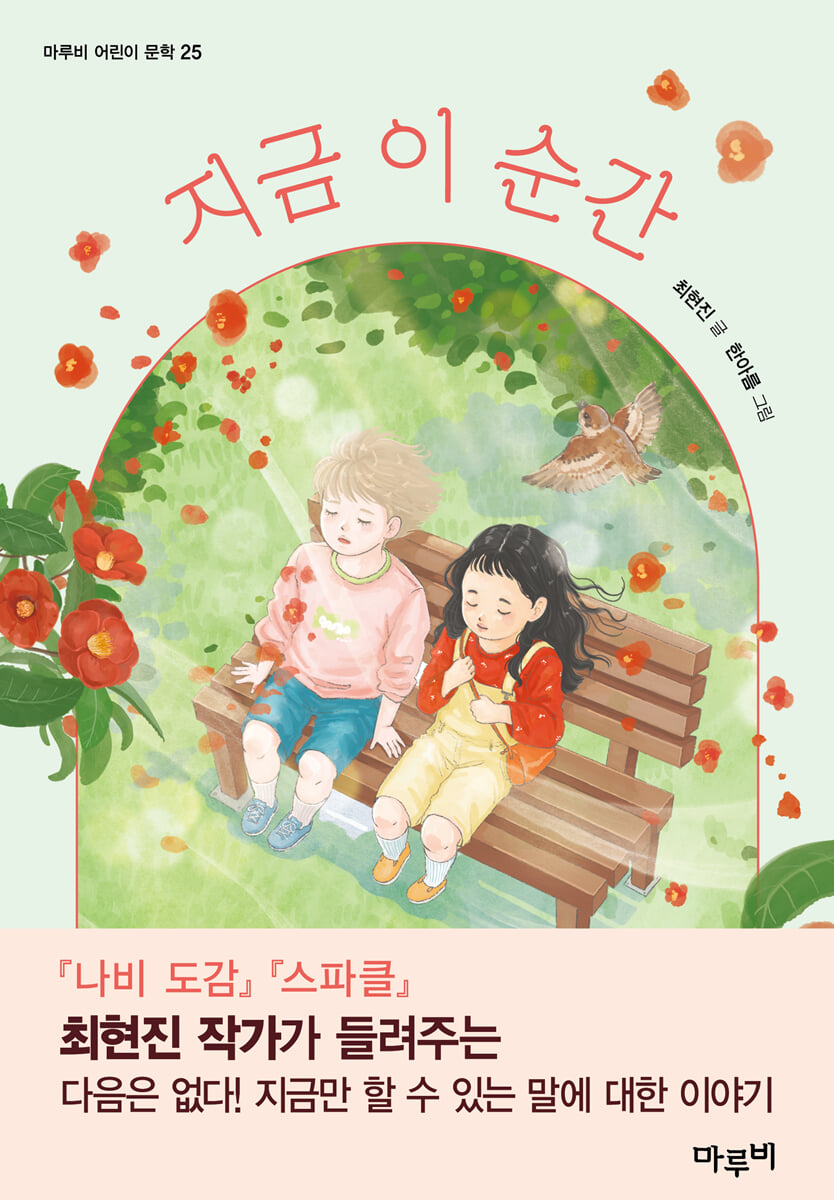
This Moment (Author's Autograph)
 |
Description
Book Introduction
Butterfly Encyclopedia Sparkle
Author Choi Hyun-jin tells us
There's no next time! A story about something that can only be said now.
“I have been wondering for a very long time why ‘words’ are so easy for some and so difficult for others.
Courage? Vocabulary? Confidence? I don't know.
But what I do know is that words arrive with a time lag.
Some people can answer right away, while others take a lifetime to come up with a single word.
“That’s what happens with ‘Grandma Sunga’ and ‘Grandpa Karl’ in this book.”
-From the author's note
The 25th work of Marubi Children's Literature, "This Moment" by Choi Hyeon-jin, has been published.
Author Choi Hyun-jin won the Hankook Ilbo New Year's Literary Contest in 2017 for her children's story "Heart-pounding Hives." She then went on to win the 25th Munhakdongne Children's Literature Award for "Butterfly Guide" and the 18th Changbi Youth Literature Award for "Sparkle," establishing herself as a promising writer in the Korean literary world.
"This Moment" is the author's third published work, and through the theme of "words," it depicts the power of relationships that transcend generations and the warmth of bonds that do not fade with time.
And it is woven warmly through the eyes of a child and the memories of old age.
Author Choi Hyun-jin tells us
There's no next time! A story about something that can only be said now.
“I have been wondering for a very long time why ‘words’ are so easy for some and so difficult for others.
Courage? Vocabulary? Confidence? I don't know.
But what I do know is that words arrive with a time lag.
Some people can answer right away, while others take a lifetime to come up with a single word.
“That’s what happens with ‘Grandma Sunga’ and ‘Grandpa Karl’ in this book.”
-From the author's note
The 25th work of Marubi Children's Literature, "This Moment" by Choi Hyeon-jin, has been published.
Author Choi Hyun-jin won the Hankook Ilbo New Year's Literary Contest in 2017 for her children's story "Heart-pounding Hives." She then went on to win the 25th Munhakdongne Children's Literature Award for "Butterfly Guide" and the 18th Changbi Youth Literature Award for "Sparkle," establishing herself as a promising writer in the Korean literary world.
"This Moment" is the author's third published work, and through the theme of "words," it depicts the power of relationships that transcend generations and the warmth of bonds that do not fade with time.
And it is woven warmly through the eyes of a child and the memories of old age.
- You can preview some of the book's contents.
Preview
index
01.
Birth of a Moment _ 9
02.
Harmony at the Funeral Hall _ 11
03.
Entering the vending machine _ 17
04.
Ninety-Nine Dreams _ 22
05.
Knife: (642) A tool used to cut, slice, or shave objects
(643) Grandfather's name _ 29
06.
Fateful Encounter _ 33
07.
The Four Meanings of 'Yes' _ 37
08.
A Tale of Nineteen Hundred and Fifty-Nine Years _ 42
09.
Why Grandpa's Eyes Are Sad _ 46
10.
Na Seong-i's Story _ 50
11.
Historical Hide and Seek _ 58
12.
A Word Across the Sea _ 63
13.
Lost Things _ 66
14.
Found the Oriole _ 72
15.
Writing and drawing now _ 77
16.
Pie of Courage _ 80
17.
Your Story _ 86
18.
The majestic Lee Soon-ga _ 91
19.
The Story of Now_98
20.
This Moment _ 104
Birth of a Moment _ 9
02.
Harmony at the Funeral Hall _ 11
03.
Entering the vending machine _ 17
04.
Ninety-Nine Dreams _ 22
05.
Knife: (642) A tool used to cut, slice, or shave objects
(643) Grandfather's name _ 29
06.
Fateful Encounter _ 33
07.
The Four Meanings of 'Yes' _ 37
08.
A Tale of Nineteen Hundred and Fifty-Nine Years _ 42
09.
Why Grandpa's Eyes Are Sad _ 46
10.
Na Seong-i's Story _ 50
11.
Historical Hide and Seek _ 58
12.
A Word Across the Sea _ 63
13.
Lost Things _ 66
14.
Found the Oriole _ 72
15.
Writing and drawing now _ 77
16.
Pie of Courage _ 80
17.
Your Story _ 86
18.
The majestic Lee Soon-ga _ 91
19.
The Story of Now_98
20.
This Moment _ 104
Detailed image

Publisher's Review
The story that started from the moment the name was changed
Lee Soon-ga and Oh Geum-geum
Ji-geum's grandmother, Lee Soon-ga, was originally named 'Lee Soon-ja', but while filling out documents, she accidentally changed her name to 'Lee Soon-ga'.
As time passed, Lee Soon-ga, who had become a grandmother, told her only granddaughter, Oh Geum-ji, that whenever someone called her “Soon-ga,” she would joke about ninety-nine times, saying, “I am Lee, I am Lee!”
“Now.
“Aren’t you sad that your grandmother passed away?”
“Goya, who ruled over harmony.
“I can’t see my sister.”
Now he spoke to an older relative wearing a black tie.
“Ahem.
Now… …you still talk like a baby.”
An older relative wearing a tie said with a serious face.
-Page 12 of the text
He will be an elementary school student next year, but he still has difficulty speaking clearly.
People worry about that now, but now he can read books and write starting with the alphabet.
While practicing pronunciation to avoid the people who came to the funeral, Jigeum discovers a strange vending machine with the words 'coffee', 'milk', 'black tea', and 'entry' written on it. He presses the 'entry' button and gets sucked into the vending machine door, where he meets Lee Soon-ga when she was ten years old.
From one thousand nine hundred and fifty-nine to one thousand nine hundred and eighty-five
If you don't have teeth, you eat with your gums.
In 1959, twenty-year-old Lee Soon-ga falls in love with Park Do-geom, a young man from the same neighborhood who was teased as a refugee.
When his parents' strong opposition makes it difficult for him to get married, Park Do-geom ends up immigrating to the United States without being able to say a single word.
Park Do-geom, who settled in the United States, works in publishing and searches for Lee Soon-ga in Korea. He is greatly disheartened when he hears that Soon-ga has become a late-blooming bride at the age of thirty-eight.
Afterwards, Park Do-geom meets Soo-kyung, a Korean adoptee, by chance and decides to start a new life, adopting her as his own daughter and forming a family.
As time passes, Soo-kyung gives birth to a son, Na-seong, but he dies early from cancer, and Park Do-geom returns to Korea with his grandson, Na-seong.
“How are you feeling about coming to Grandpa’s hometown?”
An old man wearing silver-rimmed glasses spoke to Na Seong-i, who was sitting on the bench.
“Actually, um... Not bad.”
Na Seong-i turned the can lid around with his finger.
-Page 31 of the text
A fateful encounter
The friendship of two children who are awkward with their speech
Eight-year-old Na-seong, who lost his mother in the United States and came to Korea with his grandfather, feels lonely and afraid in an unfamiliar apartment complex and in an unfamiliar Korean language. Then, in front of a vending machine in a park, he and Jigeum exchange greetings in broken Korean.
Jigeum-i, who still cannot pronounce Korean clearly, and Na-seong-i, who is still not fluent in Korean, build a warm rapport with each other even though their language is still awkward.
'Yes!' used when answering
'Yes?' used when asking a question
'Four' people, 'four' dogs, 'four' people used to indicate the number '4'
The 'ne' that is used instead of you is 'ne'ge.
“Everyone says ‘yes.’”
Now, he said, extending four fingers towards Nasung.
"Wow! Everyone says 'yes'!" - Page 40
Nasung is delighted by the fact that words with different pronunciations are pronounced as one in Korean, and he becomes closer to Jijae.
The conversation between two children who understand each other through their clumsy language is the part that most clearly and beautifully shows the author's insight into the subject of 'language'.
But as they pushed each other's swings, they discovered something surprising.
“Does ‘yes’ appear in ‘yes’ too?”
“Puhhahaha.
"That's right!" - Page 41
Historical hide-and-seek
A name we met again after 50 years
Na-seong invites Jigeum to his house and while they play hide-and-seek together while his grandfather makes cookies, Jigeum discovers 'Dong' in a flower pot.
When Park Do-geom, who was watching Jigeum, who could accurately distinguish between 'dol' and 'dong', asked how she knew that, Jigeum replied that "Grandma Sunga" told her.
“Sunga Harmony?”
Na Seong-i asked.
“Yeah, our harmony! If we sing it like this, it’s Sunga…”
“It’s not my family, it’s someone with the surname Lee.”
Grandpa Carl interrupted what he was about to say.
-Page 62
It was the moment when 'Lee Soon-ga', who had been searching for him like hide-and-seek for the past fifty years, appeared before Park Do-geom.
There is no next
One thing falls out and a new one comes in its place.
Lee Soon-ga, who has become a gem appraiser, learns that Park Do-geom has started a new life in a new land under the new name of 'Kal' while on a business trip to the United States. She intuitively feels that there is no next step between herself and Park Do-geom, so she gives up on looking for Park Do-geom and boards a plane to Korea.
And there, Sun-ga meets an unexpected connection.
“Let’s talk more next time, see you next time, see you next time.”
When they arrived in Korea, the two decided on a 'next appointment'.
And the next two people… …became the future.
A year later, we had a wedding ceremony outside of Seoul.
-Page 97
The beginning of a new story
It's more important to welcome someone quickly than to say exactly what they want to say.
Park Do-geom and Na-seong, the whole family now go to meet the dead Sun-ga.
There, for the first time, I can say 'grandmother' correctly, not 'harmony'.
The parents are thrilled by this change, calling it a gift from their grandmother.
Now, what's left is for the next generation. Jigeum and Nasung are playing together as they always have, but they stop when they see a red balloon hanging from a tree in the apartment complex.
'How did you end up up there?'
Now I thought about it.
“How did you end up there, Pungseo-na!”
Na Seong-i also cried out in pity.
Now, a burst of laughter came.
It was because Na Seong-i and I had a connection again.
-Page 105
Just then, a child who claims to be the owner of the balloon appears and introduces himself to Jigeum and Nasung, saying that he is eight years old and that his name is 'Deung Jeong-min'.
Words that start with ‘etc. etc. etc.’
Now a lightbulb of words has lit up in my head.
“Isn’t my name interesting? My family and I are from China!”
“Congratulations on your appearance, Jeongmin!”
Now, I shouted.
-Page 107
Now, in response to the welcome of Lee and Na-seong, Jeong-min told an interesting story, 'like a light on a dark night.'
This is the story of three children with different languages, different lands, and different stories.
A story where two is better than one, three is better than two, and three become bigger when they come together.
Eight-year-olds, each with their own unique lives, are huddled together under a tree and are just beginning a new story.
-Page 109
Lee Soon-ga and Oh Geum-geum
Ji-geum's grandmother, Lee Soon-ga, was originally named 'Lee Soon-ja', but while filling out documents, she accidentally changed her name to 'Lee Soon-ga'.
As time passed, Lee Soon-ga, who had become a grandmother, told her only granddaughter, Oh Geum-ji, that whenever someone called her “Soon-ga,” she would joke about ninety-nine times, saying, “I am Lee, I am Lee!”
“Now.
“Aren’t you sad that your grandmother passed away?”
“Goya, who ruled over harmony.
“I can’t see my sister.”
Now he spoke to an older relative wearing a black tie.
“Ahem.
Now… …you still talk like a baby.”
An older relative wearing a tie said with a serious face.
-Page 12 of the text
He will be an elementary school student next year, but he still has difficulty speaking clearly.
People worry about that now, but now he can read books and write starting with the alphabet.
While practicing pronunciation to avoid the people who came to the funeral, Jigeum discovers a strange vending machine with the words 'coffee', 'milk', 'black tea', and 'entry' written on it. He presses the 'entry' button and gets sucked into the vending machine door, where he meets Lee Soon-ga when she was ten years old.
From one thousand nine hundred and fifty-nine to one thousand nine hundred and eighty-five
If you don't have teeth, you eat with your gums.
In 1959, twenty-year-old Lee Soon-ga falls in love with Park Do-geom, a young man from the same neighborhood who was teased as a refugee.
When his parents' strong opposition makes it difficult for him to get married, Park Do-geom ends up immigrating to the United States without being able to say a single word.
Park Do-geom, who settled in the United States, works in publishing and searches for Lee Soon-ga in Korea. He is greatly disheartened when he hears that Soon-ga has become a late-blooming bride at the age of thirty-eight.
Afterwards, Park Do-geom meets Soo-kyung, a Korean adoptee, by chance and decides to start a new life, adopting her as his own daughter and forming a family.
As time passes, Soo-kyung gives birth to a son, Na-seong, but he dies early from cancer, and Park Do-geom returns to Korea with his grandson, Na-seong.
“How are you feeling about coming to Grandpa’s hometown?”
An old man wearing silver-rimmed glasses spoke to Na Seong-i, who was sitting on the bench.
“Actually, um... Not bad.”
Na Seong-i turned the can lid around with his finger.
-Page 31 of the text
A fateful encounter
The friendship of two children who are awkward with their speech
Eight-year-old Na-seong, who lost his mother in the United States and came to Korea with his grandfather, feels lonely and afraid in an unfamiliar apartment complex and in an unfamiliar Korean language. Then, in front of a vending machine in a park, he and Jigeum exchange greetings in broken Korean.
Jigeum-i, who still cannot pronounce Korean clearly, and Na-seong-i, who is still not fluent in Korean, build a warm rapport with each other even though their language is still awkward.
'Yes!' used when answering
'Yes?' used when asking a question
'Four' people, 'four' dogs, 'four' people used to indicate the number '4'
The 'ne' that is used instead of you is 'ne'ge.
“Everyone says ‘yes.’”
Now, he said, extending four fingers towards Nasung.
"Wow! Everyone says 'yes'!" - Page 40
Nasung is delighted by the fact that words with different pronunciations are pronounced as one in Korean, and he becomes closer to Jijae.
The conversation between two children who understand each other through their clumsy language is the part that most clearly and beautifully shows the author's insight into the subject of 'language'.
But as they pushed each other's swings, they discovered something surprising.
“Does ‘yes’ appear in ‘yes’ too?”
“Puhhahaha.
"That's right!" - Page 41
Historical hide-and-seek
A name we met again after 50 years
Na-seong invites Jigeum to his house and while they play hide-and-seek together while his grandfather makes cookies, Jigeum discovers 'Dong' in a flower pot.
When Park Do-geom, who was watching Jigeum, who could accurately distinguish between 'dol' and 'dong', asked how she knew that, Jigeum replied that "Grandma Sunga" told her.
“Sunga Harmony?”
Na Seong-i asked.
“Yeah, our harmony! If we sing it like this, it’s Sunga…”
“It’s not my family, it’s someone with the surname Lee.”
Grandpa Carl interrupted what he was about to say.
-Page 62
It was the moment when 'Lee Soon-ga', who had been searching for him like hide-and-seek for the past fifty years, appeared before Park Do-geom.
There is no next
One thing falls out and a new one comes in its place.
Lee Soon-ga, who has become a gem appraiser, learns that Park Do-geom has started a new life in a new land under the new name of 'Kal' while on a business trip to the United States. She intuitively feels that there is no next step between herself and Park Do-geom, so she gives up on looking for Park Do-geom and boards a plane to Korea.
And there, Sun-ga meets an unexpected connection.
“Let’s talk more next time, see you next time, see you next time.”
When they arrived in Korea, the two decided on a 'next appointment'.
And the next two people… …became the future.
A year later, we had a wedding ceremony outside of Seoul.
-Page 97
The beginning of a new story
It's more important to welcome someone quickly than to say exactly what they want to say.
Park Do-geom and Na-seong, the whole family now go to meet the dead Sun-ga.
There, for the first time, I can say 'grandmother' correctly, not 'harmony'.
The parents are thrilled by this change, calling it a gift from their grandmother.
Now, what's left is for the next generation. Jigeum and Nasung are playing together as they always have, but they stop when they see a red balloon hanging from a tree in the apartment complex.
'How did you end up up there?'
Now I thought about it.
“How did you end up there, Pungseo-na!”
Na Seong-i also cried out in pity.
Now, a burst of laughter came.
It was because Na Seong-i and I had a connection again.
-Page 105
Just then, a child who claims to be the owner of the balloon appears and introduces himself to Jigeum and Nasung, saying that he is eight years old and that his name is 'Deung Jeong-min'.
Words that start with ‘etc. etc. etc.’
Now a lightbulb of words has lit up in my head.
“Isn’t my name interesting? My family and I are from China!”
“Congratulations on your appearance, Jeongmin!”
Now, I shouted.
-Page 107
Now, in response to the welcome of Lee and Na-seong, Jeong-min told an interesting story, 'like a light on a dark night.'
This is the story of three children with different languages, different lands, and different stories.
A story where two is better than one, three is better than two, and three become bigger when they come together.
Eight-year-olds, each with their own unique lives, are huddled together under a tree and are just beginning a new story.
-Page 109
GOODS SPECIFICS
- Date of issue: November 10, 2025
- Page count, weight, size: 116 pages | 153*220*20mm
- ISBN13: 9791191917796
- ISBN10: 1191917797
- KC Certification: Certification Type: Conformity Confirmation
You may also like
카테고리
korean


korean

![GQ KOREA Mark (Monthly): December [2025]](http://librairie.coreenne.fr/cdn/shop/files/8ef265dbbfbf186523ed75ba7319009d.jpg?v=1765340328&width=3840)


