

Son's mother's speech practice
 |
Description
Book Introduction
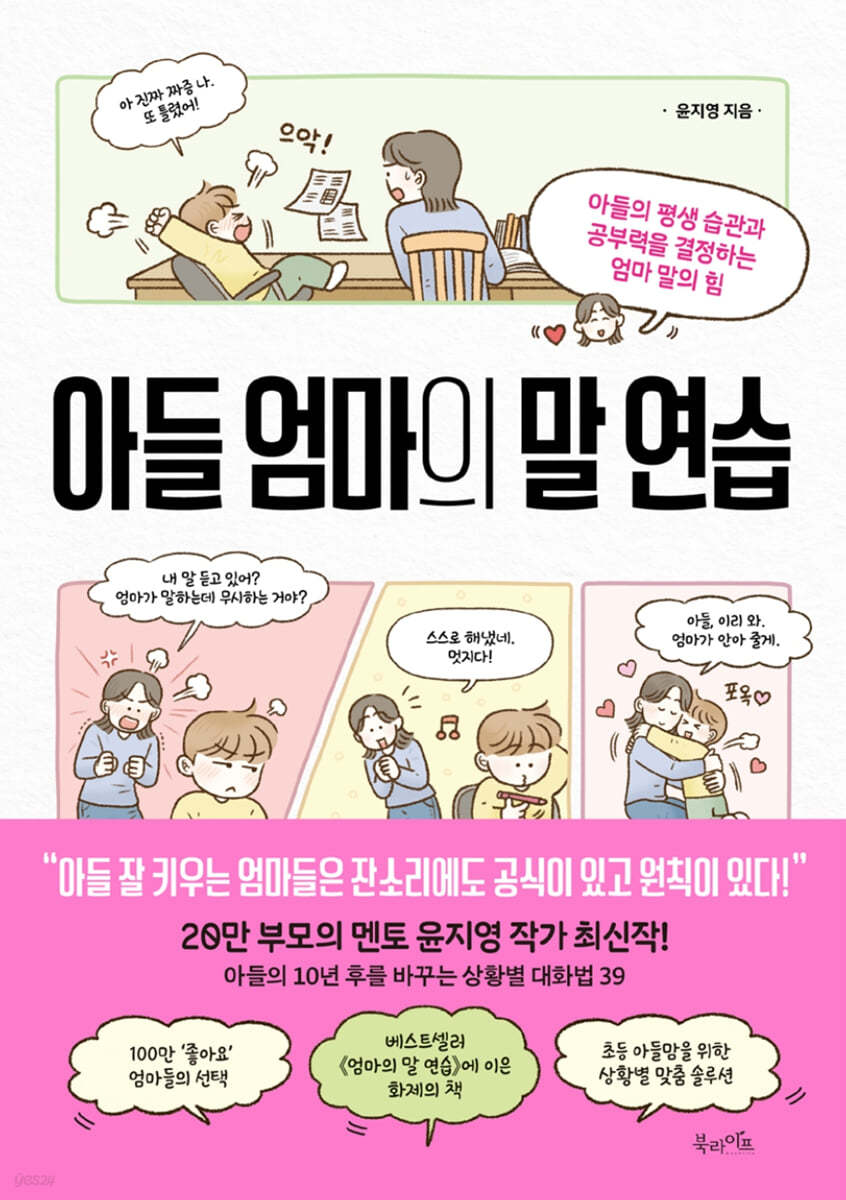
If you tell them to do their homework, they say, “No!” If you tell them to brush their teeth, they say, “Later!” Where should I start communicating with my disobedient son? Sons don't always say "yes" right away when asked to do something. Especially in the lower grades of elementary school, when told to do homework, they often say, “I don’t want to do it,” and when told to brush their teeth, they say, “It’s annoying, I’ll do it later!” and only do things they don’t like. When I say something nice, he doesn't listen, and no matter how much I say, Tyler doesn't change, so Mom is hurt and her words keep getting filled with negative emotions. Eventually, the mother gets angry or nags the child, and the child snaps at her, asking why she is angry. How can we stop this vicious cycle? Author Jiyoung Yoon, who has provided empathy and solutions to countless parents through her bestselling books, “Mom’s Speech Practice” and “Elementary Self-Esteem Class,” has now returned with a book for mothers raising sons, “Mother’s Speech Practice.” In this book, the author presents practical and effective communication techniques that can be applied immediately to a son who is disobedient and prone to procrastination. For things that must be done, such as homework, brushing teeth, and eating, it is effective to use 'instructions'. If your son does not do something that must be done, it is effective to set 'rules' with him and control him with those rules. However, 'dialogue' is necessary regarding the differences in thoughts, preferences, desires, and emotions between parents and children. 'Instructions, rules, conversations'. If you master these three things, you can maintain a positive relationship with your son without hurting his feelings, and help him develop good habits and study skills. |
- You can preview some of the book's contents.
Preview
index
prolog
[Theory] How to Raise a Son Properly Without Emotional Exploitation
PART 1: How to Give Polite Instructions to Your Son
1 Why are you leaving trash on your desk? Who told you to clean it up? Is your mom a cleaner?
Am I the housekeeper in this house? (long-winded instructions)
→ Put it away.
(short instructions)
2 Mom, I'm tired.
(vague instructions)
→ Let's sleep for 20 minutes and wake up to play.
I'll set an alarm.
(Numeric instructions)
3 Let's do our homework.
Mom, it's hard.
I want you to start with your homework.
(Emotionally-involved instructions)
→ Do your homework.
(directive without emotion)
4 No! I have so many toys at home, why are you asking me to buy more? (Emotional directive)
→ Did you know that I have several similar toys at home? (polite instruction)
5 You have to get angry to listen! (Shouting)
→ No.
(Powerful instructions)
6 Are you ignoring what I say? (accusation)
→ When your mom speaks, look, listen, and nod carefully.
(Listening instructions)
-Quiz1
PART 2 Essential Phrases for Parents of Sons
- “It’s a rule.” “Follow the rules.” “Do it by the rules.”
1 If you write like this, even the teacher won't be able to recognize it.
(negative judgment)
→ Please follow the rules.
(rule instructions)
2 Just finish what you're doing now and brush your teeth.
(I agree)
→ Start by brushing your teeth.
Brushing your teeth comes first.
(rule instructions)
3.
How many times do I have to tell you? You have to get angry for me to listen! (Shouting)
→ Homework is a rule.
I don't even accept your dislike of rules.
(rule instructions)
4 You do less compared to other kids.
(comparison)
→ It's a rule.
Follow the rules.
(rule instructions)
5 If you don't want to eat it, don't eat it.
I won't cook for you anymore.
(duress)
→ If there is a lot, you can leave some.
But there are no snacks.
(Rules Notice)
6 A student's duty is to study.
Are you doing your duty? (closed question)
→ What do you enjoy the most? (Open question)
7. Solve math problems consistently every day (ambiguous rules)
→ Solve one calculation per weekday (clear rules)
-Quiz2
-Q&A I'm curious about this ①
PART 3 How to Respect Your Son
1 My mother hates liars the most.
(Controlled by emotions)
→ Your heart must have been uncomfortable too.
Let me cut down on the lies for you.
(explanation)
2 Stop talking.
Close your eyes.
(instruction)
→ You should sleep now so that your growth hormones are released and you can grow taller.
(explanation)
3. Throw away the spicy flavor.
Make it mild.
(instruction)
→ Would you like it mild or spicy? (Question)
4 Who eats like this?
You have to eat a variety of foods! (Criticism)
→ Does it taste bad? Do you not like the texture? (Question)
5 What the hell is this?
Would you mind spending money on the game? (Forbidden)
→ I wonder why you want to buy that.
(question)
6 Sit down.
Let's talk.
(a burdensome proposal)
→ What is your favorite game? (Interest question)
-Quiz3
-Q&A I'm curious about this②
[Practical] A Mother's Words to Understand and Expand Her Son's World
PART 1: Practicing Words of Praise
1 Instead of saying “Mom, I’m busy” to your son who wants to be praised,
2 Instead of giving a vague compliment like “good job” to a son who has accomplished something,
3 Instead of giving a stern warning to a boastful son, “Stop being cocky and focus.”
4 To the son who wants to be recognized, “Don’t run.
Instead of the prohibition of “get hurt”
Instead of scolding your son, saying, “What did you do that’s so hard?” and procrastinating and doing things half-heartedly,
6 Instead of nagging your son, who is always complaining, “What if Mom writes a little?”
PART 2 Emotion Regulation Speech Practice
1 Instead of scolding a son who blames his mother by saying, “Why is it your fault?”
2 Instead of giving a one-sided notice to a son who just watches soccer, saying, “You’re going to FC next week.”
3 Instead of scolding a son who interferes with his mother's work by saying, "What's wrong with you?"
4 Instead of saying “Stop it” to your complaining son,
5 Instead of yelling at your son who is not good at expressing his emotions, “Is this something to be upset about?”
PART 3 Game Situation Speech Practice
1 Instead of saying to your son who breaks his game time, “Why don’t you keep your promise?”
2 Instead of criticizing your son for playing games secretly, say, “I’m disappointed.”
PART 4 Conflict Situation Speech Practice
1 Instead of forcing your siblings to “apologize” when they fight,
2 Instead of asking your son who fought with his friend, “Did you make up?” with concern,
3 When your son complains about his friend's problems, instead of calling his friend's mom right away,
PART 5 Daily Life Speech Practice
1 Instead of telling your son who doesn't read to "read a book,"
2 Instead of scolding my son who only reads educational comics, “He should read a proper book.”
3 Instead of yelling at your son who procrastinates on his homework, “You need to get angry so he doesn’t listen!”
Instead of asking your son, who has lost his clothes, “How many times has this happened?”
-Quiz4
Epilogue
Appendix Instructions and Dialogue at a Glance
[Theory] How to Raise a Son Properly Without Emotional Exploitation
PART 1: How to Give Polite Instructions to Your Son
1 Why are you leaving trash on your desk? Who told you to clean it up? Is your mom a cleaner?
Am I the housekeeper in this house? (long-winded instructions)
→ Put it away.
(short instructions)
2 Mom, I'm tired.
(vague instructions)
→ Let's sleep for 20 minutes and wake up to play.
I'll set an alarm.
(Numeric instructions)
3 Let's do our homework.
Mom, it's hard.
I want you to start with your homework.
(Emotionally-involved instructions)
→ Do your homework.
(directive without emotion)
4 No! I have so many toys at home, why are you asking me to buy more? (Emotional directive)
→ Did you know that I have several similar toys at home? (polite instruction)
5 You have to get angry to listen! (Shouting)
→ No.
(Powerful instructions)
6 Are you ignoring what I say? (accusation)
→ When your mom speaks, look, listen, and nod carefully.
(Listening instructions)
-Quiz1
PART 2 Essential Phrases for Parents of Sons
- “It’s a rule.” “Follow the rules.” “Do it by the rules.”
1 If you write like this, even the teacher won't be able to recognize it.
(negative judgment)
→ Please follow the rules.
(rule instructions)
2 Just finish what you're doing now and brush your teeth.
(I agree)
→ Start by brushing your teeth.
Brushing your teeth comes first.
(rule instructions)
3.
How many times do I have to tell you? You have to get angry for me to listen! (Shouting)
→ Homework is a rule.
I don't even accept your dislike of rules.
(rule instructions)
4 You do less compared to other kids.
(comparison)
→ It's a rule.
Follow the rules.
(rule instructions)
5 If you don't want to eat it, don't eat it.
I won't cook for you anymore.
(duress)
→ If there is a lot, you can leave some.
But there are no snacks.
(Rules Notice)
6 A student's duty is to study.
Are you doing your duty? (closed question)
→ What do you enjoy the most? (Open question)
7. Solve math problems consistently every day (ambiguous rules)
→ Solve one calculation per weekday (clear rules)
-Quiz2
-Q&A I'm curious about this ①
PART 3 How to Respect Your Son
1 My mother hates liars the most.
(Controlled by emotions)
→ Your heart must have been uncomfortable too.
Let me cut down on the lies for you.
(explanation)
2 Stop talking.
Close your eyes.
(instruction)
→ You should sleep now so that your growth hormones are released and you can grow taller.
(explanation)
3. Throw away the spicy flavor.
Make it mild.
(instruction)
→ Would you like it mild or spicy? (Question)
4 Who eats like this?
You have to eat a variety of foods! (Criticism)
→ Does it taste bad? Do you not like the texture? (Question)
5 What the hell is this?
Would you mind spending money on the game? (Forbidden)
→ I wonder why you want to buy that.
(question)
6 Sit down.
Let's talk.
(a burdensome proposal)
→ What is your favorite game? (Interest question)
-Quiz3
-Q&A I'm curious about this②
[Practical] A Mother's Words to Understand and Expand Her Son's World
PART 1: Practicing Words of Praise
1 Instead of saying “Mom, I’m busy” to your son who wants to be praised,
2 Instead of giving a vague compliment like “good job” to a son who has accomplished something,
3 Instead of giving a stern warning to a boastful son, “Stop being cocky and focus.”
4 To the son who wants to be recognized, “Don’t run.
Instead of the prohibition of “get hurt”
Instead of scolding your son, saying, “What did you do that’s so hard?” and procrastinating and doing things half-heartedly,
6 Instead of nagging your son, who is always complaining, “What if Mom writes a little?”
PART 2 Emotion Regulation Speech Practice
1 Instead of scolding a son who blames his mother by saying, “Why is it your fault?”
2 Instead of giving a one-sided notice to a son who just watches soccer, saying, “You’re going to FC next week.”
3 Instead of scolding a son who interferes with his mother's work by saying, "What's wrong with you?"
4 Instead of saying “Stop it” to your complaining son,
5 Instead of yelling at your son who is not good at expressing his emotions, “Is this something to be upset about?”
PART 3 Game Situation Speech Practice
1 Instead of saying to your son who breaks his game time, “Why don’t you keep your promise?”
2 Instead of criticizing your son for playing games secretly, say, “I’m disappointed.”
PART 4 Conflict Situation Speech Practice
1 Instead of forcing your siblings to “apologize” when they fight,
2 Instead of asking your son who fought with his friend, “Did you make up?” with concern,
3 When your son complains about his friend's problems, instead of calling his friend's mom right away,
PART 5 Daily Life Speech Practice
1 Instead of telling your son who doesn't read to "read a book,"
2 Instead of scolding my son who only reads educational comics, “He should read a proper book.”
3 Instead of yelling at your son who procrastinates on his homework, “You need to get angry so he doesn’t listen!”
Instead of asking your son, who has lost his clothes, “How many times has this happened?”
-Quiz4
Epilogue
Appendix Instructions and Dialogue at a Glance
Detailed image

Into the book
The key is not where you raise them, but how you raise them.
Children are most influenced by their parents' attitudes and words.
As I became more adept at discerning when to give firm instructions and when to negotiate a solution, parenting became easier, and my son's good habits developed more quickly.
---From the "Prologue"
If emotions are involved in giving instructions, it can lead to unnecessary emotional waste and arguments.
What happens when a mother tells her son she's having a hard time, but he doesn't listen? The mother feels like her struggles aren't understood and she's being rejected, leaving her heartbroken.
The same goes for my son.
I feel bad because I unintentionally became the one who made my mother suffer.
It's also unfair.
Behavioral problems spread into emotional problems.
In these cases, short, emotion-free instructions are much more effective than long, affectionate instructions.
No matter how nicely you speak, if you talk too long, it will just sound like nagging to your son.
---From the "Theory" section
Going to kindergarten, brushing teeth, solving one problem a day.
These are all things that children must do.
It is a child's daily routine and rules to follow.
Even though it's something I do every day, there are times when I don't want to do it and put it off.
In times like these, it can be confusing whether you should consider your child's feelings or firmly say no.
In such cases, take a comprehensive look at how often this happens (the frequency of the situation) and your son's age.
---From "Theory Part 2: Essential Phrases for Parents of Sons"
I allow my fourth grade son to play games or watch YouTube after he finishes his daily homework.
Of course, there is a time limit.
Through conversations with my son, we established a rule that 'he can use media after he finishes his work.'
It usually takes my son an hour to an hour and a half to finish his homework by working on math and English workbooks after school, and he can use the media for 30 minutes after he finishes.
You can use up all your media usage time that day, or you can save it up and use it all at once over the weekend.
There is also a rule that says, 'If you finish your scheduled work after 9 PM, you don't use media that day, but on the weekend.'
---From "Theory Part 2: Essential Phrases for Parents of Sons"
It's up to the child whether to make it spicy or mild, and whether to throw away the soup or eat it.
Tastes and preferences are a personal domain.
We must respect individual opinions.
This is an area that requires conversation, not instructions.
You can explain to your child what is less harmful to their health, but if you make the decision, it is an invasion.
They don't respect and don't keep each other's boundaries.
There are situations where parents need to control, and there are situations where they need to communicate.
Parents need to know when to give instructions and when to talk.
However, the situation is complex and cannot be divided into simple categories, so it is always difficult and confusing.
In that case, try to distinguish between a rule and a symbol.
---From "Theory Part 3: How to Respect Your Son"
Just as a child grows taller every day, his wisdom grows.
There is no child who does not grow, they just grow at different rates.
To discover a child's growth, you must 'observe'.
It may be difficult to confirm whether you have grown today compared to yesterday, but you can definitely see it if you compare it to a month ago or three months ago.
So, parents can praise their children when they 'discover' something, not when they 'do well'.
---From "Practice - PART 1: Practicing Words of Praise"
“Are you bored? Are you having trouble concentrating today?”
“You are a good kid at what you do, so now work hard.”
These are words that protect your son's self-esteem and instill a positive identity.
Identity cannot be created alone.
How I see myself as a person is influenced by how others see me and by how I want to be in my relationships with others.
Ultimately, identity is created through diverse interactions with many people.
Parents are important people who influence their children.
Children need their parents' help to develop a positive identity.
When you look at your child positively, believe in him or her, and support him or her, he or she can develop a positive sense and belief that he or she is a good person.
Children are most influenced by their parents' attitudes and words.
As I became more adept at discerning when to give firm instructions and when to negotiate a solution, parenting became easier, and my son's good habits developed more quickly.
---From the "Prologue"
If emotions are involved in giving instructions, it can lead to unnecessary emotional waste and arguments.
What happens when a mother tells her son she's having a hard time, but he doesn't listen? The mother feels like her struggles aren't understood and she's being rejected, leaving her heartbroken.
The same goes for my son.
I feel bad because I unintentionally became the one who made my mother suffer.
It's also unfair.
Behavioral problems spread into emotional problems.
In these cases, short, emotion-free instructions are much more effective than long, affectionate instructions.
No matter how nicely you speak, if you talk too long, it will just sound like nagging to your son.
---From the "Theory" section
Going to kindergarten, brushing teeth, solving one problem a day.
These are all things that children must do.
It is a child's daily routine and rules to follow.
Even though it's something I do every day, there are times when I don't want to do it and put it off.
In times like these, it can be confusing whether you should consider your child's feelings or firmly say no.
In such cases, take a comprehensive look at how often this happens (the frequency of the situation) and your son's age.
---From "Theory Part 2: Essential Phrases for Parents of Sons"
I allow my fourth grade son to play games or watch YouTube after he finishes his daily homework.
Of course, there is a time limit.
Through conversations with my son, we established a rule that 'he can use media after he finishes his work.'
It usually takes my son an hour to an hour and a half to finish his homework by working on math and English workbooks after school, and he can use the media for 30 minutes after he finishes.
You can use up all your media usage time that day, or you can save it up and use it all at once over the weekend.
There is also a rule that says, 'If you finish your scheduled work after 9 PM, you don't use media that day, but on the weekend.'
---From "Theory Part 2: Essential Phrases for Parents of Sons"
It's up to the child whether to make it spicy or mild, and whether to throw away the soup or eat it.
Tastes and preferences are a personal domain.
We must respect individual opinions.
This is an area that requires conversation, not instructions.
You can explain to your child what is less harmful to their health, but if you make the decision, it is an invasion.
They don't respect and don't keep each other's boundaries.
There are situations where parents need to control, and there are situations where they need to communicate.
Parents need to know when to give instructions and when to talk.
However, the situation is complex and cannot be divided into simple categories, so it is always difficult and confusing.
In that case, try to distinguish between a rule and a symbol.
---From "Theory Part 3: How to Respect Your Son"
Just as a child grows taller every day, his wisdom grows.
There is no child who does not grow, they just grow at different rates.
To discover a child's growth, you must 'observe'.
It may be difficult to confirm whether you have grown today compared to yesterday, but you can definitely see it if you compare it to a month ago or three months ago.
So, parents can praise their children when they 'discover' something, not when they 'do well'.
---From "Practice - PART 1: Practicing Words of Praise"
“Are you bored? Are you having trouble concentrating today?”
“You are a good kid at what you do, so now work hard.”
These are words that protect your son's self-esteem and instill a positive identity.
Identity cannot be created alone.
How I see myself as a person is influenced by how others see me and by how I want to be in my relationships with others.
Ultimately, identity is created through diverse interactions with many people.
Parents are important people who influence their children.
Children need their parents' help to develop a positive identity.
When you look at your child positively, believe in him or her, and support him or her, he or she can develop a positive sense and belief that he or she is a good person.
---From "Practice - PART 3 Game Situation Speech Practice"
Publisher's Review
“A single word from my mother
“Change your child’s attitude and habits.”
The Secret to Parenting a Son Who Is Less Tired, Happier, and Tireless
“Mom, it’s hard.
“Please listen to me!”, “You have to get angry to listen to me!”
If you find yourself saying these things to your son every day, you may find the answer in "Son's Mom's Speech Practice."
This book is for mothers who have emotional fights and arguments with their sons every day.
The author, who has a daughter in middle school and a son in elementary school, faced many difficulties while raising her sons.
Although I have been writing and lecturing as a parenting expert, I was confused about how to raise my son.
After much thought, the author quit her job, stopped writing, and focused on raising her children.
The author's son, who was once stubborn and resistant, now loves books so much that he takes them out as soon as he opens his eyes, and he also strictly adheres to game time.
What was the key to change?
The author says that the key to raising a son is not where you raise him, but what you say to him.
As she became more adept at discerning when to give firm instructions and when to resolve issues through dialogue, parenting became easier and her son began to develop good habits more quickly.
This book was completed based on the author's extensive experience in raising sons and his many years of experience in educational settings and parent coaching.
When conversations are based on clear instructions, rules, and respect, rather than being swayed by emotions, children can develop responsibility and confidence.
It presents practical methods to wisely resolve conflicts and concerns with your son, using specific and vivid examples, and guides parents and children on the path to growing together.
“The key to raising a son is
“It’s ‘Instruction-Rules-Conversation’”
39 Essential Phrases for Raising a Son Who Can Fulfill His Own Dreams
If you always push too hard, your relationship with your son will become distant, and if you give in to everything your son wants, he will not develop good habits.
The author says it is important to interact with your son in an appropriate manner depending on the situation and the subject.
Parents who raise their children well balance their instructions and conversations appropriately.
We need to practice being firm when it's time to be firm, being gentle when dialogue is needed, and adjusting according to the situation.
Rules are 'instructions', symbols are 'conversations'
You can alleviate many of the difficulties of raising your son by distinguishing between situations where you give instructions and situations where you talk.
However, it is difficult to clearly distinguish from the beginning when to give instructions and when to talk.
This book provides realistic and vivid examples to help parents find the right position in such difficult moments.
Essential tasks in daily life require direction.
It is important to let go of your emotions at this time.
Emotional expressions such as “Why are you like that?” or “Do you have to be angry to listen to me?” may have a temporary effect on the child, but they are counterproductive in the long run.
If you give instructions with emotion, parents can easily get hurt.
When a child doesn't listen when parents say, "Mom, I'm having a hard time, please listen to me," the parent feels like their feelings are being ignored.
So, for things that must be done, such as “Do your homework” or “Brush your teeth,” it is better to give instructions that are emotion-free.
Sometimes 'conversation' is necessary.
It is important to distinguish between situations that require parental control and situations that require communication, and differences should be resolved through communication.
It is not advisable to immediately reject my son's favorite game just because it conflicts with my tastes as a mother.
Since liking and wanting something is a preference, it is better to communicate rather than control.
Feelings change, but 'rules' remain constant, no matter the situation.
You don't always have to speak to your child in a loving and kind way.
It is important to flexibly adjust the parent's attitude depending on the situation, such as using 'affectionate empathy' when the child's heart needs to be nurtured, and using 'emotion-free instructions' when control is needed.
But giving instructions without being swayed by emotions is not as easy as it sounds.
Because it is difficult to give rational instructions every time, ‘rules’ are necessary.
Instead of nagging, “If you write like this, even the teacher won’t understand,” it is more effective to give instructions in the form of rules.
At this time, if you tell your child, “It’s a rule,” or “Follow the rules,” they will be less affected by emotions and it will be easier to maintain composure.
Strict but not scary
How to Be a Kind, But Tough Parent
The one parenting book every parent raising a son must read.
This book is largely divided into theory and practice sections.
First, the theory section covers in detail the principles and importance of 'instructions, rules, and conversation', which are the core of raising sons.
Chapter 1 examines how to give instructions that are appropriate for your son's characteristics and how to give instructions in a non-emotional and polite manner. Chapter 2 provides specific examples of how to set and give instructions on the rules necessary for raising a son.
Chapter 3 teaches you how to communicate with your son in a way that respects him, including tips for explaining things kindly at his level, asking questions that will open his heart, and differentiating between instructions and conversations depending on the situation.
In the practical section, you can learn instructions, rules, and conversation skills through speaking practice in various situations based on the contents of the theory section.
We've organized it so that you can wisely and appropriately use it right away in specific situations that you frequently encounter in daily life, such as when your child wants to be recognized, when he or she is full of complaints about everything, when he or she breaks game time, or when he or she fights with a friend and doesn't make up.
In particular, the book includes a total of 39 cartoon-style illustrations of conversations between mother and son.
At the end of each chapter, you can look at the picture to understand the content more intuitively and practice it.
In addition to this, there are also Q&As and quizzes compiled from the most frequently asked questions from parents of sons, and an appendix that organizes mothers' thoughts so that they can be seen at a glance.
Children are most influenced by their parents' attitudes and words.
Even if you feel like you're going crazy because of your son, if you're looking for a way to understand his feelings and communicate wisely without getting angry, this book will give you the wisdom to raise your son with less difficulty and more happiness.
“Change your child’s attitude and habits.”
The Secret to Parenting a Son Who Is Less Tired, Happier, and Tireless
“Mom, it’s hard.
“Please listen to me!”, “You have to get angry to listen to me!”
If you find yourself saying these things to your son every day, you may find the answer in "Son's Mom's Speech Practice."
This book is for mothers who have emotional fights and arguments with their sons every day.
The author, who has a daughter in middle school and a son in elementary school, faced many difficulties while raising her sons.
Although I have been writing and lecturing as a parenting expert, I was confused about how to raise my son.
After much thought, the author quit her job, stopped writing, and focused on raising her children.
The author's son, who was once stubborn and resistant, now loves books so much that he takes them out as soon as he opens his eyes, and he also strictly adheres to game time.
What was the key to change?
The author says that the key to raising a son is not where you raise him, but what you say to him.
As she became more adept at discerning when to give firm instructions and when to resolve issues through dialogue, parenting became easier and her son began to develop good habits more quickly.
This book was completed based on the author's extensive experience in raising sons and his many years of experience in educational settings and parent coaching.
When conversations are based on clear instructions, rules, and respect, rather than being swayed by emotions, children can develop responsibility and confidence.
It presents practical methods to wisely resolve conflicts and concerns with your son, using specific and vivid examples, and guides parents and children on the path to growing together.
“The key to raising a son is
“It’s ‘Instruction-Rules-Conversation’”
39 Essential Phrases for Raising a Son Who Can Fulfill His Own Dreams
If you always push too hard, your relationship with your son will become distant, and if you give in to everything your son wants, he will not develop good habits.
The author says it is important to interact with your son in an appropriate manner depending on the situation and the subject.
Parents who raise their children well balance their instructions and conversations appropriately.
We need to practice being firm when it's time to be firm, being gentle when dialogue is needed, and adjusting according to the situation.
Rules are 'instructions', symbols are 'conversations'
You can alleviate many of the difficulties of raising your son by distinguishing between situations where you give instructions and situations where you talk.
However, it is difficult to clearly distinguish from the beginning when to give instructions and when to talk.
This book provides realistic and vivid examples to help parents find the right position in such difficult moments.
Essential tasks in daily life require direction.
It is important to let go of your emotions at this time.
Emotional expressions such as “Why are you like that?” or “Do you have to be angry to listen to me?” may have a temporary effect on the child, but they are counterproductive in the long run.
If you give instructions with emotion, parents can easily get hurt.
When a child doesn't listen when parents say, "Mom, I'm having a hard time, please listen to me," the parent feels like their feelings are being ignored.
So, for things that must be done, such as “Do your homework” or “Brush your teeth,” it is better to give instructions that are emotion-free.
Sometimes 'conversation' is necessary.
It is important to distinguish between situations that require parental control and situations that require communication, and differences should be resolved through communication.
It is not advisable to immediately reject my son's favorite game just because it conflicts with my tastes as a mother.
Since liking and wanting something is a preference, it is better to communicate rather than control.
Feelings change, but 'rules' remain constant, no matter the situation.
You don't always have to speak to your child in a loving and kind way.
It is important to flexibly adjust the parent's attitude depending on the situation, such as using 'affectionate empathy' when the child's heart needs to be nurtured, and using 'emotion-free instructions' when control is needed.
But giving instructions without being swayed by emotions is not as easy as it sounds.
Because it is difficult to give rational instructions every time, ‘rules’ are necessary.
Instead of nagging, “If you write like this, even the teacher won’t understand,” it is more effective to give instructions in the form of rules.
At this time, if you tell your child, “It’s a rule,” or “Follow the rules,” they will be less affected by emotions and it will be easier to maintain composure.
Strict but not scary
How to Be a Kind, But Tough Parent
The one parenting book every parent raising a son must read.
This book is largely divided into theory and practice sections.
First, the theory section covers in detail the principles and importance of 'instructions, rules, and conversation', which are the core of raising sons.
Chapter 1 examines how to give instructions that are appropriate for your son's characteristics and how to give instructions in a non-emotional and polite manner. Chapter 2 provides specific examples of how to set and give instructions on the rules necessary for raising a son.
Chapter 3 teaches you how to communicate with your son in a way that respects him, including tips for explaining things kindly at his level, asking questions that will open his heart, and differentiating between instructions and conversations depending on the situation.
In the practical section, you can learn instructions, rules, and conversation skills through speaking practice in various situations based on the contents of the theory section.
We've organized it so that you can wisely and appropriately use it right away in specific situations that you frequently encounter in daily life, such as when your child wants to be recognized, when he or she is full of complaints about everything, when he or she breaks game time, or when he or she fights with a friend and doesn't make up.
In particular, the book includes a total of 39 cartoon-style illustrations of conversations between mother and son.
At the end of each chapter, you can look at the picture to understand the content more intuitively and practice it.
In addition to this, there are also Q&As and quizzes compiled from the most frequently asked questions from parents of sons, and an appendix that organizes mothers' thoughts so that they can be seen at a glance.
Children are most influenced by their parents' attitudes and words.
Even if you feel like you're going crazy because of your son, if you're looking for a way to understand his feelings and communicate wisely without getting angry, this book will give you the wisdom to raise your son with less difficulty and more happiness.
GOODS SPECIFICS
- Date of issue: November 8, 2024
- Page count, weight, size: 296 pages | 416g | 148*210*20mm
- ISBN13: 9791191013764
- ISBN10: 1191013766
You may also like
카테고리
korean


korean

![GQ KOREA Mark (Monthly): December [2025]](http://librairie.coreenne.fr/cdn/shop/files/8ef265dbbfbf186523ed75ba7319009d.jpg?v=1765340328&width=3840)


