

LLM in Production
 |
Description
Book Introduction
Learn how to deploy LLM-based applications to production safely and efficiently!
"LLM in Production" clearly explains, with ample examples, how practical LLMs work, how to interact with them, and how to integrate them with applications.
This book will help you understand how LLM differs from traditional software and machine learning (ML) and provide best practices for applying LLM beyond the lab.
The book also offers advice based on the authors' own experiences to help you avoid common problems.
"LLM in Production" clearly explains, with ample examples, how practical LLMs work, how to interact with them, and how to integrate them with applications.
This book will help you understand how LLM differs from traditional software and machine learning (ML) and provide best practices for applying LLM beyond the lab.
The book also offers advice based on the authors' own experiences to help you avoid common problems.
- You can preview some of the book's contents.
Preview
index
▣ Chapter 1: Awakening Words: Why LLMs Are Getting the Attention They deserve
1.1 LLM accelerates communication
1.2 Build your own LLM or buy it?
__1.2.1 Purchase: The Well-Worn Path
__1.2.2 Self-Building: The Road Less Traveled
__1.2.3 A word of warning: Embrace the future now.
1.3 Breaking the superstition
summation
▣ Chapter 2: Understanding LLM: A Deep Dive into Language Modeling
2.1 Language Modeling
2.1.1 Linguistic features
__2.1.2 Semiotics
__2.1.3 Multilingual NLP
2.2 Language modeling techniques
__2.2.1 N-gram and corpus-based techniques
__2.2.2 Bayesian technique
__2.2.3 Markov chain
__2.2.4 Continuous Language Modeling
__2.2.5 Embedding
__2.2.6 Multilayer Perceptron (MLP)
__2.2.7 Recurrent Neural Networks (RNNs) and Long Short-Term Memory (LSTM) Networks
__2.2.8 Attention Mechanism
2.3 “Attention Is All You Need”
__2.3.1 Encoder
__2.3.2 decoder
__2.3.3 Transformer
2.4 Very large transformer model
summation
▣ Chapter 3: LLM Ops: Building a Platform for LLM
3.1 Introduction to LLM Ops
3.2 Challenges in running an LLM
__3.2.1 Long download times
__3.2.2 Longer deployment times
__3.2.3 Delay time
__3.2.4 GPU Management
__3.2.5 Special characteristics of text data
__3.2.6 Bottleneck due to token limit
__3.2.7 Confusion due to hallucinations
__3.2.8 Bias and Ethical Considerations
__3.2.9 Security Concerns
__3.2.10 Cost Management
3.3 Key Elements of LLM Ops
__3.3.1 compression
__3.3.2 Distributed Computing
3.4 LLM Ops Infrastructure
__3.4.1 Data Infrastructure
__3.4.2 Experiment Tracker
__3.4.3 Model Registry
__3.4.4 Feature Repository
__3.4.5 Vector Database
__3.4.6 Monitoring System
__3.4.7 GPU-enabled workstation
__3.4.8 Distribution Service
summation
▣ Chapter 4: Data Engineering for LLM: Preparing for Success
4.1 Model as a Foundation
__4.1.1 GPT
__4.1.2 BLOOM
__4.1.3 Rama
__4.1.4 Wizard
__4.1.5 Falcon
__4.1.6 Vicuna
__4.1.7 Dolly
__4.1.8 Open Chat
4.2 LLM Evaluation
__4.2.1 Metrics for Text Evaluation
__4.2.2 Key industry benchmarks
__4.2.3 Responsible AI Benchmarks
__4.2.4 Developing your own benchmark
__4.2.5 Evaluation of the Code Generator
__4.2.6 Model Parameter Evaluation
4.3 Data for LLM
__4.3.1 Datasets to Know
__4.3.2 Data Cleaning and Preparation
4.4 Text Processing
__4.4.1 Tokenization
__4.4.2 Embedding
4.5 Preparing the Slack Dataset
summation
▣ Chapter 5: LLM Training: How to Create a Generator
5.1 Multi-GPU environment
__5.1.1 Preferences
__5.1.2 Library
5.2 Basic Training Techniques
__5.2.1 Training from the ground up
__5.2.2 Transfer Learning (Fine-Tuning)
__5.2.3 Prompting
5.3 Advanced Training Techniques
__5.3.1 Prompt Adjustment
__5.3.2 Fine-tuning using knowledge distillation
__5.3.3 RLHF (Reinforcement Learning Based on Human Feedback)
__5.3.4 Mix of Experts (MoE)
__5.3.5 LoRA and PEFT
5.4 Training Tips and Tricks
__5.4.1 Note on Training Data Size
__5.4.2 Efficient Training
__5.4.3 The trap of extreme values
__5.4.4 Hyperparameter Tuning Tips
__5.4.5 Notes on Operating Systems
__5.4.6 Activation Function Advice
summation
▣ Chapter 6: Building an LLM Service: A Practical Guide
6.1 Creating an LLM Service
__6.1.1 Compiling the model
__6.1.2 LLM storage strategy
__6.1.3 Adaptive Request Batching
__6.1.4 Flow Control
__6.1.5 Response Streaming
__6.1.6 Feature Repository
__6.1.7 RAG (Research Augmentation Generation)
__6.1.8 LLM Service Library
6.2 Infrastructure Construction
__6.2.1 Cluster Preparation
__6.2.2 Auto-expansion
__6.2.3 Rolling Update
__6.2.4 Inference Graph
__6.2.5 Monitoring
6.3 Production Challenges
__6.3.1 Model Update and Retraining
__6.3.2 Load Testing
__6.3.3 Troubleshooting Latency Issues
__6.3.4 Resource Management
__6.3.5 Cost Engineering
__6.3.6 Security
6.4 Edge Deployment
summation
▣ Chapter 7: Prompt Engineering: Becoming an LLM Trainer
7.1 Model Prompting
__7.1.1 Few-shot prompting
__7.1.2 One-shot prompting
__7.1.3 Zero-shot prompting
7.2 Fundamentals of Prompt Engineering
__7.2.1 Anatomy of a Prompt
__7.2.2 Prompt hyperparameters
__7.2.3 Examining the Training Data
7.3 Prompt Engineering Tools
__7.3.1 Langchain
__7.3.2 Guidance
__7.3.3 DSPy
__7.3.4 There are other tools too…
7.4 Advanced Prompt Engineering Techniques
__7.4.1 Providing Tools for LLM
__7.4.2 ReAct
summation
▣ Chapter 8: LLM Applications: Building Interactive Experiences
8.1 Creating an Application
__8.1.1 Streaming on the Front End
__8.1.2 Maintain conversation history
__8.1.3 Chatbot Interaction Features
__8.1.4 Token Counter
__8.1.5 RAG application
8.2 Edge Applications
8.3 LLM Agent
summation
▣ Chapter 9: Creating an LLM Project: Reimplementing Rama3
9.1 Meta's Llama Reimplementation
__9.1.1 Tokenization and Settings
__9.1.2 Preparing the dataset, loading data, evaluating it, and creating it
__9.1.3 Model Architecture
9.2 Simplified Rama3
9.3 Model Improvements
__9.3.1 Quantization
__9.3.2 LoRA
__9.3.3 FSDP QLoRA Application
9.4 Deploying the Model to the Hugging Face Space
summation
▣ Chapter 10: Creating a Coding Copilot Project: Will It Actually Help?
10.1 Example Model
10.2 Data is king
__10.2.1 Example Vector DB
__10.2.2 Example Dataset
__10.2.3 RAG application
10.3 Creating a VS Code Extension
10.4 Lessons Learned and Next Steps
summation
▣ Chapter 11: Deploying LLM on a Raspberry Pi: How small can you make it?
11.1 Setting up the Raspberry Pi
__11.1.1 Preparing OS images using Pie Imager
__11.1.2 Connecting to the Pi
__11.1.3 Software Installation and Update
11.2 Preparing the Model
11.3 Model Serving
11.4 Improvements
__11.4.1 Better interface
__11.4.2 Quantization changes
__11.4.3 Adding multiple modals
__11.4.4 Serving Models in Google Colab
summation
▣ Chapter 12: Production, a constantly changing landscape: This is just the beginning.
12.1 Overall view
12.2 The Future of LLM
__12.2.1 Government and Regulation
__12.2.2 LLM continues to grow
__12.2.3 Multimodal Space
__12.2.4 dataset
__12.2.5 Solving the hallucination problem
__12.2.6 New hardware
__12.2.7 The usefulness of the agent will be proven.
12.3 Concluding remarks
summation
▣ Appendix A: A Brief History of Linguistics
A.1 Ancient Linguistics
A.2 Medieval Linguistics
A.3 Renaissance and Modern Linguistics
A.4 Early 20th Century Linguistics
A.5 Mid-20th Century and Modern Linguistics
▣ Appendix B: RLHF (Reinforcement Learning Based on Human Feedback)
▣ Appendix C: Multimodal Latent Space
1.1 LLM accelerates communication
1.2 Build your own LLM or buy it?
__1.2.1 Purchase: The Well-Worn Path
__1.2.2 Self-Building: The Road Less Traveled
__1.2.3 A word of warning: Embrace the future now.
1.3 Breaking the superstition
summation
▣ Chapter 2: Understanding LLM: A Deep Dive into Language Modeling
2.1 Language Modeling
2.1.1 Linguistic features
__2.1.2 Semiotics
__2.1.3 Multilingual NLP
2.2 Language modeling techniques
__2.2.1 N-gram and corpus-based techniques
__2.2.2 Bayesian technique
__2.2.3 Markov chain
__2.2.4 Continuous Language Modeling
__2.2.5 Embedding
__2.2.6 Multilayer Perceptron (MLP)
__2.2.7 Recurrent Neural Networks (RNNs) and Long Short-Term Memory (LSTM) Networks
__2.2.8 Attention Mechanism
2.3 “Attention Is All You Need”
__2.3.1 Encoder
__2.3.2 decoder
__2.3.3 Transformer
2.4 Very large transformer model
summation
▣ Chapter 3: LLM Ops: Building a Platform for LLM
3.1 Introduction to LLM Ops
3.2 Challenges in running an LLM
__3.2.1 Long download times
__3.2.2 Longer deployment times
__3.2.3 Delay time
__3.2.4 GPU Management
__3.2.5 Special characteristics of text data
__3.2.6 Bottleneck due to token limit
__3.2.7 Confusion due to hallucinations
__3.2.8 Bias and Ethical Considerations
__3.2.9 Security Concerns
__3.2.10 Cost Management
3.3 Key Elements of LLM Ops
__3.3.1 compression
__3.3.2 Distributed Computing
3.4 LLM Ops Infrastructure
__3.4.1 Data Infrastructure
__3.4.2 Experiment Tracker
__3.4.3 Model Registry
__3.4.4 Feature Repository
__3.4.5 Vector Database
__3.4.6 Monitoring System
__3.4.7 GPU-enabled workstation
__3.4.8 Distribution Service
summation
▣ Chapter 4: Data Engineering for LLM: Preparing for Success
4.1 Model as a Foundation
__4.1.1 GPT
__4.1.2 BLOOM
__4.1.3 Rama
__4.1.4 Wizard
__4.1.5 Falcon
__4.1.6 Vicuna
__4.1.7 Dolly
__4.1.8 Open Chat
4.2 LLM Evaluation
__4.2.1 Metrics for Text Evaluation
__4.2.2 Key industry benchmarks
__4.2.3 Responsible AI Benchmarks
__4.2.4 Developing your own benchmark
__4.2.5 Evaluation of the Code Generator
__4.2.6 Model Parameter Evaluation
4.3 Data for LLM
__4.3.1 Datasets to Know
__4.3.2 Data Cleaning and Preparation
4.4 Text Processing
__4.4.1 Tokenization
__4.4.2 Embedding
4.5 Preparing the Slack Dataset
summation
▣ Chapter 5: LLM Training: How to Create a Generator
5.1 Multi-GPU environment
__5.1.1 Preferences
__5.1.2 Library
5.2 Basic Training Techniques
__5.2.1 Training from the ground up
__5.2.2 Transfer Learning (Fine-Tuning)
__5.2.3 Prompting
5.3 Advanced Training Techniques
__5.3.1 Prompt Adjustment
__5.3.2 Fine-tuning using knowledge distillation
__5.3.3 RLHF (Reinforcement Learning Based on Human Feedback)
__5.3.4 Mix of Experts (MoE)
__5.3.5 LoRA and PEFT
5.4 Training Tips and Tricks
__5.4.1 Note on Training Data Size
__5.4.2 Efficient Training
__5.4.3 The trap of extreme values
__5.4.4 Hyperparameter Tuning Tips
__5.4.5 Notes on Operating Systems
__5.4.6 Activation Function Advice
summation
▣ Chapter 6: Building an LLM Service: A Practical Guide
6.1 Creating an LLM Service
__6.1.1 Compiling the model
__6.1.2 LLM storage strategy
__6.1.3 Adaptive Request Batching
__6.1.4 Flow Control
__6.1.5 Response Streaming
__6.1.6 Feature Repository
__6.1.7 RAG (Research Augmentation Generation)
__6.1.8 LLM Service Library
6.2 Infrastructure Construction
__6.2.1 Cluster Preparation
__6.2.2 Auto-expansion
__6.2.3 Rolling Update
__6.2.4 Inference Graph
__6.2.5 Monitoring
6.3 Production Challenges
__6.3.1 Model Update and Retraining
__6.3.2 Load Testing
__6.3.3 Troubleshooting Latency Issues
__6.3.4 Resource Management
__6.3.5 Cost Engineering
__6.3.6 Security
6.4 Edge Deployment
summation
▣ Chapter 7: Prompt Engineering: Becoming an LLM Trainer
7.1 Model Prompting
__7.1.1 Few-shot prompting
__7.1.2 One-shot prompting
__7.1.3 Zero-shot prompting
7.2 Fundamentals of Prompt Engineering
__7.2.1 Anatomy of a Prompt
__7.2.2 Prompt hyperparameters
__7.2.3 Examining the Training Data
7.3 Prompt Engineering Tools
__7.3.1 Langchain
__7.3.2 Guidance
__7.3.3 DSPy
__7.3.4 There are other tools too…
7.4 Advanced Prompt Engineering Techniques
__7.4.1 Providing Tools for LLM
__7.4.2 ReAct
summation
▣ Chapter 8: LLM Applications: Building Interactive Experiences
8.1 Creating an Application
__8.1.1 Streaming on the Front End
__8.1.2 Maintain conversation history
__8.1.3 Chatbot Interaction Features
__8.1.4 Token Counter
__8.1.5 RAG application
8.2 Edge Applications
8.3 LLM Agent
summation
▣ Chapter 9: Creating an LLM Project: Reimplementing Rama3
9.1 Meta's Llama Reimplementation
__9.1.1 Tokenization and Settings
__9.1.2 Preparing the dataset, loading data, evaluating it, and creating it
__9.1.3 Model Architecture
9.2 Simplified Rama3
9.3 Model Improvements
__9.3.1 Quantization
__9.3.2 LoRA
__9.3.3 FSDP QLoRA Application
9.4 Deploying the Model to the Hugging Face Space
summation
▣ Chapter 10: Creating a Coding Copilot Project: Will It Actually Help?
10.1 Example Model
10.2 Data is king
__10.2.1 Example Vector DB
__10.2.2 Example Dataset
__10.2.3 RAG application
10.3 Creating a VS Code Extension
10.4 Lessons Learned and Next Steps
summation
▣ Chapter 11: Deploying LLM on a Raspberry Pi: How small can you make it?
11.1 Setting up the Raspberry Pi
__11.1.1 Preparing OS images using Pie Imager
__11.1.2 Connecting to the Pi
__11.1.3 Software Installation and Update
11.2 Preparing the Model
11.3 Model Serving
11.4 Improvements
__11.4.1 Better interface
__11.4.2 Quantization changes
__11.4.3 Adding multiple modals
__11.4.4 Serving Models in Google Colab
summation
▣ Chapter 12: Production, a constantly changing landscape: This is just the beginning.
12.1 Overall view
12.2 The Future of LLM
__12.2.1 Government and Regulation
__12.2.2 LLM continues to grow
__12.2.3 Multimodal Space
__12.2.4 dataset
__12.2.5 Solving the hallucination problem
__12.2.6 New hardware
__12.2.7 The usefulness of the agent will be proven.
12.3 Concluding remarks
summation
▣ Appendix A: A Brief History of Linguistics
A.1 Ancient Linguistics
A.2 Medieval Linguistics
A.3 Renaissance and Modern Linguistics
A.4 Early 20th Century Linguistics
A.5 Mid-20th Century and Modern Linguistics
▣ Appendix B: RLHF (Reinforcement Learning Based on Human Feedback)
▣ Appendix C: Multimodal Latent Space
Detailed image
Publisher's Review
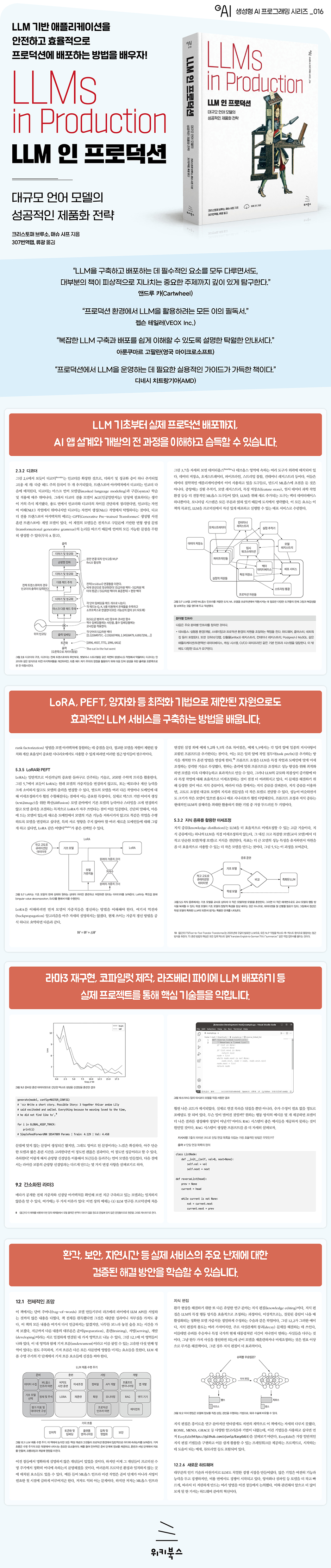
★ What this book covers ★
◎ Basic concepts and foundational technologies of LLM
◎ How to evaluate whether to use a pre-trained LLM or build your own
◎ How to efficiently scale the ML platform to handle LLM requirements
◎ How to train the foundation model of LLM and fine-tune the existing LLM
◎ How to deploy LLM to cloud and edge devices by leveraging complex architectures such as PEFT and LoRA.
◎ How to build an application that maximizes the strengths of LLM while compensating for its weaknesses
"LLM in Production" provides essential insights for seamlessly deploying LLMs into production using MLops. It provides practical guidance, from securing datasets suitable for LLM training to building platforms and addressing challenges associated with large model sizes.
We also cover practical tips and techniques for prompt engineering, model retraining, load testing, cost management, and security hardening.
◎ Basic concepts and foundational technologies of LLM
◎ How to evaluate whether to use a pre-trained LLM or build your own
◎ How to efficiently scale the ML platform to handle LLM requirements
◎ How to train the foundation model of LLM and fine-tune the existing LLM
◎ How to deploy LLM to cloud and edge devices by leveraging complex architectures such as PEFT and LoRA.
◎ How to build an application that maximizes the strengths of LLM while compensating for its weaknesses
"LLM in Production" provides essential insights for seamlessly deploying LLMs into production using MLops. It provides practical guidance, from securing datasets suitable for LLM training to building platforms and addressing challenges associated with large model sizes.
We also cover practical tips and techniques for prompt engineering, model retraining, load testing, cost management, and security hardening.
GOODS SPECIFICS
- Date of issue: June 18, 2025
- Page count, weight, size: 556 pages | 188*240*23mm
- ISBN13: 9791158396091
- ISBN10: 1158396090
You may also like
카테고리
korean


korean

![GQ KOREA Mark (Monthly): December [2025]](http://librairie.coreenne.fr/cdn/shop/files/8ef265dbbfbf186523ed75ba7319009d.jpg?v=1765340328&width=3840)


