

Deep learning through self-study
 |
Description
Book Introduction
“If you’re learning deep learning and wondering where you can apply it?”
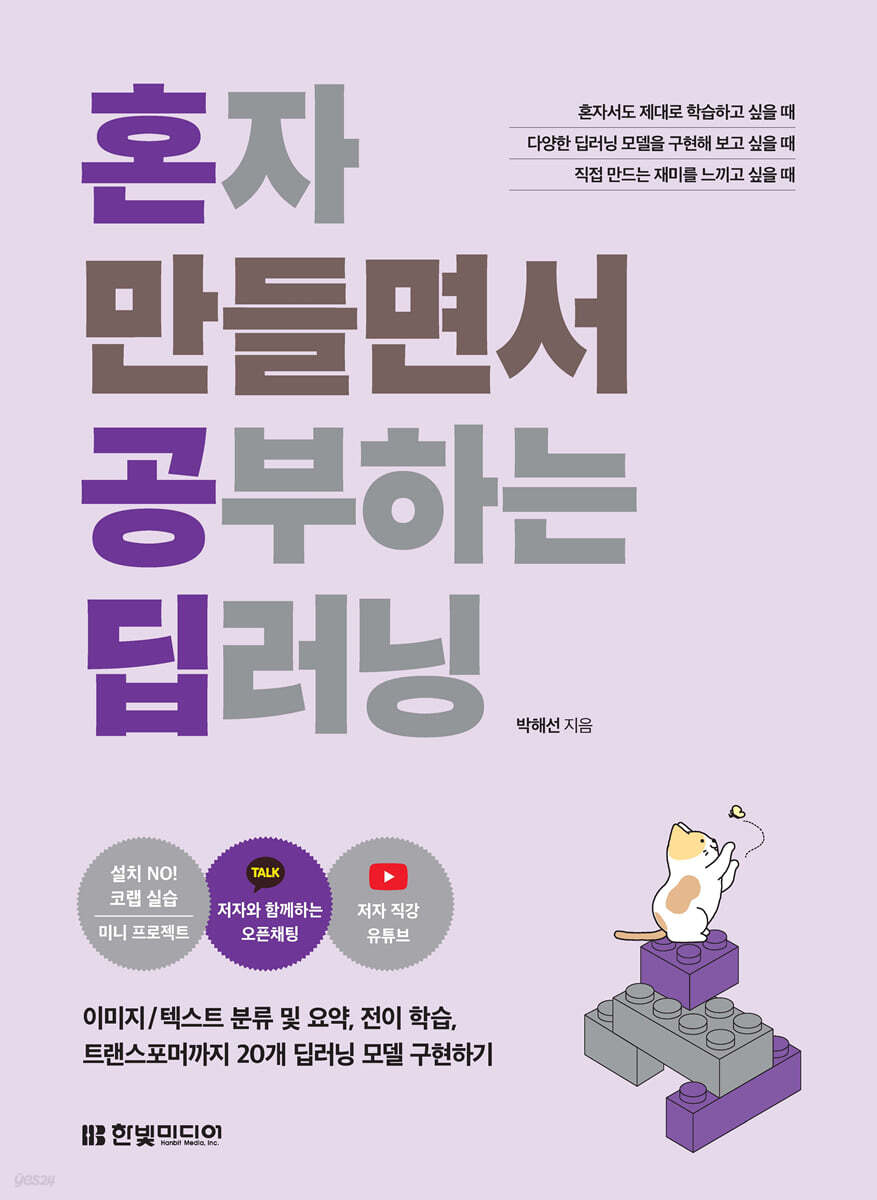
Have fun building your skills by implementing various deep learning models yourself, such as classifying puppy photos, analyzing the sentiment of movie review text, and creating a GPT model!
From early computer vision models representing the field of deep learning to cutting-edge models like large-scale language models like GPT, Llama, and Gemma, experience the fascinating evolution of artificial intelligence and the latest technologies by implementing various deep learning models.
Have fun building your skills by implementing various deep learning models yourself, such as classifying puppy photos, analyzing the sentiment of movie review text, and creating a GPT model!
From early computer vision models representing the field of deep learning to cutting-edge models like large-scale language models like GPT, Llama, and Gemma, experience the fascinating evolution of artificial intelligence and the latest technologies by implementing various deep learning models.
- You can preview some of the book's contents.
Preview
index
Chapter 01.
Classifying Fashion Product Images with Convolutional Neural Networks (CNNs)
01-1.
Setting up a deep learning development environment
__Preparing for Deep Learning, Google Colab
__Colab's screen composition
__Preparing for the lab with Colab
Key points organized by __keywords
01-2.
Understanding Convolutional Neural Network (CNN) Models
__The first CNN model - LeNet
__Convolutional layer - Conv2D
__Pooling layer and dense layer - AveragePooling2D, Dense
Key points organized by __keywords
01-3.
Classifying Fashion Product Images
__Building the LeNet model
Training the __LeNet model
Key points organized by __keywords
Chapter 02. Classifying Dog and Cat Photos with a Pre-Trained CNN Model
02-1.
Building an Image Classification CNN Model
The First CNN Model to Win the ImageNet Competition - AlexNet
__Pre-trained CNN model - VGGNet
Key points organized by __keywords
02-2.
Categorizing dog and cat photos
__Loading the VGGNet model
__Categorizing dog and cat photos
Key points organized by __keywords
02-3.
Improving the Performance of Dog and Cat Photo Classification Models
__CNN model that improves training performance - ResNet
__Building a ResNet model
__Categorizing dog and cat photos
__[Learn more] GoogLeNet
__[Mini Project] Classifying Dog and Cat Photos with GoogLeNet
Key points organized by __keywords
Chapter 03.
Classifying Images with Advanced CNN Models and Transfer Learning
03-1.
Optimizing the Efficiency of Image Classification Models
__ResNet's extension model - DenseNet
__Mobile Environment (Lightweight) Model - MobileNet
Key points organized by __keywords
03-2.
Optimizing the Performance of Image Classification Models
__Highest-Performing Model - EfficientNet
__Building an EfficientNet model
Classifying Dog Photos with the EfficientNet Model
Key points organized by __keywords
03-3.
Classifying Pistachio Images with Transfer Learning
Classifying Dog Photos with TensorFlow Hub
__Categorizing dog photos with Hugging Face
Classifying Pistachio Varieties with Transfer Learning
__[Mini Project] Classifying Pistachio Varieties with Kaggle Models
Key points organized by __keywords
Chapter 04.
Sentiment Classification of Movie Review Text Using the Transformer Encoder Model
04-1.
Understanding the Transformer Encoder Model
__Attention mechanism
__Positional encoding and layer normalization
__Building a Transformer Encoder Model
Key points organized by __keywords
04-2.
Classifying Sentiment in Movie Review Text Using Transfer Learning
__Transformer Encoder-Based Language Understanding Model - BERT
__Classifying the Sentiment of Movie Review Text with KerasNLP
__Classifying the Emotions of Movie Review Texts with Hugging Face
__[Learn More] Sentiment Analysis with Fine-Tuned Models
Key points organized by __keywords
04-3. Classifying Sentiment in Movie Review Text with a BERT Follow-up Model
__BERT's Performance Improvement Model - RoBERTa
__BERT's lightweight model - DistilBERT
__[Mini Project] Building a DistilBERT Model with KerasNLP
Key points organized by __keywords
Chapter 05.
Generating Text with the Transformer Decoder Model
05-1. Generating Text with the GPT-2 Model
__Masked multi-head attention
__Building a Transformer Decoder Module
Generating diverse texts with the GPT-2 model
__Creating various texts with Hugging Face
Key points organized by __keywords
05-2.
Generating text with the Llama model
__Understanding the Llama Model
__Building the Llama-2 Model with KerasNLP
Generating text with the __Llama-2 model
Generating text with the __Llama-3 model
__[Learn more] Llama-3.1 and Llama-3.2
Key points organized by __keywords
05-3.
Generating Text with the Gemma Model
__Understanding the Gemma Model
__Building the Gemma Model with KerasNLP
Generating text with the __Gemma model
Generating Text with the Gemma-2 Model
__[Mini Project] Building a Llama-3 Model with KerasNLP
Key points organized by __keywords
Chapter 06.
Summarizing Text with a Transformer Encoder-Decoder Model
06-1. Summarizing Text with the BART Model
__Building a Transformer Encoder-Decoder Model
Summarizing text with the __BART model
Key points organized by __keywords
06-2.
Summarizing text with the T5 model
Understanding the __T5 Model
Summarizing text with the __T5 model
Summarizing text with the __T5-1.1 model
__[Mini Project] Creating a T5-1.1 small model
Key points organized by __keywords
06-3.
Epilogue
Classifying Fashion Product Images with Convolutional Neural Networks (CNNs)
01-1.
Setting up a deep learning development environment
__Preparing for Deep Learning, Google Colab
__Colab's screen composition
__Preparing for the lab with Colab
Key points organized by __keywords
01-2.
Understanding Convolutional Neural Network (CNN) Models
__The first CNN model - LeNet
__Convolutional layer - Conv2D
__Pooling layer and dense layer - AveragePooling2D, Dense
Key points organized by __keywords
01-3.
Classifying Fashion Product Images
__Building the LeNet model
Training the __LeNet model
Key points organized by __keywords
Chapter 02. Classifying Dog and Cat Photos with a Pre-Trained CNN Model
02-1.
Building an Image Classification CNN Model
The First CNN Model to Win the ImageNet Competition - AlexNet
__Pre-trained CNN model - VGGNet
Key points organized by __keywords
02-2.
Categorizing dog and cat photos
__Loading the VGGNet model
__Categorizing dog and cat photos
Key points organized by __keywords
02-3.
Improving the Performance of Dog and Cat Photo Classification Models
__CNN model that improves training performance - ResNet
__Building a ResNet model
__Categorizing dog and cat photos
__[Learn more] GoogLeNet
__[Mini Project] Classifying Dog and Cat Photos with GoogLeNet
Key points organized by __keywords
Chapter 03.
Classifying Images with Advanced CNN Models and Transfer Learning
03-1.
Optimizing the Efficiency of Image Classification Models
__ResNet's extension model - DenseNet
__Mobile Environment (Lightweight) Model - MobileNet
Key points organized by __keywords
03-2.
Optimizing the Performance of Image Classification Models
__Highest-Performing Model - EfficientNet
__Building an EfficientNet model
Classifying Dog Photos with the EfficientNet Model
Key points organized by __keywords
03-3.
Classifying Pistachio Images with Transfer Learning
Classifying Dog Photos with TensorFlow Hub
__Categorizing dog photos with Hugging Face
Classifying Pistachio Varieties with Transfer Learning
__[Mini Project] Classifying Pistachio Varieties with Kaggle Models
Key points organized by __keywords
Chapter 04.
Sentiment Classification of Movie Review Text Using the Transformer Encoder Model
04-1.
Understanding the Transformer Encoder Model
__Attention mechanism
__Positional encoding and layer normalization
__Building a Transformer Encoder Model
Key points organized by __keywords
04-2.
Classifying Sentiment in Movie Review Text Using Transfer Learning
__Transformer Encoder-Based Language Understanding Model - BERT
__Classifying the Sentiment of Movie Review Text with KerasNLP
__Classifying the Emotions of Movie Review Texts with Hugging Face
__[Learn More] Sentiment Analysis with Fine-Tuned Models
Key points organized by __keywords
04-3. Classifying Sentiment in Movie Review Text with a BERT Follow-up Model
__BERT's Performance Improvement Model - RoBERTa
__BERT's lightweight model - DistilBERT
__[Mini Project] Building a DistilBERT Model with KerasNLP
Key points organized by __keywords
Chapter 05.
Generating Text with the Transformer Decoder Model
05-1. Generating Text with the GPT-2 Model
__Masked multi-head attention
__Building a Transformer Decoder Module
Generating diverse texts with the GPT-2 model
__Creating various texts with Hugging Face
Key points organized by __keywords
05-2.
Generating text with the Llama model
__Understanding the Llama Model
__Building the Llama-2 Model with KerasNLP
Generating text with the __Llama-2 model
Generating text with the __Llama-3 model
__[Learn more] Llama-3.1 and Llama-3.2
Key points organized by __keywords
05-3.
Generating Text with the Gemma Model
__Understanding the Gemma Model
__Building the Gemma Model with KerasNLP
Generating text with the __Gemma model
Generating Text with the Gemma-2 Model
__[Mini Project] Building a Llama-3 Model with KerasNLP
Key points organized by __keywords
Chapter 06.
Summarizing Text with a Transformer Encoder-Decoder Model
06-1. Summarizing Text with the BART Model
__Building a Transformer Encoder-Decoder Model
Summarizing text with the __BART model
Key points organized by __keywords
06-2.
Summarizing text with the T5 model
Understanding the __T5 Model
Summarizing text with the __T5 model
Summarizing text with the __T5-1.1 model
__[Mini Project] Creating a T5-1.1 small model
Key points organized by __keywords
06-3.
Epilogue
Detailed image

Publisher's Review
A book for self-taught students who want to develop deep learning skills through practice rather than grammar.
● The first convolutional neural network (CNN) model - classifying fashion product images
Pre-trained CNN model - Classifying dog and cat photos
Advanced CNN Models and Transfer Learning - Optimizing Model Efficiency & TensorFlow Hub and HuggingFace
Transformer Encoder Model - Sentiment Classification of Movie Review Text
● Transformer Decoder Model - Generating Text with GPT, Llama, and Gemma Models
● Transformer Encoder-Decoder Model - Summarizing Text with BART and T5 Models
The "Study by Making on Your Own" series was designed for readers who want to apply their acquired knowledge to real-world situations.
The core goal of this series is to go beyond theory and grammar learning and to complete projects that are practically useful in daily life and work.
By going beyond simply implementing a single model and following its evolution, you'll gain the adaptability and survival skills to new deep learning technologies.
● Who is this book for?
Beginners who have completed the introductory book on deep learning and want to gain implementation experience
- Those who want to move on to the next step after studying 『Machine Learning + Deep Learning (Revised Edition)』
- Those who understand the basic knowledge but are wondering, “So what can I do with a deep learning model?”
Deep learning learners interested in cutting-edge technologies
- Anyone interested in the latest technologies in computer vision and large-scale language models
- Those who want to use the latest deep learning models such as GPT, Llama, and Gemma
● Book Features
One, a friendly guide that allows you to learn on your own until the end.
Don't worry if you get stuck while practicing.
Systematic learning elements guide readers so that they can follow along and understand the material on their own.
"Grammar Check" that covers the necessary concepts before writing code, "Learn by Following" that includes execution results and code explanations, and "Mini Project" that allows you to apply what you've learned on your own are all available to Honman readers.
Two, sometimes alone, sometimes together! Support for author-direct YouTube lectures and learning sites.
http://hongong.hanbit.co.kr
If you have any questions while reading the book, please feel free to ask.
We operate a KakaoTalk open chatroom and a learning site Q&A where the author personally answers questions.
You can also download example files and watch video lectures at any time from the Honman Readers Community.
3. NO INSTALLATION! A deep learning hands-on course that runs online without the hassle of installation.
All examples in "Study Deep Learning by Doing It Yourself" are practiced in Google Colab, an online environment.
While it's best to try out the code yourself in Colab, all the code covered in the book is available on GitHub.
Check the execution results with the Jupyter notebook on GitHub.
A word from a beta reader about the "Studying by Making on Your Own" series
If there is anyone who is unable to even start because of the worry, “Can I really do it?”, take the first step with this book.
- Beta leader Kim Jae-eun
“The author’s meticulous attention to detail in designing the book to accommodate everyone from beginners to intermediate learners is outstanding.
“It provides a learning experience that is easy and enjoyable to follow with just one book.” - Beta Reader Namju Kwak
“For those who have only learned grammar, the method of studying by creating things on their own may be unfamiliar, but I was able to experience making it truly mine by creating and organizing the code myself.” - Beta reader Lee Ha-rang
Author-direct YouTube lectures + open chat provided
If you have any questions while reading the book, please feel free to ask.
We operate a KakaoTalk open chatroom and a learning site Q&A where the author personally answers questions.
You can also download example files and watch video lectures at any time on Hanbit Media's learning site.
● The first convolutional neural network (CNN) model - classifying fashion product images
Pre-trained CNN model - Classifying dog and cat photos
Advanced CNN Models and Transfer Learning - Optimizing Model Efficiency & TensorFlow Hub and HuggingFace
Transformer Encoder Model - Sentiment Classification of Movie Review Text
● Transformer Decoder Model - Generating Text with GPT, Llama, and Gemma Models
● Transformer Encoder-Decoder Model - Summarizing Text with BART and T5 Models
The "Study by Making on Your Own" series was designed for readers who want to apply their acquired knowledge to real-world situations.
The core goal of this series is to go beyond theory and grammar learning and to complete projects that are practically useful in daily life and work.
By going beyond simply implementing a single model and following its evolution, you'll gain the adaptability and survival skills to new deep learning technologies.
● Who is this book for?
Beginners who have completed the introductory book on deep learning and want to gain implementation experience
- Those who want to move on to the next step after studying 『Machine Learning + Deep Learning (Revised Edition)』
- Those who understand the basic knowledge but are wondering, “So what can I do with a deep learning model?”
Deep learning learners interested in cutting-edge technologies
- Anyone interested in the latest technologies in computer vision and large-scale language models
- Those who want to use the latest deep learning models such as GPT, Llama, and Gemma
● Book Features
One, a friendly guide that allows you to learn on your own until the end.
Don't worry if you get stuck while practicing.
Systematic learning elements guide readers so that they can follow along and understand the material on their own.
"Grammar Check" that covers the necessary concepts before writing code, "Learn by Following" that includes execution results and code explanations, and "Mini Project" that allows you to apply what you've learned on your own are all available to Honman readers.
Two, sometimes alone, sometimes together! Support for author-direct YouTube lectures and learning sites.
http://hongong.hanbit.co.kr
If you have any questions while reading the book, please feel free to ask.
We operate a KakaoTalk open chatroom and a learning site Q&A where the author personally answers questions.
You can also download example files and watch video lectures at any time from the Honman Readers Community.
3. NO INSTALLATION! A deep learning hands-on course that runs online without the hassle of installation.
All examples in "Study Deep Learning by Doing It Yourself" are practiced in Google Colab, an online environment.
While it's best to try out the code yourself in Colab, all the code covered in the book is available on GitHub.
Check the execution results with the Jupyter notebook on GitHub.
A word from a beta reader about the "Studying by Making on Your Own" series
If there is anyone who is unable to even start because of the worry, “Can I really do it?”, take the first step with this book.
- Beta leader Kim Jae-eun
“The author’s meticulous attention to detail in designing the book to accommodate everyone from beginners to intermediate learners is outstanding.
“It provides a learning experience that is easy and enjoyable to follow with just one book.” - Beta Reader Namju Kwak
“For those who have only learned grammar, the method of studying by creating things on their own may be unfamiliar, but I was able to experience making it truly mine by creating and organizing the code myself.” - Beta reader Lee Ha-rang
Author-direct YouTube lectures + open chat provided
If you have any questions while reading the book, please feel free to ask.
We operate a KakaoTalk open chatroom and a learning site Q&A where the author personally answers questions.
You can also download example files and watch video lectures at any time on Hanbit Media's learning site.
GOODS SPECIFICS
- Date of issue: May 12, 2025
- Page count, weight, size: 444 pages | 898g | 188*257*21mm
- ISBN13: 9791169213714
- ISBN10: 1169213715
You may also like
카테고리
korean


korean

![GQ KOREA Mark (Monthly): December [2025]](http://librairie.coreenne.fr/cdn/shop/files/8ef265dbbfbf186523ed75ba7319009d.jpg?v=1765340328&width=3840)


