

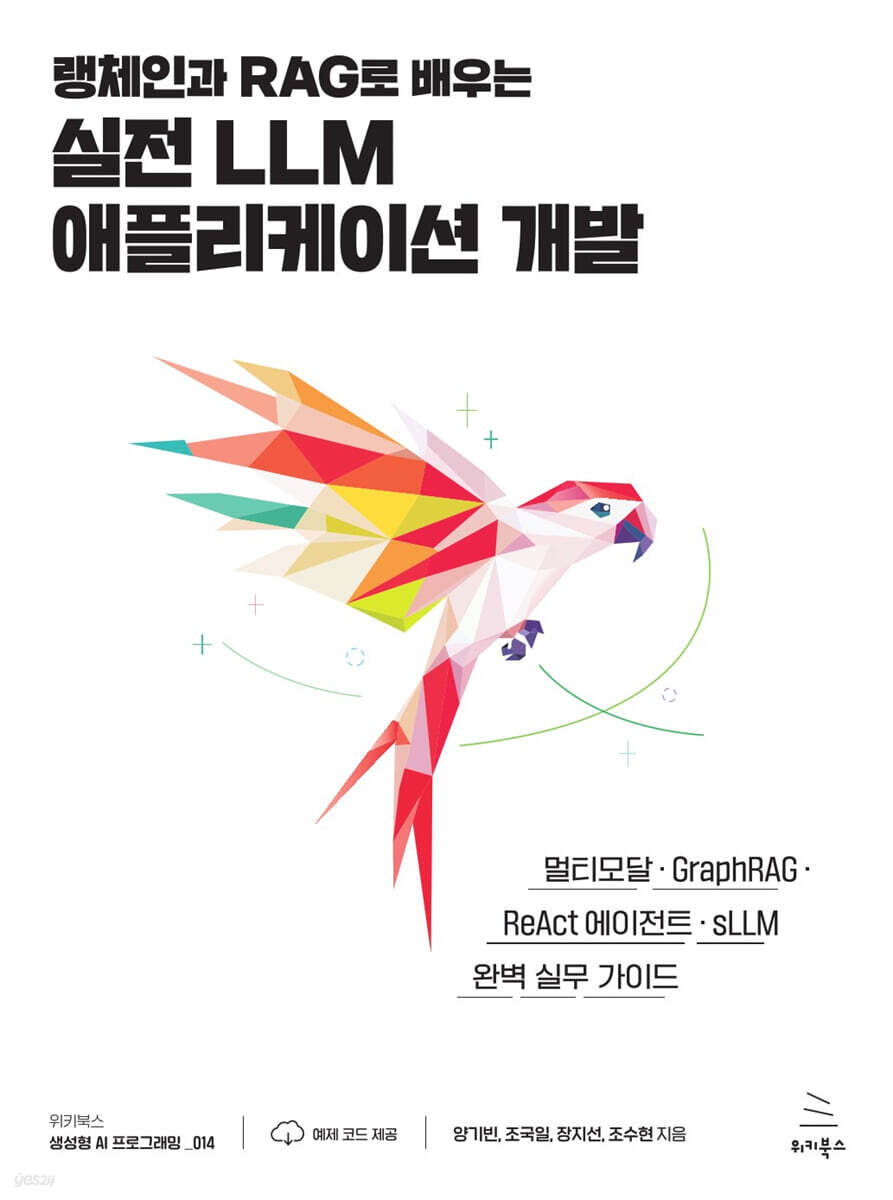
Practical LLM Application Development with LangChain and RAG
 |
Description
Book Introduction
LLM applications, now in practice!
As language models become more powerful, they present new challenges for users.
How do we connect external data and knowledge? How do we structure complex workflows? How do we control model illusions? This book answers these questions and guides us through solving real-world problems using LangChain and RAG technologies.
This book systematically covers everything from the essential components of RankChain (chain, memory, tools, agents) to various RAG methodologies (retriever, reranker, hybrid search, multimodal processing, GraphRAG, ReAct patterns, and sLLM utilization).
Each chapter begins with a conceptual explanation and progresses to increasingly complex exercises, teaching readers how to apply the basic code to their own projects.
We've lowered the barrier to entry by going beyond simple API calls to understand the evolution of the RAG methodology and its application scenarios, and by providing examples that can be run directly in a colab environment.
In particular, it provides clear guidelines on which approach is appropriate for each situation and architectural patterns that can be extended to actual services.
As language models become more powerful, they present new challenges for users.
How do we connect external data and knowledge? How do we structure complex workflows? How do we control model illusions? This book answers these questions and guides us through solving real-world problems using LangChain and RAG technologies.
This book systematically covers everything from the essential components of RankChain (chain, memory, tools, agents) to various RAG methodologies (retriever, reranker, hybrid search, multimodal processing, GraphRAG, ReAct patterns, and sLLM utilization).
Each chapter begins with a conceptual explanation and progresses to increasingly complex exercises, teaching readers how to apply the basic code to their own projects.
We've lowered the barrier to entry by going beyond simple API calls to understand the evolution of the RAG methodology and its application scenarios, and by providing examples that can be run directly in a colab environment.
In particular, it provides clear guidelines on which approach is appropriate for each situation and architectural patterns that can be extended to actual services.
- You can preview some of the book's contents.
Preview
index
▣ Chapter 1: LangChain
1.1 Preparation for Langchain
___1.1.1 Why use chains?
1.2 Colab (Google Colaboratory) environment
___1.2.1 Setting up the Colab execution environment
1.3 LLM API Key
___1.3.1 GPT API Key
___1.3.2 Gemini API Key
1.4 Hugging Face
___1.4.1 Finding the Hugging Face Model
1.5 Langchain Components
___1.5.1 Chain
___1.5.2 Prompt
___1.5.3 Memory
___1.5.4 Index
___1.5.5 Callbacks and Evaluation
▣ Chapter 02: RAG (Retrieval-Augmented Generation)
2.1 Background and Importance of RAG
2.2 RAG using Langchain
___2.2.1 Preferences
___2.2.2 Loading Data
___2.2.3 Data Chunking
___2.2.4 Vector Store
___2.2.5 Retrievers and Prompts
2.3 Advanced RAG
___2.3.1 Reranker technology that improves performance by adjusting the order of documents
___2.3.2 HyDE technology to achieve high query response performance through virtual documents
___2.3.3 Query expansion techniques to make queries more specific and richer
___2.3.4 Multi-query technology that can reflect various perspectives
▣ Chapter 3: Multimodal RAG
3.1 _Introducing Multimodal RAG
___3.1.1 Multimodal RAG Concept
___3.1.2 Use Cases
___3.1.3 Importance
3.2 Key models and technologies of multimodal RAG
___3.2.1 Multimodal Encoder
___3.2.2 Decoder for multimodal generation
___3.2.3 Knowledge Retrieval and Augmentation
___3.2.4 Convergence Technology
___3.2.5 Model Training and Fine-Tuning
3.3 [Practice] Multimodal RAG
___3.3.1 Multimodal Information Extraction
___3.3.2 Multimodal RAG Implementation
▣ Chapter 4: GraphRAG
4.1 What is GraphRAG?
4.2 Differences from the existing RAG
4.3 Setting up GraphRAG
___4.3.1 Neo4j
4.4 [Practice] GraphRAG
___4.4.1 [Practice] Graph Data Retrieval and Manipulation through Natural Language Queries
___4.4.2 [Practice] LLM-based knowledge graph construction and RAG practice
▣ Chapter 5: ReAct Agent
5.1 What is a ReAct Agent?
___5.1.1 ReAct Agent Concept
___5.1.2 Explanation of basic principles
___5.1.3 Differences between ReAct and the existing method
___5.1.4 Key Features and Use Cases of ReAct Agent
5.2 Search API Integration
___5.2.1 Generating answers based on external data
___5.2.2 Search API Calls
___5.2.3 [Practice] Integrating ReAct Agents with the Search API
5.3 [Practice] Calling Agent-Based Tools
___5.3.1 Invoking Tools from the Base Agent
___5.3.2 Calling Advanced Tools Using ReAct
5.4 Practical Financial Data Projects Using Agents
___5.4.1 Collecting and Analyzing Financial Data Using ReAct Agents
___5.4.2 Real-time financial market analysis through search API
___5.4.3 Integrated Analytics via ReAct Agent
▣ Chapter 6: sLLM
6.1 Reasons to study sLLM
6.2 Running sLLM
___6.2.1 Running the sLLM model of Hugging Face
6.3 FFT learning method and code
___6.3.1 Creating Training Data
___6.3.2 Parallel processing methods for sLLM learning
___6.3.3 sLLM Learning Full Fine-tuning
6.4 PEFT learning method and code
___6.4.1 PEFT Algorithm and Practice (QLoRA)
___6.4.2 PEFT Algorithm and Practice (DoRA)
6.5 RAG-based LLM optimization learning
___6.5.1 Generating QA data considering RAG
___6.5.2 Learning sLLM considering RAG
___6.5.3 sLLM optimization considering RAG
6.6 LLM Serving
___6.6.1 Configuring a service environment using Streamlet
___6.6.2 Deploying sLLM using Streamlet
___6.6.3 Optimizing sLLM serving with vLLM
1.1 Preparation for Langchain
___1.1.1 Why use chains?
1.2 Colab (Google Colaboratory) environment
___1.2.1 Setting up the Colab execution environment
1.3 LLM API Key
___1.3.1 GPT API Key
___1.3.2 Gemini API Key
1.4 Hugging Face
___1.4.1 Finding the Hugging Face Model
1.5 Langchain Components
___1.5.1 Chain
___1.5.2 Prompt
___1.5.3 Memory
___1.5.4 Index
___1.5.5 Callbacks and Evaluation
▣ Chapter 02: RAG (Retrieval-Augmented Generation)
2.1 Background and Importance of RAG
2.2 RAG using Langchain
___2.2.1 Preferences
___2.2.2 Loading Data
___2.2.3 Data Chunking
___2.2.4 Vector Store
___2.2.5 Retrievers and Prompts
2.3 Advanced RAG
___2.3.1 Reranker technology that improves performance by adjusting the order of documents
___2.3.2 HyDE technology to achieve high query response performance through virtual documents
___2.3.3 Query expansion techniques to make queries more specific and richer
___2.3.4 Multi-query technology that can reflect various perspectives
▣ Chapter 3: Multimodal RAG
3.1 _Introducing Multimodal RAG
___3.1.1 Multimodal RAG Concept
___3.1.2 Use Cases
___3.1.3 Importance
3.2 Key models and technologies of multimodal RAG
___3.2.1 Multimodal Encoder
___3.2.2 Decoder for multimodal generation
___3.2.3 Knowledge Retrieval and Augmentation
___3.2.4 Convergence Technology
___3.2.5 Model Training and Fine-Tuning
3.3 [Practice] Multimodal RAG
___3.3.1 Multimodal Information Extraction
___3.3.2 Multimodal RAG Implementation
▣ Chapter 4: GraphRAG
4.1 What is GraphRAG?
4.2 Differences from the existing RAG
4.3 Setting up GraphRAG
___4.3.1 Neo4j
4.4 [Practice] GraphRAG
___4.4.1 [Practice] Graph Data Retrieval and Manipulation through Natural Language Queries
___4.4.2 [Practice] LLM-based knowledge graph construction and RAG practice
▣ Chapter 5: ReAct Agent
5.1 What is a ReAct Agent?
___5.1.1 ReAct Agent Concept
___5.1.2 Explanation of basic principles
___5.1.3 Differences between ReAct and the existing method
___5.1.4 Key Features and Use Cases of ReAct Agent
5.2 Search API Integration
___5.2.1 Generating answers based on external data
___5.2.2 Search API Calls
___5.2.3 [Practice] Integrating ReAct Agents with the Search API
5.3 [Practice] Calling Agent-Based Tools
___5.3.1 Invoking Tools from the Base Agent
___5.3.2 Calling Advanced Tools Using ReAct
5.4 Practical Financial Data Projects Using Agents
___5.4.1 Collecting and Analyzing Financial Data Using ReAct Agents
___5.4.2 Real-time financial market analysis through search API
___5.4.3 Integrated Analytics via ReAct Agent
▣ Chapter 6: sLLM
6.1 Reasons to study sLLM
6.2 Running sLLM
___6.2.1 Running the sLLM model of Hugging Face
6.3 FFT learning method and code
___6.3.1 Creating Training Data
___6.3.2 Parallel processing methods for sLLM learning
___6.3.3 sLLM Learning Full Fine-tuning
6.4 PEFT learning method and code
___6.4.1 PEFT Algorithm and Practice (QLoRA)
___6.4.2 PEFT Algorithm and Practice (DoRA)
6.5 RAG-based LLM optimization learning
___6.5.1 Generating QA data considering RAG
___6.5.2 Learning sLLM considering RAG
___6.5.3 sLLM optimization considering RAG
6.6 LLM Serving
___6.6.1 Configuring a service environment using Streamlet
___6.6.2 Deploying sLLM using Streamlet
___6.6.3 Optimizing sLLM serving with vLLM
Detailed image

GOODS SPECIFICS
- Date of issue: April 10, 2025
- Page count, weight, size: 300 pages | 175*235*16mm
- ISBN13: 9791158395988
You may also like
카테고리
korean


korean

![GQ KOREA Mark (Monthly): December [2025]](http://librairie.coreenne.fr/cdn/shop/files/8ef265dbbfbf186523ed75ba7319009d.jpg?v=1765340328&width=3840)


