

Don't let go of your child's hand
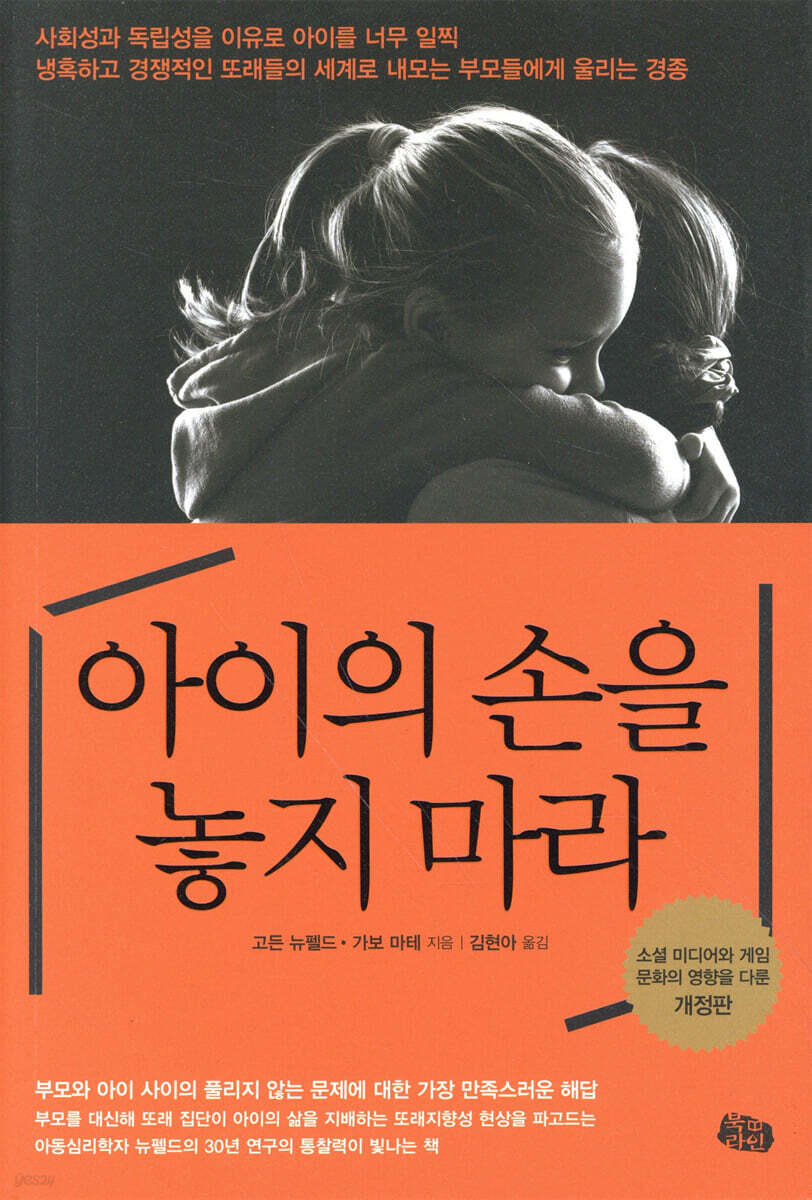 |
Description
Book Introduction
For reasons of sociality and independence
A wake-up call for parents who send their children too early into the harsh and competitive world of their peers.
The most satisfactory solution to the unresolved problem between parents and children
This book finds the cause of the difficulties parents face in parenting and the sadness and pain children experience in the fact that children lose their attachment to their parents and become dependent on peer relationships.
All children realize their identity and grow through attachment to their parents, and gradually go through a process of socialization.
However, in the name of fostering social skills and independence, many parents tear their children away from them too early and thrust them into the harsh and competitive world of their peers. In the process, the children lose the opportunity to grow and suffer irreparable wounds.
This book delves into the phenomenon of 'peer orientation', where peer groups exert a major influence on children in place of parents, producing negative outcomes. It emphasizes that what children need during their growing years are not peers, but parents and responsible adults who will never let go of their children's hands.
And it explains why you should not let go of your child's hand until you have fulfilled your role as a parent and until the child can stand on his or her own, and how to restore the parent-child relationship.
A wake-up call for parents who send their children too early into the harsh and competitive world of their peers.
The most satisfactory solution to the unresolved problem between parents and children
This book finds the cause of the difficulties parents face in parenting and the sadness and pain children experience in the fact that children lose their attachment to their parents and become dependent on peer relationships.
All children realize their identity and grow through attachment to their parents, and gradually go through a process of socialization.
However, in the name of fostering social skills and independence, many parents tear their children away from them too early and thrust them into the harsh and competitive world of their peers. In the process, the children lose the opportunity to grow and suffer irreparable wounds.
This book delves into the phenomenon of 'peer orientation', where peer groups exert a major influence on children in place of parents, producing negative outcomes. It emphasizes that what children need during their growing years are not peers, but parents and responsible adults who will never let go of their children's hands.
And it explains why you should not let go of your child's hand until you have fulfilled your role as a parent and until the child can stand on his or her own, and how to restore the parent-child relationship.
- You can preview some of the book's contents.
Preview
index
Message to readers: Being a parent is about building relationships.
Part 1.
Peers take the place of parents
01-Why Parents Are More Important Than Ever
Losing Parenthood / Peers Taking Parenthood / What's Normal Isn't Natural and Healthy / James Coleman, Sounding the First Warning / Good News: Instinct Is on Parents' Side
02-Misdirected attachment, distorted instinct
Why should we pay attention to attachment? / Attachment is an orientational instinct. / Six ways to form attachment. / When primary attachments compete. / Attachment is bipolar.
03-Why Parents Are Pushed Out by Their Peers
Attachment disappears/Families are torn apart/Rapid change, technology is distorted/Provence's living culture of attachment/Natural attachment does not compete/Peer attachment arises from lack
Part 2.
How Parental Power Weakens
04-Parents who have lost their power
Parents have a natural authority/ Parental power depends on the child's dependence/ Parenting is not a skill to be acquired/ Don't blame the child
05-The Seven Roles of Attachment
Attachment establishes a hierarchy between parents and children/ Attachment awakens the parenting instinct, makes children more loving, and increases parental patience/ Attachment attracts children's attention/ Attachment keeps children close to their parents/ Attachment makes children look up to their parents as role models/ Attachment makes children follow their parents' instructions/ Attachment makes children want to look good to their parents
06-Why Children Resist
As attachment weakens, the will to resist grows / The will to resist is a fence that protects the child / The independence of a peer-oriented child is a false independence / The myth of the omnipotent child / Force and deception are counterproductive
The racialization and cultural decline of the 7-10 generation
Part 3.
How Peers Hinder a Child's Development
08-Dangerous Escape from Emotions
Peer-oriented children are more vulnerable/ Peer-oriented children lose their natural shield against stress/ Peer-oriented children are sensitive to insensitive interactions from other children/ Vulnerability becomes an excuse for ridicule and aggression from peers/ Peer relationships are inherently unstable
09-Children in the Swamp of Immaturity
Immature children cannot mix emotions / Maturity is natural but not inevitable / The secret to maturity also begins with attachment / Five reasons why peer orientation hinders a child's growth
10-The Legacy of Aggression
Frustration Fuels Aggression/How Peer Orientation Fuels Aggression
11-Perpetrators and Victims of Peer Violence
There is only a hierarchy of dominance and submission among peers/ How do bullies come to be in a dominant position/ How do bullies gain dominance/ What triggers bullies to attack/ How do bullies form attachments/ Bullies are not bad eggs, they are eggs in hard shells
12- Premature sex, unfulfilled attachment
Sometimes attachment needs turn into sex/ Adolescent sex is more vulnerable than adult sex/ Sex is safer as it matures
13-Students who cannot be taught
Peer orientation kills curiosity/ Peer orientation dulls integrated thinking/ Peer orientation hinders adaptive trial-and-error learning/ Peer orientation turns children into attachment-based learners and makes them attach themselves to the wrong mentors/ Peer orientation makes studying meaningless/ Peer orientation takes students away from teachers
Part 4.
Don't let go of your child's hand
14-Gathering the child in your arms
The Four Stages of Attachment Dance/Shifting Focus from Actions to Relationships
15. Preserving the bond with your child
The relationship with the child comes first / Parenting that considers attachment / Maintain sufficient intimacy with the child / Maintain intimacy even when apart / Intimacy is the bond that connects parents and children / Create a framework and set limits / Set frameworks and limits on peer relationships as well
16-Discipline that connects parents and children
What is True Discipline? / Seven Principles of Natural Discipline
Part 5.
What a child needs is not a friend
17-The Trap of Peer Orientation
Don't be fooled by the first fruits of peer orientation/ Shyness is not the problem/ Lack of attachment causes stress in daycare/ Socialization does not develop just by hanging out with peers/ Children do not need friends/ Peers are not the answer to boredom/ When and how much peer contact should be allowed/ Peers are not the answer to being 'different'/ Peers do not boost a child's self-esteem/ Peers are not a substitute for siblings
18-Construction of a new attachment village
Find a helper/ Pair them with trusted adults/ Don't compete with other attachments
Part 6.
An afterthought for the digital generation, steeped in the internet, mobile phones, and games.
19-The Distorted Digital Revolution
Basic error: Ignoring attachment / Peer-oriented children communicate and socialize digitally even when apart / The digital revolution promotes peer orientation / Digital intimacy is empty / Six reasons why digital intimacy is empty / Games, cyberbullying, and pornography as attachment phenomena
20-A problem of timing
There's a time and a season for digital interaction/ How do we limit digital access?/ When should we allow video games?/ There's a time and a season for policing online information./ Maintaining our role as a provider of information becomes difficult./ We need to get our 'lost' children back.
Glossary
annotation
Part 1.
Peers take the place of parents
01-Why Parents Are More Important Than Ever
Losing Parenthood / Peers Taking Parenthood / What's Normal Isn't Natural and Healthy / James Coleman, Sounding the First Warning / Good News: Instinct Is on Parents' Side
02-Misdirected attachment, distorted instinct
Why should we pay attention to attachment? / Attachment is an orientational instinct. / Six ways to form attachment. / When primary attachments compete. / Attachment is bipolar.
03-Why Parents Are Pushed Out by Their Peers
Attachment disappears/Families are torn apart/Rapid change, technology is distorted/Provence's living culture of attachment/Natural attachment does not compete/Peer attachment arises from lack
Part 2.
How Parental Power Weakens
04-Parents who have lost their power
Parents have a natural authority/ Parental power depends on the child's dependence/ Parenting is not a skill to be acquired/ Don't blame the child
05-The Seven Roles of Attachment
Attachment establishes a hierarchy between parents and children/ Attachment awakens the parenting instinct, makes children more loving, and increases parental patience/ Attachment attracts children's attention/ Attachment keeps children close to their parents/ Attachment makes children look up to their parents as role models/ Attachment makes children follow their parents' instructions/ Attachment makes children want to look good to their parents
06-Why Children Resist
As attachment weakens, the will to resist grows / The will to resist is a fence that protects the child / The independence of a peer-oriented child is a false independence / The myth of the omnipotent child / Force and deception are counterproductive
The racialization and cultural decline of the 7-10 generation
Part 3.
How Peers Hinder a Child's Development
08-Dangerous Escape from Emotions
Peer-oriented children are more vulnerable/ Peer-oriented children lose their natural shield against stress/ Peer-oriented children are sensitive to insensitive interactions from other children/ Vulnerability becomes an excuse for ridicule and aggression from peers/ Peer relationships are inherently unstable
09-Children in the Swamp of Immaturity
Immature children cannot mix emotions / Maturity is natural but not inevitable / The secret to maturity also begins with attachment / Five reasons why peer orientation hinders a child's growth
10-The Legacy of Aggression
Frustration Fuels Aggression/How Peer Orientation Fuels Aggression
11-Perpetrators and Victims of Peer Violence
There is only a hierarchy of dominance and submission among peers/ How do bullies come to be in a dominant position/ How do bullies gain dominance/ What triggers bullies to attack/ How do bullies form attachments/ Bullies are not bad eggs, they are eggs in hard shells
12- Premature sex, unfulfilled attachment
Sometimes attachment needs turn into sex/ Adolescent sex is more vulnerable than adult sex/ Sex is safer as it matures
13-Students who cannot be taught
Peer orientation kills curiosity/ Peer orientation dulls integrated thinking/ Peer orientation hinders adaptive trial-and-error learning/ Peer orientation turns children into attachment-based learners and makes them attach themselves to the wrong mentors/ Peer orientation makes studying meaningless/ Peer orientation takes students away from teachers
Part 4.
Don't let go of your child's hand
14-Gathering the child in your arms
The Four Stages of Attachment Dance/Shifting Focus from Actions to Relationships
15. Preserving the bond with your child
The relationship with the child comes first / Parenting that considers attachment / Maintain sufficient intimacy with the child / Maintain intimacy even when apart / Intimacy is the bond that connects parents and children / Create a framework and set limits / Set frameworks and limits on peer relationships as well
16-Discipline that connects parents and children
What is True Discipline? / Seven Principles of Natural Discipline
Part 5.
What a child needs is not a friend
17-The Trap of Peer Orientation
Don't be fooled by the first fruits of peer orientation/ Shyness is not the problem/ Lack of attachment causes stress in daycare/ Socialization does not develop just by hanging out with peers/ Children do not need friends/ Peers are not the answer to boredom/ When and how much peer contact should be allowed/ Peers are not the answer to being 'different'/ Peers do not boost a child's self-esteem/ Peers are not a substitute for siblings
18-Construction of a new attachment village
Find a helper/ Pair them with trusted adults/ Don't compete with other attachments
Part 6.
An afterthought for the digital generation, steeped in the internet, mobile phones, and games.
19-The Distorted Digital Revolution
Basic error: Ignoring attachment / Peer-oriented children communicate and socialize digitally even when apart / The digital revolution promotes peer orientation / Digital intimacy is empty / Six reasons why digital intimacy is empty / Games, cyberbullying, and pornography as attachment phenomena
20-A problem of timing
There's a time and a season for digital interaction/ How do we limit digital access?/ When should we allow video games?/ There's a time and a season for policing online information./ Maintaining our role as a provider of information becomes difficult./ We need to get our 'lost' children back.
Glossary
annotation
Publisher's Review
For reasons of sociality and independence
A wake-up call for parents who send their children too early into the harsh and competitive world of their peers.
The most satisfactory solution to the unresolved problem between parents and children.
This book finds the cause of the difficulties parents face in parenting and the sadness and pain children experience in the fact that children lose their attachment to their parents and become dependent on peer relationships.
Certainly, children these days look to their peers to determine what is good, what is important, how to speak and act, and even how to think of themselves.
Child psychologist Gordon Neufeld named this phenomenon, in which peers, rather than parents, have a major influence on a child's ethics, values, behavioral patterns, and identity, producing negative outcomes, "peer orientation."
Co-authored by a child psychologist and a physician, this book delves into the consequences of peer orientation, so prevalent in our society that it has become "normal," for parents, children, and society.
The couple are particularly concerned that many parents are ripping their children off from their arms too early and thrusting them into the harsh, competitive world of their peers, in the name of fostering social skills and independence.
Eventually, the child leaves his parents and becomes dependent on his peers. Contrary to initial expectations and wishes, the child loses the opportunity to grow in the process and suffers irreparable wounds.
Moreover, our society has lost the social and economic foundation that supports the role of parents and sanctifies that role.
It is natural for all children to realize their self and grow through attachment to their parents, and to gradually go through the process of socialization.
We cannot bypass this attachment stage and jump straight to socialization; this attachment relationship must continue until the child needs parents, at least from birth until the age of 19.
While peer relationships are natural and healthy for children, it is abnormal for children to reject their parents and rely on peer relationships, each of which has a major influence on the other.
What children need during their growing years are not peers, but parents and responsible adults who will never let go of their child's hand.
The more well-formed the attachment relationship with the adults who care for them, the more likely it is that the child will not lose his or her sense of self and will be able to communicate effectively with peers.
The couple say that being a parent is about building relationships, and just as relationships are at the heart of parenting and education, so too are the solutions to problems.
Parents who have strong relationships with their children don't rely on parenting techniques recommended by experts; they act based on understanding and empathy, not on their head.
Therefore, the two focus on what parents can be for their children rather than what they can do for them, and explain why and how to restore the parent-child relationship and the child's attachment to their parents.
This book is divided into six parts.
Part 1 explains what peer orientation is and why it has become so widespread in our society.
Parts 2 and 3 explain how peer orientation can weaken parental power and hinder a child's growth, while also explaining the natural growth and development of a child.
Part 4 explains how to form a lasting bond with your child, and Parts 5 and 6 explain how to protect your child from the temptations of peer groups.
In particular, this revised edition addresses new issues arising from the advent of digital devices and social media in Part 6.
The two help us understand the phenomenon of peer orientation, which kills parents' parenting instincts, erodes their natural authority, and forces them to parent with their heads rather than their hearts, guided by the manual of expert advice, and recognize the absolute role of attachment in raising children.
As you follow their writings, you will naturally find answers to the questions of what parents are missing in raising and educating their children, why problems with their children are not resolved, and what the fundamental solutions are.
A wake-up call for parents who send their children too early into the harsh and competitive world of their peers.
The most satisfactory solution to the unresolved problem between parents and children.
This book finds the cause of the difficulties parents face in parenting and the sadness and pain children experience in the fact that children lose their attachment to their parents and become dependent on peer relationships.
Certainly, children these days look to their peers to determine what is good, what is important, how to speak and act, and even how to think of themselves.
Child psychologist Gordon Neufeld named this phenomenon, in which peers, rather than parents, have a major influence on a child's ethics, values, behavioral patterns, and identity, producing negative outcomes, "peer orientation."
Co-authored by a child psychologist and a physician, this book delves into the consequences of peer orientation, so prevalent in our society that it has become "normal," for parents, children, and society.
The couple are particularly concerned that many parents are ripping their children off from their arms too early and thrusting them into the harsh, competitive world of their peers, in the name of fostering social skills and independence.
Eventually, the child leaves his parents and becomes dependent on his peers. Contrary to initial expectations and wishes, the child loses the opportunity to grow in the process and suffers irreparable wounds.
Moreover, our society has lost the social and economic foundation that supports the role of parents and sanctifies that role.
It is natural for all children to realize their self and grow through attachment to their parents, and to gradually go through the process of socialization.
We cannot bypass this attachment stage and jump straight to socialization; this attachment relationship must continue until the child needs parents, at least from birth until the age of 19.
While peer relationships are natural and healthy for children, it is abnormal for children to reject their parents and rely on peer relationships, each of which has a major influence on the other.
What children need during their growing years are not peers, but parents and responsible adults who will never let go of their child's hand.
The more well-formed the attachment relationship with the adults who care for them, the more likely it is that the child will not lose his or her sense of self and will be able to communicate effectively with peers.
The couple say that being a parent is about building relationships, and just as relationships are at the heart of parenting and education, so too are the solutions to problems.
Parents who have strong relationships with their children don't rely on parenting techniques recommended by experts; they act based on understanding and empathy, not on their head.
Therefore, the two focus on what parents can be for their children rather than what they can do for them, and explain why and how to restore the parent-child relationship and the child's attachment to their parents.
This book is divided into six parts.
Part 1 explains what peer orientation is and why it has become so widespread in our society.
Parts 2 and 3 explain how peer orientation can weaken parental power and hinder a child's growth, while also explaining the natural growth and development of a child.
Part 4 explains how to form a lasting bond with your child, and Parts 5 and 6 explain how to protect your child from the temptations of peer groups.
In particular, this revised edition addresses new issues arising from the advent of digital devices and social media in Part 6.
The two help us understand the phenomenon of peer orientation, which kills parents' parenting instincts, erodes their natural authority, and forces them to parent with their heads rather than their hearts, guided by the manual of expert advice, and recognize the absolute role of attachment in raising children.
As you follow their writings, you will naturally find answers to the questions of what parents are missing in raising and educating their children, why problems with their children are not resolved, and what the fundamental solutions are.
GOODS SPECIFICS
- Date of publication: January 22, 2018
- Page count, weight, size: 400 pages | 594g | 152*225*20mm
- ISBN13: 9788989847625
- ISBN10: 8989847621
You may also like
카테고리
korean


korean

![GQ KOREA Mark (Monthly): December [2025]](http://librairie.coreenne.fr/cdn/shop/files/8ef265dbbfbf186523ed75ba7319009d.jpg?v=1765340328&width=3840)


