

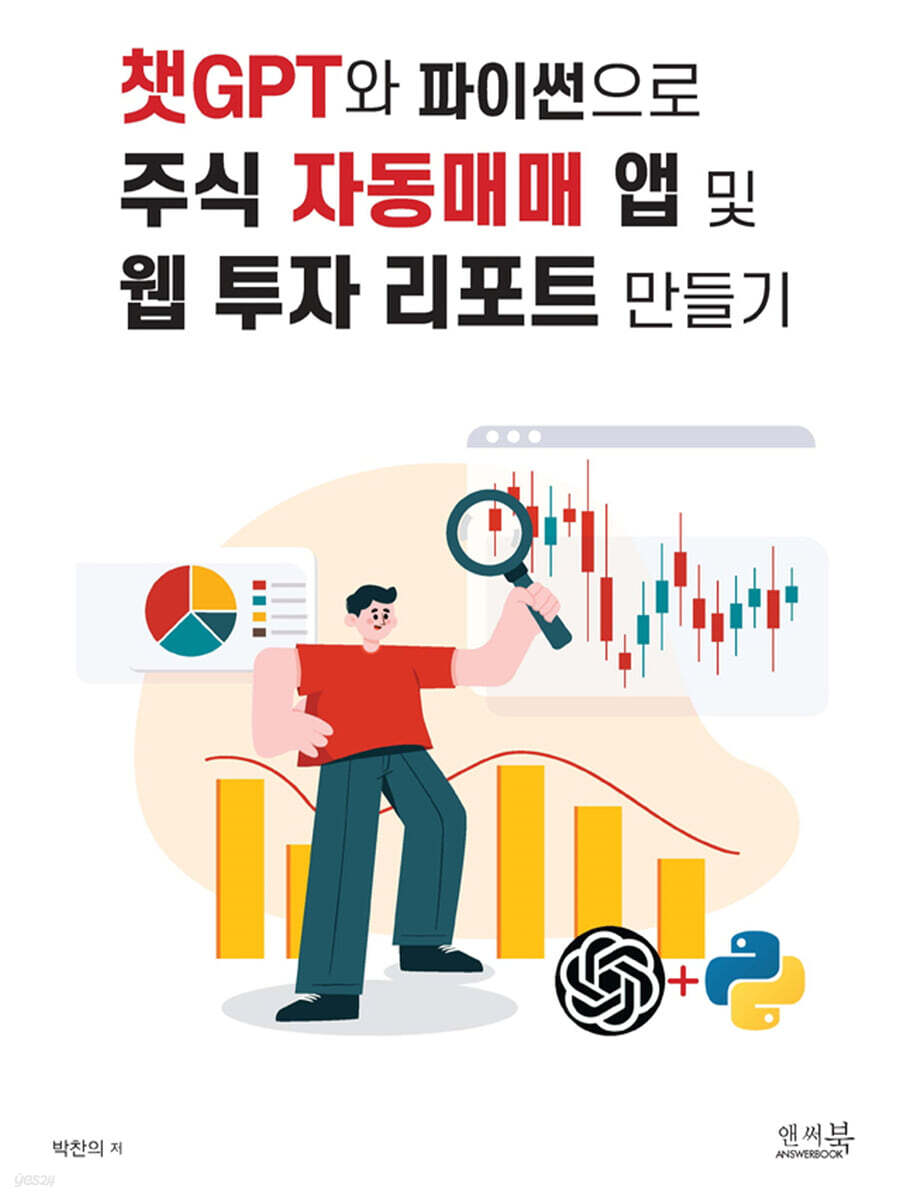
Creating an automated stock trading app and web investment report using ChatGPT and Python.
 |
Description
Book Introduction
The book, "Creating an Automated Stock Trading App and Web Investment Report with ChatGPT and Python," details the process of discovering and solving problems encountered while creating an automated stock trading system using ChatGPT and Python programming.
This book actively utilizes ChatGPT in Python programming.
To lower the barrier to entry for Python programming and demonstrate ChatGPT's potential in the programming field, we focused on building the framework of an automated trading application using ChatGPT.
Therefore, I think it will be possible to follow the basic contents of the book even if you lack basic knowledge of Python.
This book actively utilizes ChatGPT in Python programming.
To lower the barrier to entry for Python programming and demonstrate ChatGPT's potential in the programming field, we focused on building the framework of an automated trading application using ChatGPT.
Therefore, I think it will be possible to follow the basic contents of the book even if you lack basic knowledge of Python.
index
CHAPTER 01 ChatGPT and Python Programming
Introducing ChatGPT
How to ask questions effectively in ChatGPT
bad example
Good example
If you only ask a question without an example
If there are only examples without questions
If there are both questions and examples
Things to keep in mind when communicating with ChatGPT
CHAPTER 02 Learn Python Basics: Just What You Need
Python installation and programming environment setup
Declaration and assignment of variables
Types of data
Conditional statements / loops / lists / tuples /
Dictionary / Set / Function / Class / Module
CHAPTER 03 Implementing and Backtesting Stock Trading Strategies with ChatGPT
Trading Strategy: Volatility Breakout Strategy
Trading Strategies: Machine Learning-Based Strategies
CHAPTER 04 Implementing an Automated Stock Trading Application Using a Securities Firm's API
Kiwoom Securities API Overview, Application Methods, and Access Methods
Introducing the Automated Trading System Design
Implementing an automated trading application GUI with PyQt5
Implementing automatic trading logic
Receive trading order alerts via Slack
CHAPTER 05 Creating a Web Investment Dashboard with Streamlit
Introduction and Installation of Streamlit
Learn about Streamlit's basic widgets and layouts.
Creating a Streamlit Investment Web Dashboard
Introducing ChatGPT
How to ask questions effectively in ChatGPT
bad example
Good example
If you only ask a question without an example
If there are only examples without questions
If there are both questions and examples
Things to keep in mind when communicating with ChatGPT
CHAPTER 02 Learn Python Basics: Just What You Need
Python installation and programming environment setup
Declaration and assignment of variables
Types of data
Conditional statements / loops / lists / tuples /
Dictionary / Set / Function / Class / Module
CHAPTER 03 Implementing and Backtesting Stock Trading Strategies with ChatGPT
Trading Strategy: Volatility Breakout Strategy
Trading Strategies: Machine Learning-Based Strategies
CHAPTER 04 Implementing an Automated Stock Trading Application Using a Securities Firm's API
Kiwoom Securities API Overview, Application Methods, and Access Methods
Introducing the Automated Trading System Design
Implementing an automated trading application GUI with PyQt5
Implementing automatic trading logic
Receive trading order alerts via Slack
CHAPTER 05 Creating a Web Investment Dashboard with Streamlit
Introduction and Installation of Streamlit
Learn about Streamlit's basic widgets and layouts.
Creating a Streamlit Investment Web Dashboard
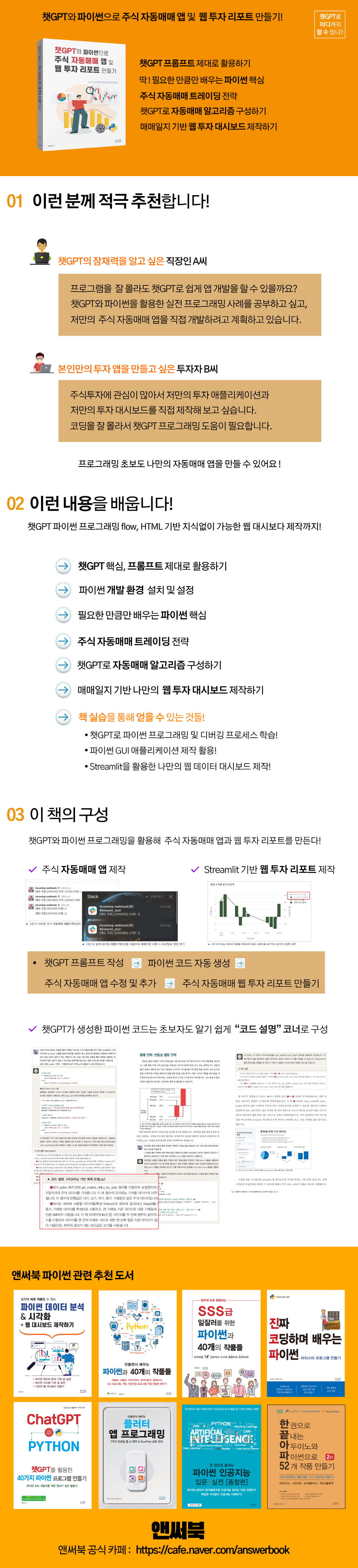
Detailed image
Publisher's Review
This book is recommended to these people:
- Mr. A, an office worker who wants to know the potential of ChatGPT, said that he is not good at programming, but he can easily develop an app with ChatGPT.
I also want to study various examples of programming with ChatGPT.
And later, I want to develop my own cool app using ChatGPT.
Investor B wants to create his own investment app.
I'm interested in stock investing, so I'd like to create my own investment application and dashboard.
I think it would be good to naturally learn the ChatGPT programming method through the production process.
What you will learn from this book
- ChatGPT Core and How to Use Prompts Correctly
- Install and set up Python development environment
- Learn only as much Python as you need
- Stock automated trading strategy
- Build an automated trading algorithm with ChatGPT
- Creating a web investment dashboard based on trading journals
Python is one of the most popular programming languages for creating automated trading systems.
Python's concise and easy-to-understand syntax and compatibility with powerful data analysis and processing libraries make it excellent for receiving and quickly processing stock data.
Additionally, Python integrates easily with various external APIs, providing easy access to various financial data sources and trading platforms.
This is a crucial factor for automated trading applications to quickly respond to real-time market changes and experiment with and reflect various trading strategies.
This book actively utilizes ChatGPT in Python programming.
Artificial intelligence, such as ChatGPT, has reached the level where it can write programming code based on algorithms envisioned by humans, support debugging, and solve various programming problems.
This lowers the barrier to entry to programming and makes the learning curve for programming languages more gentle.
However, even if ChatGPT can help you program more efficiently, ultimately, people still need to review and restructure the code based on their relevant knowledge.
This book focuses on building the framework of an automated trading application using ChatGPT to lower the barrier to entry for Python programming and demonstrate ChatGPT's potential in the programming field.
Therefore, I think it will be possible to follow the basic contents of the book even if you lack basic knowledge of Python.
However, if you want to build your own application by implementing additional features and modifications based on the content in this book, basic knowledge of Python is required in the process of linking and reviewing the code generated by ChatGPT.
If you feel that you lack basic Python knowledge, I strongly recommend that you also study the basic Python knowledge explained in the first half of this book.
Please refer to page 8 for instructions on downloading the example datasets and source code files for this book.
The book "Creating an Automated Stock Trading App and Web Investment Report with Chat GPT and Python" covers Python programming with the topic of creating an automated stock trading application using Chat GPT.
This book uses ChatGPT in Python programming to create an automated stock trading system and web investment report.
Step 1: Create a ChatGPT prompt
- Step 2: Automatically generate Python code
- Step 3: Modify and add the algorithm for the stock automatic trading app by changing the generated code.
Step 4: Create a Web Investment Report for Automated Stock Trading
In steps 1 and 2 above, ChatGPT does not always answer the same question in the same way.
In this book, you will write prompts to generate Python code from ChatGPT, and then modify or add algorithms based on the generated code.
So, if you wrote the prompts exactly as in this book and didn't get the same answers, you probably won't get the same answers in subsequent steps.
But there's no need to worry.
Of course, the code that ChatGPT generates in a “different” direction is not always “wrong.”
In such cases, you can either re-create the question several times until you get the same answer, or you can pass the script provided as source code in this book to the prompt and lead the conversation by saying something like, “Based on the code provided below, do ~ for ~.”
For example, in this book, when you ask ChatGPT a question and get a script called “A,” during the debugging process of modifying the “B” part of the “A” code to something like “C,” you can paste the “A” script provided as source code into the prompt as shown below and continue the subsequent debugging process.
Specific methods are explained in detail in the main text of the book.
--------------------------------------------------------------------
The code below is for ~.
Generate code by modifying the “B” part of the code below to something like “C”.
[Paste the “A” script here.]
--------------------------------------------------------------------
This book assumes that readers are new to ChatGPT and Python or are at a beginner level, so it does not use advanced prompt engineering or advanced Python syntax.
Ask ChatGPT questions from a beginner's perspective and generate Python code to create an application.
Therefore, rather than asking ChatGPT perfect questions and programming efficiently with minimal code, I focused on explaining the process of discovering and solving problems encountered in Python programming using ChatGPT.
Therefore, I recommend that readers learn from the perspective of seeing the forest rather than the trees, considering the problems they encounter and how to solve them as they progress through the learning objectives of each chapter.
- Mr. A, an office worker who wants to know the potential of ChatGPT, said that he is not good at programming, but he can easily develop an app with ChatGPT.
I also want to study various examples of programming with ChatGPT.
And later, I want to develop my own cool app using ChatGPT.
Investor B wants to create his own investment app.
I'm interested in stock investing, so I'd like to create my own investment application and dashboard.
I think it would be good to naturally learn the ChatGPT programming method through the production process.
What you will learn from this book
- ChatGPT Core and How to Use Prompts Correctly
- Install and set up Python development environment
- Learn only as much Python as you need
- Stock automated trading strategy
- Build an automated trading algorithm with ChatGPT
- Creating a web investment dashboard based on trading journals
Python is one of the most popular programming languages for creating automated trading systems.
Python's concise and easy-to-understand syntax and compatibility with powerful data analysis and processing libraries make it excellent for receiving and quickly processing stock data.
Additionally, Python integrates easily with various external APIs, providing easy access to various financial data sources and trading platforms.
This is a crucial factor for automated trading applications to quickly respond to real-time market changes and experiment with and reflect various trading strategies.
This book actively utilizes ChatGPT in Python programming.
Artificial intelligence, such as ChatGPT, has reached the level where it can write programming code based on algorithms envisioned by humans, support debugging, and solve various programming problems.
This lowers the barrier to entry to programming and makes the learning curve for programming languages more gentle.
However, even if ChatGPT can help you program more efficiently, ultimately, people still need to review and restructure the code based on their relevant knowledge.
This book focuses on building the framework of an automated trading application using ChatGPT to lower the barrier to entry for Python programming and demonstrate ChatGPT's potential in the programming field.
Therefore, I think it will be possible to follow the basic contents of the book even if you lack basic knowledge of Python.
However, if you want to build your own application by implementing additional features and modifications based on the content in this book, basic knowledge of Python is required in the process of linking and reviewing the code generated by ChatGPT.
If you feel that you lack basic Python knowledge, I strongly recommend that you also study the basic Python knowledge explained in the first half of this book.
Please refer to page 8 for instructions on downloading the example datasets and source code files for this book.
The book "Creating an Automated Stock Trading App and Web Investment Report with Chat GPT and Python" covers Python programming with the topic of creating an automated stock trading application using Chat GPT.
This book uses ChatGPT in Python programming to create an automated stock trading system and web investment report.
Step 1: Create a ChatGPT prompt
- Step 2: Automatically generate Python code
- Step 3: Modify and add the algorithm for the stock automatic trading app by changing the generated code.
Step 4: Create a Web Investment Report for Automated Stock Trading
In steps 1 and 2 above, ChatGPT does not always answer the same question in the same way.
In this book, you will write prompts to generate Python code from ChatGPT, and then modify or add algorithms based on the generated code.
So, if you wrote the prompts exactly as in this book and didn't get the same answers, you probably won't get the same answers in subsequent steps.
But there's no need to worry.
Of course, the code that ChatGPT generates in a “different” direction is not always “wrong.”
In such cases, you can either re-create the question several times until you get the same answer, or you can pass the script provided as source code in this book to the prompt and lead the conversation by saying something like, “Based on the code provided below, do ~ for ~.”
For example, in this book, when you ask ChatGPT a question and get a script called “A,” during the debugging process of modifying the “B” part of the “A” code to something like “C,” you can paste the “A” script provided as source code into the prompt as shown below and continue the subsequent debugging process.
Specific methods are explained in detail in the main text of the book.
--------------------------------------------------------------------
The code below is for ~.
Generate code by modifying the “B” part of the code below to something like “C”.
[Paste the “A” script here.]
--------------------------------------------------------------------
This book assumes that readers are new to ChatGPT and Python or are at a beginner level, so it does not use advanced prompt engineering or advanced Python syntax.
Ask ChatGPT questions from a beginner's perspective and generate Python code to create an application.
Therefore, rather than asking ChatGPT perfect questions and programming efficiently with minimal code, I focused on explaining the process of discovering and solving problems encountered in Python programming using ChatGPT.
Therefore, I recommend that readers learn from the perspective of seeing the forest rather than the trees, considering the problems they encounter and how to solve them as they progress through the learning objectives of each chapter.
GOODS SPECIFICS
- Date of issue: May 20, 2024
- Page count, weight, size: 228 pages | 501g | 190*257*9mm
- ISBN13: 9791193059258
- ISBN10: 1193059259
You may also like
카테고리
korean


korean

![GQ KOREA Mark (Monthly): December [2025]](http://librairie.coreenne.fr/cdn/shop/files/8ef265dbbfbf186523ed75ba7319009d.jpg?v=1765340328&width=3840)


