

English picture books that start with sound
 |
Description
Book Introduction
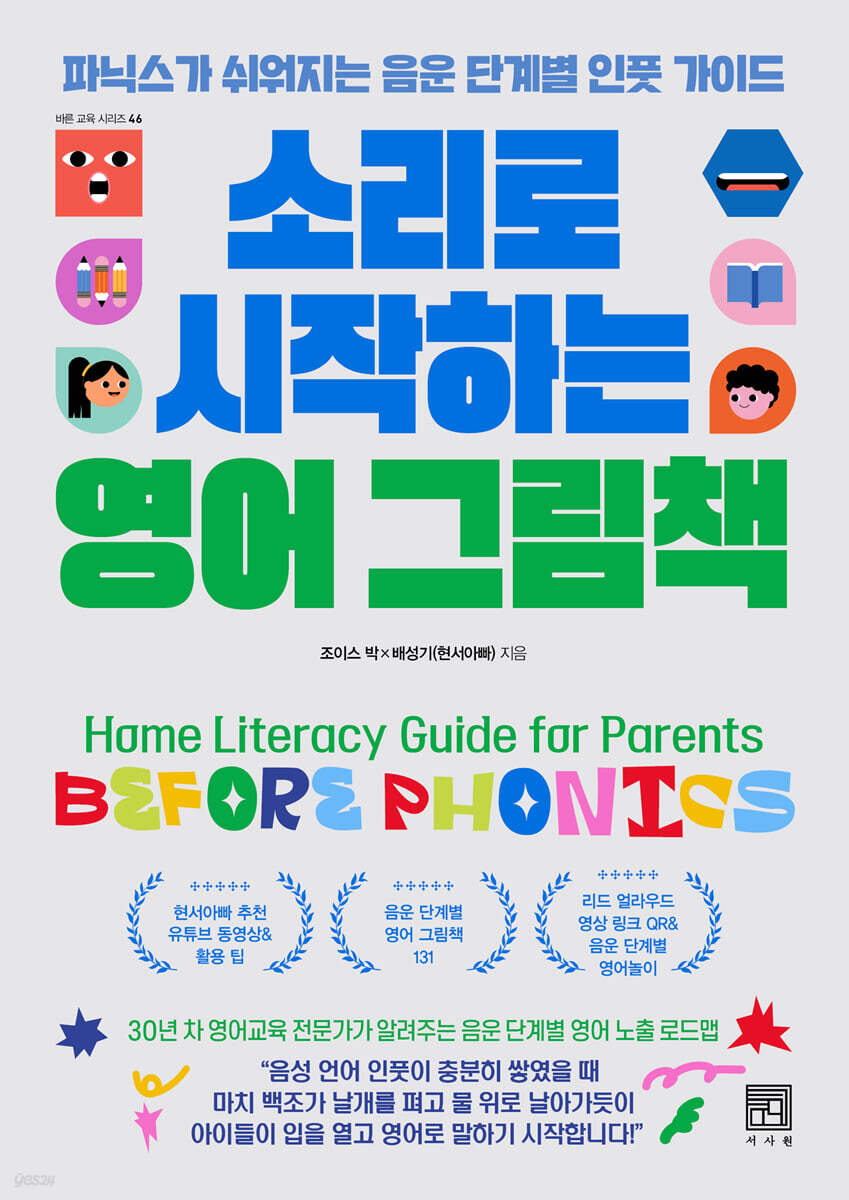
A roadmap for English exposure at each stage of phonological development, provided by an English education expert with 30 years of experience.
The first step-by-step phonological input guidebook that makes phonics easy
*Introducing 131 English picture books for each phoneme level
*Hyunseo's Dad's Recommended YouTube Videos & Usage Tips
*Includes a QR code link to the Read Aloud video and English games for each phoneme level.
This book was written by Joyce Park, an English education expert with 30 years of experience, to answer the question, “How can I provide children with spoken language input by reading English picture books before they enter the world of letters?”
While writing and giving lectures on English education for parents and teachers, I received numerous questions from the field.
Among them, the question that particularly weighed heavily was how to expose children to English through spoken language before acquiring letters, that is, before phonics.
So, after much thought, I came up with the stage of phonological awareness of native English-speaking children as a standard to use as a yardstick.
Based on this, we have organized how to provide spoken language input in order, including rhyming and sound development, word segmentation within a sentence, syllable segmentation, onset and rhyme segmentation, and phoneme recognition.
Also, to prevent the input from being too focused on English picture books, I included YouTube read-aloud links for each picture book, and Mr. Bae Seong-gi, Hyunseo's father, also provided suggestions on how to find YouTube videos.
The method of exposure to spoken language, which was scattered here and there, is organized step by step, so it is very useful for parents and teachers to refer to and follow.
The first step-by-step phonological input guidebook that makes phonics easy
*Introducing 131 English picture books for each phoneme level
*Hyunseo's Dad's Recommended YouTube Videos & Usage Tips
*Includes a QR code link to the Read Aloud video and English games for each phoneme level.
This book was written by Joyce Park, an English education expert with 30 years of experience, to answer the question, “How can I provide children with spoken language input by reading English picture books before they enter the world of letters?”
While writing and giving lectures on English education for parents and teachers, I received numerous questions from the field.
Among them, the question that particularly weighed heavily was how to expose children to English through spoken language before acquiring letters, that is, before phonics.
So, after much thought, I came up with the stage of phonological awareness of native English-speaking children as a standard to use as a yardstick.
Based on this, we have organized how to provide spoken language input in order, including rhyming and sound development, word segmentation within a sentence, syllable segmentation, onset and rhyme segmentation, and phoneme recognition.
Also, to prevent the input from being too focused on English picture books, I included YouTube read-aloud links for each picture book, and Mr. Bae Seong-gi, Hyunseo's father, also provided suggestions on how to find YouTube videos.
The method of exposure to spoken language, which was scattered here and there, is organized step by step, so it is very useful for parents and teachers to refer to and follow.
- You can preview some of the book's contents.
Preview
index
Prologue: Show your child a wider world with English picture books.
English Exposure: Pay Attention to Nouns That Make Sentences
"Tracing is useless": A game to imprint the alphabet in your child's brain.
Want to expose yourself to English like a native speaker? Let's play this, like hip-hop.
Let's start by listening to English in chunks, by 'listening' to the words in sentences.
"What's the difference between 'bus' and 'bus'?" The Secret of Native Speaker Pronunciation
6 Things to Check Before Starting Phoenix
A Crucial Reason to Learn English with Paper Books
Reading English poems and picture books
A concept book for reading the world with children
Create a mother's question in one go.
How to Use ChatGPT's "English Picture Book"
Why an English Education Expert Was Surprised After Reading a Picture Book 30 Times
Picture books that show a wider world
Appendix: YouTube videos appropriate for the phonetic level_Hyunseo's dad
English is best experienced and enjoyed through sound.
English Exposure: Pay Attention to Nouns That Make Sentences
"Tracing is useless": A game to imprint the alphabet in your child's brain.
Want to expose yourself to English like a native speaker? Let's play this, like hip-hop.
Let's start by listening to English in chunks, by 'listening' to the words in sentences.
"What's the difference between 'bus' and 'bus'?" The Secret of Native Speaker Pronunciation
6 Things to Check Before Starting Phoenix
A Crucial Reason to Learn English with Paper Books
Reading English poems and picture books
A concept book for reading the world with children
Create a mother's question in one go.
How to Use ChatGPT's "English Picture Book"
Why an English Education Expert Was Surprised After Reading a Picture Book 30 Times
Picture books that show a wider world
Appendix: YouTube videos appropriate for the phonetic level_Hyunseo's dad
English is best experienced and enjoyed through sound.
Detailed image

Into the book
When should you start phonics? Once your child has some phonemic awareness, you can start.
At the oral language stage, parents and teachers read books together and show letters, and the child simply sits in front of the book and participates in the content.
Children should never be allowed to watch YouTube videos alone. An adult should sit next to them, listen to the content, follow along, and interact with the content.
In a way, the stage before acquiring letters is like the stage where a swan moves diligently, stamping its feet under the water.
There may be no outward appearance for a while.
But when enough spoken language input has been accumulated, just like a swan spreading its wings and flying over the water, children will open their mouths and begin to speak and read English.
Until then, we who raise and teach children will be able to silently smile and walk alongside them, step by step, through the stages they must go through.
--- p.7
The most important thing in teaching children English is to provide them with rich, meaningful language experiences based on hearing, not just words.
In other words, we need to follow the natural order of listening → understanding → expression, and we need an approach that helps us become familiar with English through chunks of language in context and situations rather than focusing on words.
When adults learn a language, they learn the alphabet, learn words, and then combine those words to acquire sentences.
Learning in this way seems logical, but it's not the case for children either.
--- p.14
When teaching English as a spoken language, it's a good idea to start with expressions where one word functions like a sentence.
Of course, nouns are the easiest to learn in any language.
It's also easy to present.
However, the ability to successfully communicate by adding one small word to a noun is not a feature of all languages.
It means that it is more important to say “milk, please!” than to know that the word “milk” means “milk.”
Because we will teach English centered around nouns that function like a single sentence in the context of communication.
--- p.16
It takes at least one to two months for the brain to recognize specific visual information as text and automate it.
Because it requires recognizing seemingly meaningless, random visual symbols as text.
Especially in the case of the English alphabet, it takes more time because you have to memorize all 26 uppercase and lowercase letters and learn the relationships and order between these letters.
It is said that a child without any particular cognitive problems needs to be exposed to a letter about 10 times to learn it.
--- p.27
Native English-speaking children already have a huge reservoir of spoken language in their heads before they can read the alphabet.
It's natural because we speak and hear English every day in our daily lives.
But our children, who learn English as a foreign language, do not have a spoken language store of English in their heads.
It's doubly challenging for our children because they have to learn both the 'visual code' of the alphabet and the 'spoken language' of English for the first time.
Therefore, to compensate for this, we need to play according to the order in which English phonemic awareness develops.
This way, our children can learn English more efficiently.
--- p.47
There are some things you need to have before learning Phoenix.
The most important thing is to develop phonemic awareness in English.
A phoneme is the smallest unit of speech sound that distinguishes the meaning of a word.
Consonant sounds and vowel sounds are each one phoneme.
In English, phonemes are important.
Because consonants and vowels are each sounded independently.
But Korean is not like that.
Consonants cannot be sounded independently; they must be combined with vowels to produce a sound.
Korean is a syllable-based language made up of consonants and vowels.
--- p.95
How should I read English picture books? There are effective ways to read picture books.
It's called 'Text Talk'.
Isabel Beck and Margaret McKeon, English education professors at the University of Pittsburgh in the United States, have published a teaching method called 'Text Talk' that explains how to read aloud to children.
The key to this teaching method is how much you interact with your child while reading the book.
Text Talk is '1.
Before reading the book, 2.
Reading, 3.
After reading, it consists of 3 steps.
It contains instructions on how to interact with your child at each stage.
--- p.152
How do you interpret a painting? By carefully examining the movement, color, lines, and characters within the painting, you can discern the artist's intentions and message.
Reading a picture is about finding the hidden story.
The pictures in picture books have a path and direction created by the gaze.
To attract the reader's attention to a specific object and then move the gaze to the next important image, the artist creates a 'reading path' through the image.
If you read along this path, you can enjoy the picture book more fully.
At the oral language stage, parents and teachers read books together and show letters, and the child simply sits in front of the book and participates in the content.
Children should never be allowed to watch YouTube videos alone. An adult should sit next to them, listen to the content, follow along, and interact with the content.
In a way, the stage before acquiring letters is like the stage where a swan moves diligently, stamping its feet under the water.
There may be no outward appearance for a while.
But when enough spoken language input has been accumulated, just like a swan spreading its wings and flying over the water, children will open their mouths and begin to speak and read English.
Until then, we who raise and teach children will be able to silently smile and walk alongside them, step by step, through the stages they must go through.
--- p.7
The most important thing in teaching children English is to provide them with rich, meaningful language experiences based on hearing, not just words.
In other words, we need to follow the natural order of listening → understanding → expression, and we need an approach that helps us become familiar with English through chunks of language in context and situations rather than focusing on words.
When adults learn a language, they learn the alphabet, learn words, and then combine those words to acquire sentences.
Learning in this way seems logical, but it's not the case for children either.
--- p.14
When teaching English as a spoken language, it's a good idea to start with expressions where one word functions like a sentence.
Of course, nouns are the easiest to learn in any language.
It's also easy to present.
However, the ability to successfully communicate by adding one small word to a noun is not a feature of all languages.
It means that it is more important to say “milk, please!” than to know that the word “milk” means “milk.”
Because we will teach English centered around nouns that function like a single sentence in the context of communication.
--- p.16
It takes at least one to two months for the brain to recognize specific visual information as text and automate it.
Because it requires recognizing seemingly meaningless, random visual symbols as text.
Especially in the case of the English alphabet, it takes more time because you have to memorize all 26 uppercase and lowercase letters and learn the relationships and order between these letters.
It is said that a child without any particular cognitive problems needs to be exposed to a letter about 10 times to learn it.
--- p.27
Native English-speaking children already have a huge reservoir of spoken language in their heads before they can read the alphabet.
It's natural because we speak and hear English every day in our daily lives.
But our children, who learn English as a foreign language, do not have a spoken language store of English in their heads.
It's doubly challenging for our children because they have to learn both the 'visual code' of the alphabet and the 'spoken language' of English for the first time.
Therefore, to compensate for this, we need to play according to the order in which English phonemic awareness develops.
This way, our children can learn English more efficiently.
--- p.47
There are some things you need to have before learning Phoenix.
The most important thing is to develop phonemic awareness in English.
A phoneme is the smallest unit of speech sound that distinguishes the meaning of a word.
Consonant sounds and vowel sounds are each one phoneme.
In English, phonemes are important.
Because consonants and vowels are each sounded independently.
But Korean is not like that.
Consonants cannot be sounded independently; they must be combined with vowels to produce a sound.
Korean is a syllable-based language made up of consonants and vowels.
--- p.95
How should I read English picture books? There are effective ways to read picture books.
It's called 'Text Talk'.
Isabel Beck and Margaret McKeon, English education professors at the University of Pittsburgh in the United States, have published a teaching method called 'Text Talk' that explains how to read aloud to children.
The key to this teaching method is how much you interact with your child while reading the book.
Text Talk is '1.
Before reading the book, 2.
Reading, 3.
After reading, it consists of 3 steps.
It contains instructions on how to interact with your child at each stage.
--- p.152
How do you interpret a painting? By carefully examining the movement, color, lines, and characters within the painting, you can discern the artist's intentions and message.
Reading a picture is about finding the hidden story.
The pictures in picture books have a path and direction created by the gaze.
To attract the reader's attention to a specific object and then move the gaze to the next important image, the artist creates a 'reading path' through the image.
If you read along this path, you can enjoy the picture book more fully.
--- p.170
Publisher's Review
“When sufficient spoken language input has been accumulated,
As if a swan spreads its wings and flies over the water
“The kids open their mouths and start speaking English!”
There is a lot of talk about English education.
People who speak English well, people who have lived in an English-speaking country for a long time, people whose children speak English well, etc., each have different voices.
After carefully observing the English education scene in Korea and pondering how to properly present a roadmap for English reading, I published my previous work, "Joyce Park's Oyster Education Method."
And I started giving more lectures about reading in English, meeting more people, and getting more questions.
Among them, the question that particularly weighed heavily was, “How should we expose children to English through spoken language before acquiring letters, that is, before phonics?”
So I looked up research materials and diligently looked into what was being said in English education settings.
In fact, exposure to English as a spoken language falls into the realm of home literacy, which caregivers must assume at home unless they live in an English-speaking country.
That's why many parents worry.
What on earth should I do? I've been asking around and searching.
With this question in mind, I looked around the English education scene in Korea, and found that there are people who touch on this issue. Some talk about Mother Goose, others talk about showing English videos on YouTube, and still others talk about English kindergartens, and so on. There are various approaches scattered around.
So, after much thought, I've come up with a roadmap for exposing children to spoken English before they move on to literacy. I've come up with some benchmarks to work by.
This is the stage of phonological awareness in native English speaking children.
Native language development in children develops in the following order: 'rhyme and alliteration recognition - sentence and word recognition - syllable recognition - initial consonant and rhyme recognition - phoneme recognition'.
In fact, the level of native language input that children receive is all over the place.
Children don't just receive very easy language input that they can understand.
They listen to adults talking to them, but they also listen to what adults say to each other and what they hear on TV.
Even if the input is mixed and chaotic, children develop at that level.
Because the mother tongue develops slowly over a long period of time along with the child's cognition.
Just like how you can go anywhere and just get to Seoul, the development of your native language will take enough time and develop to that level even if you receive a mix of inputs (the development of your native language is the same for everyone).
However, children who learn English as a foreign language are exposed to English after they have become somewhat fluent in their native language, and even if they are exposed to it simultaneously, the amount and quality of exposure is bound to be lower than the input received by children whose native language is English.
In other words, you have to develop your English with limited input over a limited amount of time.
In this case, when providing input, it is most effective to provide it at the level of development of the native language of the child.
Because children who learn English as a foreign language don't have time to go back to school.
Based on this, this book has detailed how to provide spoken language input, step by step, including rhyming and sound development, word segmentation within a sentence, syllable segmentation, onset and rhyme segmentation, and phoneme recognition.
When providing verbal language input to your child at home, you can coach your child effectively by keeping the input order as above in mind.
I've also been asked many times when character acquisition, or phonics, begins.
My opinion is that it starts once you have some level of phonemic awareness.
At the oral language stage, parents and teachers read books together and show letters, and the child simply sits in front of the book and participates in the content.
Children should never be allowed to watch YouTube videos alone. An adult should sit next to them, listen to the content, follow along, and interact with the content.
In a way, the stage before acquiring letters is like the stage where a swan moves diligently, stamping its feet under the water.
There may be no outward appearance for a while.
But when enough spoken language input has been accumulated, just like a swan spreading its wings and flying over the water, children will open their mouths and begin to speak and read English.
Until then, we who raise and teach children will be able to silently smile and walk alongside them, step by step, through the stages they must go through.
As if a swan spreads its wings and flies over the water
“The kids open their mouths and start speaking English!”
There is a lot of talk about English education.
People who speak English well, people who have lived in an English-speaking country for a long time, people whose children speak English well, etc., each have different voices.
After carefully observing the English education scene in Korea and pondering how to properly present a roadmap for English reading, I published my previous work, "Joyce Park's Oyster Education Method."
And I started giving more lectures about reading in English, meeting more people, and getting more questions.
Among them, the question that particularly weighed heavily was, “How should we expose children to English through spoken language before acquiring letters, that is, before phonics?”
So I looked up research materials and diligently looked into what was being said in English education settings.
In fact, exposure to English as a spoken language falls into the realm of home literacy, which caregivers must assume at home unless they live in an English-speaking country.
That's why many parents worry.
What on earth should I do? I've been asking around and searching.
With this question in mind, I looked around the English education scene in Korea, and found that there are people who touch on this issue. Some talk about Mother Goose, others talk about showing English videos on YouTube, and still others talk about English kindergartens, and so on. There are various approaches scattered around.
So, after much thought, I've come up with a roadmap for exposing children to spoken English before they move on to literacy. I've come up with some benchmarks to work by.
This is the stage of phonological awareness in native English speaking children.
Native language development in children develops in the following order: 'rhyme and alliteration recognition - sentence and word recognition - syllable recognition - initial consonant and rhyme recognition - phoneme recognition'.
In fact, the level of native language input that children receive is all over the place.
Children don't just receive very easy language input that they can understand.
They listen to adults talking to them, but they also listen to what adults say to each other and what they hear on TV.
Even if the input is mixed and chaotic, children develop at that level.
Because the mother tongue develops slowly over a long period of time along with the child's cognition.
Just like how you can go anywhere and just get to Seoul, the development of your native language will take enough time and develop to that level even if you receive a mix of inputs (the development of your native language is the same for everyone).
However, children who learn English as a foreign language are exposed to English after they have become somewhat fluent in their native language, and even if they are exposed to it simultaneously, the amount and quality of exposure is bound to be lower than the input received by children whose native language is English.
In other words, you have to develop your English with limited input over a limited amount of time.
In this case, when providing input, it is most effective to provide it at the level of development of the native language of the child.
Because children who learn English as a foreign language don't have time to go back to school.
Based on this, this book has detailed how to provide spoken language input, step by step, including rhyming and sound development, word segmentation within a sentence, syllable segmentation, onset and rhyme segmentation, and phoneme recognition.
When providing verbal language input to your child at home, you can coach your child effectively by keeping the input order as above in mind.
I've also been asked many times when character acquisition, or phonics, begins.
My opinion is that it starts once you have some level of phonemic awareness.
At the oral language stage, parents and teachers read books together and show letters, and the child simply sits in front of the book and participates in the content.
Children should never be allowed to watch YouTube videos alone. An adult should sit next to them, listen to the content, follow along, and interact with the content.
In a way, the stage before acquiring letters is like the stage where a swan moves diligently, stamping its feet under the water.
There may be no outward appearance for a while.
But when enough spoken language input has been accumulated, just like a swan spreading its wings and flying over the water, children will open their mouths and begin to speak and read English.
Until then, we who raise and teach children will be able to silently smile and walk alongside them, step by step, through the stages they must go through.
GOODS SPECIFICS
- Date of issue: November 20, 2025
- Page count, weight, size: 214 pages | 148*210*13mm
- ISBN13: 9791168224810
- ISBN10: 1168224810
You may also like
카테고리
korean


korean

![GQ KOREA Mark (Monthly): December [2025]](http://librairie.coreenne.fr/cdn/shop/files/8ef265dbbfbf186523ed75ba7319009d.jpg?v=1765340328&width=3840)


