

My child's social skills
 |
Description
Book Introduction
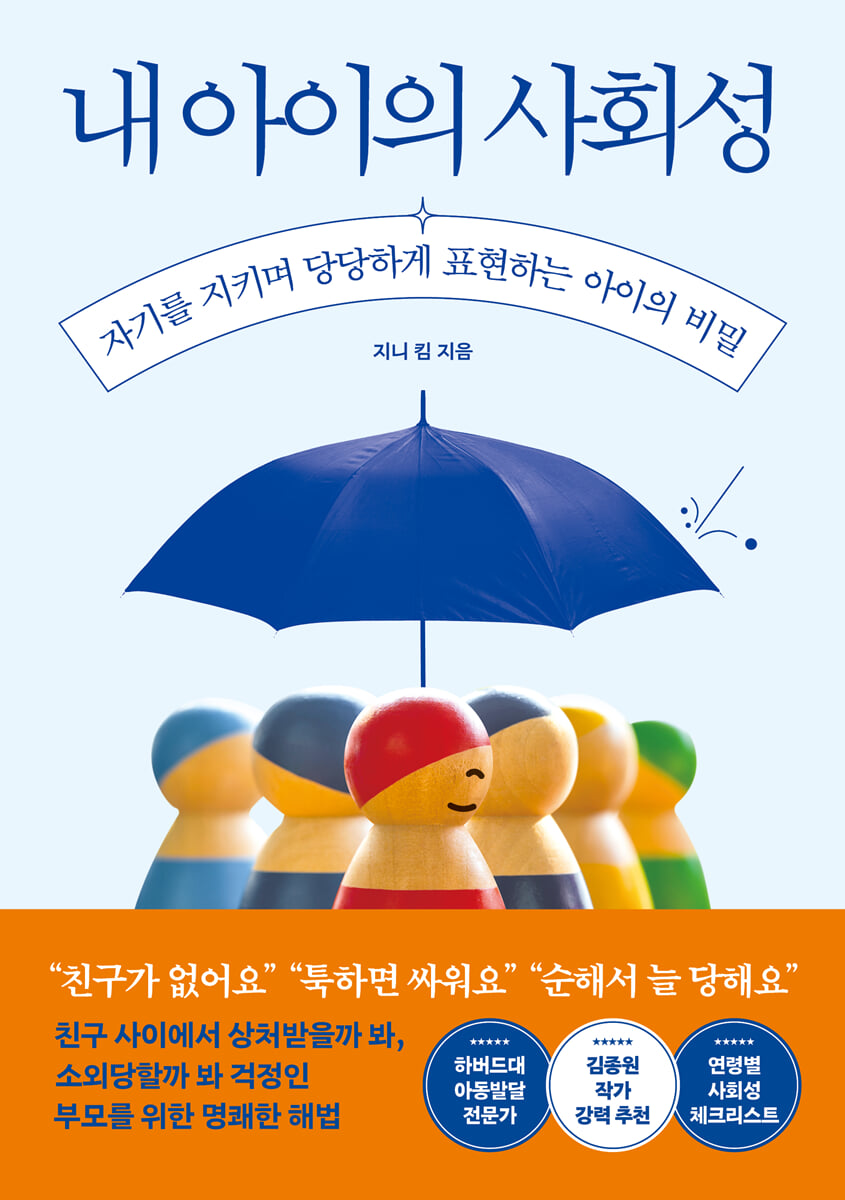
"I don't have any friends." "We fight all the time." "I'm always the one getting beat up because I'm so gentle."
I'm worried that I'll be hurt or left out by my friends.
A clear solution for parents
'Korean, English, and math are top-tier, but friendships are at the bottom' - these are the results of the International Student Achievement Test for Korean students.
As teenage depression and school violence rates surged, the Ministry of Education began introducing a Korean-style social-emotional education program to help children recover emotionally and strengthen relationships.
The problem of children's social skills, which our society has neglected by emphasizing only academics, has reached a point where it can no longer be ignored.
If you are worried that your child has no friends, gets into fights all the time, or is always beaten by strong friends, focus on developing their social skills before learning.
Children who grow up in emotionally stable and healthy relationships take charge of their own lives and ultimately get ahead.
Dr. Jini Kim, a leading expert in early childhood education and child development who has taught kindergarten and elementary school children for over 20 years, introduces practical methods for fostering children's social skills in this book, starting with "understanding and loving myself" and "how to communicate and build healthy relationships with others."
Let's take a look at a practical guide to social education that can be applied directly to children's daily lives, a life skill that even parents find difficult to teach.
I'm worried that I'll be hurt or left out by my friends.
A clear solution for parents
'Korean, English, and math are top-tier, but friendships are at the bottom' - these are the results of the International Student Achievement Test for Korean students.
As teenage depression and school violence rates surged, the Ministry of Education began introducing a Korean-style social-emotional education program to help children recover emotionally and strengthen relationships.
The problem of children's social skills, which our society has neglected by emphasizing only academics, has reached a point where it can no longer be ignored.
If you are worried that your child has no friends, gets into fights all the time, or is always beaten by strong friends, focus on developing their social skills before learning.
Children who grow up in emotionally stable and healthy relationships take charge of their own lives and ultimately get ahead.
Dr. Jini Kim, a leading expert in early childhood education and child development who has taught kindergarten and elementary school children for over 20 years, introduces practical methods for fostering children's social skills in this book, starting with "understanding and loving myself" and "how to communicate and build healthy relationships with others."
Let's take a look at a practical guide to social education that can be applied directly to children's daily lives, a life skill that even parents find difficult to teach.
- You can preview some of the book's contents.
Preview
index
Prologue_Can't we start by studying and then develop social skills later?
+ Age-specific social skills checklist
Infants aged 0-2 years
3-5 year old toddlers
Preschool childhood (ages 6-7)
8~9 years old, lower elementary school students
Chapter 1.
How does a child's social skills develop?
Parents are the first world a child encounters.
Is sociality innate or nurtured?
Children with high positive emotions, children with high negative emotions
Why You Shouldn't Reduce Your Child's Discomfort
The best education is to broaden the world of play.
+Play Problem Case 1.
A child who only wants to play by himself
+Play Problem Case 2.
A child who can't stand losing
+Play Problem Case 3.
A child who only wants to look at electronic devices
Why the World Is Focusing on Social-Emotional Education
Chapter 2.
[Basic] The skills needed to know and protect yourself
Self-Confidence: The Power to Resist Rejection or Failure
Self-Awareness: Raise Your Child to Say "I'm Sad" Instead of "I Don't Know"
Self-Expression: Communication Begins with the Practice of Expressing Your Feelings
Self-regulation ① Emotional regulation: Emotions are 'mental energy' that can be controlled by oneself.
Self-regulation ② Thought control: The power to find a better way without giving up
Self-regulation ③ Behavioral control: Practice recognizing impulses and delaying gratification
Boundaries: Teaching the "Line" in Relationships
Chapter 3.
[Advanced] Values We Must Learn to Live Together
Rules: Life Skills That Reduce Unnecessary Misunderstandings and Conflicts
Accountability: What you get when you admit your mistakes without fear.
Empathy: Why is it important to share our feelings with each other?
Cooperation: Why You Should Teach the Value of Cooperation Before Competition
Respect: The Secret to Children Seizing More Opportunities in Broader Relationships
Online Etiquette: Don't Take Every Line Lightly
Chapter 4.
[Practical] How to Resolve Friendship Conflicts Flexibly
5 Ways Kids Deal with Conflict
When and how should we intervene in children's conflicts?
A child who is overly dependent on friends
A child who is clear about what he or she wants to do and has strong self-assertion
A child who often whines and doesn't accept apologies
A child who has difficulty approaching friends
A violent child who puts his body first
A child who is bad at saying no
Chapter 5.
Common Misconceptions About Children's Social Skills
Is frequent contact with peers important?
Does sociality develop naturally as we grow up?
Are introverted children lacking social skills?
Is it good to get along with friends without conflict?
Is the number of friends a measure of sociability?
Is the playground a classroom for social skills?
If parents are introverted, will their children develop socially more slowly?
+ Age-specific social skills checklist
Infants aged 0-2 years
3-5 year old toddlers
Preschool childhood (ages 6-7)
8~9 years old, lower elementary school students
Chapter 1.
How does a child's social skills develop?
Parents are the first world a child encounters.
Is sociality innate or nurtured?
Children with high positive emotions, children with high negative emotions
Why You Shouldn't Reduce Your Child's Discomfort
The best education is to broaden the world of play.
+Play Problem Case 1.
A child who only wants to play by himself
+Play Problem Case 2.
A child who can't stand losing
+Play Problem Case 3.
A child who only wants to look at electronic devices
Why the World Is Focusing on Social-Emotional Education
Chapter 2.
[Basic] The skills needed to know and protect yourself
Self-Confidence: The Power to Resist Rejection or Failure
Self-Awareness: Raise Your Child to Say "I'm Sad" Instead of "I Don't Know"
Self-Expression: Communication Begins with the Practice of Expressing Your Feelings
Self-regulation ① Emotional regulation: Emotions are 'mental energy' that can be controlled by oneself.
Self-regulation ② Thought control: The power to find a better way without giving up
Self-regulation ③ Behavioral control: Practice recognizing impulses and delaying gratification
Boundaries: Teaching the "Line" in Relationships
Chapter 3.
[Advanced] Values We Must Learn to Live Together
Rules: Life Skills That Reduce Unnecessary Misunderstandings and Conflicts
Accountability: What you get when you admit your mistakes without fear.
Empathy: Why is it important to share our feelings with each other?
Cooperation: Why You Should Teach the Value of Cooperation Before Competition
Respect: The Secret to Children Seizing More Opportunities in Broader Relationships
Online Etiquette: Don't Take Every Line Lightly
Chapter 4.
[Practical] How to Resolve Friendship Conflicts Flexibly
5 Ways Kids Deal with Conflict
When and how should we intervene in children's conflicts?
A child who is overly dependent on friends
A child who is clear about what he or she wants to do and has strong self-assertion
A child who often whines and doesn't accept apologies
A child who has difficulty approaching friends
A violent child who puts his body first
A child who is bad at saying no
Chapter 5.
Common Misconceptions About Children's Social Skills
Is frequent contact with peers important?
Does sociality develop naturally as we grow up?
Are introverted children lacking social skills?
Is it good to get along with friends without conflict?
Is the number of friends a measure of sociability?
Is the playground a classroom for social skills?
If parents are introverted, will their children develop socially more slowly?
Detailed image

Into the book
“I was playing first, and he took the toy without saying anything.” “He just wants to do whatever he wants.” Use the moments when your child says these things as opportunities to teach social skills.
Empathize with your child's feelings of frustration, but also think about the situation together and ask, "Why did my friend act that way?"
The entire process of children interacting with diverse friends, experiencing discomfort, and sometimes learning how to mediate in conflict helps them grow into more flexible and warm individuals.
--- From "Why You Shouldn't Reduce Your Child's Discomfort"
Have you ever ridden in a bumper car? If you go too fast, you might crash into something. In that case, you have to hit the brakes to slow down or stop.
And you can avoid it by turning the steering wheel to the right or left.
The same goes for emotions.
When your emotions are about to explode, you need to stop for a moment.
You can adjust it by turning the handle.
“No matter what emotions come your way, you can decide how you react.”
--- From "Emotion Regulation: Emotions are 'mental energy' that can be controlled by oneself"
A boundary is a distance of respect that exists between me and others.
This boundary is not a cold wall that separates people, but a warm fence that keeps each other's hearts and bodies safe.
Teaching your child boundaries ultimately helps them develop the ability to protect themselves.
You need to be able to say “no” or “don’t do that” when your friend is being overly demanding or doing something you don’t like.
And when the other person rejects you, you also need to develop the ability to respect that boundary and back off.
--- From "Boundaries: Teaching the 'Line to Keep' in Relationships"
Children who grow up with people who live at different speeds, express themselves in different ways, and have different temperaments and abilities can approach anyone without hesitation.
Because we understand that disabilities, culture, language, and differences in thinking are just a part of the differences we all have.
Above all, a child with this kind of mindset is not discouraged even when he or she feels different from others.
Because I have personally experienced that being different is not something to be ashamed of, I can acknowledge my own uniqueness instead of comparing myself to others.
So, you will not be easily swayed by the gaze of those around you, and you will have the strength to express your thoughts and feelings in a healthy way.
--- From "Respect: The Secret to Children Who Seize More Opportunities in Broad Relationships"
But this is not sociality, it is only a part of 'sociability'.
Sociability should not be judged simply by dividing it into extroversion and introversion.
Being introverted and not approaching people first doesn't mean you're less social.
As I have emphasized many times, social skills are a skill made up of many different pieces.
And introverted children have their own strong social skills.
For example, they often have the ability to listen well to their friends, the ability to empathize with their friends' feelings, and the ability to problem-solve to calmly and carefully resolve conflicts.
Empathize with your child's feelings of frustration, but also think about the situation together and ask, "Why did my friend act that way?"
The entire process of children interacting with diverse friends, experiencing discomfort, and sometimes learning how to mediate in conflict helps them grow into more flexible and warm individuals.
--- From "Why You Shouldn't Reduce Your Child's Discomfort"
Have you ever ridden in a bumper car? If you go too fast, you might crash into something. In that case, you have to hit the brakes to slow down or stop.
And you can avoid it by turning the steering wheel to the right or left.
The same goes for emotions.
When your emotions are about to explode, you need to stop for a moment.
You can adjust it by turning the handle.
“No matter what emotions come your way, you can decide how you react.”
--- From "Emotion Regulation: Emotions are 'mental energy' that can be controlled by oneself"
A boundary is a distance of respect that exists between me and others.
This boundary is not a cold wall that separates people, but a warm fence that keeps each other's hearts and bodies safe.
Teaching your child boundaries ultimately helps them develop the ability to protect themselves.
You need to be able to say “no” or “don’t do that” when your friend is being overly demanding or doing something you don’t like.
And when the other person rejects you, you also need to develop the ability to respect that boundary and back off.
--- From "Boundaries: Teaching the 'Line to Keep' in Relationships"
Children who grow up with people who live at different speeds, express themselves in different ways, and have different temperaments and abilities can approach anyone without hesitation.
Because we understand that disabilities, culture, language, and differences in thinking are just a part of the differences we all have.
Above all, a child with this kind of mindset is not discouraged even when he or she feels different from others.
Because I have personally experienced that being different is not something to be ashamed of, I can acknowledge my own uniqueness instead of comparing myself to others.
So, you will not be easily swayed by the gaze of those around you, and you will have the strength to express your thoughts and feelings in a healthy way.
--- From "Respect: The Secret to Children Who Seize More Opportunities in Broad Relationships"
But this is not sociality, it is only a part of 'sociability'.
Sociability should not be judged simply by dividing it into extroversion and introversion.
Being introverted and not approaching people first doesn't mean you're less social.
As I have emphasized many times, social skills are a skill made up of many different pieces.
And introverted children have their own strong social skills.
For example, they often have the ability to listen well to their friends, the ability to empathize with their friends' feelings, and the ability to problem-solve to calmly and carefully resolve conflicts.
--- From "Do introverted children lack social skills?"
Publisher's Review
#1 bestselling author in the child education field
A new book by Harvard University child development expert Dr. Jini Kim!
Social skills that can be easily overlooked when focusing only on studying
A child with poor social skills
Lose the ability to find one's place in the world
★★★ Highly recommended by author Kim Jong-won
★★★ Includes a checklist of social skills by age.
'Korean, English, and math are top-tier, but friendships are at the bottom' - these are the results of the International Student Achievement Test for Korean students.
Although children's intellectual abilities have reached the highest level in the world thanks to an education focused on entrance exams, the issue of social and emotional competencies such as self-awareness, emotional expression, communication, and collaboration has reached a point where it can no longer be ignored.
A child who enjoys school but struggles to make friends, a child who struggles to regulate their emotions and becomes easily frustrated, a child who excels academically but is lonely... Could this be your child? Dr. Jini Kim, a leading expert in early childhood education and child development who has taught kindergarten and elementary school children for over 20 years, introduces practical methods for fostering social skills in children, starting with "understanding and loving myself" and continuing with "how to communicate and build healthy relationships with others."
How do children develop social skills? What social skills must we teach our children before conflicts between friends begin? Let's delve into a practical guide to social skills education that even parents find difficult to teach, a life skill that can be applied directly to children's daily lives.
Sociability, the ability to get along well with friends, and more
11 Core Competencies That Determine a Child's Sociality
When we talk about social skills, we often think of the ability to get along well with people.
However, having many friends does not necessarily mean that a child has excellent social skills, and even introverted children can develop healthy social skills.
Sociability is not simply a matter of good personality, but rather a complex interaction of the ability to understand and express oneself well, the ability to empathize with and be considerate of others' feelings, the ability to choose appropriate behavior according to the situation, and the ability to mediate conflict and cooperate.
So how can we foster social skills in children? The author breaks social skills down into 11 pieces, like a puzzle.
These are the five competencies that protect and express the self, and the six values that create and maintain relationships.
Let's check our child's social skills level right now using the age-specific social skills checklist included at the beginning of the book.
And let's find out what piece the child needs most and practice it intensively.
As you learn the self-expression techniques, conversation skills, and conflict resolution know-how introduced in this book, you will soon discover that your child has reached the highest level of social skills, approaching friends with confidence.
Directly applied in American elementary and middle school classrooms for 20 years
Introducing Korea's first proven 'social-emotional education method'!
Advanced countries in education, including the United States, the United Kingdom, Canada, Australia, Japan, and Singapore, have been introducing social and emotional education programs for the holistic development of children for over 20 years.
An analysis of the long-term effects of this education showed that children who developed strong social skills from an early age not only had improved academic achievement later in life, but also showed reduced problem behaviors and improved ability to cooperate and solve problems in conflict situations.
In response to the recent surge in teenage depression and school violence, the Ministry of Education has recognized the need for children to recover mentally and strengthen their social relationships. Starting in 2025, the Ministry will begin introducing a Korean-style social-emotional education program to schools.
In this book, Dr. Jini Kim introduces to Korea for the first time a proven social-emotional education method that she has directly applied in elementary and middle school classrooms for 20 years.
What is particularly impressive is that it explains the basic social skills and values that can be difficult even for adults in a way that is easy for children to understand.
For example, self-esteem is likened to a seed, and conflict is likened to paint.
“Everyone has a very small and special seed in their heart.
The name of that seed is ‘Seed of Self-Esteem.’
But will a seed grow on its own if left alone? No.
They need water, sunlight, and sometimes fertilizer.
The seeds of self-esteem are the same.
“When you think positively to yourself, saying, ‘I can do this,’ or ‘I’m good at this,’ the seed will grow.”
“Orange came out from the conflict between red and yellow, and green came out from the conflict between yellow and blue.
When different opinions clash, if we talk together and try to resolve the issue, new ideas and games can be born.
“Conflict can be an opportunity to create something more wonderful.”
In addition, “My Child’s Sociality” contains various tools and play methods for social education.
It is full of customized educational methods for children that you will never find anywhere else, such as how to visualize your child's small successes, how to express them by connecting physical reactions with emotional words, how to read nonverbal cues such as facial expressions, gestures, and voices and act sensitively, how to practice regulating emotions, thoughts, and actions in a fun way, and how to help your child visually confirm the boundaries of body, mind, and time.
If you are worried that your child has no friends, gets into fights all the time, or is always beaten by strong friends, focus on developing their social skills before learning.
A child who develops strong social skills during early childhood and elementary school will grow into a child who excels above all others, with stable emotions and healthy relationships.
A new book by Harvard University child development expert Dr. Jini Kim!
Social skills that can be easily overlooked when focusing only on studying
A child with poor social skills
Lose the ability to find one's place in the world
★★★ Highly recommended by author Kim Jong-won
★★★ Includes a checklist of social skills by age.
'Korean, English, and math are top-tier, but friendships are at the bottom' - these are the results of the International Student Achievement Test for Korean students.
Although children's intellectual abilities have reached the highest level in the world thanks to an education focused on entrance exams, the issue of social and emotional competencies such as self-awareness, emotional expression, communication, and collaboration has reached a point where it can no longer be ignored.
A child who enjoys school but struggles to make friends, a child who struggles to regulate their emotions and becomes easily frustrated, a child who excels academically but is lonely... Could this be your child? Dr. Jini Kim, a leading expert in early childhood education and child development who has taught kindergarten and elementary school children for over 20 years, introduces practical methods for fostering social skills in children, starting with "understanding and loving myself" and continuing with "how to communicate and build healthy relationships with others."
How do children develop social skills? What social skills must we teach our children before conflicts between friends begin? Let's delve into a practical guide to social skills education that even parents find difficult to teach, a life skill that can be applied directly to children's daily lives.
Sociability, the ability to get along well with friends, and more
11 Core Competencies That Determine a Child's Sociality
When we talk about social skills, we often think of the ability to get along well with people.
However, having many friends does not necessarily mean that a child has excellent social skills, and even introverted children can develop healthy social skills.
Sociability is not simply a matter of good personality, but rather a complex interaction of the ability to understand and express oneself well, the ability to empathize with and be considerate of others' feelings, the ability to choose appropriate behavior according to the situation, and the ability to mediate conflict and cooperate.
So how can we foster social skills in children? The author breaks social skills down into 11 pieces, like a puzzle.
These are the five competencies that protect and express the self, and the six values that create and maintain relationships.
Let's check our child's social skills level right now using the age-specific social skills checklist included at the beginning of the book.
And let's find out what piece the child needs most and practice it intensively.
As you learn the self-expression techniques, conversation skills, and conflict resolution know-how introduced in this book, you will soon discover that your child has reached the highest level of social skills, approaching friends with confidence.
Directly applied in American elementary and middle school classrooms for 20 years
Introducing Korea's first proven 'social-emotional education method'!
Advanced countries in education, including the United States, the United Kingdom, Canada, Australia, Japan, and Singapore, have been introducing social and emotional education programs for the holistic development of children for over 20 years.
An analysis of the long-term effects of this education showed that children who developed strong social skills from an early age not only had improved academic achievement later in life, but also showed reduced problem behaviors and improved ability to cooperate and solve problems in conflict situations.
In response to the recent surge in teenage depression and school violence, the Ministry of Education has recognized the need for children to recover mentally and strengthen their social relationships. Starting in 2025, the Ministry will begin introducing a Korean-style social-emotional education program to schools.
In this book, Dr. Jini Kim introduces to Korea for the first time a proven social-emotional education method that she has directly applied in elementary and middle school classrooms for 20 years.
What is particularly impressive is that it explains the basic social skills and values that can be difficult even for adults in a way that is easy for children to understand.
For example, self-esteem is likened to a seed, and conflict is likened to paint.
“Everyone has a very small and special seed in their heart.
The name of that seed is ‘Seed of Self-Esteem.’
But will a seed grow on its own if left alone? No.
They need water, sunlight, and sometimes fertilizer.
The seeds of self-esteem are the same.
“When you think positively to yourself, saying, ‘I can do this,’ or ‘I’m good at this,’ the seed will grow.”
“Orange came out from the conflict between red and yellow, and green came out from the conflict between yellow and blue.
When different opinions clash, if we talk together and try to resolve the issue, new ideas and games can be born.
“Conflict can be an opportunity to create something more wonderful.”
In addition, “My Child’s Sociality” contains various tools and play methods for social education.
It is full of customized educational methods for children that you will never find anywhere else, such as how to visualize your child's small successes, how to express them by connecting physical reactions with emotional words, how to read nonverbal cues such as facial expressions, gestures, and voices and act sensitively, how to practice regulating emotions, thoughts, and actions in a fun way, and how to help your child visually confirm the boundaries of body, mind, and time.
If you are worried that your child has no friends, gets into fights all the time, or is always beaten by strong friends, focus on developing their social skills before learning.
A child who develops strong social skills during early childhood and elementary school will grow into a child who excels above all others, with stable emotions and healthy relationships.
GOODS SPECIFICS
- Date of issue: June 25, 2025
- Page count, weight, size: 314 pages | 148*210*18mm
- ISBN13: 9791194033936
- ISBN10: 1194033938
You may also like
카테고리
korean


korean

![GQ KOREA Mark (Monthly): December [2025]](http://librairie.coreenne.fr/cdn/shop/files/8ef265dbbfbf186523ed75ba7319009d.jpg?v=1765340328&width=3840)


