

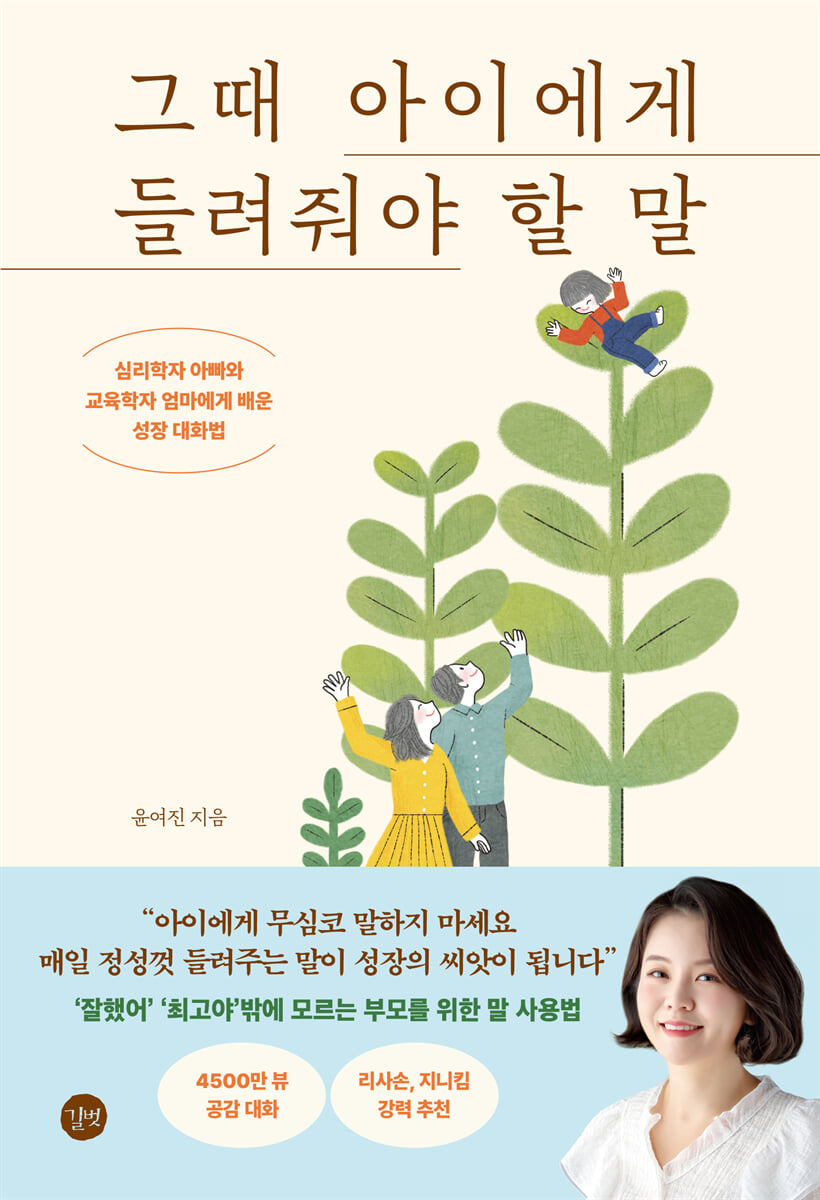
What to say to your child then
 |
Description
Book Introduction
* 45 million cumulative views, likes, and conversations
How to Use Phrases for Parents Who Only Know "Good Job" and "You're the Best"
“Don’t say things carelessly to your child.
“The words we hear every day become the seeds of growth.”
There is no parent who does not know that the words they say to their children have a great influence on their growth and inner formation.
But to a child who cries and gets irritated over trivial things, “Stop crying.
For many parents, the first thing that comes to mind is “Suddenly!”
When a child hesitates before taking on a new challenge, few parents can think of anything better to say than, "Cheer up! You can do it!"
But what if there were better words to say to children at that time? Most children grow through similar developmental stages, and at each stage, there are tasks to master. And there are words parents can use to further their child's growth.
The Key to Growth: Learning from a Psychologist Dad and an Educator Mom
"What You Should Say to Your Child Then" emphasizes that parents' words become a voice that remains in the child's mind for the rest of their life.
The author, who grew up with a psychologist father and an educator mother, studied psychology in college and realized that the things she heard from her parents growing up were more than just nice-to-hear words.
Based on the positive words I heard from my parents while growing up, words that stayed with me throughout my life and supported me, and the knowledge I gained while studying psychology, I introduce conversation methods for each stage of growth.
Based on research in psychology and brain science, we have selected appropriate expressions for each stage to help children develop a positive sense of self and become emotionally stable.
This book goes beyond simply suggesting words that parents should say to their children. Instead of saying things that parents might say inadvertently, it suggests words that will help children grow, and at the same time, it explains, based on research results, why children need such words at that age.
While opportunities for growth remain open, we will provide practical guidance for parents who want to speak better to their children and help them grow further.
How to Use Phrases for Parents Who Only Know "Good Job" and "You're the Best"
“Don’t say things carelessly to your child.
“The words we hear every day become the seeds of growth.”
There is no parent who does not know that the words they say to their children have a great influence on their growth and inner formation.
But to a child who cries and gets irritated over trivial things, “Stop crying.
For many parents, the first thing that comes to mind is “Suddenly!”
When a child hesitates before taking on a new challenge, few parents can think of anything better to say than, "Cheer up! You can do it!"
But what if there were better words to say to children at that time? Most children grow through similar developmental stages, and at each stage, there are tasks to master. And there are words parents can use to further their child's growth.
The Key to Growth: Learning from a Psychologist Dad and an Educator Mom
"What You Should Say to Your Child Then" emphasizes that parents' words become a voice that remains in the child's mind for the rest of their life.
The author, who grew up with a psychologist father and an educator mother, studied psychology in college and realized that the things she heard from her parents growing up were more than just nice-to-hear words.
Based on the positive words I heard from my parents while growing up, words that stayed with me throughout my life and supported me, and the knowledge I gained while studying psychology, I introduce conversation methods for each stage of growth.
Based on research in psychology and brain science, we have selected appropriate expressions for each stage to help children develop a positive sense of self and become emotionally stable.
This book goes beyond simply suggesting words that parents should say to their children. Instead of saying things that parents might say inadvertently, it suggests words that will help children grow, and at the same time, it explains, based on research results, why children need such words at that age.
While opportunities for growth remain open, we will provide practical guidance for parents who want to speak better to their children and help them grow further.
- You can preview some of the book's contents.
Preview
index
Prologue: Words spoken with care every day become the seeds of growth.
Part 1.
Words that foster self-esteem in early childhood
Step 1.
Words that form the foundation of self-esteem
Secure attachment
A thought that comes to mind: 'Do I really have to say it out loud?'
The words that need to be said are “I love you the most in the world.”
[Self-worth]
A thought that comes to mind: 'Can I be a good parent?'
What to say: “Thank you for coming to Mom and Dad.”
Step 2.
Words that help you discover your emotions and enjoy relationships
Accepting Emotions
A careless remark: “Stop crying.
“Suddenly!”
What you need to say: “It’s okay to cry.”
[Emotional regulation]
A thoughtless remark: “There’s no need to be angry.
stop!"
What I need to say: "How mad would that make you! It's possible."
[View acceptance]
A careless remark: “You have to give in to play together.”
What you need to say: “I understand your unwillingness to compromise.”
[Social bonding]
A casual remark: “Let’s just do this and play together.”
What I need to say: “Playing with you is so much fun!”
Step 3.
Words that foster emotional control and social skills
[Emotion Recognition and Expression]
A casual remark: “Did you have fun today?”
What should I say? “What was the most frustrating thing that happened to you today?”
Emotion Regulation Strategies
A thoughtless remark: “Stop being so annoying!”
What should I say? “What should I do when I feel bad?”
[Responsibility]
A thoughtless remark: “Parents can do that too!”
What you need to say: “Mom and Dad, I’m sorry.”
[Conflict Resolution]
A casual remark: “What on earth does that mean?”
What you need to say: “Mom and Dad may have different opinions.”
Step 4.
Words that foster self-understanding and initiative
[Positive self-concept]
A thoughtless remark: “You can do better!”
What I need to say is, “You are a special person, one of a kind in the world.”
Self-Acceptance and Self-Compassion
A thoughtless remark: “If only we could fix this, it would be perfect!”
What I need to say: “Your weaknesses are also valuable.”
[Promoting Autonomy]
A careless remark: “You can’t do that.”
What you need to say is, “Do whatever you want.”
[Self-awareness]
A careless remark: “Listen to Mom and Dad.”
What I need to say is “Would you like to choose?
Step 5.
Words that build confidence and independence
[Self-efficacy]
A careless remark: “I told you to be careful!”
What you need to know: “Anyone can make mistakes.”
[Self-esteem]
A thoughtless remark: “Let’s just do this.”
What you need to say: “Tell me what you like!”
[Positive Reinforcement]
A thoughtless remark: “What if I still can’t do it on my own?”
What I Need to Say: “I can do this much on my own!”
[Increase courage]
A casual remark: “You can do it, right? Cheer up!”
What you need to know: “It’s natural to be scared when doing something new.”
Part 2.
Words that build confidence in elementary school and society
Step 6.
Words that foster a spirit of challenge and potential
[Intrinsic motivation]
A careless remark: “If you do this, you’ll fall behind your friends.”
What you need to say: “Let’s see how much you’ve grown since last time.”
[Attribution Theory]
A casual remark: “Why do you keep making mistakes?”
What you need to know: “No one is good at something from the beginning.”
Growth Mindset
A casual remark: “I guess you have no talent.”
What I need to say is, “I can’t do it ‘yet.’”
Process-oriented learning
A careless remark: “This is the result of being clumsy.”
What you need to know: “Failure is not the end, it’s the process.”
Step 7.
Words that foster resilience and responsibility
[Emotional Support]
A careless remark: “That was your fault.”
What you need to hear: “Mom and Dad are always on your side.”
[Social Flexibility]
A thoughtless remark: “How much more fair it has to be!”
What you need to hear: “It can’t always be fair.”
[Problem-solving skills]
A careless remark: “You can’t solve this.”
What you need to know: “There is a solution to every problem.”
Accepting Failure
A thoughtless remark: “Why could you only do this?”
What you need to say: “Sometimes you may not like the results.”
Step 8.
Words that develop self-control and decision-making skills
[Collaborative Problem Solving]
A casual remark: “Mom and Dad will discuss it.”
What should I say? “Should we have a family meeting?”
[Decision and Responsibility]
A thoughtless remark: “If you do that, the result is obvious.”
What you need to know: “What happens if you choose that?”
[Self-reflection]
A casual remark: “You don’t have to overthink it so much.
"
What you need to say is “Why did you think that?”
[Metacognition]
A casual remark: “Never give up!”
A Word to Hear “It Takes a Lot of Courage to Quit.”
Epilogue: The Ability to Fulfill Life, the Ability to Be Happy
References
Part 1.
Words that foster self-esteem in early childhood
Step 1.
Words that form the foundation of self-esteem
Secure attachment
A thought that comes to mind: 'Do I really have to say it out loud?'
The words that need to be said are “I love you the most in the world.”
[Self-worth]
A thought that comes to mind: 'Can I be a good parent?'
What to say: “Thank you for coming to Mom and Dad.”
Step 2.
Words that help you discover your emotions and enjoy relationships
Accepting Emotions
A careless remark: “Stop crying.
“Suddenly!”
What you need to say: “It’s okay to cry.”
[Emotional regulation]
A thoughtless remark: “There’s no need to be angry.
stop!"
What I need to say: "How mad would that make you! It's possible."
[View acceptance]
A careless remark: “You have to give in to play together.”
What you need to say: “I understand your unwillingness to compromise.”
[Social bonding]
A casual remark: “Let’s just do this and play together.”
What I need to say: “Playing with you is so much fun!”
Step 3.
Words that foster emotional control and social skills
[Emotion Recognition and Expression]
A casual remark: “Did you have fun today?”
What should I say? “What was the most frustrating thing that happened to you today?”
Emotion Regulation Strategies
A thoughtless remark: “Stop being so annoying!”
What should I say? “What should I do when I feel bad?”
[Responsibility]
A thoughtless remark: “Parents can do that too!”
What you need to say: “Mom and Dad, I’m sorry.”
[Conflict Resolution]
A casual remark: “What on earth does that mean?”
What you need to say: “Mom and Dad may have different opinions.”
Step 4.
Words that foster self-understanding and initiative
[Positive self-concept]
A thoughtless remark: “You can do better!”
What I need to say is, “You are a special person, one of a kind in the world.”
Self-Acceptance and Self-Compassion
A thoughtless remark: “If only we could fix this, it would be perfect!”
What I need to say: “Your weaknesses are also valuable.”
[Promoting Autonomy]
A careless remark: “You can’t do that.”
What you need to say is, “Do whatever you want.”
[Self-awareness]
A careless remark: “Listen to Mom and Dad.”
What I need to say is “Would you like to choose?
Step 5.
Words that build confidence and independence
[Self-efficacy]
A careless remark: “I told you to be careful!”
What you need to know: “Anyone can make mistakes.”
[Self-esteem]
A thoughtless remark: “Let’s just do this.”
What you need to say: “Tell me what you like!”
[Positive Reinforcement]
A thoughtless remark: “What if I still can’t do it on my own?”
What I Need to Say: “I can do this much on my own!”
[Increase courage]
A casual remark: “You can do it, right? Cheer up!”
What you need to know: “It’s natural to be scared when doing something new.”
Part 2.
Words that build confidence in elementary school and society
Step 6.
Words that foster a spirit of challenge and potential
[Intrinsic motivation]
A careless remark: “If you do this, you’ll fall behind your friends.”
What you need to say: “Let’s see how much you’ve grown since last time.”
[Attribution Theory]
A casual remark: “Why do you keep making mistakes?”
What you need to know: “No one is good at something from the beginning.”
Growth Mindset
A casual remark: “I guess you have no talent.”
What I need to say is, “I can’t do it ‘yet.’”
Process-oriented learning
A careless remark: “This is the result of being clumsy.”
What you need to know: “Failure is not the end, it’s the process.”
Step 7.
Words that foster resilience and responsibility
[Emotional Support]
A careless remark: “That was your fault.”
What you need to hear: “Mom and Dad are always on your side.”
[Social Flexibility]
A thoughtless remark: “How much more fair it has to be!”
What you need to hear: “It can’t always be fair.”
[Problem-solving skills]
A careless remark: “You can’t solve this.”
What you need to know: “There is a solution to every problem.”
Accepting Failure
A thoughtless remark: “Why could you only do this?”
What you need to say: “Sometimes you may not like the results.”
Step 8.
Words that develop self-control and decision-making skills
[Collaborative Problem Solving]
A casual remark: “Mom and Dad will discuss it.”
What should I say? “Should we have a family meeting?”
[Decision and Responsibility]
A thoughtless remark: “If you do that, the result is obvious.”
What you need to know: “What happens if you choose that?”
[Self-reflection]
A casual remark: “You don’t have to overthink it so much.
"
What you need to say is “Why did you think that?”
[Metacognition]
A casual remark: “Never give up!”
A Word to Hear “It Takes a Lot of Courage to Quit.”
Epilogue: The Ability to Fulfill Life, the Ability to Be Happy
References
Detailed image

Into the book
The words parents repeat to their children go beyond simple encouragement; they become a voice that echoes within the child.
A parent's words can be an ally that supports the child, or an enemy that criticizes the child.
The most valuable gift a parent can give is the gift of loving words, creating an inner ally who will stay with them for life.
---From the "Prologue"
How your parents react to your crying as a child influences how you react to your child as a parent.
If you grew up in an environment where tears, a nonverbal means of communication, were not well received, you may be emotionally unstable.
Although it may not show up often, if your child cries and becomes upset, you may quickly become angry and irritable.
If all you heard when you cried as a child was “stop crying,” you’re likely to do the same to your own child.
Because there is no other way, because you have not experienced or learned it.
---「Step 2.
From "Words that help you discover your emotions and enjoy relationships"
The feelings of anger when you don't have something important are the fuel that ignites your motivation to do better.
If we keep being told that such fuel is 'bad', even the 'greed' to have what we want will subside.
So, we must remember that unconditionally suppressing and scolding a child's emotions when he or she loses a game is an act that hinders the child's development.
---「Step 2.
From "Words that help you discover your emotions and enjoy relationships"
In fact, children around the age of three are not yet ready to give in, so you should not define them through language.
I knelt down, looked at the child at the same height as him, and gently took his hand.
“I don’t want to give in.
“I fully understand that feeling.”
Then, usually, the child burst into tears and ran into my arms.
My unwillingness to compromise was so 'normal', but I was cornered by people around me who treated it as if it were wrong, and then I felt relieved.
Concession is an action that does not necessarily have to be done.
To be honest, I completely understand that feeling.
Especially for young children who cannot predict the future, there is no immediate benefit to be gained by giving up a toy.
'What if my friend doesn't play with me next time?' is a worry that only arises in the parents' heads.
---「Step 2.
From "Words that help you discover your emotions and enjoy relationships"
There are several possible reactions a parent might have when someone points out a child's weakness.
“That's what I'm saying.
Even though it does everything that is good for the body, you still have to eat it.
I think he's not growing well because he's a picky eater.
“See, I hear people say I’m small because I don’t eat well.”
There are parents who exaggerate and add to the criticism of others.
They perceive what they say to their child as criticism of their parents and quickly turn the blame onto the child.
"Why are you saying such things to upset the child? You're such a weirdo! Whether our child is small or not!"
Even if you can't say it out loud, there are cases where you curse or attack others excessively in front of your child.
At first glance, it may seem like the parent is acting as the child's advocate, but it is highly likely that the parent's defense mechanism was triggered because the child's weakness, which was also concerning to the parent, was pointed out.
---「Step 4.
From “Words that Grow Self-Understanding and Initiative”
“Why do you always make mistakes?”
“You are full of mistakes.”
Parental criticism for mistakes empowers the child's inner critic.
Children who grow up with parents who criticize their mistakes will grow up to be adults who criticize their own mistakes.
You might think that praise boosts confidence, but when parents only praise desired outcomes and criticize mistakes, it lowers intrinsic motivation and confidence.
Because people can't do well every time and there's always the possibility of making mistakes.
---「Step 5.
From “Words that build confidence and independence”
As parents, our role is not to find a 'conclusion' for our child within a year or two.
We are no longer in an era where parents teach their children what they will do for the rest of their lives and then leave.
In modern society, the role of parents is to help their children identify and plant the seeds of what they like and are interested in.
---「Step 5.
From “Words that build confidence and independence”
To foster a child's self-efficacy, you must clearly explain the meaning of 'first'.
People who don't believe in their own abilities think that being good at something from the beginning is talent.
So, I can't stand my clumsiness and I don't even think about putting in effort.
Because we believe that outstanding people are good from the beginning, we also want our children to do well from the beginning.
Seeing an immature child makes me anxious and worried.
A parent's words can be an ally that supports the child, or an enemy that criticizes the child.
The most valuable gift a parent can give is the gift of loving words, creating an inner ally who will stay with them for life.
---From the "Prologue"
How your parents react to your crying as a child influences how you react to your child as a parent.
If you grew up in an environment where tears, a nonverbal means of communication, were not well received, you may be emotionally unstable.
Although it may not show up often, if your child cries and becomes upset, you may quickly become angry and irritable.
If all you heard when you cried as a child was “stop crying,” you’re likely to do the same to your own child.
Because there is no other way, because you have not experienced or learned it.
---「Step 2.
From "Words that help you discover your emotions and enjoy relationships"
The feelings of anger when you don't have something important are the fuel that ignites your motivation to do better.
If we keep being told that such fuel is 'bad', even the 'greed' to have what we want will subside.
So, we must remember that unconditionally suppressing and scolding a child's emotions when he or she loses a game is an act that hinders the child's development.
---「Step 2.
From "Words that help you discover your emotions and enjoy relationships"
In fact, children around the age of three are not yet ready to give in, so you should not define them through language.
I knelt down, looked at the child at the same height as him, and gently took his hand.
“I don’t want to give in.
“I fully understand that feeling.”
Then, usually, the child burst into tears and ran into my arms.
My unwillingness to compromise was so 'normal', but I was cornered by people around me who treated it as if it were wrong, and then I felt relieved.
Concession is an action that does not necessarily have to be done.
To be honest, I completely understand that feeling.
Especially for young children who cannot predict the future, there is no immediate benefit to be gained by giving up a toy.
'What if my friend doesn't play with me next time?' is a worry that only arises in the parents' heads.
---「Step 2.
From "Words that help you discover your emotions and enjoy relationships"
There are several possible reactions a parent might have when someone points out a child's weakness.
“That's what I'm saying.
Even though it does everything that is good for the body, you still have to eat it.
I think he's not growing well because he's a picky eater.
“See, I hear people say I’m small because I don’t eat well.”
There are parents who exaggerate and add to the criticism of others.
They perceive what they say to their child as criticism of their parents and quickly turn the blame onto the child.
"Why are you saying such things to upset the child? You're such a weirdo! Whether our child is small or not!"
Even if you can't say it out loud, there are cases where you curse or attack others excessively in front of your child.
At first glance, it may seem like the parent is acting as the child's advocate, but it is highly likely that the parent's defense mechanism was triggered because the child's weakness, which was also concerning to the parent, was pointed out.
---「Step 4.
From “Words that Grow Self-Understanding and Initiative”
“Why do you always make mistakes?”
“You are full of mistakes.”
Parental criticism for mistakes empowers the child's inner critic.
Children who grow up with parents who criticize their mistakes will grow up to be adults who criticize their own mistakes.
You might think that praise boosts confidence, but when parents only praise desired outcomes and criticize mistakes, it lowers intrinsic motivation and confidence.
Because people can't do well every time and there's always the possibility of making mistakes.
---「Step 5.
From “Words that build confidence and independence”
As parents, our role is not to find a 'conclusion' for our child within a year or two.
We are no longer in an era where parents teach their children what they will do for the rest of their lives and then leave.
In modern society, the role of parents is to help their children identify and plant the seeds of what they like and are interested in.
---「Step 5.
From “Words that build confidence and independence”
To foster a child's self-efficacy, you must clearly explain the meaning of 'first'.
People who don't believe in their own abilities think that being good at something from the beginning is talent.
So, I can't stand my clumsiness and I don't even think about putting in effort.
Because we believe that outstanding people are good from the beginning, we also want our children to do well from the beginning.
Seeing an immature child makes me anxious and worried.
---「Step 6.
Among the words that foster a spirit of challenge and growth of potential,
Among the words that foster a spirit of challenge and growth of potential,
Publisher's Review
A book for parents who want to give their children even just one better word.
Developmental stage-specific conversations that must be told to children at that time
The words parents repeatedly say to their children go beyond simple encouragement and become a voice that takes root within the child and accompanies them throughout their lives.
"What to Say to Your Child Then" provides specific guidelines for what parents should say to their children and helps them apply these guidelines in real life.
Based on research in developmental psychology and brain science, the book organizes words necessary for growth at each stage of a child's development.
In particular, it guides children on what characteristics they exhibit at each stage of development so that they can develop the abilities and emotional stability they need to acquire at each stage, what difficulties children and parents face on the surface at that stage, and what abilities parents should focus on developing in their children in problematic situations, and suggests appropriate verbal expressions for this.
The author emphasizes the principle that 'good words build on good words' and says that it is important to consistently say positive words every day rather than just saying good words once and leaving it at that.
Through this, the child's self-image can be formed in a healthy way and the child can develop inner strength to sustain himself even in difficult times.
"Rather than just saying nice things, say words that will help your child grow."
The eight-stage language of growth, including self-affirmation, initiative, confidence, and resilience.
"What to Say to Your Child Then" is a book that provides practical advice to parents who are concerned about how to communicate with their children, going beyond simple praise like "Good job" or "You're the best."
Through this book, the author reminds us that parents' words play the most important role in a child's growth.
The words in the book are not simply words of sympathy or pleasant to hear.
It contains words that aim to cultivate all the abilities essential for living, such as a mind that is not swayed by the gaze of others, the strength to not give up easily, and the strength to view oneself positively, while focusing on the inner growth of children.
It emphasizes that a single word from a parent every day can become a seed of growth and take deep root in a child's mind.
This book reminds us that the words parents tell their children can become a strong force that will help them live their entire lives.
Developmental stage-specific conversations that must be told to children at that time
The words parents repeatedly say to their children go beyond simple encouragement and become a voice that takes root within the child and accompanies them throughout their lives.
"What to Say to Your Child Then" provides specific guidelines for what parents should say to their children and helps them apply these guidelines in real life.
Based on research in developmental psychology and brain science, the book organizes words necessary for growth at each stage of a child's development.
In particular, it guides children on what characteristics they exhibit at each stage of development so that they can develop the abilities and emotional stability they need to acquire at each stage, what difficulties children and parents face on the surface at that stage, and what abilities parents should focus on developing in their children in problematic situations, and suggests appropriate verbal expressions for this.
The author emphasizes the principle that 'good words build on good words' and says that it is important to consistently say positive words every day rather than just saying good words once and leaving it at that.
Through this, the child's self-image can be formed in a healthy way and the child can develop inner strength to sustain himself even in difficult times.
"Rather than just saying nice things, say words that will help your child grow."
The eight-stage language of growth, including self-affirmation, initiative, confidence, and resilience.
"What to Say to Your Child Then" is a book that provides practical advice to parents who are concerned about how to communicate with their children, going beyond simple praise like "Good job" or "You're the best."
Through this book, the author reminds us that parents' words play the most important role in a child's growth.
The words in the book are not simply words of sympathy or pleasant to hear.
It contains words that aim to cultivate all the abilities essential for living, such as a mind that is not swayed by the gaze of others, the strength to not give up easily, and the strength to view oneself positively, while focusing on the inner growth of children.
It emphasizes that a single word from a parent every day can become a seed of growth and take deep root in a child's mind.
This book reminds us that the words parents tell their children can become a strong force that will help them live their entire lives.
GOODS SPECIFICS
- Date of issue: February 28, 2025
- Page count, weight, size: 300 pages | 390g | 140*205*18mm
- ISBN13: 9791140712694
You may also like
카테고리
korean


korean

![GQ KOREA Mark (Monthly): December [2025]](http://librairie.coreenne.fr/cdn/shop/files/8ef265dbbfbf186523ed75ba7319009d.jpg?v=1765340328&width=3840)


