

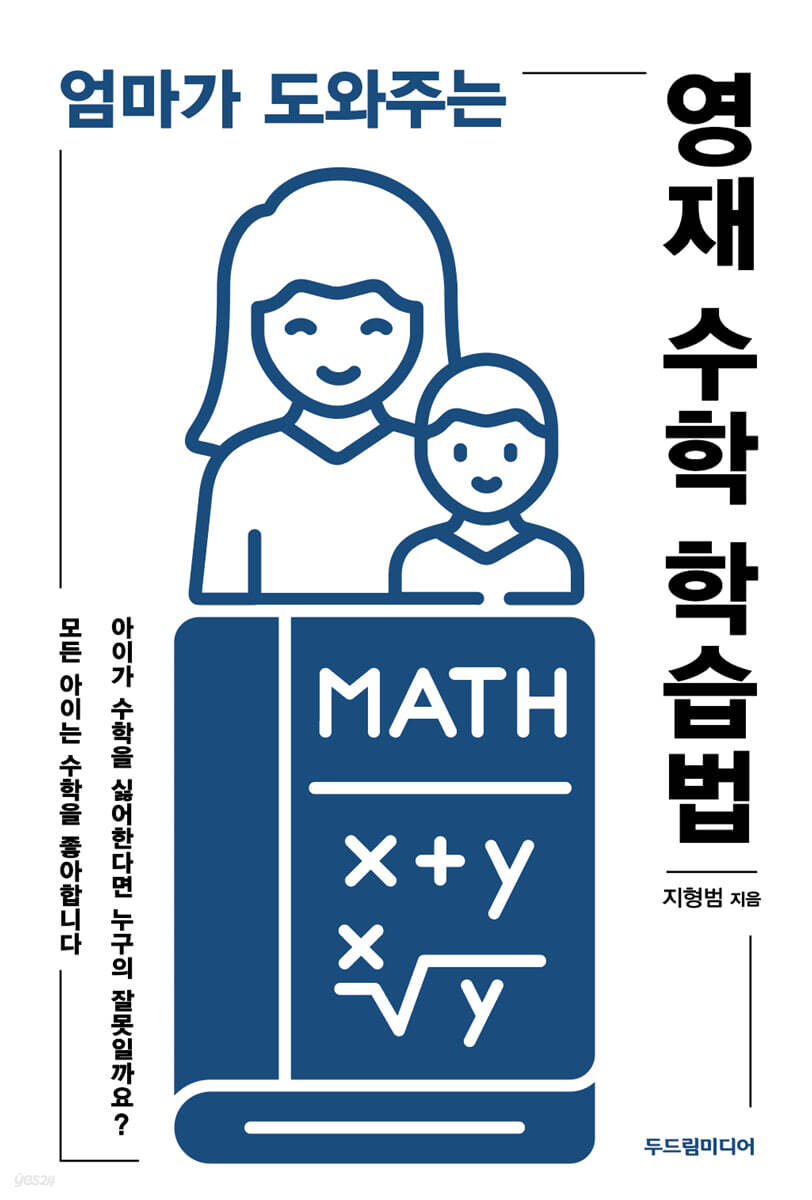
A gifted math learning method with help from mom
 |
Description
Book Introduction
If your child hates math
Whose fault is it?
The mathematical concepts required for elementary school are not that numerous, and the level of difficulty is not that high.
However, when mothers teach math directly, children often end up hating math.
The first reason is the fear of getting the wrong answer.
The desire for my child to make no mistakes unknowingly puts pressure on my child and causes him to dislike math.
Second, if you explain abstract mathematical concepts at length, it can cause children who are already unfamiliar with the concept to avoid mathematics.
Third, if you teach in a confusing way, the child will not be able to intuitively accept math and will find it difficult.
If your child doesn't understand a math concept, don't get annoyed and just repeat it over and over again.
Let your child walk on his own, but when he runs, let him run freely, and when he is resting, wait without urging him.
Although this book was written for parents raising gifted children, reading it will teach you the basic mindset needed to raise children in ordinary families as well.
If we provide a good educational environment for gifted children with intellectual potential and allow them to have a happy childhood and adolescence, they can grow into gifted children with considerable abilities and exert a positive influence on society.
The only people who can create such an environment are parents.
Proper gifted education means that parents create an appropriate growth environment for their children.
By following the guidelines in this book, you will be able to resolve the issues you face as a parent of a gifted child and find a community to share those concerns with.
Whose fault is it?
The mathematical concepts required for elementary school are not that numerous, and the level of difficulty is not that high.
However, when mothers teach math directly, children often end up hating math.
The first reason is the fear of getting the wrong answer.
The desire for my child to make no mistakes unknowingly puts pressure on my child and causes him to dislike math.
Second, if you explain abstract mathematical concepts at length, it can cause children who are already unfamiliar with the concept to avoid mathematics.
Third, if you teach in a confusing way, the child will not be able to intuitively accept math and will find it difficult.
If your child doesn't understand a math concept, don't get annoyed and just repeat it over and over again.
Let your child walk on his own, but when he runs, let him run freely, and when he is resting, wait without urging him.
Although this book was written for parents raising gifted children, reading it will teach you the basic mindset needed to raise children in ordinary families as well.
If we provide a good educational environment for gifted children with intellectual potential and allow them to have a happy childhood and adolescence, they can grow into gifted children with considerable abilities and exert a positive influence on society.
The only people who can create such an environment are parents.
Proper gifted education means that parents create an appropriate growth environment for their children.
By following the guidelines in this book, you will be able to resolve the issues you face as a parent of a gifted child and find a community to share those concerns with.
index
Prologue 4
Chapter 1.
My child is gifted, so why is it so difficult? 16
Curriculum Inadequacies 16 | Hidden Challenges in Peer Relationships 18 | Parental Confusion and the Double Burden 20
Chapter 2.
Private Education Guideline 26
Chapter 3.
Self-directed reading activities are important 36
Chapter 4.
A happy childhood doesn't happen by itself 42
Chapter 5.
An intelligence assessment should be performed once before the age of 4 or 5. 50
Chapter 6.
What should I do if I don't get early admission? 70
Chapter 7.
Some Considerations for Learning Math 76
5-Minute Mini Kids Competition 80 | One-on-One Math Mentoring 84
Chapter 8.
Motivation 88
Creating Special Date Time 89 | The Key to Motivation - Experiential Learning 93 | Creating Public Awareness 100
Chapter 9.
The Core of School Mathematics 106
Chapter 10.
After all, I'm trying to teach calculus! 114
My Precious Time! 117 | What is Calculus? 119
Chapter 11.
When Should I Teach Functions and Calculus? 126
Chapter 12.
Mathematics' Thresholds or Translucent Barriers 136
Kids Hate It When Moms Teach Math 138 | Overcoming the Fear of Getting Wrong Answers 139 | Teaching Abstract Math in Short, Repeated Lessons 141 | Avoiding Confusing Explanations 141 | Teaching the Multiplication Table 142 | Curiosity About Very Large Numbers 145 | Don't Give Up 147 | Remember the Importance of Repetition 148 | Improving Number Sense Through Play 152 | The Difficulties of Learning Math 154
Chapter 13.
Training Course for Parents of Highly IQ Gifted Children 162
Week 1: Characteristics of Gifted Children 167 | Week 2: Communication - The Key to Building Relationships 168 | Week 3: Motivation, Passion, and Underachievement 169 | Week 4: Building a Parenting Foundation and Teaching Self-Management 170 | Week 5: Over-the-topness, Perfectionism, and Stress 171 | Week 6: Idealism, Dissatisfaction, and Depression 172 | Week 7: Acquaintances, Friends, and Peers 173 | Week 8: Only Children and Siblings 174 | Week 9: Values, Traditions, and Individuality 175 | Week 10: The Complexities of Successful Parenting 176
Appendix 179
Causes, Countermeasures, and Prevention of School Violence 180 | What are Existential Concerns? Countermeasures 187 | Responding to Perfectionism 192 | Internet Media and Game Addiction? Responding to Obsessions 195 | Establishing Lifestyle Habits 198 | Dividing Parental Roles 202 | Ending One-Minute Reprimands When a Child Causes Problems 205 | The Dilemma of Praising - and Clear Standards 209 | Dr. Sally Yankee Walker's Gifted Self-Assessment Method 212
Chapter 1.
My child is gifted, so why is it so difficult? 16
Curriculum Inadequacies 16 | Hidden Challenges in Peer Relationships 18 | Parental Confusion and the Double Burden 20
Chapter 2.
Private Education Guideline 26
Chapter 3.
Self-directed reading activities are important 36
Chapter 4.
A happy childhood doesn't happen by itself 42
Chapter 5.
An intelligence assessment should be performed once before the age of 4 or 5. 50
Chapter 6.
What should I do if I don't get early admission? 70
Chapter 7.
Some Considerations for Learning Math 76
5-Minute Mini Kids Competition 80 | One-on-One Math Mentoring 84
Chapter 8.
Motivation 88
Creating Special Date Time 89 | The Key to Motivation - Experiential Learning 93 | Creating Public Awareness 100
Chapter 9.
The Core of School Mathematics 106
Chapter 10.
After all, I'm trying to teach calculus! 114
My Precious Time! 117 | What is Calculus? 119
Chapter 11.
When Should I Teach Functions and Calculus? 126
Chapter 12.
Mathematics' Thresholds or Translucent Barriers 136
Kids Hate It When Moms Teach Math 138 | Overcoming the Fear of Getting Wrong Answers 139 | Teaching Abstract Math in Short, Repeated Lessons 141 | Avoiding Confusing Explanations 141 | Teaching the Multiplication Table 142 | Curiosity About Very Large Numbers 145 | Don't Give Up 147 | Remember the Importance of Repetition 148 | Improving Number Sense Through Play 152 | The Difficulties of Learning Math 154
Chapter 13.
Training Course for Parents of Highly IQ Gifted Children 162
Week 1: Characteristics of Gifted Children 167 | Week 2: Communication - The Key to Building Relationships 168 | Week 3: Motivation, Passion, and Underachievement 169 | Week 4: Building a Parenting Foundation and Teaching Self-Management 170 | Week 5: Over-the-topness, Perfectionism, and Stress 171 | Week 6: Idealism, Dissatisfaction, and Depression 172 | Week 7: Acquaintances, Friends, and Peers 173 | Week 8: Only Children and Siblings 174 | Week 9: Values, Traditions, and Individuality 175 | Week 10: The Complexities of Successful Parenting 176
Appendix 179
Causes, Countermeasures, and Prevention of School Violence 180 | What are Existential Concerns? Countermeasures 187 | Responding to Perfectionism 192 | Internet Media and Game Addiction? Responding to Obsessions 195 | Establishing Lifestyle Habits 198 | Dividing Parental Roles 202 | Ending One-Minute Reprimands When a Child Causes Problems 205 | The Dilemma of Praising - and Clear Standards 209 | Dr. Sally Yankee Walker's Gifted Self-Assessment Method 212
Into the book
For children with high IQ, learning that is too easy, slow, and repetitive can have many negative consequences, but parents and teachers may not be aware of these difficulties.
If you look closely at the results of intelligence tests, you will see that children with an IQ of 125 or higher have developed vocabulary levels that are at least 2-3 years ahead of their grade level, and in some cases, 5-6 years ahead.
Not only their vocabulary level, but also their common sense, reasoning ability, memory, and instantaneous judgment and cognitive ability are already out of sync with the classes taught at their grade level.
In these cases, the child feels that the lessons are very repetitive, slow, extremely boring, and like an endless repetition of childish content.
Above all, it becomes difficult to respect a teacher who does not provide new knowledge.
So, is it possible to supplement this through private education? But the cold reality is negative.
There is no private education for these children.
Basically, private education, whether it is private tutoring or academy classes, is subject to the evaluation of regular schools.
Parents who invest time and money in these extracurricular activities would hope that they will help the school's evaluations.
The problem is that for highly intelligent children whose curriculum itself is not suitable, this type of private education is prolonging inappropriate classes.
--- p.16~17
There is no need to sit at a desk and do learning activities until the age of 8 or 9 (3rd or 4th grade in elementary school).
People working in the private education market argue that such habits should be developed from a young age, even if it is only one year old, but this argument is not based on any evidence.
Considering the developmental cycle of children, the harm outweighs the benefits.
While this will bring increased revenue to the private education industry, it also requires more active experiences and dynamism for growing children.
Even after the age of 8 or 9, we must maintain the effort and direction to internalize children's self-directed learning activities.
When we emphasize the various key principles of gifted education, it often sounds like we're telling parents to just sit back and watch, doing nothing.
But I am not making that claim.
Rather than being stingy with children under the age of 8 or 9, what parents should provide is to 'create good memories' with their children.
There is no such thing as too many diverse experiential activities.
There are many attractions to see, such as museums, art galleries, science centers, and observatories, and many activities are recommended, such as experiential activities, family trips, delicious food tours, amusement park visits, sledding, snowman building, water play, and camping.
--- p.80
When we bring in children who express an aversion to math, there are a few commonalities.
They are afraid of getting the wrong answer and hide their own answers.
If I had to guess, I think it's because I keep getting pointed out that I'm getting the wrong answer.
You have to keep telling them, as if hypnotizing them, that 'it's okay to be wrong'.
If you give them another chance even if they make a mistake, and if they give you a similar answer, you will be happy, encourage them, and praise them for doing well, and their attitude will change.
Children grow differently every day.
That's why the learning speed is also fast.
As fast as it is, children are learning something new every day.
So that's what makes it wrong.
It's important to remember that a high number of incorrect answers suggests that children are learning new material quickly.
The desire to have no wrong answers has the effect of unconsciously trapping children in what they are already familiar with.
Here's the most important secret to 'Mom Math Success'.
It's about making sure your child isn't afraid of getting the wrong answer.
In other words, it is about creating an attitude and habit that allows you to boldly try new things and come up with new ideas.
--- p.139~140
Raising highly gifted children requires a much higher level of cooperation from parents than other parents.
The division of roles I recommend is roughly as follows:
Mothers play the role of the villain, establishing daily habits and teaching and pointing out that children should not cause trouble or conflict within or outside the family, at least until adolescence.
In this situation, the father plays a role in protecting and comforting the child rather than the mother.
The reason mothers have to take on the villain role is that, in most cases, the younger the child, the more likely it is that the mother will be the primary caregiver.
In special circumstances within the home, such as when the mother works outside the home and the father is the primary caregiver, the roles may be reversed.
If the father or the spouse of the primary caregiver takes the side of the primary caregiver and pressures the child together to help the primary caregiver, it is less effective.
When a father or other caregiver is in a situation where he or she is coercing the child along with the primary caregiver, the child may feel somewhat oppressed as the power is 2:1.
Then, when the father or secondary caregiver goes to work and the mother or primary caregiver is left alone, in a one-on-one situation, the child may feel that he or she has the upper hand and has the advantage, so he or she may become more stubborn or rebel against the parents.
If you look closely at the results of intelligence tests, you will see that children with an IQ of 125 or higher have developed vocabulary levels that are at least 2-3 years ahead of their grade level, and in some cases, 5-6 years ahead.
Not only their vocabulary level, but also their common sense, reasoning ability, memory, and instantaneous judgment and cognitive ability are already out of sync with the classes taught at their grade level.
In these cases, the child feels that the lessons are very repetitive, slow, extremely boring, and like an endless repetition of childish content.
Above all, it becomes difficult to respect a teacher who does not provide new knowledge.
So, is it possible to supplement this through private education? But the cold reality is negative.
There is no private education for these children.
Basically, private education, whether it is private tutoring or academy classes, is subject to the evaluation of regular schools.
Parents who invest time and money in these extracurricular activities would hope that they will help the school's evaluations.
The problem is that for highly intelligent children whose curriculum itself is not suitable, this type of private education is prolonging inappropriate classes.
--- p.16~17
There is no need to sit at a desk and do learning activities until the age of 8 or 9 (3rd or 4th grade in elementary school).
People working in the private education market argue that such habits should be developed from a young age, even if it is only one year old, but this argument is not based on any evidence.
Considering the developmental cycle of children, the harm outweighs the benefits.
While this will bring increased revenue to the private education industry, it also requires more active experiences and dynamism for growing children.
Even after the age of 8 or 9, we must maintain the effort and direction to internalize children's self-directed learning activities.
When we emphasize the various key principles of gifted education, it often sounds like we're telling parents to just sit back and watch, doing nothing.
But I am not making that claim.
Rather than being stingy with children under the age of 8 or 9, what parents should provide is to 'create good memories' with their children.
There is no such thing as too many diverse experiential activities.
There are many attractions to see, such as museums, art galleries, science centers, and observatories, and many activities are recommended, such as experiential activities, family trips, delicious food tours, amusement park visits, sledding, snowman building, water play, and camping.
--- p.80
When we bring in children who express an aversion to math, there are a few commonalities.
They are afraid of getting the wrong answer and hide their own answers.
If I had to guess, I think it's because I keep getting pointed out that I'm getting the wrong answer.
You have to keep telling them, as if hypnotizing them, that 'it's okay to be wrong'.
If you give them another chance even if they make a mistake, and if they give you a similar answer, you will be happy, encourage them, and praise them for doing well, and their attitude will change.
Children grow differently every day.
That's why the learning speed is also fast.
As fast as it is, children are learning something new every day.
So that's what makes it wrong.
It's important to remember that a high number of incorrect answers suggests that children are learning new material quickly.
The desire to have no wrong answers has the effect of unconsciously trapping children in what they are already familiar with.
Here's the most important secret to 'Mom Math Success'.
It's about making sure your child isn't afraid of getting the wrong answer.
In other words, it is about creating an attitude and habit that allows you to boldly try new things and come up with new ideas.
--- p.139~140
Raising highly gifted children requires a much higher level of cooperation from parents than other parents.
The division of roles I recommend is roughly as follows:
Mothers play the role of the villain, establishing daily habits and teaching and pointing out that children should not cause trouble or conflict within or outside the family, at least until adolescence.
In this situation, the father plays a role in protecting and comforting the child rather than the mother.
The reason mothers have to take on the villain role is that, in most cases, the younger the child, the more likely it is that the mother will be the primary caregiver.
In special circumstances within the home, such as when the mother works outside the home and the father is the primary caregiver, the roles may be reversed.
If the father or the spouse of the primary caregiver takes the side of the primary caregiver and pressures the child together to help the primary caregiver, it is less effective.
When a father or other caregiver is in a situation where he or she is coercing the child along with the primary caregiver, the child may feel somewhat oppressed as the power is 2:1.
Then, when the father or secondary caregiver goes to work and the mother or primary caregiver is left alone, in a one-on-one situation, the child may feel that he or she has the upper hand and has the advantage, so he or she may become more stubborn or rebel against the parents.
--- p.202~203
Publisher's Review
With mom
Gifted Math Workbook
Raising a highly intelligent child inevitably involves facing many challenges.
There is a double burden of having a curriculum that is too easy, slow, and repetitive, which children with high IQ struggle with, having few peers with whom they can socialize at the same intellectual age, and being young in age despite their high intellectual growth, which can lead to tantrums.
For parents who are concerned about how to raise such gifted children, this book is divided into 13 chapters and provides clear guidelines.
This book provides information on how to deal with gifted children who have not been able to enroll early, and introduces how to raise and teach gifted children, including math learning.
Additionally, to ensure a happy childhood for gifted children, we guide them to the GES Center's Kkanbu group, which consists of children with similar intellectual characteristics.
It also shows how to motivate gifted children to develop their potential.
Ultimately, the goal of this entire process is to create a happy childhood for gifted children, thoroughly ensure their self-directedness, and move them to the next level of growth.
It also suggests the right approach to mathematics, which is the area that parents worry about the most in terms of education.
Although gifted children can grow into students who are very good at math, there is a high risk that they will dislike or have an aversion to math.
This book reveals the secrets to success in "Mom Math," which makes math fun and worthwhile, and serves as a helpful guide for parents who want to help their children easily embrace math.
Math with mom shouldn't be difficult, it should be fun.
This book will be with you at the beginning.
Gifted Math Workbook
Raising a highly intelligent child inevitably involves facing many challenges.
There is a double burden of having a curriculum that is too easy, slow, and repetitive, which children with high IQ struggle with, having few peers with whom they can socialize at the same intellectual age, and being young in age despite their high intellectual growth, which can lead to tantrums.
For parents who are concerned about how to raise such gifted children, this book is divided into 13 chapters and provides clear guidelines.
This book provides information on how to deal with gifted children who have not been able to enroll early, and introduces how to raise and teach gifted children, including math learning.
Additionally, to ensure a happy childhood for gifted children, we guide them to the GES Center's Kkanbu group, which consists of children with similar intellectual characteristics.
It also shows how to motivate gifted children to develop their potential.
Ultimately, the goal of this entire process is to create a happy childhood for gifted children, thoroughly ensure their self-directedness, and move them to the next level of growth.
It also suggests the right approach to mathematics, which is the area that parents worry about the most in terms of education.
Although gifted children can grow into students who are very good at math, there is a high risk that they will dislike or have an aversion to math.
This book reveals the secrets to success in "Mom Math," which makes math fun and worthwhile, and serves as a helpful guide for parents who want to help their children easily embrace math.
Math with mom shouldn't be difficult, it should be fun.
This book will be with you at the beginning.
GOODS SPECIFICS
- Date of issue: August 30, 2024
- Page count, weight, size: 224 pages | 152*225*20mm
- ISBN13: 9791194223009
- ISBN10: 1194223001
You may also like
카테고리
korean


korean

![GQ KOREA Mark (Monthly): December [2025]](http://librairie.coreenne.fr/cdn/shop/files/8ef265dbbfbf186523ed75ba7319009d.jpg?v=1765340328&width=3840)


