

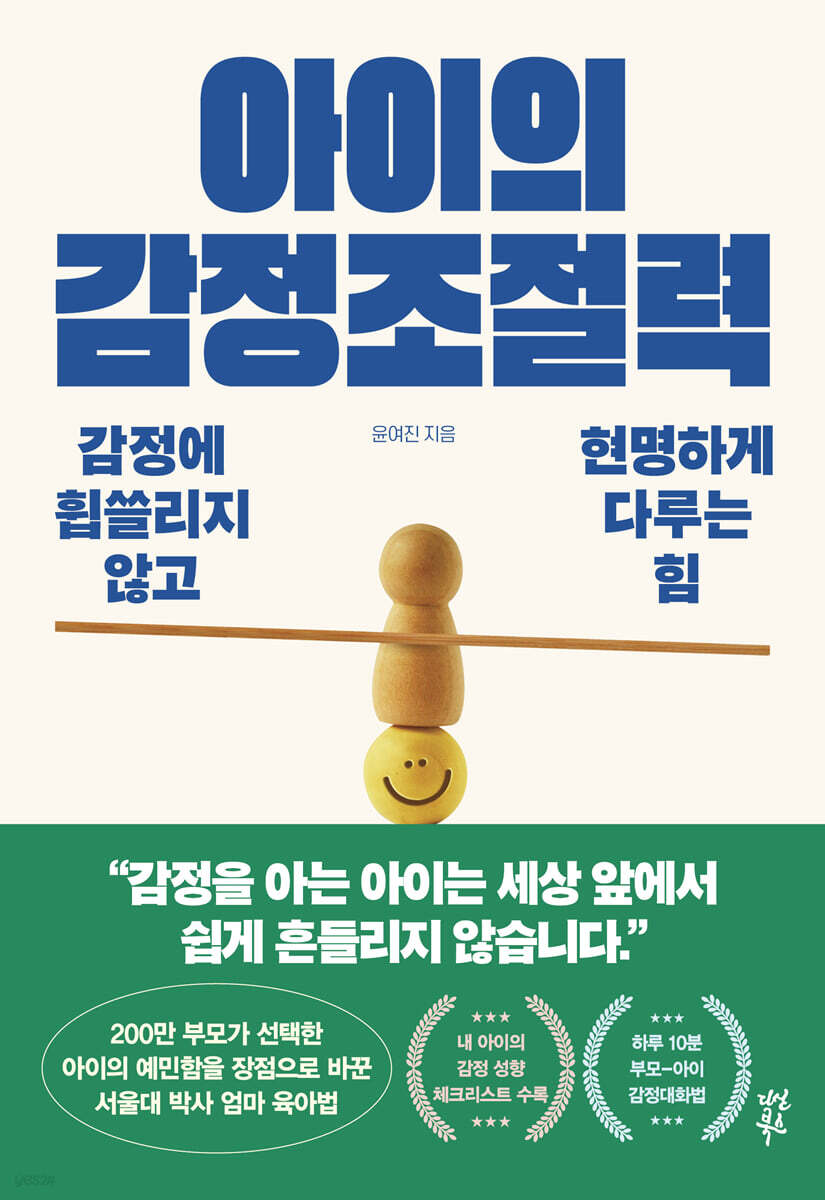
A child's ability to regulate emotions
 |
Description
Book Introduction
“A child who knows emotions is a child who knows the world.
“It doesn’t shake easily.”
The sensitivity of children chosen by 2 million parents
Seoul National University Doctoral Program Turned Parenting Methods into Advantages
Many parents worry, "My child is too sensitive," but the root of the problem lies not in the child themselves, but in the parents' perspective and language. In an age overflowing with AI and stimulating content, what children truly need is not more knowledge, but the ability to manage their emotions.
"Children's Emotional Control" provides specific methods for fostering children's emotional control, based on the psychological insight that emotions are not innate but develop through interactions with parents.
While raising a sensitive son, the author chose to empathize with his emotions and slowly observe them instead of disciplining them. This helped him develop the ability to freely express his emotions and regulate them on his own.
This process was shared through Reels and resonated with countless parents, and this book is a realistic emotional education guide that captures that journey.
It shows the process of parents first understanding their own emotions and matching their emotional frequency with their children to grow together, and presents realistic methods for parents to respond and help their children when their emotions explode.
In the digital and AI era, emotional education is no longer an option but an essential survival skill.
Parents and children develop emotional control skills only through the process of respecting each other's emotions, communicating with each other, and repeating the process.
This book is a must-read for all parents who want to raise their children to be strong and unwavering.
“It doesn’t shake easily.”
The sensitivity of children chosen by 2 million parents
Seoul National University Doctoral Program Turned Parenting Methods into Advantages
Many parents worry, "My child is too sensitive," but the root of the problem lies not in the child themselves, but in the parents' perspective and language. In an age overflowing with AI and stimulating content, what children truly need is not more knowledge, but the ability to manage their emotions.
"Children's Emotional Control" provides specific methods for fostering children's emotional control, based on the psychological insight that emotions are not innate but develop through interactions with parents.
While raising a sensitive son, the author chose to empathize with his emotions and slowly observe them instead of disciplining them. This helped him develop the ability to freely express his emotions and regulate them on his own.
This process was shared through Reels and resonated with countless parents, and this book is a realistic emotional education guide that captures that journey.
It shows the process of parents first understanding their own emotions and matching their emotional frequency with their children to grow together, and presents realistic methods for parents to respond and help their children when their emotions explode.
In the digital and AI era, emotional education is no longer an option but an essential survival skill.
Parents and children develop emotional control skills only through the process of respecting each other's emotions, communicating with each other, and repeating the process.
This book is a must-read for all parents who want to raise their children to be strong and unwavering.
- You can preview some of the book's contents.
Preview
index
To begin with
: Parents are the children's emotional daily instructors.
Part 1: Emotions are a child's lifelong asset.
Chapter 1: Why Emotional Control Is Needed Now
In the AI era, emotional regulation is a survival strategy.
Emotional intelligence determines success and happiness.
Emotional Characteristics of Digital Generation Children
Parents' emotional language shapes their children's world.
Chapter 2: The Unfamiliar Feelings You Experience After Becoming a Parent
Are there any emotions that a mother should feel?
Parenting is a process of becoming friends with your emotions.
The more I understand my feelings, the more comfortable my child becomes.
Chapter 3: Parents' Emotions Shape Their Children's Emotions
What is 'emotional frequency'?
How to align your emotional frequency with your child
Parents are co-regulators of their children's emotions.
Children grow up in the faith of their parents.
The impact of a father's emotional expression on his child
Part 2: How can we help a child who has difficulty expressing his or her emotions?
- Checklist for Understanding Your Child's Emotional Traits
Chapter 4 Why are children's emotions so clumsy and intense?
A sensitive child is a special child.
Why Children Express Their Emotions Explosively
Children learn emotional language from their parents.
How to turn your rich emotions into your own weapon
Chapter 5: Negative Emotions Are a Sign of Child Growth
There are no wrong or incorrect emotions in the world.
Anger is not the end of emotions, but the beginning of the mind.
A mindset that transforms negative emotions into assets for growth.
Chapter 6: The Power of Positive Emotions to Boost Self-Esteem
Emotional intelligence grows from positive emotional experiences.
Emotional stability created by parents' words and actions
Positive Emotions Routine at Home
Part 3: Practical Emotional Coaching for Regulating and Expressing Emotions
Chapter 7: Developing Emotion-Based Sociality
Conflict strengthens relationships.
Empathy, the ability to read and understand the emotions of others
Cooperation and belonging within the family are the roots of self-esteem.
How to develop emotional regulation through play
Chapter 8: 10 minutes, three times a day: A daily routine to nurture your child's emotions.
10 Minutes in the Morning: A Time to Start Your Day with Emotion
10 Minutes After School: A Time for Open-Minded Conversations
10 Minutes Before Bed: Connecting to Reduce Separation Anxiety
In conclusion
: Teaching emotions is not about 'choice' but 'responsibility'
Psychological Insights to Improve Emotional Regulation
: Parents are the children's emotional daily instructors.
Part 1: Emotions are a child's lifelong asset.
Chapter 1: Why Emotional Control Is Needed Now
In the AI era, emotional regulation is a survival strategy.
Emotional intelligence determines success and happiness.
Emotional Characteristics of Digital Generation Children
Parents' emotional language shapes their children's world.
Chapter 2: The Unfamiliar Feelings You Experience After Becoming a Parent
Are there any emotions that a mother should feel?
Parenting is a process of becoming friends with your emotions.
The more I understand my feelings, the more comfortable my child becomes.
Chapter 3: Parents' Emotions Shape Their Children's Emotions
What is 'emotional frequency'?
How to align your emotional frequency with your child
Parents are co-regulators of their children's emotions.
Children grow up in the faith of their parents.
The impact of a father's emotional expression on his child
Part 2: How can we help a child who has difficulty expressing his or her emotions?
- Checklist for Understanding Your Child's Emotional Traits
Chapter 4 Why are children's emotions so clumsy and intense?
A sensitive child is a special child.
Why Children Express Their Emotions Explosively
Children learn emotional language from their parents.
How to turn your rich emotions into your own weapon
Chapter 5: Negative Emotions Are a Sign of Child Growth
There are no wrong or incorrect emotions in the world.
Anger is not the end of emotions, but the beginning of the mind.
A mindset that transforms negative emotions into assets for growth.
Chapter 6: The Power of Positive Emotions to Boost Self-Esteem
Emotional intelligence grows from positive emotional experiences.
Emotional stability created by parents' words and actions
Positive Emotions Routine at Home
Part 3: Practical Emotional Coaching for Regulating and Expressing Emotions
Chapter 7: Developing Emotion-Based Sociality
Conflict strengthens relationships.
Empathy, the ability to read and understand the emotions of others
Cooperation and belonging within the family are the roots of self-esteem.
How to develop emotional regulation through play
Chapter 8: 10 minutes, three times a day: A daily routine to nurture your child's emotions.
10 Minutes in the Morning: A Time to Start Your Day with Emotion
10 Minutes After School: A Time for Open-Minded Conversations
10 Minutes Before Bed: Connecting to Reduce Separation Anxiety
In conclusion
: Teaching emotions is not about 'choice' but 'responsibility'
Psychological Insights to Improve Emotional Regulation
Detailed image

Into the book
There is a difference between being angry and being upset.
There is a difference between being annoyed and being annoyed.
All the emotions we feel are healthy and beautiful signals, but they should not become blades and be turned against others.
If you realize that your anger and frustration are being repeatedly directed at the child you love most in the world, you can't delay any longer.
Now is the time to work together to help your child develop the most important emotional intelligence in life.
Emotions are the language that enriches life and are the greatest gift a parent can give a child.
I hope this book will become the first textbook to help parents who have not yet learned emotions and children who need to learn emotions from now on grow together.
--- From "Starting with │Parents are the daily instructors of their children's emotions"
Children who grow up in homes where parents don't communicate their emotions and mistake suppressing them for "courtesy" and "patience" seek out the easiest and most irritating tools for emotional avoidance.
Children who don't know how to regulate and manage their emotions have no choice but to rely on provocative content and algorithms to resolve complex emotions.
Eventually, the child is left with simple expressions like “I’m annoyed,” “I don’t know,” and “I just don’t like it.”
The problem is that while expressions become increasingly simple, the inner self becomes increasingly complex and matures rapidly.
But that precocity is not true 'maturity', but a 'disguised maturity' created as a result of suppressing and avoiding emotions.
Complex emotions that remain beneath the fragments of simple expressions accumulate inside us without being further broken down or interpreted.
--- From Chapter 1: Why Emotional Control Is Needed Now
Research shows that simply expressing your emotions accurately in words stabilizes your autonomic nervous system and calms the amygdala's response.
The more often you use specific emotional language like “I’m angry,” “I’m sad,” “I’m excited,” and “I’m touched,” the more your brain will be able to interpret and handle situations.
In particular, the more often parents speak emotional language to their children, the more quickly the child's brain connects emotions and situations and creates its own circuits to deal with those emotions.
Learning to express your emotions verbally is the beginning of developing emotional regulation skills.
--- From “Chapter 3: Parents’ Emotions Create Children’s Emotions”
Emotion regulation is not the ability to eliminate or not feel emotions.
This doesn't mean you have to like all emotions.
It refers to the ability to recognize, express, and control unpleasant and uncomfortable emotions and ultimately use them in a way that is beneficial to oneself.
What is needed in this process is not hasty comfort or a change of mood from parents, but rather repetitive learning of language that can clearly recognize emotions and providing a safe space where emotions can be felt comfortably.
As children accumulate these experiences, they develop the ability to observe and regulate their emotions rather than suppress them.
The higher your emotional regulation skills, the more effectively you can use your cognitive resources (attention, memory, problem-solving skills, etc.) even in stressful situations, which in turn leads to learning and social adaptability.
Ultimately, we must become people who can 'pass through' the frustration, anger, and sadness that children feel.
--- From "Chapter 5: Negative Emotions Are a Sign of Child Growth"
Empathy isn't just a virtue for raising "good kids."
It is a survival skill for humans to live as social beings.
Children with high empathy feel more secure in peer relationships, are better at forming supportive relationships, and are better at emotionally managing stress.
Furthermore, empathy is also linked to resilience.
Because children who know the power of empathy and connection can bounce back when they hit a wall in life, get hurt by someone, or experience failure.
--- From "Chapter 7: Developing Emotion-Based Sociality"
What children need is not a 'perfect teacher'.
Parents who want to learn and grow together.
Showing our children that we make mistakes, try again, and don't give up is the most effective emotional education we can provide.
I sincerely thank all the parents who, several times a day, get annoyed with their children, regret it, make new promises, and try to match their emotional frequency.
If small daily efforts accumulate within a child, the child will eventually grow into an adult with the courage to live his or her life boldly.
There is a difference between being annoyed and being annoyed.
All the emotions we feel are healthy and beautiful signals, but they should not become blades and be turned against others.
If you realize that your anger and frustration are being repeatedly directed at the child you love most in the world, you can't delay any longer.
Now is the time to work together to help your child develop the most important emotional intelligence in life.
Emotions are the language that enriches life and are the greatest gift a parent can give a child.
I hope this book will become the first textbook to help parents who have not yet learned emotions and children who need to learn emotions from now on grow together.
--- From "Starting with │Parents are the daily instructors of their children's emotions"
Children who grow up in homes where parents don't communicate their emotions and mistake suppressing them for "courtesy" and "patience" seek out the easiest and most irritating tools for emotional avoidance.
Children who don't know how to regulate and manage their emotions have no choice but to rely on provocative content and algorithms to resolve complex emotions.
Eventually, the child is left with simple expressions like “I’m annoyed,” “I don’t know,” and “I just don’t like it.”
The problem is that while expressions become increasingly simple, the inner self becomes increasingly complex and matures rapidly.
But that precocity is not true 'maturity', but a 'disguised maturity' created as a result of suppressing and avoiding emotions.
Complex emotions that remain beneath the fragments of simple expressions accumulate inside us without being further broken down or interpreted.
--- From Chapter 1: Why Emotional Control Is Needed Now
Research shows that simply expressing your emotions accurately in words stabilizes your autonomic nervous system and calms the amygdala's response.
The more often you use specific emotional language like “I’m angry,” “I’m sad,” “I’m excited,” and “I’m touched,” the more your brain will be able to interpret and handle situations.
In particular, the more often parents speak emotional language to their children, the more quickly the child's brain connects emotions and situations and creates its own circuits to deal with those emotions.
Learning to express your emotions verbally is the beginning of developing emotional regulation skills.
--- From “Chapter 3: Parents’ Emotions Create Children’s Emotions”
Emotion regulation is not the ability to eliminate or not feel emotions.
This doesn't mean you have to like all emotions.
It refers to the ability to recognize, express, and control unpleasant and uncomfortable emotions and ultimately use them in a way that is beneficial to oneself.
What is needed in this process is not hasty comfort or a change of mood from parents, but rather repetitive learning of language that can clearly recognize emotions and providing a safe space where emotions can be felt comfortably.
As children accumulate these experiences, they develop the ability to observe and regulate their emotions rather than suppress them.
The higher your emotional regulation skills, the more effectively you can use your cognitive resources (attention, memory, problem-solving skills, etc.) even in stressful situations, which in turn leads to learning and social adaptability.
Ultimately, we must become people who can 'pass through' the frustration, anger, and sadness that children feel.
--- From "Chapter 5: Negative Emotions Are a Sign of Child Growth"
Empathy isn't just a virtue for raising "good kids."
It is a survival skill for humans to live as social beings.
Children with high empathy feel more secure in peer relationships, are better at forming supportive relationships, and are better at emotionally managing stress.
Furthermore, empathy is also linked to resilience.
Because children who know the power of empathy and connection can bounce back when they hit a wall in life, get hurt by someone, or experience failure.
--- From "Chapter 7: Developing Emotion-Based Sociality"
What children need is not a 'perfect teacher'.
Parents who want to learn and grow together.
Showing our children that we make mistakes, try again, and don't give up is the most effective emotional education we can provide.
I sincerely thank all the parents who, several times a day, get annoyed with their children, regret it, make new promises, and try to match their emotional frequency.
If small daily efforts accumulate within a child, the child will eventually grow into an adult with the courage to live his or her life boldly.
--- From "In conclusion│Teaching emotions is not 'choice' but 'responsibility'"
Publisher's Review
“When you listen to your child’s heart rather than his words,
“The child becomes more flexible and bolder in the world.”
Ph.D., Seoul National University & Full-time Professor, Korea Enneagram Education Research Institute
Emotional Coaching Know-How from a Mom Who Studied Psychology and Brain Science
When raising a child, you often see them crying all day, throwing tantrums, easily bursting into tears over trivial things, and getting angry for no reason.
In these situations, parents often say, “It’s okay, stop it,” but these words can leave a child with the experience of being emotionally neglected.
A child's emotional education begins with their relationship with their parents.
The reason many parents find this difficult is because they focus only on their child's emotions and neglect their own.
This book guides parents to learn to recognize and express their own emotions before teaching them to their children.
"Children's Emotional Control" is a book that started from these concerns.
The author emphasizes that emotions are not innate but rather a skill that must be learned, and that parents are the first teachers in that learning.
In particular, it sharply points out the distortion and suppression of emotions that occur when defining a child's emotions with negative language such as "sensitive" or "cry-like," and the influence of parents' words on the child's emotional world, based on research in brain science and psychology.
The author also experienced the emotional warfare of raising a child with severe emotional ups and downs, such as refusal to go to school, separation anxiety, and tantrums.
As a parent, rather than suppressing or controlling my child's emotions, I chose to slowly look into my child's inner thoughts and work with him to sort out his emotions. As a result, my child grew up to be able to freely express his emotions and enjoy school life.
Since then, the author has consistently introduced practical parenting methods that combine child emotional education and parent emotional coaching, and has begun to gain sympathy and attention from many parents through reel videos filled with vivid experiences and know-how.
The book is also full of practical ways to foster a healthy emotional world for children.
It explains the characteristics of emotional development according to age and presents specific and realistic methods for parents to understand and provide appropriate support.
It teaches you how to deal with emotions through short 10-minute routines in your daily life, such as 'in the morning', 'after school', and 'before going to bed', and also introduces customized conversation methods and play methods appropriate to the situation when you feel 'anger', 'jealousy', or 'anxiety'.
“The inner strength that sustains a child throughout his or her life,
“Starting today, help your child develop emotional control skills!”
From emotional tendencies checklists to coping strategies for crying, irritation, and anger.
Includes practical conversations and games that develop social skills and self-control.
Reality-Based! Everything You Need to Know About Mom's Emotional Coaching
As the digital and AI era begins in earnest, the importance of emotional education is rapidly increasing along with the problem of emotional deficiency.
In particular, Generation Alpha, who grew up in a digital environment, has excellent language and information processing skills, but is relatively weak in emotional communication and emotional expression.
Accordingly, parents' concerns about children who are 'unable to express their emotions' and 'children who lack empathy' are deepening, and emotional education is no longer a choice but a 'survival skill'.
In this current, the 'emotion-centered parenting method', where parents first understand and manage their own emotions, and then share and grow emotions with their children, will become the core of child education in the future.
Emotional control doesn't come naturally.
It is a strength that is slowly cultivated through time spent respecting and communicating with emotions and repeating the process.
In an age where knowledge is replaced by search and technology by artificial intelligence, the true power that allows children to protect themselves in the world is the ability to read and manage emotions and build relationships.
"Children's Emotional Control" is a warm and honest guide to emotional education for parents who want to raise children who are strong and unwavering, and for all parents who want to grow into better people along with their children.
“The child becomes more flexible and bolder in the world.”
Ph.D., Seoul National University & Full-time Professor, Korea Enneagram Education Research Institute
Emotional Coaching Know-How from a Mom Who Studied Psychology and Brain Science
When raising a child, you often see them crying all day, throwing tantrums, easily bursting into tears over trivial things, and getting angry for no reason.
In these situations, parents often say, “It’s okay, stop it,” but these words can leave a child with the experience of being emotionally neglected.
A child's emotional education begins with their relationship with their parents.
The reason many parents find this difficult is because they focus only on their child's emotions and neglect their own.
This book guides parents to learn to recognize and express their own emotions before teaching them to their children.
"Children's Emotional Control" is a book that started from these concerns.
The author emphasizes that emotions are not innate but rather a skill that must be learned, and that parents are the first teachers in that learning.
In particular, it sharply points out the distortion and suppression of emotions that occur when defining a child's emotions with negative language such as "sensitive" or "cry-like," and the influence of parents' words on the child's emotional world, based on research in brain science and psychology.
The author also experienced the emotional warfare of raising a child with severe emotional ups and downs, such as refusal to go to school, separation anxiety, and tantrums.
As a parent, rather than suppressing or controlling my child's emotions, I chose to slowly look into my child's inner thoughts and work with him to sort out his emotions. As a result, my child grew up to be able to freely express his emotions and enjoy school life.
Since then, the author has consistently introduced practical parenting methods that combine child emotional education and parent emotional coaching, and has begun to gain sympathy and attention from many parents through reel videos filled with vivid experiences and know-how.
The book is also full of practical ways to foster a healthy emotional world for children.
It explains the characteristics of emotional development according to age and presents specific and realistic methods for parents to understand and provide appropriate support.
It teaches you how to deal with emotions through short 10-minute routines in your daily life, such as 'in the morning', 'after school', and 'before going to bed', and also introduces customized conversation methods and play methods appropriate to the situation when you feel 'anger', 'jealousy', or 'anxiety'.
“The inner strength that sustains a child throughout his or her life,
“Starting today, help your child develop emotional control skills!”
From emotional tendencies checklists to coping strategies for crying, irritation, and anger.
Includes practical conversations and games that develop social skills and self-control.
Reality-Based! Everything You Need to Know About Mom's Emotional Coaching
As the digital and AI era begins in earnest, the importance of emotional education is rapidly increasing along with the problem of emotional deficiency.
In particular, Generation Alpha, who grew up in a digital environment, has excellent language and information processing skills, but is relatively weak in emotional communication and emotional expression.
Accordingly, parents' concerns about children who are 'unable to express their emotions' and 'children who lack empathy' are deepening, and emotional education is no longer a choice but a 'survival skill'.
In this current, the 'emotion-centered parenting method', where parents first understand and manage their own emotions, and then share and grow emotions with their children, will become the core of child education in the future.
Emotional control doesn't come naturally.
It is a strength that is slowly cultivated through time spent respecting and communicating with emotions and repeating the process.
In an age where knowledge is replaced by search and technology by artificial intelligence, the true power that allows children to protect themselves in the world is the ability to read and manage emotions and build relationships.
"Children's Emotional Control" is a warm and honest guide to emotional education for parents who want to raise children who are strong and unwavering, and for all parents who want to grow into better people along with their children.
GOODS SPECIFICS
- Date of issue: August 21, 2025
- Page count, weight, size: 360 pages | 705g | 145*210*30mm
- ISBN13: 9791130669427
- ISBN10: 1130669424
You may also like
카테고리
korean


korean

![GQ KOREA Mark (Monthly): December [2025]](http://librairie.coreenne.fr/cdn/shop/files/8ef265dbbfbf186523ed75ba7319009d.jpg?v=1765340328&width=3840)


