

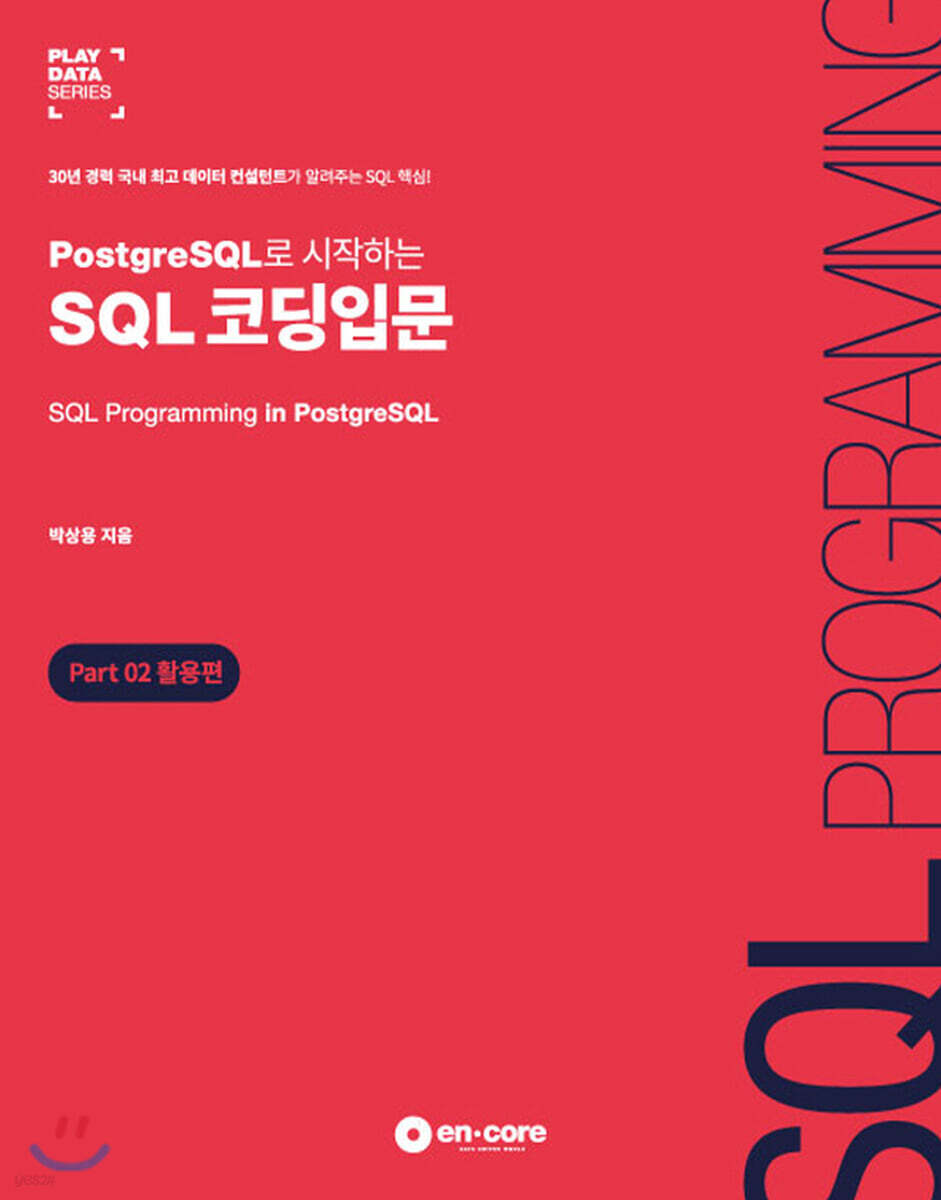
Introduction to SQL Coding with PostgreSQL Part 02: Utilization
 |
Description
Book Introduction
Everyone has a similar feeling when they first encounter a database.
Where should I start? What should I learn? Wouldn't it be great if there was someone experienced right next to me, kindly explaining everything step by step and guiding me along the way? While Googling can provide a wealth of information, fragmented knowledge can be a distant prospect for beginners.
For beginners and non-majors in need of a guide that will provide systematic knowledge and step-by-step learning, as well as entry-level developers who need to develop database-based applications, this book will be a valuable guide that will guide you into the world of SQL with joy.
Where should I start? What should I learn? Wouldn't it be great if there was someone experienced right next to me, kindly explaining everything step by step and guiding me along the way? While Googling can provide a wealth of information, fragmented knowledge can be a distant prospect for beginners.
For beginners and non-majors in need of a guide that will provide systematic knowledge and step-by-step learning, as well as entry-level developers who need to develop database-based applications, this book will be a valuable guide that will guide you into the world of SQL with joy.
index
Chapter 1. Improving SQL Utilization
1.1 Processing of query results
1.1.1 Sorting search results
1.1.2 Limiting search results
1.1.3 Row-level operations using functions
1.1.4 VALUES List
1.2 Data Grouping
1.2.1 GROUP BY
1.2.2 HAVING
1.3 Using Aggregate Functions
1.3.1 COUNT function
1.3.2 SUM function
1.3.3 AVG function
1.3.4 MIN function
1.3.5 MAX function
1.3.6 DISTINCT function
1.4 Subquery
1.4.1 What is a subquery?
1.4.2 Single-row subqueries
1.4.3 Multi-row subqueries
1.4.4 Multi-column subqueries
1.4.5 Correlated Subqueries
1.4.6 Scalar Subqueries
1.4.7 WITH Subquery (Common Table Expression)
1.4.8 Inline Views and Derived Tables
1.5 Set operations
1.6 Hierarchical querying of data
Chapter 2.
Challenge! Level Up Your SQL
2.1 Listing multiple rows of results in one row
2.1.1 Column Value Concatenation
2.1.2 How to convert rows to columns, Pivot
2.2 Converting a single row to multiple rows
2.2.1 Converting strings listed in one column to multiple rows
2.2.2 Converting multiple columns in a single row to multiple rows, UNPIVOT
2.3 Calculating subtotals and totals using group functions
2.3.1 ROLLUP
2.3.2 CUBE
2.3.3 Grouping Sets
2.4 Understanding and Using Window Functions
2.5 Page Processing
2.6 Complex DML statements
2.6.1 INSERT using SELECT statement
2.6.2 UPDATE and DELETE using SELECT statements
2.6.3 UPDATE via JOIN
2.6.4 Single Table DELETE via JOIN
2.6.5 Multi-table INSERT
2.6.6 Multi-table UPDATE
2.6.7 Multi-Table DELETE
2.6.8 Processing multiple DMLs at once
2.6.9 UPDATE and INSERT branch processing based on data presence
1.1 Processing of query results
1.1.1 Sorting search results
1.1.2 Limiting search results
1.1.3 Row-level operations using functions
1.1.4 VALUES List
1.2 Data Grouping
1.2.1 GROUP BY
1.2.2 HAVING
1.3 Using Aggregate Functions
1.3.1 COUNT function
1.3.2 SUM function
1.3.3 AVG function
1.3.4 MIN function
1.3.5 MAX function
1.3.6 DISTINCT function
1.4 Subquery
1.4.1 What is a subquery?
1.4.2 Single-row subqueries
1.4.3 Multi-row subqueries
1.4.4 Multi-column subqueries
1.4.5 Correlated Subqueries
1.4.6 Scalar Subqueries
1.4.7 WITH Subquery (Common Table Expression)
1.4.8 Inline Views and Derived Tables
1.5 Set operations
1.6 Hierarchical querying of data
Chapter 2.
Challenge! Level Up Your SQL
2.1 Listing multiple rows of results in one row
2.1.1 Column Value Concatenation
2.1.2 How to convert rows to columns, Pivot
2.2 Converting a single row to multiple rows
2.2.1 Converting strings listed in one column to multiple rows
2.2.2 Converting multiple columns in a single row to multiple rows, UNPIVOT
2.3 Calculating subtotals and totals using group functions
2.3.1 ROLLUP
2.3.2 CUBE
2.3.3 Grouping Sets
2.4 Understanding and Using Window Functions
2.5 Page Processing
2.6 Complex DML statements
2.6.1 INSERT using SELECT statement
2.6.2 UPDATE and DELETE using SELECT statements
2.6.3 UPDATE via JOIN
2.6.4 Single Table DELETE via JOIN
2.6.5 Multi-table INSERT
2.6.6 Multi-table UPDATE
2.6.7 Multi-Table DELETE
2.6.8 Processing multiple DMLs at once
2.6.9 UPDATE and INSERT branch processing based on data presence
Detailed image
.jpg)
GOODS SPECIFICS
- Publication date: November 15, 2019
- Page count, weight, size: 279 pages | 694g | 190*240*20mm
- ISBN13: 9788995447468
- ISBN10: 899544746X
You may also like
카테고리
korean


korean

![GQ KOREA Mark (Monthly): December [2025]](http://librairie.coreenne.fr/cdn/shop/files/8ef265dbbfbf186523ed75ba7319009d.jpg?v=1765340328&width=3840)


