

Do it! Introduction to the C Language
 |
Description
Book Introduction
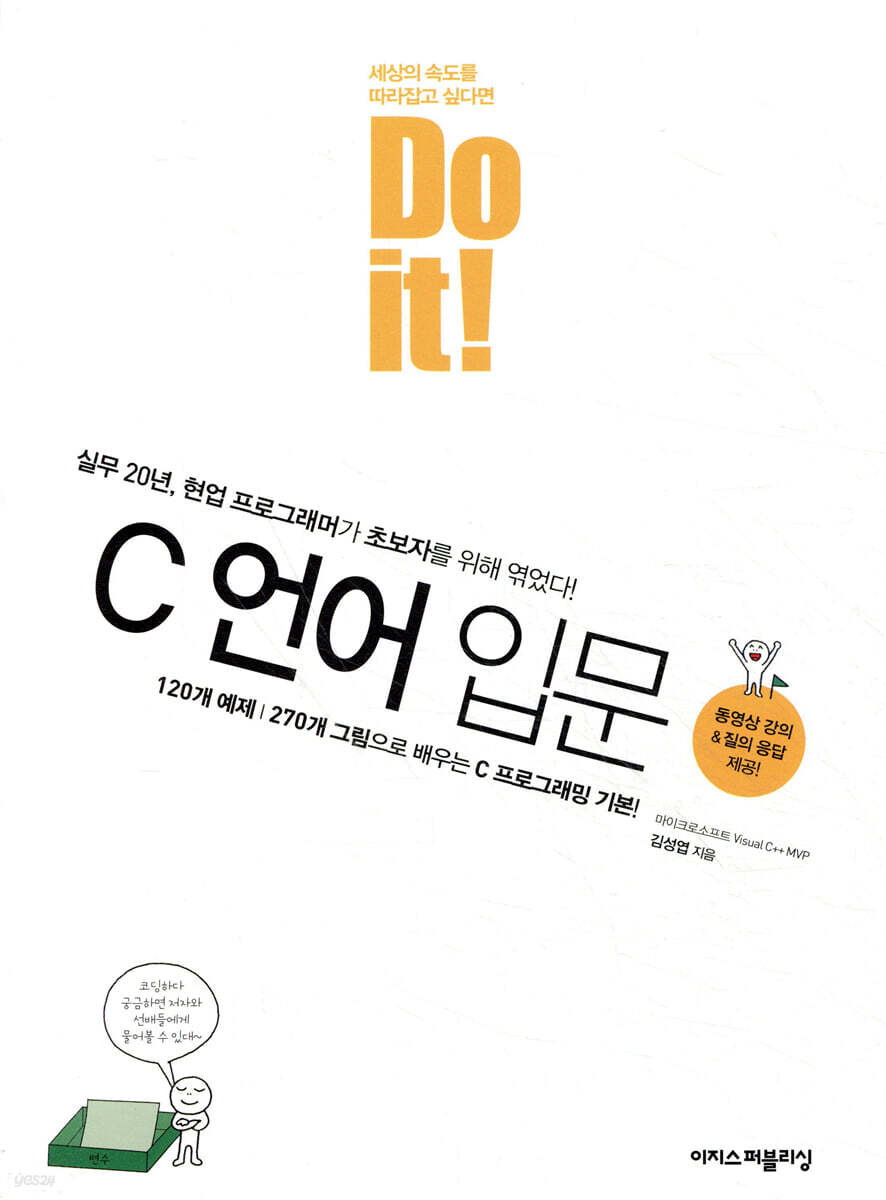
If you don't know why you're using it, it's meaningless! An introductory guide to help you avoid double-crossing!
With 20 years of practical experience and 10 years of teaching experience, a working programmer will teach you the basics!
A person who uses only the results can never catch up with a person who uses only the principles.
The starting point for starting the C language is the same, but if you understand the principles of why each grammar point of the C language was created and then code, it is different.
You'll be confident in your programming job interview and won't hear people say, "You have to start over again!"
"Do it! Introduction to C" introduces the fundamental principles of programming with 270 illustrations, teaches hands-on coding with 120 examples, and helps you immediately digest the concepts you just learned with one-minute quizzes.
Are you afraid of starting out on your own? Don't worry! In the author's online community, you can meet not only the author but also other seniors who have already studied C.
Stop struggling alone while coding and start with this book that has a corner to help you learn!
With 20 years of practical experience and 10 years of teaching experience, a working programmer will teach you the basics!
A person who uses only the results can never catch up with a person who uses only the principles.
The starting point for starting the C language is the same, but if you understand the principles of why each grammar point of the C language was created and then code, it is different.
You'll be confident in your programming job interview and won't hear people say, "You have to start over again!"
"Do it! Introduction to C" introduces the fundamental principles of programming with 270 illustrations, teaches hands-on coding with 120 examples, and helps you immediately digest the concepts you just learned with one-minute quizzes.
Are you afraid of starting out on your own? Don't worry! In the author's online community, you can meet not only the author but also other seniors who have already studied C.
Stop struggling alone while coding and start with this book that has a corner to help you learn!
- You can preview some of the book's contents.
Preview
index
First Yard C Language Basic Grammar
01 Program and C Language
01-1 Programming Basics
01-2 Introduction to the C Language
01-3 Electronic Calculator Principles and Programming Concepts
01-4 C language description format
01-5 C program executable file
02 The first program created in C language
02-1 Setting up a C language development environment
02-2 Creating a Visual Studio Project
02-3 The first program I made
03 Data type
03-1 How computers store data
03-2 A convention for expressing characters as numbers, ASCII code
03-3 Types of data types
04 Constants and Variables
04-1 Always the same number, constant
04-2 Data storage space, variables
04-3 How to convert binary to hexadecimal
05 Function
05-1 C Language and Functions
05-2 Defining and calling functions
05-3 Organizing the main function
05-4 Declaring a function prototype
06 Standard Output Function
06-1 Library
06-2 Library User Manual, Header File
06-3 Preprocessor
06-4 C Standard Library and Standard Output Functions
06-5 String output function printf
07 Operator
07-1 Basic Operators
07-2 Operator Precedence and Operation Direction
08 Conditional statement
08-1 Control statement
08-2 if conditional statement
08-3 if ~ else ~ conditional statement
08-4 Nested if conditional statements
08-5 switch conditional statement
09 Loop
09-1 Basic structure of loops and for loops
09-2 while loop
09-3 How to construct a loop
09-4 Nested loops
09-5 Break and Continue Control Statements
10 Shift Operators and Bitwise Operators
10-1 Bit-wise operations and bit patterns
10-2 Shift Operator
10-3 bit operators
11 Local and global variables
11-1 Local variables used only within functions
11-2 Global variables used throughout the program
11-3 extern keyword
11-4 static keyword
On-site reporting
Five Tips to Get Rid of the Junior Programmer Tag!
Completing the Second Yard C Language
12 Arrays and Strings
12-1 array
12-2 string
12-3 Two-dimensional array
13 pointers
13-1 Memory management method of the operating system
13-2 pointer
13-3 Pointers and the const keyword
13-4 Address operation of pointer variables
13-5 Pointer and target size
13-6 void * type pointer
14 Standard Input Functions
14-1 Standard Input Functions
14-2 Character and string input functions
14-3 Converting a string to an integer
14-4 Standard input function scanf
15 Arrays and Pointers
15-1 Array and Pointer Notation
15-2 Array start address
Pointers using arrays 15-3
15-4 Combination of arrays and pointers
16 Memory allocation
16-1 Processes and Memory Allocation
16-2 Local Variables and the Stack
16-3 Dynamic memory allocation and deallocation
16-4 Using dynamic memory
17 Multidimensional Pointers
17-1 Multidimensional Pointer Concept
17-2 Two-dimensional pointer
17-3 Two-dimensional pointers and function parameters
17-4 Two-dimensional pointers and two-dimensional arrays
18 Structures and Linked Lists
18-1 typedef syntax
18-2 Structure that groups data
18-3 Arrays and Structures
18-4 Size of data type created with structure
Linked list using 18-5 structure
19 File Input/Output
19-1 Standard Input/Output Library
19-2 Text files and binary files
19-3 Opening and Closing Files
19-4 Reading and writing data to text files
19-5 Reading and writing data to binary files
20 function pointers
20-1 Function Pointer
20-2 Function Group
20-3 Callback function
On-site reporting
Seven Tips to Get Rid of the Junior Programmer Tag!
01 Program and C Language
01-1 Programming Basics
01-2 Introduction to the C Language
01-3 Electronic Calculator Principles and Programming Concepts
01-4 C language description format
01-5 C program executable file
02 The first program created in C language
02-1 Setting up a C language development environment
02-2 Creating a Visual Studio Project
02-3 The first program I made
03 Data type
03-1 How computers store data
03-2 A convention for expressing characters as numbers, ASCII code
03-3 Types of data types
04 Constants and Variables
04-1 Always the same number, constant
04-2 Data storage space, variables
04-3 How to convert binary to hexadecimal
05 Function
05-1 C Language and Functions
05-2 Defining and calling functions
05-3 Organizing the main function
05-4 Declaring a function prototype
06 Standard Output Function
06-1 Library
06-2 Library User Manual, Header File
06-3 Preprocessor
06-4 C Standard Library and Standard Output Functions
06-5 String output function printf
07 Operator
07-1 Basic Operators
07-2 Operator Precedence and Operation Direction
08 Conditional statement
08-1 Control statement
08-2 if conditional statement
08-3 if ~ else ~ conditional statement
08-4 Nested if conditional statements
08-5 switch conditional statement
09 Loop
09-1 Basic structure of loops and for loops
09-2 while loop
09-3 How to construct a loop
09-4 Nested loops
09-5 Break and Continue Control Statements
10 Shift Operators and Bitwise Operators
10-1 Bit-wise operations and bit patterns
10-2 Shift Operator
10-3 bit operators
11 Local and global variables
11-1 Local variables used only within functions
11-2 Global variables used throughout the program
11-3 extern keyword
11-4 static keyword
On-site reporting
Five Tips to Get Rid of the Junior Programmer Tag!
Completing the Second Yard C Language
12 Arrays and Strings
12-1 array
12-2 string
12-3 Two-dimensional array
13 pointers
13-1 Memory management method of the operating system
13-2 pointer
13-3 Pointers and the const keyword
13-4 Address operation of pointer variables
13-5 Pointer and target size
13-6 void * type pointer
14 Standard Input Functions
14-1 Standard Input Functions
14-2 Character and string input functions
14-3 Converting a string to an integer
14-4 Standard input function scanf
15 Arrays and Pointers
15-1 Array and Pointer Notation
15-2 Array start address
Pointers using arrays 15-3
15-4 Combination of arrays and pointers
16 Memory allocation
16-1 Processes and Memory Allocation
16-2 Local Variables and the Stack
16-3 Dynamic memory allocation and deallocation
16-4 Using dynamic memory
17 Multidimensional Pointers
17-1 Multidimensional Pointer Concept
17-2 Two-dimensional pointer
17-3 Two-dimensional pointers and function parameters
17-4 Two-dimensional pointers and two-dimensional arrays
18 Structures and Linked Lists
18-1 typedef syntax
18-2 Structure that groups data
18-3 Arrays and Structures
18-4 Size of data type created with structure
Linked list using 18-5 structure
19 File Input/Output
19-1 Standard Input/Output Library
19-2 Text files and binary files
19-3 Opening and Closing Files
19-4 Reading and writing data to text files
19-5 Reading and writing data to binary files
20 function pointers
20-1 Function Pointer
20-2 Function Group
20-3 Callback function
On-site reporting
Seven Tips to Get Rid of the Junior Programmer Tag!
Detailed image
Publisher's Review
Learn C programming fundamentals with 120 examples and 270 illustrations!
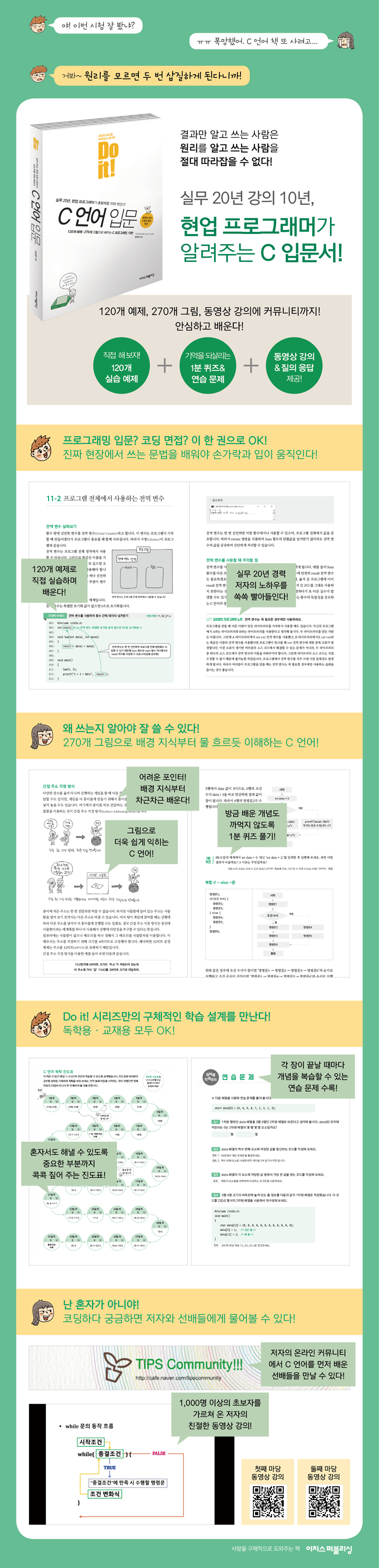
Knowing "why" you're using it can help you use it "well"! Understanding the C language from background knowledge is as easy as flowing water!
There are surprisingly many people who learn all the C language grammar but cannot write a single line of code.
Because I only learned how to use grammar without understanding the principles.
This book continuously asks the question, "Why?" and explains the background knowledge of the C language grammar step by step.
Building a foundation of C language concepts in your head based on background knowledge will prevent you from stuttering when you actually pick up the keyboard and start coding.
Additionally, the 270 diagrams and illustrations, created through extensive research by the author and editorial staff, help readers more easily understand why the grammatical elements of the C language were created.
Coding Interview! Start with grammar used in "real-world" situations to get your fingers and mouth moving!
Companies are increasingly using coding interviews when hiring new developers.
However, among the C language grammar, there are many grammars that only appear in grammar books and are not actually used in real-world situations.
If you study everything without understanding its importance, it will only be a waste of time.
This book quickly organizes parts that can be intuitively understood and explains in detail grammar that is frequently used in actual fields.
Additionally, the book includes the author's practical know-how and tips for junior programmers working in the field.
It will also be very useful in interviews.
You're not alone! If you have any questions about coding, ask the author and your peers to learn!
It's really hard for beginners to figure out why their self-made programs aren't working and what they're doing wrong.
But readers of this book are by no means alone.
In the author's online community (cafe.naver.com/tipscommunity), the author and seniors who studied the C language first answer readers' questions.
In particular, if you solve the 'utilization problems' included at the end of each chapter of the second yard and post your answers to the community, you can even receive feedback on your code.
Discover the Do It! series' unique learning design! Suitable for both self-study and textbook use!
Start learning C language on your own with a 31-day completion progress chart and video lectures!
C language is not difficult.
It just feels difficult because of the unfamiliar expressions.
The 31-day progress chart provided in this book helps you study systematically by pointing out difficult and important parts.
Additionally, the author's friendly video lectures, which have taught over 1,000 beginners, are available online for free for life.
120 practice examples + 1-minute review quizzes + practice problems, making it ideal as a textbook for academies or universities!
It can be difficult to understand the C language grammar explanation just by looking at it.
This book stands out for its learning design, which makes it easy to learn difficult C grammar and not forget it.
We provide thorough explanations from Visual Studio installation to development environment setup, allowing you to practice coding examples that help you understand grammar.
In this book, a one-minute quiz is always included right after each important concept or example.
Let's make sure to solve the problems so that we don't forget the concepts we just learned.
Finally, it also includes practice problems at the end of each chapter to review the concepts, making it suitable for use as a textbook in academies or universities.
Knowing "why" you're using it can help you use it "well"! Understanding the C language from background knowledge is as easy as flowing water!
There are surprisingly many people who learn all the C language grammar but cannot write a single line of code.
Because I only learned how to use grammar without understanding the principles.
This book continuously asks the question, "Why?" and explains the background knowledge of the C language grammar step by step.
Building a foundation of C language concepts in your head based on background knowledge will prevent you from stuttering when you actually pick up the keyboard and start coding.
Additionally, the 270 diagrams and illustrations, created through extensive research by the author and editorial staff, help readers more easily understand why the grammatical elements of the C language were created.
Coding Interview! Start with grammar used in "real-world" situations to get your fingers and mouth moving!
Companies are increasingly using coding interviews when hiring new developers.
However, among the C language grammar, there are many grammars that only appear in grammar books and are not actually used in real-world situations.
If you study everything without understanding its importance, it will only be a waste of time.
This book quickly organizes parts that can be intuitively understood and explains in detail grammar that is frequently used in actual fields.
Additionally, the book includes the author's practical know-how and tips for junior programmers working in the field.
It will also be very useful in interviews.
You're not alone! If you have any questions about coding, ask the author and your peers to learn!
It's really hard for beginners to figure out why their self-made programs aren't working and what they're doing wrong.
But readers of this book are by no means alone.
In the author's online community (cafe.naver.com/tipscommunity), the author and seniors who studied the C language first answer readers' questions.
In particular, if you solve the 'utilization problems' included at the end of each chapter of the second yard and post your answers to the community, you can even receive feedback on your code.
Discover the Do It! series' unique learning design! Suitable for both self-study and textbook use!
Start learning C language on your own with a 31-day completion progress chart and video lectures!
C language is not difficult.
It just feels difficult because of the unfamiliar expressions.
The 31-day progress chart provided in this book helps you study systematically by pointing out difficult and important parts.
Additionally, the author's friendly video lectures, which have taught over 1,000 beginners, are available online for free for life.
120 practice examples + 1-minute review quizzes + practice problems, making it ideal as a textbook for academies or universities!
It can be difficult to understand the C language grammar explanation just by looking at it.
This book stands out for its learning design, which makes it easy to learn difficult C grammar and not forget it.
We provide thorough explanations from Visual Studio installation to development environment setup, allowing you to practice coding examples that help you understand grammar.
In this book, a one-minute quiz is always included right after each important concept or example.
Let's make sure to solve the problems so that we don't forget the concepts we just learned.
Finally, it also includes practice problems at the end of each chapter to review the concepts, making it suitable for use as a textbook in academies or universities.
GOODS SPECIFICS
- Date of issue: January 10, 2017
- Page count, weight, size: 576 pages | 1,183g | 188*257*22mm
- ISBN13: 9791187370703
You may also like
카테고리
korean


korean

![GQ KOREA Mark (Monthly): December [2025]](http://librairie.coreenne.fr/cdn/shop/files/8ef265dbbfbf186523ed75ba7319009d.jpg?v=1765340328&width=3840)


