

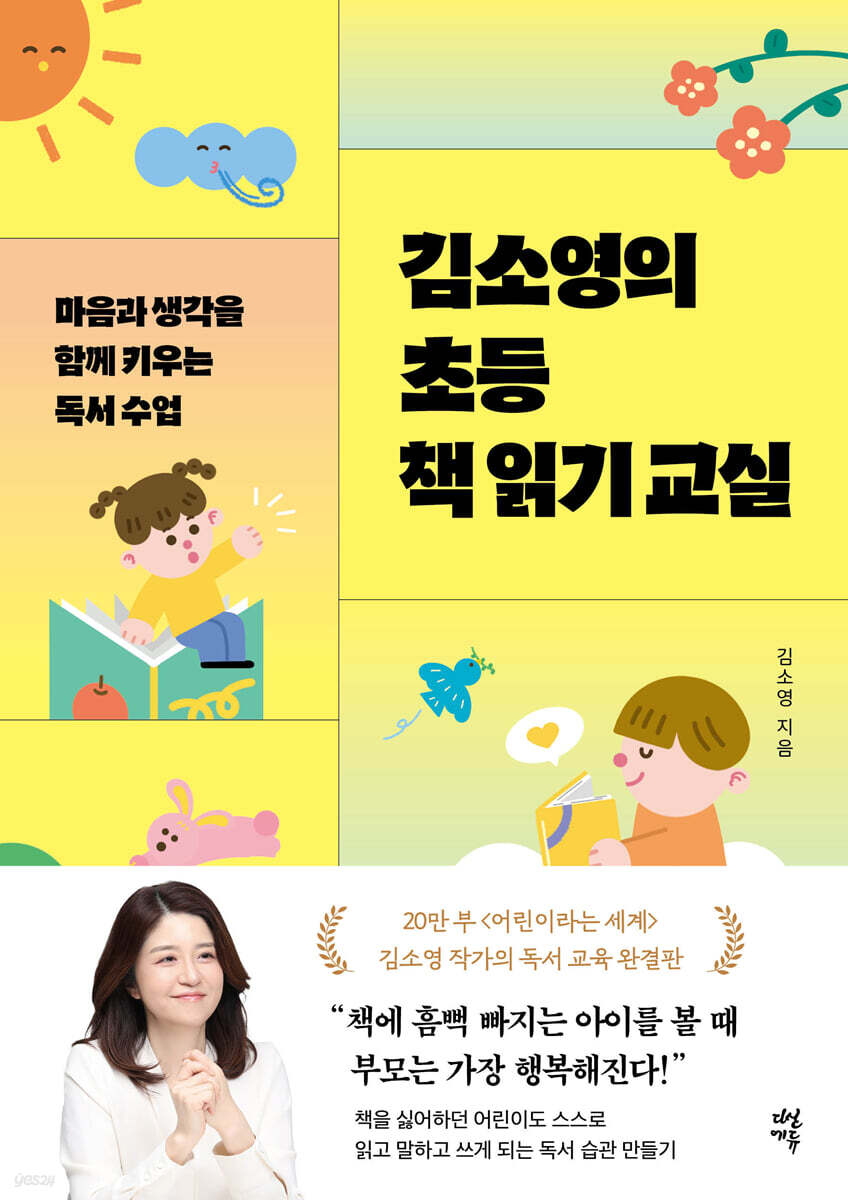
Kim So-young's Elementary Reading Class
 |
Description
Book Introduction
“Parents are happiest when they see their children absorbed in books!”
* The complete reading education edition of Kim So-young's "The World of Children," which sold 200,000 copies
How can we get our children to love books? These days, most parents have similar concerns.
The child is not reading the book.
While interest in literacy is growing day by day, children and books are becoming more and more distant.
In today's world, where there are so many things more interesting than books, such as reels and YouTube videos that provide immediate stimulation, what children need most is a 'reading habit' that makes them love books.
Reading books because you like them, not because someone told you to, is more powerful than any other education.
Author Kim So-young, a reading education expert and reading classroom teacher, has spent 25 years reading with children, teaching them how to read, and striving to help them immerse themselves in the world of reading.
The author says that the most necessary skill for children these days is 'reading'.
This is because books are the most important tool that can guide children to utilize diverse media appropriately and confidently face the coming era.
This book is a revised and expanded edition of 『Speaking Reading Method』 published in 2019.
Since the first edition was published, it contains all the know-how to help children become proficient in reading, speaking, and writing in a reading environment that has changed.
In particular, the table of contents has been reorganized to enable more intuitive learning of reading methods for each genre, such as picture books, children's books, fairy tales, and knowledge books, and various reading activities are introduced to help make reading a habit.
This book expands upon the educational program taught directly by the author in the reading classroom, making reading education easy and fun at home with just one book.
The author says that children's reading does not end with simply 'reading'.
It is absolutely necessary to 'speak' what you read with your parents and 'write' what you say.
The moment children begin to enjoy reading and develop a love for books, they grow into active readers.
This book will be your first reading lesson to kill two birds with one stone: from developing good reading habits to improving your learning ability by becoming proficient at reading and speaking.
* The complete reading education edition of Kim So-young's "The World of Children," which sold 200,000 copies
How can we get our children to love books? These days, most parents have similar concerns.
The child is not reading the book.
While interest in literacy is growing day by day, children and books are becoming more and more distant.
In today's world, where there are so many things more interesting than books, such as reels and YouTube videos that provide immediate stimulation, what children need most is a 'reading habit' that makes them love books.
Reading books because you like them, not because someone told you to, is more powerful than any other education.
Author Kim So-young, a reading education expert and reading classroom teacher, has spent 25 years reading with children, teaching them how to read, and striving to help them immerse themselves in the world of reading.
The author says that the most necessary skill for children these days is 'reading'.
This is because books are the most important tool that can guide children to utilize diverse media appropriately and confidently face the coming era.
This book is a revised and expanded edition of 『Speaking Reading Method』 published in 2019.
Since the first edition was published, it contains all the know-how to help children become proficient in reading, speaking, and writing in a reading environment that has changed.
In particular, the table of contents has been reorganized to enable more intuitive learning of reading methods for each genre, such as picture books, children's books, fairy tales, and knowledge books, and various reading activities are introduced to help make reading a habit.
This book expands upon the educational program taught directly by the author in the reading classroom, making reading education easy and fun at home with just one book.
The author says that children's reading does not end with simply 'reading'.
It is absolutely necessary to 'speak' what you read with your parents and 'write' what you say.
The moment children begin to enjoy reading and develop a love for books, they grow into active readers.
This book will be your first reading lesson to kill two birds with one stone: from developing good reading habits to improving your learning ability by becoming proficient at reading and speaking.
- You can preview some of the book's contents.
Preview
index
Preface: To lead children into the world of reading
Chapter 1: Speaking Improves Reading Skills
'Speaking': Connecting Books and Children
The best way to get to know your own thoughts
Differences between discussion and speaking
Speaking to help reading, reading to help speaking
?To teach speaking well
Chapter 2: Picture Books Stimulate Creativity
Where does creativity come from?
To read picture books well to children
The language of picture books is pictures.
Talking about the object called a picture book
Post-reading activities using picture books
Chapter 3: The Power of Language: Simultaneous Speaking
The long aftertaste of a short poem
Let's read the poem aloud
Let's become a simultaneous critic
The experience of directly selecting and feeling poetry
Finding the meaning behind the words used in the poem
Images seen and heard in poetry
Differences in the mood and feeling of the poem
Post-reading activity where you become a poet yourself
Chapter 4: Understanding and Expressing Becomes Thoughts: Telling a Fairy Tale
The misconception that there are too many letters and it is difficult to read
Things that can only be known by putting them into words
If you want to understand better, follow the plot
If you want to dive deeper, take a look at the characters
Focus on the background to see the subject
The topic isn't always right
A book review that reveals thoughts and feelings
Chapter 5: Speaking the Book of Knowledge from "Feeling of Knowing" to "Knowing"
Knowing that you don't know
Interest-linked rather than curriculum-linked
Be sure to check the author's introduction and table of contents.
Knowledge is accumulated through reading and speaking experiences.
Post-reading activities to reinforce what you've learned
Chapter 6: Writing Down What You Said
Vocabulary, the power to use vocabulary
Let's use vocabulary often
Let's learn idiomatic expressions
Writing skills, the power to write
Practice finding good writing material
How to write down what you said
?To teach writing well
Appendix: Speaking, Reading, and Writing Tips for Each Child Type
Conclusion: The moment when a child grows into a reading adult
List of children's books included in this book
Chapter 1: Speaking Improves Reading Skills
'Speaking': Connecting Books and Children
The best way to get to know your own thoughts
Differences between discussion and speaking
Speaking to help reading, reading to help speaking
?To teach speaking well
Chapter 2: Picture Books Stimulate Creativity
Where does creativity come from?
To read picture books well to children
The language of picture books is pictures.
Talking about the object called a picture book
Post-reading activities using picture books
Chapter 3: The Power of Language: Simultaneous Speaking
The long aftertaste of a short poem
Let's read the poem aloud
Let's become a simultaneous critic
The experience of directly selecting and feeling poetry
Finding the meaning behind the words used in the poem
Images seen and heard in poetry
Differences in the mood and feeling of the poem
Post-reading activity where you become a poet yourself
Chapter 4: Understanding and Expressing Becomes Thoughts: Telling a Fairy Tale
The misconception that there are too many letters and it is difficult to read
Things that can only be known by putting them into words
If you want to understand better, follow the plot
If you want to dive deeper, take a look at the characters
Focus on the background to see the subject
The topic isn't always right
A book review that reveals thoughts and feelings
Chapter 5: Speaking the Book of Knowledge from "Feeling of Knowing" to "Knowing"
Knowing that you don't know
Interest-linked rather than curriculum-linked
Be sure to check the author's introduction and table of contents.
Knowledge is accumulated through reading and speaking experiences.
Post-reading activities to reinforce what you've learned
Chapter 6: Writing Down What You Said
Vocabulary, the power to use vocabulary
Let's use vocabulary often
Let's learn idiomatic expressions
Writing skills, the power to write
Practice finding good writing material
How to write down what you said
?To teach writing well
Appendix: Speaking, Reading, and Writing Tips for Each Child Type
Conclusion: The moment when a child grows into a reading adult
List of children's books included in this book
Detailed image

Into the book
There is a special joy and reward in reading and speaking.
In the reading class, we ask students to read the books we will discuss in class in advance.
In addition, we select books together from the reading classroom bookshelf, and I also recommend books based on the children's interests and needs, so the children usually read two or three books a week.
If you like a book you've read, have a question, or have something to add, the moment we open the reading room door, the conversation begins.
(Omitted) Most of the time, these words are spoken incoherently, without even fully unpacking their bags, but these words are full of life and honest emotions.
As I flip through the pages of the book, I find a scene I like and describe it, and then suddenly I become quiet for a moment as I read it again.
It's such a shining sight that it's a shame to just watch it alone.
---From "Chapter 1: Speaking Improves Reading Skills"
When adults read picture books, children can enjoy reading with peace of mind.
Because you can have enough time to listen to the story, look at the pictures, understand, and feel.
Some people worry that if they continue to read to their children even after they have learned Korean, they will not be able to develop the habit of reading books on their own.
But if you stop reading to your child for that reason, there's a good chance they'll stop reading altogether.
Because I have to stutter while reading, it is difficult to understand the entire sentence, and above all, I do not have time to immerse myself in the picture.
---From "Chapter 2: Pictures Stimulate Creativity: Talking About Picture Books"
Please highlight the poems you particularly like from the poetry collection.
This is a reading method that both the children in the reading class and I really like.
Even if you read the same collection of poems, each person can pick out different poems.
If you explain in words 'why that poem is better than other poems', your appreciation will deepen.
Conversely, if you find something awkward in a poem, you can say why you find it that way.
When we say 'criticism', it seems like we are pointing out something that is lacking, but that is not the case.
Even children can be critics if they can provide reasons why something is good or bad.
---From "Chapter 3 The Power of Language: Simultaneous Speaking"
If your child seems reluctant to read stories, it's because he or she is having difficulty with the thought processes required to read.
What happens if we try to soothe these children by recommending picture books with lots of illustrations? The result is that they end up relying on the illustrations to read the story.
There is no way that you can understand what is expressed in writing.
If you have a child who has difficulty understanding text, you should definitely practice reading.
Even if the book is short, you should read books that require you to read the text to follow the content.
Reading storybooks out loud at this time can also be very helpful.
---From "Chapter 4: Understanding and Expressing Becomes Thought: Telling Fairy Tales"
You don't have to read a book of knowledge from beginning to end.
You can browse through the table of contents to see which parts you find interesting or necessary first.
If you come across an unfamiliar concept while reading, you can just flip through it to find related information.
It is more important to have the experience of opening a book frequently than to understand it in its entirety.
---From Chapter 5, “From ‘Feeling of Knowing’ to ‘Knowing’: Speaking of Books of Knowledge”
Have them write 'Why I like writing' at the very beginning of their writing notebook.
When I suggest this, some children are startled and back off, saying, “I don’t like writing.”
In such cases, ‘pretending to like it’ can also help.
“Let’s just be hypnotized for the next 20 minutes.
You become someone who loves writing a lot.
Or maybe you want to become a really famous writer.
So, I write with the intention of persuading people who hate writing to want to write.
“It might be a good idea to introduce my writing tips.”
---From "Chapter 6: Writing What You Said"
If you want your children to become close to books, you must give them enough time to read.
Also, the adult who is leading the way should read it together.
Realistically, it's difficult for children to read every book they read.
How about starting with the children's books introduced in this book? Once your child has become somewhat comfortable reading, ask them to recommend books for you to read.
It's also a good idea to decide on a day of the week and a time to read the book you want.
Adults can also grow as readers.
In the reading class, we ask students to read the books we will discuss in class in advance.
In addition, we select books together from the reading classroom bookshelf, and I also recommend books based on the children's interests and needs, so the children usually read two or three books a week.
If you like a book you've read, have a question, or have something to add, the moment we open the reading room door, the conversation begins.
(Omitted) Most of the time, these words are spoken incoherently, without even fully unpacking their bags, but these words are full of life and honest emotions.
As I flip through the pages of the book, I find a scene I like and describe it, and then suddenly I become quiet for a moment as I read it again.
It's such a shining sight that it's a shame to just watch it alone.
---From "Chapter 1: Speaking Improves Reading Skills"
When adults read picture books, children can enjoy reading with peace of mind.
Because you can have enough time to listen to the story, look at the pictures, understand, and feel.
Some people worry that if they continue to read to their children even after they have learned Korean, they will not be able to develop the habit of reading books on their own.
But if you stop reading to your child for that reason, there's a good chance they'll stop reading altogether.
Because I have to stutter while reading, it is difficult to understand the entire sentence, and above all, I do not have time to immerse myself in the picture.
---From "Chapter 2: Pictures Stimulate Creativity: Talking About Picture Books"
Please highlight the poems you particularly like from the poetry collection.
This is a reading method that both the children in the reading class and I really like.
Even if you read the same collection of poems, each person can pick out different poems.
If you explain in words 'why that poem is better than other poems', your appreciation will deepen.
Conversely, if you find something awkward in a poem, you can say why you find it that way.
When we say 'criticism', it seems like we are pointing out something that is lacking, but that is not the case.
Even children can be critics if they can provide reasons why something is good or bad.
---From "Chapter 3 The Power of Language: Simultaneous Speaking"
If your child seems reluctant to read stories, it's because he or she is having difficulty with the thought processes required to read.
What happens if we try to soothe these children by recommending picture books with lots of illustrations? The result is that they end up relying on the illustrations to read the story.
There is no way that you can understand what is expressed in writing.
If you have a child who has difficulty understanding text, you should definitely practice reading.
Even if the book is short, you should read books that require you to read the text to follow the content.
Reading storybooks out loud at this time can also be very helpful.
---From "Chapter 4: Understanding and Expressing Becomes Thought: Telling Fairy Tales"
You don't have to read a book of knowledge from beginning to end.
You can browse through the table of contents to see which parts you find interesting or necessary first.
If you come across an unfamiliar concept while reading, you can just flip through it to find related information.
It is more important to have the experience of opening a book frequently than to understand it in its entirety.
---From Chapter 5, “From ‘Feeling of Knowing’ to ‘Knowing’: Speaking of Books of Knowledge”
Have them write 'Why I like writing' at the very beginning of their writing notebook.
When I suggest this, some children are startled and back off, saying, “I don’t like writing.”
In such cases, ‘pretending to like it’ can also help.
“Let’s just be hypnotized for the next 20 minutes.
You become someone who loves writing a lot.
Or maybe you want to become a really famous writer.
So, I write with the intention of persuading people who hate writing to want to write.
“It might be a good idea to introduce my writing tips.”
---From "Chapter 6: Writing What You Said"
If you want your children to become close to books, you must give them enough time to read.
Also, the adult who is leading the way should read it together.
Realistically, it's difficult for children to read every book they read.
How about starting with the children's books introduced in this book? Once your child has become somewhat comfortable reading, ask them to recommend books for you to read.
It's also a good idea to decide on a day of the week and a time to read the book you want.
Adults can also grow as readers.
---From "Conclusion - The Moment a Child Grows into an Adult Who Reads"
Publisher's Review
With children's reading mentor Kim So-young
You can raise your child to be a ‘book-loving child’!
The eyes of a child absorbed in a book sparkle more than anything else.
When parents ask a child about a book he or she has read, the child's mouth moves without stopping.
It is the most shining and precious moment, and the image of a family that all parents in the world dream of.
However, making a child love books is more difficult than making him study on his own.
Most parents raising children these days have similar concerns.
The child is not reading the book.
Why are children increasingly disconnected from books, despite the growing interest in and need for literacy?
Now, with just a few swipe of a finger, we can instantly consume stimulating reels and YouTube videos via our smartphones and tablets.
Even in a situation where adults are close to short-form reading and far away from books, reading activities that emphasize literacy, such as reading books and writing reading logs, can only feel like homework to children.
It's a vicious cycle where trying to make someone like reading makes them move further and further away from books.
In today's world where there are more interesting things than books, what children need most is a reading habit that makes them love books.
Reading books because you like them, not because someone told you to, is more powerful than any other education.
Author Kim So-young, who has been reading alongside children for 25 years and has worked as a reading education expert and reading class teacher, says that the most necessary skill for children these days is 'reading.'
This is because books are the most important tool that can guide children to utilize diverse media appropriately and confidently face the coming era.
The moment children begin to enjoy reading and develop a love for books, they grow into active readers and the path to a lifelong love of books opens.
'Read together - talk happily - write what you say'
The most effective elementary reading method to improve literacy and reading skills!
This book is a revised and expanded edition of 『Speaking Reading Method』, published in 2019, completely reorganized and supplemented to suit the changing reading environment.
In an environment overflowing with stimulating images and content, making it more difficult to read, which requires high concentration, we introduce various 'reading-speaking-writing' activities for children to help them establish reading as a habit.
In particular, the author has filled the book with friendly explanations and examples so that each home can easily implement the content based on his own teachings to children in a reading classroom and his 25 years of accumulated educational know-how.
This book consists of six chapters in total.
Chapter 1 explains how 'speaking' can connect children with books and develop reading skills.
Chapters 2 through 5 provide detailed information on how to read and talk about different types of books, such as picture books, children's books, fairy tales, and knowledge books, and what post-reading activities can help readers enjoy reading.
Anyone can become a reading class teacher and start reading education the way a mother would by simply following the activities instructed in the book.
The last six chapters cover how to improve your vocabulary and sentence structure.
You will encounter a process that goes beyond simply reading books and progresses to writing, which is essential for elementary school learning.
We've included reading and writing tips specifically tailored to your child's personality type, helping you find the right teaching method for your child.
If a child has difficulty reading, you need to teach him or her how to read.
Simply connecting ‘reading a book’ and ‘reading a book log’ is not enough.
The best way is to actively read, speak, and write together.
Children who are good at reading and are not afraid of difficult texts can easily understand textbooks regardless of the subject.
Children who can immerse themselves in books can reach their full potential.
This book will serve as a friendly guide to help children who are just beginning their journey into reading kill two birds with one stone, from developing the habit of loving books to improving reading and literacy skills.
You can raise your child to be a ‘book-loving child’!
The eyes of a child absorbed in a book sparkle more than anything else.
When parents ask a child about a book he or she has read, the child's mouth moves without stopping.
It is the most shining and precious moment, and the image of a family that all parents in the world dream of.
However, making a child love books is more difficult than making him study on his own.
Most parents raising children these days have similar concerns.
The child is not reading the book.
Why are children increasingly disconnected from books, despite the growing interest in and need for literacy?
Now, with just a few swipe of a finger, we can instantly consume stimulating reels and YouTube videos via our smartphones and tablets.
Even in a situation where adults are close to short-form reading and far away from books, reading activities that emphasize literacy, such as reading books and writing reading logs, can only feel like homework to children.
It's a vicious cycle where trying to make someone like reading makes them move further and further away from books.
In today's world where there are more interesting things than books, what children need most is a reading habit that makes them love books.
Reading books because you like them, not because someone told you to, is more powerful than any other education.
Author Kim So-young, who has been reading alongside children for 25 years and has worked as a reading education expert and reading class teacher, says that the most necessary skill for children these days is 'reading.'
This is because books are the most important tool that can guide children to utilize diverse media appropriately and confidently face the coming era.
The moment children begin to enjoy reading and develop a love for books, they grow into active readers and the path to a lifelong love of books opens.
'Read together - talk happily - write what you say'
The most effective elementary reading method to improve literacy and reading skills!
This book is a revised and expanded edition of 『Speaking Reading Method』, published in 2019, completely reorganized and supplemented to suit the changing reading environment.
In an environment overflowing with stimulating images and content, making it more difficult to read, which requires high concentration, we introduce various 'reading-speaking-writing' activities for children to help them establish reading as a habit.
In particular, the author has filled the book with friendly explanations and examples so that each home can easily implement the content based on his own teachings to children in a reading classroom and his 25 years of accumulated educational know-how.
This book consists of six chapters in total.
Chapter 1 explains how 'speaking' can connect children with books and develop reading skills.
Chapters 2 through 5 provide detailed information on how to read and talk about different types of books, such as picture books, children's books, fairy tales, and knowledge books, and what post-reading activities can help readers enjoy reading.
Anyone can become a reading class teacher and start reading education the way a mother would by simply following the activities instructed in the book.
The last six chapters cover how to improve your vocabulary and sentence structure.
You will encounter a process that goes beyond simply reading books and progresses to writing, which is essential for elementary school learning.
We've included reading and writing tips specifically tailored to your child's personality type, helping you find the right teaching method for your child.
If a child has difficulty reading, you need to teach him or her how to read.
Simply connecting ‘reading a book’ and ‘reading a book log’ is not enough.
The best way is to actively read, speak, and write together.
Children who are good at reading and are not afraid of difficult texts can easily understand textbooks regardless of the subject.
Children who can immerse themselves in books can reach their full potential.
This book will serve as a friendly guide to help children who are just beginning their journey into reading kill two birds with one stone, from developing the habit of loving books to improving reading and literacy skills.
GOODS SPECIFICS
- Date of issue: March 19, 2025
- Page count, weight, size: 288 pages | 514g | 145*210*20mm
- ISBN13: 9791130664910
- ISBN10: 1130664910
You may also like
카테고리
korean


korean

![GQ KOREA Mark (Monthly): December [2025]](http://librairie.coreenne.fr/cdn/shop/files/8ef265dbbfbf186523ed75ba7319009d.jpg?v=1765340328&width=3840)


