

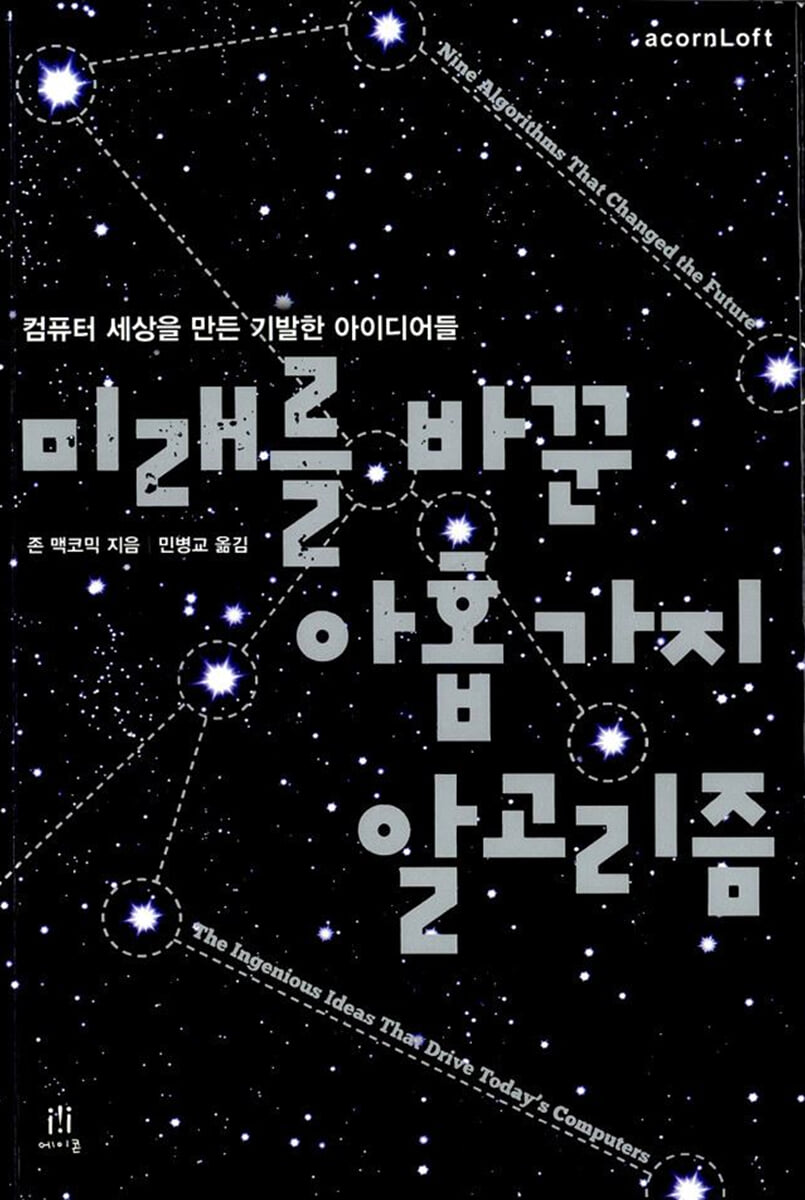
Nine Algorithms That Changed the Future
 |
Description
Book Introduction
Today, when we have a question, we type a search term into an Internet search engine, and when we need something, we buy it from an Internet shopping mall.
It is no exaggeration to say that we do all our daily activities on computers.
So, what happens inside a computer when we use it? John McCormick uses a variety of metaphors and examples to explain the fundamental ideas behind the nine great algorithms that make this possible, in a simple and accurate way.
Readers will find these nine algorithms fascinating and provide a deeper understanding of the theoretical ideas behind computer technologies we use every day, including search engines, data compression, encryption, error correction, and pattern recognition.
It is no exaggeration to say that we do all our daily activities on computers.
So, what happens inside a computer when we use it? John McCormick uses a variety of metaphors and examples to explain the fundamental ideas behind the nine great algorithms that make this possible, in a simple and accurate way.
Readers will find these nine algorithms fascinating and provide a deeper understanding of the theoretical ideas behind computer technologies we use every day, including search engines, data compression, encryption, error correction, and pattern recognition.
- You can preview some of the book's contents.
Preview
index
Chapter 1.
Getting Started: The Great Ideas That Powered Computers
Chapter 2.
Search Engine Indexing: Finding a Needle in the World's Largest Haystack
Chapter 3.
PageRank: The Technology That Launched Google
Chapter 4.
Public key cryptography: writing secrets on public postcards and sending them without anyone knowing
Chapter 5.
Error-correcting code: The magic of finding and fixing data errors on its own.
Chapter 6.
Pattern Recognition and Artificial Intelligence: Computers that Learn and Think Like Humans
Chapter 7.
Data Compression: Fitting a Book onto a Single Sheet of Paper
Chapter 8.
Databases: The Journey to Consistency
Chapter 9.
Digital Signatures: Who Really Wrote This Software?
Chapter 10.
Computability and Undecidability: Can Computers Solve Every Problem?
Chapter 11.
In Conclusion: Future Algorithms and Evolving Computers
Getting Started: The Great Ideas That Powered Computers
Chapter 2.
Search Engine Indexing: Finding a Needle in the World's Largest Haystack
Chapter 3.
PageRank: The Technology That Launched Google
Chapter 4.
Public key cryptography: writing secrets on public postcards and sending them without anyone knowing
Chapter 5.
Error-correcting code: The magic of finding and fixing data errors on its own.
Chapter 6.
Pattern Recognition and Artificial Intelligence: Computers that Learn and Think Like Humans
Chapter 7.
Data Compression: Fitting a Book onto a Single Sheet of Paper
Chapter 8.
Databases: The Journey to Consistency
Chapter 9.
Digital Signatures: Who Really Wrote This Software?
Chapter 10.
Computability and Undecidability: Can Computers Solve Every Problem?
Chapter 11.
In Conclusion: Future Algorithms and Evolving Computers
Into the book
Computers and the Internet have completely changed our way of life.
Today, companies and various organizations use computers to process work.
Moreover, we use computers in every aspect of our daily lives, including banking, shopping, reading newspapers, studying, watching movies, reading, and playing games.
Thanks to the proliferation of smartphones and tablets, we rarely spend time away from our computers.
Even toddlers who haven't yet learned to speak are adept at using smart devices.
It's clear as day that if all computers suddenly disappeared tomorrow, our society would be thrown into chaos.
How do computers and the internet, now necessities of life, actually work? For example, what exactly happens when I transfer funds using online banking? How are my transactions secure? How do search engines return relevant results? How can data be accurately transmitted over unstable networks? How does my smartphone recognize my face? In this book, author McCormick guides readers on a journey to find answers to these very questions.
In this journey, readers will experience a variety of algorithms.
In fact, computers cannot make judgments or interpretations on their own, so even problems that seem very simple to humans can only be solved if humans provide them with precise procedures and methods to solve them.
This is called an algorithm, and the computer in front of you right now is performing various tasks thanks to an algorithm created by someone.
Among the countless algorithms that made today's computer world possible, author McCormick selects and explains nine of the most important and beautiful algorithms in computer science that we use all the time.
The most outstanding thing about this book is that it explains difficult and complex algorithms in an easy and fun way.
To accurately understand and implement the algorithms used in actual computers, you need to have a fairly high level of knowledge in mathematics and computer science.
So how did he manage to explain algorithms so easily? The answer lies in the author's stated purpose for this book.
The purpose of this book is not to teach you the specific algorithms that computers actually use, but rather to help you understand the basic ideas behind the algorithms.
To this end, McCormick uses a variety of interesting examples and analogies instead of complex formulas to convey the fundamental principles of how modern computers work in an easy and fun way.
Chapter 4, which covers public-key cryptography, is a good example of how the author successfully achieved this goal.
For example, public key encryption is an algorithm that allows for the secure transmission and reception of confidential information such as passwords and credit card numbers on the Internet.
As the author notes, this is not only a challenging problem in computer science, but also relies on complex mathematics.
However, the author uses the analogy of two people secretly mixing the same color of paint in a room where all conversations must be public, to explain the fundamental concepts of this algorithm in a way that even people without a background in computer science or mathematics can easily and accurately understand.
In short, in the context of providing easy and accurate explanations of difficult theories, this book can be compared to Feynman's Lectures on Physics.
Even when solving the same math problem, there is a complete difference between someone who simply learns the solution method through examples and someone who understands the theory behind the solution method.
Only the latter can solve applied problems based on the same theory and raise new problems.
A theoretical idea is like the cornerstone of a building.
In this context, this book is a must-read for beginners in computer science and engineering.
This book is also a must-read for computing practitioners, including developers, who feel their theoretical foundation is weak or want to refresh their knowledge.
As the author notes, this book is primarily a popular read, so it will naturally appeal to people without any computer science background.
If you've ever wondered what's happening inside the computer right in front of you, I urge you to open this book right now.
I guarantee that by the end of this exciting journey, you will have a new perspective on your daily life related to computers.
Today, companies and various organizations use computers to process work.
Moreover, we use computers in every aspect of our daily lives, including banking, shopping, reading newspapers, studying, watching movies, reading, and playing games.
Thanks to the proliferation of smartphones and tablets, we rarely spend time away from our computers.
Even toddlers who haven't yet learned to speak are adept at using smart devices.
It's clear as day that if all computers suddenly disappeared tomorrow, our society would be thrown into chaos.
How do computers and the internet, now necessities of life, actually work? For example, what exactly happens when I transfer funds using online banking? How are my transactions secure? How do search engines return relevant results? How can data be accurately transmitted over unstable networks? How does my smartphone recognize my face? In this book, author McCormick guides readers on a journey to find answers to these very questions.
In this journey, readers will experience a variety of algorithms.
In fact, computers cannot make judgments or interpretations on their own, so even problems that seem very simple to humans can only be solved if humans provide them with precise procedures and methods to solve them.
This is called an algorithm, and the computer in front of you right now is performing various tasks thanks to an algorithm created by someone.
Among the countless algorithms that made today's computer world possible, author McCormick selects and explains nine of the most important and beautiful algorithms in computer science that we use all the time.
The most outstanding thing about this book is that it explains difficult and complex algorithms in an easy and fun way.
To accurately understand and implement the algorithms used in actual computers, you need to have a fairly high level of knowledge in mathematics and computer science.
So how did he manage to explain algorithms so easily? The answer lies in the author's stated purpose for this book.
The purpose of this book is not to teach you the specific algorithms that computers actually use, but rather to help you understand the basic ideas behind the algorithms.
To this end, McCormick uses a variety of interesting examples and analogies instead of complex formulas to convey the fundamental principles of how modern computers work in an easy and fun way.
Chapter 4, which covers public-key cryptography, is a good example of how the author successfully achieved this goal.
For example, public key encryption is an algorithm that allows for the secure transmission and reception of confidential information such as passwords and credit card numbers on the Internet.
As the author notes, this is not only a challenging problem in computer science, but also relies on complex mathematics.
However, the author uses the analogy of two people secretly mixing the same color of paint in a room where all conversations must be public, to explain the fundamental concepts of this algorithm in a way that even people without a background in computer science or mathematics can easily and accurately understand.
In short, in the context of providing easy and accurate explanations of difficult theories, this book can be compared to Feynman's Lectures on Physics.
Even when solving the same math problem, there is a complete difference between someone who simply learns the solution method through examples and someone who understands the theory behind the solution method.
Only the latter can solve applied problems based on the same theory and raise new problems.
A theoretical idea is like the cornerstone of a building.
In this context, this book is a must-read for beginners in computer science and engineering.
This book is also a must-read for computing practitioners, including developers, who feel their theoretical foundation is weak or want to refresh their knowledge.
As the author notes, this book is primarily a popular read, so it will naturally appeal to people without any computer science background.
If you've ever wondered what's happening inside the computer right in front of you, I urge you to open this book right now.
I guarantee that by the end of this exciting journey, you will have a new perspective on your daily life related to computers.
---From the Translator's Note
Publisher's Review
We use computers to do amazing things every day.
A simple web search will yield a very small number of relevant needles among the billions of pages on the World Wide Web, the world's largest haystack.
When you upload a photo to Facebook, you're sending millions of pieces of information across countless error-prone network links, but an exact copy of that photo arrives safely.
We also use public-key cryptography to transmit confidential information like credit card numbers without even realizing it, and use digital signatures to verify the identity of the websites we visit.
How can computers do this so easily?
This book answers these questions by revealing, for the first time, the extraordinary idea of operating PCs, laptops, and smartphones in a language that everyone can understand.
John McCormick vividly illustrates the fundamental "tricks" behind nine types of computer algorithms.
Among these nine algorithms are artificial intelligence (which uses the 'nearest neighbor trick' and the 'twenty questions trick'), Google's famous PageRank (which uses the 'random surfer trick'), data compression, and error-correcting code.
These revolutionary algorithms have changed our lives.
And this book unlocks the secrets of these algorithms, revealing the amazing ideas computers use every day.
★ Praise for this book from all walks of life ★
Since Hawking and Feynman's books in my teens, no book has excited me as much as this one.
This book reminded me why I love computers.
McCormick explains the real story behind how algorithms actually work in an easy-to-understand way.
It is not just a book to be praised, it is a book to be commemorated.
- Andrew Fitzgibbon, creator of the Emmy Award-winning camera software 'Unwrap Mosaic' and advisor for Xbox 360 Kinect
This is a must-read for anyone who has ever wondered, "What's going on inside my computer?"
McCormick clearly explains nine algorithms used by hundreds of millions of people every day.
It deals not with simple algorithms like calculations or sorting, but with complex issues such as determining the importance of a web page, why we can trust conversations with third parties through computers, and difficult problems that computers cannot solve.
I highly recommend it.
- Chuck Thacker, 2010 Turing Award winner
A delightful exploration of nine beautiful algorithms that are essential to today's computers.
McCormick uses ingenious metaphors to provide insight into the intellectual underpinnings of the technologies and computing we use every day.
McCormick combines the mathematician's understanding of great algorithms with the educator's skill in explaining them in a captivating way.
- Sharon Perl, Google
McCormick awarded nine algorithms with the "Genius Award."
It's a very good choice.
Readers will gain a new understanding of what geniuses in the field of computer science look like.
McCormick also leaves open the possibility that a future genius inspired by this book might one day make the tenth list.
- William H. Press
Press), co-author of Numerical Recipes
John McCormick has done a fantastic job of explaining many of the algorithms we use every day in a way that even people with no mathematical background can easily understand.
I especially like the explanation of public key cryptography using the analogy of mixing paint colors.
- Thomas H.
Cormen), Dartmouth College
McCormick does a great job of explaining complex concepts very simply.
The metaphors in this book are truly fantastic.
In particular, the historical anecdotes, which were explained in detail and kindly, were very interesting.
- Amy N. Langville
Langville), co-author of Google's PageRank and Beyond
Recommendation
Computing has transformed our society as profoundly as physics and chemistry did in the 200 years before computers.
In fact, there are few aspects of our lives that digital technology has not impacted or revolutionized.
Given the profound impact computing has had on modern society, it is ironic that we remain largely ignorant of the fundamental concepts that made these changes possible.
Computer science is the study of these fundamental concepts, and McCormick's book is one of the few that introduces them to a general audience.
One of the reasons why computer science receives relatively little attention as a discipline is that the subject is rarely taught in secondary education, including high schools.
While subjects like physics and chemistry are typically considered required subjects, computer science is considered an individual subject only in higher education at the university level.
Moreover, the subjects taught in schools under the names of 'computing' or 'information and communication technology (ICT)' usually only cover skills that train students how to use software packages.
Not surprisingly, students become bored and feel that computer science lacks intellectual depth, and their enthusiasm for using computer technology for play and communication quickly wanes.
This problem is at the heart of the 50% decline in the number of college students majoring in computer science over the past decade.
Given the importance of digital technologies in modern society, now is the most crucial time to re-engage the public in the fascinating world of computer science.
In 2008, I was fortunate enough to be selected as the 180th speaker in the Royal Institution Christmas Lectures, the first of which was given by Michael Faraday in 1826.
My lecture in 2008 was the first lecture ever given on the topic of computer science.
While preparing for my talk, I spent a lot of time thinking about how to explain computer science to the general public, but I realized that there were few resources available and that there were virtually no popular books addressing this need.
Therefore, the publication of McCormick's new book is all the more welcome to me.
McCormick did a great job of explaining the complex algorithms of computer science to the general public.
Many of these algorithms possess extraordinary beauty and elegance, which alone makes them worthy of attention.
Let me give you an example.
Web-based shopping grew explosively because it allowed for the private and secure transmission of confidential information, such as credit card numbers, over the Internet.
The ability to establish secure communications over 'open' channels has been considered a very difficult problem to solve for decades.
But after a while, a really cool solution was discovered.
In this book, McCormick uses precise analogies to explain the nine algorithms he selected in an easy-to-understand way, even without prior knowledge of computer science.
The mere presence of these gems within the book makes it a valuable contribution to the popular science library.
I highly recommend you read it.
Chris Bishop, Distinguished Scientist at Microsoft Research Cambridge, Deputy Director of the Royal Institution, UK, and Professor of Computer Science at the University of Edinburgh
A simple web search will yield a very small number of relevant needles among the billions of pages on the World Wide Web, the world's largest haystack.
When you upload a photo to Facebook, you're sending millions of pieces of information across countless error-prone network links, but an exact copy of that photo arrives safely.
We also use public-key cryptography to transmit confidential information like credit card numbers without even realizing it, and use digital signatures to verify the identity of the websites we visit.
How can computers do this so easily?
This book answers these questions by revealing, for the first time, the extraordinary idea of operating PCs, laptops, and smartphones in a language that everyone can understand.
John McCormick vividly illustrates the fundamental "tricks" behind nine types of computer algorithms.
Among these nine algorithms are artificial intelligence (which uses the 'nearest neighbor trick' and the 'twenty questions trick'), Google's famous PageRank (which uses the 'random surfer trick'), data compression, and error-correcting code.
These revolutionary algorithms have changed our lives.
And this book unlocks the secrets of these algorithms, revealing the amazing ideas computers use every day.
★ Praise for this book from all walks of life ★
Since Hawking and Feynman's books in my teens, no book has excited me as much as this one.
This book reminded me why I love computers.
McCormick explains the real story behind how algorithms actually work in an easy-to-understand way.
It is not just a book to be praised, it is a book to be commemorated.
- Andrew Fitzgibbon, creator of the Emmy Award-winning camera software 'Unwrap Mosaic' and advisor for Xbox 360 Kinect
This is a must-read for anyone who has ever wondered, "What's going on inside my computer?"
McCormick clearly explains nine algorithms used by hundreds of millions of people every day.
It deals not with simple algorithms like calculations or sorting, but with complex issues such as determining the importance of a web page, why we can trust conversations with third parties through computers, and difficult problems that computers cannot solve.
I highly recommend it.
- Chuck Thacker, 2010 Turing Award winner
A delightful exploration of nine beautiful algorithms that are essential to today's computers.
McCormick uses ingenious metaphors to provide insight into the intellectual underpinnings of the technologies and computing we use every day.
McCormick combines the mathematician's understanding of great algorithms with the educator's skill in explaining them in a captivating way.
- Sharon Perl, Google
McCormick awarded nine algorithms with the "Genius Award."
It's a very good choice.
Readers will gain a new understanding of what geniuses in the field of computer science look like.
McCormick also leaves open the possibility that a future genius inspired by this book might one day make the tenth list.
- William H. Press
Press), co-author of Numerical Recipes
John McCormick has done a fantastic job of explaining many of the algorithms we use every day in a way that even people with no mathematical background can easily understand.
I especially like the explanation of public key cryptography using the analogy of mixing paint colors.
- Thomas H.
Cormen), Dartmouth College
McCormick does a great job of explaining complex concepts very simply.
The metaphors in this book are truly fantastic.
In particular, the historical anecdotes, which were explained in detail and kindly, were very interesting.
- Amy N. Langville
Langville), co-author of Google's PageRank and Beyond
Recommendation
Computing has transformed our society as profoundly as physics and chemistry did in the 200 years before computers.
In fact, there are few aspects of our lives that digital technology has not impacted or revolutionized.
Given the profound impact computing has had on modern society, it is ironic that we remain largely ignorant of the fundamental concepts that made these changes possible.
Computer science is the study of these fundamental concepts, and McCormick's book is one of the few that introduces them to a general audience.
One of the reasons why computer science receives relatively little attention as a discipline is that the subject is rarely taught in secondary education, including high schools.
While subjects like physics and chemistry are typically considered required subjects, computer science is considered an individual subject only in higher education at the university level.
Moreover, the subjects taught in schools under the names of 'computing' or 'information and communication technology (ICT)' usually only cover skills that train students how to use software packages.
Not surprisingly, students become bored and feel that computer science lacks intellectual depth, and their enthusiasm for using computer technology for play and communication quickly wanes.
This problem is at the heart of the 50% decline in the number of college students majoring in computer science over the past decade.
Given the importance of digital technologies in modern society, now is the most crucial time to re-engage the public in the fascinating world of computer science.
In 2008, I was fortunate enough to be selected as the 180th speaker in the Royal Institution Christmas Lectures, the first of which was given by Michael Faraday in 1826.
My lecture in 2008 was the first lecture ever given on the topic of computer science.
While preparing for my talk, I spent a lot of time thinking about how to explain computer science to the general public, but I realized that there were few resources available and that there were virtually no popular books addressing this need.
Therefore, the publication of McCormick's new book is all the more welcome to me.
McCormick did a great job of explaining the complex algorithms of computer science to the general public.
Many of these algorithms possess extraordinary beauty and elegance, which alone makes them worthy of attention.
Let me give you an example.
Web-based shopping grew explosively because it allowed for the private and secure transmission of confidential information, such as credit card numbers, over the Internet.
The ability to establish secure communications over 'open' channels has been considered a very difficult problem to solve for decades.
But after a while, a really cool solution was discovered.
In this book, McCormick uses precise analogies to explain the nine algorithms he selected in an easy-to-understand way, even without prior knowledge of computer science.
The mere presence of these gems within the book makes it a valuable contribution to the popular science library.
I highly recommend you read it.
Chris Bishop, Distinguished Scientist at Microsoft Research Cambridge, Deputy Director of the Royal Institution, UK, and Professor of Computer Science at the University of Edinburgh
GOODS SPECIFICS
- Date of issue: May 31, 2013
- Page count, weight, size: 328 pages | 585g | 152*224*30mm
- ISBN13: 9788960774384
- ISBN10: 8960774383
You may also like
카테고리
korean


korean

![GQ KOREA Mark (Monthly): December [2025]](http://librairie.coreenne.fr/cdn/shop/files/8ef265dbbfbf186523ed75ba7319009d.jpg?v=1765340328&width=3840)


