

Real MySQL 8.0 (Volume 2)
 |
Description
Book Introduction
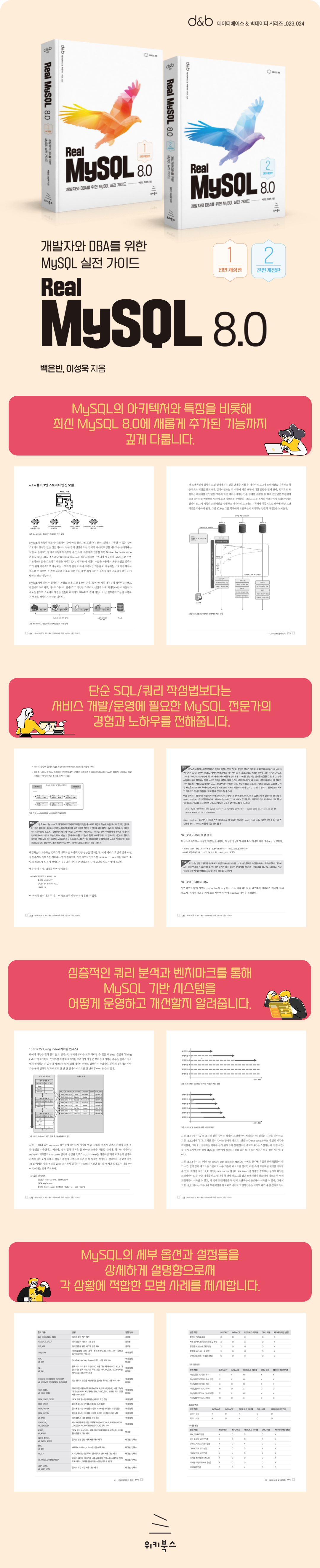
『Real MySQL 8.0』 is a refined version of 『Real MySQL』, condensed to the essential content, and includes additional features such as MySQL 8.0's GTID and InnoDB cluster functions, as well as expanded features such as GIS and specialized search that reflect software industry trends.
Furthermore, 『Real MySQL 8.0』 focuses on imparting the experience and knowledge essential for projects utilizing MySQL servers rather than simply learning SQL syntax or query writing.
Furthermore, 『Real MySQL 8.0』 focuses on imparting the experience and knowledge essential for projects utilizing MySQL servers rather than simply learning SQL syntax or query writing.
- You can preview some of the book's contents.
Preview
index
▣ Chapter 11: Writing and Optimizing Queries
11.1 System variables associated with query writing
___11.1.1 SQL Mode
___11.1.2 English case sensitivity
___11.1.3 MySQL Reserved Words
11.2 How to Read the SQL Grammar Notation in the Manual
11.3 MySQL Operators and Built-in Functions
___11.3.1 Literal Notation String
___11.3.2 MySQL Operators
___11.3.3 MySQL Built-in Functions
11.4 SELECT
___11.4.1 Processing order of SELECT clause
___11.4.2 Using indexes in the WHERE clause, GROUP BY clause, and ORDER BY clause
___11.4.3 Precautions when using comparison conditions in the WHERE clause
___11.4.4 DISTINCT
___11.4.5 LIMIT n
___11.4.6 COUNT()
___11.4.7 JOIN
___11.4.8 GROUP BY
___11.4.9 ORDER BY
___11.4.10 Subqueries
___11.4.11 CTE (Common Table Expression)
___11.4.12 Window Function
11.4.13 SELECT using locks
11.5 INSERT
___11.5.1 Advanced Options
___11.5.2 LOAD DATA Command Precautions
___11.5.3 Table Structure for Performance
11.6 UPDATE and DELETE
___11.6.1 UPDATE ... ORDER BY ... LIMIT n
___11.6.2 JOIN UPDATE
___11.6.3 UPDATE multiple records
___11.6.4 JOIN DELETE
11.7 Schema Manipulation (DDL)
___11.7.1 Online DDL
___11.7.2 Database Changes
___11.7.3 Altering Table Spaces
___11.7.4 Table Changes
___11.7.5 Column Change
___11.7.6 Change Index
___11.7.7 Executing a batch of table changes
___11.7.8 Process Query and Force Termination
___11.7.9 Active Transaction Query
11.8 Query Performance Testing
___11.8.1 Factors Affecting Query Performance
▣ Chapter 12: Extended Search
12.1 Professional Search
___12.1.1 Creation and Search of a Specialized Search Index
___12.1.2 Expert Search Query Mode
___12.1.3 Debugging the Professional Search Index
12.2 Spatial Search
___12.2.1 Glossary of Terms
___12.2.2 SRS(Spatial Reference System)
___12.2.3 Projected Coordinate Systems and Plane Coordinate Systems
___12.2.4 Geographic Coordinate System
▣ Chapter 13: Partitions
13.1 Overview
___13.1.1 Why Use Partitions?
___13.1.2 Internal Handling of MySQL Partitions
13.2 Precautions
___13.2.1 Partition Constraints
___13.2.2 Precautions when using partitions
13.3 Types of MySQL Partitions
___13.3.1 Range Partition
___13.3.2 List Partitions
___13.3.3 Hash Partitioning
___13.3.4 Key Partition
___13.3.5 Linear Hash Partition/Linear Key Partition
___13.3.6 Query Performance on Partitioned Tables
▣ Chapter 14: Stored Programs
14.1 Advantages and Disadvantages of Stored Programs
___14.1.1 Advantages of Stored Programs
___14.1.2 Disadvantages of Stored Programs
14.2 Stored Program Grammar
___14.2.1 Precautions when testing examples
___14.2.2 Stored Procedures
___14.2.3 Stored Functions
___14.2.4 Trigger
___14.2.5 Event
___14.2.6 Writing the Stored Program Body
14.3 Security Options for Stored Programs
___14.3.1 DEFINER and SQL SECURITY Options
___14.3.2 DETERMINISTIC and NOT DETERMINISTIC Options
14.4 Notes and Cautions for Stored Programs
___14.4.1 Korean processing
___14.4.2 Stored Programs and Session Variables
___14.4.3 Stored Procedures and Recursive Calls
___14.4.4 Using Nested Cursors
▣ Chapter 15: Data Types
15.1 Strings (CHAR and VARCHAR)
___15.1.1 Storage Space
___15.1.2 Storage and Schema Changes (Online DDL)
___15.1.3 Character Set
___15.1.4 Collation
___15.1.5 Comparison Method
___15.1.6 Escaping Strings
15.2 Numbers
___15.2.1 Integer
___15.2.2 Floating Point
___15.2.3 DECIMAL
___15.2.4 Precautions when creating an integer type column
___15.2.5 Using the AUTO_INCREMENT option
15.3 Date and Time
___15.3.1 Automatic Update
15.4 ENUM and SET
___15.4.1 ENUM
___15.4.2 SET
15.5 TEXT and BLOB
15.6 Spatial Data Types
___15.6.1 Creating Spatial Data
___15.6.2 Spatial Data Query
15.7 JSON Type
___15.7.1 Storage Method
___15.7.2 Partial Update Performance
___15.7.3 JSON Type Collation and Comparison
___15.7.4 Selecting JSON Columns
___15.8 Virtual Column (Derived Column)
▣ Chapter 16: Replication
16.1 Overview
16.2 Replication Architecture
16.3 Replication Types
___16.3.1 Binary Log File Location-Based Replication
___16.3.2 Global Transaction ID (GTID)-based replication
16.4 Replication Data Format
___16.4.1 Statement-based binary log format
___16.4.2 Row-based binary log format
___16.4.3 Mixed Format
___16.4.4 Capacity Optimization for Row Format
16.5 Replication Synchronization Method
___16.5.1 Asynchronous replication
___16.5.2 Semi-synchronous replication
16.6 Replication Topology
___16.6.1 Single Replica Replication Configuration
___16.6.2 Multi-replica replication configuration
___16.6.3 Chain Replication Configuration
___16.6.4 Configuring Dual Source Replication
___16.6.5 Configuring Multi-Source Replication
16.7 Advanced Replication Settings
___16.7.1 Delayed Replication
___16.7.2 Multi-threaded Replication
___16.7.3 Crash-safe Replication
___16.7.4 Filtered Replication
▣ Chapter 17: InnoDB Cluster
17.1 InnoDB Cluster Architecture
17.2 Group Replication
___17.2.1 Group Replication Architecture
___17.2.2 Group Replication Mode
___17.2.3 Group Membership Management
___17.2.4 Transaction Processing in Group Replication
___17.2.5 Automatic Failure Detection and Response in Group Replication
___17.2.6 Distributed Recovery of Group Replication
___17.2.7 Group Replication Requirements
___17.2.8 Group Replication Constraints
17.3 MySQL Shell
17.4 MySQL Router
17.5 Building an InnoDB Cluster
___17.5.1 InnoDB Cluster Requirements
___17.5.2 Creating an InnoDB Cluster
17.6 InnoDB Cluster Monitoring
17.7 Working with InnoDB Clusters
___17.7.1 Changing Cluster Mode
___17.7.2 Primary Change
___17.7.3 Removing an Instance
___17.7.4 Cluster Dismantling
___17.7.5 Changing Cluster and Instance Settings
17.8 InnoDB Cluster Troubleshooting
___17.8.1 Cluster Instance Failure
___17.8.2 Cluster Loss of Quorum
17.9 InnoDB Cluster Version Upgrade
17.10 InnoDB Cluster Limitations
▣ Chapter 18: Performance Schema & Sys Schema
18.1 What is a Performance Schema?
18.2 Performance Schema Configuration
___18.2.1 Setup Table
___18.2.2 Instance Table
___18.2.3 Connection Table
___18.2.4 Variable Table
___18.2.5 Event Table
___18.2.6 Summary Table
___18.2.7 Lock Table
___18.2.8 Replication Table
___18.2.9 Clone Table
___18.2.10 Other Tables
18.3 Performance Schema Configuration
___18.3.1 Setting Memory Usage
___18.3.2 Data Collection and Storage Settings
18.4 What is the Sys schema?
18.5 Presets for using the Sys schema
18.6 Sys Schema Configuration
18.7 Performance Schema and Sys Schema Utilization Examples
___18.7.1 Check host connection history
___18.7.2 Check for unused DB accounts
___18.7.3 Checking MySQL Total Memory Usage
___18.7.4 Checking memory usage by thread
___18.7.5 Check for unused indexes
___18.7.6 Check for duplicate indexes
___18.7.7 Check the list of tables that have not changed
___18.7.8 Check the list of tables with many I/O requests
___18.7.9 Checking workload statistics by table
___18.7.10 Checking the usage of the Auto-Increment column in the table
___18.7.11 Check full table scan query
___18.7.12 Check the list of frequently executed queries
___18.7.13 Check the list of queries with long execution times
___18.7.14 Check the list of queries that performed sorting operations
___18.7.15 Check the list of queries that create temporary tables
___18.7.16 Check the query history executed on a connection with an active transaction
___18.7.17 Query Profiling
___18.7.18 Checking the progress of the ALTER operation
___18.7.19 Check metadata lock wait
___18.7.20 Check data lock standby
11.1 System variables associated with query writing
___11.1.1 SQL Mode
___11.1.2 English case sensitivity
___11.1.3 MySQL Reserved Words
11.2 How to Read the SQL Grammar Notation in the Manual
11.3 MySQL Operators and Built-in Functions
___11.3.1 Literal Notation String
___11.3.2 MySQL Operators
___11.3.3 MySQL Built-in Functions
11.4 SELECT
___11.4.1 Processing order of SELECT clause
___11.4.2 Using indexes in the WHERE clause, GROUP BY clause, and ORDER BY clause
___11.4.3 Precautions when using comparison conditions in the WHERE clause
___11.4.4 DISTINCT
___11.4.5 LIMIT n
___11.4.6 COUNT()
___11.4.7 JOIN
___11.4.8 GROUP BY
___11.4.9 ORDER BY
___11.4.10 Subqueries
___11.4.11 CTE (Common Table Expression)
___11.4.12 Window Function
11.4.13 SELECT using locks
11.5 INSERT
___11.5.1 Advanced Options
___11.5.2 LOAD DATA Command Precautions
___11.5.3 Table Structure for Performance
11.6 UPDATE and DELETE
___11.6.1 UPDATE ... ORDER BY ... LIMIT n
___11.6.2 JOIN UPDATE
___11.6.3 UPDATE multiple records
___11.6.4 JOIN DELETE
11.7 Schema Manipulation (DDL)
___11.7.1 Online DDL
___11.7.2 Database Changes
___11.7.3 Altering Table Spaces
___11.7.4 Table Changes
___11.7.5 Column Change
___11.7.6 Change Index
___11.7.7 Executing a batch of table changes
___11.7.8 Process Query and Force Termination
___11.7.9 Active Transaction Query
11.8 Query Performance Testing
___11.8.1 Factors Affecting Query Performance
▣ Chapter 12: Extended Search
12.1 Professional Search
___12.1.1 Creation and Search of a Specialized Search Index
___12.1.2 Expert Search Query Mode
___12.1.3 Debugging the Professional Search Index
12.2 Spatial Search
___12.2.1 Glossary of Terms
___12.2.2 SRS(Spatial Reference System)
___12.2.3 Projected Coordinate Systems and Plane Coordinate Systems
___12.2.4 Geographic Coordinate System
▣ Chapter 13: Partitions
13.1 Overview
___13.1.1 Why Use Partitions?
___13.1.2 Internal Handling of MySQL Partitions
13.2 Precautions
___13.2.1 Partition Constraints
___13.2.2 Precautions when using partitions
13.3 Types of MySQL Partitions
___13.3.1 Range Partition
___13.3.2 List Partitions
___13.3.3 Hash Partitioning
___13.3.4 Key Partition
___13.3.5 Linear Hash Partition/Linear Key Partition
___13.3.6 Query Performance on Partitioned Tables
▣ Chapter 14: Stored Programs
14.1 Advantages and Disadvantages of Stored Programs
___14.1.1 Advantages of Stored Programs
___14.1.2 Disadvantages of Stored Programs
14.2 Stored Program Grammar
___14.2.1 Precautions when testing examples
___14.2.2 Stored Procedures
___14.2.3 Stored Functions
___14.2.4 Trigger
___14.2.5 Event
___14.2.6 Writing the Stored Program Body
14.3 Security Options for Stored Programs
___14.3.1 DEFINER and SQL SECURITY Options
___14.3.2 DETERMINISTIC and NOT DETERMINISTIC Options
14.4 Notes and Cautions for Stored Programs
___14.4.1 Korean processing
___14.4.2 Stored Programs and Session Variables
___14.4.3 Stored Procedures and Recursive Calls
___14.4.4 Using Nested Cursors
▣ Chapter 15: Data Types
15.1 Strings (CHAR and VARCHAR)
___15.1.1 Storage Space
___15.1.2 Storage and Schema Changes (Online DDL)
___15.1.3 Character Set
___15.1.4 Collation
___15.1.5 Comparison Method
___15.1.6 Escaping Strings
15.2 Numbers
___15.2.1 Integer
___15.2.2 Floating Point
___15.2.3 DECIMAL
___15.2.4 Precautions when creating an integer type column
___15.2.5 Using the AUTO_INCREMENT option
15.3 Date and Time
___15.3.1 Automatic Update
15.4 ENUM and SET
___15.4.1 ENUM
___15.4.2 SET
15.5 TEXT and BLOB
15.6 Spatial Data Types
___15.6.1 Creating Spatial Data
___15.6.2 Spatial Data Query
15.7 JSON Type
___15.7.1 Storage Method
___15.7.2 Partial Update Performance
___15.7.3 JSON Type Collation and Comparison
___15.7.4 Selecting JSON Columns
___15.8 Virtual Column (Derived Column)
▣ Chapter 16: Replication
16.1 Overview
16.2 Replication Architecture
16.3 Replication Types
___16.3.1 Binary Log File Location-Based Replication
___16.3.2 Global Transaction ID (GTID)-based replication
16.4 Replication Data Format
___16.4.1 Statement-based binary log format
___16.4.2 Row-based binary log format
___16.4.3 Mixed Format
___16.4.4 Capacity Optimization for Row Format
16.5 Replication Synchronization Method
___16.5.1 Asynchronous replication
___16.5.2 Semi-synchronous replication
16.6 Replication Topology
___16.6.1 Single Replica Replication Configuration
___16.6.2 Multi-replica replication configuration
___16.6.3 Chain Replication Configuration
___16.6.4 Configuring Dual Source Replication
___16.6.5 Configuring Multi-Source Replication
16.7 Advanced Replication Settings
___16.7.1 Delayed Replication
___16.7.2 Multi-threaded Replication
___16.7.3 Crash-safe Replication
___16.7.4 Filtered Replication
▣ Chapter 17: InnoDB Cluster
17.1 InnoDB Cluster Architecture
17.2 Group Replication
___17.2.1 Group Replication Architecture
___17.2.2 Group Replication Mode
___17.2.3 Group Membership Management
___17.2.4 Transaction Processing in Group Replication
___17.2.5 Automatic Failure Detection and Response in Group Replication
___17.2.6 Distributed Recovery of Group Replication
___17.2.7 Group Replication Requirements
___17.2.8 Group Replication Constraints
17.3 MySQL Shell
17.4 MySQL Router
17.5 Building an InnoDB Cluster
___17.5.1 InnoDB Cluster Requirements
___17.5.2 Creating an InnoDB Cluster
17.6 InnoDB Cluster Monitoring
17.7 Working with InnoDB Clusters
___17.7.1 Changing Cluster Mode
___17.7.2 Primary Change
___17.7.3 Removing an Instance
___17.7.4 Cluster Dismantling
___17.7.5 Changing Cluster and Instance Settings
17.8 InnoDB Cluster Troubleshooting
___17.8.1 Cluster Instance Failure
___17.8.2 Cluster Loss of Quorum
17.9 InnoDB Cluster Version Upgrade
17.10 InnoDB Cluster Limitations
▣ Chapter 18: Performance Schema & Sys Schema
18.1 What is a Performance Schema?
18.2 Performance Schema Configuration
___18.2.1 Setup Table
___18.2.2 Instance Table
___18.2.3 Connection Table
___18.2.4 Variable Table
___18.2.5 Event Table
___18.2.6 Summary Table
___18.2.7 Lock Table
___18.2.8 Replication Table
___18.2.9 Clone Table
___18.2.10 Other Tables
18.3 Performance Schema Configuration
___18.3.1 Setting Memory Usage
___18.3.2 Data Collection and Storage Settings
18.4 What is the Sys schema?
18.5 Presets for using the Sys schema
18.6 Sys Schema Configuration
18.7 Performance Schema and Sys Schema Utilization Examples
___18.7.1 Check host connection history
___18.7.2 Check for unused DB accounts
___18.7.3 Checking MySQL Total Memory Usage
___18.7.4 Checking memory usage by thread
___18.7.5 Check for unused indexes
___18.7.6 Check for duplicate indexes
___18.7.7 Check the list of tables that have not changed
___18.7.8 Check the list of tables with many I/O requests
___18.7.9 Checking workload statistics by table
___18.7.10 Checking the usage of the Auto-Increment column in the table
___18.7.11 Check full table scan query
___18.7.12 Check the list of frequently executed queries
___18.7.13 Check the list of queries with long execution times
___18.7.14 Check the list of queries that performed sorting operations
___18.7.15 Check the list of queries that create temporary tables
___18.7.16 Check the query history executed on a connection with an active transaction
___18.7.17 Query Profiling
___18.7.18 Checking the progress of the ALTER operation
___18.7.19 Check metadata lock wait
___18.7.20 Check data lock standby
Detailed image
Publisher's Review
It contains the experience and knowledge essential for projects utilizing MySQL servers!
《Real MySQL 8.0》 refines 《Real MySQL》 to include only the essential content, and includes additional features such as MySQL 8.0's GTID and InnoDB cluster functions, as well as GIS and specialized search that reflect software industry trends.
Furthermore, 《Real MySQL 8.0》 focuses on imparting the experience and knowledge essential for projects utilizing MySQL servers rather than simply SQL syntax or query writing.
It would be ideal if you could read this book from cover to cover, but even if you just skim through the material that interests you or is relevant, you'll find that it solves many of the problems you've encountered so far.
★ What this book covers ★
◎ MySQL Installation and Server Architecture
◎ Transactions and locks
◎ Structure and use of index types
◎ GTID-based replication and InnoDB cluster architecture
◎ Query execution plan analysis and optimization
◎ Stored program development
◎ Data modeling and selection of optimal data types
◎ Utilizing partitions and data compression
◎ Utilize GIS and specialized search functions
◎ Utilizing Performance Schema and Sys Schema
《Real MySQL 8.0》 refines 《Real MySQL》 to include only the essential content, and includes additional features such as MySQL 8.0's GTID and InnoDB cluster functions, as well as GIS and specialized search that reflect software industry trends.
Furthermore, 《Real MySQL 8.0》 focuses on imparting the experience and knowledge essential for projects utilizing MySQL servers rather than simply SQL syntax or query writing.
It would be ideal if you could read this book from cover to cover, but even if you just skim through the material that interests you or is relevant, you'll find that it solves many of the problems you've encountered so far.
★ What this book covers ★
◎ MySQL Installation and Server Architecture
◎ Transactions and locks
◎ Structure and use of index types
◎ GTID-based replication and InnoDB cluster architecture
◎ Query execution plan analysis and optimization
◎ Stored program development
◎ Data modeling and selection of optimal data types
◎ Utilizing partitions and data compression
◎ Utilize GIS and specialized search functions
◎ Utilizing Performance Schema and Sys Schema
GOODS SPECIFICS
- Date of issue: September 8, 2021
- Page count, weight, size: 760 pages | 188*240*31mm
- ISBN13: 9791158392727
- ISBN10: 1158392729
You may also like
카테고리
korean


korean

![GQ KOREA Mark (Monthly): December [2025]](http://librairie.coreenne.fr/cdn/shop/files/8ef265dbbfbf186523ed75ba7319009d.jpg?v=1765340328&width=3840)


