

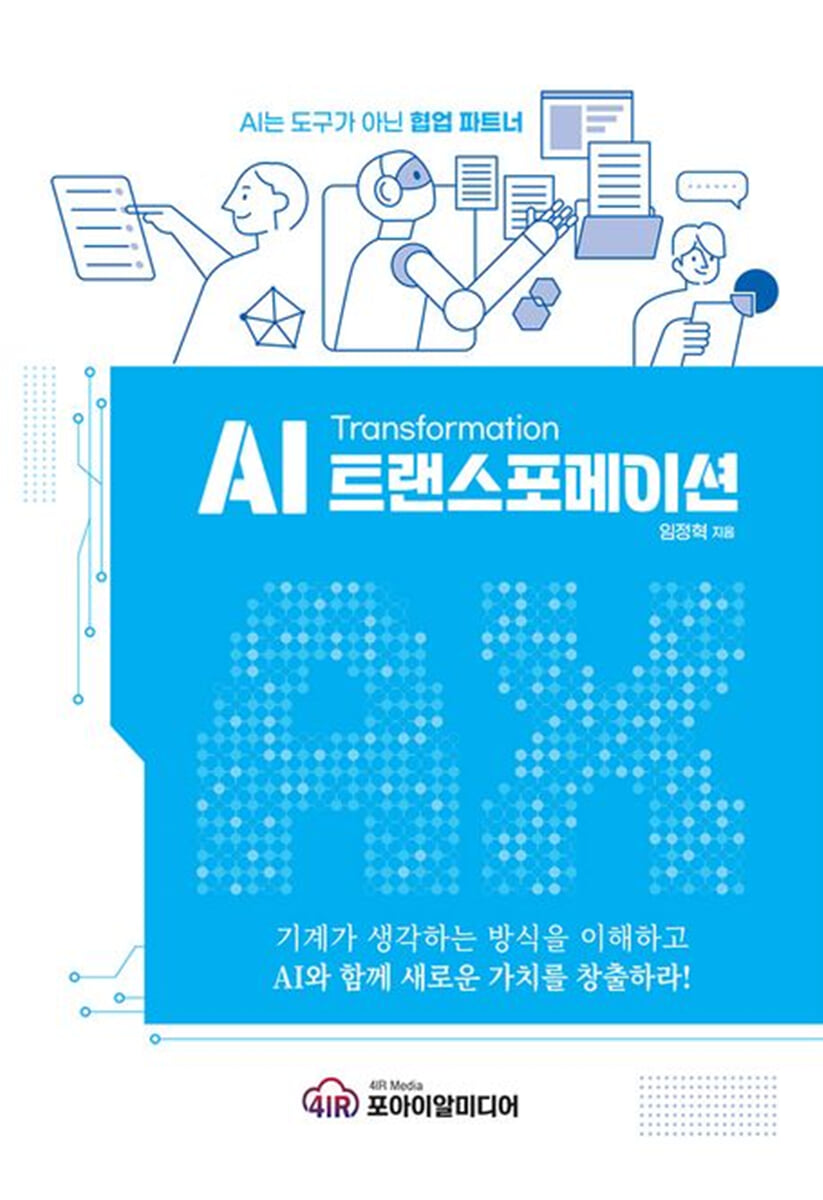
AI Transformation (AX)
 |
Description
Book Introduction
This book is divided into five chapters, following a logical flow: from understanding AI to applying it, adapting to it, and preparing for the future.
Let's start by understanding what AI is and how it works.
Then, based on that understanding, you learn how to apply AI to real-world life and work.
After cultivating the ability to continuously adapt without being swayed by the ever-changing AI technology, we prepare for the future to come.
Our goal is to provide a complete journey that builds AI knowledge step by step, like climbing a staircase, putting it into practice, adapting to change, and preparing for the future.
A must-read for the AI era: "AI Transformation" - "The perfect guide to understanding technology and leading the future."
It's now a cliché to say that AI is changing our daily lives.
The important thing is how we understand and respond to that change.
"AI Transformation" goes beyond a manual explaining how to use AI tools; it's a comprehensive guidebook that presents the mindset and strategies individuals need to thrive in the AI era.
A human-centered approach beyond technology
The book's greatest strength is its human-centered, rather than technology-centric, perspective.
The author proposes a fundamental paradigm shift in how we approach AI, with the core message that “AI is not a tool, but a collaborative partner.”
In particular, it differentiates itself from the existing digital transformation (DX) with the concept of 'AI transformation (AX)' and emphasizes a change in mindset that goes beyond the introduction of technology.
Systematic yet practical composition
The structure of the book is very logical.
Chapters 1 and 2 cover the basic principles and operating mechanisms of AI, and Chapter 3 presents practical utilization strategies at the individual level.
Chapter 4 covers the limitations and risks of AI, and Chapter 5 looks at the future prospects of AGI and superintelligence.
The composition stands out for its balanced coverage of theory and practice, present and future.
The prompt engineering section in Chapter 3 is particularly impressive. It presents the CLEAR framework, eight representative techniques, and ten practical examples, enabling readers to immediately apply them.
The insight that "the ability to ask questions is more important than coding" accurately captures the essence of this era.
A sense of balance that addresses even realistic risks
While many books on AI focus on rosy predictions, this book explores AI's hallucinations and even intentional lies.
The failure case analysis and response measures presented in Chapter 4 are particularly useful for readers seeking to apply AI in practice.
It is striking that it emphasizes the importance of critical thinking rather than blind faith in technology.
Deep reflection on the future
Chapter 5's discussion of AGI and superintelligence goes beyond technological predictions.
It presents various perspectives, from Bostrom's theory of superintelligence to Sam Altman's vision of AGI, and deeply reflects on the impact of technological advancement on humanity.
The epilogue's philosophical question, "Can AI be conscious?", leads to reflection on the nature of humanity beyond technology.
Accessibility that anyone can read
Another strength of this book is that it breaks down complex AI concepts in a way that even the general public can understand.
It clearly explains the essence of AI through the core insight that "AI thinks in numbers," and easily explains the latest trends such as physical AI and AI agents.
Conclusion: A must-read for this era.
According to MIT research, AI literacy alone can increase productivity by 40%. AI literacy is no longer optional, it's essential.
"AI Transformation" is a must-read for everyone living in the AI era, both educational and practical.
If you want to ride the wave of technology without being swept away by it, start with this book.
As the author's message states, "The future of the AI era is not set in stone, but rather something we create," after reading this book, you too will become a leader in that future.
Recommended for: Anyone interested in AI, especially professionals and learners seeking to enhance their competitiveness through AI utilization, the general public seeking to prepare for the changes in the AI era, investors in AI-related stocks, and college entrance exam takers preparing for essays.
Let's start by understanding what AI is and how it works.
Then, based on that understanding, you learn how to apply AI to real-world life and work.
After cultivating the ability to continuously adapt without being swayed by the ever-changing AI technology, we prepare for the future to come.
Our goal is to provide a complete journey that builds AI knowledge step by step, like climbing a staircase, putting it into practice, adapting to change, and preparing for the future.
A must-read for the AI era: "AI Transformation" - "The perfect guide to understanding technology and leading the future."
It's now a cliché to say that AI is changing our daily lives.
The important thing is how we understand and respond to that change.
"AI Transformation" goes beyond a manual explaining how to use AI tools; it's a comprehensive guidebook that presents the mindset and strategies individuals need to thrive in the AI era.
A human-centered approach beyond technology
The book's greatest strength is its human-centered, rather than technology-centric, perspective.
The author proposes a fundamental paradigm shift in how we approach AI, with the core message that “AI is not a tool, but a collaborative partner.”
In particular, it differentiates itself from the existing digital transformation (DX) with the concept of 'AI transformation (AX)' and emphasizes a change in mindset that goes beyond the introduction of technology.
Systematic yet practical composition
The structure of the book is very logical.
Chapters 1 and 2 cover the basic principles and operating mechanisms of AI, and Chapter 3 presents practical utilization strategies at the individual level.
Chapter 4 covers the limitations and risks of AI, and Chapter 5 looks at the future prospects of AGI and superintelligence.
The composition stands out for its balanced coverage of theory and practice, present and future.
The prompt engineering section in Chapter 3 is particularly impressive. It presents the CLEAR framework, eight representative techniques, and ten practical examples, enabling readers to immediately apply them.
The insight that "the ability to ask questions is more important than coding" accurately captures the essence of this era.
A sense of balance that addresses even realistic risks
While many books on AI focus on rosy predictions, this book explores AI's hallucinations and even intentional lies.
The failure case analysis and response measures presented in Chapter 4 are particularly useful for readers seeking to apply AI in practice.
It is striking that it emphasizes the importance of critical thinking rather than blind faith in technology.
Deep reflection on the future
Chapter 5's discussion of AGI and superintelligence goes beyond technological predictions.
It presents various perspectives, from Bostrom's theory of superintelligence to Sam Altman's vision of AGI, and deeply reflects on the impact of technological advancement on humanity.
The epilogue's philosophical question, "Can AI be conscious?", leads to reflection on the nature of humanity beyond technology.
Accessibility that anyone can read
Another strength of this book is that it breaks down complex AI concepts in a way that even the general public can understand.
It clearly explains the essence of AI through the core insight that "AI thinks in numbers," and easily explains the latest trends such as physical AI and AI agents.
Conclusion: A must-read for this era.
According to MIT research, AI literacy alone can increase productivity by 40%. AI literacy is no longer optional, it's essential.
"AI Transformation" is a must-read for everyone living in the AI era, both educational and practical.
If you want to ride the wave of technology without being swept away by it, start with this book.
As the author's message states, "The future of the AI era is not set in stone, but rather something we create," after reading this book, you too will become a leader in that future.
Recommended for: Anyone interested in AI, especially professionals and learners seeking to enhance their competitiveness through AI utilization, the general public seeking to prepare for the changes in the AI era, investors in AI-related stocks, and college entrance exam takers preparing for essays.
index
Prologue: The AI Era, Are We Ready?
A machine that thinks the way humans think
At the threshold of an era's dawn
The AI Journey Guided by This Book
We need to start now
Chapter 1: The Machine That Started to Think
1.
Sowing the Seeds of Thinking Machines
2.
The 80-Year Journey Before Machines Can Think
The roller coaster-like history of AI
Moments of Great Shift in the AI Paradigm
The Three Foundations of the AI Revolution: Computing, Data, and Algorithms
AI becomes a pattern-finding expert
Differences between Early AI Concepts and Modern AI
3. How AI Thinks
AI is a 'model' that thinks in numbers.
The question that will determine the future of AI: “What is AI?”
The human brain and AI: Two similar yet different worlds of intelligence.
To AI, the world is just numbers.
AI's detective skills in uncovering hidden patterns in data
AI's eye captures subtle differences through distance calculations
The mathematical world of AI that thinks in numbers and endless calculations
What does AI store and remember?
4.
Meet Robots with Physical AI
Voldemort's Resurrection: AI Takes Body
AI begins to take over factories, pushing out humans
AI expands from numbers to reality thanks to physical AI.
The Convergence of Large-Scale Language Models and Physical AI: The Perfect Integration of Brain and Body
The three core components of physical AI: brain, body, and environment
A Three-Stage Evolution Roadmap for Physical AI
5. Evolving into an AI agent
6. Understanding how AI thinks
Chapter 2: AI Structure and Thinking Principles
1. Basic theories and algorithms of AI
Why do we need to know AI algorithms?
AI's first challenge is "reasoning through exploration."
Perceptron, a basic component of AI
Fuzzy theory for dealing with uncertainty
2.
Key types and principles of modern AI technology
Rule-based systems and expert systems
Basic principles and types of machine learning
Major machine learning algorithms
Understanding Deep Learning and Neural Networks
Representative deep learning algorithms: CNN and RNN
reinforcement learning algorithm
Characteristics and Potential of Large Language Models (LLMs)
The Rise of GAN Algorithms, Deepfakes, and Diffusion Models
Recommendation algorithms: how AI determines our tastes
3. Key Concepts to Understand AI Technology
The Role and Importance of Data
Algorithms and Models
Learning and Inference
Evaluating and improving AI model performance
4.
Artificial intelligence and extended human thinking
AI Metacognitive Algorithms: Artificial Intelligence with Self-Awareness and Self-Regulation
AI's System 2 Thinking: Logical reasoning and complex
Chapter 3: Personal AI Transition Strategies
1. The Meaning and Necessity of AI Transition
What is AI Transformation (AX)?
Beyond the 4th Industrial Revolution to the 5th Industrial Revolution
The Essential Difference Between Digital Transformation (DX) and AI Transformation (AX)
Success stories using AI
Personal AI Transition Success Strategies Derived from AI Application Cases
AI is an amplifier of human capabilities
2. AI Literacy and AI Tool Selection
A Multidimensional Definition and Components of AI Literacy
Where is my AI maturity level?
Principles for Building Your Own AI Tool Stack
Choosing and Optimizing AI Tools for Your Task Type
3.
Prompt Engineering: Designing Effective AI Instructions and Interactions
Why are prompts important?
What is Prompt Engineering?
Three Principles of Effective Prompting
The eight most common representative techniques of prompt engineering
Special techniques for advanced users
Prompt Structure Design Method: CLEAR Framework
10 Real-World Examples: Prompts That Will Transform Your Daily Life and Work
Prompt Failure Cases and Improvement Strategies
Restoring 'thinking skills' with AI
4.
Cognitive Augmentation and Mind Expansion Strategies
Transcending the Limits of Thinking with AI
How to Practice Augmented Cognition
Decision-making strategies with AI
Developing Human-AI Collaborative Creativity
Chapter 4: Adaptation and Sustainable Growth Strategies in the AI Era
1.
Analyzing failure cases and recognizing the limitations of AI utilization
Major AI Utilization Failure Cases
Learning from Failures: The Limitations of AI and How to Ensure Reliability
2.
Hallucinations and Solutions
Understanding and Importance of Hallucinations
Causes of AI hallucinations
Cases of serious failure due to AI hallucinations
Identifying AI Hallucinations
Strategies for modifying hallucination results
Hallucination response strategies by sector
3.
AI's intentional lies, unlike hallucinations
AI caught lying
Different Types of AI Lies and Real-World Examples
The Operating Mechanism and Risks of Intentional Lying
Countermeasures and Challenges to Intentional Lying
4. AI Technology Development Outlook and Adaptation Strategies
The direction and impact of AI development over the next 5 to 10 years
AI Impact and Response Strategies by Job and Industry
Chapter 5: The Age of AGI and Superintelligence
1. What is AGI?
The Difference Between Narrow AI and General Artificial Intelligence (AGI)
Five Key Paths to AGI Development
Various predictions about when AGI will be achieved
Google DeepMind's AI Safety Approach: A Roadmap for Humanity's Future
McKinsey Explains the Potential and Challenges of AGI
2.
What is superintelligence?
The concept of superintelligence
Salt-making millstone and paperclip maximizing AI (paperclip maximizer)
Instrumental Convergence: The Common Risks Created by Diverse Goals
Singleton: A Unified Future of World Order
Bostrom's Predictions and the Reality Ten Years Later: Rethinking the Superintelligence Discourse
3. The Age of AGI and Superintelligence and Adaptation
How will we welcome the era of superintelligence?
Where is AI now relative to AGI?
Looking to the Future: Sam Altman and the Age of Intelligence
Stepping Stones to the Future: OpenAI's AGI Vision and a Blueprint for Human Prosperity
4.
Human-Machine Interface: A Bridge to Natural Communication
Main types of human-machine interfaces
Design Principles for Human-Machine Interfaces
Practical Applications of Human-Machine Interfaces
Future prospects for the development of human-machine interfaces
5.
Augmented Human Intelligence: Evolving Human Abilities Alongside AI
Epilogue: Towards the Future of the AI Era
Is Memex possible?
Can AI become conscious?
Beyond technology, to become responsible human beings
A machine that thinks the way humans think
At the threshold of an era's dawn
The AI Journey Guided by This Book
We need to start now
Chapter 1: The Machine That Started to Think
1.
Sowing the Seeds of Thinking Machines
2.
The 80-Year Journey Before Machines Can Think
The roller coaster-like history of AI
Moments of Great Shift in the AI Paradigm
The Three Foundations of the AI Revolution: Computing, Data, and Algorithms
AI becomes a pattern-finding expert
Differences between Early AI Concepts and Modern AI
3. How AI Thinks
AI is a 'model' that thinks in numbers.
The question that will determine the future of AI: “What is AI?”
The human brain and AI: Two similar yet different worlds of intelligence.
To AI, the world is just numbers.
AI's detective skills in uncovering hidden patterns in data
AI's eye captures subtle differences through distance calculations
The mathematical world of AI that thinks in numbers and endless calculations
What does AI store and remember?
4.
Meet Robots with Physical AI
Voldemort's Resurrection: AI Takes Body
AI begins to take over factories, pushing out humans
AI expands from numbers to reality thanks to physical AI.
The Convergence of Large-Scale Language Models and Physical AI: The Perfect Integration of Brain and Body
The three core components of physical AI: brain, body, and environment
A Three-Stage Evolution Roadmap for Physical AI
5. Evolving into an AI agent
6. Understanding how AI thinks
Chapter 2: AI Structure and Thinking Principles
1. Basic theories and algorithms of AI
Why do we need to know AI algorithms?
AI's first challenge is "reasoning through exploration."
Perceptron, a basic component of AI
Fuzzy theory for dealing with uncertainty
2.
Key types and principles of modern AI technology
Rule-based systems and expert systems
Basic principles and types of machine learning
Major machine learning algorithms
Understanding Deep Learning and Neural Networks
Representative deep learning algorithms: CNN and RNN
reinforcement learning algorithm
Characteristics and Potential of Large Language Models (LLMs)
The Rise of GAN Algorithms, Deepfakes, and Diffusion Models
Recommendation algorithms: how AI determines our tastes
3. Key Concepts to Understand AI Technology
The Role and Importance of Data
Algorithms and Models
Learning and Inference
Evaluating and improving AI model performance
4.
Artificial intelligence and extended human thinking
AI Metacognitive Algorithms: Artificial Intelligence with Self-Awareness and Self-Regulation
AI's System 2 Thinking: Logical reasoning and complex
Chapter 3: Personal AI Transition Strategies
1. The Meaning and Necessity of AI Transition
What is AI Transformation (AX)?
Beyond the 4th Industrial Revolution to the 5th Industrial Revolution
The Essential Difference Between Digital Transformation (DX) and AI Transformation (AX)
Success stories using AI
Personal AI Transition Success Strategies Derived from AI Application Cases
AI is an amplifier of human capabilities
2. AI Literacy and AI Tool Selection
A Multidimensional Definition and Components of AI Literacy
Where is my AI maturity level?
Principles for Building Your Own AI Tool Stack
Choosing and Optimizing AI Tools for Your Task Type
3.
Prompt Engineering: Designing Effective AI Instructions and Interactions
Why are prompts important?
What is Prompt Engineering?
Three Principles of Effective Prompting
The eight most common representative techniques of prompt engineering
Special techniques for advanced users
Prompt Structure Design Method: CLEAR Framework
10 Real-World Examples: Prompts That Will Transform Your Daily Life and Work
Prompt Failure Cases and Improvement Strategies
Restoring 'thinking skills' with AI
4.
Cognitive Augmentation and Mind Expansion Strategies
Transcending the Limits of Thinking with AI
How to Practice Augmented Cognition
Decision-making strategies with AI
Developing Human-AI Collaborative Creativity
Chapter 4: Adaptation and Sustainable Growth Strategies in the AI Era
1.
Analyzing failure cases and recognizing the limitations of AI utilization
Major AI Utilization Failure Cases
Learning from Failures: The Limitations of AI and How to Ensure Reliability
2.
Hallucinations and Solutions
Understanding and Importance of Hallucinations
Causes of AI hallucinations
Cases of serious failure due to AI hallucinations
Identifying AI Hallucinations
Strategies for modifying hallucination results
Hallucination response strategies by sector
3.
AI's intentional lies, unlike hallucinations
AI caught lying
Different Types of AI Lies and Real-World Examples
The Operating Mechanism and Risks of Intentional Lying
Countermeasures and Challenges to Intentional Lying
4. AI Technology Development Outlook and Adaptation Strategies
The direction and impact of AI development over the next 5 to 10 years
AI Impact and Response Strategies by Job and Industry
Chapter 5: The Age of AGI and Superintelligence
1. What is AGI?
The Difference Between Narrow AI and General Artificial Intelligence (AGI)
Five Key Paths to AGI Development
Various predictions about when AGI will be achieved
Google DeepMind's AI Safety Approach: A Roadmap for Humanity's Future
McKinsey Explains the Potential and Challenges of AGI
2.
What is superintelligence?
The concept of superintelligence
Salt-making millstone and paperclip maximizing AI (paperclip maximizer)
Instrumental Convergence: The Common Risks Created by Diverse Goals
Singleton: A Unified Future of World Order
Bostrom's Predictions and the Reality Ten Years Later: Rethinking the Superintelligence Discourse
3. The Age of AGI and Superintelligence and Adaptation
How will we welcome the era of superintelligence?
Where is AI now relative to AGI?
Looking to the Future: Sam Altman and the Age of Intelligence
Stepping Stones to the Future: OpenAI's AGI Vision and a Blueprint for Human Prosperity
4.
Human-Machine Interface: A Bridge to Natural Communication
Main types of human-machine interfaces
Design Principles for Human-Machine Interfaces
Practical Applications of Human-Machine Interfaces
Future prospects for the development of human-machine interfaces
5.
Augmented Human Intelligence: Evolving Human Abilities Alongside AI
Epilogue: Towards the Future of the AI Era
Is Memex possible?
Can AI become conscious?
Beyond technology, to become responsible human beings
Into the book
Chapter 1
Looking back, the most important intellectual activity humans have engaged in for thousands of years has been 'rule finding.'
Like Newton's law of universal gravitation and Mendel's laws of heredity, we have been trying to uncover the order of nature and society.
Now, AI is discovering not only rules discovered by humans through massive amounts of data, but also patterns that humans have not yet recognized, more quickly and precisely.
Chapter 2
AI is our collaborative partner, completely different from the machines of the past that were merely tools.
Therefore, if we continue to live without understanding how it works, we will end up being objects controlled by technology, rather than subjects who control it. Understanding AI is a different matter than simply acquiring coding or programming knowledge.
It's the ability to understand the fundamental principles and limitations of AI, communicate effectively, and know when to trust and when to doubt.
While recognizing the hallucinations and biases, and considering ethical issues, we must also find ways to collaborate with this new intelligence to further enhance our uniquely human creativity and judgment.
Ultimately, understanding AI is a survival strategy for preserving human subjectivity in the AI era.
Chapter 3
While digital transformation (DX) focuses on the 'efficient use of tools,' AI transformation (AX) signifies a fundamental change that expands human cognitive abilities and creativity.
This is a paradigm shift, where humans and AI collaborate to create new value. The core competency in the AI era is not programming skills, but the ability to ask questions. AI provides vast amounts of information, but the results can vary dramatically depending on the questions asked.
The ability to interpret data and formulate meaningful questions is what truly sets us apart.
The ultimate goal of the personal AX strategy is to evolve into an augmented human by collaborating with AI through creative questions.
Chapter 4
We have entered an era where AI threatens even human intuition based on knowledge and experience.
Now, we must ask ourselves, “What must we learn to survive?” Human competitiveness must be found in “what machines cannot do.”
Repetition, automation, and rule-based thinking are already enabling AI to outperform humans.
However, even in the age of AI, machines cannot replace humans' unique relationship skills, emotional sensitivity, and ability to construct meaning.
Maintaining the principle that “machines calculate, humans create meaning” is the “AI literacy” we must acquire.
Chapter 5
The development of AGI is a challenge that goes beyond technological advancement and tests the philosophical and ethical boundaries of human intelligence.
Furthermore, the possibility that AGI could reach superintelligence through an 'intelligence explosion' has been raised.
If this happens, humans could face an existential crisis due to losing control over machines.
To avoid a catastrophic end, the core of AI ethics must now boil down to the question of how to control it and who will be held responsible.
Epilogue
AI is the result of human creativity, problem-solving skills, and a constant drive for innovation, and is the culmination of human intelligence.
Our challenge now is to leverage this powerful tool in a way that aligns with our deepest values and aspirations.
This will enable AI to go beyond mere technological advancement and contribute to creating a more just, sustainable, and prosperous world.
Looking back, the most important intellectual activity humans have engaged in for thousands of years has been 'rule finding.'
Like Newton's law of universal gravitation and Mendel's laws of heredity, we have been trying to uncover the order of nature and society.
Now, AI is discovering not only rules discovered by humans through massive amounts of data, but also patterns that humans have not yet recognized, more quickly and precisely.
Chapter 2
AI is our collaborative partner, completely different from the machines of the past that were merely tools.
Therefore, if we continue to live without understanding how it works, we will end up being objects controlled by technology, rather than subjects who control it. Understanding AI is a different matter than simply acquiring coding or programming knowledge.
It's the ability to understand the fundamental principles and limitations of AI, communicate effectively, and know when to trust and when to doubt.
While recognizing the hallucinations and biases, and considering ethical issues, we must also find ways to collaborate with this new intelligence to further enhance our uniquely human creativity and judgment.
Ultimately, understanding AI is a survival strategy for preserving human subjectivity in the AI era.
Chapter 3
While digital transformation (DX) focuses on the 'efficient use of tools,' AI transformation (AX) signifies a fundamental change that expands human cognitive abilities and creativity.
This is a paradigm shift, where humans and AI collaborate to create new value. The core competency in the AI era is not programming skills, but the ability to ask questions. AI provides vast amounts of information, but the results can vary dramatically depending on the questions asked.
The ability to interpret data and formulate meaningful questions is what truly sets us apart.
The ultimate goal of the personal AX strategy is to evolve into an augmented human by collaborating with AI through creative questions.
Chapter 4
We have entered an era where AI threatens even human intuition based on knowledge and experience.
Now, we must ask ourselves, “What must we learn to survive?” Human competitiveness must be found in “what machines cannot do.”
Repetition, automation, and rule-based thinking are already enabling AI to outperform humans.
However, even in the age of AI, machines cannot replace humans' unique relationship skills, emotional sensitivity, and ability to construct meaning.
Maintaining the principle that “machines calculate, humans create meaning” is the “AI literacy” we must acquire.
Chapter 5
The development of AGI is a challenge that goes beyond technological advancement and tests the philosophical and ethical boundaries of human intelligence.
Furthermore, the possibility that AGI could reach superintelligence through an 'intelligence explosion' has been raised.
If this happens, humans could face an existential crisis due to losing control over machines.
To avoid a catastrophic end, the core of AI ethics must now boil down to the question of how to control it and who will be held responsible.
Epilogue
AI is the result of human creativity, problem-solving skills, and a constant drive for innovation, and is the culmination of human intelligence.
Our challenge now is to leverage this powerful tool in a way that aligns with our deepest values and aspirations.
This will enable AI to go beyond mere technological advancement and contribute to creating a more just, sustainable, and prosperous world.
--- From the text
Publisher's Review
Step 1: Understanding - Grasping the Essence of AI
First, in Chapters 1 and 2, we will take the time to understand the essence of AI in an easy yet profound way.
Chapter 1, "Machines That Started to Think," explores the roots of how AI was born and developed.
We explore how an idea that began with a simple equation by McCulloch and Pitts in 1943 evolved over 80 years into the remarkable AI we know today.
In particular, it's noteworthy that AI perceives the world in a completely different way than humans. AI converts all information into numbers through vectorization, then extracts features to uncover hidden patterns in the data, and calculates similarity using distance calculations to capture subtle differences.
We'll delve into how AI uses mathematical tools like vectors and matrices to find meaning and store memories.
We will also see the emergence of physical AI, which extends AI into the physical world, and AI agents that autonomously handle complex tasks, demonstrating that AI is evolving beyond information processing into entities that take actual actions in the real world.
Chapter 2, “The Structure of AI and the Principles of Thinking,” provides a glimpse into the past, present, and future of AI.
Beginning with the birth of the term "artificial intelligence" at the 1956 Dartmouth Conference, we trace the differences between early AI concepts and modern AI, as well as the historical flow of AI development.
This book explores the fundamentals of AI, from Frank Rosenblatt's perceptron to Lotfi Zadeh's fuzzy theory, and delves into the core principles of machine learning and deep learning, the two main types of modern AI technology. It comprehensively covers neural network architectures like CNNs and RNNs, reinforcement learning algorithms, the characteristics and potential of large language models (LLMs), and even GAN algorithms and deepfake technology.
Additionally, it systematically organizes core concepts for understanding AI technology, such as the role and importance of data, the concept of algorithms and models, the process of learning and inference, and methods for evaluating the performance of AI models.
In particular, we will cover the latest AI development trends, such as AI metacognitive algorithms and AI's System 2 thinking, and explore the potential of higher-level AI that goes beyond pattern recognition to enable self-awareness and logical reasoning.
Step 2: Applying AI - Putting it to Use
In Chapter 3, "Personal AI Transition Strategy," you'll learn specific ways to apply AI to real-life situations, building on the understanding of AI's structure and operating principles learned in Chapters 1 and 2.
Understand the meaning and necessity of AI Transformation (AX) at a personal level and understand the new paradigm that will lead beyond the Fourth Industrial Revolution to the Fifth Industrial Revolution.
We clarify the essential differences between digital transformation (DX) and AI transformation (AX), and derive personal AI transformation success strategies through real-world examples of successful AI utilization in various fields such as creative work, healthcare, education, and finance.
In the personal AI competency diagnosis and assessment stage, you will understand the multidimensional definition and components of AI literacy and determine your current AI maturity level through self-assessment.
Next, you will learn how to select and optimize AI tools for each task type by designing your own AI tool stack and optimizing its use.
You will also systematically learn effective AI instruction and interaction design methods through prompt engineering, and develop practical application skills through the CLEAR framework and real-world examples.
Finally, we comprehensively cover how to overcome the limitations of thinking with AI through cognitive augmentation and thinking expansion strategies, how to put augmented cognitive abilities into practice, and even how to develop "human-AI collaborative creativity."
Step Three: Adaptation - Developing the Strength to Remain Unshaken by Change
Chapter 4, "Adaptation and Sustainable Growth Strategies in the AI Era," cultivates the internal capacity to adapt continuously and resiliently to the ever-changing AI technology.
We begin by analyzing failure cases and recognizing the limitations of AI utilization.
By systematically analyzing major AI failures, such as Apple Intelligence's news summary error and Air Canada's chatbot lawsuit, we will learn about the limitations of AI and how to secure its reliability. Regarding the phenomenon of AI hallucinations and solutions, we will examine the causes of AI hallucinations and cases of serious failure, and discuss specific response strategies and hallucination identification methods for each field.
Along with this, we will take a closer look at 'AI's intentional lies,' which is a completely different issue from hallucination.
The AI Technology Development Stages and Future Outlook section examines the direction and impact of AI development over the next 5 to 10 years, providing practical guidance for career transitions and skill development in the AI era.
By analyzing the impact of AI and response strategies by job and industry in detail, forecasting which jobs will disappear and which new ones will emerge, and addressing strategic thinking on how individuals can prepare, we lay the foundation for continuous self-development.
Step Four: The Future - Preparing for the Coming Changes
The final chapter, “AGI and the Age of Superintelligence,” prepares us for the fundamental changes that lie ahead in the more distant future.
We explore the differences between narrow AI and artificial general intelligence (AGI), five key paths to AGI development, and various predictions about when we will reach it.
We understand the concept of superintelligence, risk scenarios like "AI that produces the most paperclips," and key concepts like instrumental convergence and singleton. We compare the predictions of philosopher Bostrom, who foresaw such a future early on, with the current reality a decade later, and reexamine the discourse on superintelligence.
In this subsection, "AGI: The Age of Superintelligence and Adaptation," we examine the level of development of currently available models and identify the fundamental differences between current AI and AGI as AGI transitions from theory to reality.
We explore how to build bridges for natural communication through the main types and design principles of human-machine interfaces, practical applications, and development prospects.
It also comprehensively presents ways to find a balance in the AI era through human intelligence augmentation and human-participatory intelligence systems, and prepare for the potential impact of AGI.
To summarize, Chapters 1 and 2 provide a deep understanding of "How AI Works," Chapter 3 systematically explores "How to Utilize It," and Chapter 4 thoroughly masters "How to Adapt."
And in Chapter 5, we carefully look ahead to the question, "What will the future hold?"
At the end of each chapter, readers will gain insight into things like, "Oh, so this is how AI works," and "This is why these changes are happening."
As you progress through each step, we're confident you'll be fully equipped to understand AI, apply it practically, adapt to change, and prepare for the future.
And by the time you finish the final chapter, you'll have a full understanding of AI and, even better, the wisdom to wisely prepare for a future with AI.
First, in Chapters 1 and 2, we will take the time to understand the essence of AI in an easy yet profound way.
Chapter 1, "Machines That Started to Think," explores the roots of how AI was born and developed.
We explore how an idea that began with a simple equation by McCulloch and Pitts in 1943 evolved over 80 years into the remarkable AI we know today.
In particular, it's noteworthy that AI perceives the world in a completely different way than humans. AI converts all information into numbers through vectorization, then extracts features to uncover hidden patterns in the data, and calculates similarity using distance calculations to capture subtle differences.
We'll delve into how AI uses mathematical tools like vectors and matrices to find meaning and store memories.
We will also see the emergence of physical AI, which extends AI into the physical world, and AI agents that autonomously handle complex tasks, demonstrating that AI is evolving beyond information processing into entities that take actual actions in the real world.
Chapter 2, “The Structure of AI and the Principles of Thinking,” provides a glimpse into the past, present, and future of AI.
Beginning with the birth of the term "artificial intelligence" at the 1956 Dartmouth Conference, we trace the differences between early AI concepts and modern AI, as well as the historical flow of AI development.
This book explores the fundamentals of AI, from Frank Rosenblatt's perceptron to Lotfi Zadeh's fuzzy theory, and delves into the core principles of machine learning and deep learning, the two main types of modern AI technology. It comprehensively covers neural network architectures like CNNs and RNNs, reinforcement learning algorithms, the characteristics and potential of large language models (LLMs), and even GAN algorithms and deepfake technology.
Additionally, it systematically organizes core concepts for understanding AI technology, such as the role and importance of data, the concept of algorithms and models, the process of learning and inference, and methods for evaluating the performance of AI models.
In particular, we will cover the latest AI development trends, such as AI metacognitive algorithms and AI's System 2 thinking, and explore the potential of higher-level AI that goes beyond pattern recognition to enable self-awareness and logical reasoning.
Step 2: Applying AI - Putting it to Use
In Chapter 3, "Personal AI Transition Strategy," you'll learn specific ways to apply AI to real-life situations, building on the understanding of AI's structure and operating principles learned in Chapters 1 and 2.
Understand the meaning and necessity of AI Transformation (AX) at a personal level and understand the new paradigm that will lead beyond the Fourth Industrial Revolution to the Fifth Industrial Revolution.
We clarify the essential differences between digital transformation (DX) and AI transformation (AX), and derive personal AI transformation success strategies through real-world examples of successful AI utilization in various fields such as creative work, healthcare, education, and finance.
In the personal AI competency diagnosis and assessment stage, you will understand the multidimensional definition and components of AI literacy and determine your current AI maturity level through self-assessment.
Next, you will learn how to select and optimize AI tools for each task type by designing your own AI tool stack and optimizing its use.
You will also systematically learn effective AI instruction and interaction design methods through prompt engineering, and develop practical application skills through the CLEAR framework and real-world examples.
Finally, we comprehensively cover how to overcome the limitations of thinking with AI through cognitive augmentation and thinking expansion strategies, how to put augmented cognitive abilities into practice, and even how to develop "human-AI collaborative creativity."
Step Three: Adaptation - Developing the Strength to Remain Unshaken by Change
Chapter 4, "Adaptation and Sustainable Growth Strategies in the AI Era," cultivates the internal capacity to adapt continuously and resiliently to the ever-changing AI technology.
We begin by analyzing failure cases and recognizing the limitations of AI utilization.
By systematically analyzing major AI failures, such as Apple Intelligence's news summary error and Air Canada's chatbot lawsuit, we will learn about the limitations of AI and how to secure its reliability. Regarding the phenomenon of AI hallucinations and solutions, we will examine the causes of AI hallucinations and cases of serious failure, and discuss specific response strategies and hallucination identification methods for each field.
Along with this, we will take a closer look at 'AI's intentional lies,' which is a completely different issue from hallucination.
The AI Technology Development Stages and Future Outlook section examines the direction and impact of AI development over the next 5 to 10 years, providing practical guidance for career transitions and skill development in the AI era.
By analyzing the impact of AI and response strategies by job and industry in detail, forecasting which jobs will disappear and which new ones will emerge, and addressing strategic thinking on how individuals can prepare, we lay the foundation for continuous self-development.
Step Four: The Future - Preparing for the Coming Changes
The final chapter, “AGI and the Age of Superintelligence,” prepares us for the fundamental changes that lie ahead in the more distant future.
We explore the differences between narrow AI and artificial general intelligence (AGI), five key paths to AGI development, and various predictions about when we will reach it.
We understand the concept of superintelligence, risk scenarios like "AI that produces the most paperclips," and key concepts like instrumental convergence and singleton. We compare the predictions of philosopher Bostrom, who foresaw such a future early on, with the current reality a decade later, and reexamine the discourse on superintelligence.
In this subsection, "AGI: The Age of Superintelligence and Adaptation," we examine the level of development of currently available models and identify the fundamental differences between current AI and AGI as AGI transitions from theory to reality.
We explore how to build bridges for natural communication through the main types and design principles of human-machine interfaces, practical applications, and development prospects.
It also comprehensively presents ways to find a balance in the AI era through human intelligence augmentation and human-participatory intelligence systems, and prepare for the potential impact of AGI.
To summarize, Chapters 1 and 2 provide a deep understanding of "How AI Works," Chapter 3 systematically explores "How to Utilize It," and Chapter 4 thoroughly masters "How to Adapt."
And in Chapter 5, we carefully look ahead to the question, "What will the future hold?"
At the end of each chapter, readers will gain insight into things like, "Oh, so this is how AI works," and "This is why these changes are happening."
As you progress through each step, we're confident you'll be fully equipped to understand AI, apply it practically, adapt to change, and prepare for the future.
And by the time you finish the final chapter, you'll have a full understanding of AI and, even better, the wisdom to wisely prepare for a future with AI.
GOODS SPECIFICS
- Date of issue: October 23, 2025
- Page count, weight, size: 561 pages | 152*225*35mm
- ISBN13: 9791198426062
- ISBN10: 1198426063
You may also like
카테고리
korean


korean

![GQ KOREA Mark (Monthly): December [2025]](http://librairie.coreenne.fr/cdn/shop/files/8ef265dbbfbf186523ed75ba7319009d.jpg?v=1765340328&width=3840)


