

Lakibium J Dahong
 |
Description
Book Introduction
『Lakivium J』 is a picture book magazine that considers both children and adult readers.
It includes information on which picture books are most appropriate for each age group, as well as how to enjoy picture books regardless of age.
It is a 'magazine' that contains the latest trends, but can be read regardless of the time.
It encompasses both the most casual and the most profound way to view picture books.
『Lakivium J』 names each issue by its color.
The seventh 『Lakivium J』 is bright red 'Dahong'.
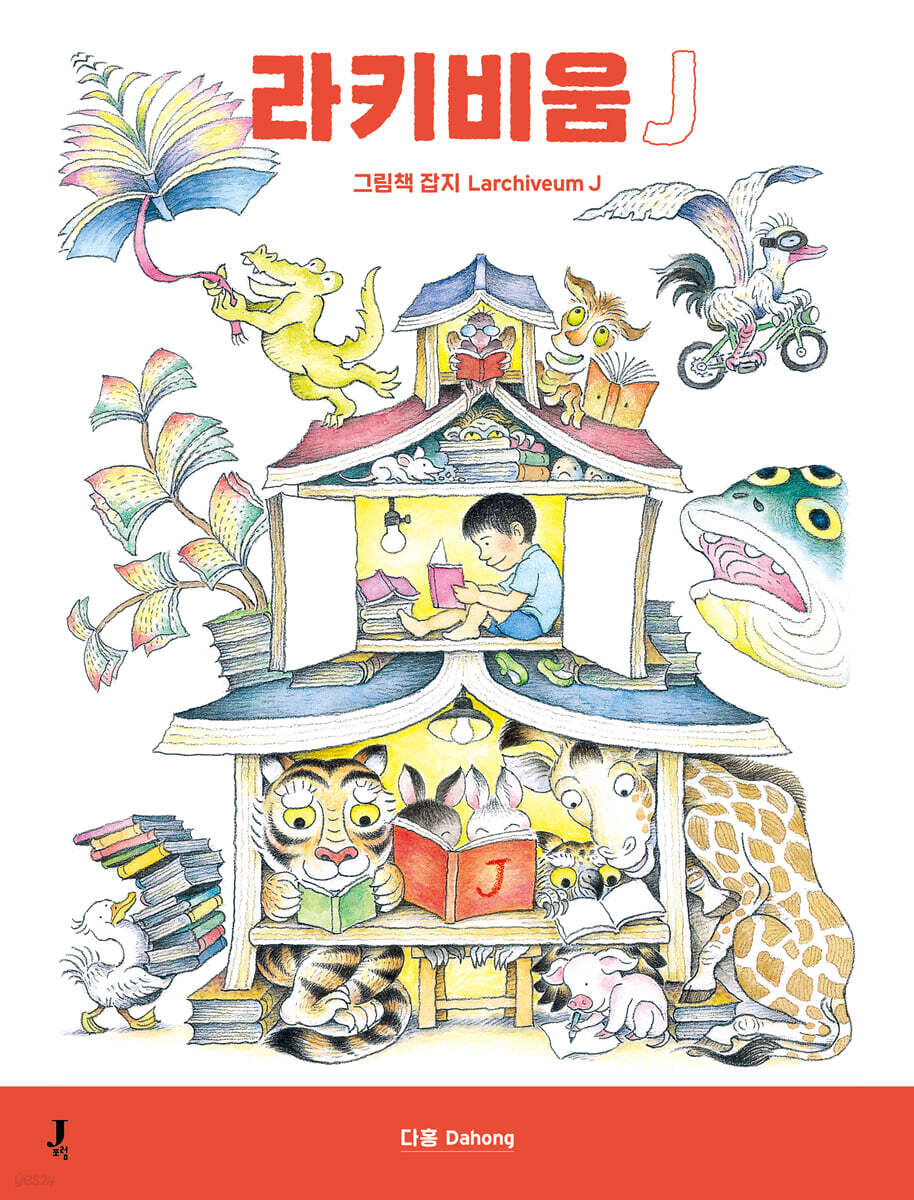
Please pay special attention to the cover of 'Dahong'.
The cover, specially drawn by picture book author Lee Eok-bae for Lakivium J, beautifully illustrates 'Reading and Child Growth', how children create their own world through reading and expand into the outside world.
It includes information on which picture books are most appropriate for each age group, as well as how to enjoy picture books regardless of age.
It is a 'magazine' that contains the latest trends, but can be read regardless of the time.
It encompasses both the most casual and the most profound way to view picture books.
『Lakivium J』 names each issue by its color.
The seventh 『Lakivium J』 is bright red 'Dahong'.
Please pay special attention to the cover of 'Dahong'.
The cover, specially drawn by picture book author Lee Eok-bae for Lakivium J, beautifully illustrates 'Reading and Child Growth', how children create their own world through reading and expand into the outside world.
- You can preview some of the book's contents.
Preview
index
First Greetings 08
T-day at our house is library day
Beautiful Picture Books: 10 Print Picture Books
Why a print is a print
Picture Book News 23
- The name of the Kate Greenaway Medal has changed?
Picture Book Physical Properties Guide 34
- The hole is wide open and the fun is full
ARGOS
Here we go! Plot 38
Author Interview - Corey R.
Taber 40
Picture book title translation 48
-Cinderella? That's not a typo!
Column 56
-The Rebellion of Small Beings
Picture Book 84
-There are people who haven't read the book, but there's no one who has read it only once!
Cover Typography 72
-Typography, the moment when letters become art
80 Caldecott Recommendations
- Our favorite Caldecott Award-winning book
Caldecott Medalist Trends of the 2000s 88
-Why the movie "Minari" and the picture book "Watercress" swept the scene
Author Interview - Piotr Soha 88
A Spoonful of Humor in a Nonfiction Picture Book
Picture Book Story - Listen to My Sister 104
The Secret to Getting Your Child to Love Nonfiction Picture Books
Picture Book Forest Play 112
-Hey kids, let's go play in the forest with Grandma, bring a picture book!
Picture Book Art Play 120
-You have to try it! You have to try it to know!
Picture Books and Literacy 130
-Conversations while looking at picture books develop literacy skills more than sentences from picture books.
Column 134
The power of picture books discovered by a mother raising a slow-growing child
Banggu Seok History Tour 140
-Suwon Hwaseong Fortress
Reading Note 156
-Time to record picture books
Picture Book Listening Time 164
-Schumann, Picture Books, and Me
Author Meets Author - Author Kim A-ram Meets Paul O.
Zelensky 172
-About a certain desire that had taken possession of me
Author Interview - Noh In-gyeong 184
-I record life in a picture book so that it doesn't just flow by.
English Picture Book Column 200
-A collection of picture books perfect for children learning phonics!
Column 208
-I hate my mom's style!
Kim Mi-jin's Picture Book 211
-Picture Book Time
Picture Book Partner Fairy Tale Book 220
-It's hard to make friends even at this age
Memorial Special - Tadashi Matsui 232
-The power of words is the power of life.
Column 240
- A journey through time with dinosaurs, a journey in a child's heart
Welcome Reprint - The Return of a Masterpiece, We've Been Waiting! 244
Out of Print - Until We Meet Again 247
New Release Rating - Bestseller Wish! 249
Picture Book Bingo 261
Editing Review 262
T-day at our house is library day
Beautiful Picture Books: 10 Print Picture Books
Why a print is a print
Picture Book News 23
- The name of the Kate Greenaway Medal has changed?
Picture Book Physical Properties Guide 34
- The hole is wide open and the fun is full
ARGOS
Here we go! Plot 38
Author Interview - Corey R.
Taber 40
Picture book title translation 48
-Cinderella? That's not a typo!
Column 56
-The Rebellion of Small Beings
Picture Book 84
-There are people who haven't read the book, but there's no one who has read it only once!
Cover Typography 72
-Typography, the moment when letters become art
80 Caldecott Recommendations
- Our favorite Caldecott Award-winning book
Caldecott Medalist Trends of the 2000s 88
-Why the movie "Minari" and the picture book "Watercress" swept the scene
Author Interview - Piotr Soha 88
A Spoonful of Humor in a Nonfiction Picture Book
Picture Book Story - Listen to My Sister 104
The Secret to Getting Your Child to Love Nonfiction Picture Books
Picture Book Forest Play 112
-Hey kids, let's go play in the forest with Grandma, bring a picture book!
Picture Book Art Play 120
-You have to try it! You have to try it to know!
Picture Books and Literacy 130
-Conversations while looking at picture books develop literacy skills more than sentences from picture books.
Column 134
The power of picture books discovered by a mother raising a slow-growing child
Banggu Seok History Tour 140
-Suwon Hwaseong Fortress
Reading Note 156
-Time to record picture books
Picture Book Listening Time 164
-Schumann, Picture Books, and Me
Author Meets Author - Author Kim A-ram Meets Paul O.
Zelensky 172
-About a certain desire that had taken possession of me
Author Interview - Noh In-gyeong 184
-I record life in a picture book so that it doesn't just flow by.
English Picture Book Column 200
-A collection of picture books perfect for children learning phonics!
Column 208
-I hate my mom's style!
Kim Mi-jin's Picture Book 211
-Picture Book Time
Picture Book Partner Fairy Tale Book 220
-It's hard to make friends even at this age
Memorial Special - Tadashi Matsui 232
-The power of words is the power of life.
Column 240
- A journey through time with dinosaurs, a journey in a child's heart
Welcome Reprint - The Return of a Masterpiece, We've Been Waiting! 244
Out of Print - Until We Meet Again 247
New Release Rating - Bestseller Wish! 249
Picture Book Bingo 261
Editing Review 262
Detailed image

Into the book
“Borrow old books from the library.
People often want to borrow new books, but most books that children have read so many times, or books with slightly bulged pages, are guaranteed to be fun.”
---p.9 From "First Greetings"
“Children’s growth begins in the absence of their guardians.
In any movie or story, the story begins when the character is separated from the group and left alone, or when the guardian is away.
The act of reading a book is like growing up alone in an unfamiliar world.
Even with a caregiver present to read picture books, children face challenges alone.”
---p.61 From “The Rebellion of Small Beings”
"What images are remembered in children's minds? Why do Paul Zelinsky's paintings, which I thought I'd forgotten, and Maurice Sendak's illustrations from my childhood, remain in my mind?"
---p.178 From “Author Aram Kim Meets Four-Time Caldecott Medal Winner Paul O. Zelinsky”
“Why did Anthony Browne write ‘Voices’ in different fonts for each letter of the alphabet, even though it is just one word? This book tells the story of four people with different personalities and perspectives, and the reader
Even the fonts in the text were expressed differently for each character so that the differences between the characters could be imagined in three dimensions.
Do you feel it? Yes.
“It’s a mix of four fonts in ‘Voices.’”
---p.77 From "Typography: The Moment Letters Become Art"
“Works like ‘Watercress,’ ‘Water Protector,’ ‘Shining Child,’ and ‘We Will Not Be Defeated’ are not suitable for light reading as bedtime reading or lap reading because they are steeped in the pain and sorrow of ethnic minorities.
It is more effective for school librarians and general teachers to first build up background knowledge related to these books in connection with social studies, and then read them to students and discuss them. In elementary school libraries, librarians sometimes hold events with students to award Mock Caldecott Medals before the Caldecott Medals are announced at the end of January.
Among the picture books published last year, we selected notable ones and gave each group 5 or 6 books, and selected one book from them.
Group members carefully read the picture books and select one book using the same criteria as the Caldecott Medal selection committee.”
---p.93 From “Why the movie “Minari” swept the picture book market, and “Watercress” swept the picture book market”
“Exploring and experiencing nature with children doesn’t have to be grand or difficult.
Opening your eyes to nature early will lay the foundation for a prosperous life.
If parents are afraid to go out into nature, children will be more afraid.
If you go into nature often with your child, he or she will open his or her eyes to small changes and discover new toys.
If you plant the seeds of nature play at a young age, you can reap great fruits.
American biologist Rachel Carson said, “If a child is to develop a sense of wonder about nature, he or she needs at least one adult to marvel with him or her.”
“I want to become that kind of adult.”
---p.119 From "Kids, Let's Go Play in the Forest with Grandma, Bring a Picture Book! A Special Nature Play Class by a Kindergarten Director with Over 30 Years of Experience"
“Oh my! After that, my second child also came home every day with a picture book asking me to read it to him.
Tonight will be tough again.
If you read the youngest child's picture book in order of arrival, the second child will say, "Why am I always second?"
Read it to me first.
“Please read it~~~, sob sob.” It’s a situation where it’s obvious that there will be muttering + irritation × a sea of tears.
“How wonderful it would be if picture book parenting were beautiful and elegant.”
---p.135 From “The Power of Picture Books Discovered by a Mother Raising a Slow Child”
“There are people who consistently record their daily lives, marveling at even the smallest things.
There are those who polish the stories gleaned from those records and put them into picture books.
Reading his book, I found it to be filled with 'the encouragement I need right now.'
When I finish reading the book and look at the picture book cover, a warm yellow light lights up in my dark heart.
Introducing Noh In-gyeong, a picture book author who records the present and conveys today with a tender gaze.
People often want to borrow new books, but most books that children have read so many times, or books with slightly bulged pages, are guaranteed to be fun.”
---p.9 From "First Greetings"
“Children’s growth begins in the absence of their guardians.
In any movie or story, the story begins when the character is separated from the group and left alone, or when the guardian is away.
The act of reading a book is like growing up alone in an unfamiliar world.
Even with a caregiver present to read picture books, children face challenges alone.”
---p.61 From “The Rebellion of Small Beings”
"What images are remembered in children's minds? Why do Paul Zelinsky's paintings, which I thought I'd forgotten, and Maurice Sendak's illustrations from my childhood, remain in my mind?"
---p.178 From “Author Aram Kim Meets Four-Time Caldecott Medal Winner Paul O. Zelinsky”
“Why did Anthony Browne write ‘Voices’ in different fonts for each letter of the alphabet, even though it is just one word? This book tells the story of four people with different personalities and perspectives, and the reader
Even the fonts in the text were expressed differently for each character so that the differences between the characters could be imagined in three dimensions.
Do you feel it? Yes.
“It’s a mix of four fonts in ‘Voices.’”
---p.77 From "Typography: The Moment Letters Become Art"
“Works like ‘Watercress,’ ‘Water Protector,’ ‘Shining Child,’ and ‘We Will Not Be Defeated’ are not suitable for light reading as bedtime reading or lap reading because they are steeped in the pain and sorrow of ethnic minorities.
It is more effective for school librarians and general teachers to first build up background knowledge related to these books in connection with social studies, and then read them to students and discuss them. In elementary school libraries, librarians sometimes hold events with students to award Mock Caldecott Medals before the Caldecott Medals are announced at the end of January.
Among the picture books published last year, we selected notable ones and gave each group 5 or 6 books, and selected one book from them.
Group members carefully read the picture books and select one book using the same criteria as the Caldecott Medal selection committee.”
---p.93 From “Why the movie “Minari” swept the picture book market, and “Watercress” swept the picture book market”
“Exploring and experiencing nature with children doesn’t have to be grand or difficult.
Opening your eyes to nature early will lay the foundation for a prosperous life.
If parents are afraid to go out into nature, children will be more afraid.
If you go into nature often with your child, he or she will open his or her eyes to small changes and discover new toys.
If you plant the seeds of nature play at a young age, you can reap great fruits.
American biologist Rachel Carson said, “If a child is to develop a sense of wonder about nature, he or she needs at least one adult to marvel with him or her.”
“I want to become that kind of adult.”
---p.119 From "Kids, Let's Go Play in the Forest with Grandma, Bring a Picture Book! A Special Nature Play Class by a Kindergarten Director with Over 30 Years of Experience"
“Oh my! After that, my second child also came home every day with a picture book asking me to read it to him.
Tonight will be tough again.
If you read the youngest child's picture book in order of arrival, the second child will say, "Why am I always second?"
Read it to me first.
“Please read it~~~, sob sob.” It’s a situation where it’s obvious that there will be muttering + irritation × a sea of tears.
“How wonderful it would be if picture book parenting were beautiful and elegant.”
---p.135 From “The Power of Picture Books Discovered by a Mother Raising a Slow Child”
“There are people who consistently record their daily lives, marveling at even the smallest things.
There are those who polish the stories gleaned from those records and put them into picture books.
Reading his book, I found it to be filled with 'the encouragement I need right now.'
When I finish reading the book and look at the picture book cover, a warm yellow light lights up in my dark heart.
Introducing Noh In-gyeong, a picture book author who records the present and conveys today with a tender gaze.
---p.185 From “I record life in picture books so that it doesn’t just flow by, an interview with author Noh In-gyeong”
Publisher's Review
‘Literacy’ is a hot topic these days.
It does not simply refer to the ability to read letters and interpret the meaning of sentences.
The ability to read the context of an object and apply it to my life is literacy.
Literacy in sentences alone is no longer enough.
It requires visual literacy, humanities skills, and creativity to read and use images.
Are you feeling a little heavy-hearted? It's okay.
Because there is a picture book.
The reason for reading picture books is not to develop a 'specific ability', but reading picture books does indeed help develop many abilities.
The picture book magazine 『Lakivium J Dahong』 suggests that we look at the same picture books more enjoyably, more deeply, and more broadly.
“I know picture books are good, but I don’t know which ones to read.”, “I’m curious about the current picture book trends.”, “I started reading picture books to my child and ended up liking them more myself.
“I want to know more.” It reflects the needs of picture book readers from 0 to 100 years old.
『Lakibium J Dahong』.
It also contains information about English picture books and various activities that can be done with them.
If you want to choose a picture book that your child will love,
If adults want to study picture books more deeply,
If you want to create a picture book class of a higher level, 『Lakibium J Dahong』.
From 'which' picture book to read
Even ‘how’ to read it is enough with 『Lakibium J Dahong』.
The first eye-catching article in 『Lakibium J Dahong』 is ‘Beautiful Picture Book.’
As I gathered all the woodblock print picture books in one place, I naturally ended up including the history of picture books.
Meet the three great illustrators of the 1800s: Walter Crane, Kate Greenaway, Randolph Caldecott, and engraver Edmund Evans.
Oh, and there's also news that the Kate Greenaway Medal, Britain's top children's book award, has changed its name.
『Lakibium J』 has consistently focused on the characteristics of picture books as paper books, such as the outer cover, the band, and the book flap.
In 『Lakibium J Dahong』, we have gathered together the ‘books with holes’ that children especially love.
“This book needs this hole for this reason.” Listen to the book’s story.
'Argos' is the name of a monster with 100 eyes in Greek mythology.
Because it has 100 eyes, it does not fall asleep at the same time, and because all 100 eyes see different things, it is often used as a symbol of the 'media'.
In 『Lakivium J Dahong』, ‘Argos’ is a corner that suggests 100 ways to look at a picture book.
I'm analyzing the 2022 Caldecott Medal winner, "Gandaaah!" (written and illustrated by Corey R. Taber/Today Books), by looking at it from all angles (and actually turning it over).
By looking at the thumbnails of the idea stages revealed in the author interview, some people will not only gain an understanding of the work but also gain creative ideas.
Starting with how the title 『Mell Fell』 became 『Gandaaaaa!』, the article introduces various episodes related to the translation of titles of various books (“Cinderula? It’s not a typo!”), an article analyzes how the subject matter and format of a book meet to maximize its effect, and an article that looks at the history of the Caldecott Award and introduces popular award-winning works that children responded enthusiastically.
All these articles were written based on a single book, "Gandaaa!"
I hope this will be a good example of how one can analyze and enjoy a book in various ways, and can be applied to other picture books.
There are many noteworthy contributions in this issue of 『Lakivium J Dahong』.
Through the article by Professor Na-ya Choi of the Department of Child and Family Studies at Seoul National University, we learn about what literacy is and how it can be developed through picture books.
When it comes to fostering literacy, what's more important than picture books?
Authors Jeon Myeong-ok of "Grandma's Forest Drink" and Lee Ji-hyun of "Picture Book Art Play" share easy tips for playing with children through picture books.
It's exactly as the article title says.
You have to play to know! You have to play!
Translator Hwang Jin-hee's special feature on the passing of Tadashi Matsui, the father of Japanese picture books and president of Fukuinkansen Publishing, is itself a guide to "book parenting."
Translator Jinhee Hwang has compiled a vast amount of information, from the influence of Tadashi Matsui on children's books to why and how we should read to children, and even what makes a good book, in a simple and concise manner.
Author Jeong Jeong-hye of "The First English Picture Book Study Method" reveals a list of picture books that will be even more effective when read by children learning phonics.
There are also several articles on non-fiction picture books.
There's also a column that shares tips on how to encourage children who hate nonfiction to read, and an exclusive interview with world-renowned nonfiction author Piotr Soha, courtesy of LakiviumJ.
The interview with four-time Caldecott Medal winner Paul O. Zelinsky, author of "A Certain Desire That Occupied Me," is even more meaningful because it was conducted in person by Aram Kim, an author based in the United States.
What heartwarming advice does a master offer to aspiring writers? Please pay attention to what facts about the author and his work are being revealed for the first time in Korea.
The 'Time to Listen to Picture Books' corner, which delves into the music in picture books, pays special attention to 'Commandments'.
This book covers everything from picture books that explain how the Doremi commandments were created to picture books that use the commandments as hidden devices within the book.
It is particularly fascinating how Schumann used the 'names' of the commandments when composing.
What picture books feature Schumann's scores? Why would they use Schumann? Knowing the background information can enhance the enjoyment of picture books, a special pleasure for adult readers.
It would also be a valuable experience for adult readers to read the article and discuss it with their children.
Don't miss the special article on 'Suwon Hwaseong Fortress,' a special experience that allows you to read a picture book and immediately apply it to your daily life.
First, we introduce picture books about Suwon Hwaseong Fortress, from complete collections to single volumes.
Also, when I actually visited Suwon Hwaseong Fortress, I meticulously researched how to best apply the picture book and which course to take.
Learn about Suwon Hwaseong Fortress in 6 steps with picture books!
It's a shame I can't present the full article.
We hope you enjoy these delightful and satisfying picture book stories.
It does not simply refer to the ability to read letters and interpret the meaning of sentences.
The ability to read the context of an object and apply it to my life is literacy.
Literacy in sentences alone is no longer enough.
It requires visual literacy, humanities skills, and creativity to read and use images.
Are you feeling a little heavy-hearted? It's okay.
Because there is a picture book.
The reason for reading picture books is not to develop a 'specific ability', but reading picture books does indeed help develop many abilities.
The picture book magazine 『Lakivium J Dahong』 suggests that we look at the same picture books more enjoyably, more deeply, and more broadly.
“I know picture books are good, but I don’t know which ones to read.”, “I’m curious about the current picture book trends.”, “I started reading picture books to my child and ended up liking them more myself.
“I want to know more.” It reflects the needs of picture book readers from 0 to 100 years old.
『Lakibium J Dahong』.
It also contains information about English picture books and various activities that can be done with them.
If you want to choose a picture book that your child will love,
If adults want to study picture books more deeply,
If you want to create a picture book class of a higher level, 『Lakibium J Dahong』.
From 'which' picture book to read
Even ‘how’ to read it is enough with 『Lakibium J Dahong』.
The first eye-catching article in 『Lakibium J Dahong』 is ‘Beautiful Picture Book.’
As I gathered all the woodblock print picture books in one place, I naturally ended up including the history of picture books.
Meet the three great illustrators of the 1800s: Walter Crane, Kate Greenaway, Randolph Caldecott, and engraver Edmund Evans.
Oh, and there's also news that the Kate Greenaway Medal, Britain's top children's book award, has changed its name.
『Lakibium J』 has consistently focused on the characteristics of picture books as paper books, such as the outer cover, the band, and the book flap.
In 『Lakibium J Dahong』, we have gathered together the ‘books with holes’ that children especially love.
“This book needs this hole for this reason.” Listen to the book’s story.
'Argos' is the name of a monster with 100 eyes in Greek mythology.
Because it has 100 eyes, it does not fall asleep at the same time, and because all 100 eyes see different things, it is often used as a symbol of the 'media'.
In 『Lakivium J Dahong』, ‘Argos’ is a corner that suggests 100 ways to look at a picture book.
I'm analyzing the 2022 Caldecott Medal winner, "Gandaaah!" (written and illustrated by Corey R. Taber/Today Books), by looking at it from all angles (and actually turning it over).
By looking at the thumbnails of the idea stages revealed in the author interview, some people will not only gain an understanding of the work but also gain creative ideas.
Starting with how the title 『Mell Fell』 became 『Gandaaaaa!』, the article introduces various episodes related to the translation of titles of various books (“Cinderula? It’s not a typo!”), an article analyzes how the subject matter and format of a book meet to maximize its effect, and an article that looks at the history of the Caldecott Award and introduces popular award-winning works that children responded enthusiastically.
All these articles were written based on a single book, "Gandaaa!"
I hope this will be a good example of how one can analyze and enjoy a book in various ways, and can be applied to other picture books.
There are many noteworthy contributions in this issue of 『Lakivium J Dahong』.
Through the article by Professor Na-ya Choi of the Department of Child and Family Studies at Seoul National University, we learn about what literacy is and how it can be developed through picture books.
When it comes to fostering literacy, what's more important than picture books?
Authors Jeon Myeong-ok of "Grandma's Forest Drink" and Lee Ji-hyun of "Picture Book Art Play" share easy tips for playing with children through picture books.
It's exactly as the article title says.
You have to play to know! You have to play!
Translator Hwang Jin-hee's special feature on the passing of Tadashi Matsui, the father of Japanese picture books and president of Fukuinkansen Publishing, is itself a guide to "book parenting."
Translator Jinhee Hwang has compiled a vast amount of information, from the influence of Tadashi Matsui on children's books to why and how we should read to children, and even what makes a good book, in a simple and concise manner.
Author Jeong Jeong-hye of "The First English Picture Book Study Method" reveals a list of picture books that will be even more effective when read by children learning phonics.
There are also several articles on non-fiction picture books.
There's also a column that shares tips on how to encourage children who hate nonfiction to read, and an exclusive interview with world-renowned nonfiction author Piotr Soha, courtesy of LakiviumJ.
The interview with four-time Caldecott Medal winner Paul O. Zelinsky, author of "A Certain Desire That Occupied Me," is even more meaningful because it was conducted in person by Aram Kim, an author based in the United States.
What heartwarming advice does a master offer to aspiring writers? Please pay attention to what facts about the author and his work are being revealed for the first time in Korea.
The 'Time to Listen to Picture Books' corner, which delves into the music in picture books, pays special attention to 'Commandments'.
This book covers everything from picture books that explain how the Doremi commandments were created to picture books that use the commandments as hidden devices within the book.
It is particularly fascinating how Schumann used the 'names' of the commandments when composing.
What picture books feature Schumann's scores? Why would they use Schumann? Knowing the background information can enhance the enjoyment of picture books, a special pleasure for adult readers.
It would also be a valuable experience for adult readers to read the article and discuss it with their children.
Don't miss the special article on 'Suwon Hwaseong Fortress,' a special experience that allows you to read a picture book and immediately apply it to your daily life.
First, we introduce picture books about Suwon Hwaseong Fortress, from complete collections to single volumes.
Also, when I actually visited Suwon Hwaseong Fortress, I meticulously researched how to best apply the picture book and which course to take.
Learn about Suwon Hwaseong Fortress in 6 steps with picture books!
It's a shame I can't present the full article.
We hope you enjoy these delightful and satisfying picture book stories.
GOODS SPECIFICS
- Date of issue: March 30, 2023
- Page count, weight, size: 264 pages | 620g | 183*240*14mm
- ISBN13: 9791197525360
- ISBN10: 119752536X
You may also like
카테고리
korean


korean

![GQ KOREA Mark (Monthly): December [2025]](http://librairie.coreenne.fr/cdn/shop/files/8ef265dbbfbf186523ed75ba7319009d.jpg?v=1765340328&width=3840)


