

Getting started with FastAPI
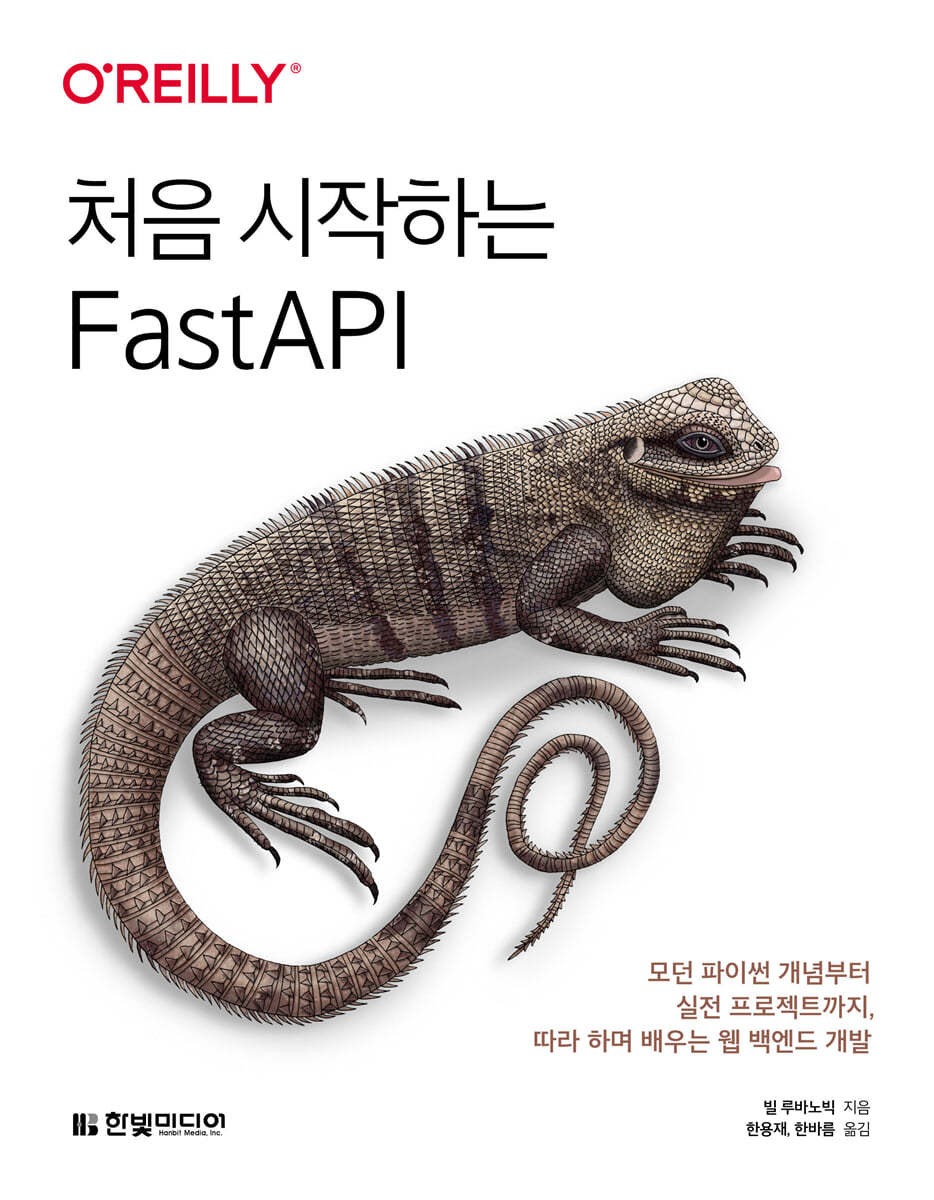 |
Description
Book Introduction
For building faster, easier web services
FastAPI Essentials Guide!
FastAPI is a robust web framework that leverages modern Python features with a clean design. Its structure is similar to Flask or Django, making it easy to get started.
This book introduces how developers familiar with Python can accomplish a lot of tasks in a short amount of time with less code.
It goes beyond the basics of FastAPI development and covers the core concepts, using examples of various topics such as forms, databases, graphics, and maps.
We also provide hands-on training to help you quickly and easily learn various topics, including RESTful APIs, data validation, and authorization.
FastAPI Essentials Guide!
FastAPI is a robust web framework that leverages modern Python features with a clean design. Its structure is similar to Flask or Django, making it easy to get started.
This book introduces how developers familiar with Python can accomplish a lot of tasks in a short amount of time with less code.
It goes beyond the basics of FastAPI development and covers the core concepts, using examples of various topics such as forms, databases, graphics, and maps.
We also provide hands-on training to help you quickly and easily learn various topics, including RESTful APIs, data validation, and authorization.
- You can preview some of the book's contents.
Preview
index
[PART 1: The Modern Web and Python]
CHAPTER 1 The Modern Web
_1.1 Services and APIs
_1.2 Concurrency
_1.3 layer
_1.4 data
_1.5 Summary
CHAPTER 2 Modern Python
_2.1 Tools
_2.2 Getting Started
_2.3 API and Services
_2.4 Variables
_2.5 Type Hints
_2.6 Data Structures
_2.7 Web Framework
_2.8 Summary
[PART 2: A Quick Look at FastAPI]
CHAPTER 3: A Tour of FastAPI
_3.1 Introduction to FastAPI
_3.2 FastAPI Application
_3.3 HTTP Request
_3.4 HTTP Response
_3.5 Automatic Documentation
_3.6 Summary
CHAPTER 4 Starlette and Asynchrony and Concurrency
_4.1 Starlette
_4.2 Concurrency Types
_4.3 FastAPI and Async
_4.4 Direct use
_4.5 Break: Cleaning the Clue Mansion
_4.6 Summary
CHAPTER 5 Pydantic, Type Hints, and Models
_5.1 Type Hints
_5.2 Data Grouping
_5.3 Alternative
_5.4 Simple Example
_5.5 Type Validation
_5.6 Value Validation
_5.7 Summary
CHAPTER 6 DEPENDENCY
_6.1 What is a dependency?
_6.2 Dependency Related Issues
_6.3 Dependency Injection
_6.4 FastAPI Dependency
_6.5 Writing Dependencies
_6.6 Dependency Scope
_6.7 Summary
CHAPTER 7: COMPARISON OF FRAMEWORKS
_7.1 Flask
_7.2 Django
_7.3 Other Web Framework Features
_7.4 Database
_7.5 Recommended
_7.6 Other Python Web Frameworks
_7.7 Summary
[PART 3: Creating a Website]
CHAPTER 8 WEB TIER
_8.1 Break Time: Bottom-up, Top-down, Two-way?
_8.2 RESTful API Design
_8.3 File and Directory Structure
_8.4 First website code
_8.5 Request
_8.6 Multiple Routers
_8.7 Building the Web Layer
_8.8 Defining the Data Model
_8.9 Stubs and fake data
_8.10 Common functions implemented step by step
_8.11 Creating fake data
_8.12 Test!
_8.13 Test forms automatically generated by FastAPI
_8.14 Dialogue between the Service Layer and the Data Layer
_8.15 Paging and Sorting
_8.16 Summary
CHAPTER 9 SERVICE LAYER
_9.1 Service Definition
_9.2 Layout
_9.3 Protection
_9.4 Features
_9.5 Test!
_9.6 Web Layer Fixes
_9.7 Other Service Level Considerations
_9.8 Summary
CHAPTER 10 DATA HIERARCHY
_10.1 DB-API
_10.2 SQLite
_10.3 Layout
_10.4 Database Initialization
_10.5 Service Layer Connection
_10.6 Test!
_10.7 Summary
CHAPTER 11 CERTIFICATION AND ACCREDITATION
_11.1 The Need for Authentication
_11.2 Authentication Method
_11.3 Global Authentication: Shared Password
_11.4 Simple Personal Authentication
_11.5 More awesome personal authentication
_11.6 Approval
_11.7 Middleware
_11.8 Summary
CHAPTER 12 TEST
_12.1 Web API Testing
_12.2 Types of tests
_12.3 Test Subject
_12.4 pytest
_12.5 layout
_12.6 Unit Test Automation
_12.7 Integrated Test Automation
_12.8 Repository Pattern
_12.9 Full Test Automation
_12.10 Security Test
_12.11 Load Testing
_12.12 Summary
CHAPTER 13 PRODUCTION
_13.1 distribution
_13.2 HTTPS
_13.3 Performance
_13.4 Troubleshooting
_13.5 Summary
[PART 4 Gallery]
CHAPTER 14 Databases, Data Science, and AI
_14.1 Data Storage
_14.2 Relational Databases and SQL
_14.3 Non-relational databases
_14.4 NoSQL Features in SQL Databases
_14.5 Database Load Testing
_14.6 Data Science and AI
_14.7 Summary
CHAPTER 15 FILES
_15.1 Multipart Support
_15.2 File Upload
_15.3 Download file
_15.4 Serving Static Files
_15.5 Summary
CHAPTER 16 FORMS AND TEMPLATES
_16.1 Form
_16.2 Template
_16.3 Summary
CHAPTER 17 Data Exploration and Visualization
_17.1 Python and Data
_17.2 PSV text output
_17.3 SQLite Data Sources and Web Output
_17.4 Summary
CHAPTER 18 GAMES
_18.1 Python Game Package
_18.2 Separation of game logic
_18.3 Game Design
_18.4 Web Tier 1: Game Initialization
_18.5 Web Layer 2: Game Stage
_18.6 Service Layer 1: Initialization
_18.7 Service Layer 2: Score Calculation
_18.8 Happy testing!
_18.9 Data Layer: Initialization
_18.10 Running Cryptonamicon
_18.11 Summary
APPENDIX A Further Reading
_A.1 Python
_A.2 FastAPI
_A.3 Starlette
_A.4 Pydantic
APPENDIX B Life and Explorers
_B.1 List of living things
_B.2 Explorer
_B.3 Explorer's Book
_B.4 Other materials
CHAPTER 1 The Modern Web
_1.1 Services and APIs
_1.2 Concurrency
_1.3 layer
_1.4 data
_1.5 Summary
CHAPTER 2 Modern Python
_2.1 Tools
_2.2 Getting Started
_2.3 API and Services
_2.4 Variables
_2.5 Type Hints
_2.6 Data Structures
_2.7 Web Framework
_2.8 Summary
[PART 2: A Quick Look at FastAPI]
CHAPTER 3: A Tour of FastAPI
_3.1 Introduction to FastAPI
_3.2 FastAPI Application
_3.3 HTTP Request
_3.4 HTTP Response
_3.5 Automatic Documentation
_3.6 Summary
CHAPTER 4 Starlette and Asynchrony and Concurrency
_4.1 Starlette
_4.2 Concurrency Types
_4.3 FastAPI and Async
_4.4 Direct use
_4.5 Break: Cleaning the Clue Mansion
_4.6 Summary
CHAPTER 5 Pydantic, Type Hints, and Models
_5.1 Type Hints
_5.2 Data Grouping
_5.3 Alternative
_5.4 Simple Example
_5.5 Type Validation
_5.6 Value Validation
_5.7 Summary
CHAPTER 6 DEPENDENCY
_6.1 What is a dependency?
_6.2 Dependency Related Issues
_6.3 Dependency Injection
_6.4 FastAPI Dependency
_6.5 Writing Dependencies
_6.6 Dependency Scope
_6.7 Summary
CHAPTER 7: COMPARISON OF FRAMEWORKS
_7.1 Flask
_7.2 Django
_7.3 Other Web Framework Features
_7.4 Database
_7.5 Recommended
_7.6 Other Python Web Frameworks
_7.7 Summary
[PART 3: Creating a Website]
CHAPTER 8 WEB TIER
_8.1 Break Time: Bottom-up, Top-down, Two-way?
_8.2 RESTful API Design
_8.3 File and Directory Structure
_8.4 First website code
_8.5 Request
_8.6 Multiple Routers
_8.7 Building the Web Layer
_8.8 Defining the Data Model
_8.9 Stubs and fake data
_8.10 Common functions implemented step by step
_8.11 Creating fake data
_8.12 Test!
_8.13 Test forms automatically generated by FastAPI
_8.14 Dialogue between the Service Layer and the Data Layer
_8.15 Paging and Sorting
_8.16 Summary
CHAPTER 9 SERVICE LAYER
_9.1 Service Definition
_9.2 Layout
_9.3 Protection
_9.4 Features
_9.5 Test!
_9.6 Web Layer Fixes
_9.7 Other Service Level Considerations
_9.8 Summary
CHAPTER 10 DATA HIERARCHY
_10.1 DB-API
_10.2 SQLite
_10.3 Layout
_10.4 Database Initialization
_10.5 Service Layer Connection
_10.6 Test!
_10.7 Summary
CHAPTER 11 CERTIFICATION AND ACCREDITATION
_11.1 The Need for Authentication
_11.2 Authentication Method
_11.3 Global Authentication: Shared Password
_11.4 Simple Personal Authentication
_11.5 More awesome personal authentication
_11.6 Approval
_11.7 Middleware
_11.8 Summary
CHAPTER 12 TEST
_12.1 Web API Testing
_12.2 Types of tests
_12.3 Test Subject
_12.4 pytest
_12.5 layout
_12.6 Unit Test Automation
_12.7 Integrated Test Automation
_12.8 Repository Pattern
_12.9 Full Test Automation
_12.10 Security Test
_12.11 Load Testing
_12.12 Summary
CHAPTER 13 PRODUCTION
_13.1 distribution
_13.2 HTTPS
_13.3 Performance
_13.4 Troubleshooting
_13.5 Summary
[PART 4 Gallery]
CHAPTER 14 Databases, Data Science, and AI
_14.1 Data Storage
_14.2 Relational Databases and SQL
_14.3 Non-relational databases
_14.4 NoSQL Features in SQL Databases
_14.5 Database Load Testing
_14.6 Data Science and AI
_14.7 Summary
CHAPTER 15 FILES
_15.1 Multipart Support
_15.2 File Upload
_15.3 Download file
_15.4 Serving Static Files
_15.5 Summary
CHAPTER 16 FORMS AND TEMPLATES
_16.1 Form
_16.2 Template
_16.3 Summary
CHAPTER 17 Data Exploration and Visualization
_17.1 Python and Data
_17.2 PSV text output
_17.3 SQLite Data Sources and Web Output
_17.4 Summary
CHAPTER 18 GAMES
_18.1 Python Game Package
_18.2 Separation of game logic
_18.3 Game Design
_18.4 Web Tier 1: Game Initialization
_18.5 Web Layer 2: Game Stage
_18.6 Service Layer 1: Initialization
_18.7 Service Layer 2: Score Calculation
_18.8 Happy testing!
_18.9 Data Layer: Initialization
_18.10 Running Cryptonamicon
_18.11 Summary
APPENDIX A Further Reading
_A.1 Python
_A.2 FastAPI
_A.3 Starlette
_A.4 Pydantic
APPENDIX B Life and Explorers
_B.1 List of living things
_B.2 Explorer
_B.3 Explorer's Book
_B.4 Other materials
Detailed image

Publisher's Review
The modern Python web framework we've all been waiting for is here!
FastAPI for quick learning
FastAPI emerged as a framework for creating fast web services with simple syntax, and quickly grew alongside Django and Flask, the leaders in Python web frameworks.
And by the end of 2023, five years after its launch, it had surpassed Flask as the second most popular Python web framework based on GitHub stars.
This book introduces how to use FastAPI by creating a simple web service that manages information about unknown organisms and researchers.
We will also introduce various projects using FastAPI, such as AI services and games, and explore how to apply FastAPI to your desired project.
Part 1: Modern Web and Python
Discusses emerging topics in the web and Python world.
We explore services and APIs, concurrency, layered architectures, and massive big data.
Part 2_ A Quick Look at FastAPI
Let's take a look at the big picture of FastAPI.
But let's look at the trees, not the forest.
Quickly review the basics, but keep your gaze above the surface so as not to get too bogged down in details.
Each chapter is relatively short, providing background information for a more in-depth look at the content in Part 3.
Part 3: Creating a Website
Let's take a closer look at the tools provided by FastAPI.
Contains tips for developing commercial software with FastAPI.
Part 4_ Gallery
Here are some examples of FastAPI.
These examples are a bit more interesting because they showcase common web features like forms, files, databases, charts and graphics, maps, and games, rather than randomly generated examples using fictional creatures created from common data sources.
You can use the examples presented in Part 4 as a starting point for a new project.
Target audience
● Beginner developers who want to start web development with Python
● Backend developers curious about FastAPI
● Students who want to quickly learn about the web backend development process
What you learn
● How to build a web application with FastAPI
● Differences between FastAPI, Starlet, and Pydantic
● FastAPI's asynchronous functions and data type checking and validation
● Differences between synchronous and asynchronous Python
● How to connect to external APIs and services
Author's Note
Reading the official documentation for FastAPI, I was deeply impressed by the design and mindset of its developer, Sebastian Ramirez.
In particular, the effort he put into his articles evaluating other frameworks was evident.
FastAPI is not a snobbish project or a curious experiment, but a serious framework for real-world development.
I have a feeling that FastAPI will be a huge success this time.
Bill Rubanovic
Translator's Note
This is the golden age of web frameworks.
Numerous frameworks have appeared and disappeared in the Python ecosystem.
For developers, frameworks are as important a skill as languages when it comes to building a career.
FastAPI is a framework that has been gaining popularity in the Python community for several years.
As the name suggests, it provides an environment for quickly building web servers, making it easy to learn and creating secure APIs.
Through this book, you will gain knowledge that can be applied to practical projects, from the basic concepts of FastAPI to architecture design.
- Han Yong-jae
As a developer, I have finished my first translation project.
Thanks to the help of translator Yongjae and the Hanbit Media editorial team, I was able to successfully complete this project.
Thanks to everyone who helped with this work.
There is a lot to learn about FastAPI from its official documentation.
While the official documentation describes FastAPI itself, this book explains how to leverage FastAPI across web development.
I think this book fills in the gaps left by official documentation.
I hope this book helps you build fast services quickly.
- Hanbarum
FastAPI for quick learning
FastAPI emerged as a framework for creating fast web services with simple syntax, and quickly grew alongside Django and Flask, the leaders in Python web frameworks.
And by the end of 2023, five years after its launch, it had surpassed Flask as the second most popular Python web framework based on GitHub stars.
This book introduces how to use FastAPI by creating a simple web service that manages information about unknown organisms and researchers.
We will also introduce various projects using FastAPI, such as AI services and games, and explore how to apply FastAPI to your desired project.
Part 1: Modern Web and Python
Discusses emerging topics in the web and Python world.
We explore services and APIs, concurrency, layered architectures, and massive big data.
Part 2_ A Quick Look at FastAPI
Let's take a look at the big picture of FastAPI.
But let's look at the trees, not the forest.
Quickly review the basics, but keep your gaze above the surface so as not to get too bogged down in details.
Each chapter is relatively short, providing background information for a more in-depth look at the content in Part 3.
Part 3: Creating a Website
Let's take a closer look at the tools provided by FastAPI.
Contains tips for developing commercial software with FastAPI.
Part 4_ Gallery
Here are some examples of FastAPI.
These examples are a bit more interesting because they showcase common web features like forms, files, databases, charts and graphics, maps, and games, rather than randomly generated examples using fictional creatures created from common data sources.
You can use the examples presented in Part 4 as a starting point for a new project.
Target audience
● Beginner developers who want to start web development with Python
● Backend developers curious about FastAPI
● Students who want to quickly learn about the web backend development process
What you learn
● How to build a web application with FastAPI
● Differences between FastAPI, Starlet, and Pydantic
● FastAPI's asynchronous functions and data type checking and validation
● Differences between synchronous and asynchronous Python
● How to connect to external APIs and services
Author's Note
Reading the official documentation for FastAPI, I was deeply impressed by the design and mindset of its developer, Sebastian Ramirez.
In particular, the effort he put into his articles evaluating other frameworks was evident.
FastAPI is not a snobbish project or a curious experiment, but a serious framework for real-world development.
I have a feeling that FastAPI will be a huge success this time.
Bill Rubanovic
Translator's Note
This is the golden age of web frameworks.
Numerous frameworks have appeared and disappeared in the Python ecosystem.
For developers, frameworks are as important a skill as languages when it comes to building a career.
FastAPI is a framework that has been gaining popularity in the Python community for several years.
As the name suggests, it provides an environment for quickly building web servers, making it easy to learn and creating secure APIs.
Through this book, you will gain knowledge that can be applied to practical projects, from the basic concepts of FastAPI to architecture design.
- Han Yong-jae
As a developer, I have finished my first translation project.
Thanks to the help of translator Yongjae and the Hanbit Media editorial team, I was able to successfully complete this project.
Thanks to everyone who helped with this work.
There is a lot to learn about FastAPI from its official documentation.
While the official documentation describes FastAPI itself, this book explains how to leverage FastAPI across web development.
I think this book fills in the gaps left by official documentation.
I hope this book helps you build fast services quickly.
- Hanbarum
GOODS SPECIFICS
- Date of issue: June 30, 2024
- Page count, weight, size: 324 pages | 183*235*30mm
- ISBN13: 9791169212649
- ISBN10: 1169212646
You may also like
카테고리
korean


korean

![GQ KOREA Mark (Monthly): December [2025]](http://librairie.coreenne.fr/cdn/shop/files/8ef265dbbfbf186523ed75ba7319009d.jpg?v=1765340328&width=3840)


