

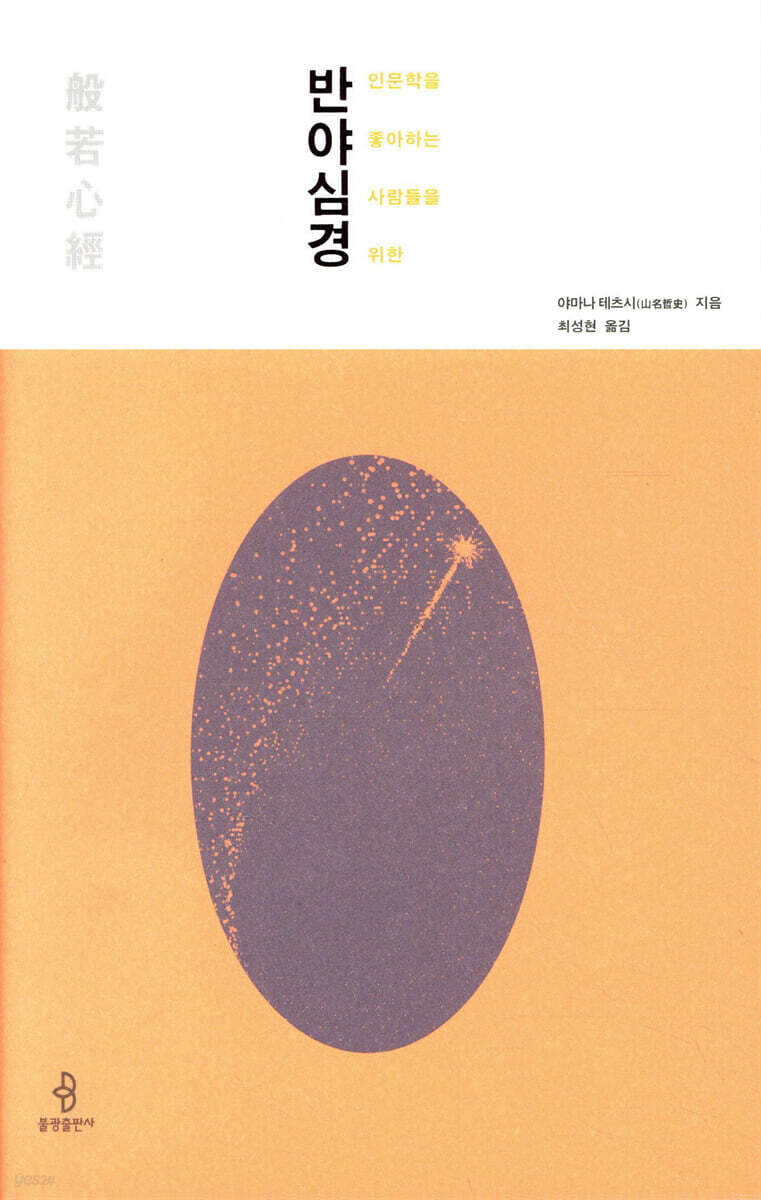
The Heart Sutra for those who love the humanities
 |
Description
Book Introduction
About happiness that is nowhere and everywhere
The oldest classic of mankind, the Heart Sutra
What an easy commentary on the Heart Sutra!
The Heart Sutra, which every Buddhist believes in.
But surprisingly, few people truly understand the meaning of that short scripture.
It's only 262 characters, but why? It's so concise.
The author of this book, Tetsushi Yamana, is a philosopher who majored in Western philosophy and has worked as an editor and consultant.
This unique history became the driving force behind publishing the world's easiest 『Heart Sutra』.
“What the Heart Sutra wants to say is how to escape suffering and thus achieve happiness—that’s the only thing.” The core of the Heart Sutra, as seen through the eyes of a Western philosophy researcher, is ‘happiness.’
The Heart Sutra is by no means a difficult or boring scripture.
This is the 'path to happiness' discovered by Buddha, who pondered deeply about life 2,600 years ago.
It's an old road, but there's still no better road than this.
If life is difficult and painful, if happiness always feels far away, I recommend reading this book.
Right now, my thoughts will change, my daily life will change, and my life will be transformed.
The oldest classic of mankind, the Heart Sutra
What an easy commentary on the Heart Sutra!
The Heart Sutra, which every Buddhist believes in.
But surprisingly, few people truly understand the meaning of that short scripture.
It's only 262 characters, but why? It's so concise.
The author of this book, Tetsushi Yamana, is a philosopher who majored in Western philosophy and has worked as an editor and consultant.
This unique history became the driving force behind publishing the world's easiest 『Heart Sutra』.
“What the Heart Sutra wants to say is how to escape suffering and thus achieve happiness—that’s the only thing.” The core of the Heart Sutra, as seen through the eyes of a Western philosophy researcher, is ‘happiness.’
The Heart Sutra is by no means a difficult or boring scripture.
This is the 'path to happiness' discovered by Buddha, who pondered deeply about life 2,600 years ago.
It's an old road, but there's still no better road than this.
If life is difficult and painful, if happiness always feels far away, I recommend reading this book.
Right now, my thoughts will change, my daily life will change, and my life will be transformed.
- You can preview some of the book's contents.
Preview
index
Entering
How to recite the Heart Sutra
Translator's Note
start
Buddhism and the Purpose of the Heart Sutra
What did Buddha want to say?
Basic knowledge for understanding Buddhism
Korean version of the Heart Sutra
happiness
Do I really like myself?
Everyone struggles with suffering
suffering
Becoming aware of the 'me' living in suffering
Why does suffering occur?
Am I really living freely?
empty
Nothing can exist alone
The three key words of the Heart Sutra: suffering, emptiness, and prajna
Knowing myself is the wisdom of Prajna
Neither mind nor body is real
'Color' is 'emptiness'
'Public' is 'color'
hope
When 'I' change, 'the outside world' changes too.
Only through the wisdom of Prajna can life change.
Awareness
Awareness Training
Training to become conscious of oneself, Jeongnyeom
Training to release the conditioning of thoughts, Jeongjeong
embrace
Anyone can be happy
Reading
The Heart Sutra, which stops the movement of the mind
How to Read the Heart Sutra
Coming out
How to recite the Heart Sutra
Translator's Note
start
Buddhism and the Purpose of the Heart Sutra
What did Buddha want to say?
Basic knowledge for understanding Buddhism
Korean version of the Heart Sutra
happiness
Do I really like myself?
Everyone struggles with suffering
suffering
Becoming aware of the 'me' living in suffering
Why does suffering occur?
Am I really living freely?
empty
Nothing can exist alone
The three key words of the Heart Sutra: suffering, emptiness, and prajna
Knowing myself is the wisdom of Prajna
Neither mind nor body is real
'Color' is 'emptiness'
'Public' is 'color'
hope
When 'I' change, 'the outside world' changes too.
Only through the wisdom of Prajna can life change.
Awareness
Awareness Training
Training to become conscious of oneself, Jeongnyeom
Training to release the conditioning of thoughts, Jeongjeong
embrace
Anyone can be happy
Reading
The Heart Sutra, which stops the movement of the mind
How to Read the Heart Sutra
Coming out
Into the book
“We live most of our time like robots, or like sleepwalkers, driven by forces that come from outside ourselves.
The goal of Buddhism is to become aware of and awaken to the state of being in such a state of sleep.
Meditation is necessary to wake up from sleep.
In our daily lives, we need to be aware of every moment and be self-aware.
The Heart Sutra is helpful.
Because reciting the Heart Sutra stops the mechanical rotation of our minds.
“The Heart Sutra acts like a spell to wake us up from our sleep.”
---From the author's note
Although short, the Heart Sutra is one of the most famous Buddhist scriptures.
There are many people who memorize it in its entirety.
But surprisingly, few people truly understand the meaning of that short scripture.
What kind of comedy is this? I asked several people, but no one could explain it clearly.
A person who studied Buddhism quite a bit said this.
It was the same for the monks.
I have searched and read many commentaries on the Heart Sutra, both domestically and internationally.
But there was no book that satisfied me.
Even after reading it carefully, it didn't really explode.
I didn't feel like I understood it properly.
Then one day.
I came across this book while traveling in Japan.
Which bookstore was it?
There was this instruction attached to the front of this book.
'The best-selling commentary on the Heart Sutra in Japan!' That's how this book was introduced to Korea.
---From the Translator's Note
When you feel anxious, angry, or as if you are about to be swept away by waves of desire, try reciting the Heart Sutra.
Repeat to yourself, as you chant, 'I am not lacking in anything in my awareness.'
Bless yourself by knowing that 'I was born into this world as a perfect being.'
And firmly declare, 'I accept myself as I am, here and now.'
I hope that through this time, you will gradually erase the negative thoughts about yourself that are in your subconscious.
--- p.9
Let's say we have a cup of water, and on the outside of the cup is written 'poison'.
Now, can you drink the water in this cup?
I can't drink it.
Why would they do that? Needless to say, it's because they "know" that drinking it will kill them.
We cannot drink that water because we know the causal relationship that the act of 'drinking' brings about the result of 'dying'.
But if I didn't know, I would have drank it without thinking.
You could not drink because you 'knew'.
‘Knowing’ has this power to govern human behavior.
In Buddhism, the word 'enlightenment' is used.
This word 'realize' is essentially no different from 'know'.
Buddhism aims to move from a state of 'not knowing' to a state of 'knowing', 'enlightened'.
When we move from ignorance to enlightenment, it feels like things get a little more difficult.
But to put it in everyday terms, it means going from a state of 'not knowing' to a state of 'knowing'.
It's not difficult.
The purpose of Buddhism is to change my way of acting, that is, my way of life, through ‘knowledge.’
--- p.21
Many people do not know that what we commonly call 'me' and love is actually nothing more than 'feelings'.
It would be fair to say that the purpose of this book is to help you understand that.
Knowing this, you realize that your own happiness is not separate from the happiness of others.
You come to realize that everything in the world is connected.
--- p.43
The central theme of Buddha was 'happiness'.
I have consistently been concerned with the question of how I can become happy, or in other words, how I can escape suffering.
What he was looking for was the know-how of happiness, not philosophy or academics.
If it doesn't actually make you happy, Buddhism is meaningless.
The teachings of the Buddha may be theoretically difficult in many ways, but when viewed from a practical perspective, they are nothing more than a way to escape suffering.
--- p.54
We are thoroughly conditioned beings.
There are always forces at work in the world that we cannot control.
We live always being swayed by that power.
In Buddhism, this state is expressed as ‘emptiness.’
It also means that whatever exists in this world is 'not real'.
What does it mean to be insubstantial? It means that there is nothing in this world that exists independently, unaffected by the forces of others, and moves solely by its own power.
--- p.70
It is impossible for the things or people that upset us to disappear from the outside world.
It is also impossible to avoid experiencing even one sad thing.
There is also no guarantee that you will be loved by everyone.
You can't get everything you want.
If we can only be happy in an external world that we cannot change at will, then it is very difficult for us to be happy.
But even without changing the outside world, we can change our emotions.
--- p.109
Among the eight paths, one that is particularly important is ‘passion.’
Passion refers to the training to become conscious of all of one's thoughts and actions in daily life.
Through this training, we can become aware of the automaticity, mechanization, and conditioned nature of our actions.
This is the 'ability of awareness' that has been called 'the wisdom of Prajna'.
We must cultivate this power thoroughly and systematically.
--- p.126
Among the eight paths, the most important one, along with ‘passion’, is ‘correctness’, or meditation.
This came to our country in the form of Zen.
(…) What is the purpose of meditation? It is to free ourselves from the conditioning of our daily actions, which occur automatically due to the external world.
Because conditioning is something that was created in the past, dismantling it can be said to be a training in living in the present, in the 'here and now.'
--- p.138
I have previously discussed several things that are necessary to release conditioning.
Among these, the most important thing as our attitude is to accept ourselves as we are now.
When you can accept yourself, your dependence on the outside world disappears and all conditioning dissolves naturally.
--- p.148
When accepting yourself, you shouldn't put any conditions on it.
To do that, we need a positive mantra that says, 'I lack nothing.'
It would not be wrong to say that the entire Heart Sutra is surrounded by this spell.
Salvation ultimately depends on whether or not you accept yourself as you are.
Because from there a new life begins.
The goal of Buddhism is to become aware of and awaken to the state of being in such a state of sleep.
Meditation is necessary to wake up from sleep.
In our daily lives, we need to be aware of every moment and be self-aware.
The Heart Sutra is helpful.
Because reciting the Heart Sutra stops the mechanical rotation of our minds.
“The Heart Sutra acts like a spell to wake us up from our sleep.”
---From the author's note
Although short, the Heart Sutra is one of the most famous Buddhist scriptures.
There are many people who memorize it in its entirety.
But surprisingly, few people truly understand the meaning of that short scripture.
What kind of comedy is this? I asked several people, but no one could explain it clearly.
A person who studied Buddhism quite a bit said this.
It was the same for the monks.
I have searched and read many commentaries on the Heart Sutra, both domestically and internationally.
But there was no book that satisfied me.
Even after reading it carefully, it didn't really explode.
I didn't feel like I understood it properly.
Then one day.
I came across this book while traveling in Japan.
Which bookstore was it?
There was this instruction attached to the front of this book.
'The best-selling commentary on the Heart Sutra in Japan!' That's how this book was introduced to Korea.
---From the Translator's Note
When you feel anxious, angry, or as if you are about to be swept away by waves of desire, try reciting the Heart Sutra.
Repeat to yourself, as you chant, 'I am not lacking in anything in my awareness.'
Bless yourself by knowing that 'I was born into this world as a perfect being.'
And firmly declare, 'I accept myself as I am, here and now.'
I hope that through this time, you will gradually erase the negative thoughts about yourself that are in your subconscious.
--- p.9
Let's say we have a cup of water, and on the outside of the cup is written 'poison'.
Now, can you drink the water in this cup?
I can't drink it.
Why would they do that? Needless to say, it's because they "know" that drinking it will kill them.
We cannot drink that water because we know the causal relationship that the act of 'drinking' brings about the result of 'dying'.
But if I didn't know, I would have drank it without thinking.
You could not drink because you 'knew'.
‘Knowing’ has this power to govern human behavior.
In Buddhism, the word 'enlightenment' is used.
This word 'realize' is essentially no different from 'know'.
Buddhism aims to move from a state of 'not knowing' to a state of 'knowing', 'enlightened'.
When we move from ignorance to enlightenment, it feels like things get a little more difficult.
But to put it in everyday terms, it means going from a state of 'not knowing' to a state of 'knowing'.
It's not difficult.
The purpose of Buddhism is to change my way of acting, that is, my way of life, through ‘knowledge.’
--- p.21
Many people do not know that what we commonly call 'me' and love is actually nothing more than 'feelings'.
It would be fair to say that the purpose of this book is to help you understand that.
Knowing this, you realize that your own happiness is not separate from the happiness of others.
You come to realize that everything in the world is connected.
--- p.43
The central theme of Buddha was 'happiness'.
I have consistently been concerned with the question of how I can become happy, or in other words, how I can escape suffering.
What he was looking for was the know-how of happiness, not philosophy or academics.
If it doesn't actually make you happy, Buddhism is meaningless.
The teachings of the Buddha may be theoretically difficult in many ways, but when viewed from a practical perspective, they are nothing more than a way to escape suffering.
--- p.54
We are thoroughly conditioned beings.
There are always forces at work in the world that we cannot control.
We live always being swayed by that power.
In Buddhism, this state is expressed as ‘emptiness.’
It also means that whatever exists in this world is 'not real'.
What does it mean to be insubstantial? It means that there is nothing in this world that exists independently, unaffected by the forces of others, and moves solely by its own power.
--- p.70
It is impossible for the things or people that upset us to disappear from the outside world.
It is also impossible to avoid experiencing even one sad thing.
There is also no guarantee that you will be loved by everyone.
You can't get everything you want.
If we can only be happy in an external world that we cannot change at will, then it is very difficult for us to be happy.
But even without changing the outside world, we can change our emotions.
--- p.109
Among the eight paths, one that is particularly important is ‘passion.’
Passion refers to the training to become conscious of all of one's thoughts and actions in daily life.
Through this training, we can become aware of the automaticity, mechanization, and conditioned nature of our actions.
This is the 'ability of awareness' that has been called 'the wisdom of Prajna'.
We must cultivate this power thoroughly and systematically.
--- p.126
Among the eight paths, the most important one, along with ‘passion’, is ‘correctness’, or meditation.
This came to our country in the form of Zen.
(…) What is the purpose of meditation? It is to free ourselves from the conditioning of our daily actions, which occur automatically due to the external world.
Because conditioning is something that was created in the past, dismantling it can be said to be a training in living in the present, in the 'here and now.'
--- p.138
I have previously discussed several things that are necessary to release conditioning.
Among these, the most important thing as our attitude is to accept ourselves as we are now.
When you can accept yourself, your dependence on the outside world disappears and all conditioning dissolves naturally.
--- p.148
When accepting yourself, you shouldn't put any conditions on it.
To do that, we need a positive mantra that says, 'I lack nothing.'
It would not be wrong to say that the entire Heart Sutra is surrounded by this spell.
Salvation ultimately depends on whether or not you accept yourself as you are.
Because from there a new life begins.
--- p.171
Publisher's Review
A person who thought about life more intensely than anyone else,
The key that opens the door to happiness that Buddha found
Is there anyone in the world who doesn't want happiness?
Working hard to earn money, using that money to buy a house, a car, watching movies, eating delicious food… … all of these are things we do to be happy.
Perhaps it is no exaggeration to say that the ultimate goal of all human actions is happiness.
But for some reason, life isn't very happy.
The more I try to be happy, the further away I feel from it.
Why is this so? How can we be happy?
Gautama Siddhārtha, born in India over 2,600 years ago, explored this question longer and more deeply than anyone else in human history.
He left home, even abandoning his princely status, in search of a way out of his painful life and to find complete happiness.
And after a long period of hardship and practice, I finally found the answer.
What we commonly call Buddhism, the Four Noble Truths, the Noble Eightfold Path, Dependent Origination, and Emptiness, which are called the core doctrines of Buddhism, are the keys to happiness that he found.
In the thousands of years since then, no better path to happiness has been discovered than the one he discovered.
This is why so many people around the world, transcending time, race, and religion, listen to and follow his teachings.
Because he was the first to reveal the path to happiness and to awaken everyone to the universal principles of life.
So people call him the enlightened one, Buddha.
The world's most beloved scripture
Rereading the Heart Sutra through the lens of humanities
The Heart Sutra, a scripture beloved by Korean Buddhists and widely read around the world, is the shortest of the numerous scriptures containing the Buddha's teachings.
There are only 262 characters in total.
The essence of Buddha's teachings is tightly packed into it.
So to speak, the Heart Sutra is a condensed essence of Buddha's theory of life and happiness.
However, because it is so concise, it is difficult to fully grasp its meaning by reading only the original text.
There are many commentaries available both domestically and internationally, but most of them are lengthy and complicated in their explanations of the theory, making it difficult to grasp what is being said even if you read them without having studied Buddhism.
This book is completely different from existing commentaries.
Rather than focusing on tedious theoretical explanations, we interpret the Heart Sutra as a practical and actionable guide to action.
It explains in detail how to become happy right now and how to put the Buddha's teachings contained in the Heart Sutra into practice in your daily life.
Another difference is that the Heart Sutra is explained in an everyday context without using difficult Buddhist terminology.
This book, which has been consistently loved by Japanese readers for over 30 years since its first publication in 1991, presents the sutra, “Heart Sutra,” to readers as a welcome gift for turning life from misfortune to happiness.
Daily Practices for Happiness
Stop, watch and meditate!
There are three keywords that run through the Heart Sutra.
Suffering, emptiness, wisdom of Prajna.
The author devotes most of the book to explaining these three things.
Because this is the core of the Buddha's teachings.
In other words, this is the most important thing we need to know to be happy.
As mentioned earlier, suffering is the teaching that life itself is a continuation of suffering.
The ball is the teaching that nothing in the world exists completely independently, and that everything exists through relationships with other things.
The gist is that there is nothing that can be called 'me' or 'mine', and that such a thought is the root cause of suffering.
Finally, the wisdom of Prajna means recognizing that we are connected beings in every moment, immediately noticing emotions and desires that arise unconsciously, and stopping automatic reactions.
If you understand these three things properly, you will know the Buddha's teachings even if you do not know Buddhism, and you can be called an 'enlightened' person.
However, there are levels to knowledge, and continuous effort and practice are required to acquire it deeply and change one's life.
What is useful at this time is the Eightfold Path (the Eightfold Path).
The Eightfold Path is one of the fundamental teachings of Buddha and is an eight-step practice that leads to freedom from suffering and attainment of great freedom.
The author recommends right mindfulness and right concentration as guidelines for behavior that ordinary people can easily follow in their daily lives.
In familiar terms, it is ‘watching’ and ‘meditation’.
It is about carefully observing the emotions and thoughts that arise at every moment and taking time to become one with your own spirit.
These two are the skills of living fully in the present moment, here and now, and the practice of looking at and loving yourself as you are.
Because it allows you to distance yourself from everything that binds you—what has passed, what has not come, everything that is not you—and focus solely on yourself.
Besides passion and meditation, the other teachings are also excellent practices that lead to happiness in life.
Let me briefly introduce the content, which can also be called the right attitude towards life.
At first glance it may seem simple, but in reality it is a very difficult life.
_ Seeing the right view correctly
_ Right thinking
_ Correct speech
_ Right action (Jeongkarma)
_ Right life
_ Right effort
_ Right mindfulness (right awareness)
_ Jeongjeong (正定) Unification of the right mind
If you really want to be free
Love me, just as I am now!
Buddha says that the reason we are not happy is because we are not free.
Buddha explains that people think they live freely, but in reality they are restricted by all kinds of things.
For example, let's say there is something you want.
We try to get our hands on that thing by any means necessary.
And I believe that I am doing it because I want to and of my own free will.
But Buddha says that if you cannot stop your own actions, you are not free.
In other words, when you can only hope, you are not in a state of freedom, but rather a state of being caught up in desire.
The same is true when you are overwhelmed by intense emotions such as anger or rage.
When we get angry at someone, we don't do it of our own free will.
Because we are caught up in the emotion of anger, we cannot help but get angry.
At that point, we have no other choice.
In this way, our lives are not free at all, but we live under the illusion that we are free.
Here's another thing, because we keep trying to find happiness outside ourselves, we can never be happy as time goes by.
A nice house, a nice car, a prestigious university, a first-class company… … These things that people usually consider to be the conditions for happiness are actually nothing more than ‘greed’ that has nothing to do with happiness.
It is merely an illusion created by the desire to be recognized by others.
Yet people believe that they can only be happy when these things are given to them.
Buddha says that happiness is distant if you seek it outside.
Whether it's material things or the recognition and attention of others that we desire from the outside, we can never have as much as we want.
People now think that there is something missing in them and that they need something more to be happy.
So every day we struggle to get that something.
But in reality, that very thought is the seed of unhappiness.
We have everything we need to be happy.
There is nothing lacking.
All you have to do is let go of your attachment and greed for yourself and the things you consider to be the conditions for happiness.
This is the path to happiness that Buddha found.
The path begins with acknowledging and accepting yourself as you are now.
When life is difficult and tiring, read the Heart Sutra.
Buddha said, 'Life is suffering.'
As long as we are born and live, that fact does not change.
But he also said this:
There is a way out of suffering in this world, and anyone can escape from suffering.
Humans are capable of achieving happiness and possess infinite potential! If we clearly recognize this fact, if we are prepared to love ourselves and our lives, we can achieve happiness.
Not somewhere in the distant future, but right where you stand now.
“Happiness depends on how positively we accept ourselves.
To accept yourself as you are, or in other words, to allow positive beliefs about yourself to take root, recite the Heart Sutra.
(…) Salvation ultimately depends on whether or not you accept yourself as you are.
Because from there a new life begins.” _ From the text
When life feels difficult and unsettling, when you feel like you're being swept away by the whirlpool of desire, when happiness always seems far away, I recommend reading this book.
My thoughts will change right now and my daily life will change.
From there, life will take a step towards happiness.
The key that opens the door to happiness that Buddha found
Is there anyone in the world who doesn't want happiness?
Working hard to earn money, using that money to buy a house, a car, watching movies, eating delicious food… … all of these are things we do to be happy.
Perhaps it is no exaggeration to say that the ultimate goal of all human actions is happiness.
But for some reason, life isn't very happy.
The more I try to be happy, the further away I feel from it.
Why is this so? How can we be happy?
Gautama Siddhārtha, born in India over 2,600 years ago, explored this question longer and more deeply than anyone else in human history.
He left home, even abandoning his princely status, in search of a way out of his painful life and to find complete happiness.
And after a long period of hardship and practice, I finally found the answer.
What we commonly call Buddhism, the Four Noble Truths, the Noble Eightfold Path, Dependent Origination, and Emptiness, which are called the core doctrines of Buddhism, are the keys to happiness that he found.
In the thousands of years since then, no better path to happiness has been discovered than the one he discovered.
This is why so many people around the world, transcending time, race, and religion, listen to and follow his teachings.
Because he was the first to reveal the path to happiness and to awaken everyone to the universal principles of life.
So people call him the enlightened one, Buddha.
The world's most beloved scripture
Rereading the Heart Sutra through the lens of humanities
The Heart Sutra, a scripture beloved by Korean Buddhists and widely read around the world, is the shortest of the numerous scriptures containing the Buddha's teachings.
There are only 262 characters in total.
The essence of Buddha's teachings is tightly packed into it.
So to speak, the Heart Sutra is a condensed essence of Buddha's theory of life and happiness.
However, because it is so concise, it is difficult to fully grasp its meaning by reading only the original text.
There are many commentaries available both domestically and internationally, but most of them are lengthy and complicated in their explanations of the theory, making it difficult to grasp what is being said even if you read them without having studied Buddhism.
This book is completely different from existing commentaries.
Rather than focusing on tedious theoretical explanations, we interpret the Heart Sutra as a practical and actionable guide to action.
It explains in detail how to become happy right now and how to put the Buddha's teachings contained in the Heart Sutra into practice in your daily life.
Another difference is that the Heart Sutra is explained in an everyday context without using difficult Buddhist terminology.
This book, which has been consistently loved by Japanese readers for over 30 years since its first publication in 1991, presents the sutra, “Heart Sutra,” to readers as a welcome gift for turning life from misfortune to happiness.
Daily Practices for Happiness
Stop, watch and meditate!
There are three keywords that run through the Heart Sutra.
Suffering, emptiness, wisdom of Prajna.
The author devotes most of the book to explaining these three things.
Because this is the core of the Buddha's teachings.
In other words, this is the most important thing we need to know to be happy.
As mentioned earlier, suffering is the teaching that life itself is a continuation of suffering.
The ball is the teaching that nothing in the world exists completely independently, and that everything exists through relationships with other things.
The gist is that there is nothing that can be called 'me' or 'mine', and that such a thought is the root cause of suffering.
Finally, the wisdom of Prajna means recognizing that we are connected beings in every moment, immediately noticing emotions and desires that arise unconsciously, and stopping automatic reactions.
If you understand these three things properly, you will know the Buddha's teachings even if you do not know Buddhism, and you can be called an 'enlightened' person.
However, there are levels to knowledge, and continuous effort and practice are required to acquire it deeply and change one's life.
What is useful at this time is the Eightfold Path (the Eightfold Path).
The Eightfold Path is one of the fundamental teachings of Buddha and is an eight-step practice that leads to freedom from suffering and attainment of great freedom.
The author recommends right mindfulness and right concentration as guidelines for behavior that ordinary people can easily follow in their daily lives.
In familiar terms, it is ‘watching’ and ‘meditation’.
It is about carefully observing the emotions and thoughts that arise at every moment and taking time to become one with your own spirit.
These two are the skills of living fully in the present moment, here and now, and the practice of looking at and loving yourself as you are.
Because it allows you to distance yourself from everything that binds you—what has passed, what has not come, everything that is not you—and focus solely on yourself.
Besides passion and meditation, the other teachings are also excellent practices that lead to happiness in life.
Let me briefly introduce the content, which can also be called the right attitude towards life.
At first glance it may seem simple, but in reality it is a very difficult life.
_ Seeing the right view correctly
_ Right thinking
_ Correct speech
_ Right action (Jeongkarma)
_ Right life
_ Right effort
_ Right mindfulness (right awareness)
_ Jeongjeong (正定) Unification of the right mind
If you really want to be free
Love me, just as I am now!
Buddha says that the reason we are not happy is because we are not free.
Buddha explains that people think they live freely, but in reality they are restricted by all kinds of things.
For example, let's say there is something you want.
We try to get our hands on that thing by any means necessary.
And I believe that I am doing it because I want to and of my own free will.
But Buddha says that if you cannot stop your own actions, you are not free.
In other words, when you can only hope, you are not in a state of freedom, but rather a state of being caught up in desire.
The same is true when you are overwhelmed by intense emotions such as anger or rage.
When we get angry at someone, we don't do it of our own free will.
Because we are caught up in the emotion of anger, we cannot help but get angry.
At that point, we have no other choice.
In this way, our lives are not free at all, but we live under the illusion that we are free.
Here's another thing, because we keep trying to find happiness outside ourselves, we can never be happy as time goes by.
A nice house, a nice car, a prestigious university, a first-class company… … These things that people usually consider to be the conditions for happiness are actually nothing more than ‘greed’ that has nothing to do with happiness.
It is merely an illusion created by the desire to be recognized by others.
Yet people believe that they can only be happy when these things are given to them.
Buddha says that happiness is distant if you seek it outside.
Whether it's material things or the recognition and attention of others that we desire from the outside, we can never have as much as we want.
People now think that there is something missing in them and that they need something more to be happy.
So every day we struggle to get that something.
But in reality, that very thought is the seed of unhappiness.
We have everything we need to be happy.
There is nothing lacking.
All you have to do is let go of your attachment and greed for yourself and the things you consider to be the conditions for happiness.
This is the path to happiness that Buddha found.
The path begins with acknowledging and accepting yourself as you are now.
When life is difficult and tiring, read the Heart Sutra.
Buddha said, 'Life is suffering.'
As long as we are born and live, that fact does not change.
But he also said this:
There is a way out of suffering in this world, and anyone can escape from suffering.
Humans are capable of achieving happiness and possess infinite potential! If we clearly recognize this fact, if we are prepared to love ourselves and our lives, we can achieve happiness.
Not somewhere in the distant future, but right where you stand now.
“Happiness depends on how positively we accept ourselves.
To accept yourself as you are, or in other words, to allow positive beliefs about yourself to take root, recite the Heart Sutra.
(…) Salvation ultimately depends on whether or not you accept yourself as you are.
Because from there a new life begins.” _ From the text
When life feels difficult and unsettling, when you feel like you're being swept away by the whirlpool of desire, when happiness always seems far away, I recommend reading this book.
My thoughts will change right now and my daily life will change.
From there, life will take a step towards happiness.
GOODS SPECIFICS
- Publication date: April 17, 2020
- Page count, weight, size: 176 pages | 236g | 120*190*14mm
- ISBN13: 9788974797959
- ISBN10: 897479795X
You may also like
카테고리
korean


korean

![GQ KOREA Mark (Monthly): December [2025]](http://librairie.coreenne.fr/cdn/shop/files/8ef265dbbfbf186523ed75ba7319009d.jpg?v=1765340328&width=3840)


