

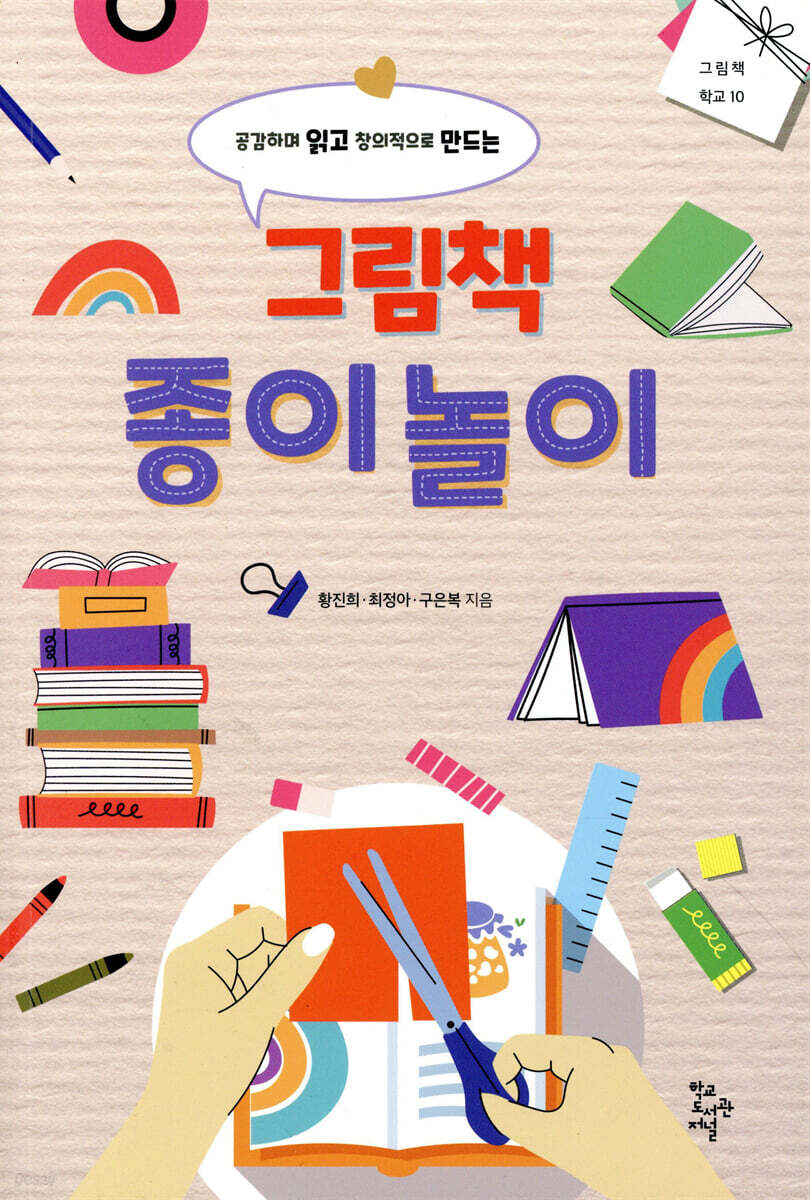
Picture book paper play
 |
Description
Book Introduction
Develop the power of empathy by reading picture books
Develop your thinking and creativity through paper play!
Reading, speaking, thinking, folding, folding and pasting
Integrated activity classes
A book containing examples of classes that used paper play as a post-reading activity for picture books.
It helps children appreciate and understand picture books more deeply by creating paper works related to the core theme.
The authors, who are elementary school teachers, share their expertise, which they have researched and applied for a long time, to move beyond reading and writing-focused reading activities and simultaneously increase the joy of reading and literacy through easy paper play.
Paper play is an important activity that helps children's development during elementary school.
Through the process of cutting, pasting, and folding paper, fine motor skills are developed, and the various colors and patterns of colored paper can enrich one's sense of color.
It also helps develop spatial perception, comprehension, and computational thinking (a way of thinking that follows steps) which are important in modern society.
"Picture Book Paper Play" is an integrated literacy class that combines the benefits of paper play with reading lessons to increase children's interest.
Develop your thinking and creativity through paper play!
Reading, speaking, thinking, folding, folding and pasting
Integrated activity classes
A book containing examples of classes that used paper play as a post-reading activity for picture books.
It helps children appreciate and understand picture books more deeply by creating paper works related to the core theme.
The authors, who are elementary school teachers, share their expertise, which they have researched and applied for a long time, to move beyond reading and writing-focused reading activities and simultaneously increase the joy of reading and literacy through easy paper play.
Paper play is an important activity that helps children's development during elementary school.
Through the process of cutting, pasting, and folding paper, fine motor skills are developed, and the various colors and patterns of colored paper can enrich one's sense of color.
It also helps develop spatial perception, comprehension, and computational thinking (a way of thinking that follows steps) which are important in modern society.
"Picture Book Paper Play" is an integrated literacy class that combines the benefits of paper play with reading lessons to increase children's interest.
- You can preview some of the book's contents.
Preview
index
Opening remarks: "A precious moment of reading, creating, and growing together!" _ 4
Before Reading _ 12
Chapter 1: Becoming Familiar with Paper Play Difficulty: ★☆☆
Sweet donuts and soft muffins 『Heart-pounding』 _ 20
The Magic Curling That Helps Solve Your Worries: "The Mole's Worries" _ 28
Paper flowers blooming on water, "Flower Flower Flower" _ 36
Sweet Potatoes That Relieve Stress 『Sweet Potatoes』 _ 44
Heartfelt Candy 『Candy』 _ 50
Rolling Paper Cup Bowling 『Rolling Paper Cup Bowling』 _ 56
Cup Ball Game: Hugging a Paper Ball 『To You』 _ 62
A colorful snake dancing around and around, "Tears of the Snake" _ 68
Enjoy playing with paper 2. Difficulty level ★★☆
My own vest made from a paper bag, "That's my vest" _ 76
The Jumping Toad 『The Toad Who Grants Only Small Wishes』 _ 84
Freely Decorated Lion Head Shapes 『Lion at the Hair Salon』 _ 90
Paper Plates That Push the Time 『My Grandmother is Unstoppable』 _ 98
Bookmarks of various shapes 『Yes, it's a book!』 _ 104
Palm Flowers with Hearts 『Three Bouquets for Dad, Three Bouquets』 _ 112
Paper Cup Emotion Dolls that Express Your Moods 『I Feel Bad!』 _ 118
The Umbrella That Makes Wishes Come True: "The Magical Umbrella Shop" _ 126
A paper cup game that fosters cooperation between snot-and-snot: "Snot-and-snot" _ 132
Colorful Ice Cream Found in the Desert _ 140
Chapter 3: I'm confident in paper play! Difficulty: ★★★
Cooling Watermelon Fan 『Watermelon Pool』 _ 148
The Velcro Mosquito Swatter That Swatts Away Worries 『Mosquito Swatter Book』 _ 156
The Penguin Deliveryman Delivering Gifts, "Seagull Delivery" _ 162
Pop-up Card Invitation for the Sharing Market: "Trash Can Fairy" _ 170
My own patbingsu and a fun legend: The Legend of Patbingsu _ 178
My own photo studio with animals, 『Forest Photo Studio』 _ 186
Save the Fish! 『The Fish with a Cold』 _ 196
Hidden Mouse Finder: "A Day I Want to Hide in a Mouse Hole" _ 208
Appendix Questions and Answers for Adults Playing with Paper _ 216
Picture Book Search _ 220
Before Reading _ 12
Chapter 1: Becoming Familiar with Paper Play Difficulty: ★☆☆
Sweet donuts and soft muffins 『Heart-pounding』 _ 20
The Magic Curling That Helps Solve Your Worries: "The Mole's Worries" _ 28
Paper flowers blooming on water, "Flower Flower Flower" _ 36
Sweet Potatoes That Relieve Stress 『Sweet Potatoes』 _ 44
Heartfelt Candy 『Candy』 _ 50
Rolling Paper Cup Bowling 『Rolling Paper Cup Bowling』 _ 56
Cup Ball Game: Hugging a Paper Ball 『To You』 _ 62
A colorful snake dancing around and around, "Tears of the Snake" _ 68
Enjoy playing with paper 2. Difficulty level ★★☆
My own vest made from a paper bag, "That's my vest" _ 76
The Jumping Toad 『The Toad Who Grants Only Small Wishes』 _ 84
Freely Decorated Lion Head Shapes 『Lion at the Hair Salon』 _ 90
Paper Plates That Push the Time 『My Grandmother is Unstoppable』 _ 98
Bookmarks of various shapes 『Yes, it's a book!』 _ 104
Palm Flowers with Hearts 『Three Bouquets for Dad, Three Bouquets』 _ 112
Paper Cup Emotion Dolls that Express Your Moods 『I Feel Bad!』 _ 118
The Umbrella That Makes Wishes Come True: "The Magical Umbrella Shop" _ 126
A paper cup game that fosters cooperation between snot-and-snot: "Snot-and-snot" _ 132
Colorful Ice Cream Found in the Desert _ 140
Chapter 3: I'm confident in paper play! Difficulty: ★★★
Cooling Watermelon Fan 『Watermelon Pool』 _ 148
The Velcro Mosquito Swatter That Swatts Away Worries 『Mosquito Swatter Book』 _ 156
The Penguin Deliveryman Delivering Gifts, "Seagull Delivery" _ 162
Pop-up Card Invitation for the Sharing Market: "Trash Can Fairy" _ 170
My own patbingsu and a fun legend: The Legend of Patbingsu _ 178
My own photo studio with animals, 『Forest Photo Studio』 _ 186
Save the Fish! 『The Fish with a Cold』 _ 196
Hidden Mouse Finder: "A Day I Want to Hide in a Mouse Hole" _ 208
Appendix Questions and Answers for Adults Playing with Paper _ 216
Picture Book Search _ 220
Detailed image

Into the book
Q.
I am concerned that children in early childhood to early elementary school age may get hurt while using tools.
A.
It is recommended that young children use safety scissors because their fine motor skills are still limited.
It is difficult for children to put the tips of scissors into holes such as electrical outlets.
There is also less chance of getting cut during the day.
We recommend not using knives as they pose a high risk of injury.
I hope this book will be helpful to you, as none of the activities presented here involve knives.
Q.
Are there any tips for increasing children's interest and concentration?
A.
First, please share the story sufficiently through picture books.
When children begin to show interest and curiosity, talk about the promises they must keep with each other right before playing with paper.
Activities include doing your best as much as you can, actively asking teachers or friends when you don't know, and friends who have completed their work first thinking about what they need to improve on in their own work or helping other friends.
--- From the "Appendix"
While the children were coloring the paper flowers, I filled them with water and placed it in front of the classroom.
The first child to complete the task comes out holding a flower and calls out to a friend.
It looks like you wrote down what you wanted to say to that friend.
When you float the flowers in the water, other friends come running.
You can't miss the first sight of flowers blooming.
The petals open, and in the middle is written the words, 'Let's play together tomorrow too.'
As expected, best friends are different.
--- p.38~39
The point of appreciation is ‘respect.’
I decided to praise and support any work.
His unique looks, including short hair, star-shaped hair, spiky triangle hair, and long beard, are admirable.
--- p.92~93
A game is played where a paper cup is placed between rubber bands, and the players apply appropriate amounts of force to stretch and contract the rubber bands, holding the paper cup and moving it.
As you feel each other's strength and adjust your direction and speed, you learn to observe your friends more closely and learn how to be considerate.
--- p.135
Before folding, I will write down on the paper a time when I was embarrassed or ashamed.
If you fold the mouse, the letters won't be visible, right? Hide the finished work around the classroom.
Every time I find a mouse, I hear a "Yahoo!" and follow my friend around to see if there are any more.
When you've found all the mice, sit in a circle and talk.
You can spread out the paper, announce the written content, and collect the completed works in a basket to play the game of finding them again later.
How could I comfort my friend if he or she had an embarrassing moment like that?
“That can happen in life!” “Everything will be okay with time!”
If we spend time pouring out our hearts and comforting each other, wouldn't our classroom become a warm place like Mr. Mouse's?
I am concerned that children in early childhood to early elementary school age may get hurt while using tools.
A.
It is recommended that young children use safety scissors because their fine motor skills are still limited.
It is difficult for children to put the tips of scissors into holes such as electrical outlets.
There is also less chance of getting cut during the day.
We recommend not using knives as they pose a high risk of injury.
I hope this book will be helpful to you, as none of the activities presented here involve knives.
Q.
Are there any tips for increasing children's interest and concentration?
A.
First, please share the story sufficiently through picture books.
When children begin to show interest and curiosity, talk about the promises they must keep with each other right before playing with paper.
Activities include doing your best as much as you can, actively asking teachers or friends when you don't know, and friends who have completed their work first thinking about what they need to improve on in their own work or helping other friends.
--- From the "Appendix"
While the children were coloring the paper flowers, I filled them with water and placed it in front of the classroom.
The first child to complete the task comes out holding a flower and calls out to a friend.
It looks like you wrote down what you wanted to say to that friend.
When you float the flowers in the water, other friends come running.
You can't miss the first sight of flowers blooming.
The petals open, and in the middle is written the words, 'Let's play together tomorrow too.'
As expected, best friends are different.
--- p.38~39
The point of appreciation is ‘respect.’
I decided to praise and support any work.
His unique looks, including short hair, star-shaped hair, spiky triangle hair, and long beard, are admirable.
--- p.92~93
A game is played where a paper cup is placed between rubber bands, and the players apply appropriate amounts of force to stretch and contract the rubber bands, holding the paper cup and moving it.
As you feel each other's strength and adjust your direction and speed, you learn to observe your friends more closely and learn how to be considerate.
--- p.135
Before folding, I will write down on the paper a time when I was embarrassed or ashamed.
If you fold the mouse, the letters won't be visible, right? Hide the finished work around the classroom.
Every time I find a mouse, I hear a "Yahoo!" and follow my friend around to see if there are any more.
When you've found all the mice, sit in a circle and talk.
You can spread out the paper, announce the written content, and collect the completed works in a basket to play the game of finding them again later.
How could I comfort my friend if he or she had an embarrassing moment like that?
“That can happen in life!” “Everything will be okay with time!”
If we spend time pouring out our hearts and comforting each other, wouldn't our classroom become a warm place like Mr. Mouse's?
--- p.210~211
Publisher's Review
■ A time to broadly understand picture books and discover the fun of making them.
The 'Picture Book Paper Play' activity begins with looking deeply into the book's theme and eliciting children's thoughts.
After exploring the topic sufficiently, curiosity will arise and you will be able to understand 'why paper play activities are necessary and what they mean'.
Even after becoming immersed in the joy of folding, folding, and pasting to complete a work of art, they do not give up picture book literacy.
The 'Dorandoran Story Time' included with each activity provides teachers with the necessary introductions and conversation topics for class.
In the 'Read Together' section of the 'Learn More' corner, we've curated books that are good to read along with activities.
'Let's do it together' is a section that simply introduces activities that can be done in addition to the main activity, such as making works using materials other than paper and providing guidance on appreciation methods that can be used during class.
■ Step-by-step structure that anyone can approach step by step
Chapter 1 consists of the easiest and most simple activities in this book.
Great for preschool and early elementary school children.
It features many activities that are easy to make and require a lot of body movement, such as crumpling and rolling paper, and playing in the school garden with a snake-shaped mobile.
Chapter 2 contains activities that involve more steps than Chapter 1.
You can complete the work in about 10 times.
Chapter 3 is filled with challenging content for children who are interested in paper play.
These are activities that require more than 10 steps to complete.
As 'Picture Book Paper Play' is a class that focuses on interpreting picture books, the activities were arranged with the literacy level in mind.
Chapter 1 is focused on activities that examine one's own emotions, while Chapter 2 broadens the scope and focuses on peer and family relationships.
Chapter 3 is structured around topics related to a sense of challenge, environment, and community sensitivity, allowing the perspective to be expanded to cover society as a whole.
■ A more useful book with actual class examples
『Picture Book Paper Play』 is a book that contains actual class examples applied by elementary school teachers.
You can also look at the discussions shared with children in the educational setting, and see how they come up with ideas related to picture books while completing paper works.
Also noteworthy is the appendix, which contains practical advice on how to play with paper safely and how to keep lessons flowing smoothly in a classroom with children of different skill levels.
The activities in this book do not use 'knives' for safety reasons.
We have provided guidance on how to use safety scissors, plastic rulers, etc. in place of a knife.
It is packed with secrets that everyone can follow step by step in a classroom where children with different levels of participation and concentration gather.
■ Paper play classes with various subjects
This book serves as an integrated teaching resource that connects picture book stories and paper play with various subjects.
You can learn about capillary phenomena by folding flower petals and placing them on water to make the leaves open up, and you can also have an ecology lesson by looking at the characters in picture books.
You can reflect on your speaking habits by thinking about how to talk to friends and playing with related paper games, and you can also use them for literacy classes.
When making emotional dolls, you also go through a process of learning the concepts of various emotions.
The 'Picture Book Paper Play' class provides children with a unique and fun experience through activities that can be connected to various subjects.
The 'Picture Book Paper Play' activity begins with looking deeply into the book's theme and eliciting children's thoughts.
After exploring the topic sufficiently, curiosity will arise and you will be able to understand 'why paper play activities are necessary and what they mean'.
Even after becoming immersed in the joy of folding, folding, and pasting to complete a work of art, they do not give up picture book literacy.
The 'Dorandoran Story Time' included with each activity provides teachers with the necessary introductions and conversation topics for class.
In the 'Read Together' section of the 'Learn More' corner, we've curated books that are good to read along with activities.
'Let's do it together' is a section that simply introduces activities that can be done in addition to the main activity, such as making works using materials other than paper and providing guidance on appreciation methods that can be used during class.
■ Step-by-step structure that anyone can approach step by step
Chapter 1 consists of the easiest and most simple activities in this book.
Great for preschool and early elementary school children.
It features many activities that are easy to make and require a lot of body movement, such as crumpling and rolling paper, and playing in the school garden with a snake-shaped mobile.
Chapter 2 contains activities that involve more steps than Chapter 1.
You can complete the work in about 10 times.
Chapter 3 is filled with challenging content for children who are interested in paper play.
These are activities that require more than 10 steps to complete.
As 'Picture Book Paper Play' is a class that focuses on interpreting picture books, the activities were arranged with the literacy level in mind.
Chapter 1 is focused on activities that examine one's own emotions, while Chapter 2 broadens the scope and focuses on peer and family relationships.
Chapter 3 is structured around topics related to a sense of challenge, environment, and community sensitivity, allowing the perspective to be expanded to cover society as a whole.
■ A more useful book with actual class examples
『Picture Book Paper Play』 is a book that contains actual class examples applied by elementary school teachers.
You can also look at the discussions shared with children in the educational setting, and see how they come up with ideas related to picture books while completing paper works.
Also noteworthy is the appendix, which contains practical advice on how to play with paper safely and how to keep lessons flowing smoothly in a classroom with children of different skill levels.
The activities in this book do not use 'knives' for safety reasons.
We have provided guidance on how to use safety scissors, plastic rulers, etc. in place of a knife.
It is packed with secrets that everyone can follow step by step in a classroom where children with different levels of participation and concentration gather.
■ Paper play classes with various subjects
This book serves as an integrated teaching resource that connects picture book stories and paper play with various subjects.
You can learn about capillary phenomena by folding flower petals and placing them on water to make the leaves open up, and you can also have an ecology lesson by looking at the characters in picture books.
You can reflect on your speaking habits by thinking about how to talk to friends and playing with related paper games, and you can also use them for literacy classes.
When making emotional dolls, you also go through a process of learning the concepts of various emotions.
The 'Picture Book Paper Play' class provides children with a unique and fun experience through activities that can be connected to various subjects.
GOODS SPECIFICS
- Date of issue: March 31, 2022
- Page count, weight, size: 224 pages | 418g | 152*225*20mm
- ISBN13: 9788969151261
- ISBN10: 8969151265
You may also like
카테고리
korean


korean

![GQ KOREA Mark (Monthly): December [2025]](http://librairie.coreenne.fr/cdn/shop/files/8ef265dbbfbf186523ed75ba7319009d.jpg?v=1765340328&width=3840)


