

The 20 minutes I spend with my mom are the most precious.
 |
Description
Book Introduction
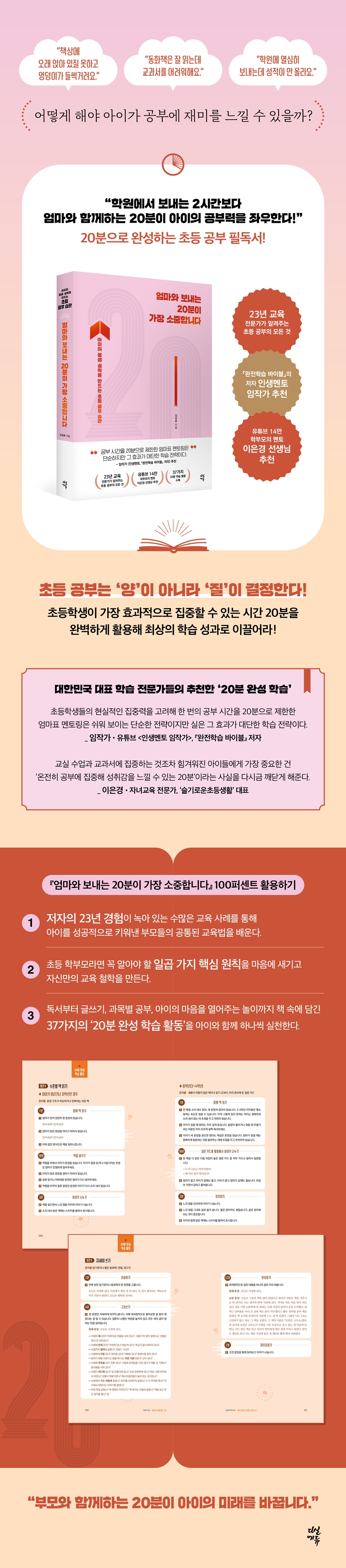
than the two hours spent at the academy 20 minutes spent with mom can affect a child's academic performance. What is the attention span of elementary school students? The average attention span for first graders is about 10 to 15 minutes. If you force children who start shaking their buttocks after just 10 minutes to study for an hour or two, the children will inevitably become more and more distant from studying. If you are greedy from the beginning and think that you can easily study for an hour or two, both the child and the mother will end up exhausted. So, how can we help our children enjoy studying and stay focused for long periods of time? "20 minutes with mom are the most precious" introduces essential 20-minute study habits for elementary school students that are essential for effectively guiding children to love and excel at studying, and includes 37 specific learning activities. Author Kim Seong-hyo is an elementary school teacher and scholarship recipient who has taught children in the educational field and has been a mentor to parents and teachers nationwide for 23 years. Based on that experience, I propose a mother-style mentoring strategy that can perfectly utilize 20 minutes to achieve 100% learning effect. This book contains the essentials of elementary school studies and educational philosophy that elementary school parents must know, including practical know-how in reading and writing education, effective study methods that will help students improve their grades in each subject, and large and small character education methods that will help children grow into good characters, as well as why smartphone and media literacy education is necessary and how to teach it. This is a must-read for elementary school students that guides them in developing the habit of focusing and studying. |
- You can preview some of the book's contents.
Preview
index
Prologue: 20 Minutes with Parents Can Change a Child's Future
Part 1: The 20-Minute Miracle That Changes Your Child
Chapter 1: Lifelong learning ability is determined by 20 minutes of elementary school.
Why Elementary School Students Can't Focus on Their Studies
As small achievements accumulate, you become more comfortable with studying.
Changing relationships and spaces improves learning.
Types of parents who raise children who excel in school
Chapter 2: Seven Key Principles to Start Your 20-Minute Study
First, we complement our weaknesses and push our strengths even further.
Second, we provide table manners education.
Third, it teaches generosity.
Fourth, teach gratitude.
Fifth, listen to your child and wait.
Sixth, seek advice from someone you trust. 066
Seventh, instead of nagging, say, "I trust you." 070
Part 2: Building the Foundation for Learning
Chapter 3: The 20-Minute Reading Method for Improving Literacy
Why should parents and children read together?
Four Types of Kids Who Need to Read with Their Parents
Reading strategically makes textbooks easier.
Ask questions and discuss the contents of the book
Start reading meaning units right now
How should I teach a child who hates books?
Chapter 4: Writing from Short to Long Texts Easily
Any mom can be a writing teacher.
The Secrets of Writing They Don't Teach You in School
Two Ways to Write Better
You can write a book review with six Post-it notes.
Writing an essay on one A4 page
Part 3: The Time When Studying Becomes Fun
Chapter 5: 20-Minute Korean Study to Accurately Understand the Context
The beginning and root of all studies, Korean
Three Ways to Learn Vocabulary
From short sentences to long sentences, improving reading comprehension.
How and how much should I read?
Chapter 6: 20-Minute English Study to Gain Confidence in Listening and Speaking
English, how are you teaching it?
It can be short, just get used to speaking English
Listening or vocabulary, which comes first?
How to learn words and sentences easily?
Chapter 7: 20 Minutes of Math Study to Improve Your Skills Every Day
What will we learn in elementary school math?
Building a foundation with step-by-step leveling up
Math: Review is more important than preview
Chapter 8: 20-Minute Social Studies: Learning Comprehensive Thinking
Learn core concepts and the overall context together
Mind maps allow you to see history at a glance.
Reviewing class content using visual thinking
Broaden your horizons with TalkStick conversations
Chapter 9: 20-Minute Science Study: Finding Your Own Answers
Satisfying curiosity makes science fun.
Studying science begins with asking the right questions.
Scientific writing essential for studying science
Easy and fun way to write a science research report
Develop logical thinking skills through scientific discussions
Part 4: Time to Open Your Child's Heart
Chapter 10: Raising a Smartphone-Capable Child
Media Literacy to Protect Our Children
How should we guide smartphone use?
Critical activities for using smartphones wisely
Mother and child become creators together
Chapter 11: Building Healthy Relationships Through Play
Three Gifts of Play
A good parent is what a child wants vs. what a parent thinks a good parent is.
The best games kids love
A precious time to get to know your family better
Playing with your hands makes you smarter
Epilogue: A child ultimately grows up with the faith of his parents.
References
Part 1: The 20-Minute Miracle That Changes Your Child
Chapter 1: Lifelong learning ability is determined by 20 minutes of elementary school.
Why Elementary School Students Can't Focus on Their Studies
As small achievements accumulate, you become more comfortable with studying.
Changing relationships and spaces improves learning.
Types of parents who raise children who excel in school
Chapter 2: Seven Key Principles to Start Your 20-Minute Study
First, we complement our weaknesses and push our strengths even further.
Second, we provide table manners education.
Third, it teaches generosity.
Fourth, teach gratitude.
Fifth, listen to your child and wait.
Sixth, seek advice from someone you trust. 066
Seventh, instead of nagging, say, "I trust you." 070
Part 2: Building the Foundation for Learning
Chapter 3: The 20-Minute Reading Method for Improving Literacy
Why should parents and children read together?
Four Types of Kids Who Need to Read with Their Parents
Reading strategically makes textbooks easier.
Ask questions and discuss the contents of the book
Start reading meaning units right now
How should I teach a child who hates books?
Chapter 4: Writing from Short to Long Texts Easily
Any mom can be a writing teacher.
The Secrets of Writing They Don't Teach You in School
Two Ways to Write Better
You can write a book review with six Post-it notes.
Writing an essay on one A4 page
Part 3: The Time When Studying Becomes Fun
Chapter 5: 20-Minute Korean Study to Accurately Understand the Context
The beginning and root of all studies, Korean
Three Ways to Learn Vocabulary
From short sentences to long sentences, improving reading comprehension.
How and how much should I read?
Chapter 6: 20-Minute English Study to Gain Confidence in Listening and Speaking
English, how are you teaching it?
It can be short, just get used to speaking English
Listening or vocabulary, which comes first?
How to learn words and sentences easily?
Chapter 7: 20 Minutes of Math Study to Improve Your Skills Every Day
What will we learn in elementary school math?
Building a foundation with step-by-step leveling up
Math: Review is more important than preview
Chapter 8: 20-Minute Social Studies: Learning Comprehensive Thinking
Learn core concepts and the overall context together
Mind maps allow you to see history at a glance.
Reviewing class content using visual thinking
Broaden your horizons with TalkStick conversations
Chapter 9: 20-Minute Science Study: Finding Your Own Answers
Satisfying curiosity makes science fun.
Studying science begins with asking the right questions.
Scientific writing essential for studying science
Easy and fun way to write a science research report
Develop logical thinking skills through scientific discussions
Part 4: Time to Open Your Child's Heart
Chapter 10: Raising a Smartphone-Capable Child
Media Literacy to Protect Our Children
How should we guide smartphone use?
Critical activities for using smartphones wisely
Mother and child become creators together
Chapter 11: Building Healthy Relationships Through Play
Three Gifts of Play
A good parent is what a child wants vs. what a parent thinks a good parent is.
The best games kids love
A precious time to get to know your family better
Playing with your hands makes you smarter
Epilogue: A child ultimately grows up with the faith of his parents.
References
Detailed image
Into the book
Develop the habit of focusing on studying for 20 minutes at a time by engaging in a variety of learning activities with your child, from reading and writing to studying specific subjects.
In child education, quality is more important than quantity.
Any parent, any child can do it.
If you know the correct and proper method, you can maximize the results even in a short period of time.
If your child can focus and concentrate for the first 20 minutes, he or she will be able to gain the concentration and self-control to study on his or her own for 2-3 hours afterwards.
--- p.8 From “Prologue: 20 minutes with parents can change a child’s future”
Elementary school students really need to be encouraged and respected for even the smallest things they do well.
If you think, 'It's natural for my child to solve the workbook that the kid next door is solving. My child goes to the same academy that everyone else goes to, so what's the point of that?', then in reality, there's not much to praise or encourage elementary school students for.
From now on, please look at each and every effort your child makes with great care.
If you study for 10 minutes today, you can consider that as a step forward.
I studied for 10 minutes today, so I'll work hard tomorrow too. Please encourage me and give me encouragement.
--- p.32 From “Chapter 1: Lifelong study skills are determined by 20 minutes of elementary school”
Many parents expect that if their children read a lot of books, they will automatically do well in school.
Is that really true? Eugene read 6,000 books in fourth grade, but he didn't really understand the content of his social studies textbook.
Just because you read a lot of books doesn't mean you automatically know the content. (Omitted) When a child who reads a lot begins to study seriously, he or she will have a significant advantage over a child who doesn't read.
However, if you vaguely expect that you will naturally do well in your studies because you have read a lot of books, that is overly optimistic.
To do well in your studies, you must study consistently.
--- p.80 From “Chapter 3: 20-Minute Reading Method to Improve Literacy”
If you want to teach writing, teach speaking first.
Speech and writing have the same roots.
Teaching students to speak logically is the beginning of writing education.
Since speaking is a habit, it is good to listen carefully to what your child says and give warm feedback.
If you consistently guide them, you will eventually be able to persuade anyone, either verbally or in writing.
You can raise your child to be an invincible person who is good at both writing and debating.
Of course, the same goes for life essays and book reviews.
--- p.123 From Chapter 4, Writing Easily from Short to Long Texts
Some children read the same text for a long time, while others read it quickly.
The more unfamiliar vocabulary there is in a text, the slower your reading speed will be.
If your reading speed is slow, you won't have enough time to solve the problems, and if you don't have enough time, you won't get a good score.
Conversely, if you read quickly but skim the material, you will not get a good score.
To maximize your reading comprehension, it is important to consistently practice reading accurately and quickly.
Since reading speed increases the more you read, elementary school students should focus on accurately grasping and understanding the meaning.
--- p.160 From “Chapter 5: 20-Minute Korean Study to Accurately Understand the Context”
In mathematics, nothing should be missed or overlooked.
If you don't know even one area or part well at the basic level and just skim over it, you won't be able to solve problems that deepen the basic problem.
Even if you get lucky and get one or two questions right, more advanced questions will come out next time.
I still can't solve it.
If this continues, the child will eventually give up on math.
--- p.219 From “Chapter 7: 20 Minutes of Math Study to Improve Your Skills Every Day”
Even as early as the fourth grade, when puberty begins, the presence of friends becomes incredibly important to children.
In the past, we would meet up with friends in person, play, talk, and chat to build relationships, but now we chat through SNS messengers and use the Internet to play.
The world of smartphones is another school and playground for children.
Of course, just like in the real world, fights happen, conflicts arise, violence and bullying exist.
If parents don't educate and guide their children about this in advance, they can't even guarantee what kind of experience they will have.
--- p.285 From “Chapter 10: Raising a Child Who Can Win Over Smartphones”
Play has principles that everyone can agree on, and when everyone participating in the play follows these principles, the game proceeds smoothly.
Children who have played with friends frequently since childhood have good social skills and good interpersonal relationships because they are accustomed to acknowledging and following these rules and regulations.
Children naturally go through the socialization process as they repeatedly experience voluntarily following rules and sometimes making sacrifices or concessions to reach agreements in order to have fun.
In child education, quality is more important than quantity.
Any parent, any child can do it.
If you know the correct and proper method, you can maximize the results even in a short period of time.
If your child can focus and concentrate for the first 20 minutes, he or she will be able to gain the concentration and self-control to study on his or her own for 2-3 hours afterwards.
--- p.8 From “Prologue: 20 minutes with parents can change a child’s future”
Elementary school students really need to be encouraged and respected for even the smallest things they do well.
If you think, 'It's natural for my child to solve the workbook that the kid next door is solving. My child goes to the same academy that everyone else goes to, so what's the point of that?', then in reality, there's not much to praise or encourage elementary school students for.
From now on, please look at each and every effort your child makes with great care.
If you study for 10 minutes today, you can consider that as a step forward.
I studied for 10 minutes today, so I'll work hard tomorrow too. Please encourage me and give me encouragement.
--- p.32 From “Chapter 1: Lifelong study skills are determined by 20 minutes of elementary school”
Many parents expect that if their children read a lot of books, they will automatically do well in school.
Is that really true? Eugene read 6,000 books in fourth grade, but he didn't really understand the content of his social studies textbook.
Just because you read a lot of books doesn't mean you automatically know the content. (Omitted) When a child who reads a lot begins to study seriously, he or she will have a significant advantage over a child who doesn't read.
However, if you vaguely expect that you will naturally do well in your studies because you have read a lot of books, that is overly optimistic.
To do well in your studies, you must study consistently.
--- p.80 From “Chapter 3: 20-Minute Reading Method to Improve Literacy”
If you want to teach writing, teach speaking first.
Speech and writing have the same roots.
Teaching students to speak logically is the beginning of writing education.
Since speaking is a habit, it is good to listen carefully to what your child says and give warm feedback.
If you consistently guide them, you will eventually be able to persuade anyone, either verbally or in writing.
You can raise your child to be an invincible person who is good at both writing and debating.
Of course, the same goes for life essays and book reviews.
--- p.123 From Chapter 4, Writing Easily from Short to Long Texts
Some children read the same text for a long time, while others read it quickly.
The more unfamiliar vocabulary there is in a text, the slower your reading speed will be.
If your reading speed is slow, you won't have enough time to solve the problems, and if you don't have enough time, you won't get a good score.
Conversely, if you read quickly but skim the material, you will not get a good score.
To maximize your reading comprehension, it is important to consistently practice reading accurately and quickly.
Since reading speed increases the more you read, elementary school students should focus on accurately grasping and understanding the meaning.
--- p.160 From “Chapter 5: 20-Minute Korean Study to Accurately Understand the Context”
In mathematics, nothing should be missed or overlooked.
If you don't know even one area or part well at the basic level and just skim over it, you won't be able to solve problems that deepen the basic problem.
Even if you get lucky and get one or two questions right, more advanced questions will come out next time.
I still can't solve it.
If this continues, the child will eventually give up on math.
--- p.219 From “Chapter 7: 20 Minutes of Math Study to Improve Your Skills Every Day”
Even as early as the fourth grade, when puberty begins, the presence of friends becomes incredibly important to children.
In the past, we would meet up with friends in person, play, talk, and chat to build relationships, but now we chat through SNS messengers and use the Internet to play.
The world of smartphones is another school and playground for children.
Of course, just like in the real world, fights happen, conflicts arise, violence and bullying exist.
If parents don't educate and guide their children about this in advance, they can't even guarantee what kind of experience they will have.
--- p.285 From “Chapter 10: Raising a Child Who Can Win Over Smartphones”
Play has principles that everyone can agree on, and when everyone participating in the play follows these principles, the game proceeds smoothly.
Children who have played with friends frequently since childhood have good social skills and good interpersonal relationships because they are accustomed to acknowledging and following these rules and regulations.
Children naturally go through the socialization process as they repeatedly experience voluntarily following rules and sometimes making sacrifices or concessions to reach agreements in order to have fun.
--- p.305 From “Chapter 11: Building Healthy Relationships Through Play”
Publisher's Review
Elementary school studies are determined by 'quality', not 'quantity'!
How to Use 20 Minutes to Optimize Your Learning Achievements
If you want your child to enjoy studying, you need to instill a positive attitude toward studying. If you want your child to concentrate for a long time, you need to develop the habit of focusing a little bit every day.
If you start studying for long hours without thinking, your child will gradually become distant from studying and both you and your child will become exhausted.
But any child can change if you guide them to focus and study for 20 minutes.
Elementary school students can only focus on one activity for about 10 minutes, and the maximum time they can focus is 20 minutes.
20 minutes is really short.
When you watch an interesting video on YouTube or click 'Like' on social media, it passes by in the blink of an eye.
But depending on how the mother handles it, during these 20 minutes, the child can write, plan his own study, study, engage in healthy play, have discussions, and talk with family instead of looking at his smartphone.
"20 minutes with mom are the most precious" introduces the "20-minute elementary study method" to effectively guide children to love and excel at studying, and contains 37 specific learning activities.
Author Kim Seong-hyo, an elementary school teacher and scholarship recipient who has mentored parents and teachers nationwide for 23 years, proposes a mother-style mentoring strategy that can achieve 100% learning effectiveness, taking into account the short attention span of elementary school students.
The 20-minute study method, which slightly exceeds the average concentration of elementary school students (10-15 minutes), is easy for anyone to follow and has the advantage of effectively stimulating children's brains while maximizing learning efficiency.
From reading and writing to subject-specific studies and even play that opens children's minds.
Elementary learning completed in just one volume
Having met and counseled countless parents in the educational field for 23 years, the author discovered one thing in common among parents who successfully raised their children.
All of them were parents who mentored their children and taught them intensively, even if it was just for 20 minutes, not for a long time.
No one has watched over a child longer than their parents, and no one knows their child better than their parents.
Any parent can help their children focus fully on their studies and feel a sense of accomplishment if they know the correct study methods and principles.
This book contains the essentials of elementary school studies and educational philosophy that elementary school parents must know, from reading and writing to subject-specific studies and character education.
Part 1 introduces the most effective '20-minute study' for elementary school students with short attention spans, and explains educational principles that parents must know before starting learning.
In Part 2, we built a solid foundation for study through reading and writing, which are the beginning and end of all learning.
Part 3 contains study methods that make studying Korean, English, Math, Social Studies, and Science easier.
The final four parts offer media education methods to help children overcome the temptations of smartphones, YouTube, and games, along with various activities that can help build deep bonds with family.
In children's education, quality is more important than quantity.
What elementary school parents must do is to take a warm interest in their children's studies, encourage them to continue steadily, and provide them with good guidance on how and in what direction to study.
This book is a must-read for elementary school students, including parents who want to be their children's learning coaches and parents who want their children to develop good study habits.
How to Use 20 Minutes to Optimize Your Learning Achievements
If you want your child to enjoy studying, you need to instill a positive attitude toward studying. If you want your child to concentrate for a long time, you need to develop the habit of focusing a little bit every day.
If you start studying for long hours without thinking, your child will gradually become distant from studying and both you and your child will become exhausted.
But any child can change if you guide them to focus and study for 20 minutes.
Elementary school students can only focus on one activity for about 10 minutes, and the maximum time they can focus is 20 minutes.
20 minutes is really short.
When you watch an interesting video on YouTube or click 'Like' on social media, it passes by in the blink of an eye.
But depending on how the mother handles it, during these 20 minutes, the child can write, plan his own study, study, engage in healthy play, have discussions, and talk with family instead of looking at his smartphone.
"20 minutes with mom are the most precious" introduces the "20-minute elementary study method" to effectively guide children to love and excel at studying, and contains 37 specific learning activities.
Author Kim Seong-hyo, an elementary school teacher and scholarship recipient who has mentored parents and teachers nationwide for 23 years, proposes a mother-style mentoring strategy that can achieve 100% learning effectiveness, taking into account the short attention span of elementary school students.
The 20-minute study method, which slightly exceeds the average concentration of elementary school students (10-15 minutes), is easy for anyone to follow and has the advantage of effectively stimulating children's brains while maximizing learning efficiency.
From reading and writing to subject-specific studies and even play that opens children's minds.
Elementary learning completed in just one volume
Having met and counseled countless parents in the educational field for 23 years, the author discovered one thing in common among parents who successfully raised their children.
All of them were parents who mentored their children and taught them intensively, even if it was just for 20 minutes, not for a long time.
No one has watched over a child longer than their parents, and no one knows their child better than their parents.
Any parent can help their children focus fully on their studies and feel a sense of accomplishment if they know the correct study methods and principles.
This book contains the essentials of elementary school studies and educational philosophy that elementary school parents must know, from reading and writing to subject-specific studies and character education.
Part 1 introduces the most effective '20-minute study' for elementary school students with short attention spans, and explains educational principles that parents must know before starting learning.
In Part 2, we built a solid foundation for study through reading and writing, which are the beginning and end of all learning.
Part 3 contains study methods that make studying Korean, English, Math, Social Studies, and Science easier.
The final four parts offer media education methods to help children overcome the temptations of smartphones, YouTube, and games, along with various activities that can help build deep bonds with family.
In children's education, quality is more important than quantity.
What elementary school parents must do is to take a warm interest in their children's studies, encourage them to continue steadily, and provide them with good guidance on how and in what direction to study.
This book is a must-read for elementary school students, including parents who want to be their children's learning coaches and parents who want their children to develop good study habits.
GOODS SPECIFICS
- Publication date: November 22, 2021
- Page count, weight, size: 332 pages | 612g | 152*224*20mm
- ISBN13: 9791130678030
- ISBN10: 1130678032
You may also like
카테고리
korean


korean

![GQ KOREA Mark (Monthly): December [2025]](http://librairie.coreenne.fr/cdn/shop/files/8ef265dbbfbf186523ed75ba7319009d.jpg?v=1765340328&width=3840)


