

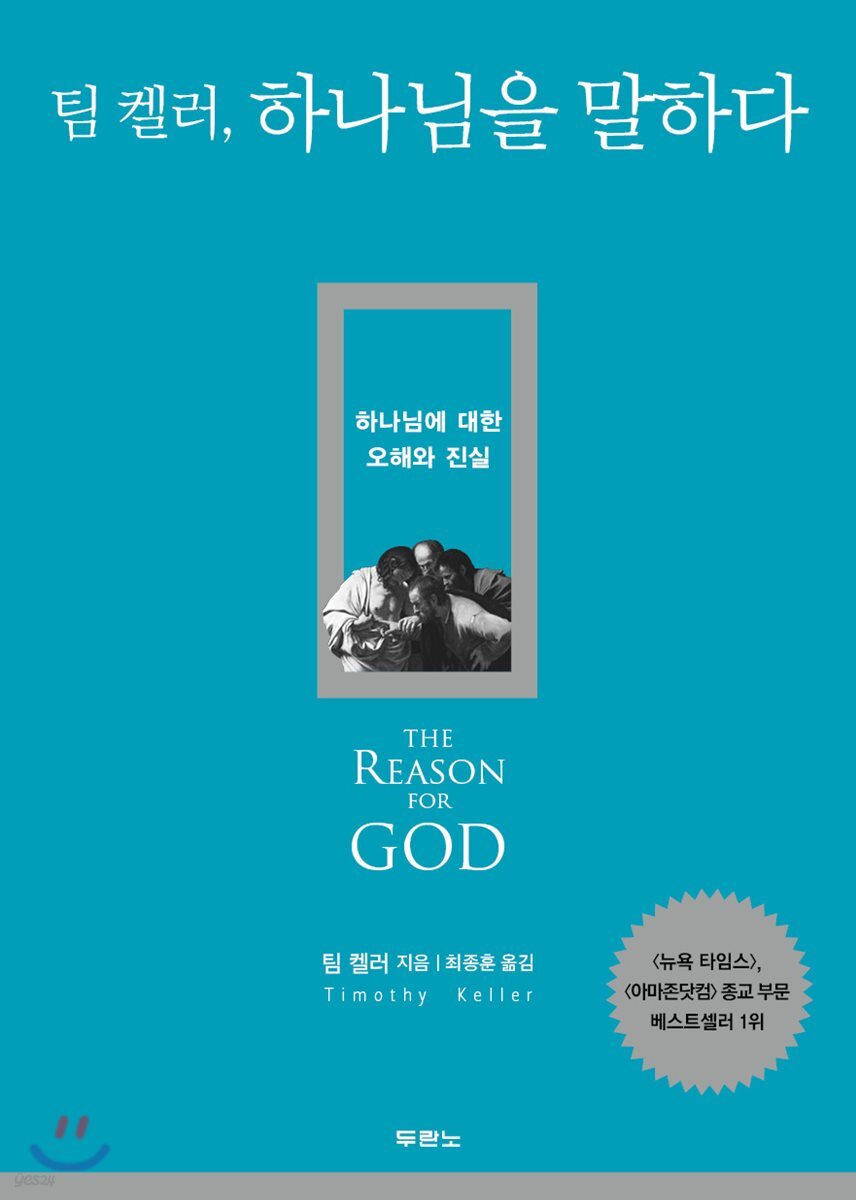
Tim Keller Speaks of God
 |
Description
Book Introduction
Crying out for irrefutable evidence of God Pastor Tim Keller's Heartwarming Defense Against Atheists A book that revisits the core of faith in an age of distrust. “No one has ever proven that there is no God!” [New York Times] #1 Bestseller in the Religion Category on Amazon.com! A book for skeptics, atheists, and agnostics of this age who ask for directions and seek the truth! Does God really exist? Why does God allow suffering in the world? How can someone so loving send people to hell? Why Christianity Isn't More Inclusive Does it make sense that there is only one true faith? Why are so many wars fought in the name of God? Defending God to the Thomases of Our Time “A book that answers the question, ‘Why should we believe in God?’” By addressing the questions of countless people who have doubts about the Christian faith, it clearly presents the reasons why we must believe in God. 19th century writer Robert Louis Stevenson and modern New Testament theologian N. T. Wright, C. He used S. Lewis to analyze everyone from atheist Richard Dawkins to popular author Dan Brown. He defends God to those who are skeptical and to those who want to reevaluate what they believe and why. |
- You can preview some of the book's contents.
Preview
index
Prologue: For those who struggle between doubt and faith
Part 1: Why This Age Doesn't Believe in God
- Answering Seven Questions That Misunderstand God
1.
exclusivity
Does it make sense that salvation is found only in Christianity?
2.
Evil and suffering
If God is good, why does he allow suffering in the world?
3.
bondage
Is Christianity a shackle that strangles human freedom?
4.
Injustice in Christianity
Why is it unrighteous to go to church?
5.
judgment
How could a loving God send humans to hell?
6.
Science and Christianity
Hasn't science proven that the Christian faith is wrong?
7.
Bible
How can we believe the miracles of the Bible at face value?
Between the Intermission Meeting and the Journey to Faith
Part 2: The Sure Grounds for Our Belief in God
- Facing the undeniable truth of God's existence
8.
Clues hinting at the existence of God
All things bear the fingerprints of God, pointing to His existence.
9.
Knowledge of God
Everyone already knows that there is a God.
10.
sinful nature
The empty space in the heart is filled with either God or sin.
11.
Religion and the Gospel
Christianity is not a religion, it is a gospel.
12.
cross
The most certain evidence is Jesus.
13.
The challenge of resurrection
The resurrection of Jesus is a historical fact that has been thoroughly verified.
14.
eternal life
There is a place prepared for us to return to.
Epilogue: Are You Ready to Believe in God Now?
Part 1: Why This Age Doesn't Believe in God
- Answering Seven Questions That Misunderstand God
1.
exclusivity
Does it make sense that salvation is found only in Christianity?
2.
Evil and suffering
If God is good, why does he allow suffering in the world?
3.
bondage
Is Christianity a shackle that strangles human freedom?
4.
Injustice in Christianity
Why is it unrighteous to go to church?
5.
judgment
How could a loving God send humans to hell?
6.
Science and Christianity
Hasn't science proven that the Christian faith is wrong?
7.
Bible
How can we believe the miracles of the Bible at face value?
Between the Intermission Meeting and the Journey to Faith
Part 2: The Sure Grounds for Our Belief in God
- Facing the undeniable truth of God's existence
8.
Clues hinting at the existence of God
All things bear the fingerprints of God, pointing to His existence.
9.
Knowledge of God
Everyone already knows that there is a God.
10.
sinful nature
The empty space in the heart is filled with either God or sin.
11.
Religion and the Gospel
Christianity is not a religion, it is a gospel.
12.
cross
The most certain evidence is Jesus.
13.
The challenge of resurrection
The resurrection of Jesus is a historical fact that has been thoroughly verified.
14.
eternal life
There is a place prepared for us to return to.
Epilogue: Are You Ready to Believe in God Now?
Into the book
I would like to offer two paths to the readers of this book.
First, I encourage skeptics to grapple with the "blind beliefs" that underpin atheism.
So I hope you realize how difficult it is to prove your convictions to those who do not agree with your beliefs.
On the other hand, believers are urged to confront personal and cultural objections.
When we reach the end of the road, even if we remain in the position of skeptic or believer without any change, we will maintain that position more clearly and humbly than before.
You will have understanding, empathy, and respect for others that you never had before.
Believers and non-believers will be able to more clearly identify their differences of opinion without denigrating each other.
These things only happen when both sides learn to express their opponent's arguments in the most powerful and positive way possible.
That's no small thing.
Embark on the Third Spiritual Path
What follows is the distillation of countless conversations I've had with skeptics over the years.
Through both sermons and personal conversations, I have tried to respectfully help skeptics examine their own faith foundations while also exposing the very foundations of my own faith to their fiercest criticism.
In the first half of this book, I will examine seven of the most common arguments against and questioning the Christian faith that I have heard from countless people over the years.
We will try to carefully discern the alternative beliefs lurking behind each one.
In the latter part, we will examine the underlying logic of Christian faith.
It's wonderful to think that there could be a polite dialogue between the entrenched traditional conservatives and the liberals.
I hope that this book can contribute to stimulating such exchanges of opinions.
My experiences as a pastor in New York also provided another motivation for writing this article.
There's something I realized shortly after setting foot here.
The reality for those with faith and those with doubt is completely different from what experts think.
The white, middle-aged cultural workers in New York were decidedly secular.
But among the growing multiethnic workforce of professionals and working-class immigrants, strong religious convictions were prevalent and diverse enough to defy categorization.
In particular, the Christian faith was growing rapidly among them.
I believe that it is these relatively young Christians who can end the age-old culture war.
They are at the forefront of a new wave of major religious, social and political solidarities.
They are struggling with doubts or resistance to Christianity and are flocking to a third zone with another orthodoxy that cannot be lumped into the current categories of progressive democrat or conservative republican.
Many believe that the two major camps currently waging a "culture war" prioritize individual freedom and happiness over God and the common good as their ultimate values.
The progressive camp's individualism stands out in its views on abortion, sex, marriage, and so on.
On the other hand, the individualism of the conservative camp is clearly revealed in a deep distrust of the public sector and a poverty consciousness that regards poverty as simply the result of the individual's failure to take responsibility for his or her own life.
A new, urban, multi-ethnic, and rapidly expanding orthodoxy is more concerned with poverty and social justice than Republicans, while also holding Christian ethical and sexual morals to a much higher standard than Democrats.
The first half of this book seeks to pave the way for many Christians to navigate the swamp of doubt.
In contrast, the latter half will present a more positive account of their faith in the world.
Here are three Christians who currently belong to such a church.
June graduated from a prestigious Ivy League university and worked in Manhattan.
However, she became so obsessed with her appearance that she developed an eating disorder and drug addiction.
I suddenly felt like I was on the path to ruining my own life, but I had no compelling reason to live any other way.
Above all, it was difficult to find meaning in life.
Even if I was driven into a dead end, what's the big deal? Then, I entered the church, realized God's love, and began to yearn to experience His reality.
I also met a counselor at church who helped me connect my almost infinite longing for acceptance with God's mercy.
I finally became convinced that I had to seek and save God.
I can't say exactly when it started, but for the first time in my life, I felt like I was truly receiving unconditional love as a daughter of God.
After that, I gradually stopped my self-destructive behavior and began to enjoy freedom.
Jeffrey came from a conservative Jewish family and worked as a musician in New York City.
Both of my parents suffered greatly from cancer, and my mother eventually passed away from the disease.
Having suffered from various illnesses since childhood, he followed a Chinese health diet based on Taoist and Buddhist meditation methods and devoted an excessive amount of effort to maintaining his health.
Even when my friend brought up the topic of Redeemer Church, I didn't feel any 'spiritual deprivation' at all.
It was nice to hear the sermon, but only “until the word Jesus came out.”
After that, I didn't listen anymore.
But soon, I began to envy the hope and joy my Christian friends had for the future.
I've never encountered such feelings before.
Eventually, I listened to the sermon to the end and realized that each and every verse presented an unexpected intellectual challenge.
Even while meditating, he found himself unable to experience the “normal moments of pure calm and stability” because the image of Jesus on the cross kept coming back to him.
Jeffrey began to pray to the Christian God.
I began to realize that running away from pain and avoiding it altogether had been the narrative that had dominated my life.
I felt like it was a truly pointless goal in life.
I was deeply moved to learn that Jesus gave up not only his physical health but also his life to save the world.
Although I could not avoid the pain that would come, I found the courage to face it and a way to overcome it.
That is how Jeffrey accepted the gospel of Jesus Christ.
Kelly was an atheist who attended an Ivy League school.
When I was twelve, my grandfather passed away from cancer.
That same year, I watched my two-year-old sister undergo surgery, chemotherapy, and radiation treatment for a brain tumor.
I got into Columbia University, but I wondered what meaning there was in life.
Some of my college friends told me stories of their faith, but those testimonies were like 'seeds that fell on gravel.'
Around that time, my fourteen-year-old younger brother fell ill.
Even though he was unable to use his body properly, he did not give up on God and instead sought Him with even greater desperation.
After graduating from college, Kelly went to work in New York City.
There she met her future husband, Kevin.
Kevin is a Wall Street J.P. Morgan.
He attended the University of P. Morgan, and like Kelly, he was an atheist and a Columbia University alumnus.
Their doubts about God were very strong, but they also knew how to doubt their doubts.
So we started going to Redeemer Church together.
The pilgrimage was slow and painful.
However, it was thanks to the faithful Christians around me that I did not give up in the middle.
They were the most sophisticated and intelligent people I had ever met in the world.
I finally felt confident.
Christianity was not only intellectually credible, but also offered an attractive vision of life.
Kelly wrote:
“Even when I was an atheist, I prided myself on living an ethical, community-oriented, and socially just life, but Christianity held a much higher standard, encompassing even the state of mind and heart.
“I received forgiveness from God and welcomed the Lord into my life,” Kevin confesses.
“Sitting in a coffee shop C.
While reading Mere Christianity by S. Lewis, I put the book down, took out a notebook, and wrote some notes.
'The evidence surrounding the claims of Christianity is simply overwhelming.' I realized that no matter what I achieved, I could never achieve ultimate satisfaction, that approval from others was fleeting, and that a carpe diem life, a life of thrills and adventures, was just another form of narcissism and idolatry.
So I became a Christian.”
Jesus, the One Who Embraces Even Doubt
Kelly explains how the New Testament account of Thomas was a great comfort to her as she struggled between doubt and faith.
In the text, Jesus personally demonstrates a new perspective on doubt.
This is a position that differs subtly from the views of today's skeptics and believers.
When Jesus faced doubting Thomas, instead of ignoring his skepticism (“Be quiet and believe!”), he meekly complied with the disciple’s request for evidence.
I once met a man who confessed that his heart was full of doubts (Mark 9:24).
He cried out to Jesus, “Help my unbelief!”
It meant to catch myself from doubting.
Jesus granted the man's request by honestly admitting it.
He showed his grace and healed his son.
Whether you consider yourself a Christian or a skeptic, I encourage you to be as honest as the main character in this passage and to delve deeper into the nature of doubt day by day.
If you do this, you will reap results beyond anything you could imagine. (From the Prologue)
Believers need to be aware of their doubts and wrestle with them.
I have to embrace not only my own suspicions, but also those of my friends and neighbors.
It is not enough to simply believe in the faith we have inherited from our ancestors.
Only by waging a long and arduous battle against ideas that contradict our faith can we establish a foundation of faith that will stand up to our own convictions and those of skeptics.
This process is important not only for navigating the immediate situation, but also for respecting and understanding others who may harbor doubts even after their faith has been firmly established.
--- p.
23
Rather, we should strive to ask and answer questions.
Among all the claims about God, human nature, and spiritual reality, what is true and what is false? And we must build our lives based on the answers to those questions.
--- p.
44
Christians believe that all human beings are created in the image of God, capable of doing good and making wise decisions.
Therefore, the doctrine of the universal image of God leads Christians to believe that those who do not have faith are far better off than those who have false beliefs.
Moreover, the doctrine of the universal sinfulness of human beings may lead us to expect that, in terms of practice, it may fall far short of what orthodox Christian faith teaches it should be.
This will provide sufficient ground for cooperation based on mutual respect.
--- p.
54-55
Accepting the Christian teachings of the incarnation and the cross can provide great comfort even in the midst of suffering.
The doctrine of resurrection inspires powerful hope.
Because it promises the life you desire the most.
Moreover, it is infinitely beautiful and glorious because it requires no great courage, patience, sacrifice, or effort to achieve salvation.
--- p.
Page 74
This may be true in other religions, or other forms of faith, but it is not true at all in Christianity.
The Christian God has adapted himself to humanity in the most extreme way: through incarnation and atoning work.
Through Jesus Christ, God became finite human, a being vulnerable enough to suffer and die.
He accepted the limitations of humanity (being a sinner) on the cross and died in our place to forgive humanity.
--- p.
96
“What makes a Christian a Christian is not religious acts, but participation in God’s suffering while living in the world.
Metanoia, or repentance, means not putting one's own needs first, but rather immersing oneself deeply in the way of Jesus Christ.
… suffering is a holy angel.
…through that angel, man becomes far greater than all the joys of the world.
…the pain of longing for something is certainly there, and is often physically palpable.
There is no need to judge right or wrong about that.
We must overcome the pain of longing moment by moment.
So there is an angel who is more holy than that.
“It is an angel of joy in God.”
--- p.
120
The prevailing notion that science and religion are still at war still holds sway among the public, but we must quickly move beyond the notion that we must choose between the two, or that becoming a Christian means being prepared to engage in conflict with science.
The majority of scientists consider themselves deeply or moderately religious, and that number has been steadily increasing in recent decades.
There is no reason why there should be a gap between science and devout faith.
--- p.
157-158
“If ‘evolution’ were to be elevated to the status of a worldview that views the way things exist, it would directly clash with biblical faith.
But if 'evolution' remains a scientific and biological hypothesis, there is no reason for a conflict between the Christian belief in a Creator and the scientific exploration (at the biological level) of how God initiated the process of creation.”
--- p.
Page 161
Modern people see miracles as a 'pause' in the natural order, but Jesus used them as tools to 'restore' the natural order.
The Bible says that God did not create the world to include disease, hunger, and death.
The Lord came to redeem the wicked world and heal its broken and wounded wounds.
The miracles Jesus performed were not only evidence of his authority, but also a foreshadowing of the amazing things he would do with that authority.
--- p.
162-163
“We believe that the sun has risen not simply because we see it with our eyes.
“Because I see all things in the world illuminated by the sun.”
Let's say you decide to look straight at the sun to learn about it.
No matter how hard you try, you can't achieve your goal.
Instead, the retina will burn out and you will lose the ability to distinguish objects.
If we wish to understand the existence, power, and nature of the sun, it is far better to examine the world it illuminates, to understand how sunlight brings life to all things before our eyes, and how humans can observe it.
--- p.
199
We can accept that we live as if beauty and love have meaning, as if life has value, as if human beings have an innate dignity.
Because I know that God is alive.
It would be dishonest to live as if God existed and yet be unaware of the Being who gave us all these gifts.
--- p.
249
Everyone lives for something.
Something becomes the 'master of life' regardless of one's thoughts.
When we simply accept Jesus into our hearts, He becomes our Lord, the only One who fills us completely and forgives all our wrongdoings.
--- p.
269
The basic message of Christianity is fundamentally different from the assumptions of traditional religions.
The founders of major religions have invariably positioned themselves as teachers, not saviors.
Everyone says, “If you do this and that, you will meet God.”
But Jesus came into the world not as a teacher in essence (though he did so in abundance), but as a Savior.
He says:
“I have come as God to do for you what you cannot do for yourselves.” The Christian message is that humans are saved not by their own achievements but by the merits of Christ.
First, I encourage skeptics to grapple with the "blind beliefs" that underpin atheism.
So I hope you realize how difficult it is to prove your convictions to those who do not agree with your beliefs.
On the other hand, believers are urged to confront personal and cultural objections.
When we reach the end of the road, even if we remain in the position of skeptic or believer without any change, we will maintain that position more clearly and humbly than before.
You will have understanding, empathy, and respect for others that you never had before.
Believers and non-believers will be able to more clearly identify their differences of opinion without denigrating each other.
These things only happen when both sides learn to express their opponent's arguments in the most powerful and positive way possible.
That's no small thing.
Embark on the Third Spiritual Path
What follows is the distillation of countless conversations I've had with skeptics over the years.
Through both sermons and personal conversations, I have tried to respectfully help skeptics examine their own faith foundations while also exposing the very foundations of my own faith to their fiercest criticism.
In the first half of this book, I will examine seven of the most common arguments against and questioning the Christian faith that I have heard from countless people over the years.
We will try to carefully discern the alternative beliefs lurking behind each one.
In the latter part, we will examine the underlying logic of Christian faith.
It's wonderful to think that there could be a polite dialogue between the entrenched traditional conservatives and the liberals.
I hope that this book can contribute to stimulating such exchanges of opinions.
My experiences as a pastor in New York also provided another motivation for writing this article.
There's something I realized shortly after setting foot here.
The reality for those with faith and those with doubt is completely different from what experts think.
The white, middle-aged cultural workers in New York were decidedly secular.
But among the growing multiethnic workforce of professionals and working-class immigrants, strong religious convictions were prevalent and diverse enough to defy categorization.
In particular, the Christian faith was growing rapidly among them.
I believe that it is these relatively young Christians who can end the age-old culture war.
They are at the forefront of a new wave of major religious, social and political solidarities.
They are struggling with doubts or resistance to Christianity and are flocking to a third zone with another orthodoxy that cannot be lumped into the current categories of progressive democrat or conservative republican.
Many believe that the two major camps currently waging a "culture war" prioritize individual freedom and happiness over God and the common good as their ultimate values.
The progressive camp's individualism stands out in its views on abortion, sex, marriage, and so on.
On the other hand, the individualism of the conservative camp is clearly revealed in a deep distrust of the public sector and a poverty consciousness that regards poverty as simply the result of the individual's failure to take responsibility for his or her own life.
A new, urban, multi-ethnic, and rapidly expanding orthodoxy is more concerned with poverty and social justice than Republicans, while also holding Christian ethical and sexual morals to a much higher standard than Democrats.
The first half of this book seeks to pave the way for many Christians to navigate the swamp of doubt.
In contrast, the latter half will present a more positive account of their faith in the world.
Here are three Christians who currently belong to such a church.
June graduated from a prestigious Ivy League university and worked in Manhattan.
However, she became so obsessed with her appearance that she developed an eating disorder and drug addiction.
I suddenly felt like I was on the path to ruining my own life, but I had no compelling reason to live any other way.
Above all, it was difficult to find meaning in life.
Even if I was driven into a dead end, what's the big deal? Then, I entered the church, realized God's love, and began to yearn to experience His reality.
I also met a counselor at church who helped me connect my almost infinite longing for acceptance with God's mercy.
I finally became convinced that I had to seek and save God.
I can't say exactly when it started, but for the first time in my life, I felt like I was truly receiving unconditional love as a daughter of God.
After that, I gradually stopped my self-destructive behavior and began to enjoy freedom.
Jeffrey came from a conservative Jewish family and worked as a musician in New York City.
Both of my parents suffered greatly from cancer, and my mother eventually passed away from the disease.
Having suffered from various illnesses since childhood, he followed a Chinese health diet based on Taoist and Buddhist meditation methods and devoted an excessive amount of effort to maintaining his health.
Even when my friend brought up the topic of Redeemer Church, I didn't feel any 'spiritual deprivation' at all.
It was nice to hear the sermon, but only “until the word Jesus came out.”
After that, I didn't listen anymore.
But soon, I began to envy the hope and joy my Christian friends had for the future.
I've never encountered such feelings before.
Eventually, I listened to the sermon to the end and realized that each and every verse presented an unexpected intellectual challenge.
Even while meditating, he found himself unable to experience the “normal moments of pure calm and stability” because the image of Jesus on the cross kept coming back to him.
Jeffrey began to pray to the Christian God.
I began to realize that running away from pain and avoiding it altogether had been the narrative that had dominated my life.
I felt like it was a truly pointless goal in life.
I was deeply moved to learn that Jesus gave up not only his physical health but also his life to save the world.
Although I could not avoid the pain that would come, I found the courage to face it and a way to overcome it.
That is how Jeffrey accepted the gospel of Jesus Christ.
Kelly was an atheist who attended an Ivy League school.
When I was twelve, my grandfather passed away from cancer.
That same year, I watched my two-year-old sister undergo surgery, chemotherapy, and radiation treatment for a brain tumor.
I got into Columbia University, but I wondered what meaning there was in life.
Some of my college friends told me stories of their faith, but those testimonies were like 'seeds that fell on gravel.'
Around that time, my fourteen-year-old younger brother fell ill.
Even though he was unable to use his body properly, he did not give up on God and instead sought Him with even greater desperation.
After graduating from college, Kelly went to work in New York City.
There she met her future husband, Kevin.
Kevin is a Wall Street J.P. Morgan.
He attended the University of P. Morgan, and like Kelly, he was an atheist and a Columbia University alumnus.
Their doubts about God were very strong, but they also knew how to doubt their doubts.
So we started going to Redeemer Church together.
The pilgrimage was slow and painful.
However, it was thanks to the faithful Christians around me that I did not give up in the middle.
They were the most sophisticated and intelligent people I had ever met in the world.
I finally felt confident.
Christianity was not only intellectually credible, but also offered an attractive vision of life.
Kelly wrote:
“Even when I was an atheist, I prided myself on living an ethical, community-oriented, and socially just life, but Christianity held a much higher standard, encompassing even the state of mind and heart.
“I received forgiveness from God and welcomed the Lord into my life,” Kevin confesses.
“Sitting in a coffee shop C.
While reading Mere Christianity by S. Lewis, I put the book down, took out a notebook, and wrote some notes.
'The evidence surrounding the claims of Christianity is simply overwhelming.' I realized that no matter what I achieved, I could never achieve ultimate satisfaction, that approval from others was fleeting, and that a carpe diem life, a life of thrills and adventures, was just another form of narcissism and idolatry.
So I became a Christian.”
Jesus, the One Who Embraces Even Doubt
Kelly explains how the New Testament account of Thomas was a great comfort to her as she struggled between doubt and faith.
In the text, Jesus personally demonstrates a new perspective on doubt.
This is a position that differs subtly from the views of today's skeptics and believers.
When Jesus faced doubting Thomas, instead of ignoring his skepticism (“Be quiet and believe!”), he meekly complied with the disciple’s request for evidence.
I once met a man who confessed that his heart was full of doubts (Mark 9:24).
He cried out to Jesus, “Help my unbelief!”
It meant to catch myself from doubting.
Jesus granted the man's request by honestly admitting it.
He showed his grace and healed his son.
Whether you consider yourself a Christian or a skeptic, I encourage you to be as honest as the main character in this passage and to delve deeper into the nature of doubt day by day.
If you do this, you will reap results beyond anything you could imagine. (From the Prologue)
Believers need to be aware of their doubts and wrestle with them.
I have to embrace not only my own suspicions, but also those of my friends and neighbors.
It is not enough to simply believe in the faith we have inherited from our ancestors.
Only by waging a long and arduous battle against ideas that contradict our faith can we establish a foundation of faith that will stand up to our own convictions and those of skeptics.
This process is important not only for navigating the immediate situation, but also for respecting and understanding others who may harbor doubts even after their faith has been firmly established.
--- p.
23
Rather, we should strive to ask and answer questions.
Among all the claims about God, human nature, and spiritual reality, what is true and what is false? And we must build our lives based on the answers to those questions.
--- p.
44
Christians believe that all human beings are created in the image of God, capable of doing good and making wise decisions.
Therefore, the doctrine of the universal image of God leads Christians to believe that those who do not have faith are far better off than those who have false beliefs.
Moreover, the doctrine of the universal sinfulness of human beings may lead us to expect that, in terms of practice, it may fall far short of what orthodox Christian faith teaches it should be.
This will provide sufficient ground for cooperation based on mutual respect.
--- p.
54-55
Accepting the Christian teachings of the incarnation and the cross can provide great comfort even in the midst of suffering.
The doctrine of resurrection inspires powerful hope.
Because it promises the life you desire the most.
Moreover, it is infinitely beautiful and glorious because it requires no great courage, patience, sacrifice, or effort to achieve salvation.
--- p.
Page 74
This may be true in other religions, or other forms of faith, but it is not true at all in Christianity.
The Christian God has adapted himself to humanity in the most extreme way: through incarnation and atoning work.
Through Jesus Christ, God became finite human, a being vulnerable enough to suffer and die.
He accepted the limitations of humanity (being a sinner) on the cross and died in our place to forgive humanity.
--- p.
96
“What makes a Christian a Christian is not religious acts, but participation in God’s suffering while living in the world.
Metanoia, or repentance, means not putting one's own needs first, but rather immersing oneself deeply in the way of Jesus Christ.
… suffering is a holy angel.
…through that angel, man becomes far greater than all the joys of the world.
…the pain of longing for something is certainly there, and is often physically palpable.
There is no need to judge right or wrong about that.
We must overcome the pain of longing moment by moment.
So there is an angel who is more holy than that.
“It is an angel of joy in God.”
--- p.
120
The prevailing notion that science and religion are still at war still holds sway among the public, but we must quickly move beyond the notion that we must choose between the two, or that becoming a Christian means being prepared to engage in conflict with science.
The majority of scientists consider themselves deeply or moderately religious, and that number has been steadily increasing in recent decades.
There is no reason why there should be a gap between science and devout faith.
--- p.
157-158
“If ‘evolution’ were to be elevated to the status of a worldview that views the way things exist, it would directly clash with biblical faith.
But if 'evolution' remains a scientific and biological hypothesis, there is no reason for a conflict between the Christian belief in a Creator and the scientific exploration (at the biological level) of how God initiated the process of creation.”
--- p.
Page 161
Modern people see miracles as a 'pause' in the natural order, but Jesus used them as tools to 'restore' the natural order.
The Bible says that God did not create the world to include disease, hunger, and death.
The Lord came to redeem the wicked world and heal its broken and wounded wounds.
The miracles Jesus performed were not only evidence of his authority, but also a foreshadowing of the amazing things he would do with that authority.
--- p.
162-163
“We believe that the sun has risen not simply because we see it with our eyes.
“Because I see all things in the world illuminated by the sun.”
Let's say you decide to look straight at the sun to learn about it.
No matter how hard you try, you can't achieve your goal.
Instead, the retina will burn out and you will lose the ability to distinguish objects.
If we wish to understand the existence, power, and nature of the sun, it is far better to examine the world it illuminates, to understand how sunlight brings life to all things before our eyes, and how humans can observe it.
--- p.
199
We can accept that we live as if beauty and love have meaning, as if life has value, as if human beings have an innate dignity.
Because I know that God is alive.
It would be dishonest to live as if God existed and yet be unaware of the Being who gave us all these gifts.
--- p.
249
Everyone lives for something.
Something becomes the 'master of life' regardless of one's thoughts.
When we simply accept Jesus into our hearts, He becomes our Lord, the only One who fills us completely and forgives all our wrongdoings.
--- p.
269
The basic message of Christianity is fundamentally different from the assumptions of traditional religions.
The founders of major religions have invariably positioned themselves as teachers, not saviors.
Everyone says, “If you do this and that, you will meet God.”
But Jesus came into the world not as a teacher in essence (though he did so in abundance), but as a Savior.
He says:
“I have come as God to do for you what you cannot do for yourselves.” The Christian message is that humans are saved not by their own achievements but by the merits of Christ.
--- p.
286
286
GOODS SPECIFICS
- Date of publication: June 19, 2017
- Page count, weight, size: 396 pages | 538g | 150*210*30mm
- ISBN13: 9788953128675
- ISBN10: 8953128676
You may also like
카테고리
korean


korean

![GQ KOREA Mark (Monthly): December [2025]](http://librairie.coreenne.fr/cdn/shop/files/8ef265dbbfbf186523ed75ba7319009d.jpg?v=1765340328&width=3840)


