

AI and Korean language education
 |
Description
Book Introduction
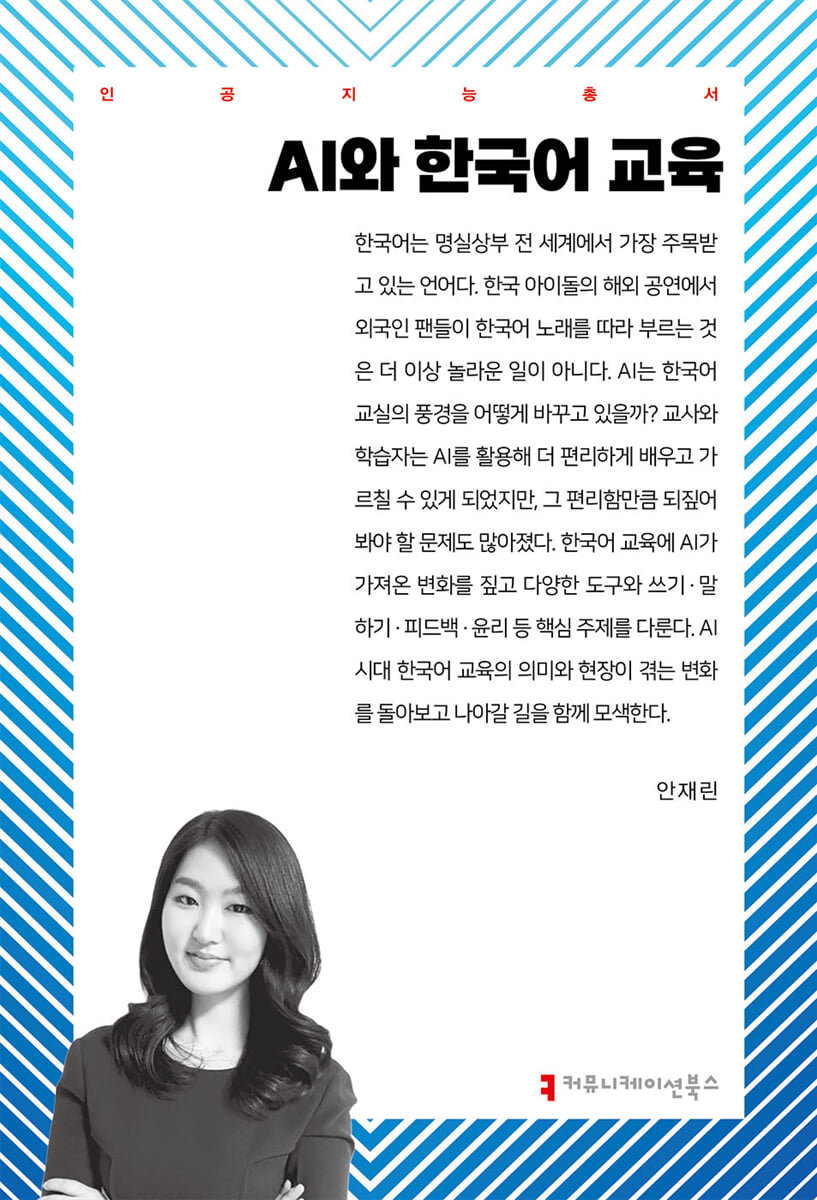
In an age where translation and conversation are automated, we're re-examining the reasons for learning Korean.
Based on the unique characteristics of the Korean language, we design AI as a collaborative partner and present prompting, writing, and speaking instructional models, as well as assessment, feedback, and ethics and policy guides.
It increases practical applicability by including a continuous strategy to reduce beginner dropouts and connect to intermediate and advanced levels.
Artificial Intelligence Encyclopedia.
You can find the artificial intelligence knowledge you need at aiseries.oopy.io.
Based on the unique characteristics of the Korean language, we design AI as a collaborative partner and present prompting, writing, and speaking instructional models, as well as assessment, feedback, and ethics and policy guides.
It increases practical applicability by including a continuous strategy to reduce beginner dropouts and connect to intermediate and advanced levels.
Artificial Intelligence Encyclopedia.
You can find the artificial intelligence knowledge you need at aiseries.oopy.io.
- You can preview some of the book's contents.
Preview
index
A New Paradigm for Korean Language Education in the AI Era
01 AI and the Changing Language Education Paradigm
02 AI Enters the Korean Classroom
03 Machine Translation and AI
04 Effective Prompting for Learning Korean
05 Writing with AI
06 AI Feedback
07 Talking to AI
08 Ethical Issues in the Use of AI
09 AI Policy Creation Together
10 AI and the Changing Role of Teachers
01 AI and the Changing Language Education Paradigm
02 AI Enters the Korean Classroom
03 Machine Translation and AI
04 Effective Prompting for Learning Korean
05 Writing with AI
06 AI Feedback
07 Talking to AI
08 Ethical Issues in the Use of AI
09 AI Policy Creation Together
10 AI and the Changing Role of Teachers
Into the book
Unlike computers, mobile devices have the advantage of being highly portable, allowing learning anytime, anywhere.
In line with this, various language learning apps have emerged.
Apps like Duolingo incorporate game elements to keep learners engaged, and machine translation services like Google Translate have become established as everyday learning tools.
At the same time, the proliferation of social media and YouTube has led learners to embrace a participatory culture, where they learn by directly communicating with speakers of the target language or by accessing cultural content like dramas, songs, and memes in real time.
--- From “01_“AI and the Change in the Language Education Paradigm””
Machine translation is basically translating sentences written in one language into another language.
When machine translation was first introduced, it was based on rules and statistics, translating each word individually, so it could not properly handle context or idiomatic expressions.
But things are a little different these days.
With the introduction of artificial neural network-based machine translation (NMT) technology, it has advanced beyond words and phrases to the level of understanding the entire context and translating it into natural sentences, and as a result, accuracy has also improved significantly.
These changes raise new questions about how and to what extent translators can be used as learning aids.
--- From 「03_“Machine Translation and AI”」
Is AI really good at providing feedback? How different would the results be if both a teacher and AI provided feedback on the same piece of writing? This question arises because studies consistently cite AI's immediate feedback as a strength.
Ahn Jae-rin and Park Jeong-ah's research began with this curiosity.
The research team gave six Korean learners' writings to six teachers and ChatGPT with the same instructions, and compared the resulting feedback side by side.
The result wasn't simply a question of who did better.
The two feedbacks revealed different strengths and limitations.
--- From “06_“AI Feedback””
As AI increasingly impacts classroom instruction and assessment, simply following the guidelines outlined above is no longer enough.
Teachers are the ones who know best when to allow and where to restrict the use of AI in the classroom.
Policies that do not properly reflect the voices of those on the ground are difficult to implement in reality.
Therefore, it is necessary for teachers to reflect on and share their own experiences to determine in which situations AI use is problematic and in which activities it is acceptable.
In line with this, various language learning apps have emerged.
Apps like Duolingo incorporate game elements to keep learners engaged, and machine translation services like Google Translate have become established as everyday learning tools.
At the same time, the proliferation of social media and YouTube has led learners to embrace a participatory culture, where they learn by directly communicating with speakers of the target language or by accessing cultural content like dramas, songs, and memes in real time.
--- From “01_“AI and the Change in the Language Education Paradigm””
Machine translation is basically translating sentences written in one language into another language.
When machine translation was first introduced, it was based on rules and statistics, translating each word individually, so it could not properly handle context or idiomatic expressions.
But things are a little different these days.
With the introduction of artificial neural network-based machine translation (NMT) technology, it has advanced beyond words and phrases to the level of understanding the entire context and translating it into natural sentences, and as a result, accuracy has also improved significantly.
These changes raise new questions about how and to what extent translators can be used as learning aids.
--- From 「03_“Machine Translation and AI”」
Is AI really good at providing feedback? How different would the results be if both a teacher and AI provided feedback on the same piece of writing? This question arises because studies consistently cite AI's immediate feedback as a strength.
Ahn Jae-rin and Park Jeong-ah's research began with this curiosity.
The research team gave six Korean learners' writings to six teachers and ChatGPT with the same instructions, and compared the resulting feedback side by side.
The result wasn't simply a question of who did better.
The two feedbacks revealed different strengths and limitations.
--- From “06_“AI Feedback””
As AI increasingly impacts classroom instruction and assessment, simply following the guidelines outlined above is no longer enough.
Teachers are the ones who know best when to allow and where to restrict the use of AI in the classroom.
Policies that do not properly reflect the voices of those on the ground are difficult to implement in reality.
Therefore, it is necessary for teachers to reflect on and share their own experiences to determine in which situations AI use is problematic and in which activities it is acceptable.
--- From “09_“AI Policy We Create Together””
Publisher's Review
Connecting AI, Tools, and the Essence of Learning
In an age where AI tools assist with translation and conversation, we're asking ourselves a new question: why learn Korean?
Amidst the spread of the Korean Wave, the rapidly increasing demand for learning, and the high dropout rate from entry-level courses, this book presents concrete examples of how LLM, machine translation, and real-time feedback can transform classrooms.
It covers step-by-step the redesign of writing, speaking, and feedback, the principles of prompts, the design of calibrated tasks, and ethics and policies such as fairness and copyright.
Based on the linguistic and cultural specificity of the Korean language, we propose an educational model that positions AI as a "collaborator" rather than a "replacement," linking learning motivation, identity, and cultural context.
This paper realistically analyzes the learning curve of Korean as a high-difficulty language classified by the FSI and presents a sustainable strategy to move beyond beginner level to intermediate and advanced level.
It sets the standard for Korean language education in the AI era, including activity design, assessment rubrics, feedback management, and policy guides that teachers, learners, and researchers can immediately apply in the field.
Chapter 1 outlines paradigm shifts, Chapter 2 discusses classroom and learner perception, and Chapter 3 outlines the characteristics of machine translation and generative AI.
Chapters 4-7 present prompts and writing/speaking lesson models, Chapters 8-9 present ethics and policies, and Chapter 10 presents the role of teachers and future tasks.
In an age where AI tools assist with translation and conversation, we're asking ourselves a new question: why learn Korean?
Amidst the spread of the Korean Wave, the rapidly increasing demand for learning, and the high dropout rate from entry-level courses, this book presents concrete examples of how LLM, machine translation, and real-time feedback can transform classrooms.
It covers step-by-step the redesign of writing, speaking, and feedback, the principles of prompts, the design of calibrated tasks, and ethics and policies such as fairness and copyright.
Based on the linguistic and cultural specificity of the Korean language, we propose an educational model that positions AI as a "collaborator" rather than a "replacement," linking learning motivation, identity, and cultural context.
This paper realistically analyzes the learning curve of Korean as a high-difficulty language classified by the FSI and presents a sustainable strategy to move beyond beginner level to intermediate and advanced level.
It sets the standard for Korean language education in the AI era, including activity design, assessment rubrics, feedback management, and policy guides that teachers, learners, and researchers can immediately apply in the field.
Chapter 1 outlines paradigm shifts, Chapter 2 discusses classroom and learner perception, and Chapter 3 outlines the characteristics of machine translation and generative AI.
Chapters 4-7 present prompts and writing/speaking lesson models, Chapters 8-9 present ethics and policies, and Chapter 10 presents the role of teachers and future tasks.
GOODS SPECIFICS
- Date of issue: October 27, 2025
- Page count, weight, size: 130 pages | 128*188*7mm
- ISBN13: 9791143012050
You may also like
카테고리
korean


korean

![GQ KOREA Mark (Monthly): December [2025]](http://librairie.coreenne.fr/cdn/shop/files/8ef265dbbfbf186523ed75ba7319009d.jpg?v=1765340328&width=3840)


