

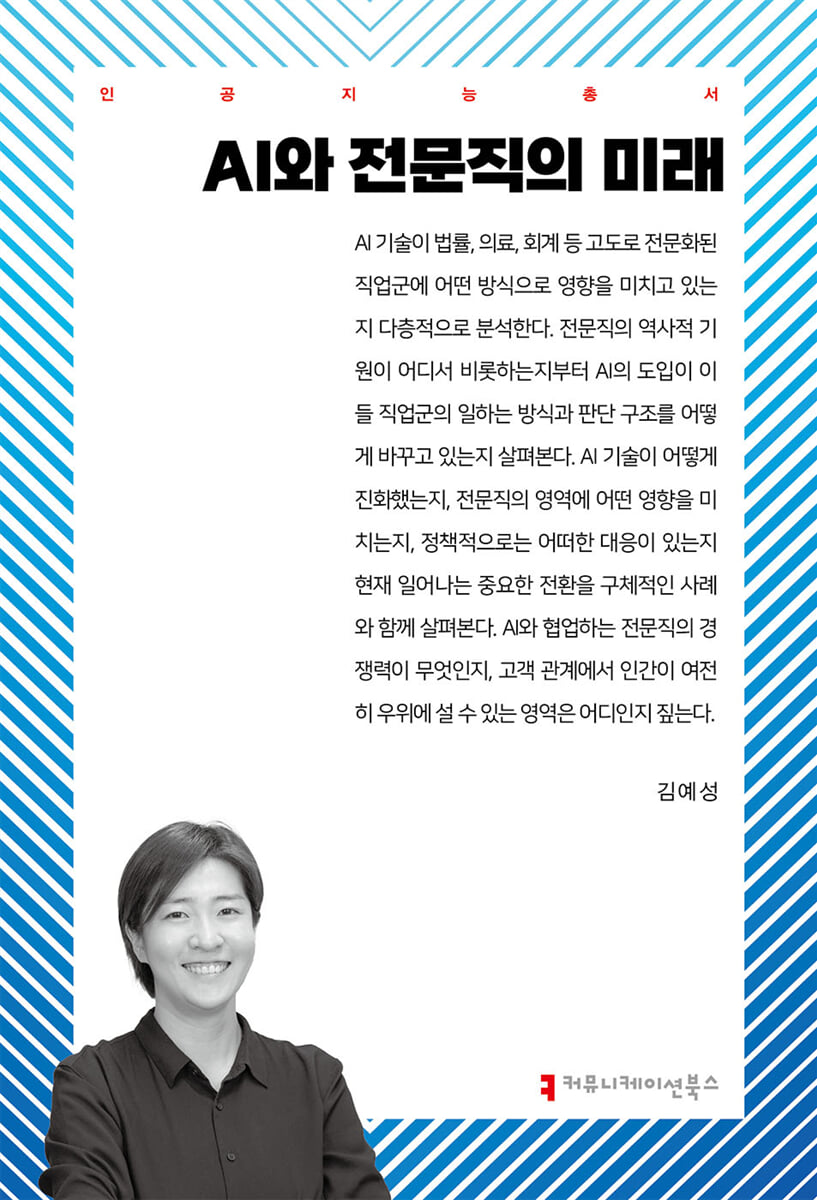
AI and the Future of Professionals
 |
Description
Book Introduction
Repetitive tasks are automated, and professionals focus on judgment, ethics, and communication.
This book, which combines national guidelines, overseas solutions, ontology, and HR, compliance, and financial frameworks, presents experts' guidance on how to lead AI.
We examine ethical issues such as data bias and explainability, and design changes with prompt literacy, verification workflows, and implementation checklists.
Artificial Intelligence Encyclopedia.
You can find the artificial intelligence knowledge you need at aiseries.oopy.io.
This book, which combines national guidelines, overseas solutions, ontology, and HR, compliance, and financial frameworks, presents experts' guidance on how to lead AI.
We examine ethical issues such as data bias and explainability, and design changes with prompt literacy, verification workflows, and implementation checklists.
Artificial Intelligence Encyclopedia.
You can find the artificial intelligence knowledge you need at aiseries.oopy.io.
- You can preview some of the book's contents.
Preview
index
In the AI era, will professional jobs disappear?
01 The Origins of Professionalism and its Reason for Existence
02 Developments in Generative AI and Large-Scale Language Models and the National Perspective
03 The way we work with customers is changing.
04 Current Status of AI Utilization by Industry
05 AI Adoption Status by Area of Expertise: US, Japan, Germany
06 What if ontology is introduced into professional work?
07 What kind of personnel decisions should companies make in the AI era?
08 What compliance decisions should companies make in the AI era?
09 What decisions should financial executives make in the AI era?
10 AI and the Future of Professionals
01 The Origins of Professionalism and its Reason for Existence
02 Developments in Generative AI and Large-Scale Language Models and the National Perspective
03 The way we work with customers is changing.
04 Current Status of AI Utilization by Industry
05 AI Adoption Status by Area of Expertise: US, Japan, Germany
06 What if ontology is introduced into professional work?
07 What kind of personnel decisions should companies make in the AI era?
08 What compliance decisions should companies make in the AI era?
09 What decisions should financial executives make in the AI era?
10 AI and the Future of Professionals
Into the book
The ILO international standard defines a profession as “an occupation with advanced education and training that enables people to solve complex and difficult problems.”
These classification criteria emphasize that professionals exist not as simple labor, but rather as formal and systematic knowledge systems.
In Korea, too, when referring to statistics from the Organization for Economic Cooperation and Development (OECD), lawyers, doctors, accountants, etc. all fall into the category of “highly skilled professionals.”
--- From “01_“The Origin of Professionalism, the Reason for Existence””
Many professional services firms still don't publicly emphasize the fact that they "use AI."
Rather, they are cautious about whether customers will feel that 'the machine has taken over'.
Because of this dilemma, promotion of AI is limited, regardless of its utilization rate. In reality, while many customers view AI-based services positively, they are often unaware of whether specialized companies are adopting AI.
--- From "03_“The way we work with customers is changing”"
Ontology is not simply a data integration, but is the core of AI knowledge structure that defines “in what context does this data make sense?”
This concept is implemented in Palantir's Foundry platform, which integrates enterprise data and models business objects by leveraging ontology concepts within the organization.
Palantir's ontology layer connects a company's various digital assets (datasets, models, etc.) with real-world objects, forming a digital twin representing the organization.
--- From “06_“What if ontology is introduced to professional work?”
In the age of AI, CFOs are evolving from mere numbers-focused finance executives to strategists responsible for corporate value from a company-wide perspective.
In addition to their traditional role of managing financial figures, they are now expected to act as architects of digital innovation and growth strategies.
To achieve this, CFOs need a strategic mindset that allows them to understand changing business models and shifting market landscapes, and a robust framework for measuring the financial impact of AI.
Additionally, we must demonstrate leadership in changing roles within the organization, become role models for AI utilization, encourage a shift in mindset, and build a culture that increases AI acceptance.
These classification criteria emphasize that professionals exist not as simple labor, but rather as formal and systematic knowledge systems.
In Korea, too, when referring to statistics from the Organization for Economic Cooperation and Development (OECD), lawyers, doctors, accountants, etc. all fall into the category of “highly skilled professionals.”
--- From “01_“The Origin of Professionalism, the Reason for Existence””
Many professional services firms still don't publicly emphasize the fact that they "use AI."
Rather, they are cautious about whether customers will feel that 'the machine has taken over'.
Because of this dilemma, promotion of AI is limited, regardless of its utilization rate. In reality, while many customers view AI-based services positively, they are often unaware of whether specialized companies are adopting AI.
--- From "03_“The way we work with customers is changing”"
Ontology is not simply a data integration, but is the core of AI knowledge structure that defines “in what context does this data make sense?”
This concept is implemented in Palantir's Foundry platform, which integrates enterprise data and models business objects by leveraging ontology concepts within the organization.
Palantir's ontology layer connects a company's various digital assets (datasets, models, etc.) with real-world objects, forming a digital twin representing the organization.
--- From “06_“What if ontology is introduced to professional work?”
In the age of AI, CFOs are evolving from mere numbers-focused finance executives to strategists responsible for corporate value from a company-wide perspective.
In addition to their traditional role of managing financial figures, they are now expected to act as architects of digital innovation and growth strategies.
To achieve this, CFOs need a strategic mindset that allows them to understand changing business models and shifting market landscapes, and a robust framework for measuring the financial impact of AI.
Additionally, we must demonstrate leadership in changing roles within the organization, become role models for AI utilization, encourage a shift in mindset, and build a culture that increases AI acceptance.
--- From "09_“What kind of decisions should financial executives make in the AI era?”
Publisher's Review
Redefining, Not Replacing: AI and the Future of Professionals
Professional jobs don't disappear.
While tools and procedures change, the core functions of publicness, trust, and accountability become more sophisticated.
In fields such as medicine, law, and accounting, generative AI automates research, summarization, drafting, evidence organization, risk detection, and explanatory material production, while experts' roles are being reorganized to focus on high-level judgment, ethical interpretation, and customer communication.
It presents a step-by-step roadmap, covering national and association guidelines, government regulatory trends, overseas solution maps, ontology-based data integration and business standardization cases, HR, compliance, and financial decision-making frameworks, and even changes in education and qualification systems.
In an era where customer information asymmetry has been resolved, we propose "redefinition" and "reassignment of responsibility" as strategies rather than "replacement," and design a path for experts to lead AI to realize broader public value.
This is a practical guide that combines field cases and the author's practical experience.
It examines ethical issues such as data bias, explainability, and audit traceability, and presents prompt literacy and verification workflows.
Crossing the waves of change.
Professional jobs don't disappear.
While tools and procedures change, the core functions of publicness, trust, and accountability become more sophisticated.
In fields such as medicine, law, and accounting, generative AI automates research, summarization, drafting, evidence organization, risk detection, and explanatory material production, while experts' roles are being reorganized to focus on high-level judgment, ethical interpretation, and customer communication.
It presents a step-by-step roadmap, covering national and association guidelines, government regulatory trends, overseas solution maps, ontology-based data integration and business standardization cases, HR, compliance, and financial decision-making frameworks, and even changes in education and qualification systems.
In an era where customer information asymmetry has been resolved, we propose "redefinition" and "reassignment of responsibility" as strategies rather than "replacement," and design a path for experts to lead AI to realize broader public value.
This is a practical guide that combines field cases and the author's practical experience.
It examines ethical issues such as data bias, explainability, and audit traceability, and presents prompt literacy and verification workflows.
Crossing the waves of change.
GOODS SPECIFICS
- Date of issue: October 24, 2025
- Page count, weight, size: 147 pages | 128*188*7mm
- ISBN13: 9791143010858
You may also like
카테고리
korean


korean

![GQ KOREA Mark (Monthly): December [2025]](http://librairie.coreenne.fr/cdn/shop/files/8ef265dbbfbf186523ed75ba7319009d.jpg?v=1765340328&width=3840)


